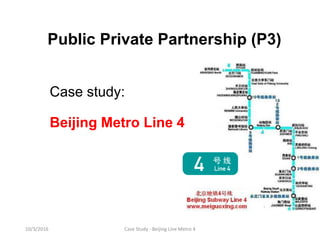
Case study:
Beijing Metro Line 4
Public Private Partnership (P3)
Case Study - Beijing Line Metro 410/3/2016
Public Private Partnership (P3) – what is it?
• Definition – “A contractual arrangement between a public agency (‘government’) and a
private sector entity. Through this agreement, the skills and assets of each sector (public
and private) are shared in delivering a service or facility for the use of the general public.
• In addition to the sharing of resources, each party shares in the risks and rewards
potential in the delivery of the service and/or facility.”
(National Council for Public-Private Partnerships)
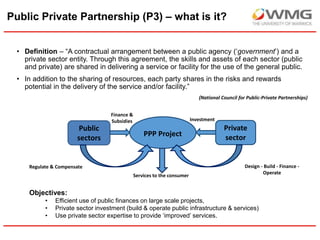
Finance &
Subsidies Investment
Private
sector
Public
sectors
PPP Project
Regulate & Compensate Design - Build - Finance -
Operate
Services to the consumer
Objectives:
• Efficient use of public finances on large scale projects,
• Private sector investment (build & operate public infrastructure & services)
• Use private sector expertise to provide ‘improved’ services.
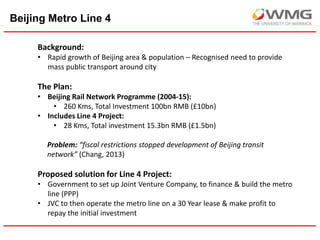
Beijing Metro Line 4
Background:
• Rapid growth of Beijing area & population – Recognised need to provide
mass public transport around city
The Plan:
• Beijing Rail Network Programme (2004-15):
• 260 Kms, Total Investment 100bn RMB (£10bn)
• Includes Line 4 Project:
• 28 Kms, Total investment 15.3bn RMB (£1.5bn)
Problem: “fiscal restrictions stopped development of Beijing transit
network” (Chang, 2013)
Proposed solution for Line 4 Project:
• Government to set up Joint Venture Company, to finance & build the metro
line (PPP)
• JVC to then operate the metro line on a 30 Year lease & make profit to
repay the initial investment
Beijing Metro Line 4 – The Collaboration
JVC Partners:
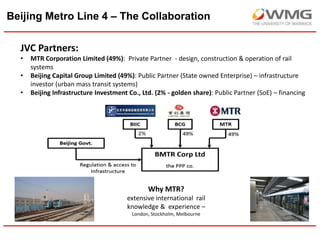
• MTR Corporation Limited (49%): Private Partner - design, construction & operation of rail
systems
• Beijing Capital Group Limited (49%): Public Partner (State owned Enterprise) – infrastructure
investor (urban mass transit systems)
• Beijing Infrastructure Investment Co., Ltd. (2% - golden share): Public Partner (SoE) – financing
Why MTR?
extensive international rail
knowledge & experience –
London, Stockholm, Melbourne
Beijing Metro Line 4 – what were the outcomes?
Benefits
• Government:
• Reduced public investment
• Changed role (service provider to regulator)
• Access to skills and knowledge of overseas partner
• MTR Private Partner provided:
• Effective project management (command and control)
• Efficient development and operation (est. 9.4% savings below budget
over project life cycle)
Risks
• MTR only involved after construction had commenced – optimal
configuration?
• Government assured ticket fares to the public – “same network, same price”
• Ongoing subsidy paid to MTR to compensate for impact on its anticipated
revenues

PPP Case Study - Beijing Metro Line 4 v5

  • 1.
    Case study: Beijing MetroLine 4 Public Private Partnership (P3) Case Study - Beijing Line Metro 410/3/2016
  • 2.
    Public Private Partnership(P3) – what is it? • Definition – “A contractual arrangement between a public agency (‘government’) and a private sector entity. Through this agreement, the skills and assets of each sector (public and private) are shared in delivering a service or facility for the use of the general public. • In addition to the sharing of resources, each party shares in the risks and rewards potential in the delivery of the service and/or facility.” (National Council for Public-Private Partnerships) Finance & Subsidies Investment Private sector Public sectors PPP Project Regulate & Compensate Design - Build - Finance - Operate Services to the consumer Objectives: • Efficient use of public finances on large scale projects, • Private sector investment (build & operate public infrastructure & services) • Use private sector expertise to provide ‘improved’ services.
  • 3.
    Beijing Metro Line4 Background: • Rapid growth of Beijing area & population – Recognised need to provide mass public transport around city The Plan: • Beijing Rail Network Programme (2004-15): • 260 Kms, Total Investment 100bn RMB (£10bn) • Includes Line 4 Project: • 28 Kms, Total investment 15.3bn RMB (£1.5bn) Problem: “fiscal restrictions stopped development of Beijing transit network” (Chang, 2013) Proposed solution for Line 4 Project: • Government to set up Joint Venture Company, to finance & build the metro line (PPP) • JVC to then operate the metro line on a 30 Year lease & make profit to repay the initial investment
  • 4.
    Beijing Metro Line4 – The Collaboration JVC Partners: • MTR Corporation Limited (49%): Private Partner - design, construction & operation of rail systems • Beijing Capital Group Limited (49%): Public Partner (State owned Enterprise) – infrastructure investor (urban mass transit systems) • Beijing Infrastructure Investment Co., Ltd. (2% - golden share): Public Partner (SoE) – financing Why MTR? extensive international rail knowledge & experience – London, Stockholm, Melbourne
  • 5.
    Beijing Metro Line4 – what were the outcomes? Benefits • Government: • Reduced public investment • Changed role (service provider to regulator) • Access to skills and knowledge of overseas partner • MTR Private Partner provided: • Effective project management (command and control) • Efficient development and operation (est. 9.4% savings below budget over project life cycle) Risks • MTR only involved after construction had commenced – optimal configuration? • Government assured ticket fares to the public – “same network, same price” • Ongoing subsidy paid to MTR to compensate for impact on its anticipated revenues

Editor's Notes

  • #3 The improvement of public services and infrastructure is the responsibility of government, e.g. public health services (NHS), power generation, and transport infrastructure (road, rail, air) However, whilst the expectations of the general public (the consumer) increases, so the cost of setting and running public services increases. These services can be paid for through a. general taxation, and b. government borrowing. Example: National Health Service net expenditure (resource plus capital, minus depreciation) has increased from £75.822 billion in 2005/06 to £117.229 billion in 2015/16. Planned expenditure for 2016/17 is £118.829bn. (http://www.nhsconfed.org/resources/key-statistics-on-the-nhs). One ‘Collaborative’ solution is involving private sector companies in public service projects/programmes. Government use the finances and specialist capabilities of private contracts to design, build, and deliver operations to the consumer (general public). This model is called Public Private Partnership (PPP or P3). For government this is offers, in principle, value-for-money services, sharing the risk (and the reward) with private providers. The Public sector will part-provide finances for the project and become the eventual ‘regulator’ of the operation of the services or product provided by the private sector. The Private sector brings project management and service expertise to the programme, and can operate ‘the services/product’ under a long-term concession. PPP Collaboration is controversial, because some stakeholders (e.g. consumers) will consider companies making profit from the delivery of public services is wrong!
  • #4 Case Study: Beijing Metro Line 4 – is an example of Public-Private Partnership (PPP) between the Beijing city government and the Hong Kong MTR company. This project of 28.2 kms and 24 station with 10 interchanges was to be the north to south transportation artery for the capital, at an estimated total investment of 15.3bn RMB (or £1.5bn). It was but one part of the much larger Beijing Rail Network plan to run from 2004 to 2015; some 260 kms at a total investment of 100bn RMB. The development of this ‘overall’ plan has been driven by the rapid growth of the population and the area expansion of the city limits. A view of the city ring roads shows that since the Millennium (2000) when the 4th ring road was 8kms from the city centre, this has now grown with the completion of 7th ‘ring’ in 2015, which over 20 kms from the centre and catering for a population of over 21,000, 000 people in an area of 16,400 kms2. This has naturally created a need to provide mass public transport throughout the city. However, it has been argued that ‘fiscal restrictions’ had stopped the development of this transit network in the city (Chang, Z., 2013, Public-Private Partnerships in China: A case of the Beijing No. 4 Metro line. Transport Policy, 30, pp153-160). The question was “How to build a public transport system both quickly and relatively cheaply? Beijing city government had neither the finances nor take on the full borrowing burden for the Beijing Rail Network plan. From a traditional transport build programme, government also did not have the expertise to project manage the building and running of a subway system. Solution: for government to find a partner with the expertise who has already built and run an efficient subway system. This would involve government part financing the project to 1. build the rail line and stations infrastructure, 2. lease the operation of the Metro line to the ‘private’ JVC created. The ‘concessionary’ operation of the was for a 30 year period and involved subsidised pricing to allow the JVC to make profit.
  • #5 The PPP Joint Venture Company was called Beijing MTR and involved three core partners: Beijing Capital Group Limited (BCG) – a large State-Owned-Enterprise (SoE) affiliated to the ‘State-Owned Assets Supervision & Administration Commission of Beijing Municipal Government.’ The ‘Capital group’ had three core business; urban infrastructure, urban real estate, and financial services. BCG took 49% stake in BMTR joint venture company MTR Corporation Limited (MTR) – is a listed company HKSAR government and operates pre-dominantly the rail based transportation system in Hong Kong. It operates both HK domestic and cross-border services, a dedicated high-speed Airport Express, and light rail systems (218 kms, 84 stations, 68 stops). MTR also had investment experience over rail transit projects in London, Melbourne and other international cities. The Hong Kong systems has a reputation for reliability, safety and efficiency (Beijing MTR, 2014). MTR took 49% stake in BMTR joint venture company. Although 77% owned by HK-SAR govt, is publicly listed on the HK stock exchange (2000); run as a ‘private’ company (23% public listing). Extensive Rail Knowledge & Experience - London Overground & Crossrail, Melbourne metropolitan rail service, Stockholm Metro, Intercity & Commuter rail services, Sydney Metro North West Beijing Infrastructure Investment Corporation Limited (BIIC) – is a wholly owned SoE of the ‘State-Owned Assets Supervision & Administration Commission of Beijing Municipal Government’, focusing on investment, financing and capital operation of infrastructure projects in Beijing. In 2010, BIIC had registered capital 55bn RMB, net assets 83bn RMB, and total assets of 190bn RMB. BIIC took a 2% ‘golden share’ stake in BMTR joint venture company. ‘PPP’ JVC Board of Directors – comprised of 5 directors; 2 – BCG, 2 – MTR, 1 – BIIC. The tenure of each director was 3 years. There is a Chairman delegated by BIIC and approved by BCG and MTR. Two Vice-Chairman delegated by BCG and MTR respectively and approved by BIIC. The involvement of BCG and BIIC guaranteed a government requirement for supervision and control over the rail transit system. The Beijing Metro Line 4 ‘project’ was broken down into two phases: Part A (70%) – build of stations, tunnels, track laying, which was owned and financed by Beijing municipal government. The agreed investment ratio was 7:3, government to private project funding. Part B (30%) – supply and fitment of subway electro-mechanical equipment & vehicles (rolling stock), which was the three-way collaboration between public and private partners. This then led on to the 30-year concessionary ‘Operation’ by the JVC and its profit share (through subsidised pricing from Beijing municipal government).
  • #6 So what were the outcomes? Benefits: Reduced public sector resource needs, primarily investment. This was from Capital Savings of 10bn RMB (16% less). Taking into account the overall concession period, government will spend 52bn RMB under the PPP model compared to an estimated 62bn RMB under a ‘traditional’ government run model. Efficiency savings from MTR project management and control over schedules and budgets, the JVC financial control on costs & loan repayments, and efficient operations management. Considered that the PPP model saved 31% of initial investment and 9.4% of the total cost (Chang, Z., 2013) – actual figures unavailable publicly. Please note that ‘parent’ partners and the JVC will have differing objectives, especially during the ‘Operation’ phase Government wanted to offer assured ticket fares of a 2 RMB ticket (“same network, same price”) by subsidising Operations Customer usage higher than expected - 734,000 daily forecast, 1.3m actual (2011) Government tax collection – 5bn RMB from a profitable JVC BMTR joint venture company operates under a government compensation scheme, providing profits – 40bn RMB (over 30 years) Dr. Chang, Zheng is an assistant professor and associate program leader of the real estate management in the City University of Hong Kong. His research focuses on urban economics, real estate, housing studies and social network analysis. In 2013, he published his article on ‘Public-private partnerships in China: A case of the Beijing No.4 Metro line’ in Transport Policy,  Nov, 30: 153-160. (http://bccw.cityu.edu.hk/main/wp_staff_view.asp?people_number=4676) Other publications: ANG, G. and MARCHAL, V., 2013. Mobilising Private Investment in Sustainable Transport: THE CASE OF LAND-BASED PASSENGER TRANSPORT INFRASTRUCTURE. Paris: Organisation for Economic Cooperation and Development (OECD). LIU, T. and WILKINSON, S., 2013. Can the pilot public-private partnerships project be applied in future urban rail development? Built Environment Project and Asset Management, 3(2), pp. 250-263.