Developing a Heritage Trail:
Community Projects and Local
       Organization


  Krista Sherwood, National Park Service


  Texas Trails and Active Transportation
                Conference
               Feb 1-3, 2012
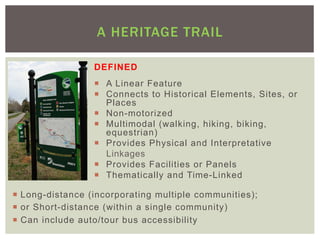
A HERITAGE TRAIL

                  DEFINED
                  ¡  A Linear Feature
                  ¡  Connects to Historical Elements, Sites, or
                      Places
                  ¡  Non-motorized
                  ¡  Multimodal (walking, hiking, biking,
                      equestrian)
                  ¡  Provides Physical and Interpretative
                      Linkages
                  ¡  Provides Facilities or Panels
                  ¡  Thematically and Time-Linked

¡  Long-distance (incorporating multiple communities);
¡  or Short-distance (within a single community)
¡  Can include auto/tour bus accessibility
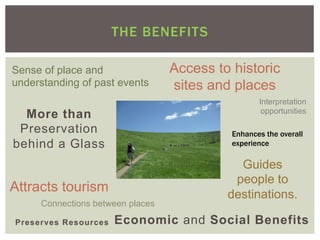
THE BENEFITS

Sense of place and                Access to historic
understanding of past events      sites and places
                                                   Interpretation
                                                    opportunities
  More than
 Preservation                               Enhances the overall
behind a Glass                              experience

                                             Guides
                                            people to
Attracts tourism                           destinations.
     Connections between places

Preserves Resources   Economic and Social Benefits
Alice’s Adventure’s in Wonderland by
Lewis Carroll


 “Would you tell me please which way I ought
  to go from here?”

         “That depends a good deal on where you want to get
 to.” – said the Cheshire Cat

       “I don’t care where.” – said Alice

                     “Then it doesn’t matter which way
                     you go.” – said the Cat
CHOOSING A DESTINATION

   78% participate in cultural and/or heritage
                   activities.

61% say they started with a desired destination in
                     mind.

         Two-thirds visited historic sites.

               “The desire to participate in cultural and heritage
               travel remains strong and lucrative.”

                    The Cultural and Heritage Traveler, 2009 Edition
                               Mandala Research, LLC
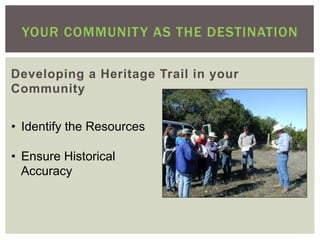
YOUR COMMUNIT Y AS THE DESTINATION

Developing a Heritage Trail in your
Community


•  Identify the Resources

•  Ensure Historical
   Accuracy
A TRAIL OR…. A TRAIL

Difference between:

¡ A trail which provides connections to Historic
   Sites and/or Places

                versus

¡ A trail which portrays a retracement of a
   Historic Route
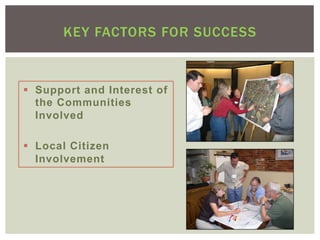
KEY FACTORS FOR SUCCESS


§  Support and Interest of
    the Communities
    Involved

§  Local Citizen
    Involvement
WHO CAN HELP?


    National Park Service


Rivers, Trails, & Conservation
 Assistance (RTCA) Program
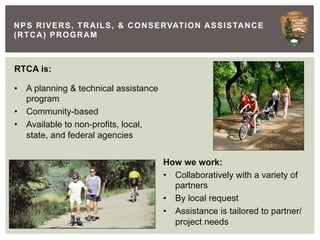
N P S R I V E R S , T R A I L S , & C O N S E RVAT I O N A S S I S TA N C E
(RTCA) PROGRAM


RTCA is:

•  A planning & technical assistance
   program
•  Community-based
•  Available to non-profits, local,
   state, and federal agencies


                                            How we work:
                                            •  Collaboratively with a variety of
                                               partners
                                            •  By local request
                                            •  Assistance is tailored to partner/
                                               project needs
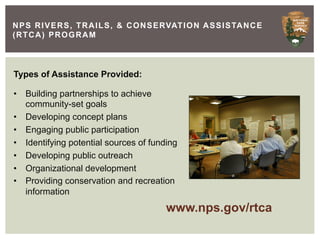
N P S R I V E R S , T R A I L S , & C O N S E RVAT I O N A S S I S TA N C E
(RTCA) PROGRAM


Types of Assistance Provided:

•  Building partnerships to achieve
   community-set goals
•  Developing concept plans
•  Engaging public participation
•  Identifying potential sources of funding
•  Developing public outreach
•  Organizational development
•  Providing conservation and recreation
   information
                                              www.nps.gov/rtca
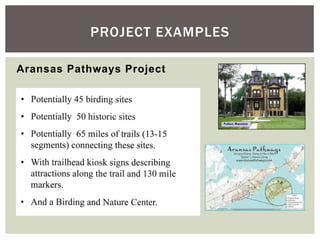
PROJECT EXAMPLES

Aransas Pathways Project
PROJECT EXAMPLES

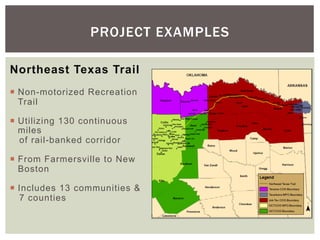
Northeast Texas Trail
¡  Non-motorized Recreation
    Trail

¡  Utilizing 130 continuous
    miles
    of rail-banked corridor

¡  From Farmersville to New
    Boston

¡  Includes 13 communities &
    7 counties
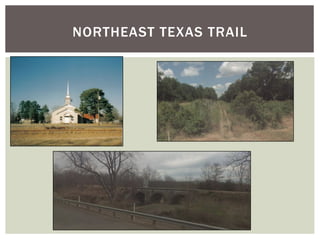
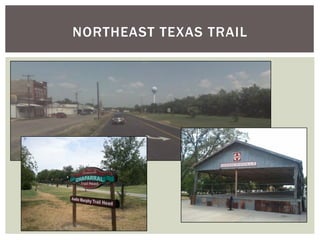
NORTHEAST TEXAS TRAIL
PROJECT EXAMPLES

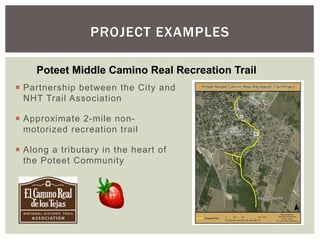
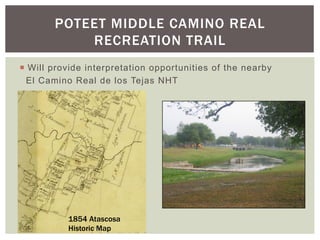
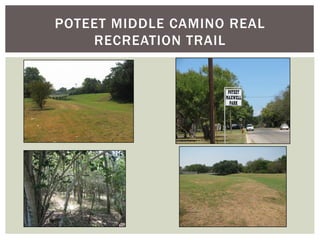
     Poteet Middle Camino Real Recreation Trail
¡  Partnership between the City and
    NHT Trail Association

¡  Approximate 2-mile non-
    motorized recreation trail

¡  Along a tributary in the heart of
    the Poteet Community
POTEET MIDDLE CAMINO REAL
            RECREATION TRAIL
¡  Will provide interpretation opportunities of the nearby
   El Camino Real de los Tejas NHT


           1854 Atascosa
           Historic Map
POTEET MIDDLE CAMINO REAL
    RECREATION TRAIL
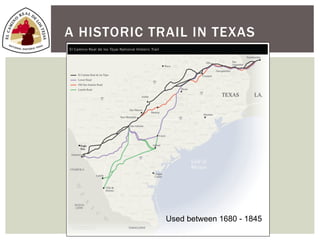
A HISTORIC TRAIL IN TEXAS


             Used between 1680 - 1845
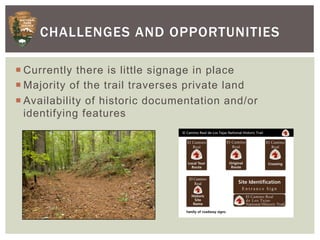
CHALLENGES AND OPPORTUNITIES

¡ Currently there is little signage in place
¡ Majority of the trail traverses private land
¡ Availability of historic documentation and/or
   identifying features
THANK YOU!


                  Contact Info:


                  Krista Sherwood
               National Park Service
Rivers, Trails, & Conservation Assistance (RTCA)
                 (210) 627 – 1203
            krista_sherwood@nps.gov

Heritage Trails to Foster a Regional Trail System in Texas - Krista Sherwood

  • 1.
    Developing a HeritageTrail: Community Projects and Local Organization Krista Sherwood, National Park Service Texas Trails and Active Transportation Conference Feb 1-3, 2012
  • 2.
    A HERITAGE TRAIL DEFINED ¡  A Linear Feature ¡  Connects to Historical Elements, Sites, or Places ¡  Non-motorized ¡  Multimodal (walking, hiking, biking, equestrian) ¡  Provides Physical and Interpretative Linkages ¡  Provides Facilities or Panels ¡  Thematically and Time-Linked ¡  Long-distance (incorporating multiple communities); ¡  or Short-distance (within a single community) ¡  Can include auto/tour bus accessibility
  • 3.
    THE BENEFITS Sense ofplace and Access to historic understanding of past events sites and places Interpretation opportunities More than Preservation Enhances the overall behind a Glass experience Guides people to Attracts tourism destinations. Connections between places Preserves Resources Economic and Social Benefits
  • 4.
    Alice’s Adventure’s inWonderland by Lewis Carroll “Would you tell me please which way I ought to go from here?” “That depends a good deal on where you want to get to.” – said the Cheshire Cat “I don’t care where.” – said Alice “Then it doesn’t matter which way you go.” – said the Cat
  • 5.
    CHOOSING A DESTINATION 78% participate in cultural and/or heritage activities. 61% say they started with a desired destination in mind. Two-thirds visited historic sites. “The desire to participate in cultural and heritage travel remains strong and lucrative.” The Cultural and Heritage Traveler, 2009 Edition Mandala Research, LLC
  • 6.
    YOUR COMMUNIT YAS THE DESTINATION Developing a Heritage Trail in your Community •  Identify the Resources •  Ensure Historical Accuracy
  • 7.
    A TRAIL OR….A TRAIL Difference between: ¡ A trail which provides connections to Historic Sites and/or Places versus ¡ A trail which portrays a retracement of a Historic Route
  • 8.
    KEY FACTORS FORSUCCESS §  Support and Interest of the Communities Involved §  Local Citizen Involvement
  • 9.
    WHO CAN HELP? National Park Service Rivers, Trails, & Conservation Assistance (RTCA) Program
  • 10.
    N P SR I V E R S , T R A I L S , & C O N S E RVAT I O N A S S I S TA N C E (RTCA) PROGRAM RTCA is: •  A planning & technical assistance program •  Community-based •  Available to non-profits, local, state, and federal agencies How we work: •  Collaboratively with a variety of partners •  By local request •  Assistance is tailored to partner/ project needs
  • 11.
    N P SR I V E R S , T R A I L S , & C O N S E RVAT I O N A S S I S TA N C E (RTCA) PROGRAM Types of Assistance Provided: •  Building partnerships to achieve community-set goals •  Developing concept plans •  Engaging public participation •  Identifying potential sources of funding •  Developing public outreach •  Organizational development •  Providing conservation and recreation information www.nps.gov/rtca
  • 12.
  • 13.
    PROJECT EXAMPLES Northeast TexasTrail ¡  Non-motorized Recreation Trail ¡  Utilizing 130 continuous miles of rail-banked corridor ¡  From Farmersville to New Boston ¡  Includes 13 communities & 7 counties
  • 14.
  • 15.
  • 16.
    PROJECT EXAMPLES Poteet Middle Camino Real Recreation Trail ¡  Partnership between the City and NHT Trail Association ¡  Approximate 2-mile non- motorized recreation trail ¡  Along a tributary in the heart of the Poteet Community
  • 17.
    POTEET MIDDLE CAMINOREAL RECREATION TRAIL ¡  Will provide interpretation opportunities of the nearby El Camino Real de los Tejas NHT 1854 Atascosa Historic Map
  • 18.
    POTEET MIDDLE CAMINOREAL RECREATION TRAIL
  • 19.
    A HISTORIC TRAILIN TEXAS Used between 1680 - 1845
  • 20.
    CHALLENGES AND OPPORTUNITIES ¡ Currentlythere is little signage in place ¡ Majority of the trail traverses private land ¡ Availability of historic documentation and/or identifying features
  • 21.
    THANK YOU! Contact Info: Krista Sherwood National Park Service Rivers, Trails, & Conservation Assistance (RTCA) (210) 627 – 1203 krista_sherwood@nps.gov