Income Taxes Our Tax System
Types of Taxes Progressive – taxes that take a larger share of income as the amount of income grows.  Federal Income Taxes
Regressive – taxes that take a smaller share of income as the amount of income grows Sales taxes Consumption taxes  Excise taxes  (taxes imposed on specific goods and services such as gas, cigarettes, air travel, telephone service)
Proportional taxes (flat taxes) – taxes for which the rate stays the same, regardless of income Property taxes
Components  of the Tax System The IRS (Internal Revenue Service) The Power to Tax Paying Your Fair Share
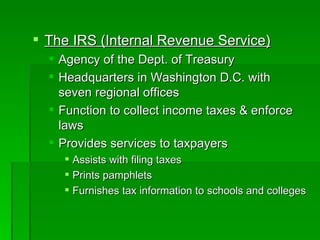
The IRS (Internal Revenue Service) Agency of the Dept. of Treasury Headquarters in Washington D.C. with seven regional offices Function to collect income taxes & enforce laws Provides services to taxpayers Assists with filing taxes Prints pamphlets Furnishes tax information to schools and colleges
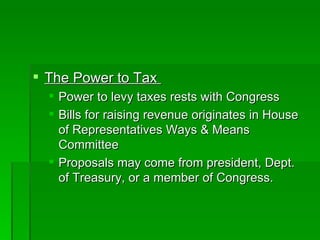
The Power to Tax  Power to levy taxes rests with Congress Bills for raising revenue originates in House of Representatives Ways & Means Committee Proposals may come from president, Dept. of Treasury, or a member of Congress.
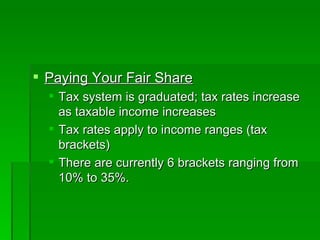
Paying Your Fair Share Tax system is graduated; tax rates increase as taxable income increases Tax rates apply to income ranges (tax brackets) There are currently 6 brackets ranging from 10% to 35%.
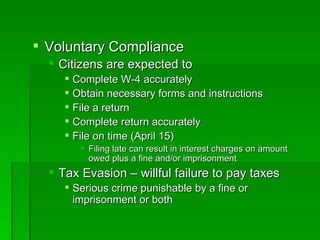
Voluntary Compliance Citizens are expected to  Complete W-4 accurately Obtain necessary forms and instructions File a return Complete return accurately File on time (April 15)  Filing late can result in interest charges on amount owed plus a fine and/or imprisonment Tax Evasion – willful failure to pay taxes Serious crime punishable by a fine or imprisonment or both
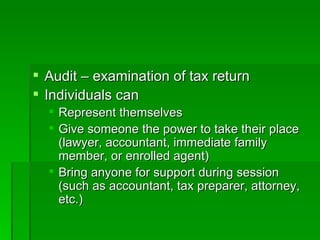
Audit – examination of tax return Individuals can Represent themselves Give someone the power to take their place (lawyer, accountant, immediate family member, or enrolled agent) Bring anyone for support during session (such as accountant, tax preparer, attorney, etc.)
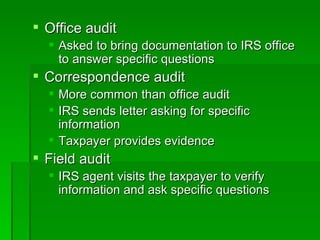
Office audit Asked to bring documentation to IRS office to answer specific questions Correspondence audit More common than office audit IRS sends letter asking for specific information Taxpayer provides evidence Field audit IRS agent visits the taxpayer to verify information and ask specific questions
The End! Source:  Managing Your Personal Finance, 5 th  Edition, Joan S. Ryan

Income Taxes

  • 1.
    Income Taxes OurTax System
  • 2.
    Types of TaxesProgressive – taxes that take a larger share of income as the amount of income grows. Federal Income Taxes
  • 3.
    Regressive – taxesthat take a smaller share of income as the amount of income grows Sales taxes Consumption taxes Excise taxes (taxes imposed on specific goods and services such as gas, cigarettes, air travel, telephone service)
  • 4.
    Proportional taxes (flattaxes) – taxes for which the rate stays the same, regardless of income Property taxes
  • 5.
    Components ofthe Tax System The IRS (Internal Revenue Service) The Power to Tax Paying Your Fair Share
  • 6.
    The IRS (InternalRevenue Service) Agency of the Dept. of Treasury Headquarters in Washington D.C. with seven regional offices Function to collect income taxes & enforce laws Provides services to taxpayers Assists with filing taxes Prints pamphlets Furnishes tax information to schools and colleges
  • 7.
    The Power toTax Power to levy taxes rests with Congress Bills for raising revenue originates in House of Representatives Ways & Means Committee Proposals may come from president, Dept. of Treasury, or a member of Congress.
  • 8.
    Paying Your FairShare Tax system is graduated; tax rates increase as taxable income increases Tax rates apply to income ranges (tax brackets) There are currently 6 brackets ranging from 10% to 35%.
  • 9.
    Voluntary Compliance Citizensare expected to Complete W-4 accurately Obtain necessary forms and instructions File a return Complete return accurately File on time (April 15) Filing late can result in interest charges on amount owed plus a fine and/or imprisonment Tax Evasion – willful failure to pay taxes Serious crime punishable by a fine or imprisonment or both
  • 10.
    Audit – examinationof tax return Individuals can Represent themselves Give someone the power to take their place (lawyer, accountant, immediate family member, or enrolled agent) Bring anyone for support during session (such as accountant, tax preparer, attorney, etc.)
  • 11.
    Office audit Askedto bring documentation to IRS office to answer specific questions Correspondence audit More common than office audit IRS sends letter asking for specific information Taxpayer provides evidence Field audit IRS agent visits the taxpayer to verify information and ask specific questions
  • 12.
    The End! Source: Managing Your Personal Finance, 5 th Edition, Joan S. Ryan