ECONOMIC SYSTEMS Introduction to Business Lesson 1-3
Key Economic Questions What goods and services are to be produced? How should the goods and services be produced? What needs and wants will be satisfied with the goods and services produced?
Economic Systems Traditional (Custom-Based) Economy Command Economy Market Economy
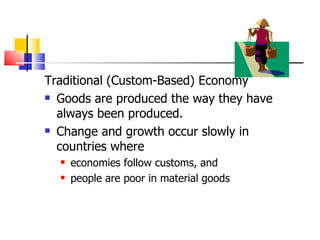
Traditional (Custom-Based) Economy Goods are produced the way they have always been produced. Change and growth occur slowly in countries where economies follow customs, and people are poor in material goods
Command Economy Resources are owned and controlled by the government Officials of the government (central committee) decide what and how goods will be produced and how they will be shared.
Market Economy The three questions are answered by individuals through buying and selling activities in the  marketplace . Consumers and businesses make economic decisions based on their own interest.
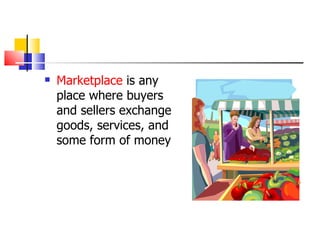
Marketplace  is any place where buyers and sellers exchange goods, services, and some form of money
Our Economic System Capitalism  – economic resources are usually privately owned by individuals rather than by the government This freedom of the individual to choose what to produce provides the rationale for another name:  free enterprise or private enterprise system
Capitalism, free enterprise, private enterprise  refer to a system in which most economic resources are privately owned and decisions about production and distribution are largely made by  voluntary exchange  in the marketplace
Features of US Market Economy Private Property Profit Competition Freedom of Choice
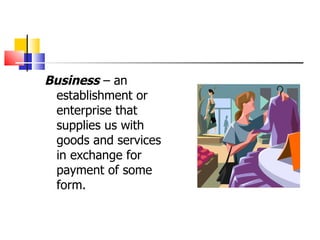
Business  – an establishment or enterprise that supplies us with goods and services in exchange for payment of some form.
Private Property – The right to own, use, or dispose of things of value – sell, trade, give away, or throw away. Businesses also have the right to own property.
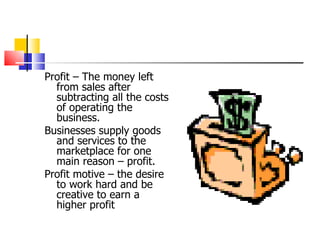
Profit – The money left from sales after subtracting all the costs of operating the business. Businesses supply goods and services to the marketplace for one main reason – profit.  Profit motive – the desire to work hard and be creative to earn a higher profit
Competition – The rivalry among businesses to sell their goods and services to buyers. Competition encourages owners to improve products, offer better services, keep prices reasonable, and produce new things.
Freedom of Choice – Consumers have the right to: enter business or career of choice, own property, make a profit, compete
Other Rights include Right of workers to organize with other workers Right to travel when and where you please in this country and abroad Right to express opinions as long as you do not slander another person
Mixed Economic Systems Most countries are thought to have mixed economic systems. In U.S., there is some government regulation of business.
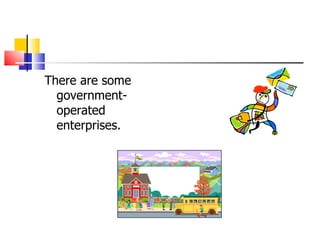
There are some government-operated enterprises.
Emerging Market Economies Command economies are not designed to meet the wants and needs of individuals.  In most controlled economies, workers with different skills and responsibilities receive similar wages – little incentive for people to work hard.
Many controlled economies have changed. USSR (Soviet Union) is now Russia. Other countries are moving toward market economies.
The  End

Intro To Business; Lesson 1 3

  • 1.
    ECONOMIC SYSTEMS Introductionto Business Lesson 1-3
  • 2.
    Key Economic QuestionsWhat goods and services are to be produced? How should the goods and services be produced? What needs and wants will be satisfied with the goods and services produced?
  • 3.
    Economic Systems Traditional(Custom-Based) Economy Command Economy Market Economy
  • 4.
    Traditional (Custom-Based) EconomyGoods are produced the way they have always been produced. Change and growth occur slowly in countries where economies follow customs, and people are poor in material goods
  • 5.
    Command Economy Resourcesare owned and controlled by the government Officials of the government (central committee) decide what and how goods will be produced and how they will be shared.
  • 6.
    Market Economy Thethree questions are answered by individuals through buying and selling activities in the marketplace . Consumers and businesses make economic decisions based on their own interest.
  • 7.
    Marketplace isany place where buyers and sellers exchange goods, services, and some form of money
  • 8.
    Our Economic SystemCapitalism – economic resources are usually privately owned by individuals rather than by the government This freedom of the individual to choose what to produce provides the rationale for another name: free enterprise or private enterprise system
  • 9.
    Capitalism, free enterprise,private enterprise refer to a system in which most economic resources are privately owned and decisions about production and distribution are largely made by voluntary exchange in the marketplace
  • 10.
    Features of USMarket Economy Private Property Profit Competition Freedom of Choice
  • 11.
    Business –an establishment or enterprise that supplies us with goods and services in exchange for payment of some form.
  • 12.
    Private Property –The right to own, use, or dispose of things of value – sell, trade, give away, or throw away. Businesses also have the right to own property.
  • 13.
    Profit – Themoney left from sales after subtracting all the costs of operating the business. Businesses supply goods and services to the marketplace for one main reason – profit. Profit motive – the desire to work hard and be creative to earn a higher profit
  • 14.
    Competition – Therivalry among businesses to sell their goods and services to buyers. Competition encourages owners to improve products, offer better services, keep prices reasonable, and produce new things.
  • 15.
    Freedom of Choice– Consumers have the right to: enter business or career of choice, own property, make a profit, compete
  • 16.
    Other Rights includeRight of workers to organize with other workers Right to travel when and where you please in this country and abroad Right to express opinions as long as you do not slander another person
  • 17.
    Mixed Economic SystemsMost countries are thought to have mixed economic systems. In U.S., there is some government regulation of business.
  • 18.
    There are somegovernment-operated enterprises.
  • 19.
    Emerging Market EconomiesCommand economies are not designed to meet the wants and needs of individuals. In most controlled economies, workers with different skills and responsibilities receive similar wages – little incentive for people to work hard.
  • 20.
    Many controlled economieshave changed. USSR (Soviet Union) is now Russia. Other countries are moving toward market economies.
  • 21.