Lesson 5-2 Forms of Business Ownership
Proprietorship Business owned and run by one person Easiest to start Few legal requirements More control over business decisions Owner receives all profits Owner is responsible for losses No shelter from creditors (personal assets may be used to pay debt of business)
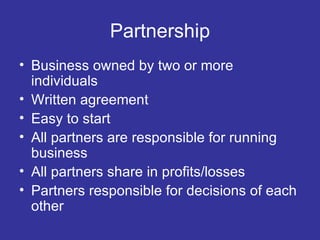
Partnership Business owned by two or more individuals Written agreement Easy to start All partners are responsible for running business All partners share in profits/losses Partners responsible for decisions of each other
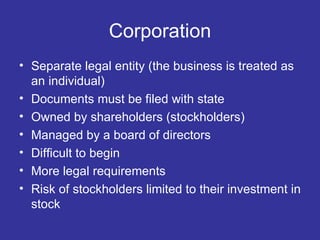
Corporation Separate legal entity (the business is treated as an individual) Documents must be filed with state Owned by shareholders (stockholders) Managed by a board of directors Difficult to begin More legal requirements Risk of stockholders limited to their investment in stock
 
 
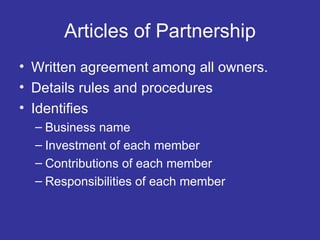
Articles of Partnership Written agreement among all owners. Details rules and procedures  Identifies  Business name Investment of each member Contributions of each member Responsibilities of each member
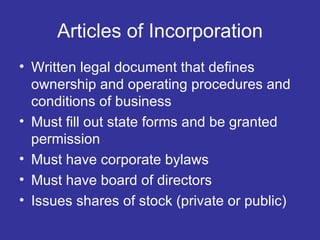
Articles of Incorporation Written legal document that defines ownership and operating procedures and conditions of business Must fill out state forms and be granted permission Must have corporate bylaws Must have board of directors Issues shares of stock (private or public)
Other Forms of Ownership Limited liability partnership Joint venture S-corporation Limited liability company Nonprofit corporation
Franchises Franchise is a written contract granting permission to operate a business to sell products and services in a set way Franchiser – company that owns the products or service and grants the rights Assists with operations Provides national advertising Franchisee – company purchasing the rights to run the business Maintains day-to-day operations Pays a fee & percentages of profits to the franchiser
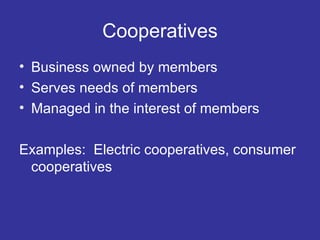
Cooperatives Business owned by members Serves needs of members Managed in the interest of members Examples:  Electric cooperatives, consumer cooperatives
The End

Lesson 5 2

  • 1.
    Lesson 5-2 Formsof Business Ownership
  • 2.
    Proprietorship Business ownedand run by one person Easiest to start Few legal requirements More control over business decisions Owner receives all profits Owner is responsible for losses No shelter from creditors (personal assets may be used to pay debt of business)
  • 3.
    Partnership Business ownedby two or more individuals Written agreement Easy to start All partners are responsible for running business All partners share in profits/losses Partners responsible for decisions of each other
  • 4.
    Corporation Separate legalentity (the business is treated as an individual) Documents must be filed with state Owned by shareholders (stockholders) Managed by a board of directors Difficult to begin More legal requirements Risk of stockholders limited to their investment in stock
  • 5.
  • 6.
  • 7.
    Articles of PartnershipWritten agreement among all owners. Details rules and procedures Identifies Business name Investment of each member Contributions of each member Responsibilities of each member
  • 8.
    Articles of IncorporationWritten legal document that defines ownership and operating procedures and conditions of business Must fill out state forms and be granted permission Must have corporate bylaws Must have board of directors Issues shares of stock (private or public)
  • 9.
    Other Forms ofOwnership Limited liability partnership Joint venture S-corporation Limited liability company Nonprofit corporation
  • 10.
    Franchises Franchise isa written contract granting permission to operate a business to sell products and services in a set way Franchiser – company that owns the products or service and grants the rights Assists with operations Provides national advertising Franchisee – company purchasing the rights to run the business Maintains day-to-day operations Pays a fee & percentages of profits to the franchiser
  • 11.
    Cooperatives Business ownedby members Serves needs of members Managed in the interest of members Examples: Electric cooperatives, consumer cooperatives
  • 12.