Include it all.
Filter it afterward.


   Mark Baker
   Analecta Communications Inc.
David Weinberger
“We seem to be making a cultural
choice---with our new infrastructure's
thumb heavily on the scale---to prefer
to start with abundance rather than
curation. Include it all. Filter it
afterward. Even then, the filters do
not remove anything; they filter
forward, not out.”
                          To Big to Know
            Copyright Analecta Communications Inc. 2012   2
Too Big to Know
"Traditional knowledge seemed like true
content handed to us by competent
experts. Networked knowledge seems
like the work of humans who never
quite get anything right."

                                 David Weinberger
                        summing up Too Big to Know


             Copyright Analecta Communications Inc. 2012   3
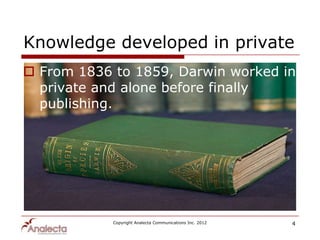
Knowledge developed in private
 From 1836 to 1859, Darwin worked in
  private and alone before finally
  publishing.


            Copyright Analecta Communications Inc. 2012   4
Open Notebook Science


         Copyright Analecta Communications Inc. 2012   5
Climategate
“the climategate furore has
galvanised the scientific
information community to
make data more open,
transparent and accessible
than ever” --
http://www.thefreelibrary.com/Data+without+the+doubts%3A+the+climat
egate+furore+has+galvanised+the...-a0257556897

                      Copyright Analecta Communications Inc. 2012   6
Networked facts
“The new default is: If you are
going to cite the data, you might
as well link to it. Networked facts
point to where they came from
and, sometimes, where they lead
to.”
                                                         To Big to Know


           Copyright Analecta Communications Inc. 2012                7
Something that we do together
“Links are the visible manifestation of
the author giving up any claim to
completeness or even sufficiency; links
invite the reader to browse the network
in which the work is enmeshed, and
acknowledgement that thinking is
something that we do together.”
                                                           Too Big to Know


             Copyright Analecta Communications Inc. 2012                 8
Abundance
"We seem to be making a
cultural choice---with our new
infrastructure's thumb heavily
on the scale---to prefer to
start with abundance rather
than curation. Include it all.
Filter it afterward.”
          Copyright Analecta Communications Inc. 2012   9
Scarcity
 We grew up in a culture of
  information scarcity.
   Though we didn’t think so at the
    time.


                                                                Image courtesy of dan / FreeDigitalPhotos.net
             Copyright Analecta Communications Inc. 2012   10
Not shaped like books

“To think that knowledge
itself is shaped like
books is to marvel that a
rock fits so well in its
hole in the ground.”
                                           Too Big to Know
          Copyright Analecta Communications Inc. 2012   11
Selective publication


          Copyright Analecta Communications Inc. 2012   12
Rare and gem-like

“Because of the economics
of paper, facts were
relatively rare and gem-like
because there wasn‟t room
for a whole lot of them.”
                                          Too Big to Know

         Copyright Analecta Communications Inc. 2012   13
Time consuming to get


         Copyright Analecta Communications Inc. 2012   14
Hard to search


          Copyright Analecta Communications Inc. 2012   15
Hard to link


          Copyright Analecta Communications Inc. 2012   16
Nailed down
“Paper-based citations are like
nails: If you wonder why the
author made a particular
claim, you can see that it‟s
nailed down by a footnote.”
                                                    Too Big To Know

          Copyright Analecta Communications Inc. 2012            17
Commitment
 Getting books is expensive. You are
  committed to the ones you have.


                        Image courtesy of imagerymajestic / FreeDigitalPhotos.net


            Copyright Analecta Communications Inc. 2012                             18
Trust


Copyright Analecta Communications Inc. 2012
19


                                              Image courtesy of graur razvan ionutS / FreeDigitalPhotos.net
Distrust


“Distrust is an expensive vice”
                                                         Too Big to Know


           Copyright Analecta Communications Inc. 2012                20
Authors
 Authors provided an aggregation of
  the information and a conclusion.
 Authors did the hard work of
  knowledge making.
 The publisher did the hard work of
  vetting.
 You paid them to do it for you
  because it was hard to do yourself.
             Copyright Analecta Communications Inc. 2012   21
The Web: Information is cheap
   Abundance
   Comprehensive publication
   Easy to get
   Easy to search
   No investment in the content
     No motive to trust
 Cheap content = access to diversity
     Nicholas Carr not withstanding.
                Copyright Analecta Communications Inc. 2012   22
Experience vs. credentials

“Now the technology lets
you find experienced
people as easily as
credentialed ones.”
                                          Too Big To Know
          Copyright Analecta Communications Inc. 2012   23
The virtue of diversity
“The best problem solvers tend to be
similar; therefore, a collection of the
best problem solvers performs little
better than any one of them
individually. A collection of random, but
intelligent, problem solvers tends to be
diverse. This diversity allows them to be
collectively better.”
                                                           Too Big to Know
             Copyright Analecta Communications Inc. 2012                24
What are we paying for
   The   conclusion?
   The   validation?
   The   stopping point?
   The   aggregation of content?


                Copyright Analecta Communications Inc. 2012   25
Include it all
 Our idea of knowledge has changed
 Everything is a debate
 We don‟t want the filter
 We don‟t trust the filter
 We want the data
 We want the experienced as well as
  the credentialed
 And now it‟s cheap!
            Copyright Analecta Communications Inc. 2012   26
Filter it afterward
 We can aggregate it for ourselves
 We can filter it for ourselves
 And with our friends
     Pinterest
     Reddit
     Twitter
     Etc.


                  Copyright Analecta Communications Inc. 2012   27
Filter it socially


            Copyright Analecta Communications Inc. 2012   28
Authority is shifting
“If our social networks are our
new filters, then authority is
shifting from experts in
faraway offices to the network
of people we know, like, and
respect.”
                                                         Too Big to Know
           Copyright Analecta Communications Inc. 2012                29
Websites are upside down


                                                       Image copyright (c) 123RF Stock Photos
         Copyright Analecta Communications Inc. 2012                                            30
Destination websites
 Aggregators: Facebook, Twitter,
  Amazon
   Unfiltered aggregation and the tools to
    create your own filters
 Monopolies: government
 Regular vendors: bank, etc
 Favorite authors (blogs, etc,)


              Copyright Analecta Communications Inc. 2012   31
Twitter
 Twitter exemplifies include it all, filter
  it afterward
   Unfiltered tweet stream, to which you
    can apply filters
   Or just dip in and rely on repetition to
    surface relevance


               Copyright Analecta Communications Inc. 2012   32
Twitter vs. RSS
 “On my smartphone, I used to
 have Google Reader as one of
 my four quicklinks on the
 bottom toolbar. I recently
 replaced it with Twitter Topic,
 an app that shows all tweets
 that meet a specific hashtag.”
                                                        Tom Johnson
          Copyright Analecta Communications Inc. 2012            33
LinkedIn
 LinkedIn contains massive amounts
  of information from thousands of
  users, and give you the tools to filter
  what you see.


             Copyright Analecta Communications Inc. 2012   34
Dethroning the book
“Long-form writing is by no means
unnecessary or „dead.‟ But the fact
that it is improved by being placed
into the Net‟s web of connections
means it is being dethroned by that
web as the single best way to
assemble ideas.”

                                                          Too Big to Know
            Copyright Analecta Communications Inc. 2012                35
Content Strategy crossroads
 Try to reclaim the order and certainty
  of the book world, or cooperate in the
  linked ecology of the web with its
  social approach to authority and its
  fuzzy edges?


             Copyright Analecta Communications Inc. 2012   36
Raucous market of ideas
“Expertise preferred to speak in a
single voice. Books have authors and
editors who ensure the content is
self-consistent. … Networked
expertise is more like a raucous
market of ideas, knowledge, and
authority.”

                                                          Too Big to Know
            Copyright Analecta Communications Inc. 2012                37
Pick your battle
 Is it easier to win the battle against
  the raucous market of ideas…
 or win your battles in the raucous
  market of ideas?


             Copyright Analecta Communications Inc. 2012   38
Can you command the tide?


         Copyright Analecta Communications Inc. 2012   39
A network is of many minds
“Because the multitude of people on the
Internet are different in their interests
and abilities, a network of experts is of
many minds about just about
everything. The value of a network of
experts can be in opening thing up, not
simply in coming to unshakable
conclusions.”
                                                           Too Big to Know
             Copyright Analecta Communications Inc. 2012                40
What, therefore, must we do?
 Do we attempt to make our web
  presence work like a book – to filter
  for the reader and lead them to our
  conclusion?
 Or do we acknowledge that that is not
  what the reader wants, and that
  there is no way to force them into
  that mold?
 And if so, what then?
            Copyright Analecta Communications Inc. 2012   41
Living within a web
“Readers are being trained by
the linked Net to see any
piece that develops an idea as
living within a connected
traversable web.”
                                                        Too Big to Know

          Copyright Analecta Communications Inc. 2012                42
Embrace the network
“The best way to move
forward is to embrace the
peculiar properties of this
peculiar network.”
                                                        Too Big to Know


          Copyright Analecta Communications Inc. 2012                43
Every Page is Page One
 Every page is page one is a fact of
  the web
 People come to pages via search and
  links
 Every page they land on is their page
  one
 The question is, does every page of
  your content work as page one?
             Copyright Analecta Communications Inc. 2012   44
Include it all
 Contribute to the content that the
  reader aggregates and filters for
  themself
 Reader is more likely to visit one
  page from 10 sites than ten pages
  from your site
 Make each page worth including in
  someone‟s selection

             Copyright Analecta Communications Inc. 2012   45
Filter is afterward
 Be easy to filter correctly.
 Clearly identify the subject and
  context.
 Easy to consume as a unit.
 No point in being filtered in falsely.
  Don‟t get a reputation as a waste of
  time.


             Copyright Analecta Communications Inc. 2012   46
An EPPO topic
   Self-contained
   Establishes its context
   Conforms to a type
   Links richly


               Copyright Analecta Communications Inc. 2012   47
Self contained
 Works as the reader‟s first page
 No order dependency
 No assumption about how the reader
  got here


            Copyright Analecta Communications Inc. 2012   48
Establish Context
 Establish the context in every topic
 Your website is not a context
   Context is not determined by topic‟s
    place in your site hierarchy
   Next, previous, home, etc, do not
    establish context
 Context means context in the world,
  and context in the network of ideas

              Copyright Analecta Communications Inc. 2012   49
Conforms to type
 Many topic types are defined socially
   Recipes
   Car reviews
   API reference
 Types help the user orient themselves
 Types help the user trust
 Types help the user filter content in


             Copyright Analecta Communications Inc. 2012   50
Links
 Links are about more than SEO
 Links locate your topic in context
 Links let your topic stand alone
  without repeating ancillary material
 Links guide readers to other topics
   Preferably on your site!
 Links let readers get to the right topic
  without having to go back to Google
              Copyright Analecta Communications Inc. 2012   51
The Walled Garden?


         Copyright Analecta Communications Inc. 2012   55
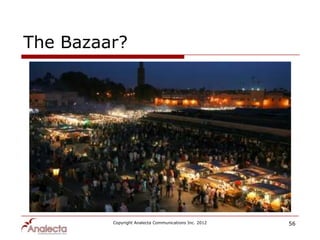
The Bazaar?


         Copyright Analecta Communications Inc. 2012   56
Every Page is Page One
 In the raucous market of ideas,
  knowledge, and authority, Every Page is
  Page One.
 Readers can come from anywhere. Is
  your content ready to receive them?


             Copyright Analecta Communications Inc. 2012   57
Every Page is Page One


         Copyright Analecta Communications Inc. 2012   58
Thank You
   Mark Baker
   Analecta Communications Inc.
   mbaker@analecta.com
   @mbakeranalecta
   analecta.com
   everypageispageone.com


              Copyright Analecta Communications Inc. 2012   59

Include it all. Filter it afterward.

  • 1.
    Include it all. Filterit afterward. Mark Baker Analecta Communications Inc.
  • 2.
    David Weinberger “We seemto be making a cultural choice---with our new infrastructure's thumb heavily on the scale---to prefer to start with abundance rather than curation. Include it all. Filter it afterward. Even then, the filters do not remove anything; they filter forward, not out.” To Big to Know Copyright Analecta Communications Inc. 2012 2
  • 3.
    Too Big toKnow "Traditional knowledge seemed like true content handed to us by competent experts. Networked knowledge seems like the work of humans who never quite get anything right." David Weinberger summing up Too Big to Know Copyright Analecta Communications Inc. 2012 3
  • 4.
    Knowledge developed inprivate  From 1836 to 1859, Darwin worked in private and alone before finally publishing. Copyright Analecta Communications Inc. 2012 4
  • 5.
    Open Notebook Science Copyright Analecta Communications Inc. 2012 5
  • 6.
    Climategate “the climategate furorehas galvanised the scientific information community to make data more open, transparent and accessible than ever” -- http://www.thefreelibrary.com/Data+without+the+doubts%3A+the+climat egate+furore+has+galvanised+the...-a0257556897 Copyright Analecta Communications Inc. 2012 6
  • 7.
    Networked facts “The newdefault is: If you are going to cite the data, you might as well link to it. Networked facts point to where they came from and, sometimes, where they lead to.” To Big to Know Copyright Analecta Communications Inc. 2012 7
  • 8.
    Something that wedo together “Links are the visible manifestation of the author giving up any claim to completeness or even sufficiency; links invite the reader to browse the network in which the work is enmeshed, and acknowledgement that thinking is something that we do together.” Too Big to Know Copyright Analecta Communications Inc. 2012 8
  • 9.
    Abundance "We seem tobe making a cultural choice---with our new infrastructure's thumb heavily on the scale---to prefer to start with abundance rather than curation. Include it all. Filter it afterward.” Copyright Analecta Communications Inc. 2012 9
  • 10.
    Scarcity  We grewup in a culture of information scarcity.  Though we didn’t think so at the time. Image courtesy of dan / FreeDigitalPhotos.net Copyright Analecta Communications Inc. 2012 10
  • 11.
    Not shaped likebooks “To think that knowledge itself is shaped like books is to marvel that a rock fits so well in its hole in the ground.” Too Big to Know Copyright Analecta Communications Inc. 2012 11
  • 12.
    Selective publication Copyright Analecta Communications Inc. 2012 12
  • 13.
    Rare and gem-like “Becauseof the economics of paper, facts were relatively rare and gem-like because there wasn‟t room for a whole lot of them.” Too Big to Know Copyright Analecta Communications Inc. 2012 13
  • 14.
    Time consuming toget Copyright Analecta Communications Inc. 2012 14
  • 15.
    Hard to search Copyright Analecta Communications Inc. 2012 15
  • 16.
    Hard to link Copyright Analecta Communications Inc. 2012 16
  • 17.
    Nailed down “Paper-based citationsare like nails: If you wonder why the author made a particular claim, you can see that it‟s nailed down by a footnote.” Too Big To Know Copyright Analecta Communications Inc. 2012 17
  • 18.
    Commitment  Getting booksis expensive. You are committed to the ones you have. Image courtesy of imagerymajestic / FreeDigitalPhotos.net Copyright Analecta Communications Inc. 2012 18
  • 19.
    Trust Copyright Analecta CommunicationsInc. 2012 19 Image courtesy of graur razvan ionutS / FreeDigitalPhotos.net
  • 20.
    Distrust “Distrust is anexpensive vice” Too Big to Know Copyright Analecta Communications Inc. 2012 20
  • 21.
    Authors  Authors providedan aggregation of the information and a conclusion.  Authors did the hard work of knowledge making.  The publisher did the hard work of vetting.  You paid them to do it for you because it was hard to do yourself. Copyright Analecta Communications Inc. 2012 21
  • 22.
    The Web: Informationis cheap  Abundance  Comprehensive publication  Easy to get  Easy to search  No investment in the content  No motive to trust  Cheap content = access to diversity  Nicholas Carr not withstanding. Copyright Analecta Communications Inc. 2012 22
  • 23.
    Experience vs. credentials “Nowthe technology lets you find experienced people as easily as credentialed ones.” Too Big To Know Copyright Analecta Communications Inc. 2012 23
  • 24.
    The virtue ofdiversity “The best problem solvers tend to be similar; therefore, a collection of the best problem solvers performs little better than any one of them individually. A collection of random, but intelligent, problem solvers tends to be diverse. This diversity allows them to be collectively better.” Too Big to Know Copyright Analecta Communications Inc. 2012 24
  • 25.
    What are wepaying for  The conclusion?  The validation?  The stopping point?  The aggregation of content? Copyright Analecta Communications Inc. 2012 25
  • 26.
    Include it all Our idea of knowledge has changed  Everything is a debate  We don‟t want the filter  We don‟t trust the filter  We want the data  We want the experienced as well as the credentialed  And now it‟s cheap! Copyright Analecta Communications Inc. 2012 26
  • 27.
    Filter it afterward We can aggregate it for ourselves  We can filter it for ourselves  And with our friends  Pinterest  Reddit  Twitter  Etc. Copyright Analecta Communications Inc. 2012 27
  • 28.
    Filter it socially Copyright Analecta Communications Inc. 2012 28
  • 29.
    Authority is shifting “Ifour social networks are our new filters, then authority is shifting from experts in faraway offices to the network of people we know, like, and respect.” Too Big to Know Copyright Analecta Communications Inc. 2012 29
  • 30.
    Websites are upsidedown Image copyright (c) 123RF Stock Photos Copyright Analecta Communications Inc. 2012 30
  • 31.
    Destination websites  Aggregators:Facebook, Twitter, Amazon  Unfiltered aggregation and the tools to create your own filters  Monopolies: government  Regular vendors: bank, etc  Favorite authors (blogs, etc,) Copyright Analecta Communications Inc. 2012 31
  • 32.
    Twitter  Twitter exemplifiesinclude it all, filter it afterward  Unfiltered tweet stream, to which you can apply filters  Or just dip in and rely on repetition to surface relevance Copyright Analecta Communications Inc. 2012 32
  • 33.
    Twitter vs. RSS “On my smartphone, I used to have Google Reader as one of my four quicklinks on the bottom toolbar. I recently replaced it with Twitter Topic, an app that shows all tweets that meet a specific hashtag.” Tom Johnson Copyright Analecta Communications Inc. 2012 33
  • 34.
    LinkedIn  LinkedIn containsmassive amounts of information from thousands of users, and give you the tools to filter what you see. Copyright Analecta Communications Inc. 2012 34
  • 35.
    Dethroning the book “Long-formwriting is by no means unnecessary or „dead.‟ But the fact that it is improved by being placed into the Net‟s web of connections means it is being dethroned by that web as the single best way to assemble ideas.” Too Big to Know Copyright Analecta Communications Inc. 2012 35
  • 36.
    Content Strategy crossroads Try to reclaim the order and certainty of the book world, or cooperate in the linked ecology of the web with its social approach to authority and its fuzzy edges? Copyright Analecta Communications Inc. 2012 36
  • 37.
    Raucous market ofideas “Expertise preferred to speak in a single voice. Books have authors and editors who ensure the content is self-consistent. … Networked expertise is more like a raucous market of ideas, knowledge, and authority.” Too Big to Know Copyright Analecta Communications Inc. 2012 37
  • 38.
    Pick your battle Is it easier to win the battle against the raucous market of ideas…  or win your battles in the raucous market of ideas? Copyright Analecta Communications Inc. 2012 38
  • 39.
    Can you commandthe tide? Copyright Analecta Communications Inc. 2012 39
  • 40.
    A network isof many minds “Because the multitude of people on the Internet are different in their interests and abilities, a network of experts is of many minds about just about everything. The value of a network of experts can be in opening thing up, not simply in coming to unshakable conclusions.” Too Big to Know Copyright Analecta Communications Inc. 2012 40
  • 41.
    What, therefore, mustwe do?  Do we attempt to make our web presence work like a book – to filter for the reader and lead them to our conclusion?  Or do we acknowledge that that is not what the reader wants, and that there is no way to force them into that mold?  And if so, what then? Copyright Analecta Communications Inc. 2012 41
  • 42.
    Living within aweb “Readers are being trained by the linked Net to see any piece that develops an idea as living within a connected traversable web.” Too Big to Know Copyright Analecta Communications Inc. 2012 42
  • 43.
    Embrace the network “Thebest way to move forward is to embrace the peculiar properties of this peculiar network.” Too Big to Know Copyright Analecta Communications Inc. 2012 43
  • 44.
    Every Page isPage One  Every page is page one is a fact of the web  People come to pages via search and links  Every page they land on is their page one  The question is, does every page of your content work as page one? Copyright Analecta Communications Inc. 2012 44
  • 45.
    Include it all Contribute to the content that the reader aggregates and filters for themself  Reader is more likely to visit one page from 10 sites than ten pages from your site  Make each page worth including in someone‟s selection Copyright Analecta Communications Inc. 2012 45
  • 46.
    Filter is afterward Be easy to filter correctly.  Clearly identify the subject and context.  Easy to consume as a unit.  No point in being filtered in falsely. Don‟t get a reputation as a waste of time. Copyright Analecta Communications Inc. 2012 46
  • 47.
    An EPPO topic  Self-contained  Establishes its context  Conforms to a type  Links richly Copyright Analecta Communications Inc. 2012 47
  • 48.
    Self contained  Worksas the reader‟s first page  No order dependency  No assumption about how the reader got here Copyright Analecta Communications Inc. 2012 48
  • 49.
    Establish Context  Establishthe context in every topic  Your website is not a context  Context is not determined by topic‟s place in your site hierarchy  Next, previous, home, etc, do not establish context  Context means context in the world, and context in the network of ideas Copyright Analecta Communications Inc. 2012 49
  • 50.
    Conforms to type Many topic types are defined socially  Recipes  Car reviews  API reference  Types help the user orient themselves  Types help the user trust  Types help the user filter content in Copyright Analecta Communications Inc. 2012 50
  • 51.
    Links  Links areabout more than SEO  Links locate your topic in context  Links let your topic stand alone without repeating ancillary material  Links guide readers to other topics  Preferably on your site!  Links let readers get to the right topic without having to go back to Google Copyright Analecta Communications Inc. 2012 51
  • 52.
    The Walled Garden? Copyright Analecta Communications Inc. 2012 55
  • 53.
    The Bazaar? Copyright Analecta Communications Inc. 2012 56
  • 54.
    Every Page isPage One  In the raucous market of ideas, knowledge, and authority, Every Page is Page One.  Readers can come from anywhere. Is your content ready to receive them? Copyright Analecta Communications Inc. 2012 57
  • 55.
    Every Page isPage One Copyright Analecta Communications Inc. 2012 58
  • 56.
    Thank You  Mark Baker  Analecta Communications Inc.  mbaker@analecta.com  @mbakeranalecta  analecta.com  everypageispageone.com Copyright Analecta Communications Inc. 2012 59