IT’S STORIES ALL THE WAY DOWN
Mark Baker
2015
It’s Stories All the Way Down
Mark Baker
Author: Every Page is Page One: Topic-based Writing for
Technical Communication and the Web
Storytelling and Purpose
“The idea of “purpose” has swept the
corporate world. … But activating
purpose is impossible without
storytelling. … Individuals must learn to
connect their drives to the
organization’s purpose and to articulate
their story to others.”
John Coleman, Use Storytelling to Explain Your Company’s
Purpose, HBR
What we sell is the ability for a 43-
year-old accountant to dress in black
leather, ride through small towns
and have people be afraid of him. –
Harley Davidson Exec (apocryphal?)
Power of story in business
“Facts and figures and all the rational
things that we think are important in
the business world actually don’t stick in
our minds at all,” …. But stories create
“sticky” memories by attaching
emotions to things that happen.
How to Tell a Great Story, Carolyn O'Hara, HBR
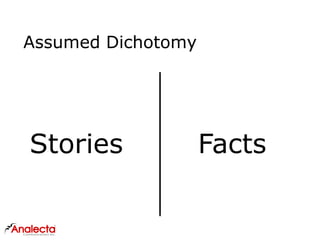
Assumed Dichotomy
Stories Facts
“[C]haracter-driven stories with
emotional content result in a better
understanding of the key points a
speaker wishes to make and enable
better recall of these points weeks
later.”
Paul J. Zak, Why Your Brain Loves Good Storytelling
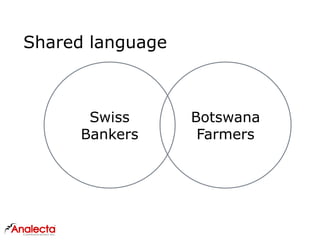
Swiss
Bankers
Botswana
Farmers
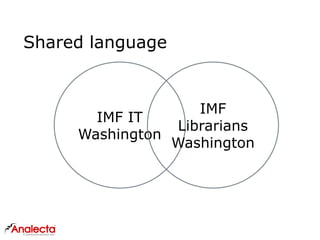
Shared language
IMF IT
Washington
IMF
Librarians
Washington
Shared language
Problem widely recognized
Every single person working on the web today has dealt with
a situation where the pain with no name has reared its ugly
head, leaving disinformation and misinformation in its wake.
Consider:
 “Our marketing team has a different language than the
technology team.”
 “Our users don’t understand the language of our
business.”
 “The way this is labeled or classified is keeping users
from finding or understanding it.”
 “We have several labels for the same thing and it gets in
the way when discussing things.”
Abby Covert, The Pain With No Name, A List Apart
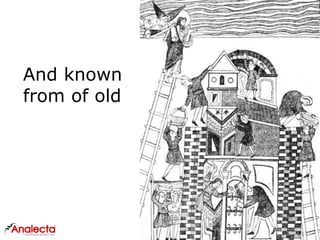
And known
from of old
Taxonomy to the Rescue?
 Agreement on terms = clear
communication
 Or does it?
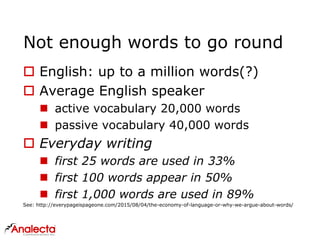
Not enough words to go round
 English: up to a million words(?)
 Average English speaker
 active vocabulary 20,000 words
 passive vocabulary 40,000 words
 Everyday writing
 first 25 words are used in 33%
 first 100 words appear in 50%
 first 1,000 words are used in 89%
See: http://everypageispageone.com/2015/08/04/the-economy-of-language-or-why-we-argue-about-words/
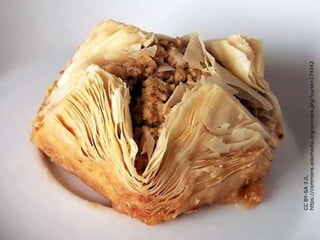
Words are like phyllo pastry
CCBY-SA3.0,
https://commons.wikimedia.org/w/index.php?curid=174342
How do we talk about
so much stuff with so
few words?
We tell stories.
Stories made up of stories
Algorithms make mistakes all the time. Just think
about auto-correction on your iPhone, the
recommendations on Netflix, or the coupons
automatically printed at Kmart’s checkout. Just
this past week, a fraud detection algorithm
incorrectly blocked my ATM card while I was
traveling in Germany, despite having called in a
travel notification before the trip.
KAISER FUNG, ANDREW GELMAN,
Why Consumers Should Care About Apple’s War on Big Data
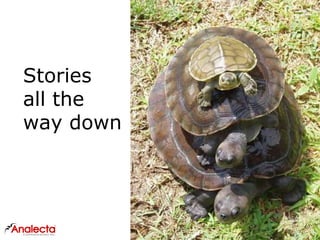
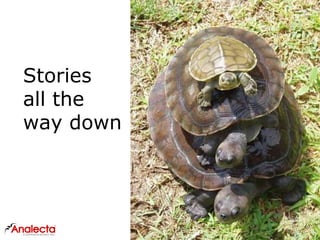
Stories
all the
way down
Words evoke stories
 What picture pops into your head
when you hear:
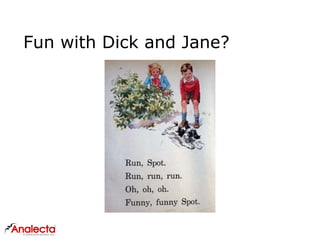
“See Spot Run”
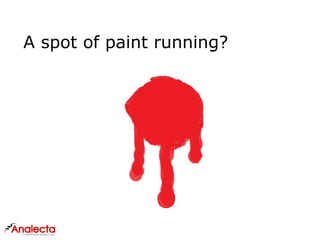
A spot of paint running?
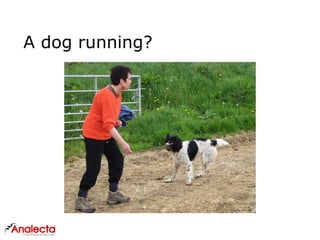
A dog running?
Fun with Dick and Jane?
Words evoke stories
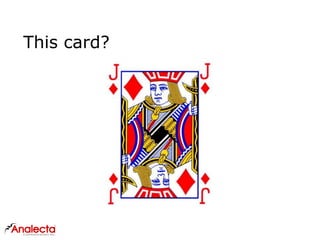
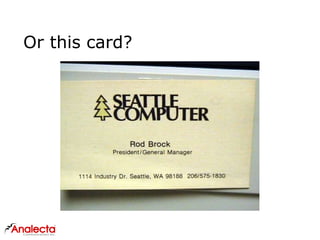
“I met a man at the
poker game and he
gave me his card.”
This card?
Or this card?
Words evoke stories
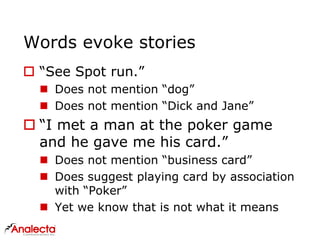
 “See Spot run.”
 Does not mention “dog”
 Does not mention “Dick and Jane”
 “I met a man at the poker game
and he gave me his card.”
 Does not mention “business card”
 Does suggest playing card by association
with “Poker”
 Yet we know that is not what it means
Words evoke stories
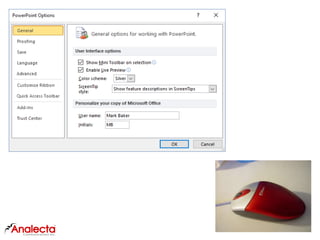
“Click the OK button”
From telling to
assuming the story
 Move the mouse over the surface of the
desk until the screen cursor is over the
button labeled OK on your screen. Press
and release the left mouse button with
your finger. You will hear a click and the
dialog box will disappear.
 Click the OK button.
 Click OK.
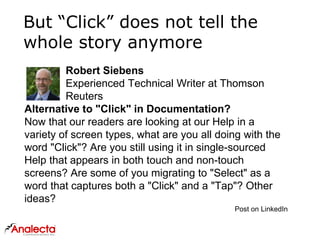
But “Click” does not tell the
whole story anymore
Robert Siebens
Experienced Technical Writer at Thomson
Reuters
Alternative to "Click" in Documentation?
Now that our readers are looking at our Help in a
variety of screen types, what are you all doing with the
word "Click"? Are you still using it in single-sourced
Help that appears in both touch and non-touch
screens? Are some of you migrating to "Select" as a
word that captures both a "Click" and a "Tap"? Other
ideas?
Post on LinkedIn
Suggestions
 tap
 select, choose
 But “double select” does not work
 And select is for options, not buttons
 select with a long press
 Why not just “long press”
 press
A generic alternative
 Mark Baker: The interfaces in
question are all still point-and-press
interfaces. All that is changed is what
we point with and how we press.
"Press" would work as a device
independent way of giving point-and-
press instructions.
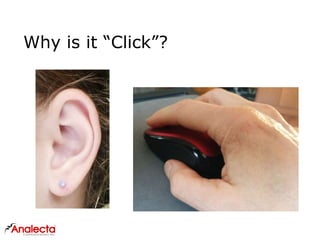
Why is it “Click”?
Learned stories
 Steve Arrants: I have to disagree
about click. It IS, to the end user, the
action. After reading it, learning it,
using it for so long as an action (Click
OK, Click Close, Click Options and
then double-click Set.) that's how
they understand it. As far as most
users are concerned, the sound of
click is feedback that they've done it.
Words invoked learned stories
 “Click” names the feedback, not the
action.
 But once learned, “click” now means
the action.
 And we internalize the story and
forget it is a story. Recognition
becomes instantaneous.
 Until we try to find an analog for
touch interfaces!
How to words attach to stories?
 Why is click the word that invokes
this story? Why pick the feedback
sound?
 Theory: We choose the most concrete
word that is unambiguous in context
Why not Press originally?
 Ian Saunders: To me, "press" is
what you do on physical keyboards,
"click" is for mice, and either "touch"
or "tap" for touchscreens. So, I don't
think that "Press" is device
independent - it always refers to a
physical key or button.
One word, one meaning
 Simplified Technical English says, use
oil as noun, a not verb
 Don’t use: “Oil the bearing”
 Use: “Put oil on the bearing”
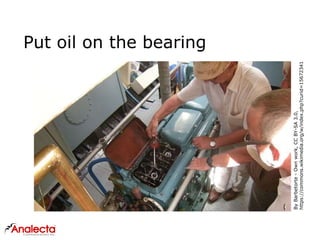
Put oil on the bearing
ByBarbetorte-Ownwork,CCBY-SA3.0,
https://commons.wikimedia.org/w/index.php?curid=15672341
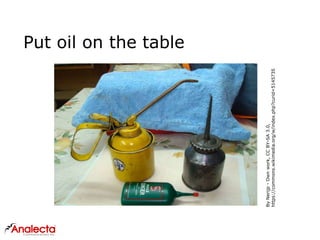
Put oil on the table
ByNerijp-Ownwork,CCBY-SA3.0,
https://commons.wikimedia.org/w/index.php?curid=5145735
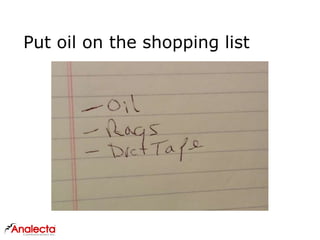
Put oil on the shopping list
How do we know?
 Put oil on the bearing means the fluid
 Put oil on the table means the bottle
 Put oil on the shopping list means the
word
 Because each phrase invokes a
different story in which “oil” plays a
different role
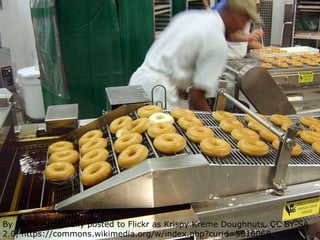
By Neil T - originally posted to Flickr as Krispy Kreme Doughnuts, CC BY-SA
2.0, https://commons.wikimedia.org/w/index.php?curid=5816068
The efficiency of language
 We don’t need to unpack the stories
we refer to
 We recognize the references instantly
 Stories feel like facts
 Without this facility, language would
be very inefficient
But what happens
when our audience
does not share our
stories?
Stories shape thinking
Words are impactful. They may not
break your bones, as the saying goes,
but they do guide the way we all think,
debate, decide and act.
The On-Demand, Sharing And Gig Economies Never Existed,
So Stop Pretending They Did, Matt Bencke, TechCrunch
Sharing economy
 Suggests a story of altruistic
communal living
 ‘The “sharing economy” term was
naive at best, destructive at
worst. Very few people share stuff for
free.’ -- Matt Bencke
Gig Economy
 Suggest the story of a struggling
band
 ‘The bias promoted by the term “gig”
is particularly destructive because it
confuses politicians’ -- Matt Bencke
Taxonomy can’t fix this
 Taxonomy tries to fix meanings to
words
 But words work together to evoke
stories
 Same words in different combinations
evoke different stories
 Same words evoke different stories in
different people
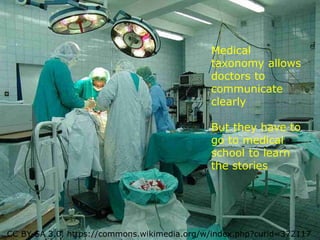
CC BY-SA 3.0, https://commons.wikimedia.org/w/index.php?curid=372117
Medical
taxonomy allows
doctors to
communicate
clearly
But they have to
go to medical
school to learn
the stories
Losing business
When an American manager in Japan cannot
understand why his Japanese staff will not give
him the “ballpark figure” he has demanded, this
breakdown in communication can lead to a real
disintegration in workplace relations. And the
underlying feelings of mistrust are mutual. The
inability of the travelling native English speaker to
refrain from homeland idiosyncrasies, subtextual
dexterity and cultural in-jokes has been found to
result in resentment and suspicion.
Spencer Hazel, Why native English speakers fail to be
understood in English – and lose out in global business
English speakers abroad
 [A]broad they discover that their own
English renders them
incomprehensible to colleagues and
business partners.
Spencer Hazel, Why native English speakers fail to be
understood in English – and lose out in global business
No shared stories = no shared
language
 But it is not just “idiosyncrasies,
subtextual dexterity and cultural
in-jokes”
 It is stories
 Foreign customers and partners
may speak English, but they don’t
share all of our stories
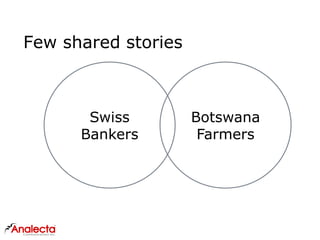
Swiss
Bankers
Botswana
Farmers
Few shared stories
‘Many sensible strategies fail to drive action
because executives formulate them in sweeping,
general language. “Achieving customer delight!”
“Becoming the most efficient manufacturer!”
“Unlocking shareholder value!” One explanation
for executives’ love affair with vague strategy
statements relates to a phenomenon called the
curse of knowledge. Top executives have had
years of immersion in the logic and conventions of
business, so when they speak abstractly, they are
simply summarizing the wealth of concrete data in
their heads. But frontline employees, who aren’t
privy to the underlying meaning, hear only
opaque phrases. As a result, the strategies being
touted don’t stick.’
Chip and Dan Heath, The Curse of Knowledge, HBR
Curse of Knowledge
 The curse of knowledge is a
cognitive bias that leads better-
informed parties to find it extremely
difficult to think about problems from
the perspective of lesser-informed
parties. -- Wikipedia
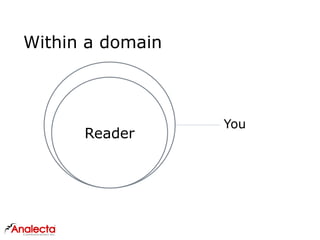
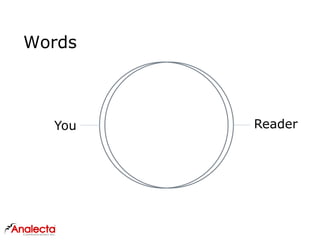
Reader
Within a domain
You
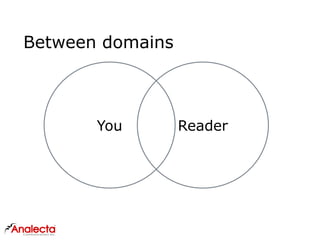
You Reader
Between domains
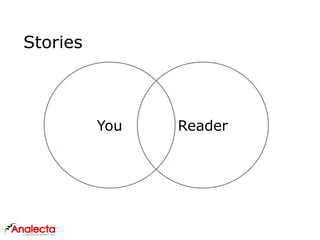
You Reader
Stories
Words
ReaderYou
Two types of confusion
 Your words evoke no stories for the
reader
 The reader knows they are confused
 Your words evoke different stories for
the reader
 The reader does not know they are
confused
 Or they know of discover it through a
wider incongruity
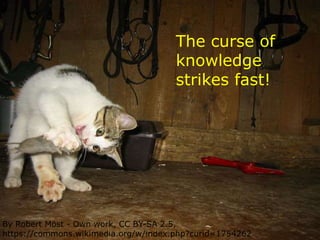
By Robert Möst - Own work, CC BY-SA 2.5,
https://commons.wikimedia.org/w/index.php?curid=1754262
The curse of
knowledge
strikes fast!
ByUser:LiveForever-EnglishWikipedia,CCBY-SA3.0,
https://commons.wikimedia.org/w/index.php?curid=2324027
Bridge the gap with stories
Stories build a picture
 Dave went to the store.
By Joe Mabel, CC BY-SA 3.0, https://commons.wikimedia.org/w/index.php?curid=2666267
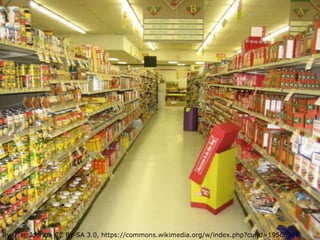
Adding detail refines the picture
 Dave went to the store to buy milk.
By User:Joerite, CC BY-SA 3.0, https://commons.wikimedia.org/w/index.php?curid=19566325
More detail refines further
 Dave went to the store to buy milk
because the baby was crying.
CC BY-SA 3.0, https://commons.wikimedia.org/w/index.php?curid=808069
Refine to remove ambiguity
 Everyone’s picture is different. We
keep refining our story until the
differences are incidental to the story
we are trying to tell.
 As far as we can tell…
 Because we can’t know for sure what
associations others might have to
lead them astray
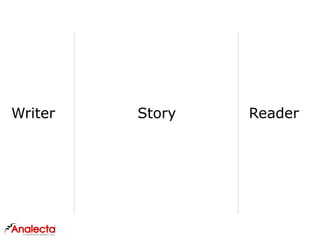
Writer ReaderStory
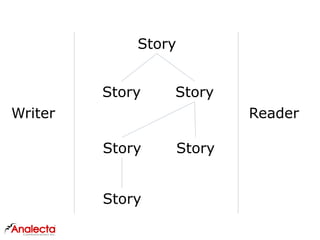
Writer Reader
Story
Story Story
StoryStory
Story
By Binette228 - Own work, CC BY-SA 3.0, https://commons.wikimedia.org/w/index.php?curid=31888310
Stories are fractal
Fractal expansion of stories
does not stop when we hit
facts, but when we hit
common stories based on
common experience
Facts are just
stories we agree on.
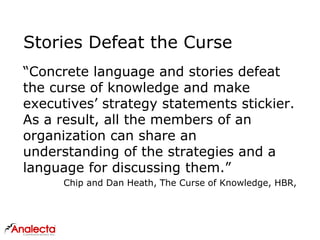
Stories Defeat the Curse
“Concrete language and stories defeat
the curse of knowledge and make
executives’ strategy statements stickier.
As a result, all the members of an
organization can share an
understanding of the strategies and a
language for discussing them.”
Chip and Dan Heath, The Curse of Knowledge, HBR,
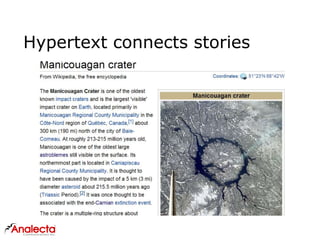
Hypertext connects stories
Keys
 All facts are stories
 All communication is an exchange of
stories
 Stories are made up of stories
 Be conscious of the curse of knowledge
 Figure out what stories the reader
knows, and how the express them
 Use hypertext to connect stories
Stories
all the
way down
Questions?
 Contact information
 Mark Baker
 Analecta Communications Inc.
 +1 226 808 1098
 mbaker@analecta.com
 Twitter: @mbakeranalecta
 http://analecta.com
 http://everypageispageone.com

It's Stories All the Way Down: Spectrum 2016

  • 1.
    IT’S STORIES ALLTHE WAY DOWN Mark Baker 2015
  • 2.
    It’s Stories Allthe Way Down Mark Baker Author: Every Page is Page One: Topic-based Writing for Technical Communication and the Web
  • 3.
    Storytelling and Purpose “Theidea of “purpose” has swept the corporate world. … But activating purpose is impossible without storytelling. … Individuals must learn to connect their drives to the organization’s purpose and to articulate their story to others.” John Coleman, Use Storytelling to Explain Your Company’s Purpose, HBR
  • 4.
    What we sellis the ability for a 43- year-old accountant to dress in black leather, ride through small towns and have people be afraid of him. – Harley Davidson Exec (apocryphal?)
  • 5.
    Power of storyin business “Facts and figures and all the rational things that we think are important in the business world actually don’t stick in our minds at all,” …. But stories create “sticky” memories by attaching emotions to things that happen. How to Tell a Great Story, Carolyn O'Hara, HBR
  • 6.
  • 7.
    “[C]haracter-driven stories with emotionalcontent result in a better understanding of the key points a speaker wishes to make and enable better recall of these points weeks later.” Paul J. Zak, Why Your Brain Loves Good Storytelling
  • 11.
  • 12.
  • 13.
    Problem widely recognized Everysingle person working on the web today has dealt with a situation where the pain with no name has reared its ugly head, leaving disinformation and misinformation in its wake. Consider:  “Our marketing team has a different language than the technology team.”  “Our users don’t understand the language of our business.”  “The way this is labeled or classified is keeping users from finding or understanding it.”  “We have several labels for the same thing and it gets in the way when discussing things.” Abby Covert, The Pain With No Name, A List Apart
  • 14.
  • 16.
    Taxonomy to theRescue?  Agreement on terms = clear communication  Or does it?
  • 17.
    Not enough wordsto go round  English: up to a million words(?)  Average English speaker  active vocabulary 20,000 words  passive vocabulary 40,000 words  Everyday writing  first 25 words are used in 33%  first 100 words appear in 50%  first 1,000 words are used in 89% See: http://everypageispageone.com/2015/08/04/the-economy-of-language-or-why-we-argue-about-words/
  • 18.
    Words are likephyllo pastry CCBY-SA3.0, https://commons.wikimedia.org/w/index.php?curid=174342
  • 19.
    How do wetalk about so much stuff with so few words? We tell stories.
  • 20.
    Stories made upof stories Algorithms make mistakes all the time. Just think about auto-correction on your iPhone, the recommendations on Netflix, or the coupons automatically printed at Kmart’s checkout. Just this past week, a fraud detection algorithm incorrectly blocked my ATM card while I was traveling in Germany, despite having called in a travel notification before the trip. KAISER FUNG, ANDREW GELMAN, Why Consumers Should Care About Apple’s War on Big Data
  • 21.
  • 22.
    Words evoke stories What picture pops into your head when you hear: “See Spot Run”
  • 23.
    A spot ofpaint running?
  • 24.
  • 25.
    Fun with Dickand Jane?
  • 27.
    Words evoke stories “Imet a man at the poker game and he gave me his card.”
  • 28.
  • 29.
  • 30.
    Words evoke stories “See Spot run.”  Does not mention “dog”  Does not mention “Dick and Jane”  “I met a man at the poker game and he gave me his card.”  Does not mention “business card”  Does suggest playing card by association with “Poker”  Yet we know that is not what it means
  • 31.
  • 33.
    From telling to assumingthe story  Move the mouse over the surface of the desk until the screen cursor is over the button labeled OK on your screen. Press and release the left mouse button with your finger. You will hear a click and the dialog box will disappear.  Click the OK button.  Click OK.
  • 34.
    But “Click” doesnot tell the whole story anymore Robert Siebens Experienced Technical Writer at Thomson Reuters Alternative to "Click" in Documentation? Now that our readers are looking at our Help in a variety of screen types, what are you all doing with the word "Click"? Are you still using it in single-sourced Help that appears in both touch and non-touch screens? Are some of you migrating to "Select" as a word that captures both a "Click" and a "Tap"? Other ideas? Post on LinkedIn
  • 35.
    Suggestions  tap  select,choose  But “double select” does not work  And select is for options, not buttons  select with a long press  Why not just “long press”  press
  • 36.
    A generic alternative Mark Baker: The interfaces in question are all still point-and-press interfaces. All that is changed is what we point with and how we press. "Press" would work as a device independent way of giving point-and- press instructions.
  • 37.
    Why is it“Click”?
  • 38.
    Learned stories  SteveArrants: I have to disagree about click. It IS, to the end user, the action. After reading it, learning it, using it for so long as an action (Click OK, Click Close, Click Options and then double-click Set.) that's how they understand it. As far as most users are concerned, the sound of click is feedback that they've done it.
  • 39.
    Words invoked learnedstories  “Click” names the feedback, not the action.  But once learned, “click” now means the action.  And we internalize the story and forget it is a story. Recognition becomes instantaneous.  Until we try to find an analog for touch interfaces!
  • 40.
    How to wordsattach to stories?  Why is click the word that invokes this story? Why pick the feedback sound?  Theory: We choose the most concrete word that is unambiguous in context
  • 41.
    Why not Pressoriginally?  Ian Saunders: To me, "press" is what you do on physical keyboards, "click" is for mice, and either "touch" or "tap" for touchscreens. So, I don't think that "Press" is device independent - it always refers to a physical key or button.
  • 42.
    One word, onemeaning  Simplified Technical English says, use oil as noun, a not verb  Don’t use: “Oil the bearing”  Use: “Put oil on the bearing”
  • 43.
    Put oil onthe bearing ByBarbetorte-Ownwork,CCBY-SA3.0, https://commons.wikimedia.org/w/index.php?curid=15672341
  • 44.
    Put oil onthe table ByNerijp-Ownwork,CCBY-SA3.0, https://commons.wikimedia.org/w/index.php?curid=5145735
  • 45.
    Put oil onthe shopping list
  • 46.
    How do weknow?  Put oil on the bearing means the fluid  Put oil on the table means the bottle  Put oil on the shopping list means the word  Because each phrase invokes a different story in which “oil” plays a different role
  • 47.
    By Neil T- originally posted to Flickr as Krispy Kreme Doughnuts, CC BY-SA 2.0, https://commons.wikimedia.org/w/index.php?curid=5816068
  • 48.
    The efficiency oflanguage  We don’t need to unpack the stories we refer to  We recognize the references instantly  Stories feel like facts  Without this facility, language would be very inefficient
  • 49.
    But what happens whenour audience does not share our stories?
  • 50.
    Stories shape thinking Wordsare impactful. They may not break your bones, as the saying goes, but they do guide the way we all think, debate, decide and act. The On-Demand, Sharing And Gig Economies Never Existed, So Stop Pretending They Did, Matt Bencke, TechCrunch
  • 51.
    Sharing economy  Suggestsa story of altruistic communal living  ‘The “sharing economy” term was naive at best, destructive at worst. Very few people share stuff for free.’ -- Matt Bencke
  • 52.
    Gig Economy  Suggestthe story of a struggling band  ‘The bias promoted by the term “gig” is particularly destructive because it confuses politicians’ -- Matt Bencke
  • 53.
    Taxonomy can’t fixthis  Taxonomy tries to fix meanings to words  But words work together to evoke stories  Same words in different combinations evoke different stories  Same words evoke different stories in different people
  • 54.
    CC BY-SA 3.0,https://commons.wikimedia.org/w/index.php?curid=372117 Medical taxonomy allows doctors to communicate clearly But they have to go to medical school to learn the stories
  • 55.
    Losing business When anAmerican manager in Japan cannot understand why his Japanese staff will not give him the “ballpark figure” he has demanded, this breakdown in communication can lead to a real disintegration in workplace relations. And the underlying feelings of mistrust are mutual. The inability of the travelling native English speaker to refrain from homeland idiosyncrasies, subtextual dexterity and cultural in-jokes has been found to result in resentment and suspicion. Spencer Hazel, Why native English speakers fail to be understood in English – and lose out in global business
  • 56.
    English speakers abroad [A]broad they discover that their own English renders them incomprehensible to colleagues and business partners. Spencer Hazel, Why native English speakers fail to be understood in English – and lose out in global business
  • 57.
    No shared stories= no shared language  But it is not just “idiosyncrasies, subtextual dexterity and cultural in-jokes”  It is stories  Foreign customers and partners may speak English, but they don’t share all of our stories
  • 58.
  • 59.
    ‘Many sensible strategiesfail to drive action because executives formulate them in sweeping, general language. “Achieving customer delight!” “Becoming the most efficient manufacturer!” “Unlocking shareholder value!” One explanation for executives’ love affair with vague strategy statements relates to a phenomenon called the curse of knowledge. Top executives have had years of immersion in the logic and conventions of business, so when they speak abstractly, they are simply summarizing the wealth of concrete data in their heads. But frontline employees, who aren’t privy to the underlying meaning, hear only opaque phrases. As a result, the strategies being touted don’t stick.’ Chip and Dan Heath, The Curse of Knowledge, HBR
  • 60.
    Curse of Knowledge The curse of knowledge is a cognitive bias that leads better- informed parties to find it extremely difficult to think about problems from the perspective of lesser-informed parties. -- Wikipedia
  • 61.
  • 62.
  • 63.
  • 64.
  • 65.
    Two types ofconfusion  Your words evoke no stories for the reader  The reader knows they are confused  Your words evoke different stories for the reader  The reader does not know they are confused  Or they know of discover it through a wider incongruity
  • 66.
    By Robert Möst- Own work, CC BY-SA 2.5, https://commons.wikimedia.org/w/index.php?curid=1754262 The curse of knowledge strikes fast!
  • 67.
  • 68.
    Stories build apicture  Dave went to the store.
  • 69.
    By Joe Mabel,CC BY-SA 3.0, https://commons.wikimedia.org/w/index.php?curid=2666267
  • 70.
    Adding detail refinesthe picture  Dave went to the store to buy milk.
  • 71.
    By User:Joerite, CCBY-SA 3.0, https://commons.wikimedia.org/w/index.php?curid=19566325
  • 72.
    More detail refinesfurther  Dave went to the store to buy milk because the baby was crying.
  • 73.
    CC BY-SA 3.0,https://commons.wikimedia.org/w/index.php?curid=808069
  • 74.
    Refine to removeambiguity  Everyone’s picture is different. We keep refining our story until the differences are incidental to the story we are trying to tell.  As far as we can tell…  Because we can’t know for sure what associations others might have to lead them astray
  • 75.
  • 76.
  • 77.
    By Binette228 -Own work, CC BY-SA 3.0, https://commons.wikimedia.org/w/index.php?curid=31888310 Stories are fractal
  • 78.
    Fractal expansion ofstories does not stop when we hit facts, but when we hit common stories based on common experience
  • 79.
  • 80.
    Stories Defeat theCurse “Concrete language and stories defeat the curse of knowledge and make executives’ strategy statements stickier. As a result, all the members of an organization can share an understanding of the strategies and a language for discussing them.” Chip and Dan Heath, The Curse of Knowledge, HBR,
  • 81.
  • 82.
    Keys  All factsare stories  All communication is an exchange of stories  Stories are made up of stories  Be conscious of the curse of knowledge  Figure out what stories the reader knows, and how the express them  Use hypertext to connect stories
  • 83.
  • 84.
    Questions?  Contact information Mark Baker  Analecta Communications Inc.  +1 226 808 1098  mbaker@analecta.com  Twitter: @mbakeranalecta  http://analecta.com  http://everypageispageone.com