In Vitro Meat
       By: Sam Turchyn
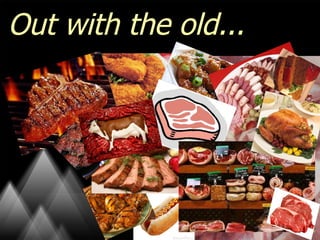
Out with the old...
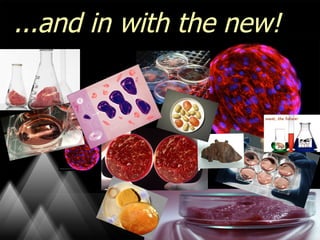
...and in with the new!
MEAT the Future
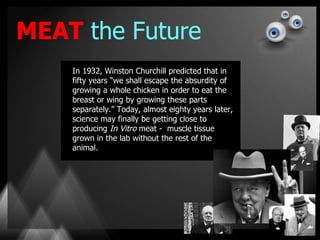
    In 1932, Winston Churchill predicted that in
    fifty years “we shall escape the absurdity of
    growing a whole chicken in order to eat the
    breast or wing by growing these parts
    separately.” Today, almost eighty years later,
    science may finally be getting close to
    producing In Vitro meat - muscle tissue
    grown in the lab without the rest of the
    animal.
What is In Vitro Meat?
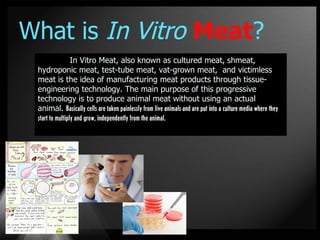
                 In Vitro Meat, also known as cultured meat, shmeat,
 hydroponic meat, test-tube meat, vat-grown meat, and victimless
 meat is the idea of manufacturing meat products through tissue-
 engineering technology. The main purpose of this progressive
 technology is to produce animal meat without using an actual
 animal. Basically cells are taken painlessly from live animals and are put into a culture media where they
 start to multiply and grow, independently from the animal.
Why would we need In Vitro MEAT?
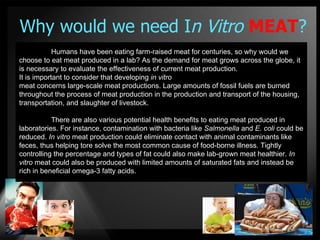
            Humans have been eating farm-raised meat for centuries, so why would we
choose to eat meat produced in a lab? As the demand for meat grows across the globe, it
is necessary to evaluate the effectiveness of current meat production.
It is important to consider that developing in vitro
meat concerns large-scale meat productions. Large amounts of fossil fuels are burned
throughout the process of meat production in the production and transport of the housing,
transportation, and slaughter of livestock.

           There are also various potential health benefits to eating meat produced in
laboratories. For instance, contamination with bacteria like Salmonella and E. coli could be
reduced. In vitro meat production could eliminate contact with animal contaminants like
feces, thus helping tore solve the most common cause of food-borne illness. Tightly
controlling the percentage and types of fat could also make lab-grown meat healthier. In
vitro meat could also be produced with limited amounts of saturated fats and instead be
rich in beneficial omega-3 fatty acids.
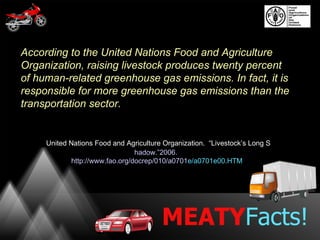
According to the United Nations Food and Agriculture
Organization, raising livestock produces twenty percent
of human-related greenhouse gas emissions. In fact, it is
responsible for more greenhouse gas emissions than the
transportation sector.


     United Nations Food and Agriculture Organization. “Livestock’s Long S
                                 hadow.”2006.
             http://www.fao.org/docrep/010/a0701e/a0701e00.HTM


                                        MEATYFacts!
How do you grow In Vitro MEAT in the lab?
               The meat we eat is muscle produced from livestock. One way to produce muscle
  tissue in the lab is to grow cells that are capable of becoming muscle cells and organizing
  themselves into muscle tissue.

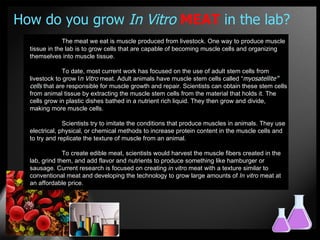
               To date, most current work has focused on the use of adult stem cells from
  livestock to grow In Vitro meat. Adult animals have muscle stem cells called “myosatellite”
  cells that are responsible for muscle growth and repair. Scientists can obtain these stem cells
  from animal tissue by extracting the muscle stem cells from the material that holds it. The
  cells grow in plastic dishes bathed in a nutrient rich liquid. They then grow and divide,
  making more muscle cells.

               Scientists try to imitate the conditions that produce muscles in animals. They use
  electrical, physical, or chemical methods to increase protein content in the muscle cells and
  to try and replicate the texture of muscle from an animal.

               To create edible meat, scientists would harvest the muscle fibers created in the
  lab, grind them, and add flavor and nutrients to produce something like hamburger or
  sausage. Current research is focused on creating in vitro meat with a texture similar to
  conventional meat and developing the technology to grow large amounts of In vitro meat at
  an affordable price.
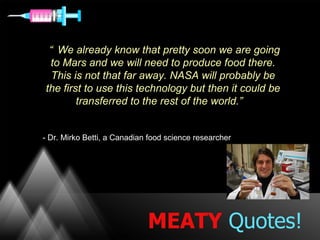
“ We already know that pretty soon we are going
 to Mars and we will need to produce food there.
  This is not that far away. NASA will probably be
the first to use this technology but then it could be
        transferred to the rest of the world.”


- Dr. Mirko Betti, a Canadian food science researcher


                             MEATY Quotes!
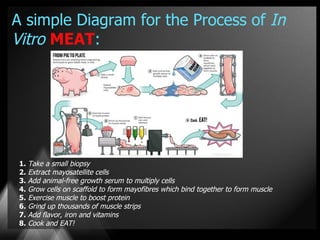
A simple Diagram for the Process of In
Vitro MEAT:


 1. Take a small biopsy
 2. Extract mayosatellite cells
 3. Add animal-free growth serum to multiply cells
 4. Grow cells on scaffold to form mayofibres which bind together to form muscle
 5. Exercise muscle to boost protein
 6. Grind up thousands of muscle strips
 7. Add flavor, iron and vitamins
 8. Cook and EAT!
Why isn’t there In Vitro MEAT on my
plate right now?
    A major hurdle facing the development of In Vitro meat is the nutrient
    liquid the cells use to grow and divide in the lab. A major component of
    this liquid comes from animal blood, which is both expensive and
    somewhat also defeats the purpose of In Vitro meat. Animal-free
    alternatives have been tested, including components taken from
    mushrooms and algae, but these are too expensive to be used for large-
    scale production.

               Another challenge of In Vitro meat production is the difference in
    texture between lab-grown and natural meat. In an animal, large masses
    of muscle tissue are able to survive and grow because a vast network of
    blood vessels delivers nutrients to cells throughout the tissue. In order for
    the nutrient rich liquid to reach all cells, current lab-grown muscle can only
    be made in small pieces and used to make ground meat like hamburger.
    Until scientists develop a way to nourish cells of larger portions of muscle
    tissue, a lab-grown steak remains an idea of the future.
Cons:
 1. Very expensive to produce with current technology

 2. Requires enormous investment for Research & Development

 3. Unnatural

 4. People might be reluctant to switch over from normal meat

 5. Limited to ground meat

 6. Subject to media criticism

 7. Possible unknown health consequences
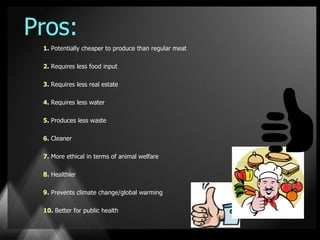
Pros:
 1. Potentially cheaper to produce than regular meat

 2. Requires less food input

 3. Requires less real estate

 4. Requires less water

 5. Produces less waste

 6. Cleaner

 7. More ethical in terms of animal welfare

 8. Healthier

 9. Prevents climate change/global warming

 10. Better for public health
Juicy In Vitro MEAT Videos:
   Science in Seconds - In Vitro Meat
    In-Vitro Meat: Bring it on!

    Meat The Future
Will you ever be
able to look at
meat the same
      way?
Bibliography                                   (APA-Style):
•   Brain, M. (n.d.). How In-Vitro Meat Works – creating meat without killing any animals – The Blogs
    at How Stuff Works. The Blogs at How Stuff Works. Retrieved April 29, 2012, from
    http://blogs.howstuffworks.com/2009/11/18/how-in-vitro-meat-works-creating-meat-without-killing-any-animals/

•   In Search of a Test-Tube Hamburger - TIME. (n.d.). Breaking News, Analysis, Politics, Blogs, News
    Photos, Video, Tech Reviews - TIME.com. Retrieved April 29, 2012, from
    http://www.time.com/time/health/article/0,8599,1734630,00.html

•   In Search of a Test-Tube Hamburger - TIME. (n.d.). Breaking News, Analysis, Politics, Blogs, News
    Photos, Video, Tech Reviews - TIME.com. Retrieved April 29, 2012, from
    http://www.time.com/time/health/article/0,8599,1734630,00.html

•   In vitro meat, new technologies, and the “yuck factor” | Practical Ethics. (n.d.). Practical Ethics.
    Retrieved April 29, 2012, from http://
    blog.practicalethics.ox.ac.uk/2012/03/in-vitro-meat-new-technologies-and-the-yuck-factor/

•   In-Vitro Meat: More research, more questions « Aesthetics of Everywhere. (n.d.).
    Aesthetics of Everywhere. Retrieved April 29, 2012, from
    http://crystalbae.com/2011/05/19/in-vitro-meat-more-research-questions/

•   The In Vitro Meat Consortium - Home. (n.d.). The In Vitro Meat Consortium - Home. Retrieved
    April 29, 2012, from http://invitromeat.org/

•   soon., &certain., a. (n.d.). Eight Ways In-Vitro Meat will Change Our Lives.
    H+ Magazine | Covering technological, scientific, and cultural trends that are changing–and will
    change–human beings in fundamental ways. Retrieved April29, 2012, from
    http://hplusmagazine.com/2009/11/17/eight-ways-vitro-meat-will-change-our-lives/

In vitro meat

  • 1.
    In Vitro Meat By: Sam Turchyn
  • 2.
  • 3.
  • 4.
    MEAT the Future In 1932, Winston Churchill predicted that in fifty years “we shall escape the absurdity of growing a whole chicken in order to eat the breast or wing by growing these parts separately.” Today, almost eighty years later, science may finally be getting close to producing In Vitro meat - muscle tissue grown in the lab without the rest of the animal.
  • 5.
    What is InVitro Meat? In Vitro Meat, also known as cultured meat, shmeat, hydroponic meat, test-tube meat, vat-grown meat, and victimless meat is the idea of manufacturing meat products through tissue- engineering technology. The main purpose of this progressive technology is to produce animal meat without using an actual animal. Basically cells are taken painlessly from live animals and are put into a culture media where they start to multiply and grow, independently from the animal.
  • 6.
    Why would weneed In Vitro MEAT? Humans have been eating farm-raised meat for centuries, so why would we choose to eat meat produced in a lab? As the demand for meat grows across the globe, it is necessary to evaluate the effectiveness of current meat production. It is important to consider that developing in vitro meat concerns large-scale meat productions. Large amounts of fossil fuels are burned throughout the process of meat production in the production and transport of the housing, transportation, and slaughter of livestock. There are also various potential health benefits to eating meat produced in laboratories. For instance, contamination with bacteria like Salmonella and E. coli could be reduced. In vitro meat production could eliminate contact with animal contaminants like feces, thus helping tore solve the most common cause of food-borne illness. Tightly controlling the percentage and types of fat could also make lab-grown meat healthier. In vitro meat could also be produced with limited amounts of saturated fats and instead be rich in beneficial omega-3 fatty acids.
  • 7.
    According to theUnited Nations Food and Agriculture Organization, raising livestock produces twenty percent of human-related greenhouse gas emissions. In fact, it is responsible for more greenhouse gas emissions than the transportation sector. United Nations Food and Agriculture Organization. “Livestock’s Long S hadow.”2006. http://www.fao.org/docrep/010/a0701e/a0701e00.HTM MEATYFacts!
  • 8.
    How do yougrow In Vitro MEAT in the lab? The meat we eat is muscle produced from livestock. One way to produce muscle tissue in the lab is to grow cells that are capable of becoming muscle cells and organizing themselves into muscle tissue. To date, most current work has focused on the use of adult stem cells from livestock to grow In Vitro meat. Adult animals have muscle stem cells called “myosatellite” cells that are responsible for muscle growth and repair. Scientists can obtain these stem cells from animal tissue by extracting the muscle stem cells from the material that holds it. The cells grow in plastic dishes bathed in a nutrient rich liquid. They then grow and divide, making more muscle cells. Scientists try to imitate the conditions that produce muscles in animals. They use electrical, physical, or chemical methods to increase protein content in the muscle cells and to try and replicate the texture of muscle from an animal. To create edible meat, scientists would harvest the muscle fibers created in the lab, grind them, and add flavor and nutrients to produce something like hamburger or sausage. Current research is focused on creating in vitro meat with a texture similar to conventional meat and developing the technology to grow large amounts of In vitro meat at an affordable price.
  • 9.
    “ We alreadyknow that pretty soon we are going to Mars and we will need to produce food there. This is not that far away. NASA will probably be the first to use this technology but then it could be transferred to the rest of the world.” - Dr. Mirko Betti, a Canadian food science researcher MEATY Quotes!
  • 10.
    A simple Diagramfor the Process of In Vitro MEAT: 1. Take a small biopsy 2. Extract mayosatellite cells 3. Add animal-free growth serum to multiply cells 4. Grow cells on scaffold to form mayofibres which bind together to form muscle 5. Exercise muscle to boost protein 6. Grind up thousands of muscle strips 7. Add flavor, iron and vitamins 8. Cook and EAT!
  • 11.
    Why isn’t thereIn Vitro MEAT on my plate right now? A major hurdle facing the development of In Vitro meat is the nutrient liquid the cells use to grow and divide in the lab. A major component of this liquid comes from animal blood, which is both expensive and somewhat also defeats the purpose of In Vitro meat. Animal-free alternatives have been tested, including components taken from mushrooms and algae, but these are too expensive to be used for large- scale production. Another challenge of In Vitro meat production is the difference in texture between lab-grown and natural meat. In an animal, large masses of muscle tissue are able to survive and grow because a vast network of blood vessels delivers nutrients to cells throughout the tissue. In order for the nutrient rich liquid to reach all cells, current lab-grown muscle can only be made in small pieces and used to make ground meat like hamburger. Until scientists develop a way to nourish cells of larger portions of muscle tissue, a lab-grown steak remains an idea of the future.
  • 12.
    Cons: 1. Veryexpensive to produce with current technology 2. Requires enormous investment for Research & Development 3. Unnatural 4. People might be reluctant to switch over from normal meat 5. Limited to ground meat 6. Subject to media criticism 7. Possible unknown health consequences
  • 13.
    Pros: 1. Potentiallycheaper to produce than regular meat 2. Requires less food input 3. Requires less real estate 4. Requires less water 5. Produces less waste 6. Cleaner 7. More ethical in terms of animal welfare 8. Healthier 9. Prevents climate change/global warming 10. Better for public health
  • 14.
    Juicy In VitroMEAT Videos: Science in Seconds - In Vitro Meat In-Vitro Meat: Bring it on! Meat The Future
  • 15.
    Will you everbe able to look at meat the same way?
  • 16.
    Bibliography (APA-Style): • Brain, M. (n.d.). How In-Vitro Meat Works – creating meat without killing any animals – The Blogs at How Stuff Works. The Blogs at How Stuff Works. Retrieved April 29, 2012, from http://blogs.howstuffworks.com/2009/11/18/how-in-vitro-meat-works-creating-meat-without-killing-any-animals/ • In Search of a Test-Tube Hamburger - TIME. (n.d.). Breaking News, Analysis, Politics, Blogs, News Photos, Video, Tech Reviews - TIME.com. Retrieved April 29, 2012, from http://www.time.com/time/health/article/0,8599,1734630,00.html • In Search of a Test-Tube Hamburger - TIME. (n.d.). Breaking News, Analysis, Politics, Blogs, News Photos, Video, Tech Reviews - TIME.com. Retrieved April 29, 2012, from http://www.time.com/time/health/article/0,8599,1734630,00.html • In vitro meat, new technologies, and the “yuck factor” | Practical Ethics. (n.d.). Practical Ethics. Retrieved April 29, 2012, from http:// blog.practicalethics.ox.ac.uk/2012/03/in-vitro-meat-new-technologies-and-the-yuck-factor/ • In-Vitro Meat: More research, more questions « Aesthetics of Everywhere. (n.d.). Aesthetics of Everywhere. Retrieved April 29, 2012, from http://crystalbae.com/2011/05/19/in-vitro-meat-more-research-questions/ • The In Vitro Meat Consortium - Home. (n.d.). The In Vitro Meat Consortium - Home. Retrieved April 29, 2012, from http://invitromeat.org/ • soon., &certain., a. (n.d.). Eight Ways In-Vitro Meat will Change Our Lives. H+ Magazine | Covering technological, scientific, and cultural trends that are changing–and will change–human beings in fundamental ways. Retrieved April29, 2012, from http://hplusmagazine.com/2009/11/17/eight-ways-vitro-meat-will-change-our-lives/