IMS LIS Outcomes and Sakai  Standardizing Grade Exchange John A. Lewis Chief Software Architect Unicon, Inc. Sakai 2010 Conference 17 June 2010 © Copyright Unicon, Inc., 2010.  Some rights reserved.  This work is licensed under a Creative Commons Attribution-Noncommercial-Share Alike 3.0 United States License. To view a copy of this license, visit  http://creativecommons.org/licenses/by-nc-sa/3.0/us/ Special thanks to Gary Gilbert for all his help with this presentation and demo!
Intro to IMS Outcomes
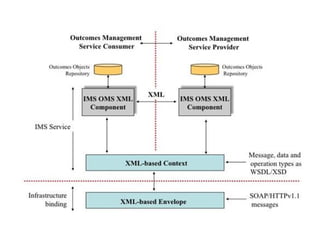
Background  IMS Outcomes Management Service
Part of the IMS Learning Information Services (LIS) Specification
Version 1.0 (Currently in public draft)
Released March 2010
Primary contributors: IMS, Oracle, Pearson, SunguardHE, Desire2Learn, Blackboard
Overview Formal definition : the definition of how systems manage the exchange of information that describes Outcomes
How to exchange assignment and grade data in a standard way
 
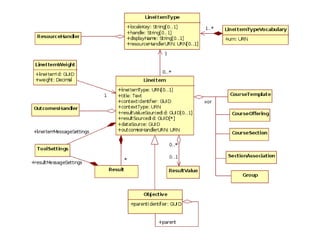
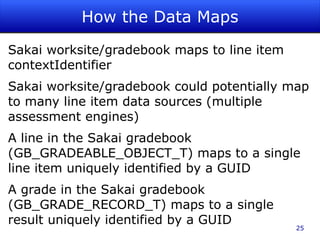
Key Terminology LineItem : assignment in context (course, course section, etc)
Result : grade for a student in a context
Outcomes Data Model
 
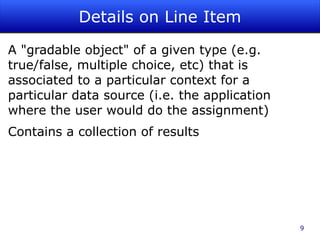
Details on Line Item A "gradable object" of a given type (e.g. true/false, multiple choice, etc) that is associated to a particular context for a particular data source (i.e. the application where the user would do the assignment)
Contains a collection of results
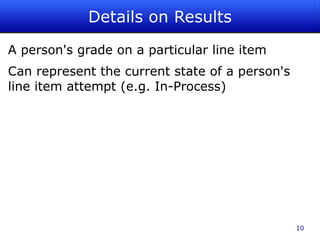
Details on Results A person's grade on a particular line item
Can represent the current state of a person's line item attempt (e.g. In-Process)
Outcomes Services
Line Items Services LineItemManager Interface Defines CRUD operations for line items Typically, exposed as a web service by the system that controls the gradebook
Supporting services LineItemTypeVocabluaryManager, LineItemWeightManager
Results Services ResultManager interface Defines CRUD operations for results
Like the LineItemManager service, exposed as a web service by the system that controls the gradebook Supporting services ResultValueManager, ResultStatusManager
How Outcomes Relates to LTI IMS Outcomes is its own specification however it is also a "profile" of the IMS LTI specification
That is, the parties (that agree to the LTI contract) may extend that contract to include Outcomes
Outcomes + LTI Benefits Outcomes tool launch - direct accesses from Gradebook to line item or result
A guarantee that the tool consumer will expose the LineItemManager and ResultManager interfaces as web services
Deployment time agreement on security profiles of the web services (typically, WS-Security) and POST (typically, hash message (MAC/OAuth) token security)
Deployment time provisioning of outcomes endpoint locations in the tool provider
Pearson's Implementation
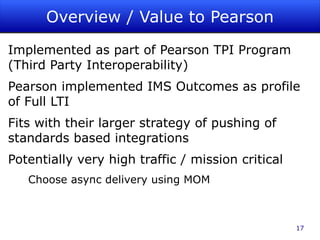
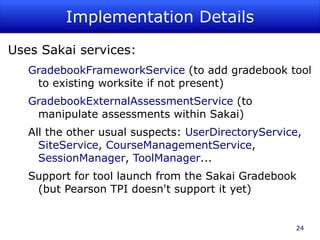
Overview / Value to Pearson Implemented as part of Pearson TPI Program (Third Party Interoperability)
Pearson implemented IMS Outcomes as profile of Full LTI
Fits with their larger strategy of pushing of standards based integrations
Potentially very high traffic / mission critical Choose async delivery using MOM
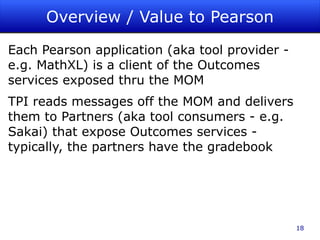
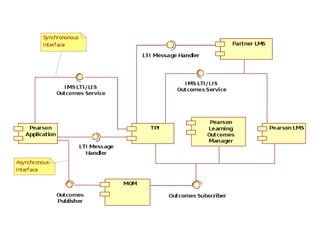
Overview / Value to Pearson Each Pearson application (aka tool provider - e.g. MathXL) is a client of the Outcomes services exposed thru the MOM
TPI reads messages off the MOM and delivers them to Partners (aka tool consumers - e.g. Sakai) that expose Outcomes services - typically, the partners have the gradebook
 
Extensions to the Spec (Ugh) Unfortunately, the Outcomes spec didn't cover everything that Pearson wanted
Had to extend the spec for: Additional line item level data
Additional result level data In both of the above cases, the extension mechanism that is supported by the Outcomes data types was deemed insufficient  Support for Pearson's internal  SimpleAssessment  type

IMS LIS Outcomes and Sakai: Standardizing Grade Exchange

  • 1.
    IMS LIS Outcomesand Sakai Standardizing Grade Exchange John A. Lewis Chief Software Architect Unicon, Inc. Sakai 2010 Conference 17 June 2010 © Copyright Unicon, Inc., 2010. Some rights reserved. This work is licensed under a Creative Commons Attribution-Noncommercial-Share Alike 3.0 United States License. To view a copy of this license, visit http://creativecommons.org/licenses/by-nc-sa/3.0/us/ Special thanks to Gary Gilbert for all his help with this presentation and demo!
  • 2.
    Intro to IMSOutcomes
  • 3.
    Background IMSOutcomes Management Service
  • 4.
    Part of theIMS Learning Information Services (LIS) Specification
  • 5.
    Version 1.0 (Currentlyin public draft)
  • 6.
  • 7.
    Primary contributors: IMS,Oracle, Pearson, SunguardHE, Desire2Learn, Blackboard
  • 8.
    Overview Formal definition: the definition of how systems manage the exchange of information that describes Outcomes
  • 9.
    How to exchangeassignment and grade data in a standard way
  • 10.
  • 11.
    Key Terminology LineItem: assignment in context (course, course section, etc)
  • 12.
    Result : gradefor a student in a context
  • 13.
  • 14.
  • 15.
    Details on LineItem A "gradable object" of a given type (e.g. true/false, multiple choice, etc) that is associated to a particular context for a particular data source (i.e. the application where the user would do the assignment)
  • 16.
  • 17.
    Details on ResultsA person's grade on a particular line item
  • 18.
    Can represent thecurrent state of a person's line item attempt (e.g. In-Process)
  • 19.
  • 20.
    Line Items ServicesLineItemManager Interface Defines CRUD operations for line items Typically, exposed as a web service by the system that controls the gradebook
  • 21.
  • 22.
    Results Services ResultManagerinterface Defines CRUD operations for results
  • 23.
    Like the LineItemManagerservice, exposed as a web service by the system that controls the gradebook Supporting services ResultValueManager, ResultStatusManager
  • 24.
    How Outcomes Relatesto LTI IMS Outcomes is its own specification however it is also a "profile" of the IMS LTI specification
  • 25.
    That is, theparties (that agree to the LTI contract) may extend that contract to include Outcomes
  • 26.
    Outcomes + LTIBenefits Outcomes tool launch - direct accesses from Gradebook to line item or result
  • 27.
    A guarantee thatthe tool consumer will expose the LineItemManager and ResultManager interfaces as web services
  • 28.
    Deployment time agreementon security profiles of the web services (typically, WS-Security) and POST (typically, hash message (MAC/OAuth) token security)
  • 29.
    Deployment time provisioningof outcomes endpoint locations in the tool provider
  • 30.
  • 31.
    Overview / Valueto Pearson Implemented as part of Pearson TPI Program (Third Party Interoperability)
  • 32.
    Pearson implemented IMSOutcomes as profile of Full LTI
  • 33.
    Fits with theirlarger strategy of pushing of standards based integrations
  • 34.
    Potentially very hightraffic / mission critical Choose async delivery using MOM
  • 35.
    Overview / Valueto Pearson Each Pearson application (aka tool provider - e.g. MathXL) is a client of the Outcomes services exposed thru the MOM
  • 36.
    TPI reads messagesoff the MOM and delivers them to Partners (aka tool consumers - e.g. Sakai) that expose Outcomes services - typically, the partners have the gradebook
  • 37.
  • 38.
    Extensions to theSpec (Ugh) Unfortunately, the Outcomes spec didn't cover everything that Pearson wanted
  • 39.
    Had to extendthe spec for: Additional line item level data
  • 40.
    Additional result leveldata In both of the above cases, the extension mechanism that is supported by the Outcomes data types was deemed insufficient Support for Pearson's internal SimpleAssessment type