Sakai UpdateMichael KorcuskaMarch 17, 2009. Nagoya, Japan
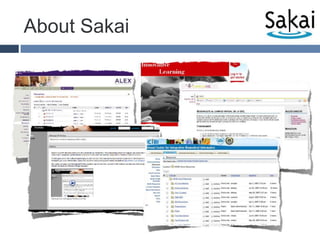
About Sakai
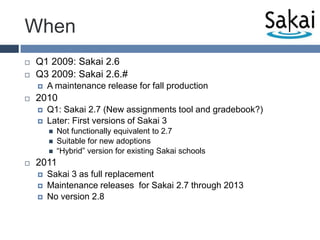
Sakai HistoryCourseware Management SystemStarted in 2004 Michigan, Indiana, Stanford, MIT (and Berkeley)Mellon Foundation Grant2.6 release in QA
Why Start Sakai?5 Schools with Homegrown CMSInefficient to build 5 systemsWanted to maintain controlExperts in teaching and learningDesire to work together and share knowledge
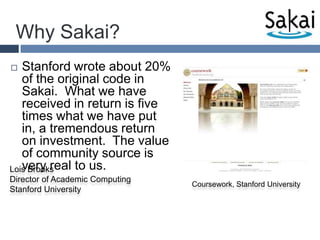
Why Sakai?Stanford wrote about 20% of the original code in Sakai.  What we have received in return is five times what we have put in, a tremendous return on investment.  The value of community source is very real to us.Lois BrooksDirector of Academic Computing Stanford UniversityCoursework, Stanford University
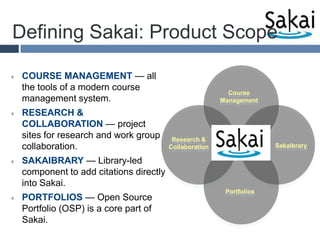
Course ManagementResearch & CollaborationSakaibraryPortfoliosDefining Sakai: Product ScopeCOURSE MANAGEMENT — all the tools of a modern course management system.RESEARCH & COLLABORATION — project sites for research and work group collaboration.SAKAIBRARY — Library-led component to add citations directly into Sakai.PORTFOLIOS — Open Source Portfolio (OSP) is a core part of Sakai.
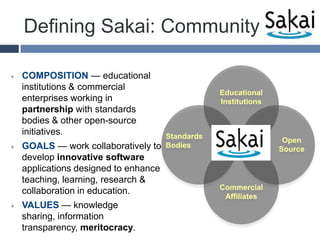
Defining Sakai: CommunityCOMPOSITION — educational institutions & commercial enterprises working in partnership with standards bodies & other open-source initiatives.GOALS — work collaboratively to develop innovative software applications designed to enhance teaching, learning, research & collaboration in education.VALUES — knowledge sharing, information transparency, meritocracy.Educational InstitutionsStandards BodiesOpen SourceCommercial Affiliates
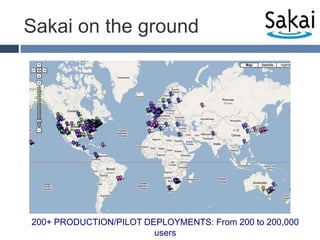
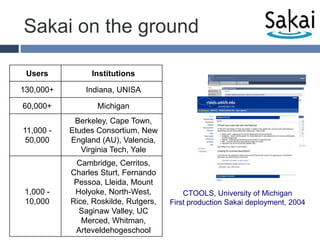
Sakai on the ground200+ PRODUCTION/PILOT DEPLOYMENTS: From 200 to 200,000 users
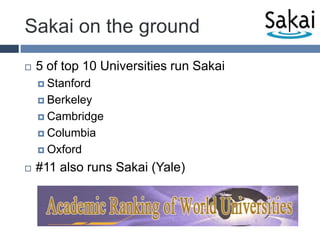
Sakai on the ground5 of top 10 Universities run SakaiStanfordBerkeleyCambridgeColumbiaOxford#11 also runs Sakai (Yale)
Sakai on the groundCTOOLS, University of MichiganFirst production Sakai deployment, 2004
Defining Sakai: CodeOPEN LICENSING — Sakai’s software is made available under the terms of the ECL, a variant of the Apache license. The ECL encourages a wide range of use, including commercial use. NO FEES OR ROYALTIES — Sakai is free to acquire, use, copy, modify, merge, publish, redistribute & sublicense for any purpose provided our copyright notice & disclaimer are included.NO “COPYLEFT” RESTRICTIONS — unlike GPL redistributed derivative works are neither required to adopt the Sakai license nor publish the source code as open-source.EDUCATIONAL COMMUNITY LICENSE (ECL)
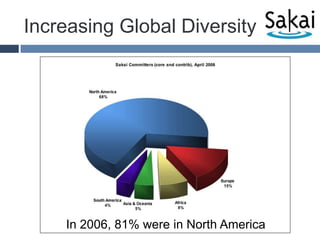
Increasing Global DiversityIn 2006, 81% were in North America
Defining Sakai: FoundationMISSION  — manage & protect intellectual property; provide basic infrastructure & small staff; help coordinate design, development, testing & distribution of software; champion open source & open standards.GOVERNANCE — ten board members elected by member reps to serve three-year terms; Executive Director manages day-to-day operations.PARTNERS — over 100 member organizations contribute $10K per year ($5K for smaller institutions).BUDGET — funds 4-6 staffers, admin services, computing infrastructure, project coordination, conferences, Sakai Fellows Program, advocacy & outreach activities.
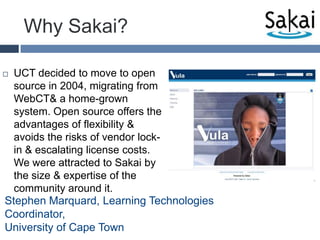
Why Sakai?UCT decided to move to open source in 2004, migrating from WebCT & a home-grown system. Open source offers the advantages of flexibility & avoids the risks of vendor lock-in & escalating license costs. We were attracted to Sakai by the size & expertise of the community around it.Stephen Marquard, Learning Technologies Coordinator, University of Cape Town
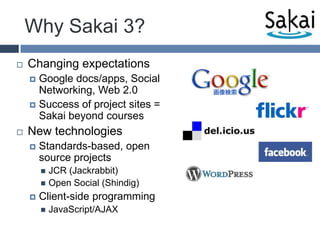
Why Sakai 3?Changing expectationsGoogle docs/apps, Social Networking, Web 2.0Success of project sites = Sakai beyond coursesNew technologiesStandards-based, open source projectsJCR (Jackrabbit)Open Social (Shindig)Client-side programmingJavaScript/AJAX
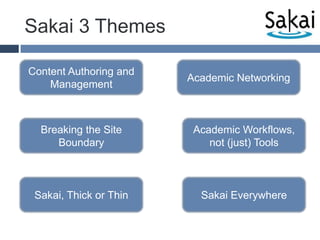
Sakai 3 ThemesContent Authoring and ManagementAcademic NetworkingBreaking the Site BoundaryAcademic Workflows, not (just) ToolsSakai, Thick or ThinSakai Everywhere
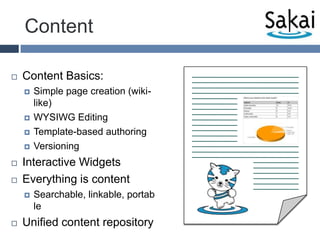
ContentContent Basics:Simple page creation (wiki-like)WYSIWG EditingTemplate-based authoringVersioningInteractive WidgetsEverything is contentSearchable, linkable, portableUnified content repository
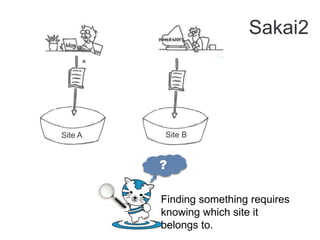
Sakai2Site BSite A?Finding something requires knowing which site it belongs to.
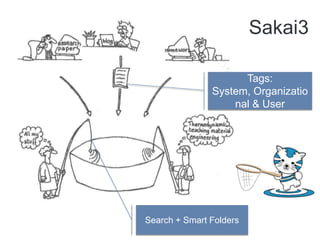
Sakai3Tags: System, Organizational & UserSearch + Smart Folders
Academic NetworkingContentPeopleAcademic NetworkingPeople are important, but “friends” aren’t enoughContent-based – Who is reading the same articles?Activity based – Who has taken the same classes?
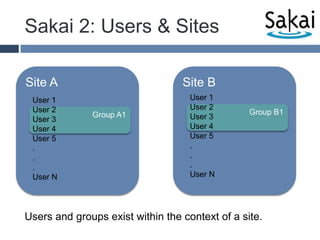
Sakai 2: Users & SitesSite ASite BUser 1User 2User 3User 4User 5...User NUser 1User 2User 3User 4User 5...User NGroup B1Group A1Users and groups exist within the context of a site.
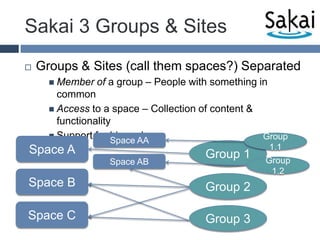
Groups & Sites (call them spaces?) SeparatedMember of a group – People with something in commonAccess to a space – Collection of content & functionalitySupport for hierarchySakai 3 Groups & SitesGroup 1.1Space AASpace AGroup 1Space ABGroup 1.2Space BGroup 2Space CGroup 3
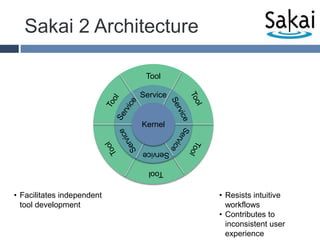
KernelToolSakai 2 ArchitectureKernelServiceToolToolServiceServiceKernelServiceServiceToolToolServiceToolFacilitates independent tool development
Resists intuitive workflows
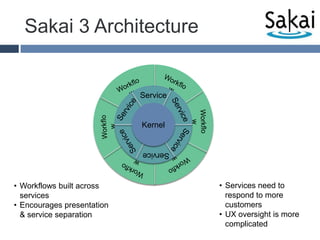
Contributes to inconsistent user experienceSakai 3 ArchitectureKernelWorkflowKernelServiceWorkflowWorkflowServiceServiceKernelServiceServiceWorkflowWorkflowServiceWorkflowServices need to respond to more customers
UX oversight is more complicated
Workflows built across services
Encourages presentation & service separationAcademic WorkflowBeyond Tool SilosAcademic work flows often cross tool boundariesAnything can be graded!Anything can be discussed!This is beginning to appear in Sakai 2But more needs to be doneExample: Instructor puts into syllabus an assignment to create a discussionpost that will be graded.4 tools for both instructors and students!
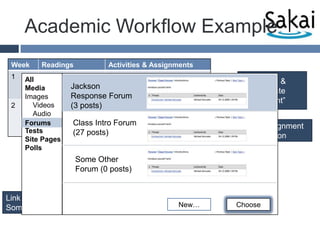
Academic Workflow ExampleSelect text & click “Create Assignment”AllMediaImages	Videos	AudioForumsTestsSite PagesPollsJackson Response Forum (3 posts)Create Assignment…Name: Jackson Reading ResponseDue Date: September 10, 2009Points: 10 (of 150)Type: IndividualDescription:Respond to the Jackson article in no more than 500 words. Post that response to the class discussion forum.Link To: Select...Class Intro Forum (27 posts)ForumsEdit Assignment InformationSome Other Forum (0 posts)CreateCancelAdvanced Options…Link to SomethingChooseNew…
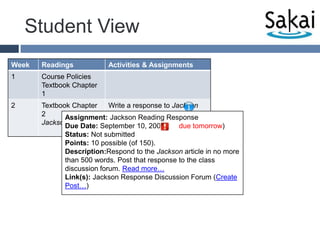
Student ViewAssignment: Jackson Reading ResponseDue Date: September 10, 2009 (     due tomorrow)Status: Not submittedPoints: 10 possible (of 150).Description:Respond to the Jackson article in no more than 500 words. Post that response to the class discussion forum. Read more…Link(s): Jackson Response Discussion Forum (Create Post…)
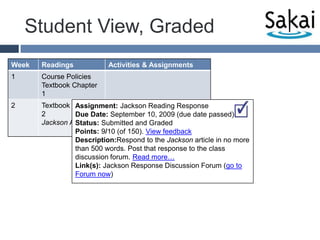
Student View, GradedAssignment: Jackson Reading ResponseDue Date: September 10, 2009 (due date passed)Status: Submitted and GradedPoints: 9/10 (of 150). View feedbackDescription:Respond to the Jackson article in no more than 500 words. Post that response to the class discussion forum. Read more…Link(s): Jackson Response Discussion Forum (go to Forum now)
Sakai, Thick or ThinMultiple ConfigurationsSakai as CMSSakai as Collaboration SystemSakai as Portfolio SystemSakai IntegrationsGoogle ApplicationsSocial Networks (Open Social, Facebook) Sakai does not need to do everything for everyone
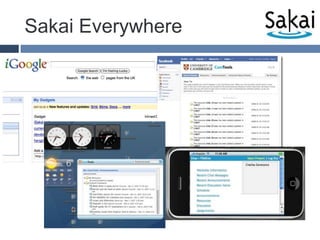
Sakai Everywhere
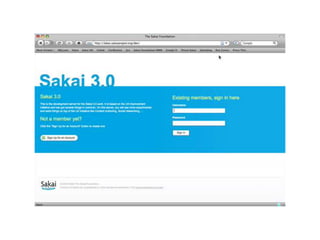
http://3akai.sakaifoundation.orgSakai 3 Demo
Sakai 3 Technology GoalsScalabilityRemove bottlenecks from Sakai 2Improve cluster supportDeveloper ProductivityFaster buildsUX & back-end development separatedCode Quality & MaintenanceReliance on other open source effortsIncrease unit testingEasier to install/buildTo improve initial experience for new developers
JCR as Content StoreStandards-basedJSR 170Ships with Apache Jackrabbit, but can be changedEverything as contentDiscussion post, User profile information, etc.Components put Content into JCR Content storeSakai Kernel creates relational indices in DBComponent doesn’t need to do anythingAutomatic tracking of most events by kernel
JSONSakai Kernel supports JSON microformatComponents use REST calls to interact with KernelAgain, standards basedJAX-RS currently in Kernel (JSR 311)BenefitsBack-end services stay Java-basedUX programmers more often skilled in JavaScriptEasier UX developers can work on SakaiTools like GWT can be used for Java-based UIComponents can be written using other languages

Ja Sakai 09 V01

  • 1.
    Sakai UpdateMichael KorcuskaMarch17, 2009. Nagoya, Japan
  • 2.
  • 3.
    Sakai HistoryCourseware ManagementSystemStarted in 2004 Michigan, Indiana, Stanford, MIT (and Berkeley)Mellon Foundation Grant2.6 release in QA
  • 4.
    Why Start Sakai?5Schools with Homegrown CMSInefficient to build 5 systemsWanted to maintain controlExperts in teaching and learningDesire to work together and share knowledge
  • 5.
    Why Sakai?Stanford wroteabout 20% of the original code in Sakai. What we have received in return is five times what we have put in, a tremendous return on investment. The value of community source is very real to us.Lois BrooksDirector of Academic Computing Stanford UniversityCoursework, Stanford University
  • 6.
    Course ManagementResearch &CollaborationSakaibraryPortfoliosDefining Sakai: Product ScopeCOURSE MANAGEMENT — all the tools of a modern course management system.RESEARCH & COLLABORATION — project sites for research and work group collaboration.SAKAIBRARY — Library-led component to add citations directly into Sakai.PORTFOLIOS — Open Source Portfolio (OSP) is a core part of Sakai.
  • 7.
    Defining Sakai: CommunityCOMPOSITION— educational institutions & commercial enterprises working in partnership with standards bodies & other open-source initiatives.GOALS — work collaboratively to develop innovative software applications designed to enhance teaching, learning, research & collaboration in education.VALUES — knowledge sharing, information transparency, meritocracy.Educational InstitutionsStandards BodiesOpen SourceCommercial Affiliates
  • 8.
    Sakai on theground200+ PRODUCTION/PILOT DEPLOYMENTS: From 200 to 200,000 users
  • 9.
    Sakai on theground5 of top 10 Universities run SakaiStanfordBerkeleyCambridgeColumbiaOxford#11 also runs Sakai (Yale)
  • 10.
    Sakai on thegroundCTOOLS, University of MichiganFirst production Sakai deployment, 2004
  • 11.
    Defining Sakai: CodeOPENLICENSING — Sakai’s software is made available under the terms of the ECL, a variant of the Apache license. The ECL encourages a wide range of use, including commercial use. NO FEES OR ROYALTIES — Sakai is free to acquire, use, copy, modify, merge, publish, redistribute & sublicense for any purpose provided our copyright notice & disclaimer are included.NO “COPYLEFT” RESTRICTIONS — unlike GPL redistributed derivative works are neither required to adopt the Sakai license nor publish the source code as open-source.EDUCATIONAL COMMUNITY LICENSE (ECL)
  • 12.
    Increasing Global DiversityIn2006, 81% were in North America
  • 13.
    Defining Sakai: FoundationMISSION — manage & protect intellectual property; provide basic infrastructure & small staff; help coordinate design, development, testing & distribution of software; champion open source & open standards.GOVERNANCE — ten board members elected by member reps to serve three-year terms; Executive Director manages day-to-day operations.PARTNERS — over 100 member organizations contribute $10K per year ($5K for smaller institutions).BUDGET — funds 4-6 staffers, admin services, computing infrastructure, project coordination, conferences, Sakai Fellows Program, advocacy & outreach activities.
  • 14.
    Why Sakai?UCT decidedto move to open source in 2004, migrating from WebCT & a home-grown system. Open source offers the advantages of flexibility & avoids the risks of vendor lock-in & escalating license costs. We were attracted to Sakai by the size & expertise of the community around it.Stephen Marquard, Learning Technologies Coordinator, University of Cape Town
  • 15.
    Why Sakai 3?ChangingexpectationsGoogle docs/apps, Social Networking, Web 2.0Success of project sites = Sakai beyond coursesNew technologiesStandards-based, open source projectsJCR (Jackrabbit)Open Social (Shindig)Client-side programmingJavaScript/AJAX
  • 16.
    Sakai 3 ThemesContentAuthoring and ManagementAcademic NetworkingBreaking the Site BoundaryAcademic Workflows, not (just) ToolsSakai, Thick or ThinSakai Everywhere
  • 17.
    ContentContent Basics:Simple pagecreation (wiki-like)WYSIWG EditingTemplate-based authoringVersioningInteractive WidgetsEverything is contentSearchable, linkable, portableUnified content repository
  • 18.
    Sakai2Site BSite A?Findingsomething requires knowing which site it belongs to.
  • 19.
    Sakai3Tags: System, Organizational& UserSearch + Smart Folders
  • 20.
    Academic NetworkingContentPeopleAcademic NetworkingPeopleare important, but “friends” aren’t enoughContent-based – Who is reading the same articles?Activity based – Who has taken the same classes?
  • 21.
    Sakai 2: Users& SitesSite ASite BUser 1User 2User 3User 4User 5...User NUser 1User 2User 3User 4User 5...User NGroup B1Group A1Users and groups exist within the context of a site.
  • 22.
    Groups & Sites(call them spaces?) SeparatedMember of a group – People with something in commonAccess to a space – Collection of content & functionalitySupport for hierarchySakai 3 Groups & SitesGroup 1.1Space AASpace AGroup 1Space ABGroup 1.2Space BGroup 2Space CGroup 3
  • 23.
  • 24.
  • 25.
    Contributes to inconsistentuser experienceSakai 3 ArchitectureKernelWorkflowKernelServiceWorkflowWorkflowServiceServiceKernelServiceServiceWorkflowWorkflowServiceWorkflowServices need to respond to more customers
  • 26.
    UX oversight ismore complicated
  • 27.
  • 28.
    Encourages presentation &service separationAcademic WorkflowBeyond Tool SilosAcademic work flows often cross tool boundariesAnything can be graded!Anything can be discussed!This is beginning to appear in Sakai 2But more needs to be doneExample: Instructor puts into syllabus an assignment to create a discussionpost that will be graded.4 tools for both instructors and students!
  • 29.
    Academic Workflow ExampleSelecttext & click “Create Assignment”AllMediaImages Videos AudioForumsTestsSite PagesPollsJackson Response Forum (3 posts)Create Assignment…Name: Jackson Reading ResponseDue Date: September 10, 2009Points: 10 (of 150)Type: IndividualDescription:Respond to the Jackson article in no more than 500 words. Post that response to the class discussion forum.Link To: Select...Class Intro Forum (27 posts)ForumsEdit Assignment InformationSome Other Forum (0 posts)CreateCancelAdvanced Options…Link to SomethingChooseNew…
  • 30.
    Student ViewAssignment: JacksonReading ResponseDue Date: September 10, 2009 ( due tomorrow)Status: Not submittedPoints: 10 possible (of 150).Description:Respond to the Jackson article in no more than 500 words. Post that response to the class discussion forum. Read more…Link(s): Jackson Response Discussion Forum (Create Post…)
  • 31.
    Student View, GradedAssignment:Jackson Reading ResponseDue Date: September 10, 2009 (due date passed)Status: Submitted and GradedPoints: 9/10 (of 150). View feedbackDescription:Respond to the Jackson article in no more than 500 words. Post that response to the class discussion forum. Read more…Link(s): Jackson Response Discussion Forum (go to Forum now)
  • 32.
    Sakai, Thick orThinMultiple ConfigurationsSakai as CMSSakai as Collaboration SystemSakai as Portfolio SystemSakai IntegrationsGoogle ApplicationsSocial Networks (Open Social, Facebook) Sakai does not need to do everything for everyone
  • 33.
  • 34.
  • 36.
    Sakai 3 TechnologyGoalsScalabilityRemove bottlenecks from Sakai 2Improve cluster supportDeveloper ProductivityFaster buildsUX & back-end development separatedCode Quality & MaintenanceReliance on other open source effortsIncrease unit testingEasier to install/buildTo improve initial experience for new developers
  • 37.
    JCR as ContentStoreStandards-basedJSR 170Ships with Apache Jackrabbit, but can be changedEverything as contentDiscussion post, User profile information, etc.Components put Content into JCR Content storeSakai Kernel creates relational indices in DBComponent doesn’t need to do anythingAutomatic tracking of most events by kernel
  • 38.
    JSONSakai Kernel supportsJSON microformatComponents use REST calls to interact with KernelAgain, standards basedJAX-RS currently in Kernel (JSR 311)BenefitsBack-end services stay Java-basedUX programmers more often skilled in JavaScriptEasier UX developers can work on SakaiTools like GWT can be used for Java-based UIComponents can be written using other languages