Planning, Designing, Constructing & Implementing a Carbon Management Response Plan A tool for performance managing carbon emission reductions in the business by key result area A Unit of Competency in CTI’s Advanced Carbon Management Course
Learning Objectives What a Carbon Management Response Plan is Why CMRP’s are an important strategic management tool CMRP development within the business planning process The features & components of a CMRP The elements that make the CMRP an integrated tool How to plan, prepare, design & construct a CMRP Linking a portfolio of CMRP’s across the business  Communicating & Implementing CMRP’s Performance managing CMRP’s in the business The role of CMRP’s as a KPI management tool CMRP Organisational Challenges
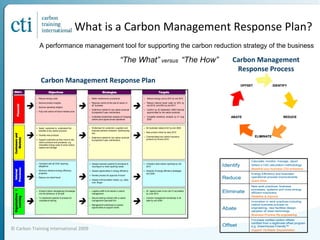
What is a Carbon Management Response Plan? A performance management tool for supporting the carbon reduction strategy of the business  Carbon Management Response Process Carbon Management Response Plan “ The What” “ The How” versus
CMRP Business Elements Natural resources and raw materials Supply chains and logistics Fixed asset design and construction Asset operation, performance and maintenance Business processes Asset values Markets, customers and competitors Products and services Workforces Local community and environment A carbon management response plan needs to address critical elements within the entire business model. This makes it an important strategic management tool
Organisational Linkages Bringing the business together through key result areas (KRAs) focuses outcomes KRA 2 KRA 1 KRA 4 KRA 3
Operational Strategy Map Using This CARBON EMISSIONS Do This Deliver This Achieve This
Evolution of the CMRP
A CMRP is designed with a focus on KRA’s & supports SMART principles
A SMART CMRP means: Specific Measurable Actionable / Achievable Realistic / Results Focused Time-Based
Business Systems Analysis Understanding the evolving business system is key to developing the right responses Example
A SWOT is an key input into developing the CMRP Example
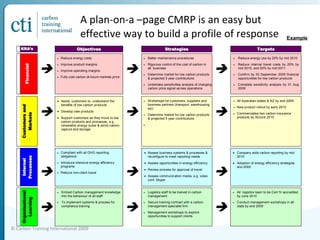
A plan-on-a –page CMRP is an easy but effective way to build a profile of response Example
Class Exercise Construct a plan-on-a-page CMRP using the process outlined Base the CMRP on a group nominated & selected business Nominate a team lead to speak on groups behalf & discuss the final product
Implementing a CMRP Needs to be managed under a change management framework when introduced for the first time This primarily means engaging staff through the entire process to obtain buy-in, support & ownership Regular & relevant communication about the CMRP is key in the early stages – people want to know that it is succeeding Keep the CMRP simple in the first year
A CMRP = Value Generation A well constructed CMRP will deliver upfront value to the business as well as help to secure longer term sustainability & prosperity
Q&A Robert Nicholls Director Innovation & Organisational Adaptation [email_address] www.carbontraininginternational.com
About the Trainer Robert Nicholls – B.Ec; B.Bus(Hons); MBA Rob is Carbon Training International’s Director of Innovation & Organisational Adaptation. Within this role Rob is charged with working with industry, business, local government & community groups to help them identify & understand the risks & opportunities associated with the low carbon economy, the strategies for responding and the capacity building needs of the organisation to do so. Rob is involved with delivering CTI’s facilitated workshop programs on developing and implementing an organisational carbon management response plan. As well as being a market economist, he is an experienced business strategist & operational improvement specialist with diverse industry experience gained from working both in Australia & overseas over the past 13 years. Rob has an extensive working knowledge of the evolving climate change & carbon management business system gained from projects associated with sustainability planning, risk mitigation, eco-focused investments and carbon markets. He has a solid understanding of the international and national climate change frameworks, protocols, mechanisms, policies, legislation & governance systems related to mitigating & abating GHG emissions and the related implications for business continuity.

Constructing a Carbon Management Response Plan

  • 1.
    Planning, Designing, Constructing& Implementing a Carbon Management Response Plan A tool for performance managing carbon emission reductions in the business by key result area A Unit of Competency in CTI’s Advanced Carbon Management Course
  • 2.
    Learning Objectives Whata Carbon Management Response Plan is Why CMRP’s are an important strategic management tool CMRP development within the business planning process The features & components of a CMRP The elements that make the CMRP an integrated tool How to plan, prepare, design & construct a CMRP Linking a portfolio of CMRP’s across the business Communicating & Implementing CMRP’s Performance managing CMRP’s in the business The role of CMRP’s as a KPI management tool CMRP Organisational Challenges
  • 3.
    What is aCarbon Management Response Plan? A performance management tool for supporting the carbon reduction strategy of the business Carbon Management Response Process Carbon Management Response Plan “ The What” “ The How” versus
  • 4.
    CMRP Business ElementsNatural resources and raw materials Supply chains and logistics Fixed asset design and construction Asset operation, performance and maintenance Business processes Asset values Markets, customers and competitors Products and services Workforces Local community and environment A carbon management response plan needs to address critical elements within the entire business model. This makes it an important strategic management tool
  • 5.
    Organisational Linkages Bringingthe business together through key result areas (KRAs) focuses outcomes KRA 2 KRA 1 KRA 4 KRA 3
  • 6.
    Operational Strategy MapUsing This CARBON EMISSIONS Do This Deliver This Achieve This
  • 7.
  • 8.
    A CMRP isdesigned with a focus on KRA’s & supports SMART principles
  • 9.
    A SMART CMRPmeans: Specific Measurable Actionable / Achievable Realistic / Results Focused Time-Based
  • 10.
    Business Systems AnalysisUnderstanding the evolving business system is key to developing the right responses Example
  • 11.
    A SWOT isan key input into developing the CMRP Example
  • 12.
    A plan-on-a –pageCMRP is an easy but effective way to build a profile of response Example
  • 13.
    Class Exercise Constructa plan-on-a-page CMRP using the process outlined Base the CMRP on a group nominated & selected business Nominate a team lead to speak on groups behalf & discuss the final product
  • 14.
    Implementing a CMRPNeeds to be managed under a change management framework when introduced for the first time This primarily means engaging staff through the entire process to obtain buy-in, support & ownership Regular & relevant communication about the CMRP is key in the early stages – people want to know that it is succeeding Keep the CMRP simple in the first year
  • 15.
    A CMRP =Value Generation A well constructed CMRP will deliver upfront value to the business as well as help to secure longer term sustainability & prosperity
  • 16.
    Q&A Robert NichollsDirector Innovation & Organisational Adaptation [email_address] www.carbontraininginternational.com
  • 17.
    About the TrainerRobert Nicholls – B.Ec; B.Bus(Hons); MBA Rob is Carbon Training International’s Director of Innovation & Organisational Adaptation. Within this role Rob is charged with working with industry, business, local government & community groups to help them identify & understand the risks & opportunities associated with the low carbon economy, the strategies for responding and the capacity building needs of the organisation to do so. Rob is involved with delivering CTI’s facilitated workshop programs on developing and implementing an organisational carbon management response plan. As well as being a market economist, he is an experienced business strategist & operational improvement specialist with diverse industry experience gained from working both in Australia & overseas over the past 13 years. Rob has an extensive working knowledge of the evolving climate change & carbon management business system gained from projects associated with sustainability planning, risk mitigation, eco-focused investments and carbon markets. He has a solid understanding of the international and national climate change frameworks, protocols, mechanisms, policies, legislation & governance systems related to mitigating & abating GHG emissions and the related implications for business continuity.