Technology Facilitation and Leadership
   What Every K-12 Leader Should Know and Be Able to Do


                                Sal DeAngelo, MBA, CAS
                            Bethlehem Central School District
                                      Director of Technology
                        College of Saint Rose Presentation
                                             July 22, 2010
Sal DeAngelo
                                                     A little about who I am


I have spent over 26 years coordinating and managing instructional technology
programs in an educational environment. I have developed and supported the
infrastructure for bringing classrooms students and staff into the 21st century
and beyond.

I am experienced in the design, specification, and installation of instructional
technology equipment and software to enable partnering and enriched
curriculum delivery.

I am committed to ongoing professional development in my field to better
serve the needs of students, staff, parents and the community at large.


      “Leadership is the process of creating and sustaining a culture
       where everyone works together in achieving common goals,
          not because they have to but because they want to.”
Sal DeAngelo
        Some of my personal beliefs and Educational Technology Vision

   Our strategic intent should be to maximize each student’s growth
    and individual success by meeting each student where he or she is,
    and empowering them to develop their own personal learning
    process

   Studies have shown that students understand and retain knowledge
    best when they can apply it in a practical, relevant setting. We
    must strive to provide this proper setting for them. Technology and
    Web 2.0 has profoundly changed the way we all work, collaborate
    and communicate and our relationship with information
                                                  information.

   “Technology has the potential to transform education when
    integrated with emerging models of teaching and learning.”
    [NAESP,
    [NAESP 2006] - we need leverage professional development to
    ensure the staff has the capacity to achieve this goal

   Learning with technology should not be about the technology
    itself but about the learning that can be facilitated through it

   Maximize learning through the blending of various technologies
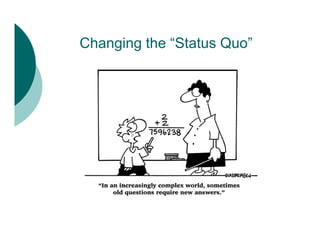
Changing the “Status Quo
              Status Quo”
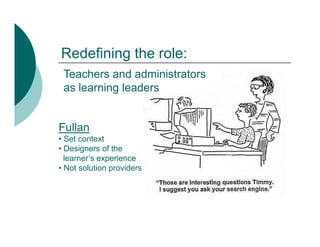
Redefining the role:
 Teachers and administrators
 as learning leaders


Fullan
• Set context
• Designers of the
  learner’s experience
• Not solution providers
Redefining the role:
Building Level Leaders/Administrators


    “Schools need leadership from
  principals who focus on advancing
      student and staff learning.”
       t d t d t ff l        i ”
                              Richard DuFour
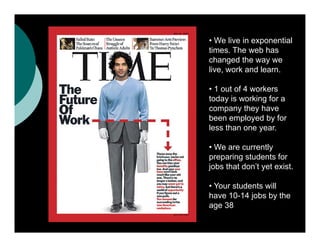
• We live in exponential
times. The web has
changed the way we
live, work and learn.

• 1 out of 4 workers
today is working for a
company they have
been employed by for
less than one year.

• We are currently
preparing students for
j
jobs that don’t y exist.
                yet

• Your students will
have 10-14 jobs by the
age 38
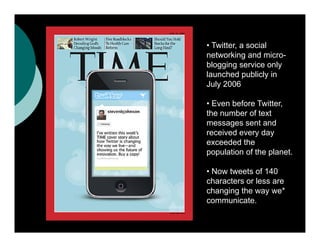
• Twitter a social
  Twitter,
networking and micro-
blogging service only
launched publicly in
July 2006

• Even before Twitter,
the number of text
messages sent and
received every day
exceeded the
population of the planet.

• Now tweets of 140
characters or less are
changing the way we*
communicate.
communicate
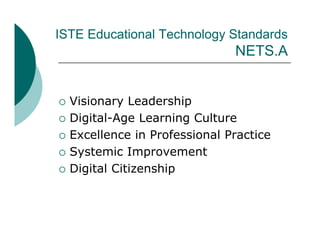
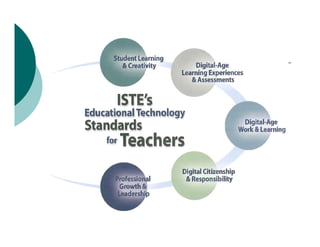
ISTE Educational Technology Standards
                                NETS.A
                                NETS A


   Visionary Leadership
   Digital-Age Learning Culture
   Excellence in Professional Practice
   Systemic Improvement
   Digital Citizenship
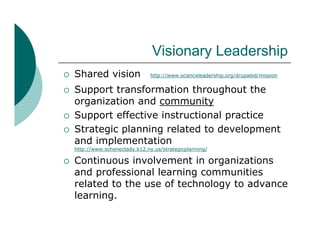
Visionary L d hi
                                 Vi i      Leadership
   Shared vision                http://www.scienceleadership.org/drupaled/mission


   Support transformation throughout the
    organization and community
   Support effective instructional practice
   Strategic planning related to development
    and implementation
    http://www.schenectady.k12.ny.us/strategicplanning/

   Continuous involvement in organizations
    and professional learning communities
    related to the use of technology to advance
    learning.
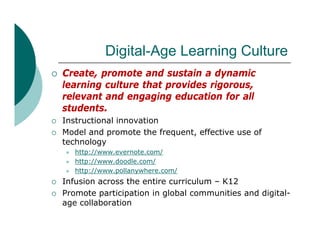
Digital-Age Learning C lt
                Di it l A L      i Culture
   Create, promote and sustain a dynamic
           ,p                         y
    learning culture that provides rigorous,
    relevant and engaging education for all
    students.
    students
   Instructional innovation
   Model and promote the frequent, effective use of
    technology
    t h l
       http://www.evernote.com/
       http://www.doodle.com/
       http://www.pollanywhere.com/
        http://www pollanywhere com/
   Infusion across the entire curriculum – K12
   Promote participation in global communities and digital-
    age collaboration
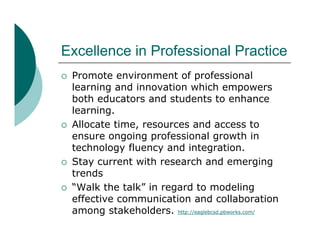
Excellence i P f
E   ll     in Professional P ti
                     i   l Practice
   Promote environment of professional
    learning and innovation which empowers
    both educators and students to enhance
    learning.
    l    i
   Allocate time, resources and access to
    ensure ongoing professional growth in
    technology fluency and integration.
   Stay current with research and emerging
    trends
    t   d
   “Walk the talk” in regard to modeling
    effective communication and collaboration
    among stakeholders. http://eaglebcsd.pbworks.com/
Systemic I
                         S t i Improvement
                                         t

   Lead purposeful change through appropriate
    use of technology and media rich resources.
   Recruit and retain highly competent personnel
   Strategic partnerships
   Infrastructure, interoperability, management,
    operations teaching and learning
   Collaborate to establish the metric, collect and
    analyze d t /
        l    data/results and share findings to
                              lt        d h           fi di           t
    improve staff performance and student
           g
    learning. Dash Navigation Training Work Book 20080218-Revised.pdf
Digital Citizenship
                         Di it l Citi    hi
   Model and facilitate understanding of social
                                          social,
    ethical and legal issues and responsibilities.
   Equitable access and appropriate tools to
    meet the needs of all learners.
   Promote, model and recommend polices for
    safe,
    safe legal and ethical use of digital
    information and technology
   Promote and facilitate a shared culture of
    involvement in issues related to the use of
    contemporary communications and
    collaboration tools.
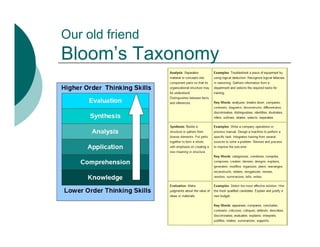
Our old friend
Bloom’s Taxonomy
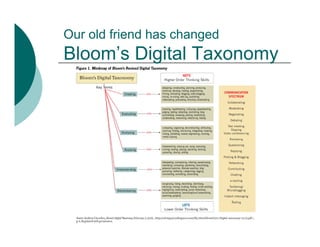
Our old friend has changed
Bloom’s Digital Taxonomy
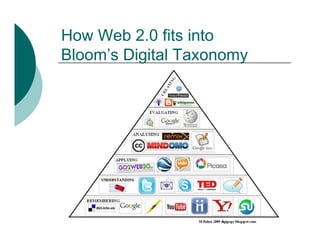
How Web 2.0 fits into
Bloom’s Digital Taxonomy
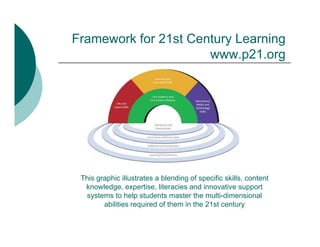
Framework for 21st Century Learning
                         y        g
                      www.p21.org


 This graphic illustrates a blending of specific skills, content
  knowledge, expertise, literacies and innovative support
  systems to help students master the multi-dimensional
        abilities required of them in the 21st century
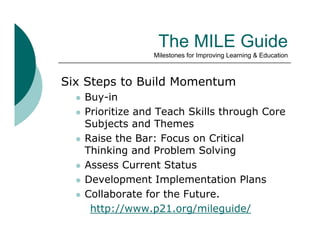
The MILE Guide
                   Milestones for Improving Learning & Education


Six Steps to Build Momentum
     Buy-in
     Prioritize
      P i i i and T
                  d Teach Skills through C
                         h Skill h     h Core
      Subjects and Themes
     Raise the Bar: Focus on Critical
      Thinking and Problem Solving
     Assess Current Status
     Development Implementation Plans
     Collaborate for the Future.
       http://www.p21.org/mileguide/
(optional)
  (        )
 Insert your
institution’s
  logo here
“We cannot become what 
  “We cannot become what
     we would like to be 
 by remaining what we are” 
                       Max DePree


“Move out of your comfort zone. 
 You can only grow is you are 
  willing to feel awkward and 
        g
 uncomfortable when you try 
        something new
        something new”
                          Brian Tracy
Thank You
          Thank You

         Sal DeAngelo
         S lD A    l
    saldeangelo@gmail.com
   sdeangelo@bcsd.neric.org
    d      l @b d     i

    For a copy of this presentation:
    For a copy of this presentation:
www.slideshare.net/saldeangelo/csr

       www.bcsd.k12.ny.us

http://delicious.com ‐ saldeangelo
htt //d li i             ld     l

CSR

  • 1.
    Technology Facilitation andLeadership What Every K-12 Leader Should Know and Be Able to Do Sal DeAngelo, MBA, CAS Bethlehem Central School District Director of Technology College of Saint Rose Presentation July 22, 2010
  • 2.
    Sal DeAngelo A little about who I am I have spent over 26 years coordinating and managing instructional technology programs in an educational environment. I have developed and supported the infrastructure for bringing classrooms students and staff into the 21st century and beyond. I am experienced in the design, specification, and installation of instructional technology equipment and software to enable partnering and enriched curriculum delivery. I am committed to ongoing professional development in my field to better serve the needs of students, staff, parents and the community at large. “Leadership is the process of creating and sustaining a culture where everyone works together in achieving common goals, not because they have to but because they want to.”
  • 3.
    Sal DeAngelo Some of my personal beliefs and Educational Technology Vision  Our strategic intent should be to maximize each student’s growth and individual success by meeting each student where he or she is, and empowering them to develop their own personal learning process  Studies have shown that students understand and retain knowledge best when they can apply it in a practical, relevant setting. We must strive to provide this proper setting for them. Technology and Web 2.0 has profoundly changed the way we all work, collaborate and communicate and our relationship with information information.  “Technology has the potential to transform education when integrated with emerging models of teaching and learning.” [NAESP, [NAESP 2006] - we need leverage professional development to ensure the staff has the capacity to achieve this goal  Learning with technology should not be about the technology itself but about the learning that can be facilitated through it  Maximize learning through the blending of various technologies
  • 4.
    Changing the “StatusQuo Status Quo”
  • 5.
    Redefining the role: Teachers and administrators as learning leaders Fullan • Set context • Designers of the learner’s experience • Not solution providers
  • 6.
    Redefining the role: BuildingLevel Leaders/Administrators “Schools need leadership from principals who focus on advancing student and staff learning.” t d t d t ff l i ” Richard DuFour
  • 8.
    • We livein exponential times. The web has changed the way we live, work and learn. • 1 out of 4 workers today is working for a company they have been employed by for less than one year. • We are currently preparing students for j jobs that don’t y exist. yet • Your students will have 10-14 jobs by the age 38
  • 9.
    • Twitter asocial Twitter, networking and micro- blogging service only launched publicly in July 2006 • Even before Twitter, the number of text messages sent and received every day exceeded the population of the planet. • Now tweets of 140 characters or less are changing the way we* communicate. communicate
  • 10.
    ISTE Educational TechnologyStandards NETS.A NETS A  Visionary Leadership  Digital-Age Learning Culture  Excellence in Professional Practice  Systemic Improvement  Digital Citizenship
  • 11.
    Visionary L dhi Vi i Leadership  Shared vision http://www.scienceleadership.org/drupaled/mission  Support transformation throughout the organization and community  Support effective instructional practice  Strategic planning related to development and implementation http://www.schenectady.k12.ny.us/strategicplanning/  Continuous involvement in organizations and professional learning communities related to the use of technology to advance learning.
  • 12.
    Digital-Age Learning Clt Di it l A L i Culture  Create, promote and sustain a dynamic ,p y learning culture that provides rigorous, relevant and engaging education for all students. students  Instructional innovation  Model and promote the frequent, effective use of technology t h l  http://www.evernote.com/  http://www.doodle.com/  http://www.pollanywhere.com/ http://www pollanywhere com/  Infusion across the entire curriculum – K12  Promote participation in global communities and digital- age collaboration
  • 13.
    Excellence i Pf E ll in Professional P ti i l Practice  Promote environment of professional learning and innovation which empowers both educators and students to enhance learning. l i  Allocate time, resources and access to ensure ongoing professional growth in technology fluency and integration.  Stay current with research and emerging trends t d  “Walk the talk” in regard to modeling effective communication and collaboration among stakeholders. http://eaglebcsd.pbworks.com/
  • 14.
    Systemic I S t i Improvement t  Lead purposeful change through appropriate use of technology and media rich resources.  Recruit and retain highly competent personnel  Strategic partnerships  Infrastructure, interoperability, management, operations teaching and learning  Collaborate to establish the metric, collect and analyze d t / l data/results and share findings to lt d h fi di t improve staff performance and student g learning. Dash Navigation Training Work Book 20080218-Revised.pdf
  • 15.
    Digital Citizenship Di it l Citi hi  Model and facilitate understanding of social social, ethical and legal issues and responsibilities.  Equitable access and appropriate tools to meet the needs of all learners.  Promote, model and recommend polices for safe, safe legal and ethical use of digital information and technology  Promote and facilitate a shared culture of involvement in issues related to the use of contemporary communications and collaboration tools.
  • 18.
  • 19.
    Our old friendhas changed Bloom’s Digital Taxonomy
  • 20.
    How Web 2.0fits into Bloom’s Digital Taxonomy
  • 21.
    Framework for 21stCentury Learning y g www.p21.org This graphic illustrates a blending of specific skills, content knowledge, expertise, literacies and innovative support systems to help students master the multi-dimensional abilities required of them in the 21st century
  • 22.
    The MILE Guide Milestones for Improving Learning & Education Six Steps to Build Momentum  Buy-in  Prioritize P i i i and T d Teach Skills through C h Skill h h Core Subjects and Themes  Raise the Bar: Focus on Critical Thinking and Problem Solving  Assess Current Status  Development Implementation Plans  Collaborate for the Future. http://www.p21.org/mileguide/
  • 23.
    (optional) ( ) Insert your institution’s logo here
  • 41.
    “We cannot become what  “Wecannot become what we would like to be  by remaining what we are”  Max DePree “Move out of your comfort zone.  You can only grow is you are  willing to feel awkward and  g uncomfortable when you try  something new something new” Brian Tracy
  • 42.
    Thank You Thank You Sal DeAngelo S lD A l saldeangelo@gmail.com sdeangelo@bcsd.neric.org d l @b d i For a copy of this presentation: For a copy of this presentation: www.slideshare.net/saldeangelo/csr www.bcsd.k12.ny.us http://delicious.com ‐ saldeangelo htt //d li i ld l