IMPROVING EMPLOYEE
ENGAGEMENT THROUGH
   SOCIAL LEARNING


             Thomas Stone
             Senior Research Analyst, Taleo
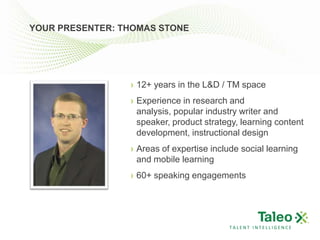
YOUR PRESENTER: THOMAS STONE


                 › 12+ years in the L&D / TM space
                 › Experience in research and
                   analysis, popular industry writer and
                   speaker, product strategy, learning content
                   development, instructional design
                 › Areas of expertise include social learning
                   and mobile learning
                 › 60+ speaking engagements


                                          TALENT INTELLIGENCE
Did you know?

› Earnings per share of top quartile companies is 2.6
  times greater than below average companies
› 59% of engaged employees feel that their job
  “brings out their most creative ideas” vs 17% of
  unengaged employees and 3% of disengaged
› 74% of engaged employees “share new ideas
  with customers,” only 13% of disengaged
› Disengaged workers cost the economy about $328
  billion annually

                                           TALENT INTELLIGENCE
HOW DOES ENGAGEMENT DRIVE RESULTS?


› More productive workers
› Higher profit
› Safer workers and less risk
› Stronger customer relationships
› Longer tenure and less dysfunctional turnover
› Nimbleness and agility in times of change
› More positive work environment


                                          TALENT INTELLIGENCE
WHAT DRIVES ENGAGEMENT?


› Relationship with peers
› Opportunity to grow and develop
› Opportunity to excel by using unique skills and
  talents
› Clear direction and communication about role,
  objectives, success
› Recognition and reward for excellence
› Trust in management and peers to take risks
› Employee self-direction and ownership

                                           TALENT INTELLIGENCE
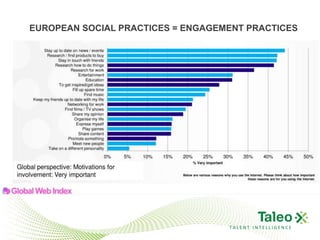
EUROPEAN SOCIAL PRACTICES = ENGAGEMENT PRACTICES


                                   TALENT INTELLIGENCE
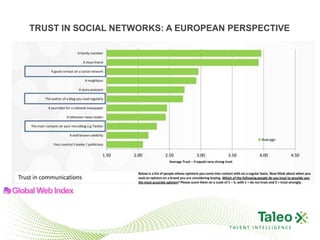
TRUST IN SOCIAL NETWORKS: A EUROPEAN PERSPECTIVE


                                    TALENT INTELLIGENCE
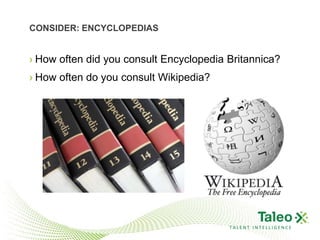
CONSIDER: ENCYCLOPEDIAS


› How often did you consult Encyclopedia Britannica?
› How often do you consult Wikipedia?


                                         TALENT INTELLIGENCE
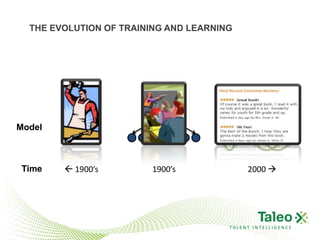
THE EVOLUTION OF TRAINING AND LEARNING


         1:1            1 : Many           Many : Many


Model


Time     1900’s         1900’s               2000 


                                       TALENT INTELLIGENCE
SO WHAT IS SOCIAL LEARNING?

Functional Definition:
Social learning is learning through your interactions with
others and through the knowledge and expertise of
others.

Techniques:
   • User-generated content
   • Social networking, expertise discovery
   • Collaboration and sharing

Tools:
Blogs, wikis, microblogs, social networking, discussions
Ratings and reviews, file sharing, video, podcasts
                                           TALENT INTELLIGENCE
POLL


Which of these tools do you use to enable greater Social
Learning in your organization today?
› Discussion forums
› Blogs
› Wikis
› Microblogs / activity streaming
› Social networking profiles
› Content ratings and reviews
› YouTube-like internal video portal
› Podcasting (subscribable audio)


                                                  TALENT INTELLIGENCE
SOCIAL LEARNING & ENGAGEMENT – BIG PICTURE


1. Develop a pro-sumer model to give all employees a
   voice and validation
2. Develop employee social networks to deepen
   relationships, peer commitment and trust
3. Create shared spaces where employees can
   collaborate on company initiatives or share
   expertise
4. Create shared spaces where groups can connect
   based on common interests or identity


                                        TALENT INTELLIGENCE
DEVELOP
     LEARNING
     PROSUMER
       MODEL

1.       COPYRIGHT 2009
DEVELOP A PRO-SUMER MODEL


› Everyone is a producer and consumer of
  learning, rather than dependence on “training team”
› Techniques?
  – File and link sharing infrastructure
  – Video recording and sharing – HD Video Cams are cheap!
  – Discussion forums
  – “Open” course authoring tools
  – Blogs, wikis, and microblogs
  – Ratings and reviews


                                              TALENT INTELLIGENCE
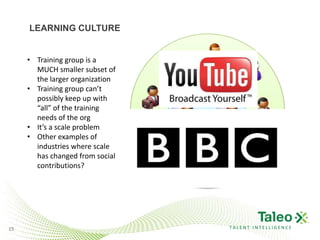
LEARNING CULTURE


     • Training group is a
       MUCH smaller subset of
       the larger organization
     • Training group can’t
       possibly keep up with
       “all” of the training
       needs of the org
     • It’s a scale problem
     • Other examples of
       industries where scale
       has changed from social
       contributions?


15                               TALENT INTELLIGENCE
LEARNING CULTURE


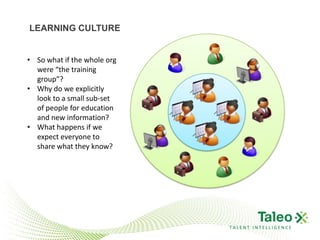
• So what if the whole org
  were “the training
  group”?
• Why do we explicitly
  look to a small sub-set
  of people for education
  and new information?
• What happens if we
  expect everyone to
  share what they know?


                             TALENT INTELLIGENCE
LEARNING CULTURE


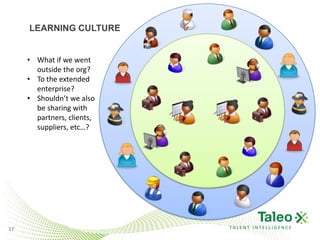
     • What if we went
       outside the org?
     • To the extended
       enterprise?
     • Shouldn’t we also
       be sharing with
       partners, clients,
       suppliers, etc…?


17                          TALENT INTELLIGENCE
ENGAGEMENT BENEFITS FROM A PRO-SUMER MODEL?


› Everyone becomes a creator and a consumer
› Everyone has a chance to share their unique
  expertise, knowledge or skills
› Everyone has a chance to share their voice
› Employee can discover new connections and
  strengthen existing ones
› Highly engaged employees can find new avenues to
  add value
› Unengaged workers may find a voice and new
  opportunities to become engaged again

                                         TALENT INTELLIGENCE
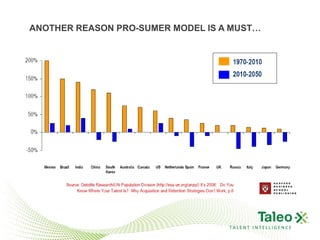
ANOTHER REASON PRO-SUMER MODEL IS A MUST…


                                   TALENT INTELLIGENCE
DEVELOP
     EMPLOYEE
     LEARNING
     NETWORKS

2.       COPYRIGHT 2009
DEVELOP EMPLOYEE NETWORKS


› Turn potential ties into weak ties, turn weak ties into
  strong ties, and develop denser networks
› Techniques?
  – Linking content to people and people to content
  – Expert and expertise location
  – Ratings and reviews
  – User-generated content
  – Microblogs
  – Activity feeds / Walls


                                                 TALENT INTELLIGENCE
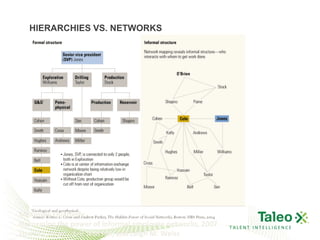
HIERARCHIES VS. NETWORKS


McKinsey Quarterly
Harnessing the power of informal employee networks, 2007   TALENT INTELLIGENCE
Lowell L. Bryan, Eric Matson, and Leigh M. Weiss
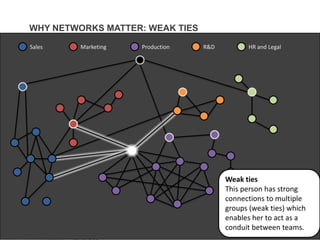
WHY NETWORKS MATTER: WEAK TIES

Sales    Marketing   Production   R&D             HR and Legal


                                        Weak ties
                                        This person has strong
                                        connections to multiple
                                        groups (weak ties) which
                                        enables her to act as a
                                        conduit between N C E
                                         T A L E N T I N T E L L I G E teams.
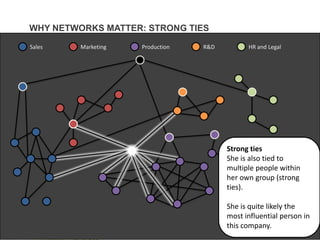
WHY NETWORKS MATTER: STRONG TIES

Sales    Marketing   Production   R&D           HR and Legal


                                        Strong ties
                                        She is also tied to
                                        multiple people within
                                        her own group (strong
                                        ties).

                                        She is quite likely the
                                        most influential person in
                                        this E N T I N T E L L I G E N C E
                                         T A L company.
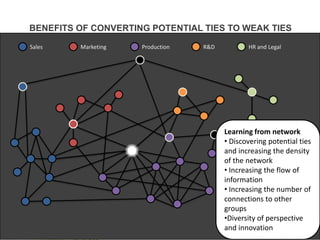
BENEFITS OF CONVERTING POTENTIAL TIES TO WEAK TIES

Sales    Marketing   Production   R&D          HR and Legal


                                        Learning from network
                                        • Discovering potential ties
                                        and increasing the density
                                        of the network
                                        • Increasing the flow of
                                        information
                                        • Increasing the number of
                                        connections to other
                                        groups
                                        •Diversity of perspective
                                        andLinnovationI G E N C E
                                          TA ENT INTELL
ENGAGEMENT BENEFITS OF LEARNING NETWORKS?


› Reflects expectations of Millennials
  – McKinsey research shows networks = retention
  – Millennials move in tribes, grown up with networks
  – GenX = biggest user of LinkedIn and Twitter
› More connections = greater resiliency, agility
› Connections = relationships = trust = engagement


                                                  TALENT INTELLIGENCE
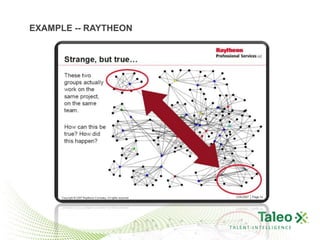
EXAMPLE -- RAYTHEON


                      TALENT INTELLIGENCE
CREATE
      SHARED
     LEARNING
      SPACES

3.       COPYRIGHT 2009
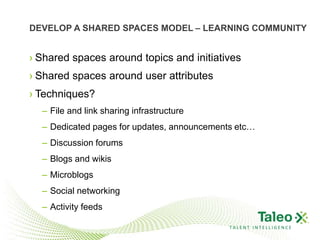
DEVELOP A SHARED SPACES MODEL – LEARNING COMMUNITY


› Shared spaces around topics and initiatives
› Shared spaces around user attributes
› Techniques?
  – File and link sharing infrastructure
  – Dedicated pages for updates, announcements etc…
  – Discussion forums
  – Blogs and wikis
  – Microblogs
  – Social networking
  – Activity feeds

                                             TALENT INTELLIGENCE
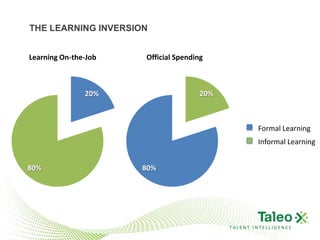
THE LEARNING INVERSION


Learning On-the-Job   Official Spending


               20%                    20%


                                                    Formal Learning
                                                    Informal Learning


80%                   80%


                                            TALENT INTELLIGENCE
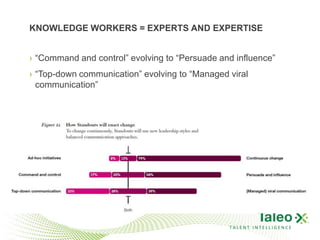
KNOWLEDGE WORKERS = EXPERTS AND EXPERTISE


› “Command and control” evolving to “Persuade and influence”
› “Top-down communication” evolving to “Managed viral
  communication”


                                                TALENT INTELLIGENCE
SELF-ORGANIZATION, ENGAGEMENT, AND LEARNING


› In a world of knowledge workers, does expertise still
  primarily come from above?
› What happens when learners share expertise with
  each other?
  – Opportunity to grow and develop
  – Opportunity to be recognized
  – Opportunity to connect with peers
  – Development of a true learning culture
  – Learning culture = self-efficacy = engagement


                                                TALENT INTELLIGENCE
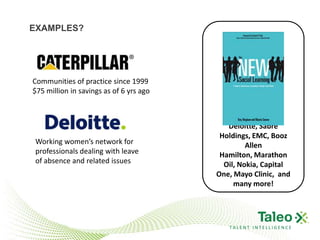
EXAMPLES?


Communities of practice since 1999
$75 million in savings as of 6 yrs ago


                                            Deloitte, Sabre
                                          Holdings, EMC, Booz
Working women’s network for                       Allen
professionals dealing with leave          Hamilton, Marathon
of absence and related issues              Oil, Nokia, Capital
                                         One, Mayo Clinic, and
                                              many more!


                                            TALENT INTELLIGENCE
1. Engagement has a direct impact on key business metrics.
2. Engagement is tied to employee voice, opportunities to
   learn, reward & recognition, relationships with peers, and self-
   directed behavior.
3. Social learning is an enabler of all of these engagement drivers.
4. Three ways to use social learning to drive engagement:
    a. Provide infrastructure and tools for users to share.
    b. Provide opportunities for users to network with each other.
    c. Create shared spaces where learners can collaborate.


                                                 TALENT INTELLIGENCE
QUESTIONS


CONTACT
tstone@taleo.com
@TaleoResearch on Twitter
@ThomasStone on Twitter


                            COPYRIGHT 2009
SOURCES


› Slide 2 – EPS Data
  http://gmj.gallup.com/content/102523/Return-Investment-Engaging-
  Employees.aspx
› Slide 2 – Engagement Data
  http://gmj.gallup.com/content/24880/Gallup-Study-Engaged-
  Employees-Inspire-Company-Innovation.aspx
› Slide 28 – Training Percent Data
  US Dept of Labor
› Slide 29 – IBM – Global Study: Capitalizing on Complexity, page 31
› Slide 31 – Caterpillar
  http://findarticles.com/p/articles/mi_m4467/is_200406/ai_n21350864/


                                                       TALENT INTELLIGENCE

Improving Employee Engagement Through Social Learning

  • 1.
    IMPROVING EMPLOYEE ENGAGEMENT THROUGH SOCIAL LEARNING Thomas Stone Senior Research Analyst, Taleo
  • 2.
    YOUR PRESENTER: THOMASSTONE › 12+ years in the L&D / TM space › Experience in research and analysis, popular industry writer and speaker, product strategy, learning content development, instructional design › Areas of expertise include social learning and mobile learning › 60+ speaking engagements TALENT INTELLIGENCE
  • 3.
    Did you know? ›Earnings per share of top quartile companies is 2.6 times greater than below average companies › 59% of engaged employees feel that their job “brings out their most creative ideas” vs 17% of unengaged employees and 3% of disengaged › 74% of engaged employees “share new ideas with customers,” only 13% of disengaged › Disengaged workers cost the economy about $328 billion annually TALENT INTELLIGENCE
  • 4.
    HOW DOES ENGAGEMENTDRIVE RESULTS? › More productive workers › Higher profit › Safer workers and less risk › Stronger customer relationships › Longer tenure and less dysfunctional turnover › Nimbleness and agility in times of change › More positive work environment TALENT INTELLIGENCE
  • 5.
    WHAT DRIVES ENGAGEMENT? ›Relationship with peers › Opportunity to grow and develop › Opportunity to excel by using unique skills and talents › Clear direction and communication about role, objectives, success › Recognition and reward for excellence › Trust in management and peers to take risks › Employee self-direction and ownership TALENT INTELLIGENCE
  • 6.
    EUROPEAN SOCIAL PRACTICES= ENGAGEMENT PRACTICES TALENT INTELLIGENCE
  • 7.
    TRUST IN SOCIALNETWORKS: A EUROPEAN PERSPECTIVE TALENT INTELLIGENCE
  • 8.
    CONSIDER: ENCYCLOPEDIAS › Howoften did you consult Encyclopedia Britannica? › How often do you consult Wikipedia? TALENT INTELLIGENCE
  • 9.
    THE EVOLUTION OFTRAINING AND LEARNING 1:1 1 : Many Many : Many Model Time  1900’s 1900’s 2000  TALENT INTELLIGENCE
  • 10.
    SO WHAT ISSOCIAL LEARNING? Functional Definition: Social learning is learning through your interactions with others and through the knowledge and expertise of others. Techniques: • User-generated content • Social networking, expertise discovery • Collaboration and sharing Tools: Blogs, wikis, microblogs, social networking, discussions Ratings and reviews, file sharing, video, podcasts TALENT INTELLIGENCE
  • 11.
    POLL Which of thesetools do you use to enable greater Social Learning in your organization today? › Discussion forums › Blogs › Wikis › Microblogs / activity streaming › Social networking profiles › Content ratings and reviews › YouTube-like internal video portal › Podcasting (subscribable audio) TALENT INTELLIGENCE
  • 12.
    SOCIAL LEARNING &ENGAGEMENT – BIG PICTURE 1. Develop a pro-sumer model to give all employees a voice and validation 2. Develop employee social networks to deepen relationships, peer commitment and trust 3. Create shared spaces where employees can collaborate on company initiatives or share expertise 4. Create shared spaces where groups can connect based on common interests or identity TALENT INTELLIGENCE
  • 13.
    DEVELOP LEARNING PROSUMER MODEL 1. COPYRIGHT 2009
  • 14.
    DEVELOP A PRO-SUMERMODEL › Everyone is a producer and consumer of learning, rather than dependence on “training team” › Techniques? – File and link sharing infrastructure – Video recording and sharing – HD Video Cams are cheap! – Discussion forums – “Open” course authoring tools – Blogs, wikis, and microblogs – Ratings and reviews TALENT INTELLIGENCE
  • 15.
    LEARNING CULTURE • Training group is a MUCH smaller subset of the larger organization • Training group can’t possibly keep up with “all” of the training needs of the org • It’s a scale problem • Other examples of industries where scale has changed from social contributions? 15 TALENT INTELLIGENCE
  • 16.
    LEARNING CULTURE • Sowhat if the whole org were “the training group”? • Why do we explicitly look to a small sub-set of people for education and new information? • What happens if we expect everyone to share what they know? TALENT INTELLIGENCE
  • 17.
    LEARNING CULTURE • What if we went outside the org? • To the extended enterprise? • Shouldn’t we also be sharing with partners, clients, suppliers, etc…? 17 TALENT INTELLIGENCE
  • 18.
    ENGAGEMENT BENEFITS FROMA PRO-SUMER MODEL? › Everyone becomes a creator and a consumer › Everyone has a chance to share their unique expertise, knowledge or skills › Everyone has a chance to share their voice › Employee can discover new connections and strengthen existing ones › Highly engaged employees can find new avenues to add value › Unengaged workers may find a voice and new opportunities to become engaged again TALENT INTELLIGENCE
  • 19.
    ANOTHER REASON PRO-SUMERMODEL IS A MUST… TALENT INTELLIGENCE
  • 20.
    DEVELOP EMPLOYEE LEARNING NETWORKS 2. COPYRIGHT 2009
  • 21.
    DEVELOP EMPLOYEE NETWORKS ›Turn potential ties into weak ties, turn weak ties into strong ties, and develop denser networks › Techniques? – Linking content to people and people to content – Expert and expertise location – Ratings and reviews – User-generated content – Microblogs – Activity feeds / Walls TALENT INTELLIGENCE
  • 22.
    HIERARCHIES VS. NETWORKS McKinseyQuarterly Harnessing the power of informal employee networks, 2007 TALENT INTELLIGENCE Lowell L. Bryan, Eric Matson, and Leigh M. Weiss
  • 23.
    WHY NETWORKS MATTER:WEAK TIES Sales Marketing Production R&D HR and Legal Weak ties This person has strong connections to multiple groups (weak ties) which enables her to act as a conduit between N C E T A L E N T I N T E L L I G E teams.
  • 24.
    WHY NETWORKS MATTER:STRONG TIES Sales Marketing Production R&D HR and Legal Strong ties She is also tied to multiple people within her own group (strong ties). She is quite likely the most influential person in this E N T I N T E L L I G E N C E T A L company.
  • 25.
    BENEFITS OF CONVERTINGPOTENTIAL TIES TO WEAK TIES Sales Marketing Production R&D HR and Legal Learning from network • Discovering potential ties and increasing the density of the network • Increasing the flow of information • Increasing the number of connections to other groups •Diversity of perspective andLinnovationI G E N C E TA ENT INTELL
  • 26.
    ENGAGEMENT BENEFITS OFLEARNING NETWORKS? › Reflects expectations of Millennials – McKinsey research shows networks = retention – Millennials move in tribes, grown up with networks – GenX = biggest user of LinkedIn and Twitter › More connections = greater resiliency, agility › Connections = relationships = trust = engagement TALENT INTELLIGENCE
  • 27.
    EXAMPLE -- RAYTHEON TALENT INTELLIGENCE
  • 28.
    CREATE SHARED LEARNING SPACES 3. COPYRIGHT 2009
  • 29.
    DEVELOP A SHAREDSPACES MODEL – LEARNING COMMUNITY › Shared spaces around topics and initiatives › Shared spaces around user attributes › Techniques? – File and link sharing infrastructure – Dedicated pages for updates, announcements etc… – Discussion forums – Blogs and wikis – Microblogs – Social networking – Activity feeds TALENT INTELLIGENCE
  • 30.
    THE LEARNING INVERSION LearningOn-the-Job Official Spending 20% 20% Formal Learning Informal Learning 80% 80% TALENT INTELLIGENCE
  • 31.
    KNOWLEDGE WORKERS =EXPERTS AND EXPERTISE › “Command and control” evolving to “Persuade and influence” › “Top-down communication” evolving to “Managed viral communication” TALENT INTELLIGENCE
  • 32.
    SELF-ORGANIZATION, ENGAGEMENT, ANDLEARNING › In a world of knowledge workers, does expertise still primarily come from above? › What happens when learners share expertise with each other? – Opportunity to grow and develop – Opportunity to be recognized – Opportunity to connect with peers – Development of a true learning culture – Learning culture = self-efficacy = engagement TALENT INTELLIGENCE
  • 33.
    EXAMPLES? Communities of practicesince 1999 $75 million in savings as of 6 yrs ago Deloitte, Sabre Holdings, EMC, Booz Working women’s network for Allen professionals dealing with leave Hamilton, Marathon of absence and related issues Oil, Nokia, Capital One, Mayo Clinic, and many more! TALENT INTELLIGENCE
  • 34.
    1. Engagement hasa direct impact on key business metrics. 2. Engagement is tied to employee voice, opportunities to learn, reward & recognition, relationships with peers, and self- directed behavior. 3. Social learning is an enabler of all of these engagement drivers. 4. Three ways to use social learning to drive engagement: a. Provide infrastructure and tools for users to share. b. Provide opportunities for users to network with each other. c. Create shared spaces where learners can collaborate. TALENT INTELLIGENCE
  • 35.
  • 36.
    SOURCES › Slide 2– EPS Data http://gmj.gallup.com/content/102523/Return-Investment-Engaging- Employees.aspx › Slide 2 – Engagement Data http://gmj.gallup.com/content/24880/Gallup-Study-Engaged- Employees-Inspire-Company-Innovation.aspx › Slide 28 – Training Percent Data US Dept of Labor › Slide 29 – IBM – Global Study: Capitalizing on Complexity, page 31 › Slide 31 – Caterpillar http://findarticles.com/p/articles/mi_m4467/is_200406/ai_n21350864/ TALENT INTELLIGENCE