


SOCIAL TALENT RESEARCH
David Wilkins, VP Taleo Research
TALENT INTELLIGENCE
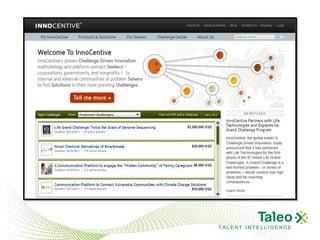
INNOCENTIVE


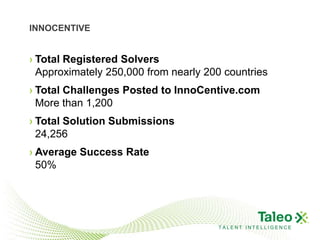
› Total Registered Solvers
  Approximately 250,000 from nearly 200 countries
› Total Challenges Posted to InnoCentive.com
  More than 1,200
› Total Solution Submissions
  24,256
› Average Success Rate
  50%


                                      TALENT INTELLIGENCE
…we multiply our internal
                   innovation capability with a global
                   network of innovation partners
                   outside P&G. More than half of all
                   product innovation coming from
                   P&G today includes at least one
                   major component from an
                    external partner.


                                                                        TALENT INTELLIGENCE
http://www.annualreport.pg.com/annualreport2009/letter/strength.shtml
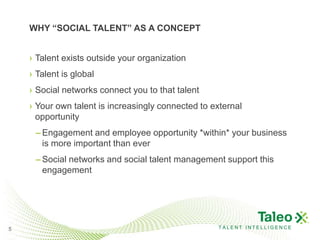
WHY “SOCIAL TALENT” AS A CONCEPT


    › Talent exists outside your organization
    › Talent is global
    › Social networks connect you to that talent
    › Your own talent is increasingly connected to external
      opportunity
     – Engagement and employee opportunity *within* your business
       is more important than ever
     – Social networks and social talent management support this
       engagement


5                                                   TALENT INTELLIGENCE
EMPLOYEE ENGAGEMENT


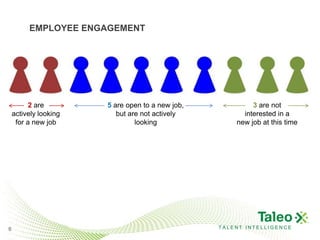
          2 are        5 are open to a new job,            3 are not
    actively looking      but are not actively          interested in a
     for a new job              looking               new job at this time


6                                                 TALENT INTELLIGENCE
EMPLOYEE ENGAGEMENT


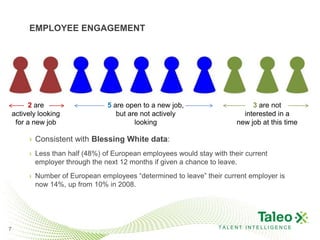
          2 are                  5 are open to a new job,                     3 are not
    actively looking                but are not actively                   interested in a
     for a new job                        looking                        new job at this time

         › Consistent with Blessing White data:
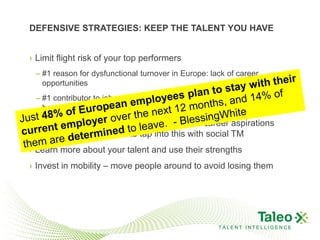
         › Less than half (48%) of European employees would stay with their current
           employer through the next 12 months if given a chance to leave.
         › Number of European employees “determined to leave” their current employer is
           now 14%, up from 10% in 2008.


7                                                                  TALENT INTELLIGENCE
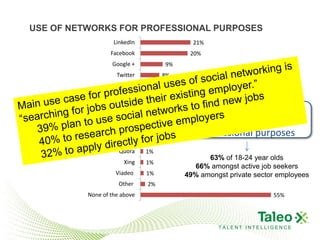
USE OF NETWORKS FOR PROFESSIONAL PURPOSES
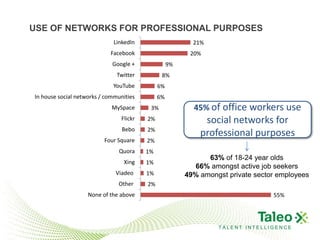
                              LinkedIn                    21%
                            Facebook                     20%
                             Google +              9%
                               Twitter         8%
                             YouTube          6%
In house social networks / communities        6%
                             MySpace      3%              45% of office workers use
                                Flickr   2%                  social networks for
                                 Bebo    2%
                                                            professional purposes
                          Four Square    2%
                                Quora    1%
                                                              63% of 18-24 year olds
                                 Xing    1%
                                                          66% amongst active job seekers
                              Viadeo     1%             49% amongst private sector employees
                               Other     2%
                    None of the above                                            55%


                                                                 TALENT INTELLIGENCE
USE OF NETWORKS FOR PROFESSIONAL PURPOSES
                              LinkedIn                    21%
                            Facebook                     20%
                             Google +              9%
                               Twitter         8%
                             YouTube          6%
In house social networks / communities        6%
                             MySpace      3%              45% of office workers use
                                Flickr   2%                  social networks for
                                 Bebo    2%
                                                            professional purposes
                          Four Square    2%
                                Quora    1%
                                                              63% of 18-24 year olds
                                 Xing    1%
                                                          66% amongst active job seekers
                              Viadeo     1%             49% amongst private sector employees
                               Other     2%
                    None of the above                                            55%


                                                                 TALENT INTELLIGENCE
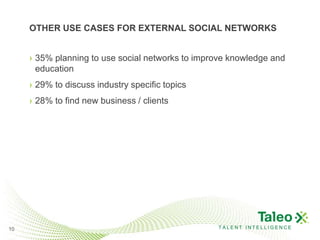
OTHER USE CASES FOR EXTERNAL SOCIAL NETWORKS


     › 35% planning to use social networks to improve knowledge and
       education
     › 29% to discuss industry specific topics
     › 28% to find new business / clients


10                                                TALENT INTELLIGENCE
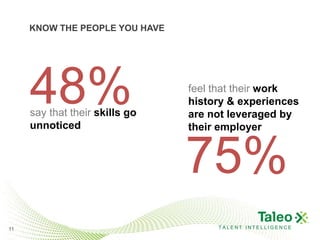
KNOW THE PEOPLE YOU HAVE


     48%
     say that their skills go
     unnoticed
                                feel that their work
                                history & experiences
                                are not leveraged by
                                their employer


                                75%
11                                   TALENT INTELLIGENCE
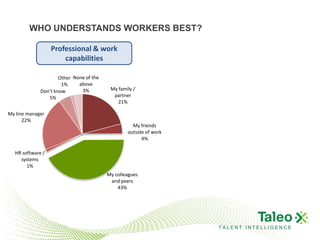
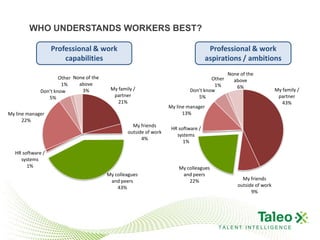
WHO UNDERSTANDS WORKERS BEST?

                  Professional & work
                      capabilities

                     Other None of the
                      1%     above
             Don’t know       3%          My family /
                5%                         partner
                                             21%

My line manager
      22%
                                                   My friends
                                                 outside of work
                                                       4%

  HR software /
    systems
       1%
                                         My colleagues
                                          and peers
                                             43%


                                                                   TALENT INTELLIGENCE
WHO UNDERSTANDS WORKERS BEST?

                  Professional & work                                                Professional & work
                      capabilities                                                  aspirations / ambitions
                                                                                             None of the
                     Other None of the                                               Other     above
                      1%     above                                                    1%
                                          My family /                                           6%
             Don’t know       3%                                            Don’t know                             My family /
                5%                         partner                             5%                                   partner
                                             21%                                                                      43%
                                                                   My line manager
My line manager                                                          13%
      22%
                                                   My friends
                                                                    HR software /
                                                 outside of work
                                                                      systems
                                                       4%
                                                                         1%

  HR software /
    systems
       1%                                                              My colleagues
                                         My colleagues                  and peers
                                          and peers                        22%                     My friends
                                             43%                                                 outside of work
                                                                                                       9%


                                                                                        TALENT INTELLIGENCE
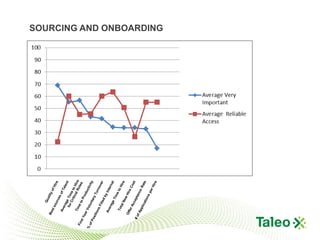
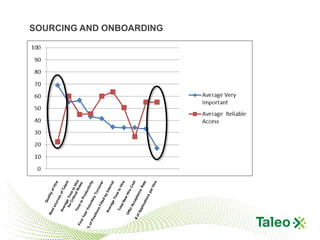
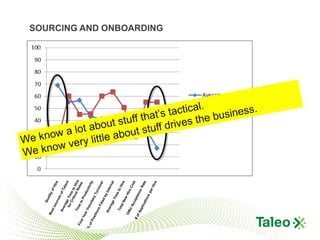
SOURCING AND ONBOARDING
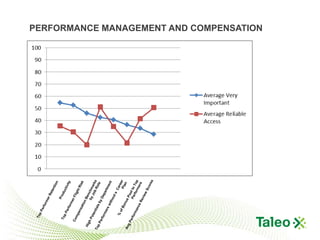
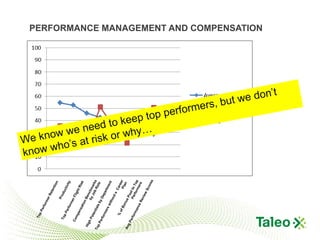
PERFORMANCE MANAGEMENT AND COMPENSATION
TOP PERFORMER AND HI-PO DATA IS UGLY


› 80% of companies don’t know who is a flight risk.
› 78% of companies don’t know who is on a succession plan.
› 80% of companies don’t know who has a career path.
› 65% of companies don’t know much about who they’re
  retaining.
› 84% of companies don’t if their development plans are working.
› 65% of companies don’t know much about Hi-Po’s.


                                                TALENT INTELLIGENCE
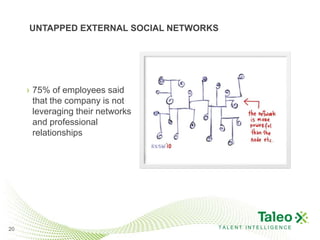
UNTAPPED EXTERNAL SOCIAL NETWORKS


     › 75% of employees said
       that the company is not
       leveraging their networks
       and professional
       relationships


20                                   TALENT INTELLIGENCE
Strategic Implications


                         21
DEFENSIVE STRATEGIES: KEEP THE TALENT YOU HAVE


› Limit flight risk of your top performers
 – #1 reason for dysfunctional turnover in Europe: lack of career
   opportunities
 – #1 contributor to job satisfaction: “more opportunities to do what I do
   best,” “career development opportunities and training” (tie)


                                                      TALENT INTELLIGENCE
DEFENSIVE STRATEGIES: KEEP THE TALENT YOU HAVE


› Limit flight risk of your top performers
 – #1 reason for dysfunctional turnover in Europe: lack of career
   opportunities
 – #1 contributor to job satisfaction: “more opportunities to do what I do
   best,” “career development opportunities and training” (tie)
› Since peers know more about each others’ career aspirations
  and skills / talents, then to tap into this with social TM
› Learn more about your talent and use their strengths


                                                      TALENT INTELLIGENCE
DEFENSIVE STRATEGIES: KEEP THE TALENT YOU HAVE


› Limit flight risk of your top performers
 – #1 reason for dysfunctional turnover in Europe: lack of career
   opportunities
 – #1 contributor to job satisfaction: “more opportunities to do what I do
   best,” “career development opportunities and training” (tie)
› Since peers know more about each others’ career aspirations
  and skills / talents, then to tap into this with social TM
› Learn more about your talent and use their strengths
› Invest in mobility – move people around to avoid losing them


                                                      TALENT INTELLIGENCE
DEFENSIVE STRATEGIES: KEEP THE TALENT YOU HAVE


› Limit flight risk of your top performers
 – #1 reason for dysfunctional turnover in Europe: lack of career
   opportunities
 – #1 contributor to job satisfaction: “more opportunities to do what I do
   best,” “career development opportunities and training” (tie)
› So, if peers know more about each others’ career aspirations
  and skills / talents, then to tap into this with social TM
› Learn more about your talent and use their strengths
› Invest in mobility – move people around to avoid losing them


                                                      TALENT INTELLIGENCE
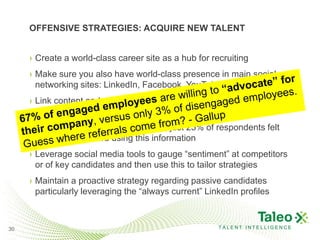
OFFENSIVE STRATEGIES: ACQUIRE NEW TALENT


     › Create a world-class career site as a hub for recruiting
     › Make sure you also have world-class presence in main social
       networking sites: LinkedIn, Facebook, YouTube, Twitter


26                                                     TALENT INTELLIGENCE
OFFENSIVE STRATEGIES: ACQUIRE NEW TALENT


     › Create a world-class career site as a hub for recruiting
     › Make sure you also have world-class presence in main social
       networking sites: LinkedIn, Facebook, YouTube, Twitter
     › Link content and external education strategies to recruiting;
       passive candidates can find you in a variety of ways


27                                                     TALENT INTELLIGENCE
OFFENSIVE STRATEGIES: ACQUIRE NEW TALENT


     › Create a world-class career site as a hub for recruiting
     › Make sure you also have world-class presence in main social
       networking sites: LinkedIn, Facebook, YouTube, Twitter
     › Link content and external education strategies to recruiting;
       passive candidates can find you in a variety of ways
     › Tap into your employee networks; just 25% of respondents felt
       like companies are using this information
     › Leverage social media tools to gauge “sentiment” at competitors
       or of key candidates and then use this to tailor strategies
     › Maintain a proactive strategy regarding passive candidates
       particularly leveraging the “always current” LinkedIn profiles


28                                                     TALENT INTELLIGENCE
OFFENSIVE STRATEGIES: ACQUIRE NEW TALENT


     › Create a world-class career site as a hub for recruiting
     › Make sure you also have world-class presence in main social
       networking sites: LinkedIn, Facebook, YouTube, Twitter
     › Link content and external education strategies to recruiting;
       passive candidates can find you in a variety of ways
     › Tap into your employee networks; just 25% of respondents felt
       like companies are using this information
     › Leverage social media tools to gauge “sentiment” at competitors
       or of key candidates and then use this to tailor strategies
     › Maintain a proactive strategy regarding passive candidates
       particularly leveraging the “always current” LinkedIn profiles


29                                                     TALENT INTELLIGENCE
OFFENSIVE STRATEGIES: ACQUIRE NEW TALENT


     › Create a world-class career site as a hub for recruiting
     › Make sure you also have world-class presence in main social
       networking sites: LinkedIn, Facebook, YouTube, Twitter
     › Link content and external education strategies to recruiting;
       passive candidates can find you in a variety of ways
     › Tap into your employee networks; just 25% of respondents felt
       like companies are using this information
     › Leverage social media tools to gauge “sentiment” at competitors
       or of key candidates and then use this to tailor strategies
     › Maintain a proactive strategy regarding passive candidates
       particularly leveraging the “always current” LinkedIn profiles


30                                                     TALENT INTELLIGENCE
EXPERIMENT


     › Facebook – hub for blue collar, line workers
     › LinkedIn – hub for white collar, knowledge workers
     › Twitter – channel or link to other content?
     › YouTube – content and hub, source for other sites
     › Txt – link to Millennials and mobile users


31                                                    TALENT INTELLIGENCE
EXPERIMENT


     › Facebook – hub for blue collar, line workers
     › LinkedIn – hub for white collar, knowledge workers
     › Twitter – channel or link to other content?
     › YouTube – content and hub, source for other sites
     › Txt – link to Millennials and mobile users


     › Your success in each channel will vary by geography
     › Your success will vary by job type
     › Your success will vary based on maturity


32                                                    TALENT INTELLIGENCE
FINAL THOUGHTS: RECRUITING DOESN’T LIVE IN A VACUUM


     › Strong talent practices internally reduce dysfunctional turnover
     › Less dysfunctional turnover means less time re-filling roles
     › Which means more time on acquisition strategy
      – LinkedIn
      – Facebook
      – YouTube
      – Twitter
     › Social is here to stay: examine all facets of social brand image
       to candidates; it’s bigger than your recruiting presence
     › You don’t have to be an expert to get started, just get started…


33                                                    TALENT INTELLIGENCE
Social Talent Management Research

Social Talent Management Research

  • 1.
    SOCIAL TALENT RESEARCH DavidWilkins, VP Taleo Research
  • 2.
  • 3.
    INNOCENTIVE › Total RegisteredSolvers Approximately 250,000 from nearly 200 countries › Total Challenges Posted to InnoCentive.com More than 1,200 › Total Solution Submissions 24,256 › Average Success Rate 50% TALENT INTELLIGENCE
  • 4.
    …we multiply ourinternal innovation capability with a global network of innovation partners outside P&G. More than half of all product innovation coming from P&G today includes at least one major component from an external partner. TALENT INTELLIGENCE http://www.annualreport.pg.com/annualreport2009/letter/strength.shtml
  • 5.
    WHY “SOCIAL TALENT”AS A CONCEPT › Talent exists outside your organization › Talent is global › Social networks connect you to that talent › Your own talent is increasingly connected to external opportunity – Engagement and employee opportunity *within* your business is more important than ever – Social networks and social talent management support this engagement 5 TALENT INTELLIGENCE
  • 6.
    EMPLOYEE ENGAGEMENT 2 are 5 are open to a new job, 3 are not actively looking but are not actively interested in a for a new job looking new job at this time 6 TALENT INTELLIGENCE
  • 7.
    EMPLOYEE ENGAGEMENT 2 are 5 are open to a new job, 3 are not actively looking but are not actively interested in a for a new job looking new job at this time › Consistent with Blessing White data: › Less than half (48%) of European employees would stay with their current employer through the next 12 months if given a chance to leave. › Number of European employees “determined to leave” their current employer is now 14%, up from 10% in 2008. 7 TALENT INTELLIGENCE
  • 8.
    USE OF NETWORKSFOR PROFESSIONAL PURPOSES LinkedIn 21% Facebook 20% Google + 9% Twitter 8% YouTube 6% In house social networks / communities 6% MySpace 3% 45% of office workers use Flickr 2% social networks for Bebo 2% professional purposes Four Square 2% Quora 1% 63% of 18-24 year olds Xing 1% 66% amongst active job seekers Viadeo 1% 49% amongst private sector employees Other 2% None of the above 55% TALENT INTELLIGENCE
  • 9.
    USE OF NETWORKSFOR PROFESSIONAL PURPOSES LinkedIn 21% Facebook 20% Google + 9% Twitter 8% YouTube 6% In house social networks / communities 6% MySpace 3% 45% of office workers use Flickr 2% social networks for Bebo 2% professional purposes Four Square 2% Quora 1% 63% of 18-24 year olds Xing 1% 66% amongst active job seekers Viadeo 1% 49% amongst private sector employees Other 2% None of the above 55% TALENT INTELLIGENCE
  • 10.
    OTHER USE CASESFOR EXTERNAL SOCIAL NETWORKS › 35% planning to use social networks to improve knowledge and education › 29% to discuss industry specific topics › 28% to find new business / clients 10 TALENT INTELLIGENCE
  • 11.
    KNOW THE PEOPLEYOU HAVE 48% say that their skills go unnoticed feel that their work history & experiences are not leveraged by their employer 75% 11 TALENT INTELLIGENCE
  • 12.
    WHO UNDERSTANDS WORKERSBEST? Professional & work capabilities Other None of the 1% above Don’t know 3% My family / 5% partner 21% My line manager 22% My friends outside of work 4% HR software / systems 1% My colleagues and peers 43% TALENT INTELLIGENCE
  • 13.
    WHO UNDERSTANDS WORKERSBEST? Professional & work Professional & work capabilities aspirations / ambitions None of the Other None of the Other above 1% above 1% My family / 6% Don’t know 3% Don’t know My family / 5% partner 5% partner 21% 43% My line manager My line manager 13% 22% My friends HR software / outside of work systems 4% 1% HR software / systems 1% My colleagues My colleagues and peers and peers 22% My friends 43% outside of work 9% TALENT INTELLIGENCE
  • 14.
  • 15.
  • 16.
  • 17.
  • 18.
  • 19.
    TOP PERFORMER ANDHI-PO DATA IS UGLY › 80% of companies don’t know who is a flight risk. › 78% of companies don’t know who is on a succession plan. › 80% of companies don’t know who has a career path. › 65% of companies don’t know much about who they’re retaining. › 84% of companies don’t if their development plans are working. › 65% of companies don’t know much about Hi-Po’s. TALENT INTELLIGENCE
  • 20.
    UNTAPPED EXTERNAL SOCIALNETWORKS › 75% of employees said that the company is not leveraging their networks and professional relationships 20 TALENT INTELLIGENCE
  • 21.
  • 22.
    DEFENSIVE STRATEGIES: KEEPTHE TALENT YOU HAVE › Limit flight risk of your top performers – #1 reason for dysfunctional turnover in Europe: lack of career opportunities – #1 contributor to job satisfaction: “more opportunities to do what I do best,” “career development opportunities and training” (tie) TALENT INTELLIGENCE
  • 23.
    DEFENSIVE STRATEGIES: KEEPTHE TALENT YOU HAVE › Limit flight risk of your top performers – #1 reason for dysfunctional turnover in Europe: lack of career opportunities – #1 contributor to job satisfaction: “more opportunities to do what I do best,” “career development opportunities and training” (tie) › Since peers know more about each others’ career aspirations and skills / talents, then to tap into this with social TM › Learn more about your talent and use their strengths TALENT INTELLIGENCE
  • 24.
    DEFENSIVE STRATEGIES: KEEPTHE TALENT YOU HAVE › Limit flight risk of your top performers – #1 reason for dysfunctional turnover in Europe: lack of career opportunities – #1 contributor to job satisfaction: “more opportunities to do what I do best,” “career development opportunities and training” (tie) › Since peers know more about each others’ career aspirations and skills / talents, then to tap into this with social TM › Learn more about your talent and use their strengths › Invest in mobility – move people around to avoid losing them TALENT INTELLIGENCE
  • 25.
    DEFENSIVE STRATEGIES: KEEPTHE TALENT YOU HAVE › Limit flight risk of your top performers – #1 reason for dysfunctional turnover in Europe: lack of career opportunities – #1 contributor to job satisfaction: “more opportunities to do what I do best,” “career development opportunities and training” (tie) › So, if peers know more about each others’ career aspirations and skills / talents, then to tap into this with social TM › Learn more about your talent and use their strengths › Invest in mobility – move people around to avoid losing them TALENT INTELLIGENCE
  • 26.
    OFFENSIVE STRATEGIES: ACQUIRENEW TALENT › Create a world-class career site as a hub for recruiting › Make sure you also have world-class presence in main social networking sites: LinkedIn, Facebook, YouTube, Twitter 26 TALENT INTELLIGENCE
  • 27.
    OFFENSIVE STRATEGIES: ACQUIRENEW TALENT › Create a world-class career site as a hub for recruiting › Make sure you also have world-class presence in main social networking sites: LinkedIn, Facebook, YouTube, Twitter › Link content and external education strategies to recruiting; passive candidates can find you in a variety of ways 27 TALENT INTELLIGENCE
  • 28.
    OFFENSIVE STRATEGIES: ACQUIRENEW TALENT › Create a world-class career site as a hub for recruiting › Make sure you also have world-class presence in main social networking sites: LinkedIn, Facebook, YouTube, Twitter › Link content and external education strategies to recruiting; passive candidates can find you in a variety of ways › Tap into your employee networks; just 25% of respondents felt like companies are using this information › Leverage social media tools to gauge “sentiment” at competitors or of key candidates and then use this to tailor strategies › Maintain a proactive strategy regarding passive candidates particularly leveraging the “always current” LinkedIn profiles 28 TALENT INTELLIGENCE
  • 29.
    OFFENSIVE STRATEGIES: ACQUIRENEW TALENT › Create a world-class career site as a hub for recruiting › Make sure you also have world-class presence in main social networking sites: LinkedIn, Facebook, YouTube, Twitter › Link content and external education strategies to recruiting; passive candidates can find you in a variety of ways › Tap into your employee networks; just 25% of respondents felt like companies are using this information › Leverage social media tools to gauge “sentiment” at competitors or of key candidates and then use this to tailor strategies › Maintain a proactive strategy regarding passive candidates particularly leveraging the “always current” LinkedIn profiles 29 TALENT INTELLIGENCE
  • 30.
    OFFENSIVE STRATEGIES: ACQUIRENEW TALENT › Create a world-class career site as a hub for recruiting › Make sure you also have world-class presence in main social networking sites: LinkedIn, Facebook, YouTube, Twitter › Link content and external education strategies to recruiting; passive candidates can find you in a variety of ways › Tap into your employee networks; just 25% of respondents felt like companies are using this information › Leverage social media tools to gauge “sentiment” at competitors or of key candidates and then use this to tailor strategies › Maintain a proactive strategy regarding passive candidates particularly leveraging the “always current” LinkedIn profiles 30 TALENT INTELLIGENCE
  • 31.
    EXPERIMENT › Facebook – hub for blue collar, line workers › LinkedIn – hub for white collar, knowledge workers › Twitter – channel or link to other content? › YouTube – content and hub, source for other sites › Txt – link to Millennials and mobile users 31 TALENT INTELLIGENCE
  • 32.
    EXPERIMENT › Facebook – hub for blue collar, line workers › LinkedIn – hub for white collar, knowledge workers › Twitter – channel or link to other content? › YouTube – content and hub, source for other sites › Txt – link to Millennials and mobile users › Your success in each channel will vary by geography › Your success will vary by job type › Your success will vary based on maturity 32 TALENT INTELLIGENCE
  • 33.
    FINAL THOUGHTS: RECRUITINGDOESN’T LIVE IN A VACUUM › Strong talent practices internally reduce dysfunctional turnover › Less dysfunctional turnover means less time re-filling roles › Which means more time on acquisition strategy – LinkedIn – Facebook – YouTube – Twitter › Social is here to stay: examine all facets of social brand image to candidates; it’s bigger than your recruiting presence › You don’t have to be an expert to get started, just get started… 33 TALENT INTELLIGENCE

Editor's Notes

  • #5 The IRI New Product Pacesetter Report ranks the best-selling new products in our industry in the U.S. every year. Over the past 14 years, P&G has had 114 top 25 Pacesetters — more than our six largest competitors combined. In the last year alone, P&G had five of the top 10 new product launches in the U.S. and 10 of the top 25.
  • #7 Let’s start with some interesting data about employees. According to the data, 7 out of 10 respondents were open to new job opportunities. 20% were actively looking. And 50% were what we would call “passive candidates” – open to a change, perhaps looking around a bit, but not actively pursuing a job change.While this isn’t particularly surprising given the economy of late, it does suggest an overall weakness in the morale and engagement of the UK workforce.2011 Employee Engagement Report, 2011. http://www.blessingwhite.com/content/reports/BlessingWhite_2011_EE_Report.pdf
  • #8 Let’s start with some interesting data about employees. According to the data, 7 out of 10 respondents were open to new job opportunities. 20% were actively looking. And 50% were what we would call “passive candidates” – open to a change, perhaps looking around a bit, but not actively pursuing a job change.While this isn’t particularly surprising given the economy of late, it does suggest an overall weakness in the morale and engagement of the UK workforce.2011 Employee Engagement Report, 2011. http://www.blessingwhite.com/content/reports/BlessingWhite_2011_EE_Report.pdf
  • #23 On learning more about talent – two obvious comments to make: better profiles means better matching for job openings which means less turnover of top talent and it means greater recognition and affirmation of talent which means less turnover.On connecting individuals – peer relationships creates more supported work environment which reduces turnover and it can spark innovation and improve organizational resilience (by virtue of increased network density) when times get tough.#1 Data above is also from Blessing White2011 Employee Engagement Report, 2011. http://www.blessingwhite.com/content/reports/BlessingWhite_2011_EE_Report.pdf
  • #24 On learning more about talent – two obvious comments to make: better profiles means better matching for job openings which means less turnover of top talent and it means greater recognition and affirmation of talent which means less turnover.On connecting individuals – peer relationships creates more supported work environment which reduces turnover and it can spark innovation and improve organizational resilience (by virtue of increased network density) when times get tough.#1 Data above is also from Blessing White2011 Employee Engagement Report, 2011. http://www.blessingwhite.com/content/reports/BlessingWhite_2011_EE_Report.pdf
  • #25 On learning more about talent – two obvious comments to make: better profiles means better matching for job openings which means less turnover of top talent and it means greater recognition and affirmation of talent which means less turnover.On connecting individuals – peer relationships creates more supported work environment which reduces turnover and it can spark innovation and improve organizational resilience (by virtue of increased network density) when times get tough.#1 Data above is also from Blessing White2011 Employee Engagement Report, 2011. http://www.blessingwhite.com/content/reports/BlessingWhite_2011_EE_Report.pdf
  • #26 On learning more about talent – two obvious comments to make: better profiles means better matching for job openings which means less turnover of top talent and it means greater recognition and affirmation of talent which means less turnover.On connecting individuals – peer relationships creates more supported work environment which reduces turnover and it can spark innovation and improve organizational resilience (by virtue of increased network density) when times get tough.#1 Data above is also from Blessing White2011 Employee Engagement Report, 2011. http://www.blessingwhite.com/content/reports/BlessingWhite_2011_EE_Report.pdf