FIXED PROSTHODONTIC I
Department of Fixed Prosthodontics
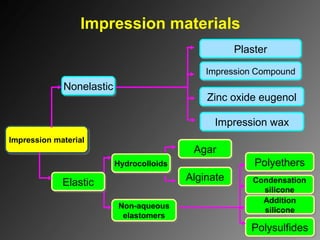
Impression materials
Impression materialImpression material
ElasticElastic
NonelasticNonelastic
HydrocolloidsHydrocolloids
Zinc oxide eugenolZinc oxide eugenol
Impression CompoundImpression Compound
PlasterPlaster
Non-aqueous
elastomers
Non-aqueous
elastomers
AgarAgar
AlginateAlginate
PolyethersPolyethers
Addition
silicone
Addition
silicone
Condensation
silicone
Condensation
silicone
PolysulfidesPolysulfides
Impression waxImpression wax
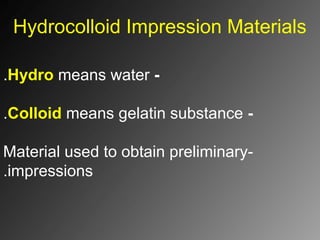
Hydrocolloid Impression Materials
-Hydro means water.
-Colloid means gelatin substance.
-Material used to obtain preliminary
impressions.
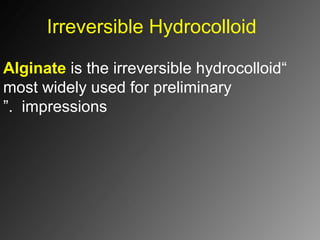
Irreversible Hydrocolloid
“Alginate is the irreversible hydrocolloid
most widely used for preliminary
impressions”.
Makeup of Alginate
Sodium alginate
-As a thickening agent.
Calcium sulfate
-Reacts with the potassium alginate to form
the gel.
Trisodium phosphate
-Added to slow down the reaction time for
mixing.
Makeup of Alginate
Diatomaceous earth
-A filler that adds bulk to the material.
Zinc oxide
-Adds bulk to the material.
Potassium titanium fluoride
-Added so as not to interfere with the setting
and surface strength.
Physical Phases of Alginate
-The first phase is a sol (as in solution). In the
sol phase, the material is in a liquid or semi liquid
form.
-The second phase is a gel. In the gel phase,
the material is semisolid, similar to a gelatin
dessert.
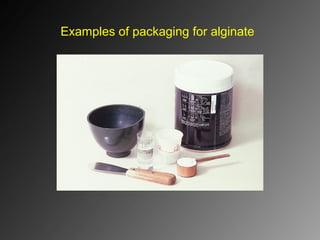
Packaging and Storing of Alginate
-Containers about the size of a coffee can are
the most commonly used form of packaging.
-Premeasured packages are more expensive,
but save time by eliminating the need for
measurement of the powder.
-Shelf life of alginate is approximately 1 year.
Examples of packaging for alginate
Causes for Distortion and Dimensional
Change of Alginate
-If an alginate impression is stored in water or in
a very wet paper towel, the alginate will absorb
additional water and expand. This condition is
called imbibition.
-If an alginate impression remains in the open
air, moisture will evaporate from the material,
causing it to shrink and distort. This condition is
called syneresis.
Alginate Settings
Normal set alginate
-Working time of 2 minutes and a setting time of up
to 41/2 minutes after mixing.
Fast set alginate
-Working time of 11/4 minutes and a setting time of 1
to 2 minutes.
Working time
-The time allowed for mixing the alginate, loading the
tray, and positioning the tray in the patient's mouth.
Setting time
-The time required for the chemical action to be
completed.
Altering the Setting Times of Alginate
-Cooler water can increase the setting
time if additional time is needed for the
procedure.
-Warmer water can reduce or shorten
the setting time of the procedure.
Water-to-Powder Ratio
-An adult mandibular impression generally
requires two scoops of powder and two
measures of water.
-An adult maxillary impression generally
requires three scoops of powder and three
measures of water.
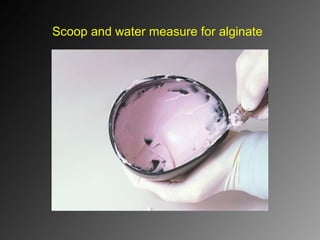
Scoop and water measure for alginate
Taking an Alginate Impression
Explain the procedure to the patient:
-The material will feel cold, there is no
unpleasant taste, and the material will set
quickly.
-Breathe deeply through your nose to
help you relax and be more comfortable.
-Use hand signals to communicate any
discomfort!
An Acceptable Alginate Impression
-The impression tray is centered over the central and
lateral incisors.
-There is a complete "peripheral roll," which includes all
of the vestibular areas.
-The impression is free from tears or voids.
-There is sharp anatomic detail of all teeth and soft
tissues.
-The retromolar area, lingual frenum, tongue space,
and mylohyoid ridge are reproduced in the mandibular
impression.
-The hard palate and tuberosities are recorded in the
maxillary impression.
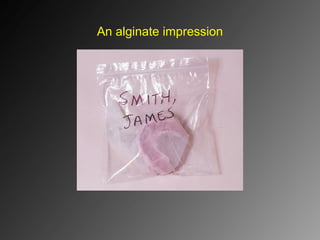
An alginate impression
Elastomeric Impression Materials
“A material that is used when an extremely
accurate impression is essential. The term
elastomeric means having elastic or rubberlike
qualities”.
Characteristics or Elastomeric
Impression Materials
Base
Packaged as a paste in a tube, as a cartridge,
or as putty in a jar.
Catalyst
Also known as the accelerator, is packaged as
a paste in a tube, as a cartridge, or as a liquid
in a bottle with a dropper top.
Forms of Elastomeric Materials
Light-bodied
Also referred to as syringe type, or wash type.
This material is used because of its ability to
flow in and about the details of the prepared
tooth. A special syringe, or extruder, is used to
place the light-bodied material on and
immediately around the prepared teeth.
Forms of Elastomeric Materials
Regular and heavy-bodied
Often referred to as tray type materials,‑
they are much thicker. As the names
imply, they are used to fill the tray. Their
stiffness helps to force the light bodied‑
material into close contact with the
prepared teeth and surrounding tissues to
ensure a more accurate impression of the
details of a preparation
Basic Impression Technique
1.The material selected depends upon the dentist’s preference
and the type of impression required for the procedure.
2.The dentist prepares the tooth or teeth for the impression.
3.The light-bodied material is prepared and loaded into the
syringe and transferred to the dentist.
4.The dentist places the light-bodied material over and around the
prepared teeth and onto the surrounding tissues.
5.The heavy-bodied material is prepared and loaded into the tray
and transferred to the dentist.
6.When the impression material has reached final set, the
impression is removed and inspected for accuracy.
7.The impression is disinfected, placed in a biohazard bag,
labeled, and readied for the laboratory technician.
Types of Elastomeric Materials
Polyether
Silicone
Polyvinyl siloxane
Polysulfide
Polyether Impression Material
Chemical makeup
Base: Polyether
Cross-linking agent: Sulfate
Catalysts: Glycol-based plasticizers
Filler: Silica
Manipulation and Technique
Considerations for Polyether Material
-Material is very stiff, which makes it difficult to
remove without rocking.
-Water, saliva, and blood affect polyether
material.
-Added moisture will increase the impression’s
marginal discrepancy.
-Increased water absorption occurs if a thinning
agent is used.
Steps:
1(Tray selection
2(Preparation of the square
3(Impression
4(Removal of the impression
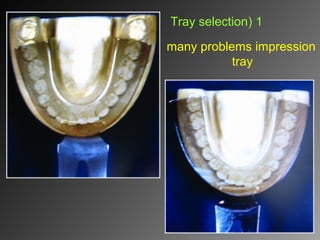
many problems impression
tray
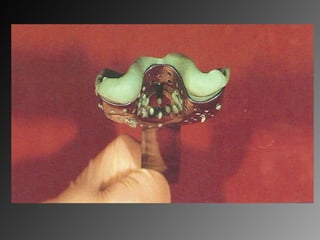
1(Tray selection
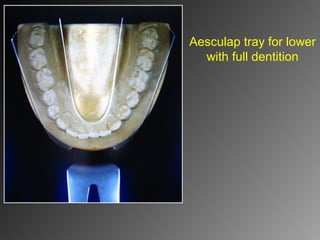
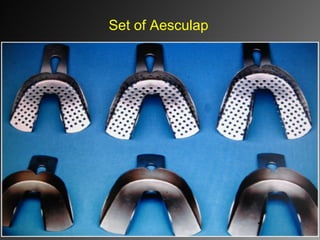
Aesculap tray for lower
with full dentition
Set of Aesculap
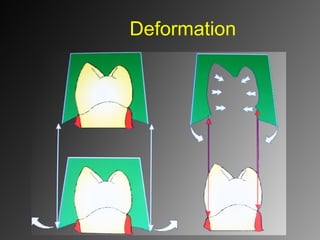
Deformation
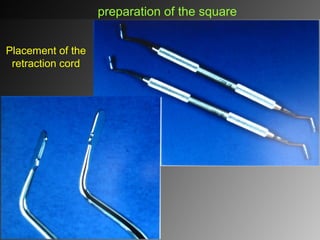
preparation of the square
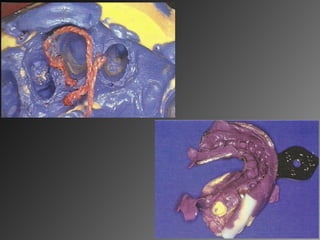
Placement of the
retraction cord
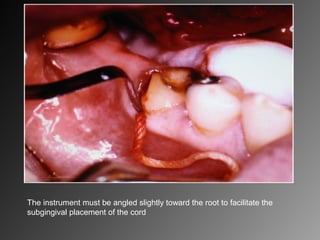
The instrument must be angled slightly toward the root to facilitate the
subgingival placement of the cord
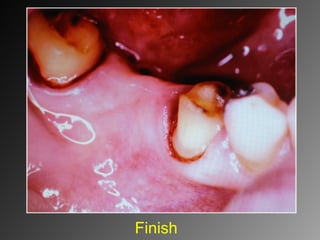
Finish
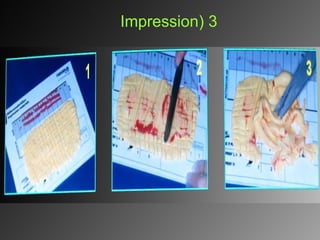
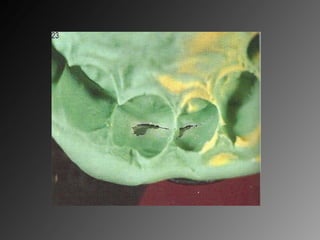
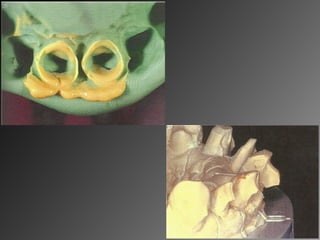
3(Impression
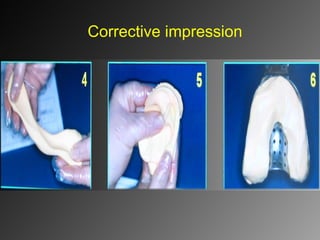
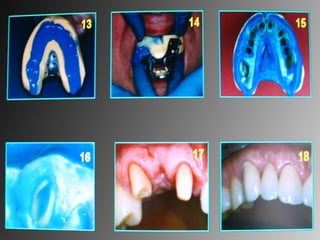
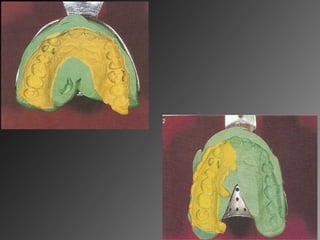
Corrective impression
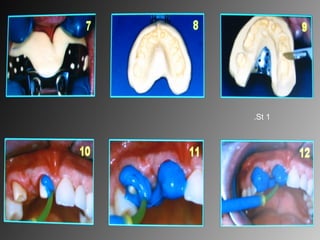
1St.
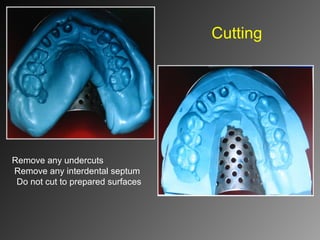
Cutting
Remove any undercuts
Remove any interdental septum
Do not cut to prepared surfaces
Corrective impression
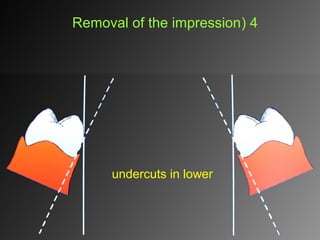
undercuts in lower
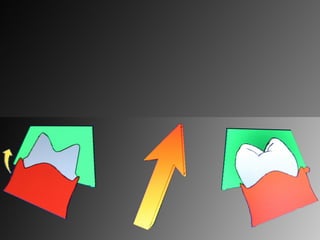
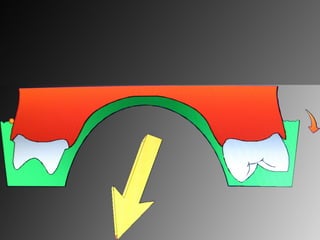
4(Removal of the impression
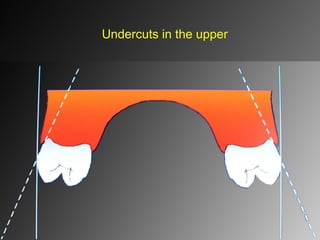
Undercuts in the upper
Which one of the impression
materials we choose?
•What’s the job you do?
primary impression
final impression
•How accurate do you want?
removable denture
fixed prostheses
•What technique do you use?
7.impression materials and techniques 2

7.impression materials and techniques 2

  • 1.
    FIXED PROSTHODONTIC I Departmentof Fixed Prosthodontics
  • 2.
    Impression materials Impression materialImpressionmaterial ElasticElastic NonelasticNonelastic HydrocolloidsHydrocolloids Zinc oxide eugenolZinc oxide eugenol Impression CompoundImpression Compound PlasterPlaster Non-aqueous elastomers Non-aqueous elastomers AgarAgar AlginateAlginate PolyethersPolyethers Addition silicone Addition silicone Condensation silicone Condensation silicone PolysulfidesPolysulfides Impression waxImpression wax
  • 3.
    Hydrocolloid Impression Materials -Hydromeans water. -Colloid means gelatin substance. -Material used to obtain preliminary impressions.
  • 4.
    Irreversible Hydrocolloid “Alginate isthe irreversible hydrocolloid most widely used for preliminary impressions”.
  • 5.
    Makeup of Alginate Sodiumalginate -As a thickening agent. Calcium sulfate -Reacts with the potassium alginate to form the gel. Trisodium phosphate -Added to slow down the reaction time for mixing.
  • 6.
    Makeup of Alginate Diatomaceousearth -A filler that adds bulk to the material. Zinc oxide -Adds bulk to the material. Potassium titanium fluoride -Added so as not to interfere with the setting and surface strength.
  • 7.
    Physical Phases ofAlginate -The first phase is a sol (as in solution). In the sol phase, the material is in a liquid or semi liquid form. -The second phase is a gel. In the gel phase, the material is semisolid, similar to a gelatin dessert.
  • 8.
    Packaging and Storingof Alginate -Containers about the size of a coffee can are the most commonly used form of packaging. -Premeasured packages are more expensive, but save time by eliminating the need for measurement of the powder. -Shelf life of alginate is approximately 1 year.
  • 9.
  • 10.
    Causes for Distortionand Dimensional Change of Alginate -If an alginate impression is stored in water or in a very wet paper towel, the alginate will absorb additional water and expand. This condition is called imbibition. -If an alginate impression remains in the open air, moisture will evaporate from the material, causing it to shrink and distort. This condition is called syneresis.
  • 11.
    Alginate Settings Normal setalginate -Working time of 2 minutes and a setting time of up to 41/2 minutes after mixing. Fast set alginate -Working time of 11/4 minutes and a setting time of 1 to 2 minutes. Working time -The time allowed for mixing the alginate, loading the tray, and positioning the tray in the patient's mouth. Setting time -The time required for the chemical action to be completed.
  • 12.
    Altering the SettingTimes of Alginate -Cooler water can increase the setting time if additional time is needed for the procedure. -Warmer water can reduce or shorten the setting time of the procedure.
  • 13.
    Water-to-Powder Ratio -An adultmandibular impression generally requires two scoops of powder and two measures of water. -An adult maxillary impression generally requires three scoops of powder and three measures of water.
  • 14.
    Scoop and watermeasure for alginate
  • 15.
    Taking an AlginateImpression Explain the procedure to the patient: -The material will feel cold, there is no unpleasant taste, and the material will set quickly. -Breathe deeply through your nose to help you relax and be more comfortable. -Use hand signals to communicate any discomfort!
  • 16.
    An Acceptable AlginateImpression -The impression tray is centered over the central and lateral incisors. -There is a complete "peripheral roll," which includes all of the vestibular areas. -The impression is free from tears or voids. -There is sharp anatomic detail of all teeth and soft tissues. -The retromolar area, lingual frenum, tongue space, and mylohyoid ridge are reproduced in the mandibular impression. -The hard palate and tuberosities are recorded in the maxillary impression.
  • 17.
  • 18.
    Elastomeric Impression Materials “Amaterial that is used when an extremely accurate impression is essential. The term elastomeric means having elastic or rubberlike qualities”.
  • 19.
    Characteristics or Elastomeric ImpressionMaterials Base Packaged as a paste in a tube, as a cartridge, or as putty in a jar. Catalyst Also known as the accelerator, is packaged as a paste in a tube, as a cartridge, or as a liquid in a bottle with a dropper top.
  • 20.
    Forms of ElastomericMaterials Light-bodied Also referred to as syringe type, or wash type. This material is used because of its ability to flow in and about the details of the prepared tooth. A special syringe, or extruder, is used to place the light-bodied material on and immediately around the prepared teeth.
  • 21.
    Forms of ElastomericMaterials Regular and heavy-bodied Often referred to as tray type materials,‑ they are much thicker. As the names imply, they are used to fill the tray. Their stiffness helps to force the light bodied‑ material into close contact with the prepared teeth and surrounding tissues to ensure a more accurate impression of the details of a preparation
  • 22.
    Basic Impression Technique 1.Thematerial selected depends upon the dentist’s preference and the type of impression required for the procedure. 2.The dentist prepares the tooth or teeth for the impression. 3.The light-bodied material is prepared and loaded into the syringe and transferred to the dentist. 4.The dentist places the light-bodied material over and around the prepared teeth and onto the surrounding tissues. 5.The heavy-bodied material is prepared and loaded into the tray and transferred to the dentist. 6.When the impression material has reached final set, the impression is removed and inspected for accuracy. 7.The impression is disinfected, placed in a biohazard bag, labeled, and readied for the laboratory technician.
  • 23.
    Types of ElastomericMaterials Polyether Silicone Polyvinyl siloxane Polysulfide
  • 24.
    Polyether Impression Material Chemicalmakeup Base: Polyether Cross-linking agent: Sulfate Catalysts: Glycol-based plasticizers Filler: Silica
  • 25.
    Manipulation and Technique Considerationsfor Polyether Material -Material is very stiff, which makes it difficult to remove without rocking. -Water, saliva, and blood affect polyether material. -Added moisture will increase the impression’s marginal discrepancy. -Increased water absorption occurs if a thinning agent is used.
  • 26.
    Steps: 1(Tray selection 2(Preparation ofthe square 3(Impression 4(Removal of the impression
  • 27.
  • 28.
    Aesculap tray forlower with full dentition
  • 29.
  • 30.
  • 31.
    preparation of thesquare Placement of the retraction cord
  • 32.
    The instrument mustbe angled slightly toward the root to facilitate the subgingival placement of the cord
  • 33.
  • 34.
  • 35.
  • 36.
  • 37.
    Cutting Remove any undercuts Removeany interdental septum Do not cut to prepared surfaces
  • 38.
  • 39.
  • 41.
  • 43.
    Which one ofthe impression materials we choose? •What’s the job you do? primary impression final impression •How accurate do you want? removable denture fixed prostheses •What technique do you use?