PRESENTATION
ON
BANKING
PRODUCTS
Kuldeep Jangid
Sanjay Rajput
Ritesh Singh
VikasYadav
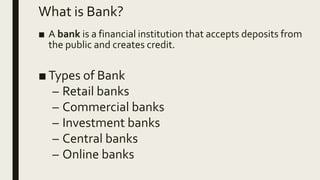
What is Bank?
■ A bank is a financial institution that accepts deposits from
the public and creates credit.
■ Types of Bank
– Retail banks
– Commercial banks
– Investment banks
– Central banks
– Online banks
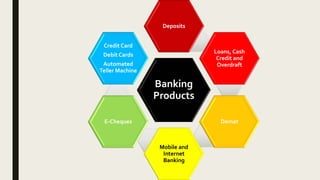
Banking
Products
Deposits
Loans, Cash
Credit and
Overdraft
Demat
Mobile and
Internet
Banking
E-Cheques
Credit Card
Debit Cards
Automated
Teller Machine
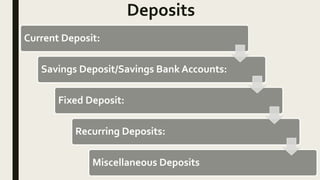
Deposits
Current Deposit:
Savings Deposit/Savings Bank Accounts:
Fixed Deposit:
Recurring Deposits:
Miscellaneous Deposits
Loan
A loan is money, property or other material goods given to another party in exchange for
future repayment of the loan value amount, along with interest or other finance charges.
■ Types of Loans
– Secured vs. Unsecured Loan
– Revolving vs.Term
Special Considerations for Loans
Interest rates have a huge effect on loans: Loans with high interest rates have higher
monthly payments – or take longer to pay off – than loans with low interest rates.
■ Types of Interest
– Simple vs. Compound Interest
Cash Credit - CC
■ Cash credit is a facility to withdraw money
from a current bank account without having
credit balance but limited to the extent of
borrowing limit which is fixed by the
commercial bank.The interest on this facility
is charged on the running balance and not the
borrowing limit which is given by bank.
■ Advantages
– Source of working capital financing
– . Easy arrangement
– Flexibility
– Tax-deductible
– Interest charged
Overdraft - OD
■ An overdraft occurs when money is
withdrawn from a bank account and the
available balance goes below zero. In this
situation the account is said to be
"overdrawn". If there is a prior agreement
with the account provider for an overdraft,
and the amount overdrawn is within the
authorized overdraft limit, then interest is
normally charged at the agreed rate.
■ Types of Overdraft
– Authorized bank overdraft
– Unauthorized bank overdraft
Advantages
– Perfect for mismatch of cash
– Prevents bouncing checks
– Enables on-time payments
– Saves time and paper
– Provides convenience
Credit Card
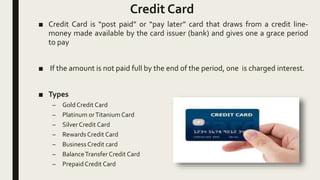
■ Credit Card is “post paid” or “pay later” card that draws from a credit line-
money made available by the card issuer (bank) and gives one a grace period
to pay
■ If the amount is not paid full by the end of the period, one is charged interest.
■ Types
– Gold Credit Card
– Platinum orTitanium Card
– Silver Credit Card
– Rewards Credit Card
– Business Credit card
– BalanceTransfer Credit Card
– Prepaid Credit Card
Credit Card Companies (Leading companies in India)
■ American Express Gold credit card
■ IndianOverseas BankVisa International Credit card
■ Axis Platinum card
■ Bank of India's IndiaCard
■ Gold International Card
■ Citibank Dinners Club International card
■ ICICI Bank Online card
■ Syndicate Global Gold Credit Card
■ CorpBank Gold card
■ Vijaya BankVisaGold Credit Card
■ HSBC Platinum card
■ CorpBank Classic card
■ Vijaya BankVISA Classic International Card
■ HDFC Silver credit card
Debit Card
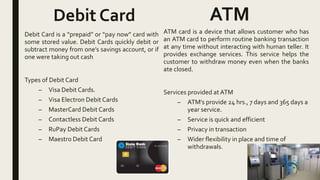
Debit Card is a “prepaid” or “pay now” card with
some stored value. Debit Cards quickly debit or
subtract money from one’s savings account, or if
one were taking out cash
Types of Debit Card
– Visa Debit Cards.
– Visa Electron Debit Cards
– MasterCard Debit Cards
– Contactless Debit Cards
– RuPay Debit Cards
– Maestro Debit Card
ATM
ATM card is a device that allows customer who has
an ATM card to perform routine banking transaction
at any time without interacting with human teller. It
provides exchange services. This service helps the
customer to withdraw money even when the banks
ate closed.
Services provided at ATM
– ATM’s provide 24 hrs., 7 days and 365 days a
year service.
– Service is quick and efficient
– Privacy in transaction
– Wider flexibility in place and time of
withdrawals.
Mobile Banking and Online Banking
On-line banking is now moving to the mobile world, giving everybody with a mobile phone
access to real-time banking services, regardless of their location.
Perks of having Mobile Banking
– Enjoy FREE, 24-Hour Access to account balances and transaction histories using your
Smartphone, orTablet.
– Bill Pay - Pay virtually anyone. No more stamps, no more paper checks!
– Easily and quickly search history by date and description
– Person-to-PersonTransfers - Send money to anyone
– Personalized Account Balance and Security Alerts.
Benefits of Internet Banking:
■ Reduce the transaction costs of offering several banking
services and diminishes the need for longer numbers of
expensive brick and mortar branches and staff.
■ Increase convenience for customers, since they can
conduct many banking transaction 24 hours a day.
■ Increase customer loyalty.
■ Improve customer access.
■ Attract new customers.
■ Easy online application for all accounts, including personal
loans and mortgages
Demat
■ An account that is used to hold shares and securities in electronic format is called a Demat account.
The full form of Demat account is a dematerialised account. During online trading, the purpose of a
Demat account is to hold shares that have been bought or dematerialised (converted from physical to
electronic shares), thus making share trading easy for the users.
■ Demat Account or dematerialised account provides facility of holding shares and securities in
electronic format. During online trading, shares are bought and held in a Demat account, thus
facilitating easy trade for the users. A Demat Account holds all the investments an individual makes in
shares, government securities, exchange-traded funds, bonds and mutual funds in one place.
■ Benefits of opening a Demat account andAdvantages of Investing in Share Market:
– InvestmentGains:
– Dividend Income:
– Diversification:
– Ownership:
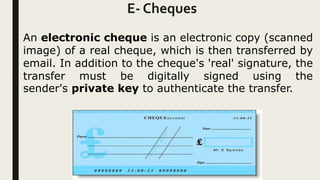
E- Cheques
An electronic cheque is an electronic copy (scanned
image) of a real cheque, which is then transferred by
email. In addition to the cheque's 'real' signature, the
transfer must be digitally signed using the
sender's private key to authenticate the transfer.
THANKYOU

Presentation on Banking Products

  • 1.
  • 2.
    What is Bank? ■A bank is a financial institution that accepts deposits from the public and creates credit. ■ Types of Bank – Retail banks – Commercial banks – Investment banks – Central banks – Online banks
  • 3.
    Banking Products Deposits Loans, Cash Credit and Overdraft Demat Mobileand Internet Banking E-Cheques Credit Card Debit Cards Automated Teller Machine
  • 4.
    Deposits Current Deposit: Savings Deposit/SavingsBank Accounts: Fixed Deposit: Recurring Deposits: Miscellaneous Deposits
  • 5.
    Loan A loan ismoney, property or other material goods given to another party in exchange for future repayment of the loan value amount, along with interest or other finance charges. ■ Types of Loans – Secured vs. Unsecured Loan – Revolving vs.Term Special Considerations for Loans Interest rates have a huge effect on loans: Loans with high interest rates have higher monthly payments – or take longer to pay off – than loans with low interest rates. ■ Types of Interest – Simple vs. Compound Interest
  • 6.
    Cash Credit -CC ■ Cash credit is a facility to withdraw money from a current bank account without having credit balance but limited to the extent of borrowing limit which is fixed by the commercial bank.The interest on this facility is charged on the running balance and not the borrowing limit which is given by bank. ■ Advantages – Source of working capital financing – . Easy arrangement – Flexibility – Tax-deductible – Interest charged Overdraft - OD ■ An overdraft occurs when money is withdrawn from a bank account and the available balance goes below zero. In this situation the account is said to be "overdrawn". If there is a prior agreement with the account provider for an overdraft, and the amount overdrawn is within the authorized overdraft limit, then interest is normally charged at the agreed rate. ■ Types of Overdraft – Authorized bank overdraft – Unauthorized bank overdraft Advantages – Perfect for mismatch of cash – Prevents bouncing checks – Enables on-time payments – Saves time and paper – Provides convenience
  • 7.
    Credit Card ■ CreditCard is “post paid” or “pay later” card that draws from a credit line- money made available by the card issuer (bank) and gives one a grace period to pay ■ If the amount is not paid full by the end of the period, one is charged interest. ■ Types – Gold Credit Card – Platinum orTitanium Card – Silver Credit Card – Rewards Credit Card – Business Credit card – BalanceTransfer Credit Card – Prepaid Credit Card
  • 8.
    Credit Card Companies(Leading companies in India) ■ American Express Gold credit card ■ IndianOverseas BankVisa International Credit card ■ Axis Platinum card ■ Bank of India's IndiaCard ■ Gold International Card ■ Citibank Dinners Club International card ■ ICICI Bank Online card ■ Syndicate Global Gold Credit Card ■ CorpBank Gold card ■ Vijaya BankVisaGold Credit Card ■ HSBC Platinum card ■ CorpBank Classic card ■ Vijaya BankVISA Classic International Card ■ HDFC Silver credit card
  • 9.
    Debit Card Debit Cardis a “prepaid” or “pay now” card with some stored value. Debit Cards quickly debit or subtract money from one’s savings account, or if one were taking out cash Types of Debit Card – Visa Debit Cards. – Visa Electron Debit Cards – MasterCard Debit Cards – Contactless Debit Cards – RuPay Debit Cards – Maestro Debit Card ATM ATM card is a device that allows customer who has an ATM card to perform routine banking transaction at any time without interacting with human teller. It provides exchange services. This service helps the customer to withdraw money even when the banks ate closed. Services provided at ATM – ATM’s provide 24 hrs., 7 days and 365 days a year service. – Service is quick and efficient – Privacy in transaction – Wider flexibility in place and time of withdrawals.
  • 10.
    Mobile Banking andOnline Banking On-line banking is now moving to the mobile world, giving everybody with a mobile phone access to real-time banking services, regardless of their location. Perks of having Mobile Banking – Enjoy FREE, 24-Hour Access to account balances and transaction histories using your Smartphone, orTablet. – Bill Pay - Pay virtually anyone. No more stamps, no more paper checks! – Easily and quickly search history by date and description – Person-to-PersonTransfers - Send money to anyone – Personalized Account Balance and Security Alerts.
  • 11.
    Benefits of InternetBanking: ■ Reduce the transaction costs of offering several banking services and diminishes the need for longer numbers of expensive brick and mortar branches and staff. ■ Increase convenience for customers, since they can conduct many banking transaction 24 hours a day. ■ Increase customer loyalty. ■ Improve customer access. ■ Attract new customers. ■ Easy online application for all accounts, including personal loans and mortgages
  • 12.
    Demat ■ An accountthat is used to hold shares and securities in electronic format is called a Demat account. The full form of Demat account is a dematerialised account. During online trading, the purpose of a Demat account is to hold shares that have been bought or dematerialised (converted from physical to electronic shares), thus making share trading easy for the users. ■ Demat Account or dematerialised account provides facility of holding shares and securities in electronic format. During online trading, shares are bought and held in a Demat account, thus facilitating easy trade for the users. A Demat Account holds all the investments an individual makes in shares, government securities, exchange-traded funds, bonds and mutual funds in one place. ■ Benefits of opening a Demat account andAdvantages of Investing in Share Market: – InvestmentGains: – Dividend Income: – Diversification: – Ownership:
  • 13.
    E- Cheques An electroniccheque is an electronic copy (scanned image) of a real cheque, which is then transferred by email. In addition to the cheque's 'real' signature, the transfer must be digitally signed using the sender's private key to authenticate the transfer.
  • 14.