The document provides an overview of the banking domain, including:
- Defining key terms like money, financial instruments, assets and liabilities, and non-performing assets.
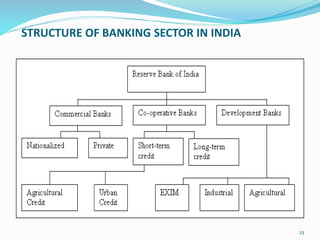
- Describing the structure of the banking sector in India including the roles of the central bank and different types of banks.
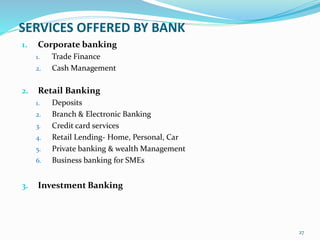
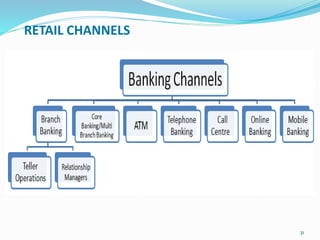
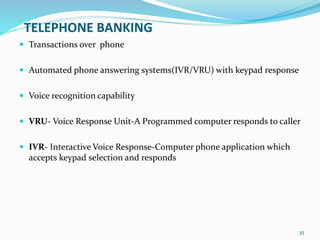
- Explaining various retail banking services offered to individuals and businesses like deposits, loans, credit/debit cards, ATMs, online and mobile banking.
- Providing details on deposit products, retail channels, funds transfer mechanisms, and the services offered by banks in areas like corporate, retail, and investment banking.
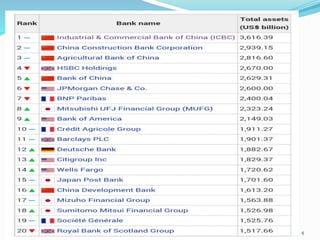
FEW OF THEGIANTS IN BANKING
International and Commercial Bank of China
Assets of this Chinese bank are more than the entire banking
sector of India!
Assets = 3616 (US$ billion)
INR= 239789435200000
3
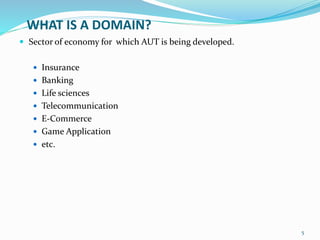
WHAT IS ADOMAIN?
Sector of economy for which AUT is being developed.
Insurance
Banking
Life sciences
Telecommunication
E-Commerce
Game Application
etc.
5
6.
ADVANTAGES OF DOMAINKNOWLEDGE
Reduces the training time
Knowledge of functional flow chart (work flow, business process &
rules)
Good Idea on UI features
Helps in writing precise and accurate test cases
Those hoping for the position of ‘Business Analyst’ at the earliest must
need a strong command on domain knowledge
6
7.
OBJECTIVE
Provide anoverview of Banking Domain
Enable Technology people understand Financial Terms
Explain Operations in specific lines of banking
Cover Global Banking Practices
Introduce some of the recent developments in banking
7
MONEY
Standard unitof Exchange- advancement over barter system
Currencies-based upon development level of countries
Exchange Rates- Who decides, Pegged currencies
Face value of currency
Standard Value currency
Interest charged on loan amount- Simple and Compound
Simple- On Rs.100 by 10 per cent, amount paid every year is Rs. 10
Compound- On Rs.100 by 10 per cent, amount paid every year varies
9
10.
INFLATION
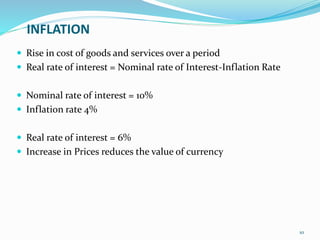
Rise incost of goods and services over a period
Real rate of interest = Nominal rate of Interest-Inflation Rate
Nominal rate of interest = 10%
Inflation rate 4%
Real rate of interest = 6%
Increase in Prices reduces the value of currency
10
11.
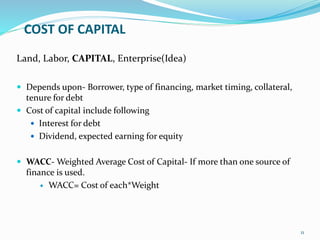
COST OF CAPITAL
Land,Labor, CAPITAL, Enterprise(Idea)
Depends upon- Borrower, type of financing, market timing, collateral,
tenure for debt
Cost of capital include following
Interest for debt
Dividend, expected earning for equity
WACC- Weighted Average Cost of Capital- If more than one source of
finance is used.
WACC= Cost of each*Weight
11
12.
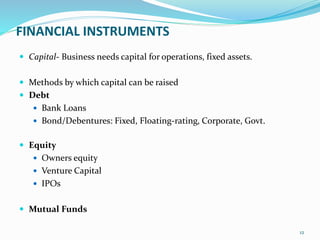
FINANCIAL INSTRUMENTS
Capital-Business needs capital for operations, fixed assets.
Methods by which capital can be raised
Debt
Bank Loans
Bond/Debentures: Fixed, Floating-rating, Corporate, Govt.
Equity
Owners equity
Venture Capital
IPOs
Mutual Funds
12
DEBT
Money owedby one entity to other
Cost is interest
Debt is considered senior to equity i.e. the interest on debt is paid
before the dividends on stock in case of liquidation of assets
Examples- Bonds, Loan, Commercial papers
Investors chose between debt and equity based on their investment
objectives
14
15.
BONDS
An investorloans money to an entity at a specific interest rate.
Small deposits from multiple people
Investment ceiling
Interest is generally paid semiannually
Factors influencing coupon rate
Prevailing economic conditions
Issuers Credit rating (risk)
In return investor gets the bond/certificate which contains:
Interest rate (Coupon rate)
Maturity date (Repayment date)
Face amount
15
16.
…CONTINUED
Corporate bond
Secured bonds- backed by specific assets
Unsecured bonds (Debentures)
Treasury Securities (Government agencies)
Treasury bills-Short term
Treasury bonds-Long term
Most secure bonds
16
17.
EQUITY
Equity (Stock)-represents ownership interest
Common Stock
Voting Rights
Majority shareholders manage organization
Popular
Corporations sells it through IPO
Can be traded in secondary markets-BSE, NYSE etc.
Preferred Stock
No voting rights
Fixed rate of return
17
18.
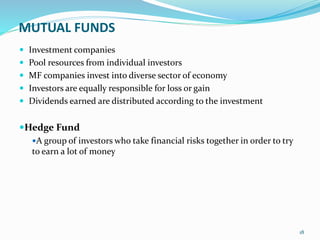
MUTUAL FUNDS
Investmentcompanies
Pool resources from individual investors
MF companies invest into diverse sector of economy
Investors are equally responsible for loss or gain
Dividends earned are distributed according to the investment
Hedge Fund
A group of investors who take financial risks together in order to try
to earn a lot of money
18
19.
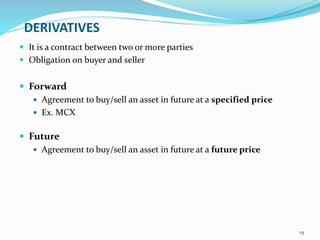
DERIVATIVES
It isa contract between two or more parties
Obligation on buyer and seller
Forward
Agreement to buy/sell an asset in future at a specified price
Ex. MCX
Future
Agreement to buy/sell an asset in future at a future price
19
20.
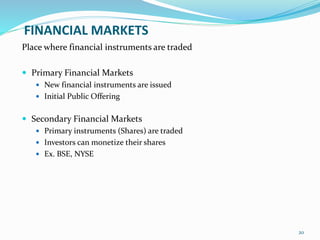
FINANCIAL MARKETS
Place wherefinancial instruments are traded
Primary Financial Markets
New financial instruments are issued
Initial Public Offering
Secondary Financial Markets
Primary instruments (Shares) are traded
Investors can monetize their shares
Ex. BSE, NYSE
20
BANKING
Any financialinstitution licensed to accept deposits and issue
credit through loans
Functions
Channelize savings
Credit facilities to borrower
Investment avenues o investors
Facilitate the trade and commerce dealings
Financial Inclusion
Minimize cash transactions
Provide financial services
Creation of money in the economy
Restricts expansion of black money
22
CENTRAL BANK
Banker’sbank
Regulator to other banks
Governments bank
Provide stable monetary and financial policy
Decides policy rates-Impacts money in the market
Protects rights of the consumer by supervising banking institution
Monitors inflow and outflow of foreign currencies
Clearing house facility
Banker of last resort
Ex. RBI
24
25.
HOW DO BANKEARN PROFITS?
Difference in the rate of interest between depositors and lenders
Number of products
Through investment of its resources
Fee based services
Net banking
Mobile banking
Demand Draft
Universal Banking
Commercial as well as investment banking services under one roof
25
26.
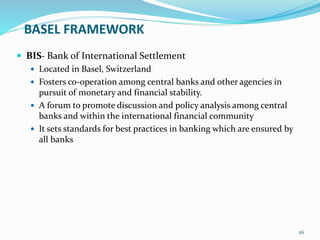
BASEL FRAMEWORK
BIS-Bank of International Settlement
Located in Basel, Switzerland
Fosters co-operation among central banks and other agencies in
pursuit of monetary and financial stability.
A forum to promote discussion and policy analysis among central
banks and within the international financial community
It sets standards for best practices in banking which are ensured by
all banks
26
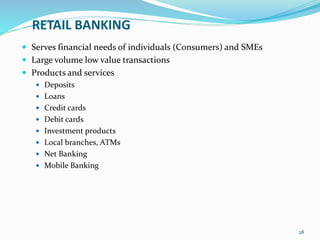
RETAIL BANKING
Servesfinancial needs of individuals (Consumers) and SMEs
Large volume low value transactions
Products and services
Deposits
Loans
Credit cards
Debit cards
Investment products
Local branches, ATMs
Net Banking
Mobile Banking
28
29.
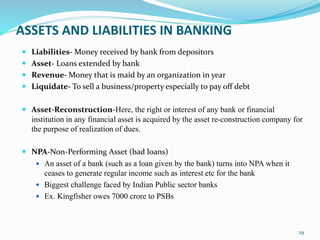
ASSETS AND LIABILITIESIN BANKING
Liabilities- Money received by bank from depositors
Asset- Loans extended by bank
Revenue- Money that is maid by an organization in year
Liquidate- To sell a business/property especially to pay off debt
Asset-Reconstruction-Here, the right or interest of any bank or financial
institution in any financial asset is acquired by the asset re-construction company for
the purpose of realization of dues.
NPA-Non-Performing Asset (bad loans)
An asset of a bank (such as a loan given by the bank) turns into NPA when it
ceases to generate regular income such as interest etc for the bank
Biggest challenge faced by Indian Public sector banks
Ex. Kingfisher owes 7000 crore to PSBs
29
30.
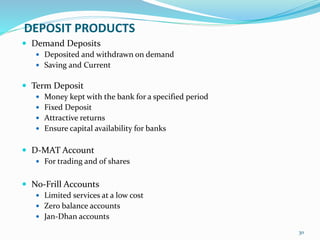
DEPOSIT PRODUCTS
DemandDeposits
Deposited and withdrawn on demand
Saving and Current
Term Deposit
Money kept with the bank for a specified period
Fixed Deposit
Attractive returns
Ensure capital availability for banks
D-MAT Account
For trading and of shares
No-Frill Accounts
Limited services at a low cost
Zero balance accounts
Jan-Dhan accounts
30
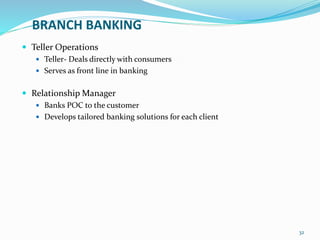
BRANCH BANKING
TellerOperations
Teller- Deals directly with consumers
Serves as front line in banking
Relationship Manager
Banks POC to the customer
Develops tailored banking solutions for each client
32
33.
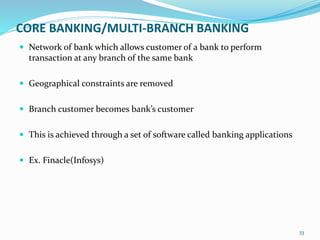
CORE BANKING/MULTI-BRANCH BANKING
Network of bank which allows customer of a bank to perform
transaction at any branch of the same bank
Geographical constraints are removed
Branch customer becomes bank’s customer
This is achieved through a set of software called banking applications
Ex. Finacle(Infosys)
33
34.
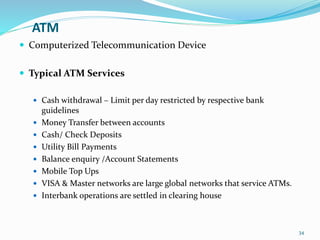
ATM
Computerized TelecommunicationDevice
Typical ATM Services
Cash withdrawal – Limit per day restricted by respective bank
guidelines
Money Transfer between accounts
Cash/ Check Deposits
Utility Bill Payments
Balance enquiry /Account Statements
Mobile Top Ups
VISA & Master networks are large global networks that service ATMs.
Interbank operations are settled in clearing house
34
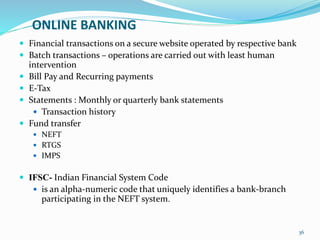
ONLINE BANKING
Financialtransactions on a secure website operated by respective bank
Batch transactions – operations are carried out with least human
intervention
Bill Pay and Recurring payments
E-Tax
Statements : Monthly or quarterly bank statements
Transaction history
Fund transfer
NEFT
RTGS
IMPS
IFSC- Indian Financial System Code
is an alpha-numeric code that uniquely identifies a bank-branch
participating in the NEFT system.
36
37.
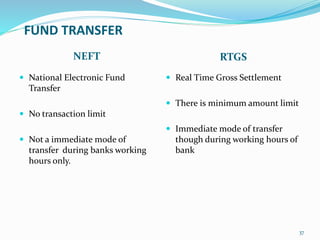
FUND TRANSFER
NEFT RTGS
National Electronic Fund
Transfer
No transaction limit
Not a immediate mode of
transfer during banks working
hours only.
Real Time Gross Settlement
There is minimum amount limit
Immediate mode of transfer
though during working hours of
bank
37
38.
IMPS
Immediate PaymentService
Instant money transfer through mobile phone or online
Mobile number of remitter and beneficiary should be linked to their
respective bank accounts
Best way for transferring remittances
MMID- Mobile money identifier is generated
There is a limit on amount of transaction
SWIFT- Society for Worldwide Interbank Financial
Telecommunications
SWIFT transports messages between two financial institutions. This
activity involves the secure exchange of proprietary data while ensuring its
confidentiality and integrity
BIC- Uses Bank Identifier Code
38
39.
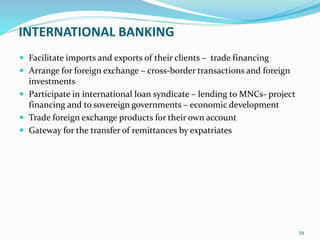
INTERNATIONAL BANKING
Facilitateimports and exports of their clients – trade financing
Arrange for foreign exchange – cross-border transactions and foreign
investments
Participate in international loan syndicate – lending to MNCs- project
financing and to sovereign governments – economic development
Trade foreign exchange products for their own account
Gateway for the transfer of remittances by expatriates
39
40.
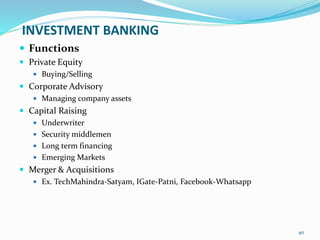
INVESTMENT BANKING
Functions
Private Equity
Buying/Selling
Corporate Advisory
Managing company assets
Capital Raising
Underwriter
Security middlemen
Long term financing
Emerging Markets
Merger & Acquisitions
Ex. TechMahindra-Satyam, IGate-Patni, Facebook-Whatsapp
40
41.
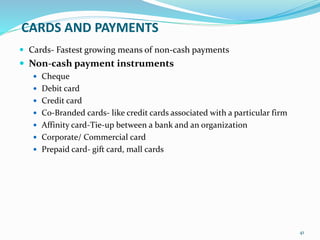
CARDS AND PAYMENTS
Cards- Fastest growing means of non-cash payments
Non-cash payment instruments
Cheque
Debit card
Credit card
C0-Branded cards- like credit cards associated with a particular firm
Affinity card-Tie-up between a bank and an organization
Corporate/ Commercial card
Prepaid card- gift card, mall cards
41
42.
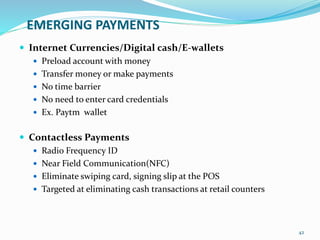
EMERGING PAYMENTS
InternetCurrencies/Digital cash/E-wallets
Preload account with money
Transfer money or make payments
No time barrier
No need to enter card credentials
Ex. Paytm wallet
Contactless Payments
Radio Frequency ID
Near Field Communication(NFC)
Eliminate swiping card, signing slip at the POS
Targeted at eliminating cash transactions at retail counters
42
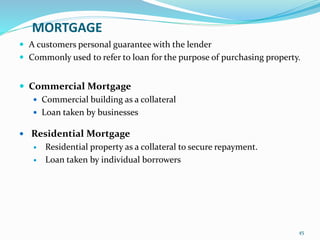
MORTGAGE
A customerspersonal guarantee with the lender
Commonly used to refer to loan for the purpose of purchasing property.
Commercial Mortgage
Commercial building as a collateral
Loan taken by businesses
Residential Mortgage
Residential property as a collateral to secure repayment.
Loan taken by individual borrowers
45
ROLE OF INFORMATIONTECHNOLOGY (IT) IN
THE BANKING
Competitiveness compel to adapt to latest technologies
Instrument of cost reduction
Effective communication with people and institutions associated with
the banking business.
Better market infrastructure
helps the financial intermediaries to reach geographically distant and
diversified markets in a cost effective manner
47
Definition: Insuranceis defined as the equitable transfer of the risk
of a loss from one entity to another in exchange for payment
Terminologies:
Insurer: Insurance company selling the policy
Insured: Policy holder or the entity availing the policy
Re-Insurance: Insurance by another insurer of all or a part of a risk
previously assumed by a insurance company
49
50.
CONTINUED…
Premium: Anamount charged by insurer in order to cover insured
against a risk
Factors determining premium amount:
The Frequency of Claims (how many)
The Severity (Cost of each Claim)
Condition of insurer, kind of policy, probability of risk, etc.
Underwriter: Person who approves the policy and determines the
premium to be charged against a coverage.
Claim: Request by insured in order to seek policy benefits from insurer
Adjudicator: One who processes or settles the claims.
50
51.
TYPES OF INSURANCE
Life Insurance (Long Term)
Non-Life Insurance (Short Term)
By the Law of Insurance in USA
Unemployment Insurance
Social Security
Worker’s Compensation
51
52.
CATEGORY OF INSURANCE
Dental
Health
Life
Business
Residential
Transport/Communication
Other
52
53.
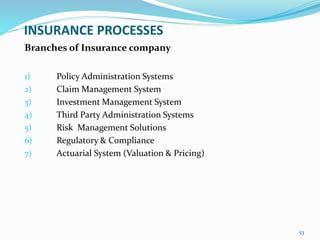
INSURANCE PROCESSES
Branches ofInsurance company
1) Policy Administration Systems
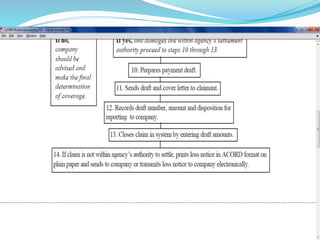
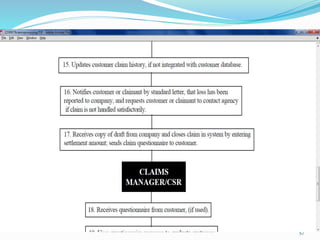
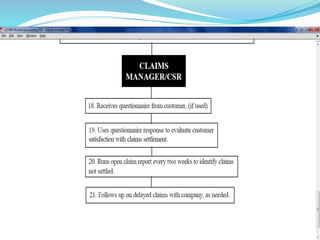
2) Claim Management System
3) Investment Management System
4) Third Party Administration Systems
5) Risk Management Solutions
6) Regulatory & Compliance
7) Actuarial System (Valuation & Pricing)
53