MONEY AND BANKING
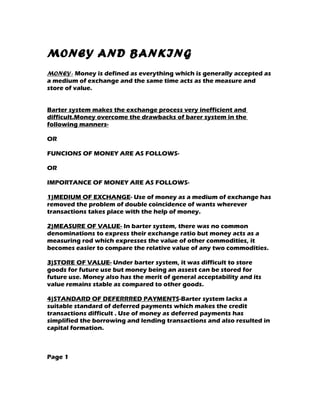
MONEY- Money is defined as everything which is generally accepted as
a medium of exchange and the same time acts as the measure and
store of value.


Barter system makes the exchange process very inefficient and
difficult.Money overcome the drawbacks of barer system in the
following manners-

OR

FUNCIONS OF MONEY ARE AS FOLLOWS-

OR

IMPORTANCE OF MONEY ARE AS FOLLOWS-

1)MEDIUM OF EXCHANGE- Use of money as a medium of exchange has
removed the problem of double coincidence of wants wherever
transactions takes place with the help of money.

2)MEASURE OF VALUE- In barter system, there was no common
denominations to express their exchange ratio but money acts as a
measuring rod which expresses the value of other commodities, it
becomes easier to compare the relative value of any two commodities.

3)STORE OF VALUE- Under barter system, it was difficult to store
goods for future use but money being an assest can be stored for
future use. Money also has the merit of general acceptability and its
value remains stable as compared to other goods.

4)STANDARD OF DEFERRRED PAYMENTS-Barter system lacks a
suitable standard of deferred payments which makes the credit
transactions difficult . Use of money as deferred payments has
simplified the borrowing and lending transactions and also resulted in
capital formation.


Page 1
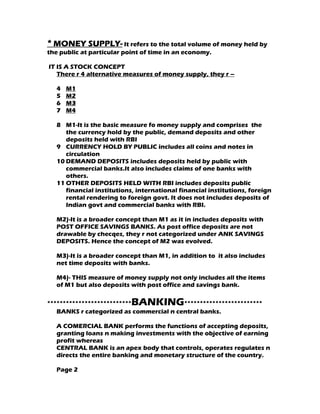
* MONEY SUPPLY- It refers to the total volume of money held by
the public at particular point of time in an economy.

IT IS A STOCK CONCEPT
   There r 4 alternative measures of money supply, they r –

   4   M1
   5   M2
   6   M3
   7   M4

   8 M1-It is the basic measure fo money supply and comprises the
      the currency hold by the public, demand deposits and other
      deposits held with RBI
   9 CURRENCY HOLD BY PUBLIC includes all coins and notes in
      circulation
   10 DEMAND DEPOSITS includes deposits held by public with
      commercial banks.It also includes claims of one banks with
      others.
   11 OTHER DEPOSITS HELD WITH RBI includes deposits public
      financial institutions, international financial institutions, foreign
      rental rendering to foreign govt. It does not includes deposits of
      Indian govt and commercial banks with RBI.

   M2)-It is a broader concept than M1 as it in includes deposits with
   POST OFFICE SAVINGS BANKS. As post office deposits are not
   drawable by checqes, they r not categorized under ANK SAVINGS
   DEPOSITS. Hence the concept of M2 was evolved.

   M3)-It is a broader concept than M1, in addition to it also includes
   net time deposits with banks.

   M4)- THIS measure of money supply not only includes all the items
   of M1 but also deposits with post office and savings bank.

*************************** BANKING      *************************
   BANKS r categorized as commercial n central banks.

   A COMERCIAL BANK performs the functions of accepting deposits,
   granting loans n making investments with the objective of earning
   profit whereas
   CENTRAL BANK is an apex body that controls, operates regulates n
   directs the entire banking and monetary structure of the country.

   Page 2
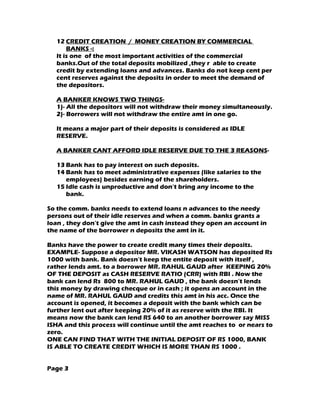
12 CREDIT CREATION / MONEY CREATION BY COMMERCIAL
       BANKS -:
   It is one of the most important activities of the commercial
   banks.Out of the total deposits mobilized ,they r able to create
   credit by extending loans and advances. Banks do not keep cent per
   cent reserves against the deposits in order to meet the demand of
   the depositors.

   A BANKER KNOWS TWO THINGS-
   1)- All the depositors will not withdraw their money simultaneously.
   2)- Borrowers will not withdraw the entire amt in one go.

   It means a major part of their deposits is considered as IDLE
   RESERVE.

   A BANKER CANT AFFORD IDLE RESERVE DUE TO THE 3 REASONS-

   13 Bank has to pay interest on such deposits.
   14 Bank has to meet administrative expenses (like salaries to the
      employees) besides earning of the shareholders.
   15 Idle cash is unproductive and don’t bring any income to the
      bank.

So the comm. banks needs to extend loans n advances to the needy
persons out of their idle reserves and when a comm. banks grants a
loan , they don’t give the amt in cash instead they open an account in
the name of the borrower n deposits the amt in it.

Banks have the power to create credit many times their deposits.
EXAMPLE- Suppose a depositor MR. VIKASH WATSON has deposited Rs
1000 with bank. Bank doesn’t keep the entite deposit with itself ,
rather lends amt. to a borrower MR. RAHUL GAUD after KEEPING 20%
OF THE DEPOSIT as CASH RESERVE RATIO (CRR) with RBI . Now the
bank can lend Rs 800 to MR. RAHUL GAUD , the bank doesn’t lends
this money by drawing checque or in cash ; it opens an account in the
name of MR. RAHUL GAUD and credits this amt in his acc. Once the
account is opened, it becomes a deposit with the bank which can be
further lent out after keeping 20% of it as reserve with the RBI. It
means now the bank can lend RS 640 to an another borrower say MISS
ISHA and this process will continue until the amt reaches to or nears to
zero.
ONE CAN FIND THAT WITH THE INITIAL DEPOSIT OF RS 1000, BANK
IS ABLE TO CREATE CREDIT WHICH IS MORE THAN RS 1000 .


Page 3
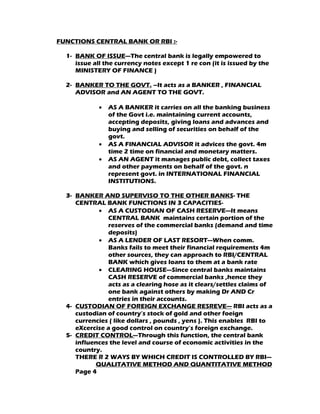
FUNCTIONS CENTRAL BANK OR RBI :-

  1- BANK OF ISSUE—The central bank is legally empowered to
     issue all the currency notes except 1 re con (it is issued by the
     MINISTERY OF FINANCE )

  2- BANKER TO THE GOVT. –It acts as a BANKER , FINANCIAL
     ADVISOR and AN AGENT TO THE GOVT.

             •   AS A BANKER it carries on all the banking business
                 of the Govt i.e. maintaining current accounts,
                 accepting deposits, giving loans and advances and
                 buying and selling of securities on behalf of the
                 govt.
             •   AS A FINANCIAL ADVISOR it advices the govt. 4m
                 time 2 time on financial and monetary matters.
             •   AS AN AGENT it manages public debt, collect taxes
                 and other payments on behalf of the govt. n
                 represent govt. in INTERNATIONAL FINANCIAL
                 INSTITUTIONS.

  3- BANKER AND SUPERVISO TO THE OTHER BANKS- THE
     CENTRAL BANK FUNCTIONS IN 3 CAPACITIES-
            • AS A CUSTODIAN OF CASH RESERVE—It means
               CENTRAL BANK maintains certain portion of the
               reserves of the commercial banks (demand and time
               deposits)
            • AS A LENDER OF LAST RESORT---When comm.
               Banks fails to meet their financial requirements 4m
               other sources, they can approach to RBI/CENTRAL
               BANK which gives loans to them at a bank rate
            • CLEARING HOUSE—Since central banks maintains
               CASH RESERVE of commercial banks ,hence they
               acts as a clearing hose as it clears/settles claims of
               one bank against others by making Dr AND Cr
               entries in their accounts.
  4- CUSTODIAN OF FOREIGN EXCHANGE RESREVE— RBI acts as a
     custodian of country’s stock of gold and other foeign
     currencies ( like dollars , pounds , yens ). This enables RBI to
     eXcercise a good control on country’s foreign exchange.
  5- CREDIT CONTROL---Through this function, the central bank
     influences the level and course of economic activities in the
     country.
     THERE R 2 WAYS BY WHICH CREDIT IS CONTROLLED BY RBI---
           QUALITATIVE METHOD AND QUANTITATIVE METHOD
     Page 4
A) QUANTATIVE METHOD

                     OR

         HOW RBI CONTROLS MONEY SUPPLY?

         ------Main qualitative methods r-----
               16 BANK RATE—It is the rate of interest charged by RBI
                  from the comm.. banks. Increase in bank rate means cost
                  of credit will go up. Increase in bank rate increases the
                  cost of credit as credit becomes costly. Its opposite
                  happens when there is a decrease in bank rate.
               17 OPEN MARKET OPERATIONS- It refers to purchase and
                  sale of securities in open market. When RBI offers
                  securities for sale , it reduces money supply.
               18 LEGAL RESERVE REQUIREMENTS—It refers to the min.
                  %ge of total deposits to be kept by commercial with
                  themselves and with RBI

WHEN MIN. %ge OF TOTAL DEPOSIT R KEPT BY COMM. WITH
THEMSELVES, IT IS CALLED SATUITORY LIQUIDITY RATIO (SLR)

WHEN MIN. %ge OF TOTAL DEPOSIT R KEPT BY COMM. WITH RBI, IT IS
CALLED CASH RESERVE RATIO (CRR)


         B) QUALITATIVE METHODS—THERE R 3 TYPES OF
            QUALITATIVE METHODS---
               • MARGIN REQUIREMENTS—It is the difference
                  between the market value of securities offered and
                  the amt. of loan lent.In the situation of deficit
                  demand this margini s reduced 2 encourage
                  borrowings.
               • CREDIT RATINING—It refers to the method of fixing
                  maximum limit on loans and advances given by the
                  comm.. banks. During deficit demand , it is lifted
                  and during excess demand it is imposed.
               • MORAL SUASION---It refers to the advice (in written
                  or oral) issued by the central bank to the
                  commercial banks to regulate the flow of credit.
                  During the deflation RBI persuades comm.. banks to
                  expand the credit facilities and during inflation , to
                  reduce the credit facilities.

Page 5
GOVERNMENT BUDGET
AND ECONOMY
GOVERNMENT BUDGET IS AN ANNUAL STATEMENT
SHOWING ITEMS WITH ESTIMATES OF RECEIPTS AND PAYMENTS
DURING THE FISCAL YEAR.

GOVERNMENT MAKES BUDGET IN ORDER TO FULFILL THE
FOLLOWING OBJECTIVES------

  19 Govt aims to Reduce the inequalities of income and wealth
     through taxation and expenditure on social security and welfare.
  20 Govt aims to Reallocate resources in accordance with economic
     and social priorities of the country.
  21 Govt aims to Mobilize resources in such a way that savings,
     investments and hence economic growth is promoted.
  22 Budget is prepared with the objective of making various
     Provisions for managing public enterprises and providing them
     financial help.
  23 Budget is prepared with the objective to reduce business
     Fluctuations and maintain economic stability.

(R2 MPF )


*COMPONENTS OF BUDGET---
IT HAS 2 COMPONENTS---
   24 REVENUE BUDGET—It deals with revenue aspects of the budget
     and comprises of revenue   receipts and revenue
     expenditure
  25 CAPITAL BUDGET—It deals with capital aspects of the budget
     and comprises of capital   receipts and capital
     expenditure.                                          PAGE 6
ON THE BASIS OF RECEIPTS AND EXPENDITURE , GOVT. BUDGET IS
CLASSIFIED AS BUDGET      RECEIPTS AND BUDGET
EXPENDITURE

1)BUDGET RECEIPTS—It refers to the estimated money receipts
of the govt from all the sources. It comprises of REVENUE RECEIPTS
AND CAPITAL RECEIPTS.

  26 ( A ) REVENUE RECEIPTS—It refers to those receipts
     which neither creates any liability nor any reduction
     in assets of the govt.

  EXAMPLE—Taxes or receipts from the tax liability of an
  individual or receipts from the sale shares of a public
  enterprise.

  REVENUE RECEIPTS ARE REGULAR AND RECURRING IN
  NATURE

  REVENUE RECEIPTS ARE CLASSIFIED INTO – TAX AND
  NON-TAX RECEIPTS.

  27 TAX—It is a compulsory payment imposed on people
    and companies to meet the expenditure incurred by the
    govt. for the common benefit of the people in the
    country.
  28NON-TAX RECEIPTS--- It refers to the receipts from all
    the sources other than tax receipts. EXAMPLE—interest
    received on loan given to state govt. and pvt.
    Enterprises etc.


Page 7
     29 ( B ) CAPITAL RECEIPTS—This refers to those receipts
         which either creates any liability or any reduction
         in the assets of the govt.
EXAMPLE-BORROWINGS(IT LEADS TO INCREASE IN
    LIABILITY) , SALE OF SHARES OF PUBLIC SECTOR UNITS
    (IT LEADS TO REDUCTION IN ASSETS)

    CAPITAL RECEIPTS ARE NON-RECURRING IN NATUTRE


CAPITAL RECEIPTS ARE CATEGORISED INTO---
  30BORROWINGS
  31RECOVERY OF LOANS
  32 OTHER RECIPTS—This includes disinvestments and
     small savings.

  33 BUDGET   EXPENDITURE---It refers to the
    expenditures of the govt. and comprises of revenue
    expenditure and capital expenditure.


    34 REVENUE    EXPENDITUTE is the exp. Which
      neither creates any assests nor any reduction in the
      liability.
    EXAMPLE- PAYMENT OF SALARIES, PENSIONS,
    EXP.ON ADMINISTRATIVE, DEFENCE, AND HEALTH
    SERVICES ETC.

    35CAPITAL EXPENDITURE refers to those exp. Which
      either creates any assests or any reduction in the
      liability.
    Example- Construction of roads and flyovers,
    repayment of borrowings etc.


    Page 8

    MEASUREMENT OF GOVT. DEFICIT---:::
    THERE R 3 TYPES OF DEFICITS--------
36REVENUE DEFICIT
    37FISCAL DEFICIT
    38PRIMARY DEFICIT


       1) REVENUE DEFICIT—
             • It is excess of revenue expenditure over
               revenue receipts
             • Its signifies that the revenue receipts are
               less than revenue expenditure and govt has
               to make up this deficit through capital
               receipts ( i.e. through borrowings or
               disinvestments)
             • This means either increase in liability or
               reduction in assets
             • It may also leads to inflationary situations in
               an economy as high borrowings increase
               the future burden in terms of loan’s amt and
               interest payment.
             • It is a signal to either reduce fixed
               expenditure or increase in revenue.

       2) FISCAL DEFICIT---It refers to excess of total
          expenditure over total receipts excluding
          borrowings. It has to be financed through
          borrowing.


Page 9
IMPLICATIONS OF FISCAL DEFICIT-----:::

  39It leads to debt trap. It implies total borrowing which
    creates the problem of repayment of loans with
interest. Interest payment raises revenue expenditure
    which leads to revenue deficit. IT CREATES A VISCOUS
    CIRCLE.
  40In order to meet the deficit requirements, more
    currency is printed by RBI which increases the money
    circulation and money supply and hence leading to
    inflation
  41It increases of dependence of govt. on other countries.
  42It hampers economic growth.

    3)PRIMARY DEFICIT---It is fiscal deficit minus (-) interest
    payment.
    It indicates how much govt borrowings r going to meet
    the expenses other than the interest payment. The
    difference between fiscal and primary deficit is interest
    payment on the borrowings made in the past.
    Zero or no primary deficit indicates that interest
    commitment has forged the govt. to borrow.

    -------------------------------------------------------0------------------------------------------------


Page 10


                                  ADVISORY
Each and every word in the notes are VVI so don’t dare to skip any
content.
For further assistance and help , feel free to contact the undersigned 27x7
on the following contacts----------

+91-9716839380

011-22611858

139-H
POCKET A 3
MAYUR VIHAR PHASE 3
DELHI 1100096
axthedevil@gmail.com
ax_ashwin2006@rediffmail.com
ashwintheax@gmail.com
ax_devil27@yahoo.com
WWW.TWITTER.CO/DEVILAX


Sd/-

ASHWIN PATEL                     aka   DEVIL Ax

Macro

  • 1.
    MONEY AND BANKING MONEY-Money is defined as everything which is generally accepted as a medium of exchange and the same time acts as the measure and store of value. Barter system makes the exchange process very inefficient and difficult.Money overcome the drawbacks of barer system in the following manners- OR FUNCIONS OF MONEY ARE AS FOLLOWS- OR IMPORTANCE OF MONEY ARE AS FOLLOWS- 1)MEDIUM OF EXCHANGE- Use of money as a medium of exchange has removed the problem of double coincidence of wants wherever transactions takes place with the help of money. 2)MEASURE OF VALUE- In barter system, there was no common denominations to express their exchange ratio but money acts as a measuring rod which expresses the value of other commodities, it becomes easier to compare the relative value of any two commodities. 3)STORE OF VALUE- Under barter system, it was difficult to store goods for future use but money being an assest can be stored for future use. Money also has the merit of general acceptability and its value remains stable as compared to other goods. 4)STANDARD OF DEFERRRED PAYMENTS-Barter system lacks a suitable standard of deferred payments which makes the credit transactions difficult . Use of money as deferred payments has simplified the borrowing and lending transactions and also resulted in capital formation. Page 1
  • 2.
    * MONEY SUPPLY-It refers to the total volume of money held by the public at particular point of time in an economy. IT IS A STOCK CONCEPT There r 4 alternative measures of money supply, they r – 4 M1 5 M2 6 M3 7 M4 8 M1-It is the basic measure fo money supply and comprises the the currency hold by the public, demand deposits and other deposits held with RBI 9 CURRENCY HOLD BY PUBLIC includes all coins and notes in circulation 10 DEMAND DEPOSITS includes deposits held by public with commercial banks.It also includes claims of one banks with others. 11 OTHER DEPOSITS HELD WITH RBI includes deposits public financial institutions, international financial institutions, foreign rental rendering to foreign govt. It does not includes deposits of Indian govt and commercial banks with RBI. M2)-It is a broader concept than M1 as it in includes deposits with POST OFFICE SAVINGS BANKS. As post office deposits are not drawable by checqes, they r not categorized under ANK SAVINGS DEPOSITS. Hence the concept of M2 was evolved. M3)-It is a broader concept than M1, in addition to it also includes net time deposits with banks. M4)- THIS measure of money supply not only includes all the items of M1 but also deposits with post office and savings bank. *************************** BANKING ************************* BANKS r categorized as commercial n central banks. A COMERCIAL BANK performs the functions of accepting deposits, granting loans n making investments with the objective of earning profit whereas CENTRAL BANK is an apex body that controls, operates regulates n directs the entire banking and monetary structure of the country. Page 2
  • 3.
    12 CREDIT CREATION/ MONEY CREATION BY COMMERCIAL BANKS -: It is one of the most important activities of the commercial banks.Out of the total deposits mobilized ,they r able to create credit by extending loans and advances. Banks do not keep cent per cent reserves against the deposits in order to meet the demand of the depositors. A BANKER KNOWS TWO THINGS- 1)- All the depositors will not withdraw their money simultaneously. 2)- Borrowers will not withdraw the entire amt in one go. It means a major part of their deposits is considered as IDLE RESERVE. A BANKER CANT AFFORD IDLE RESERVE DUE TO THE 3 REASONS- 13 Bank has to pay interest on such deposits. 14 Bank has to meet administrative expenses (like salaries to the employees) besides earning of the shareholders. 15 Idle cash is unproductive and don’t bring any income to the bank. So the comm. banks needs to extend loans n advances to the needy persons out of their idle reserves and when a comm. banks grants a loan , they don’t give the amt in cash instead they open an account in the name of the borrower n deposits the amt in it. Banks have the power to create credit many times their deposits. EXAMPLE- Suppose a depositor MR. VIKASH WATSON has deposited Rs 1000 with bank. Bank doesn’t keep the entite deposit with itself , rather lends amt. to a borrower MR. RAHUL GAUD after KEEPING 20% OF THE DEPOSIT as CASH RESERVE RATIO (CRR) with RBI . Now the bank can lend Rs 800 to MR. RAHUL GAUD , the bank doesn’t lends this money by drawing checque or in cash ; it opens an account in the name of MR. RAHUL GAUD and credits this amt in his acc. Once the account is opened, it becomes a deposit with the bank which can be further lent out after keeping 20% of it as reserve with the RBI. It means now the bank can lend RS 640 to an another borrower say MISS ISHA and this process will continue until the amt reaches to or nears to zero. ONE CAN FIND THAT WITH THE INITIAL DEPOSIT OF RS 1000, BANK IS ABLE TO CREATE CREDIT WHICH IS MORE THAN RS 1000 . Page 3
  • 4.
    FUNCTIONS CENTRAL BANKOR RBI :- 1- BANK OF ISSUE—The central bank is legally empowered to issue all the currency notes except 1 re con (it is issued by the MINISTERY OF FINANCE ) 2- BANKER TO THE GOVT. –It acts as a BANKER , FINANCIAL ADVISOR and AN AGENT TO THE GOVT. • AS A BANKER it carries on all the banking business of the Govt i.e. maintaining current accounts, accepting deposits, giving loans and advances and buying and selling of securities on behalf of the govt. • AS A FINANCIAL ADVISOR it advices the govt. 4m time 2 time on financial and monetary matters. • AS AN AGENT it manages public debt, collect taxes and other payments on behalf of the govt. n represent govt. in INTERNATIONAL FINANCIAL INSTITUTIONS. 3- BANKER AND SUPERVISO TO THE OTHER BANKS- THE CENTRAL BANK FUNCTIONS IN 3 CAPACITIES- • AS A CUSTODIAN OF CASH RESERVE—It means CENTRAL BANK maintains certain portion of the reserves of the commercial banks (demand and time deposits) • AS A LENDER OF LAST RESORT---When comm. Banks fails to meet their financial requirements 4m other sources, they can approach to RBI/CENTRAL BANK which gives loans to them at a bank rate • CLEARING HOUSE—Since central banks maintains CASH RESERVE of commercial banks ,hence they acts as a clearing hose as it clears/settles claims of one bank against others by making Dr AND Cr entries in their accounts. 4- CUSTODIAN OF FOREIGN EXCHANGE RESREVE— RBI acts as a custodian of country’s stock of gold and other foeign currencies ( like dollars , pounds , yens ). This enables RBI to eXcercise a good control on country’s foreign exchange. 5- CREDIT CONTROL---Through this function, the central bank influences the level and course of economic activities in the country. THERE R 2 WAYS BY WHICH CREDIT IS CONTROLLED BY RBI--- QUALITATIVE METHOD AND QUANTITATIVE METHOD Page 4
  • 5.
    A) QUANTATIVE METHOD OR HOW RBI CONTROLS MONEY SUPPLY? ------Main qualitative methods r----- 16 BANK RATE—It is the rate of interest charged by RBI from the comm.. banks. Increase in bank rate means cost of credit will go up. Increase in bank rate increases the cost of credit as credit becomes costly. Its opposite happens when there is a decrease in bank rate. 17 OPEN MARKET OPERATIONS- It refers to purchase and sale of securities in open market. When RBI offers securities for sale , it reduces money supply. 18 LEGAL RESERVE REQUIREMENTS—It refers to the min. %ge of total deposits to be kept by commercial with themselves and with RBI WHEN MIN. %ge OF TOTAL DEPOSIT R KEPT BY COMM. WITH THEMSELVES, IT IS CALLED SATUITORY LIQUIDITY RATIO (SLR) WHEN MIN. %ge OF TOTAL DEPOSIT R KEPT BY COMM. WITH RBI, IT IS CALLED CASH RESERVE RATIO (CRR) B) QUALITATIVE METHODS—THERE R 3 TYPES OF QUALITATIVE METHODS--- • MARGIN REQUIREMENTS—It is the difference between the market value of securities offered and the amt. of loan lent.In the situation of deficit demand this margini s reduced 2 encourage borrowings. • CREDIT RATINING—It refers to the method of fixing maximum limit on loans and advances given by the comm.. banks. During deficit demand , it is lifted and during excess demand it is imposed. • MORAL SUASION---It refers to the advice (in written or oral) issued by the central bank to the commercial banks to regulate the flow of credit. During the deflation RBI persuades comm.. banks to expand the credit facilities and during inflation , to reduce the credit facilities. Page 5
  • 6.
    GOVERNMENT BUDGET AND ECONOMY GOVERNMENTBUDGET IS AN ANNUAL STATEMENT SHOWING ITEMS WITH ESTIMATES OF RECEIPTS AND PAYMENTS DURING THE FISCAL YEAR. GOVERNMENT MAKES BUDGET IN ORDER TO FULFILL THE FOLLOWING OBJECTIVES------ 19 Govt aims to Reduce the inequalities of income and wealth through taxation and expenditure on social security and welfare. 20 Govt aims to Reallocate resources in accordance with economic and social priorities of the country. 21 Govt aims to Mobilize resources in such a way that savings, investments and hence economic growth is promoted. 22 Budget is prepared with the objective of making various Provisions for managing public enterprises and providing them financial help. 23 Budget is prepared with the objective to reduce business Fluctuations and maintain economic stability. (R2 MPF ) *COMPONENTS OF BUDGET--- IT HAS 2 COMPONENTS--- 24 REVENUE BUDGET—It deals with revenue aspects of the budget and comprises of revenue receipts and revenue expenditure 25 CAPITAL BUDGET—It deals with capital aspects of the budget and comprises of capital receipts and capital expenditure. PAGE 6
  • 7.
    ON THE BASISOF RECEIPTS AND EXPENDITURE , GOVT. BUDGET IS CLASSIFIED AS BUDGET RECEIPTS AND BUDGET EXPENDITURE 1)BUDGET RECEIPTS—It refers to the estimated money receipts of the govt from all the sources. It comprises of REVENUE RECEIPTS AND CAPITAL RECEIPTS. 26 ( A ) REVENUE RECEIPTS—It refers to those receipts which neither creates any liability nor any reduction in assets of the govt. EXAMPLE—Taxes or receipts from the tax liability of an individual or receipts from the sale shares of a public enterprise. REVENUE RECEIPTS ARE REGULAR AND RECURRING IN NATURE REVENUE RECEIPTS ARE CLASSIFIED INTO – TAX AND NON-TAX RECEIPTS. 27 TAX—It is a compulsory payment imposed on people and companies to meet the expenditure incurred by the govt. for the common benefit of the people in the country. 28NON-TAX RECEIPTS--- It refers to the receipts from all the sources other than tax receipts. EXAMPLE—interest received on loan given to state govt. and pvt. Enterprises etc. Page 7 29 ( B ) CAPITAL RECEIPTS—This refers to those receipts which either creates any liability or any reduction in the assets of the govt.
  • 8.
    EXAMPLE-BORROWINGS(IT LEADS TOINCREASE IN LIABILITY) , SALE OF SHARES OF PUBLIC SECTOR UNITS (IT LEADS TO REDUCTION IN ASSETS) CAPITAL RECEIPTS ARE NON-RECURRING IN NATUTRE CAPITAL RECEIPTS ARE CATEGORISED INTO--- 30BORROWINGS 31RECOVERY OF LOANS 32 OTHER RECIPTS—This includes disinvestments and small savings. 33 BUDGET EXPENDITURE---It refers to the expenditures of the govt. and comprises of revenue expenditure and capital expenditure. 34 REVENUE EXPENDITUTE is the exp. Which neither creates any assests nor any reduction in the liability. EXAMPLE- PAYMENT OF SALARIES, PENSIONS, EXP.ON ADMINISTRATIVE, DEFENCE, AND HEALTH SERVICES ETC. 35CAPITAL EXPENDITURE refers to those exp. Which either creates any assests or any reduction in the liability. Example- Construction of roads and flyovers, repayment of borrowings etc. Page 8 MEASUREMENT OF GOVT. DEFICIT---::: THERE R 3 TYPES OF DEFICITS--------
  • 9.
    36REVENUE DEFICIT 37FISCAL DEFICIT 38PRIMARY DEFICIT 1) REVENUE DEFICIT— • It is excess of revenue expenditure over revenue receipts • Its signifies that the revenue receipts are less than revenue expenditure and govt has to make up this deficit through capital receipts ( i.e. through borrowings or disinvestments) • This means either increase in liability or reduction in assets • It may also leads to inflationary situations in an economy as high borrowings increase the future burden in terms of loan’s amt and interest payment. • It is a signal to either reduce fixed expenditure or increase in revenue. 2) FISCAL DEFICIT---It refers to excess of total expenditure over total receipts excluding borrowings. It has to be financed through borrowing. Page 9 IMPLICATIONS OF FISCAL DEFICIT-----::: 39It leads to debt trap. It implies total borrowing which creates the problem of repayment of loans with
  • 10.
    interest. Interest paymentraises revenue expenditure which leads to revenue deficit. IT CREATES A VISCOUS CIRCLE. 40In order to meet the deficit requirements, more currency is printed by RBI which increases the money circulation and money supply and hence leading to inflation 41It increases of dependence of govt. on other countries. 42It hampers economic growth. 3)PRIMARY DEFICIT---It is fiscal deficit minus (-) interest payment. It indicates how much govt borrowings r going to meet the expenses other than the interest payment. The difference between fiscal and primary deficit is interest payment on the borrowings made in the past. Zero or no primary deficit indicates that interest commitment has forged the govt. to borrow. -------------------------------------------------------0------------------------------------------------ Page 10 ADVISORY
  • 11.
    Each and everyword in the notes are VVI so don’t dare to skip any content. For further assistance and help , feel free to contact the undersigned 27x7 on the following contacts---------- +91-9716839380 011-22611858 139-H POCKET A 3 MAYUR VIHAR PHASE 3 DELHI 1100096 axthedevil@gmail.com ax_ashwin2006@rediffmail.com ashwintheax@gmail.com ax_devil27@yahoo.com WWW.TWITTER.CO/DEVILAX Sd/- ASHWIN PATEL aka DEVIL Ax