anilanantagiri@gmail.com
OBJECTIVE
⚫ Providean overviewof Banking Domain
⚫ Enable Technologypeople understand Financial Terms
⚫ Explain Operations in specific lines of banking
⚫ CoverGlobal Banking Practices
⚫ Introducesomeof the recentdevelopments in banking
KEYWORDS
3
⚫ Conceptof money
⚫ Financial Instruments
⚫ Financial Statements
⚫ Introduction toBanking
⚫ Retail Banking
⚫ ConsumerLending
⚫ Cardsand Payments
⚫ Commercialand Wholesale Banking
⚫ Investmentbanking
⚫ InvestmentManagement
⚫ Settlement
⚫ Corporate Services
⚫ Insurance
MONEY
4
⚫ Standard unitof Exchange- advancement over bartersystem
⚫ Currencies-based upon development level of countries
⚫ Exchange Rates- Whodecides, Pegged currencies
⚫ Facevalueof currency
⚫ Standard Valuecurrency
⚫ Interestcharged on loan amount- Simpleand Compound
⚫ Simple- On Rs.100 by 10 percent, amount paid everyyear is Rs. 10
⚫ Compound- On Rs.100 by 10 percent, amount paid everyyearvaries
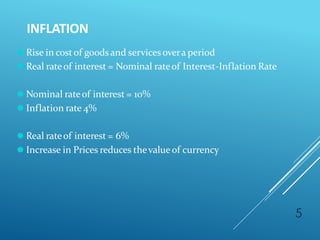
INFLATION
5
⚫ Rise in cost of goodsand services overa period
⚫ Real rateof interest = Nominal rateof Interest-Inflation Rate
⚫ Nominal rateof interest = 10%
⚫ Inflation rate 4%
⚫ Real rateof interest = 6%
⚫ Increase in Prices reduces thevalue of currency
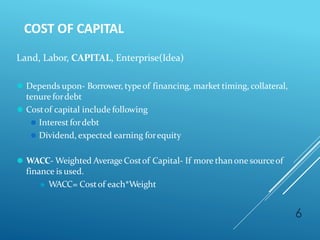
COST OF CAPITAL
6
Land, Labor, CAPITAL, Enterprise(Idea)
⚫ Depends upon- Borrower, typeof financing, market timing, collateral,
tenure fordebt
⚫ Costof capital include following
⚫ Interest fordebt
⚫ Dividend, expected earning forequity
⚫ WACC- Weighted Average Costof Capital- If more thanone sourceof
finance is used.
⚫ WACC= Costof each*Weight
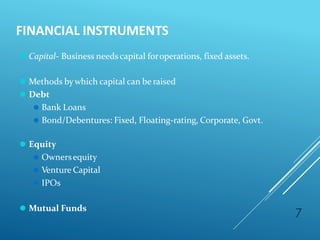
FINANCIAL INSTRUMENTS
7
⚫ Capital- Business needs capital foroperations, fixed assets.
⚫ Methods bywhich capital can be raised
⚫ Debt
⚫ Bank Loans
⚫ Bond/Debentures: Fixed, Floating-rating, Corporate, Govt.
⚫ Equity
⚫ Ownersequity
⚫ Venture Capital
⚫ IPOs
⚫ Mutual Funds
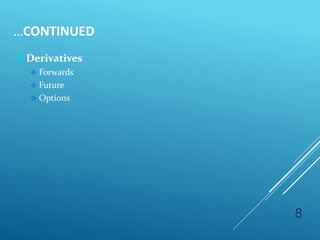
…CONTINUED
8
⚫Derivatives
 Forwards
 Future
 Options
DEBT
9
⚫ Moneyowed by oneentity toother
⚫ Cost is interest
⚫ Debt is considered seniortoequity i.e. the intereston debt is paid
before thedividendson stock in caseof liquidationof assets
⚫ Examples- Bonds, Loan, Commercial papers
⚫ Investorschose between debtand equity based on their investment
objectives
BONDS
10
⚫ An investorloans money toan entityata specific interestrate.
⚫ Small deposits from multiple people
⚫ Investmentceiling
⚫ Interest is generallypaid semiannually
⚫ Factors influencing coupon rate
⚫ Prevailing economic conditions
⚫ Issuers Credit rating (risk)
⚫ In return investorgets the bond/certificatewhich contains:
⚫ Interestrate (Coupon rate)
⚫ Maturitydate (Repayment date)
⚫ Faceamount
…CONTINUED
11
⚫ Corporate bond
⚫ Secured bonds- backed byspecific assets
⚫ Unsecured bonds (Debentures)
⚫ Treasury Securities (Government agencies)
⚫ Treasury bills-Shortterm
⚫ Treasury bonds-Long term
⚫ Mostsecure bonds
EQUITY
12
⚫ Equity (Stock)- representsownership interest
⚫ Common Stock
⚫ Voting Rights
⚫ Majorityshareholdersmanageorganization
⚫ Popular
⚫ Corporations sells it through IPO
⚫ Can be traded in secondary markets-BSE, NYSE etc.
⚫ Preferred Stock
⚫ No voting rights
⚫ Fixed rate of return
MUTUAL FUNDS
13
⚫ Investmentcompanies
⚫ Pool resources from individual investors
⚫ MF companies invest intodiversesectorof economy
⚫ Investorsareequally responsible for loss orgain
⚫ Dividendsearned aredistributed according tothe investment
⚫Hedge Fund
⚫A groupof investorswho take financial risks together in ordertotry
toearn a lotof money
DERIVATIVES
14
⚫ It is acontract between twoor more parties
⚫ Obligation on buyerand seller
⚫ Forward
⚫ Agreementto buy/sell an asset in futureata specified price
⚫ Ex. MCX
⚫ Future
⚫ Agreementto buy/sell an asset in futureata futureprice
FINANCIAL MARKETS
15
Placewhere financial instrumentsare traded
⚫ Primary Financial Markets
⚫ New financial instrumentsare issued
⚫ Initial Public Offering
⚫ Secondary Financial Markets
⚫ Primary instruments (Shares) are traded
⚫ Investorscan monetize theirshares
⚫ Ex. BSE, NYSE
BANKING
16
BANKING
17
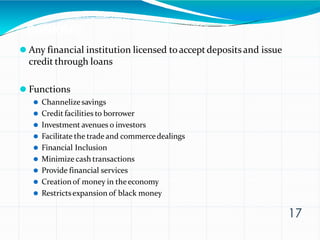
⚫ Any financial institution licensed toacceptdepositsand issue
credit through loans
⚫ Functions
⚫ Channelizesavings
⚫ Credit facilities to borrower
⚫ Investment avenues o investors
⚫ Facilitate the trade and commercedealings
⚫ Financial Inclusion
⚫ Minimize cash transactions
⚫ Provide financial services
⚫ Creationof money in theeconomy
⚫ Restrictsexpansion of black money
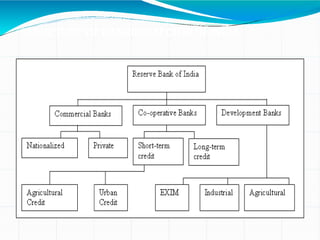
STRUCTURE OF BANKING SECTOR IN INDIA
18
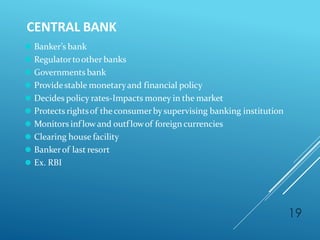
CENTRAL BANK
19
⚫ Banker’s bank
⚫ Regulatortoother banks
⚫ Governments bank
⚫ Providestable monetaryand financial policy
⚫ Decides policy rates-Impacts money in the market
⚫ Protects rightsof theconsumerby supervising banking institution
⚫ Monitors inf lowand outf lowof foreigncurrencies
⚫ Clearing house facility
⚫ Bankerof last resort
⚫ Ex. RBI
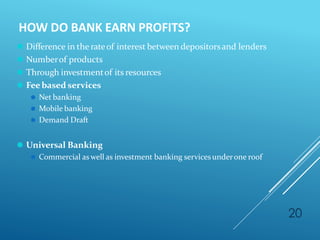
HOW DO BANK EARN PROFITS?
20
⚫ Difference in the rateof interest between depositorsand lenders
⚫ Numberof products
⚫ Through investmentof its resources
⚫ Fee based services
⚫ Net banking
⚫ Mobile banking
⚫ Demand Draft
⚫ Universal Banking
⚫ Commercial as well as investment banking services underone roof
BASEL FRAMEWORK
21
⚫ BIS- Bank of International Settlement
⚫ Located in Basel, Switzerland
⚫ Fostersco-operationamong central banks and otheragencies in
pursuitof monetaryand financial stability.
⚫ A forum topromotediscussionand policyanalysis among central
banks and within the international financial community
⚫ Itsets standards for best practices in banking which areensured by
all banks
SERVICES OFFERED BY BANK
22
1. Corporate banking
1. Trade Finance
2. Cash Management
2. Retail Banking
1. Deposits
2. Branch & Electronic Banking
3. Creditcard services
4. Retail Lending- Home, Personal, Car
5. Private banking & wealth Management
6. Business banking for SMEs
3. InvestmentBanking
RETAIL BANKING
23
⚫ Serves financial needs of individuals (Consumers) and SMEs
⚫ Largevolume lowvalue transactions
⚫ Productsand services
⚫ Deposits
⚫ Loans
⚫ Creditcards
⚫ Debitcards
⚫ Investment products
⚫ Local branches, ATMs
⚫ Net Banking
⚫ Mobile Banking
ASSETS AND LIABILITIES IN BANKING
24
⚫ Liabilities- Money received by bank from depositors
⚫ Asset- Loans extended by bank
⚫ Revenue- Money that is maid byan organization in year
⚫ Liquidate- To sell a business/propertyespecially to pay off debt
⚫ Asset-Reconstruction-Here, the right or interest of any bank or financial
institution in any financial asset is acquired by the asset re-construction company for
the purpose of realization of dues.
⚫ NPA-Non-Performing Asset (bad loans)
⚫ An asset of a bank (such as a loan given by the bank) turns into NPAwhen it
ceases to generate regular income such as interest etc for the bank
⚫ Biggest challenge faced by Indian Public sector banks
⚫ Ex. Kingfisher owes 7000 crore to PSBs
DEPOSIT PRODUCTS
25
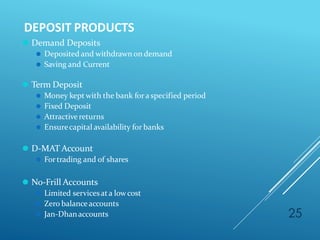
⚫ Demand Deposits
⚫ Deposited and withdrawn on demand
⚫ Saving and Current
⚫ Term Deposit
⚫ Money kept with the bank fora specified period
⚫ Fixed Deposit
⚫ Attractivereturns
⚫ Ensurecapital availability for banks
⚫ D-MAT Account
⚫ Fortrading and of shares
⚫ No-Frill Accounts
⚫ Limited servicesata lowcost
⚫ Zero balanceaccounts
⚫ Jan-Dhanaccounts
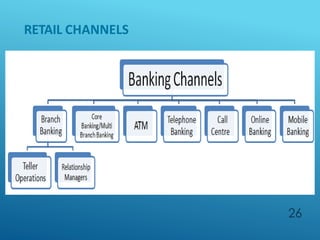
RETAIL CHANNELS
26
BRANCH BANKING
27
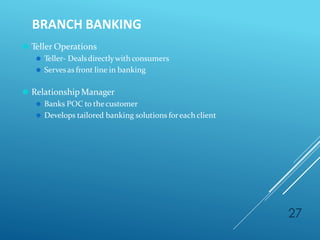
⚫ Teller Operations
⚫ Teller- Dealsdirectlywith consumers
⚫ Servesas front line in banking
⚫ Relationship Manager
⚫ Banks POC to thecustomer
⚫ Develops tailored banking solutions foreach client
CORE BANKING/MULTI-BRANCH BANKING
28
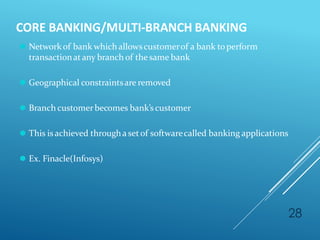
⚫ Networkof bank which allowscustomerof a bank toperform
transactionatany branch of the same bank
⚫ Geographical constraintsare removed
⚫ Branch customerbecomes bank’scustomer
⚫ This is achieved througha set of softwarecalled banking applications
⚫ Ex. Finacle(Infosys)
ATM
29
⚫ Computerized Telecommunication Device
⚫ Typical ATM Services
⚫ Cash withdrawal – Limit perday restricted by respective bank
guidelines
⚫ MoneyTransfer between accounts
⚫ Cash/ Check Deposits
⚫ Utility Bill Payments
⚫ Balance enquiry /Account Statements
⚫ Mobile Top Ups
⚫ VISA & Master networks are large global networks that serviceATMs.
⚫ Interbank operations aresettled in clearing house
TELEPHONE BANKING
30
⚫ Transactionsover phone
⚫ Automated phoneanswering systems(IVR/VRU) with keypad response
⚫ Voice recognitioncapability
⚫ VRU- Voice Response Unit-A Programmed computerresponds tocaller
⚫ IVR- InteractiveVoice Response-Computerphone application which
accepts keypad selection and responds
ONLINE BANKING
31
⚫ Financial transactionson a securewebsiteoperated by respective bank
⚫ Batch transactions – operations arecarried outwith least human
intervention
⚫ Bill Pay and Recurring payments
⚫ E-Tax
⚫ Statements : Monthlyorquarterly bank statements
⚫ Transaction history
⚫ Fund transfer
⚫ NEFT
⚫ RTGS
⚫ IMPS
⚫ IFSC- Indian Financial System Code
⚫ is an alpha-numericcode thatuniquely identifies a bank-branch
participating in the NEFT system.
FUND TRANSFER
32
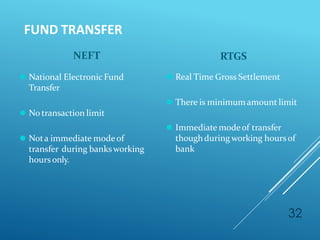
NEFT
⚫ National Electronic Fund
Transfer
⚫ No transaction limit
⚫ Nota immediate modeof
transfer during banksworking
hoursonly.
RTGS
⚫ Real Time Gross Settlement
⚫ There is minimumamount limit
⚫ Immediate modeof transfer
thoughduring working hoursof
bank
IMPS
33
⚫ Immediate Payment Service
⚫ Instant money transferthrough mobile phone oronline
⚫ Mobile numberof remitterand beneficiary should be linked to their
respective bank accounts
⚫ Bestway fortransferring remittances
⚫ MMID- Mobile money identifier is generated
⚫ There is a limiton amountof transaction
⚫ SWIFT- Society forWorldwide Interbank Financial
Telecommunications
⚫ SWIFT transports messages between two financial institutions. This
activity involves the secureexchange of proprietarydatawhileensuring its
confidentiality and integrity
⚫ BIC- Uses Bank Identifier Code
INTERNATIONAL BANKING
34
⚫ Facilitate importsand exportsof theirclients – trade financing
⚫ Arrangeforforeignexchange – cross-bordertransactionsand foreign
investments
⚫ Participate in international loan syndicate – lending to MNCs- project
financing and tosovereigngovernments – economicdevelopment
⚫ Trade foreignexchangeproducts fortheirownaccount
⚫ Gateway forthe transferof remittances byexpatriates
INVESTMENT BANKING
35
⚫Functions
⚫ Private Equity
⚫ Buying/Selling
⚫ CorporateAdvisory
⚫ Managing company assets
⚫ Capital Raising
⚫ Underwriter
⚫ Security middlemen
⚫ Long term financing
⚫ Emerging Markets
⚫ Merger & Acquisitions
⚫ Ex. TechMahindra-Satyam, IGate-Patni, Facebook-Whatsapp
CARDS AND PAYMENTS
36
⚫ Cards- Fastestgrowing means of non-cash payments
⚫ Non-cash payment instruments
⚫ Cheque
⚫ Debit card
⚫ Creditcard
⚫ C0-Branded cards- like creditcards associated with a particular firm
⚫ Affinitycard-Tie-up between a bank and an organization
⚫ Corporate/ Commercial card
⚫ Prepaid card- giftcard, mall cards
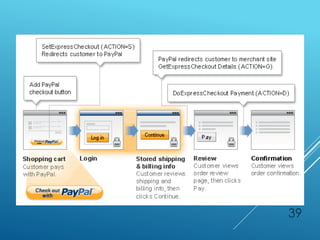
EMERGING PAYMENTS
37
⚫ Internet Currencies/Digital cash/E-wallets
⚫ Preload accountwith money
⚫ Transfer moneyor make payments
⚫ Notime barrier
⚫ No need toentercard credentials
⚫ Ex. Paytm wallet
⚫ Contactless Payments
⚫ Radio Frequency ID
⚫ NearField Communication(NFC)
⚫ Eliminateswiping card, signing slipat the POS
⚫ Targeted ateliminating cash transactionsat retail counters
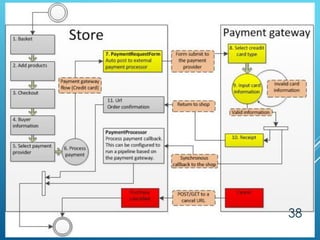
38
39
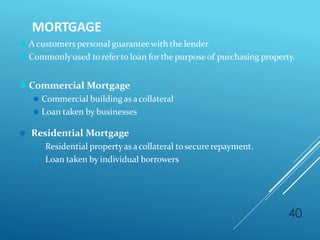
MORTGAGE
40
⚫ A customerspersonal guaranteewith the lender
⚫ Commonlyused toreferto loan forthe purposeof purchasing property.
⚫ Commercial Mortgage
⚫ Commercial building as acollateral
⚫ Loan taken by businesses
⚫ Residential Mortgage
⚫ Residential propertyas acollateral tosecurerepayment.
⚫ Loan taken by individual borrowers
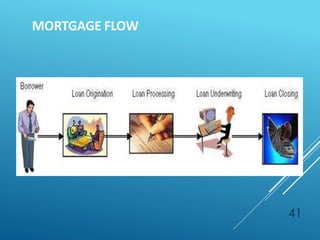
MORTGAGE FLOW
41
ROLE OF INFORMATION TECHNOLOGY (IT) IN
THE BANKING
42
⚫ Competitivenesscompel toadapt to latest technologies
⚫ Instrumentof cost reduction
⚫ Effectivecommunicationwith people and institutionsassociated with
the banking business.
⚫ Bettermarket infrastructure
⚫ helps the financial intermediaries to reach geographicallydistantand
diversified markets in acosteffective manner
INSURANCE
43
⚫ Definition: Insurance is defined as theequitable transferof the risk
of a loss fromoneentity toanother in exchange forpayment
⚫ Terminologies:
⚫ Insurer: Insurancecompany selling the policy
⚫Insured: Policy holderortheentityavailing the policy
⚫ Re-Insurance: Insurance byanother insurerof all ora partof a risk
previouslyassumed by a insurancecompany
44
CONTINUED…
45
⚫ Premium: An amountcharged by insurerin ordertocoverinsured
againsta risk
⚫ Factorsdetermining premium amount:
⚫ The Frequencyof Claims (how many)
⚫ The Severity (Costof each Claim)
⚫ Condition of insurer, kind of policy, probabilityof risk, etc.
⚫ Underwriter: Person whoapproves thepolicy and determines the
premium to becharged againstacoverage.
⚫ Claim: Request by insured in ordertoseek policy benefits from insurer
⚫ Adjudicator: One who processes orsettles theclaims.
TYPES OF INSURANCE
46
⚫ Life Insurance (Long Term)
⚫ Non-Life Insurance (Short Term)
⚫
⚫
⚫
CATEGORY OF INSURANCE
47
⚫ Dental
⚫ Health
⚫ Life
⚫ Business
⚫ Residential
⚫ Transport/Communication
⚫ Other
INSURANCE PROCESSES
48
Branchesof Insurancecompany
1)
2)
3)
4)
5)
6)
7)
Policy Administration Systems
Claim Management System
Investment Management System
Third PartyAdministration Systems
Risk Management Solutions
Regulatory & Compliance
Actuarial System (Valuation & Pricing)
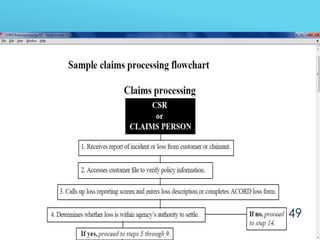
49
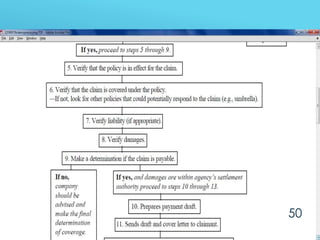
50
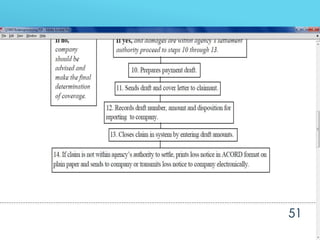
51
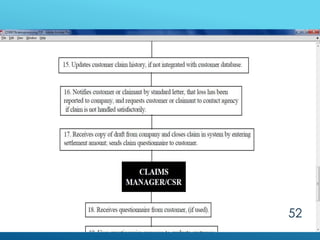
52
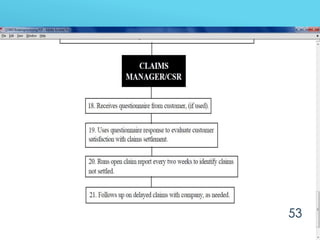
53

Banking Domain.pdf

  • 1.
  • 2.
    OBJECTIVE ⚫ Providean overviewofBanking Domain ⚫ Enable Technologypeople understand Financial Terms ⚫ Explain Operations in specific lines of banking ⚫ CoverGlobal Banking Practices ⚫ Introducesomeof the recentdevelopments in banking
  • 3.
    KEYWORDS 3 ⚫ Conceptof money ⚫Financial Instruments ⚫ Financial Statements ⚫ Introduction toBanking ⚫ Retail Banking ⚫ ConsumerLending ⚫ Cardsand Payments ⚫ Commercialand Wholesale Banking ⚫ Investmentbanking ⚫ InvestmentManagement ⚫ Settlement ⚫ Corporate Services ⚫ Insurance
  • 4.
    MONEY 4 ⚫ Standard unitofExchange- advancement over bartersystem ⚫ Currencies-based upon development level of countries ⚫ Exchange Rates- Whodecides, Pegged currencies ⚫ Facevalueof currency ⚫ Standard Valuecurrency ⚫ Interestcharged on loan amount- Simpleand Compound ⚫ Simple- On Rs.100 by 10 percent, amount paid everyyear is Rs. 10 ⚫ Compound- On Rs.100 by 10 percent, amount paid everyyearvaries
  • 5.
    INFLATION 5 ⚫ Rise incost of goodsand services overa period ⚫ Real rateof interest = Nominal rateof Interest-Inflation Rate ⚫ Nominal rateof interest = 10% ⚫ Inflation rate 4% ⚫ Real rateof interest = 6% ⚫ Increase in Prices reduces thevalue of currency
  • 6.
    COST OF CAPITAL 6 Land,Labor, CAPITAL, Enterprise(Idea) ⚫ Depends upon- Borrower, typeof financing, market timing, collateral, tenure fordebt ⚫ Costof capital include following ⚫ Interest fordebt ⚫ Dividend, expected earning forequity ⚫ WACC- Weighted Average Costof Capital- If more thanone sourceof finance is used. ⚫ WACC= Costof each*Weight
  • 7.
    FINANCIAL INSTRUMENTS 7 ⚫ Capital-Business needs capital foroperations, fixed assets. ⚫ Methods bywhich capital can be raised ⚫ Debt ⚫ Bank Loans ⚫ Bond/Debentures: Fixed, Floating-rating, Corporate, Govt. ⚫ Equity ⚫ Ownersequity ⚫ Venture Capital ⚫ IPOs ⚫ Mutual Funds
  • 8.
  • 9.
    DEBT 9 ⚫ Moneyowed byoneentity toother ⚫ Cost is interest ⚫ Debt is considered seniortoequity i.e. the intereston debt is paid before thedividendson stock in caseof liquidationof assets ⚫ Examples- Bonds, Loan, Commercial papers ⚫ Investorschose between debtand equity based on their investment objectives
  • 10.
    BONDS 10 ⚫ An investorloansmoney toan entityata specific interestrate. ⚫ Small deposits from multiple people ⚫ Investmentceiling ⚫ Interest is generallypaid semiannually ⚫ Factors influencing coupon rate ⚫ Prevailing economic conditions ⚫ Issuers Credit rating (risk) ⚫ In return investorgets the bond/certificatewhich contains: ⚫ Interestrate (Coupon rate) ⚫ Maturitydate (Repayment date) ⚫ Faceamount
  • 11.
    …CONTINUED 11 ⚫ Corporate bond ⚫Secured bonds- backed byspecific assets ⚫ Unsecured bonds (Debentures) ⚫ Treasury Securities (Government agencies) ⚫ Treasury bills-Shortterm ⚫ Treasury bonds-Long term ⚫ Mostsecure bonds
  • 12.
    EQUITY 12 ⚫ Equity (Stock)-representsownership interest ⚫ Common Stock ⚫ Voting Rights ⚫ Majorityshareholdersmanageorganization ⚫ Popular ⚫ Corporations sells it through IPO ⚫ Can be traded in secondary markets-BSE, NYSE etc. ⚫ Preferred Stock ⚫ No voting rights ⚫ Fixed rate of return
  • 13.
    MUTUAL FUNDS 13 ⚫ Investmentcompanies ⚫Pool resources from individual investors ⚫ MF companies invest intodiversesectorof economy ⚫ Investorsareequally responsible for loss orgain ⚫ Dividendsearned aredistributed according tothe investment ⚫Hedge Fund ⚫A groupof investorswho take financial risks together in ordertotry toearn a lotof money
  • 14.
    DERIVATIVES 14 ⚫ It isacontract between twoor more parties ⚫ Obligation on buyerand seller ⚫ Forward ⚫ Agreementto buy/sell an asset in futureata specified price ⚫ Ex. MCX ⚫ Future ⚫ Agreementto buy/sell an asset in futureata futureprice
  • 15.
    FINANCIAL MARKETS 15 Placewhere financialinstrumentsare traded ⚫ Primary Financial Markets ⚫ New financial instrumentsare issued ⚫ Initial Public Offering ⚫ Secondary Financial Markets ⚫ Primary instruments (Shares) are traded ⚫ Investorscan monetize theirshares ⚫ Ex. BSE, NYSE
  • 16.
  • 17.
    BANKING 17 ⚫ Any financialinstitution licensed toacceptdepositsand issue credit through loans ⚫ Functions ⚫ Channelizesavings ⚫ Credit facilities to borrower ⚫ Investment avenues o investors ⚫ Facilitate the trade and commercedealings ⚫ Financial Inclusion ⚫ Minimize cash transactions ⚫ Provide financial services ⚫ Creationof money in theeconomy ⚫ Restrictsexpansion of black money
  • 18.
    STRUCTURE OF BANKINGSECTOR IN INDIA 18
  • 19.
    CENTRAL BANK 19 ⚫ Banker’sbank ⚫ Regulatortoother banks ⚫ Governments bank ⚫ Providestable monetaryand financial policy ⚫ Decides policy rates-Impacts money in the market ⚫ Protects rightsof theconsumerby supervising banking institution ⚫ Monitors inf lowand outf lowof foreigncurrencies ⚫ Clearing house facility ⚫ Bankerof last resort ⚫ Ex. RBI
  • 20.
    HOW DO BANKEARN PROFITS? 20 ⚫ Difference in the rateof interest between depositorsand lenders ⚫ Numberof products ⚫ Through investmentof its resources ⚫ Fee based services ⚫ Net banking ⚫ Mobile banking ⚫ Demand Draft ⚫ Universal Banking ⚫ Commercial as well as investment banking services underone roof
  • 21.
    BASEL FRAMEWORK 21 ⚫ BIS-Bank of International Settlement ⚫ Located in Basel, Switzerland ⚫ Fostersco-operationamong central banks and otheragencies in pursuitof monetaryand financial stability. ⚫ A forum topromotediscussionand policyanalysis among central banks and within the international financial community ⚫ Itsets standards for best practices in banking which areensured by all banks
  • 22.
    SERVICES OFFERED BYBANK 22 1. Corporate banking 1. Trade Finance 2. Cash Management 2. Retail Banking 1. Deposits 2. Branch & Electronic Banking 3. Creditcard services 4. Retail Lending- Home, Personal, Car 5. Private banking & wealth Management 6. Business banking for SMEs 3. InvestmentBanking
  • 23.
    RETAIL BANKING 23 ⚫ Servesfinancial needs of individuals (Consumers) and SMEs ⚫ Largevolume lowvalue transactions ⚫ Productsand services ⚫ Deposits ⚫ Loans ⚫ Creditcards ⚫ Debitcards ⚫ Investment products ⚫ Local branches, ATMs ⚫ Net Banking ⚫ Mobile Banking
  • 24.
    ASSETS AND LIABILITIESIN BANKING 24 ⚫ Liabilities- Money received by bank from depositors ⚫ Asset- Loans extended by bank ⚫ Revenue- Money that is maid byan organization in year ⚫ Liquidate- To sell a business/propertyespecially to pay off debt ⚫ Asset-Reconstruction-Here, the right or interest of any bank or financial institution in any financial asset is acquired by the asset re-construction company for the purpose of realization of dues. ⚫ NPA-Non-Performing Asset (bad loans) ⚫ An asset of a bank (such as a loan given by the bank) turns into NPAwhen it ceases to generate regular income such as interest etc for the bank ⚫ Biggest challenge faced by Indian Public sector banks ⚫ Ex. Kingfisher owes 7000 crore to PSBs
  • 25.
    DEPOSIT PRODUCTS 25 ⚫ DemandDeposits ⚫ Deposited and withdrawn on demand ⚫ Saving and Current ⚫ Term Deposit ⚫ Money kept with the bank fora specified period ⚫ Fixed Deposit ⚫ Attractivereturns ⚫ Ensurecapital availability for banks ⚫ D-MAT Account ⚫ Fortrading and of shares ⚫ No-Frill Accounts ⚫ Limited servicesata lowcost ⚫ Zero balanceaccounts ⚫ Jan-Dhanaccounts
  • 26.
  • 27.
    BRANCH BANKING 27 ⚫ TellerOperations ⚫ Teller- Dealsdirectlywith consumers ⚫ Servesas front line in banking ⚫ Relationship Manager ⚫ Banks POC to thecustomer ⚫ Develops tailored banking solutions foreach client
  • 28.
    CORE BANKING/MULTI-BRANCH BANKING 28 ⚫Networkof bank which allowscustomerof a bank toperform transactionatany branch of the same bank ⚫ Geographical constraintsare removed ⚫ Branch customerbecomes bank’scustomer ⚫ This is achieved througha set of softwarecalled banking applications ⚫ Ex. Finacle(Infosys)
  • 29.
    ATM 29 ⚫ Computerized TelecommunicationDevice ⚫ Typical ATM Services ⚫ Cash withdrawal – Limit perday restricted by respective bank guidelines ⚫ MoneyTransfer between accounts ⚫ Cash/ Check Deposits ⚫ Utility Bill Payments ⚫ Balance enquiry /Account Statements ⚫ Mobile Top Ups ⚫ VISA & Master networks are large global networks that serviceATMs. ⚫ Interbank operations aresettled in clearing house
  • 30.
    TELEPHONE BANKING 30 ⚫ Transactionsoverphone ⚫ Automated phoneanswering systems(IVR/VRU) with keypad response ⚫ Voice recognitioncapability ⚫ VRU- Voice Response Unit-A Programmed computerresponds tocaller ⚫ IVR- InteractiveVoice Response-Computerphone application which accepts keypad selection and responds
  • 31.
    ONLINE BANKING 31 ⚫ Financialtransactionson a securewebsiteoperated by respective bank ⚫ Batch transactions – operations arecarried outwith least human intervention ⚫ Bill Pay and Recurring payments ⚫ E-Tax ⚫ Statements : Monthlyorquarterly bank statements ⚫ Transaction history ⚫ Fund transfer ⚫ NEFT ⚫ RTGS ⚫ IMPS ⚫ IFSC- Indian Financial System Code ⚫ is an alpha-numericcode thatuniquely identifies a bank-branch participating in the NEFT system.
  • 32.
    FUND TRANSFER 32 NEFT ⚫ NationalElectronic Fund Transfer ⚫ No transaction limit ⚫ Nota immediate modeof transfer during banksworking hoursonly. RTGS ⚫ Real Time Gross Settlement ⚫ There is minimumamount limit ⚫ Immediate modeof transfer thoughduring working hoursof bank
  • 33.
    IMPS 33 ⚫ Immediate PaymentService ⚫ Instant money transferthrough mobile phone oronline ⚫ Mobile numberof remitterand beneficiary should be linked to their respective bank accounts ⚫ Bestway fortransferring remittances ⚫ MMID- Mobile money identifier is generated ⚫ There is a limiton amountof transaction ⚫ SWIFT- Society forWorldwide Interbank Financial Telecommunications ⚫ SWIFT transports messages between two financial institutions. This activity involves the secureexchange of proprietarydatawhileensuring its confidentiality and integrity ⚫ BIC- Uses Bank Identifier Code
  • 34.
    INTERNATIONAL BANKING 34 ⚫ Facilitateimportsand exportsof theirclients – trade financing ⚫ Arrangeforforeignexchange – cross-bordertransactionsand foreign investments ⚫ Participate in international loan syndicate – lending to MNCs- project financing and tosovereigngovernments – economicdevelopment ⚫ Trade foreignexchangeproducts fortheirownaccount ⚫ Gateway forthe transferof remittances byexpatriates
  • 35.
    INVESTMENT BANKING 35 ⚫Functions ⚫ PrivateEquity ⚫ Buying/Selling ⚫ CorporateAdvisory ⚫ Managing company assets ⚫ Capital Raising ⚫ Underwriter ⚫ Security middlemen ⚫ Long term financing ⚫ Emerging Markets ⚫ Merger & Acquisitions ⚫ Ex. TechMahindra-Satyam, IGate-Patni, Facebook-Whatsapp
  • 36.
    CARDS AND PAYMENTS 36 ⚫Cards- Fastestgrowing means of non-cash payments ⚫ Non-cash payment instruments ⚫ Cheque ⚫ Debit card ⚫ Creditcard ⚫ C0-Branded cards- like creditcards associated with a particular firm ⚫ Affinitycard-Tie-up between a bank and an organization ⚫ Corporate/ Commercial card ⚫ Prepaid card- giftcard, mall cards
  • 37.
    EMERGING PAYMENTS 37 ⚫ InternetCurrencies/Digital cash/E-wallets ⚫ Preload accountwith money ⚫ Transfer moneyor make payments ⚫ Notime barrier ⚫ No need toentercard credentials ⚫ Ex. Paytm wallet ⚫ Contactless Payments ⚫ Radio Frequency ID ⚫ NearField Communication(NFC) ⚫ Eliminateswiping card, signing slipat the POS ⚫ Targeted ateliminating cash transactionsat retail counters
  • 38.
  • 39.
  • 40.
    MORTGAGE 40 ⚫ A customerspersonalguaranteewith the lender ⚫ Commonlyused toreferto loan forthe purposeof purchasing property. ⚫ Commercial Mortgage ⚫ Commercial building as acollateral ⚫ Loan taken by businesses ⚫ Residential Mortgage ⚫ Residential propertyas acollateral tosecurerepayment. ⚫ Loan taken by individual borrowers
  • 41.
  • 42.
    ROLE OF INFORMATIONTECHNOLOGY (IT) IN THE BANKING 42 ⚫ Competitivenesscompel toadapt to latest technologies ⚫ Instrumentof cost reduction ⚫ Effectivecommunicationwith people and institutionsassociated with the banking business. ⚫ Bettermarket infrastructure ⚫ helps the financial intermediaries to reach geographicallydistantand diversified markets in acosteffective manner
  • 43.
  • 44.
    ⚫ Definition: Insuranceis defined as theequitable transferof the risk of a loss fromoneentity toanother in exchange forpayment ⚫ Terminologies: ⚫ Insurer: Insurancecompany selling the policy ⚫Insured: Policy holderortheentityavailing the policy ⚫ Re-Insurance: Insurance byanother insurerof all ora partof a risk previouslyassumed by a insurancecompany 44
  • 45.
    CONTINUED… 45 ⚫ Premium: Anamountcharged by insurerin ordertocoverinsured againsta risk ⚫ Factorsdetermining premium amount: ⚫ The Frequencyof Claims (how many) ⚫ The Severity (Costof each Claim) ⚫ Condition of insurer, kind of policy, probabilityof risk, etc. ⚫ Underwriter: Person whoapproves thepolicy and determines the premium to becharged againstacoverage. ⚫ Claim: Request by insured in ordertoseek policy benefits from insurer ⚫ Adjudicator: One who processes orsettles theclaims.
  • 46.
    TYPES OF INSURANCE 46 ⚫Life Insurance (Long Term) ⚫ Non-Life Insurance (Short Term) ⚫ ⚫ ⚫
  • 47.
    CATEGORY OF INSURANCE 47 ⚫Dental ⚫ Health ⚫ Life ⚫ Business ⚫ Residential ⚫ Transport/Communication ⚫ Other
  • 48.
    INSURANCE PROCESSES 48 Branchesof Insurancecompany 1) 2) 3) 4) 5) 6) 7) PolicyAdministration Systems Claim Management System Investment Management System Third PartyAdministration Systems Risk Management Solutions Regulatory & Compliance Actuarial System (Valuation & Pricing)
  • 49.
  • 50.
  • 51.
  • 52.
  • 53.