
Financial Education
Class VII
A Section 8 (Not for Profit) Company
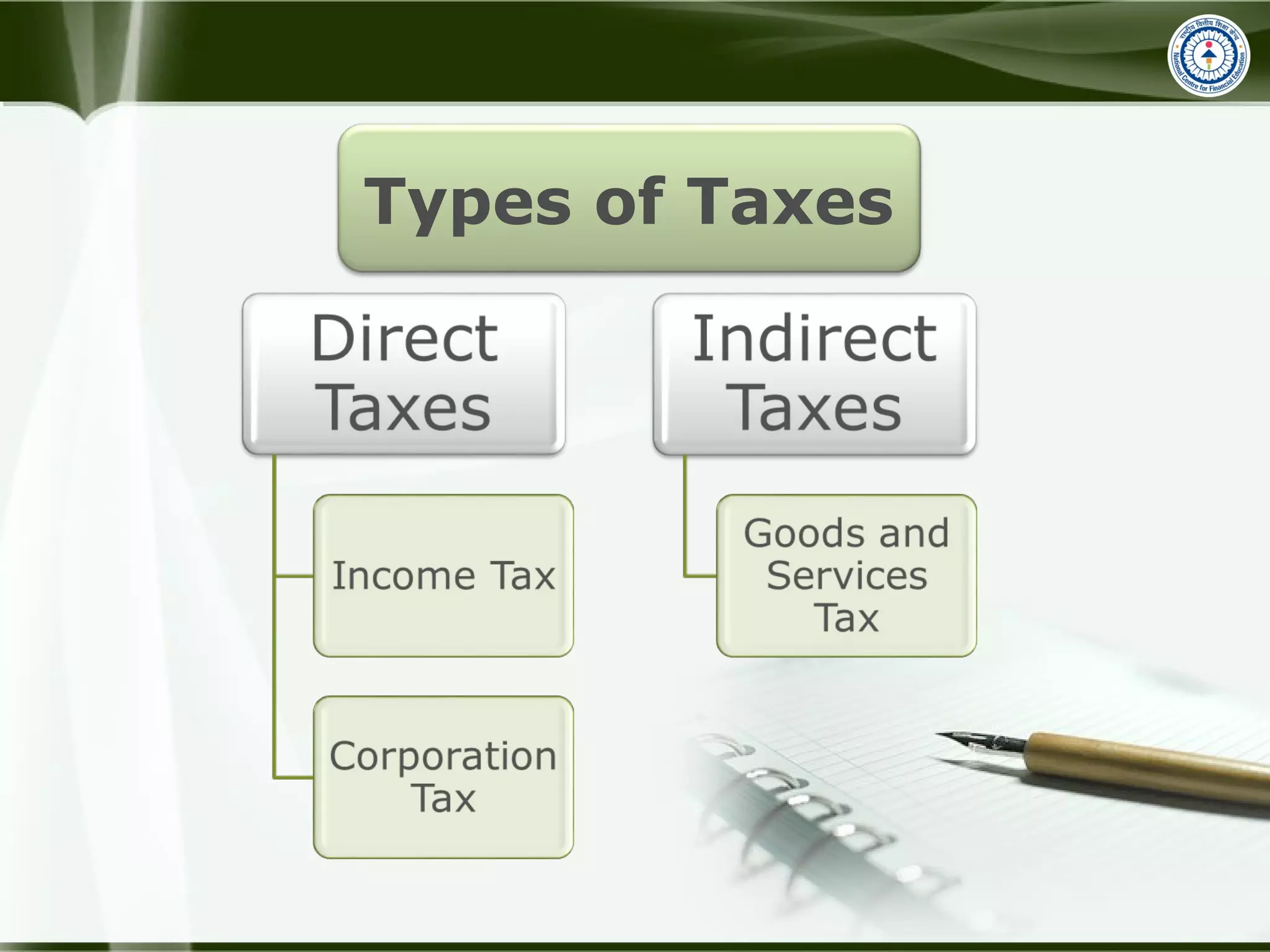
Types of Taxes
Need and Sources
of Borrowing
Need of Borrowing
 Borrowing helps us fill the gap between what
we have and what we need.
 It helps us deal with the temporary scarcity.
 What is borrowed is supposed to be returned
in a pre-determined period of time with
interest.
Sources of Borrowing
Internal Sources
of Borrowing
External Sources
of Borrowing
When we borrow from
friends, family,
relatives, etc., it is
called internal source of
borrowing.
We borrow from banks,
other financial
institutions and non-
institutional lenders e.g.
moneylenders, NBFCs
etc.
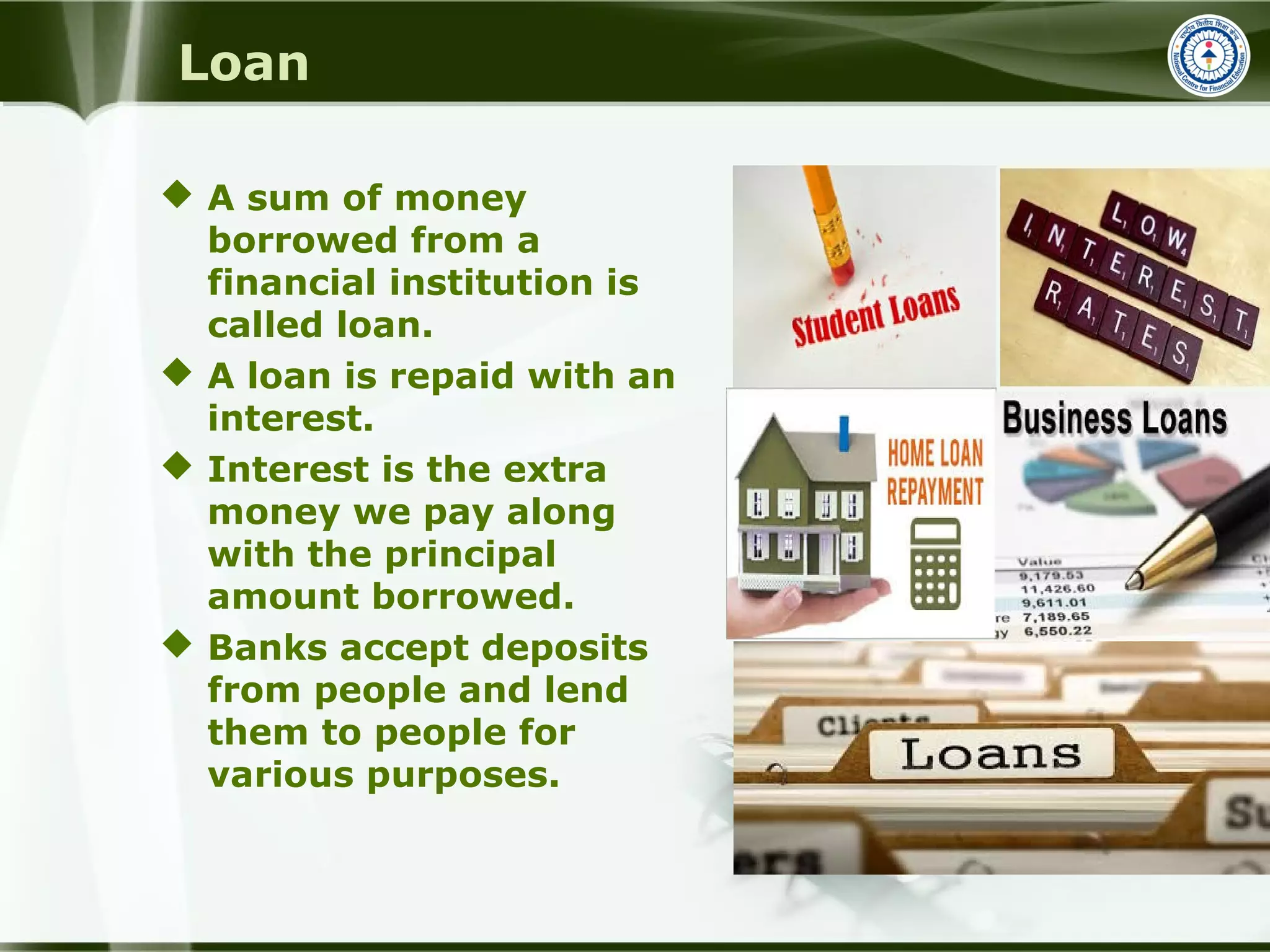
Loan
 A sum of money
borrowed from a
financial institution is
called loan.
 A loan is repaid with an
interest.
 Interest is the extra
money we pay along
with the principal
amount borrowed.
 Banks accept deposits
from people and lend
them to people for
various purposes.
Role and Functions
of the RBI
What is RBI?
 Every country has an organization called the
central bank of the country.
 It controls and monitors the banking and
financial system of the country.
 In India, the Reserve Bank of India (RBI) is
the central bank and it plays the role of a
regulator of the banking system of the
country.
 The RBI was established in 1935 and was
nationalized in 1949. The Banking Regulation
Act 1949 and the RBI Act 1935 have given
the RBI the power to regulate the banking
system.
Role of RBI
 The RBI is responsible for controlling the
overall operations of all banks in India.
These banks may be:
 Public sector banks
 Private sector banks
 Foreign banks
 Co-operative banks
 Regional rural banks
 It maintains people’s confidence in the
banking system.
 It provides forum for redressing customer’s
grievances.
Main Functions of RBI
 Monetary authority
 Issuer of currency
 Banker and debt manager to Government
 Banker to Banks
 Regulator and supervisor of the financial
institutions
 Manager of Foreign Exchange
 Regulator and Supervisor of the Payment and
Settlement Systems
 Maintaining financial stability
 Developmental role
Issuer of Currency
 RBI issues currency notes.
 Coins and one rupee notes are supplied by
Government of India and RBI only helps in its
distribution.
 Every bank note issued by RBI has signature
of the RBI governor on it.
 Rupee one notes however have the signature
of the Finance Secretary, Government of
India.
Promissory Clause
 The promissory clause refers to the Bank’s
obligation to pay.
 All the currency notes issued by RBI have a
promissory clause written on it.
“I promise to pay the bearer the sum of
…………………….Rupees”.
Consumer
Protection
Consumer Rights
 Protection from all kinds of hazardous goods
and services.
 Full information about the performance and
quality of all goods and services.
 Freely choose goods and services.
 Grievance making and redressal (in case of
infringement of consumer rights)
 Be heard in all decision-making processes
related to consumer interests.
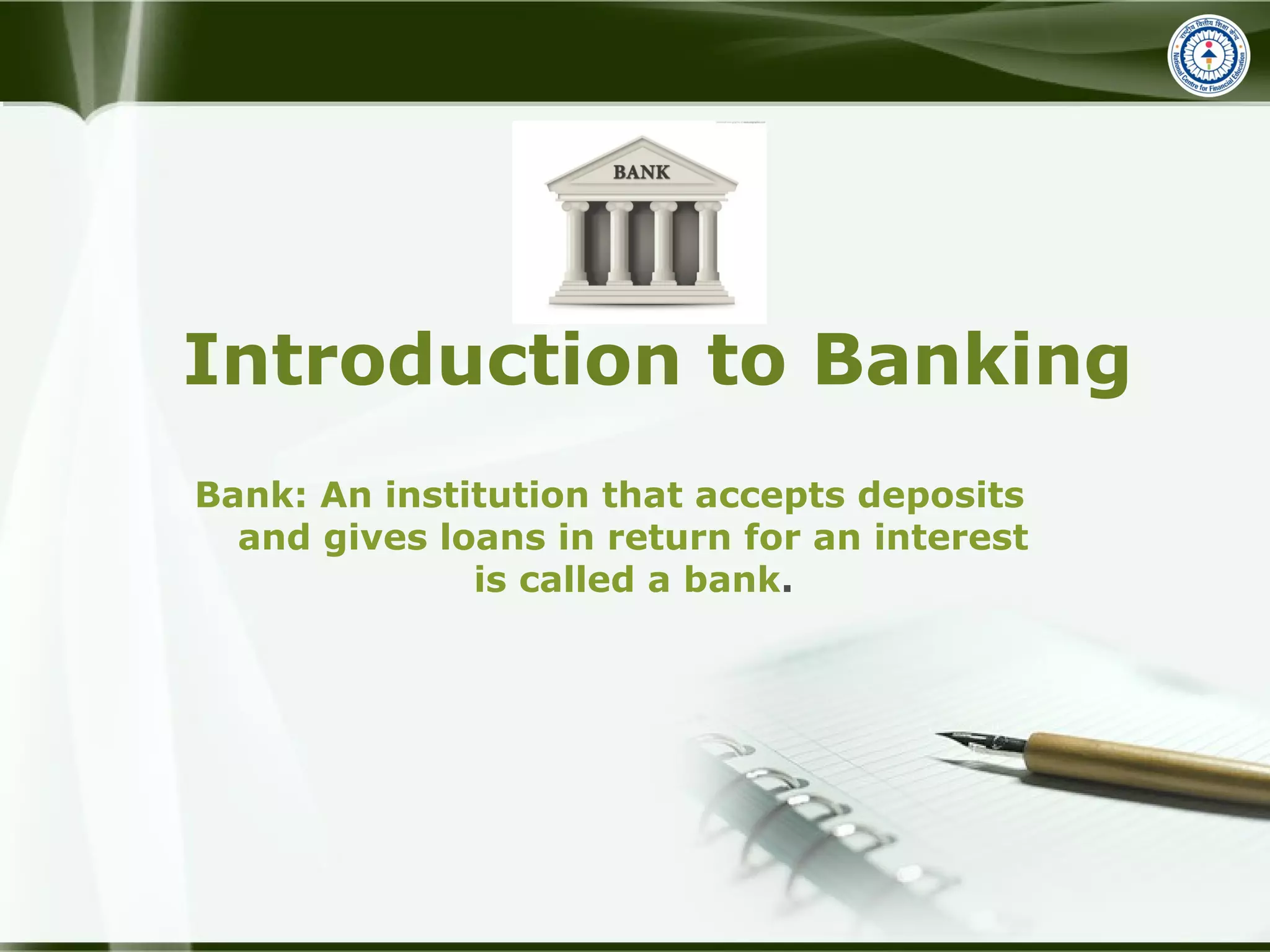
Introduction to Banking
Bank: An institution that accepts deposits
and gives loans in return for an interest
is called a bank.
Deposits
 Bank accepts money
from the public.
 A person depositing
money in the bank is
benefitted from the
interest that bank pays
to the depositor over a
specific period of time.
 Example of Deposits:
Time Deposits, Savings
account, etc.
Loans
 Bank gives money to
the public.
 A person taking loan
from the bank is
charged with a
percentage of interest
that he has to pay to
the bank over a specific
time period.
 Example of Loans:
Home loan, Car loan,
education loan, etc.
Credit Card
 Issued by a financial institution, usually
banks, giving the holder an option to buy
goods and services without making any
actual cash payment.
 A type of short-term borrowing.
 The card holder has to pay the money back to
the bank within 30-50 days and an interest
is charged on late payment.
Debit Card
 Issued by a bank, allows the holder access to
his account to withdraw cash or pay for
goods and services.
 It’s a type of plastic money that allows
access only to ones own deposited money.
 The card holder can go to an ATM or pay
electronically at merchant locations.
Removes the need for cheques as it enables
immediate transfer and withdrawal of cash.
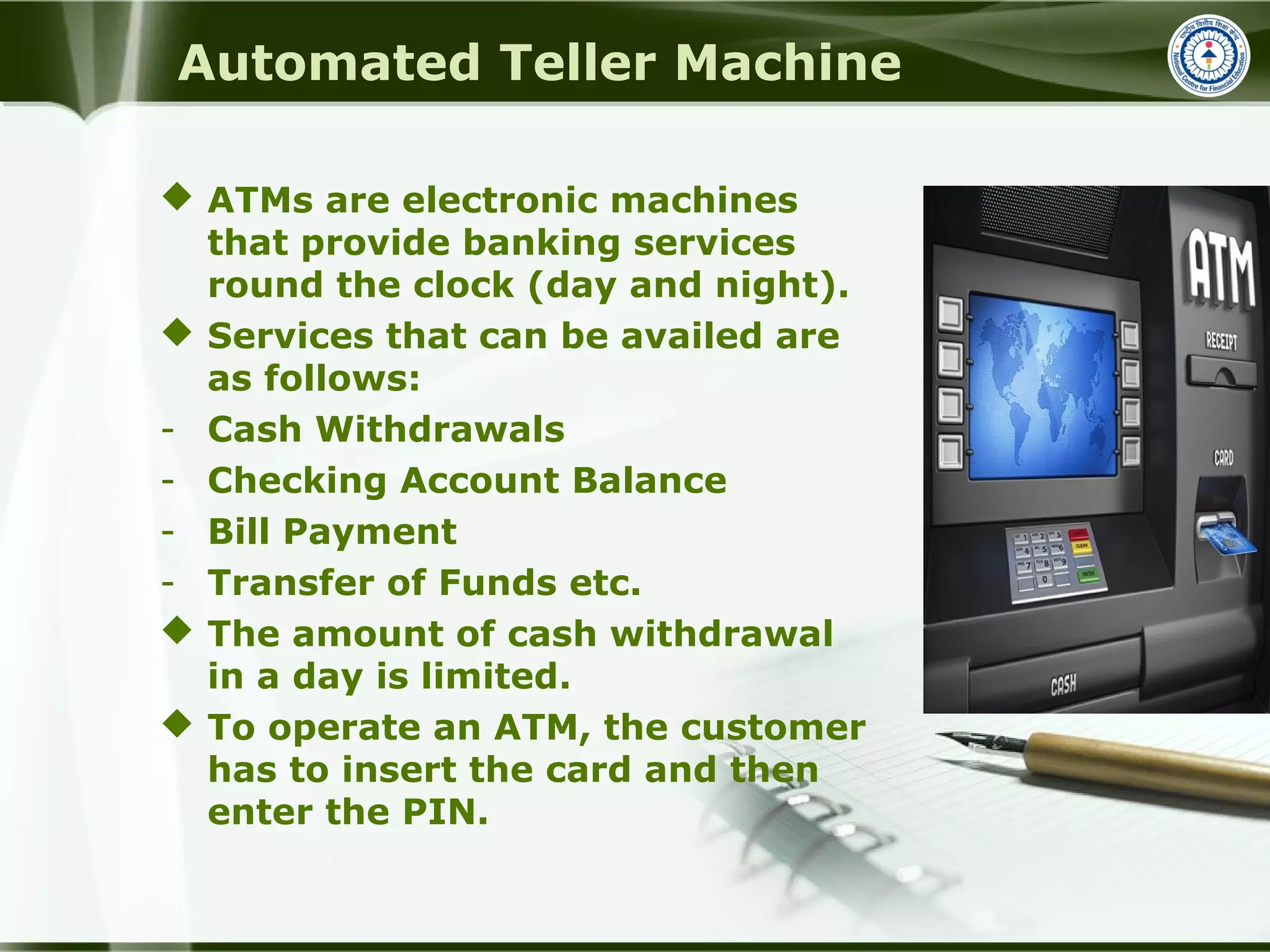
Automated Teller Machine
 ATMs are electronic machines
that provide banking services
round the clock (day and night).
 Services that can be availed are
as follows:
- Cash Withdrawals
- Checking Account Balance
- Bill Payment
- Transfer of Funds etc.
 The amount of cash withdrawal
in a day is limited.
 To operate an ATM, the customer
has to insert the card and then
enter the PIN.
ATM Card and PIN
 ATM card is used in an ATM machine for using
the banking services.
 ATM is a plastic card, magnetically coded and
contains a unique card number and some
security information which can be read by the
machine.
 Every card (ATM card, Credit card and Debit
card) comes with an expiration date and
requires a PIN.
 PIN or Personal Identification Number has to
be entered in an ATM machine to use the
card.
 A card in the ATM can be used only if the PIN
is correct.
Cheque
 A payment instruction from the account
holder to his/her bank directing to pay a
certain sum of money to a specific person or
the bearer of the instrument is called cheque.
 This process takes 1-3 days depending on the
local clearing house procedures.
 The presence of sufficient balance of funds in
ones account must be ensured before issuing
it.
Banking
Banking is an institution which accepts money
from one person as deposits and lends to
other person as loan in return for some
interest.
Types of Accounts
Traditionally, banks in India have 4 types of
deposit accounts.
Opened to run a business that have a large
number of daily banking transactions. It is a
non-interest bearing bank account. It needs a
higher minimum balance to be maintained.
Current Account
Savings Bank Account
Opened to encourage people to save and
deposit their small savings. Interest paid is
normal. Can be opened in single or joint
names. Allowed to withdraw money as and
when required. There is lot of flexibility for
deposits and withdrawals of funds from the
account. Basic Savings Bank Deposit Account
has no minimum balance requirement.
Recurring Deposit
Opened by those who want to save regularly
for a certain period of time and earn a higher
interest rate than Savings Bank Account. No
withdrawals are allowed. However, banks
may allow closing the account before the
maturity period within which any default
attracts small penalty. RD are normally
allowed for 6 months to 120 months
maturity. It can be opened in single or joint
names.
Fixed Deposit
Opened for a particular fixed term by
depositing particular amount of money.
Money is deposited for 7 days to 10 years.
Withdrawal cannot be made before expiry (if
closed before maturity, penalty is imposed).
Interest amount is paid in lump sum, monthly
or quarterly. Deposits can be renewed for
further period.
Banking: With new technology
 A system through which electronic
instructions can be given for instant
transfer of funds from the account of a
customer in one bank to the account of
a customer of another bank across
cities. RTGS takes place on a ‘real time’
basis. The beneficiary’s bank has the
responsibility to credit his account
within 2 hours from the initiation time
of transaction. Minimum amount
transferred is 2 lakh rupees.
 Anyone can transfer funds directly from
his account to the bank account of
receiver/beneficiary. Operates in hourly
batches. Amount is credited in the
beneficiary’s account within 2 hours.
There is no minimum or maximum limit
for transferring money through NEFT.
 Real Time
Gross
Settlement
(RTGS)
 National
Electronic
Fund
Transfer
(NEFT)
Banking: With new technology (cont.)
 Allows individuals to carry out banking
activities anytime, anywhere via
internet without visiting a bank branch.
Enables routine transactions such as
money transfer, balance inquiry, bill
payments, etc.
 The use of cellular device to perform
banking activities. A customer needs to
register with the bank.
 Internet
Banking
 Mobile
Banking
Living within means
 Sneha’s daddy used to spend on expensive gifts for
his daughter.
 But he used his card for this.
 Members of the family were concerned on the type
of card used by Sneha’s father.
 He had used the debit card but Sneha was not aware
about the difference between the debit card and
credit card.
 Sneha thought that her father was spending without
having money (which is through credit card).
 The difference between both the cards was
explained and everyone was convinced that they
were living within their means and were not
borrowing money unnecessarily.
Go for Shopping
Quick terms
 Marked Price or Maximum Retail Price (MRP)
of a product is the upper limit on the price of
an item set by the manufacturer. Charging
price more than the MRP of a product is
illegal.
 Selling Price of the product is the actual price
paid to the shopkeeper for purchasing the
product.
 Cost price of the product is the cost to
produce the product without any profit.
 Profit/Loss = Selling Price – Cost Price
 Selling Price > Cost Price = Profit.
 Selling Price < Cost Price = Loss.
Simple Interest
Formula to calculate simple interest:
SI = Prt/100, where
SI = Simple Interest
P = Principal
r = Interest rate
t = time
Thank You
Email : ncfe@nism.ac.in
Call : 022 6673 4600-01
Like : facebook.com/ncfeindia
Follow : twitter.com/ncfeindia
Share : youtube.com/ncfeindia

Class VII ppt based on Financial Education workbook

  • 1.
    Financial Education Class VII ASection 8 (Not for Profit) Company
  • 2.
  • 3.
  • 4.
    Need of Borrowing Borrowing helps us fill the gap between what we have and what we need.  It helps us deal with the temporary scarcity.  What is borrowed is supposed to be returned in a pre-determined period of time with interest.
  • 5.
    Sources of Borrowing InternalSources of Borrowing External Sources of Borrowing When we borrow from friends, family, relatives, etc., it is called internal source of borrowing. We borrow from banks, other financial institutions and non- institutional lenders e.g. moneylenders, NBFCs etc.
  • 6.
    Loan  A sumof money borrowed from a financial institution is called loan.  A loan is repaid with an interest.  Interest is the extra money we pay along with the principal amount borrowed.  Banks accept deposits from people and lend them to people for various purposes.
  • 7.
  • 8.
    What is RBI? Every country has an organization called the central bank of the country.  It controls and monitors the banking and financial system of the country.  In India, the Reserve Bank of India (RBI) is the central bank and it plays the role of a regulator of the banking system of the country.  The RBI was established in 1935 and was nationalized in 1949. The Banking Regulation Act 1949 and the RBI Act 1935 have given the RBI the power to regulate the banking system.
  • 9.
    Role of RBI The RBI is responsible for controlling the overall operations of all banks in India. These banks may be:  Public sector banks  Private sector banks  Foreign banks  Co-operative banks  Regional rural banks  It maintains people’s confidence in the banking system.  It provides forum for redressing customer’s grievances.
  • 10.
    Main Functions ofRBI  Monetary authority  Issuer of currency  Banker and debt manager to Government  Banker to Banks  Regulator and supervisor of the financial institutions  Manager of Foreign Exchange  Regulator and Supervisor of the Payment and Settlement Systems  Maintaining financial stability  Developmental role
  • 11.
    Issuer of Currency RBI issues currency notes.  Coins and one rupee notes are supplied by Government of India and RBI only helps in its distribution.  Every bank note issued by RBI has signature of the RBI governor on it.  Rupee one notes however have the signature of the Finance Secretary, Government of India.
  • 12.
    Promissory Clause  Thepromissory clause refers to the Bank’s obligation to pay.  All the currency notes issued by RBI have a promissory clause written on it. “I promise to pay the bearer the sum of …………………….Rupees”.
  • 13.
  • 14.
    Consumer Rights  Protectionfrom all kinds of hazardous goods and services.  Full information about the performance and quality of all goods and services.  Freely choose goods and services.  Grievance making and redressal (in case of infringement of consumer rights)  Be heard in all decision-making processes related to consumer interests.
  • 15.
    Introduction to Banking Bank:An institution that accepts deposits and gives loans in return for an interest is called a bank.
  • 16.
    Deposits  Bank acceptsmoney from the public.  A person depositing money in the bank is benefitted from the interest that bank pays to the depositor over a specific period of time.  Example of Deposits: Time Deposits, Savings account, etc. Loans  Bank gives money to the public.  A person taking loan from the bank is charged with a percentage of interest that he has to pay to the bank over a specific time period.  Example of Loans: Home loan, Car loan, education loan, etc.
  • 17.
    Credit Card  Issuedby a financial institution, usually banks, giving the holder an option to buy goods and services without making any actual cash payment.  A type of short-term borrowing.  The card holder has to pay the money back to the bank within 30-50 days and an interest is charged on late payment.
  • 18.
    Debit Card  Issuedby a bank, allows the holder access to his account to withdraw cash or pay for goods and services.  It’s a type of plastic money that allows access only to ones own deposited money.  The card holder can go to an ATM or pay electronically at merchant locations. Removes the need for cheques as it enables immediate transfer and withdrawal of cash.
  • 19.
    Automated Teller Machine ATMs are electronic machines that provide banking services round the clock (day and night).  Services that can be availed are as follows: - Cash Withdrawals - Checking Account Balance - Bill Payment - Transfer of Funds etc.  The amount of cash withdrawal in a day is limited.  To operate an ATM, the customer has to insert the card and then enter the PIN.
  • 20.
    ATM Card andPIN  ATM card is used in an ATM machine for using the banking services.  ATM is a plastic card, magnetically coded and contains a unique card number and some security information which can be read by the machine.  Every card (ATM card, Credit card and Debit card) comes with an expiration date and requires a PIN.  PIN or Personal Identification Number has to be entered in an ATM machine to use the card.  A card in the ATM can be used only if the PIN is correct.
  • 21.
    Cheque  A paymentinstruction from the account holder to his/her bank directing to pay a certain sum of money to a specific person or the bearer of the instrument is called cheque.  This process takes 1-3 days depending on the local clearing house procedures.  The presence of sufficient balance of funds in ones account must be ensured before issuing it.
  • 22.
    Banking Banking is aninstitution which accepts money from one person as deposits and lends to other person as loan in return for some interest.
  • 23.
    Types of Accounts Traditionally,banks in India have 4 types of deposit accounts.
  • 24.
    Opened to runa business that have a large number of daily banking transactions. It is a non-interest bearing bank account. It needs a higher minimum balance to be maintained. Current Account
  • 25.
    Savings Bank Account Openedto encourage people to save and deposit their small savings. Interest paid is normal. Can be opened in single or joint names. Allowed to withdraw money as and when required. There is lot of flexibility for deposits and withdrawals of funds from the account. Basic Savings Bank Deposit Account has no minimum balance requirement.
  • 26.
    Recurring Deposit Opened bythose who want to save regularly for a certain period of time and earn a higher interest rate than Savings Bank Account. No withdrawals are allowed. However, banks may allow closing the account before the maturity period within which any default attracts small penalty. RD are normally allowed for 6 months to 120 months maturity. It can be opened in single or joint names.
  • 27.
    Fixed Deposit Opened fora particular fixed term by depositing particular amount of money. Money is deposited for 7 days to 10 years. Withdrawal cannot be made before expiry (if closed before maturity, penalty is imposed). Interest amount is paid in lump sum, monthly or quarterly. Deposits can be renewed for further period.
  • 28.
    Banking: With newtechnology  A system through which electronic instructions can be given for instant transfer of funds from the account of a customer in one bank to the account of a customer of another bank across cities. RTGS takes place on a ‘real time’ basis. The beneficiary’s bank has the responsibility to credit his account within 2 hours from the initiation time of transaction. Minimum amount transferred is 2 lakh rupees.  Anyone can transfer funds directly from his account to the bank account of receiver/beneficiary. Operates in hourly batches. Amount is credited in the beneficiary’s account within 2 hours. There is no minimum or maximum limit for transferring money through NEFT.  Real Time Gross Settlement (RTGS)  National Electronic Fund Transfer (NEFT)
  • 29.
    Banking: With newtechnology (cont.)  Allows individuals to carry out banking activities anytime, anywhere via internet without visiting a bank branch. Enables routine transactions such as money transfer, balance inquiry, bill payments, etc.  The use of cellular device to perform banking activities. A customer needs to register with the bank.  Internet Banking  Mobile Banking
  • 30.
  • 31.
     Sneha’s daddyused to spend on expensive gifts for his daughter.  But he used his card for this.  Members of the family were concerned on the type of card used by Sneha’s father.  He had used the debit card but Sneha was not aware about the difference between the debit card and credit card.  Sneha thought that her father was spending without having money (which is through credit card).  The difference between both the cards was explained and everyone was convinced that they were living within their means and were not borrowing money unnecessarily.
  • 32.
  • 33.
    Quick terms  MarkedPrice or Maximum Retail Price (MRP) of a product is the upper limit on the price of an item set by the manufacturer. Charging price more than the MRP of a product is illegal.  Selling Price of the product is the actual price paid to the shopkeeper for purchasing the product.  Cost price of the product is the cost to produce the product without any profit.  Profit/Loss = Selling Price – Cost Price  Selling Price > Cost Price = Profit.  Selling Price < Cost Price = Loss.
  • 34.
    Simple Interest Formula tocalculate simple interest: SI = Prt/100, where SI = Simple Interest P = Principal r = Interest rate t = time
  • 35.
    Thank You Email :ncfe@nism.ac.in Call : 022 6673 4600-01 Like : facebook.com/ncfeindia Follow : twitter.com/ncfeindia Share : youtube.com/ncfeindia