Sardar Vallabhbhai Patel Institute Of Technology,
Vasad
ENVIRONMENT studies
 Economical Importance Of Forests
Introductio
n
A forest is a type of ecosystem in which there is
high density of trees occupying a relatively
large area of land. An ecosystem is
an ecological unit consisting of a biotic
community together with it’s a biotic
environment. In the case of a forest, trees
dominate the biotic landscape, although there
are also other plants and animals. There are
many types of forest, such as rainforests and
temperate hardwood forest. Forests provide
innumerable values to people, provide aspects
that address both physical needs as well as the
internal nature of people .
FOREST PRESERVATION
Environmental activists consider forests as one of the top 5 natural
resources on earth. This is rightly so, and today, we shall look at how
wonderful our forests are to us, and why we should immediately stop
its' destruction. There is more to forests than just a massive
collection of trees. It is a natural, complex ecosystem, made up of a
wide variety of trees, that support a massive range of life forms.
Quiet apart from trees, forests also include the soils that support the
trees, the water bodies that run through them and even the
atmosphere (air) around them. Forests of the world are a natural
wonder that humans have sadly taken for granted. Forests come in
many sizes and forms. For example, the piece of land with huge trees
and many animals, birds and water bodies running through it in a
part of Kenya can be called a forest. In the same way, the large belt of
thick, evergreen trees running from Peru to Brazil (called the
Amazon Rain Forest) is also a forest. A good example is the Amazon
Rain Forest.
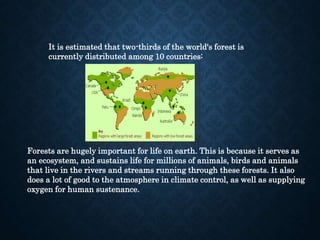
It is estimated that two-thirds of the world's forest is
currently distributed among 10 countries:
Forests are hugely important for life on earth. This is because it serves as
an ecosystem, and sustains life for millions of animals, birds and animals
that live in the rivers and streams running through these forests. It also
does a lot of good to the atmosphere in climate control, as well as supplying
oxygen for human sustenance.
ECONOMICAL
IMPORTANCE
Forests have obvious economic significance
through the provision of timber and wood.
In addition, non-timber products like
rubber, cotton, medicinal products, and food
represent significant economic value.
Even more important is fuel wood and
fodder, especially in developing nations,
where people depend on wood almost entirely
for their household energy.
Given the immense economic benefit of
forests, the demand for commercial timber
and other products is ever increasing.
Already, there are signs of a growing
shortage of tropical hardwoods. This is due to
over-harvesting of timber, but also increasing
demands from a growing human population,
agriculture, mining and water storage.
•Forests accumulate large amounts of standing biomass,
and many are capable of accumulating it at high rates, i.e.
they are highly productive. Such high levels of biomass and
tall vertical structures represent large stores of potential
energy that can be converted to kinetic energy under the
right circumstances.
•Two such conversions of great importance
are fires and tree falls, both of which radically alter
the biota and the physical environment where they occur.
•Also, in forests of high productivity, the rapid growth of
the trees themselves induces biotic and environmental
changes, although at a slower rate and lower intensity than
relatively instantaneous disturbances such as fires.
ECONOMIC
S
ENVIRONMENT studies

ENVIRONMENT studies

  • 1.
    Sardar Vallabhbhai PatelInstitute Of Technology, Vasad ENVIRONMENT studies
  • 3.
  • 4.
    Introductio n A forest isa type of ecosystem in which there is high density of trees occupying a relatively large area of land. An ecosystem is an ecological unit consisting of a biotic community together with it’s a biotic environment. In the case of a forest, trees dominate the biotic landscape, although there are also other plants and animals. There are many types of forest, such as rainforests and temperate hardwood forest. Forests provide innumerable values to people, provide aspects that address both physical needs as well as the internal nature of people .
  • 5.
    FOREST PRESERVATION Environmental activistsconsider forests as one of the top 5 natural resources on earth. This is rightly so, and today, we shall look at how wonderful our forests are to us, and why we should immediately stop its' destruction. There is more to forests than just a massive collection of trees. It is a natural, complex ecosystem, made up of a wide variety of trees, that support a massive range of life forms. Quiet apart from trees, forests also include the soils that support the trees, the water bodies that run through them and even the atmosphere (air) around them. Forests of the world are a natural wonder that humans have sadly taken for granted. Forests come in many sizes and forms. For example, the piece of land with huge trees and many animals, birds and water bodies running through it in a part of Kenya can be called a forest. In the same way, the large belt of thick, evergreen trees running from Peru to Brazil (called the Amazon Rain Forest) is also a forest. A good example is the Amazon Rain Forest.
  • 6.
    It is estimatedthat two-thirds of the world's forest is currently distributed among 10 countries: Forests are hugely important for life on earth. This is because it serves as an ecosystem, and sustains life for millions of animals, birds and animals that live in the rivers and streams running through these forests. It also does a lot of good to the atmosphere in climate control, as well as supplying oxygen for human sustenance.
  • 7.
  • 8.
    Forests have obviouseconomic significance through the provision of timber and wood. In addition, non-timber products like rubber, cotton, medicinal products, and food represent significant economic value. Even more important is fuel wood and fodder, especially in developing nations, where people depend on wood almost entirely for their household energy. Given the immense economic benefit of forests, the demand for commercial timber and other products is ever increasing. Already, there are signs of a growing shortage of tropical hardwoods. This is due to over-harvesting of timber, but also increasing demands from a growing human population, agriculture, mining and water storage.
  • 9.
    •Forests accumulate largeamounts of standing biomass, and many are capable of accumulating it at high rates, i.e. they are highly productive. Such high levels of biomass and tall vertical structures represent large stores of potential energy that can be converted to kinetic energy under the right circumstances. •Two such conversions of great importance are fires and tree falls, both of which radically alter the biota and the physical environment where they occur. •Also, in forests of high productivity, the rapid growth of the trees themselves induces biotic and environmental changes, although at a slower rate and lower intensity than relatively instantaneous disturbances such as fires.
  • 11.