INTERNATIONAL DAY OF FOREST 2024
March - 21
Date: 21-03-2024
Prof. P.Thangarasu,
AsP/Chemistry,
Sengunthar Engineering College
 The UN General Assembly (UNGA) proclaimed 21
March as the International Day of Forests in 2012.
 The Day celebrates and raises awareness of the
importance of all types of forests.
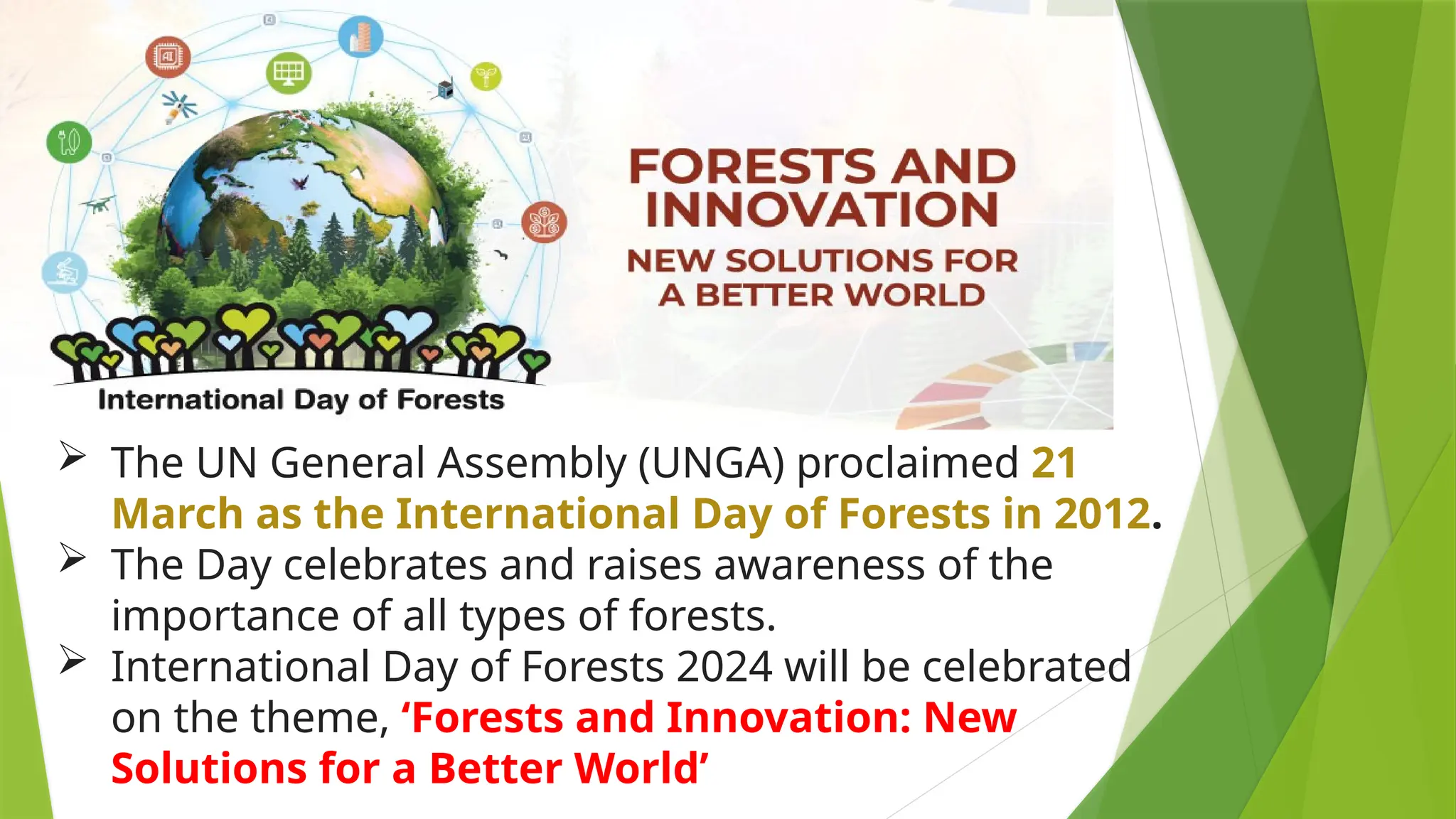
 International Day of Forests 2024 will be celebrated
on the theme, ‘Forests and Innovation: New
Solutions for a Better World’
Forest
Resources
Forest Resources
 The word forest is derived from a Latin word
 “ Foris” means Outside
 Forest are one of the most important natural resources of the earth.
 Forests cover one-third of the Earth's landmass, performing vital functions
around the world.
 Around 1.6 billion people - depend on forests for their livelihoods, medicines,
fuel, food and shelter. Forests are the most biologically diverse ecosystems on
land, home to more than 80% of the terrestrial species of animals, plants
and insects.
 Tree forests cover approximately 9.4 percent of the Earth's surface (or 30 percent
of total land area i.e., Approximately 1/3rd
of the earth’s total land area ).
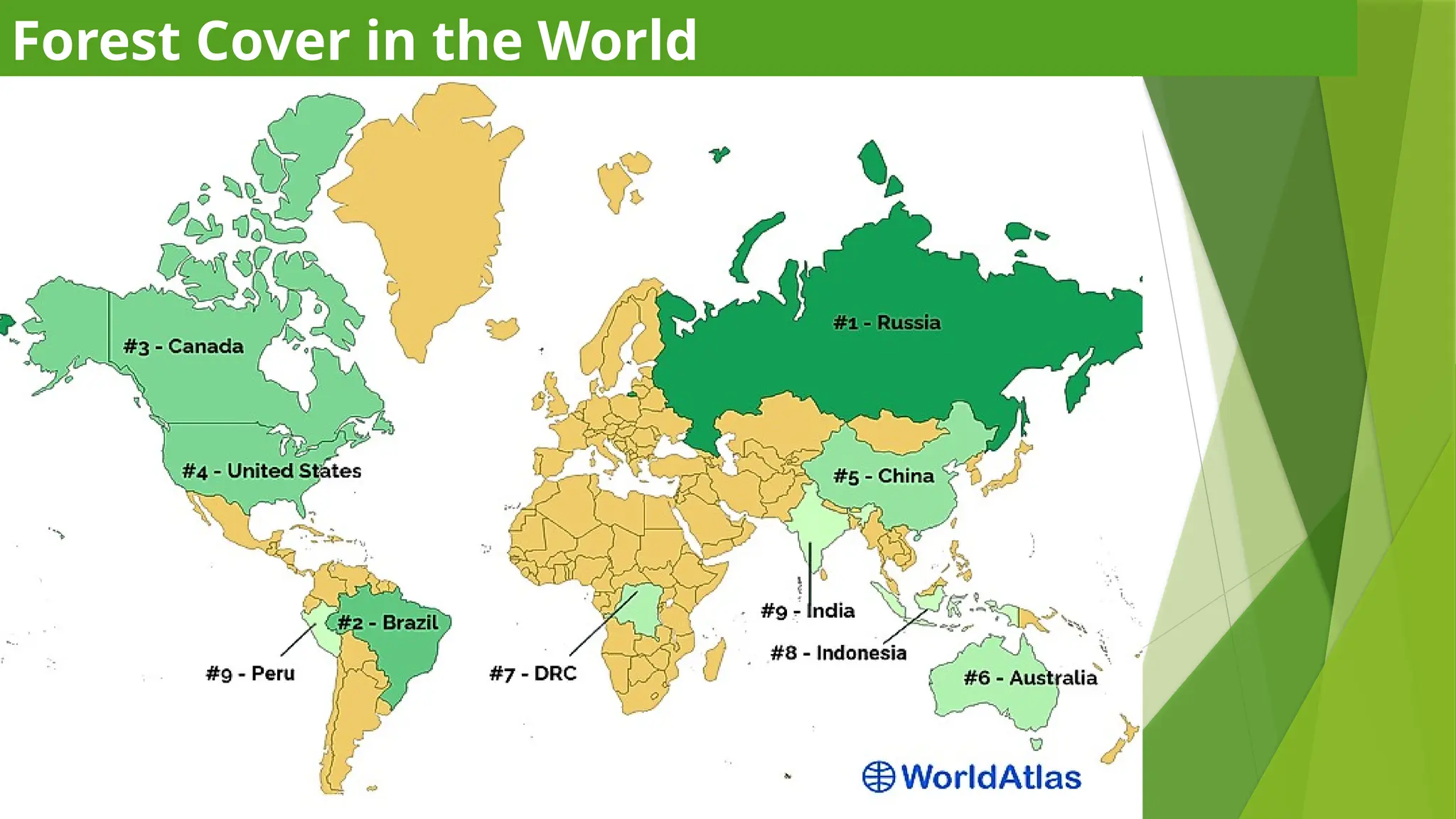
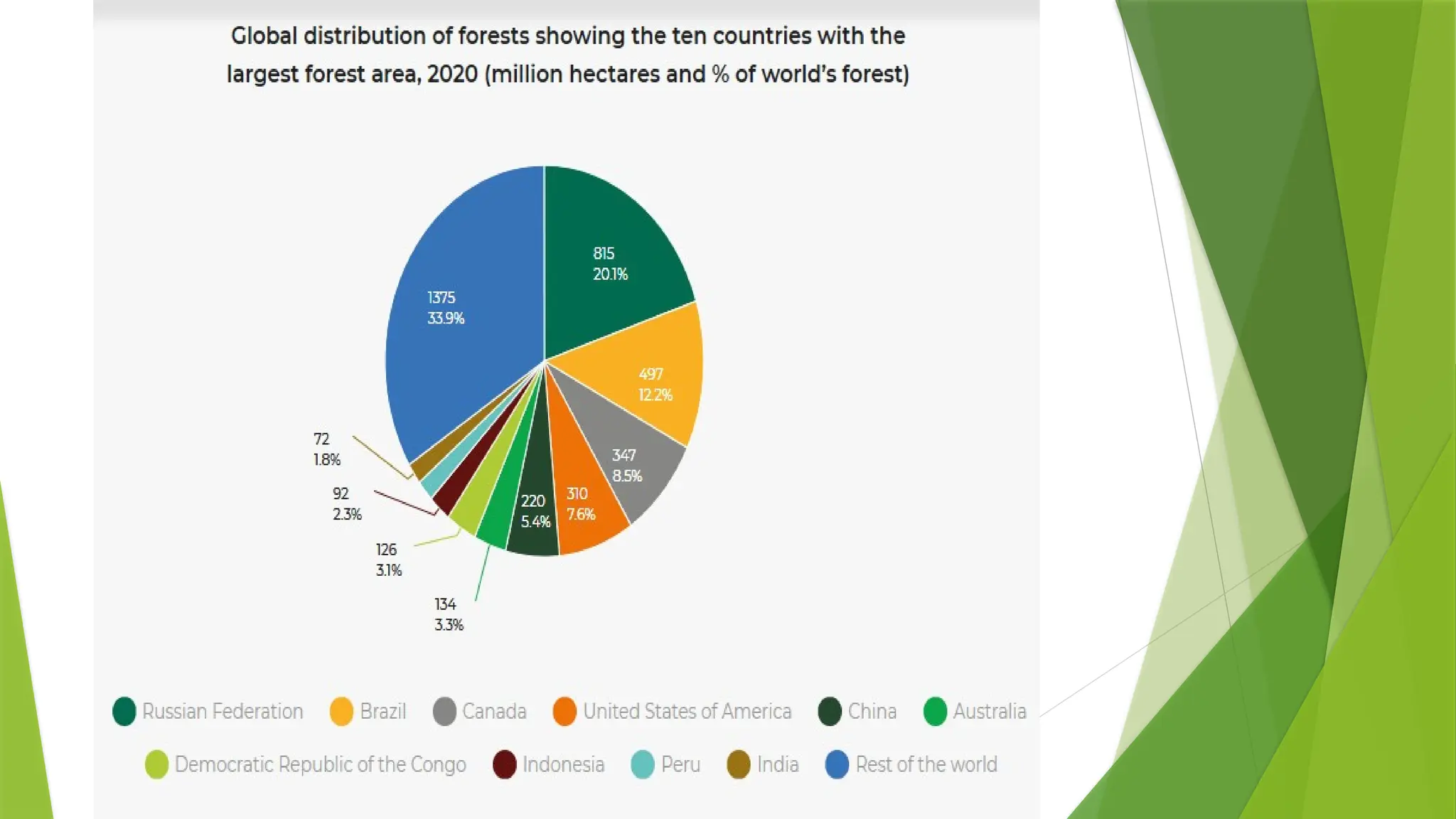
 India is one of the ten most forest-rich countries of the world along with the
Russian Federation, Brazil, Canada, United States of America, China, Democratic
Republic of the Congo, Australia, Indonesia and Sudan.
Forest Cover in the World
Indian Scenario
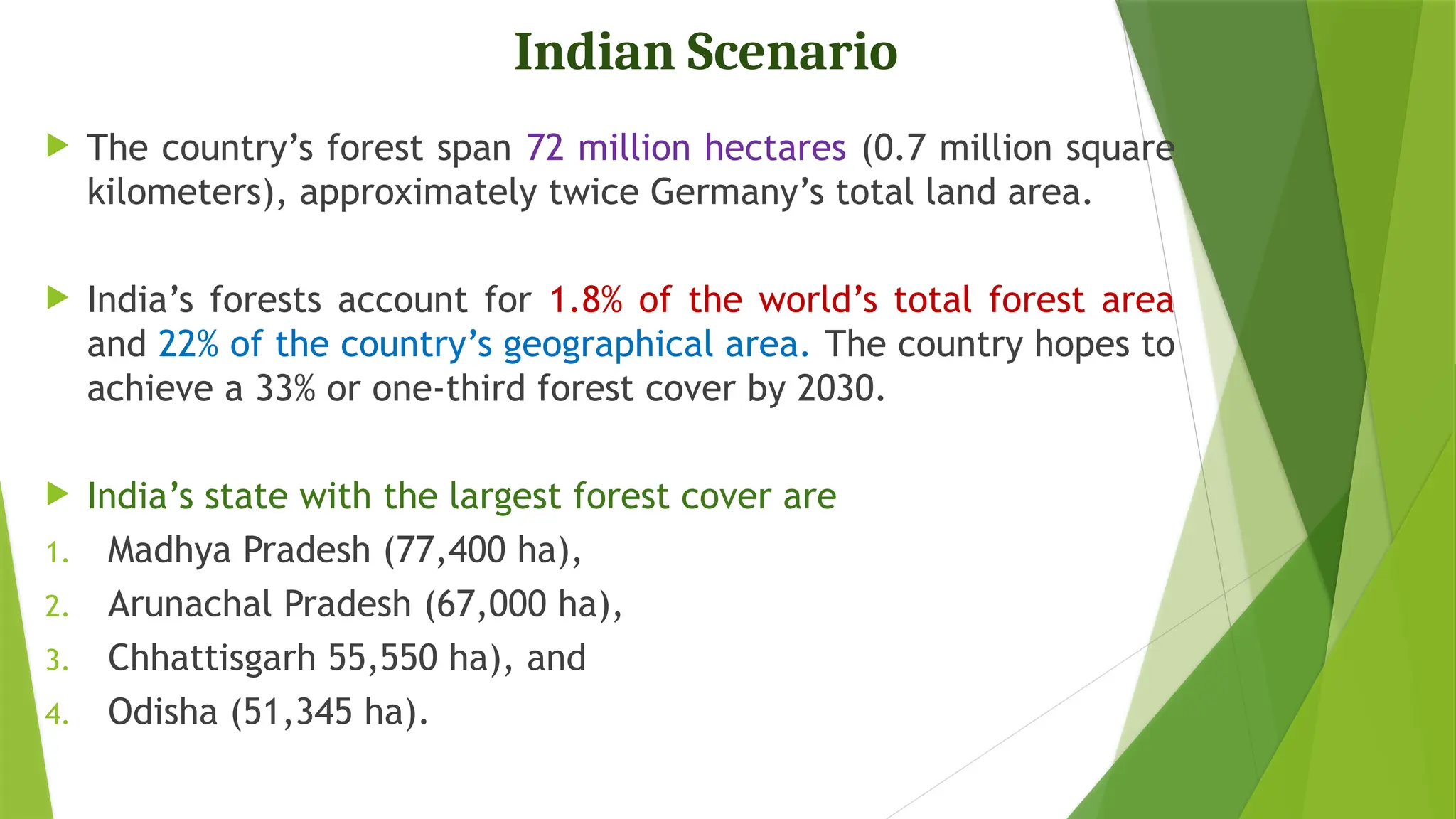
 The country’s forest span 72 million hectares (0.7 million square
kilometers), approximately twice Germany’s total land area.
 India’s forests account for 1.8% of the world’s total forest area
and 22% of the country’s geographical area. The country hopes to
achieve a 33% or one-third forest cover by 2030.
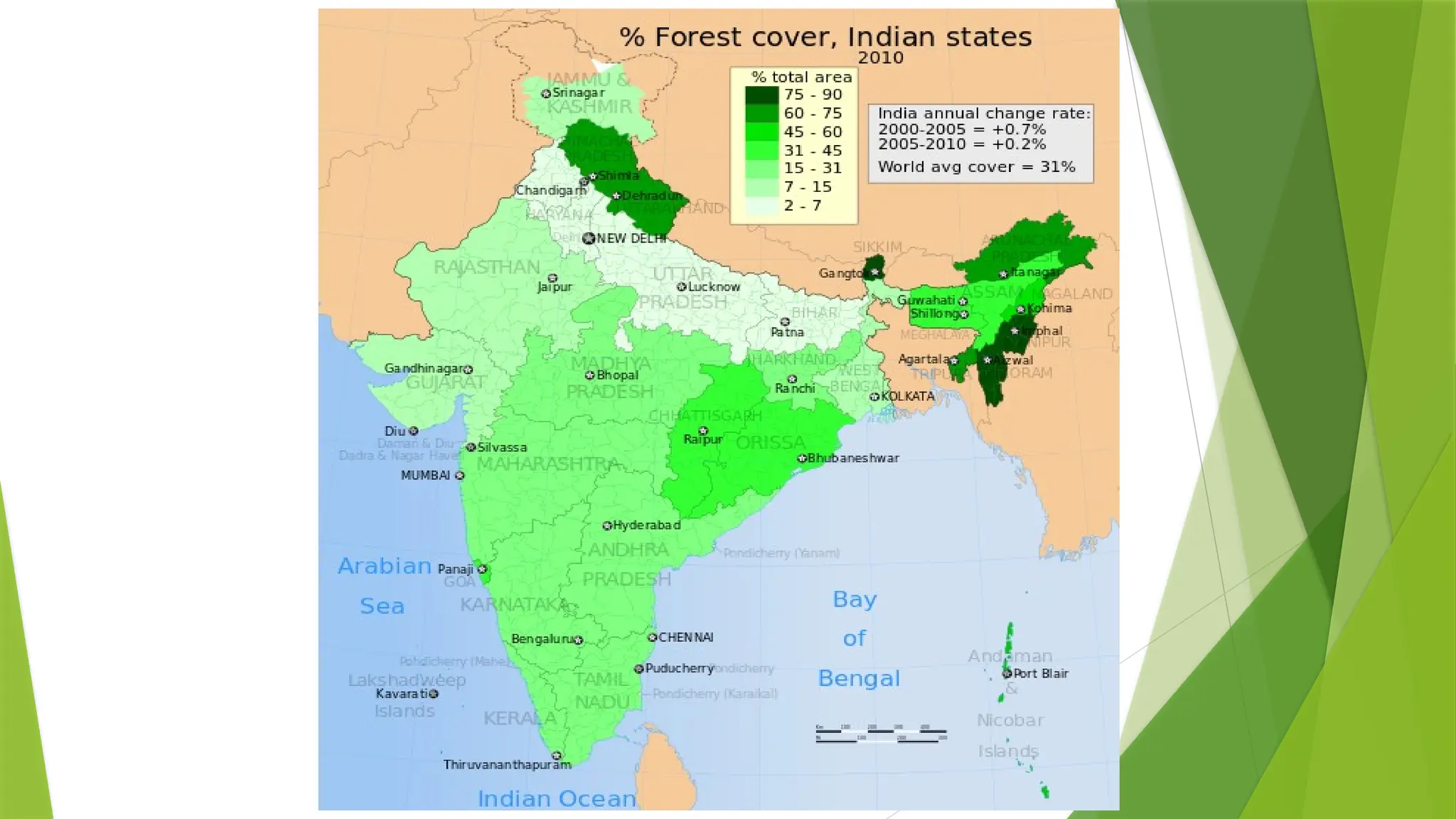
 India’s state with the largest forest cover are
1. Madhya Pradesh (77,400 ha),
2. Arunachal Pradesh (67,000 ha),
3. Chhattisgarh 55,550 ha), and
4. Odisha (51,345 ha).
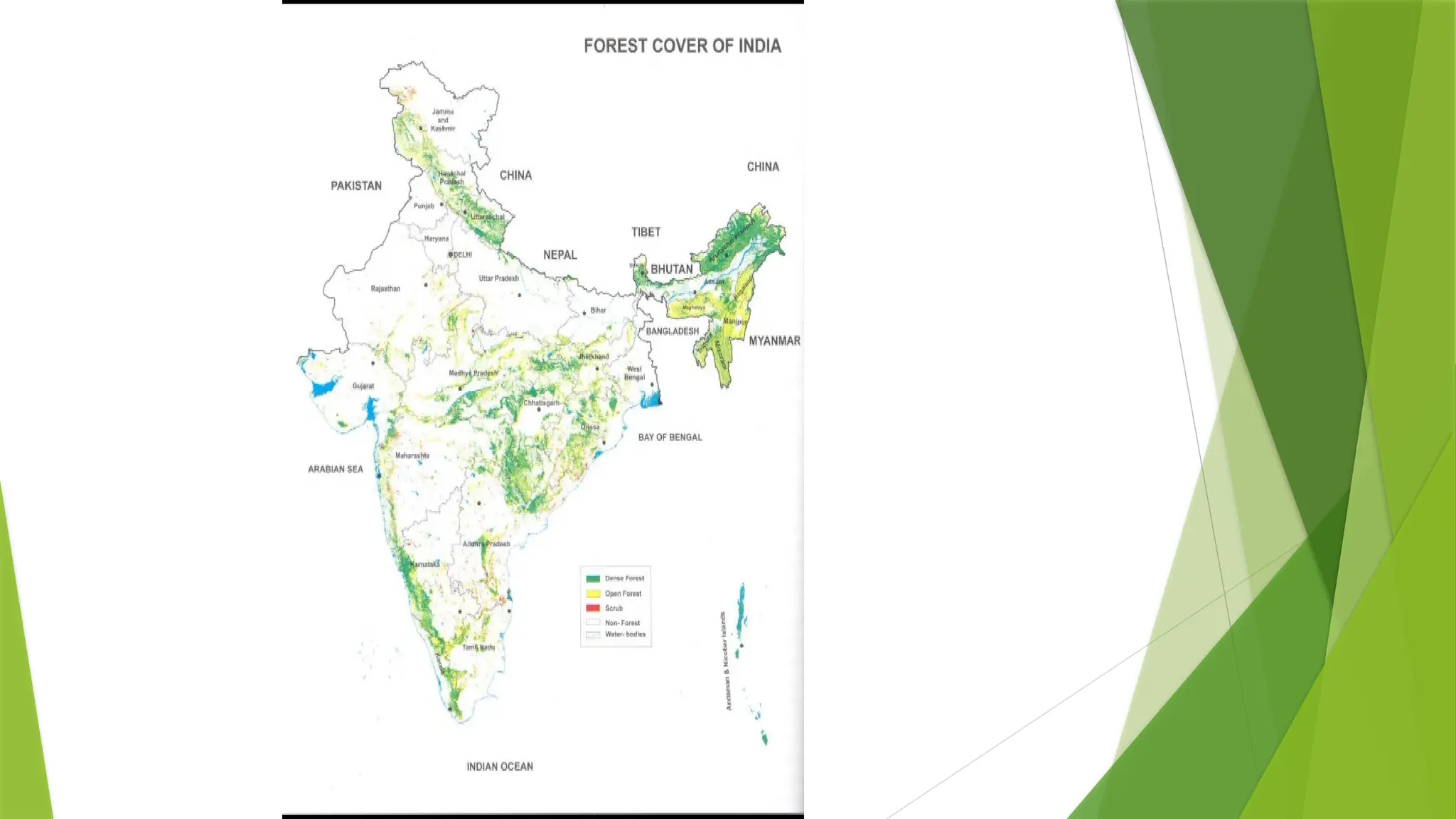
Indian top five states with largest area
under forest cover
According to India's 2013 forest survey report, thus obtained
and published by the Government of India suggests the top
five states with largest area under forest cover:
Madhya Pradesh: 7.75 million hectares
Arunachal Pradesh: 6.73 million hectares
Chhattisgarh: 5.6 million hectares
Maharashtra: 5.06 million hectares
Odisha: 5.03 million hectares
The seven north-eastern States of India have nearly 1/4 th of the
country’s forest cover.
Forest Degradation in India
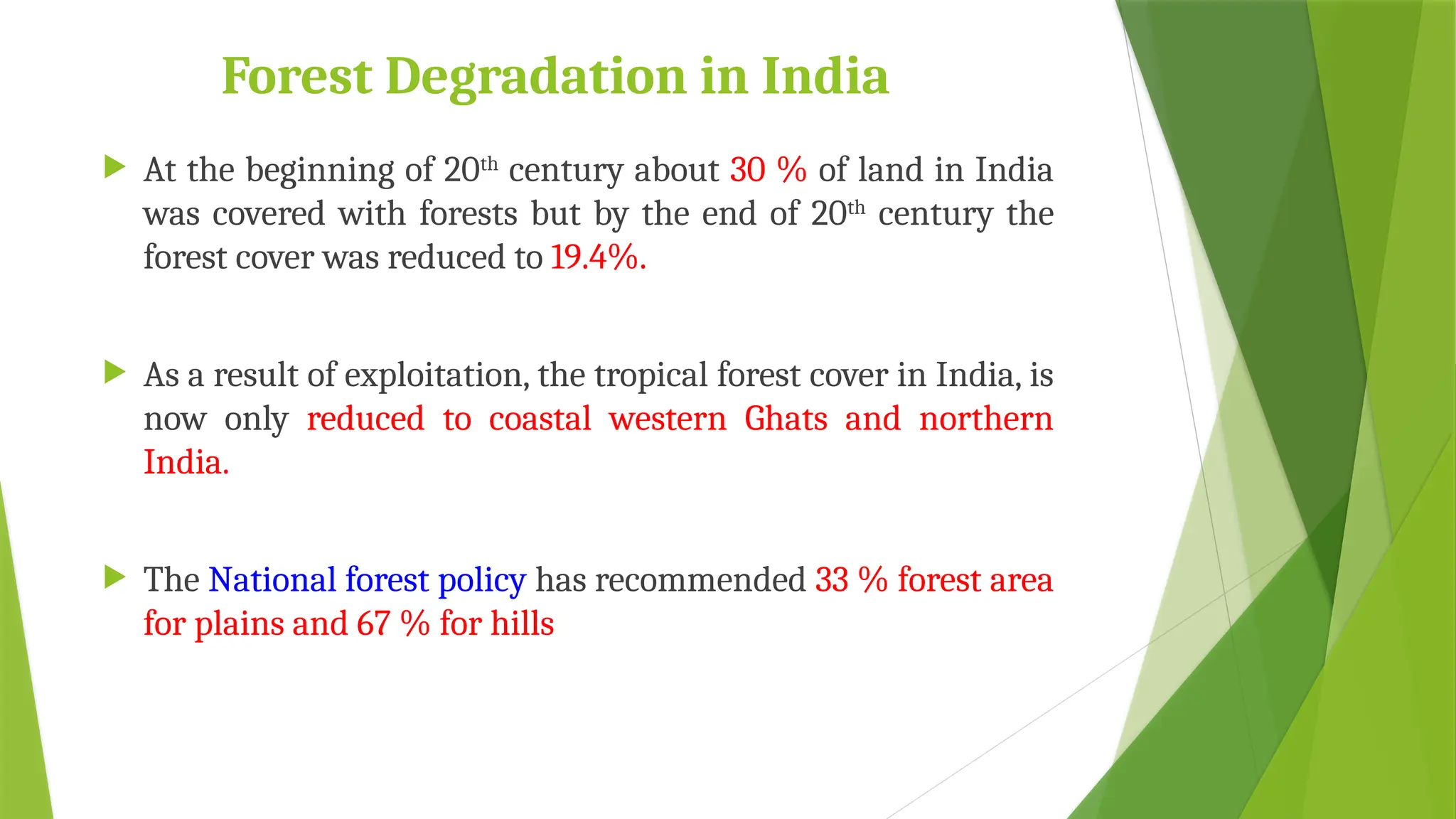
 At the beginning of 20th
century about 30 % of land in India
was covered with forests but by the end of 20th
century the
forest cover was reduced to 19.4%.
 As a result of exploitation, the tropical forest cover in India, is
now only reduced to coastal western Ghats and northern
India.
 The National forest policy has recommended 33 % forest area
for plains and 67 % for hills
Importance of Forests
 Timber (plywood, door, windows, sports goods etc.)
 Raw material (forest based industries: bee keeping, furniture, beedi,
sal seed oil, bamboo sticks etc.)
 Edible product (fruits, seeds, nuts, spices etc.)
 They provide natural habitat to tribal people.
 Manure and fuel wood (India is the world's largest consumer of fuel-
wood)
 They are an important source of national income.
 Medicinal plants
 Tourism: Ecotourism
 Employment opportunities
Direct Benefits
Indirect Benefits
 Forests help in minimizing natural hazards (Flood, drought).
 They help in reducing soil erosion and siltation of downstream
water bodies.
 They help in reducing desertification and land degradation.
 They help in maintaining biodiversity by providing habitat to
wild animals.
 They help in regulating hydrological cycle.
 They help in regulating the gases in atmosphere.
Functions of Forests
 The functions of forest may broadly classified into following
categories
 Protective Function
 Productive Function
 Regulative Function
 Accessory Function
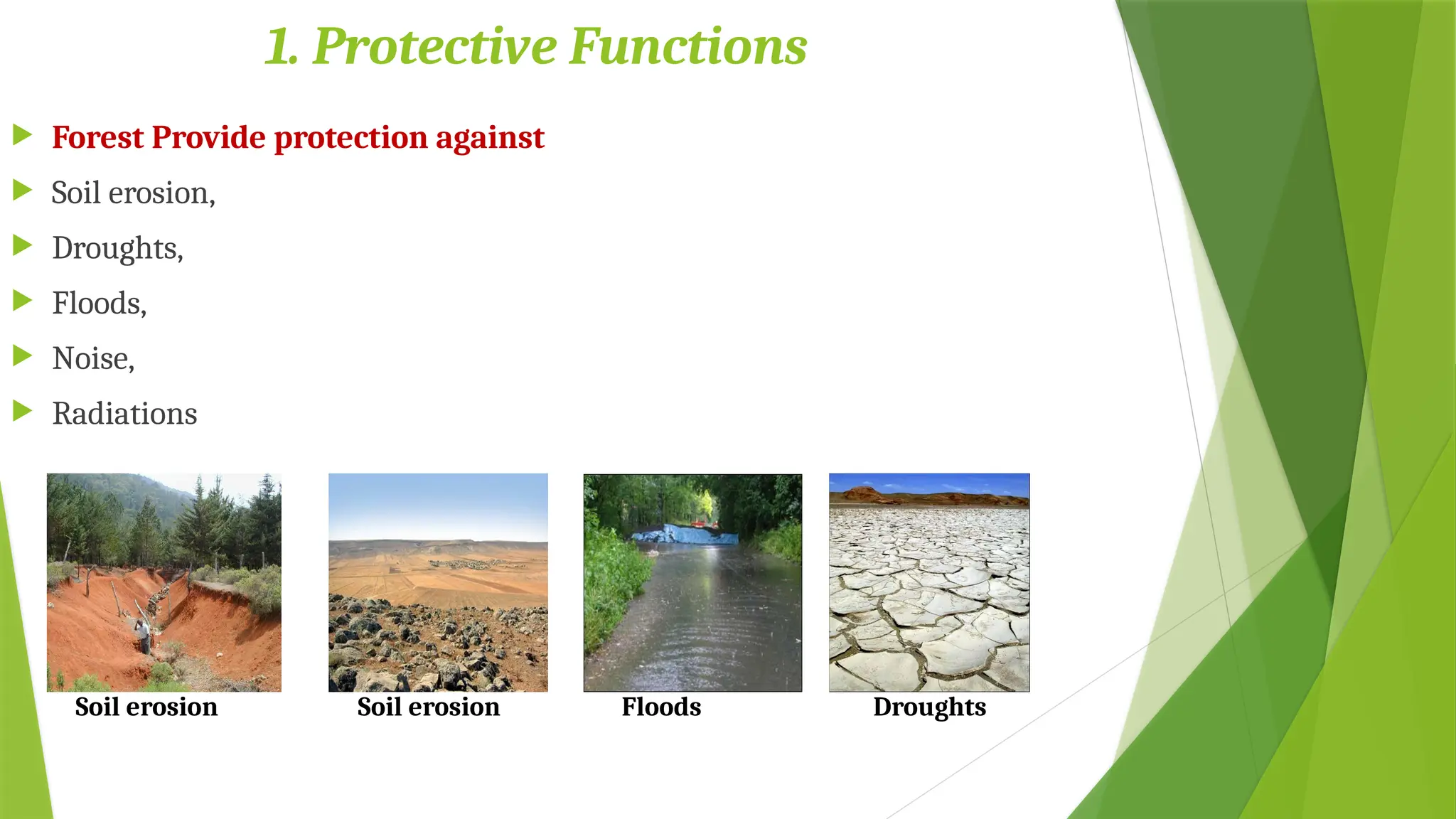
1. Protective Functions
 Forest Provide protection against
 Soil erosion,
 Droughts,
 Floods,
 Noise,
 Radiations
Soil erosion Floods
Soil erosion Droughts
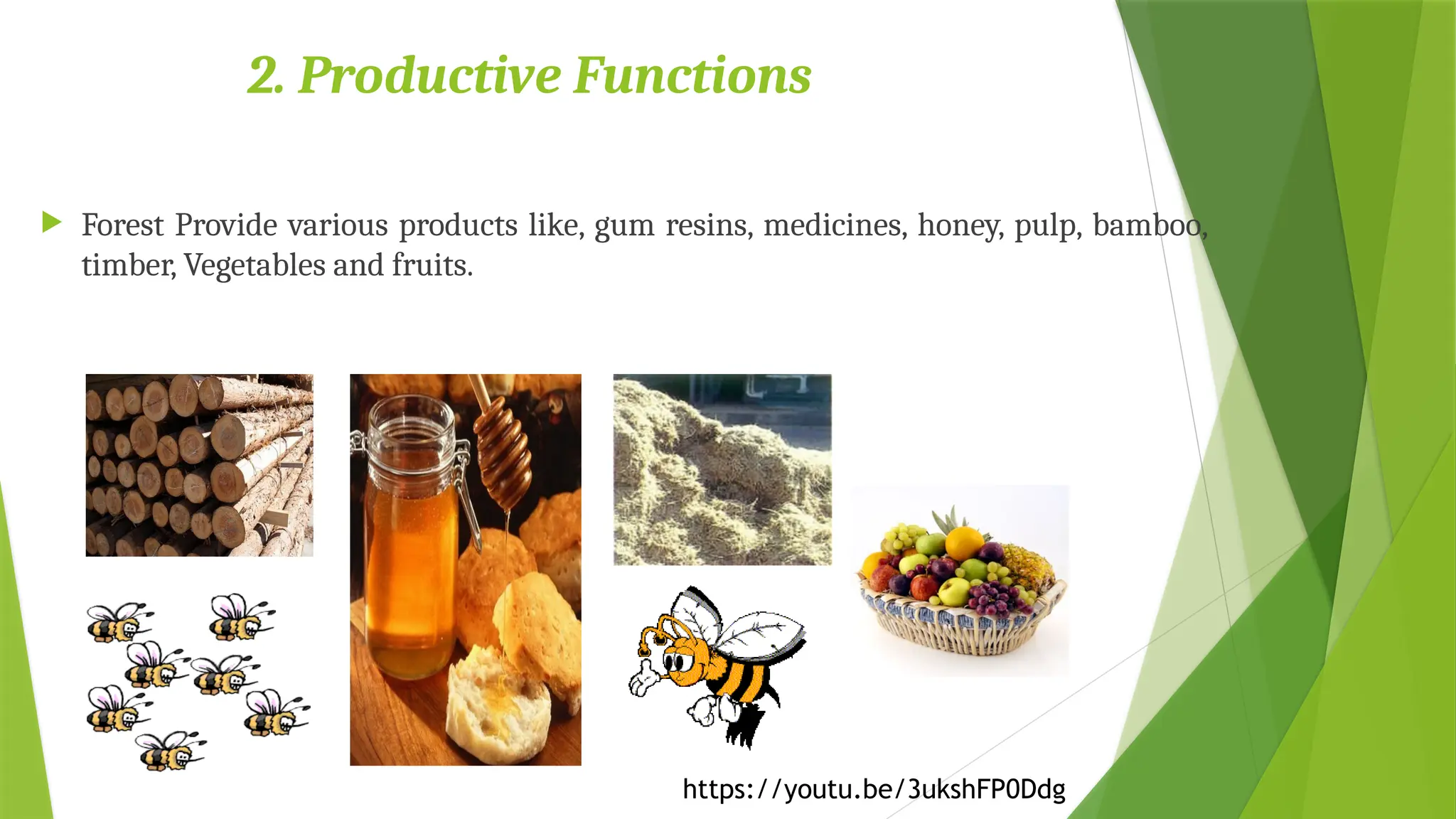
2. Productive Functions
 Forest Provide various products like, gum resins, medicines, honey, pulp, bamboo,
timber, Vegetables and fruits.
https://youtu.be/3ukshFP0Ddg
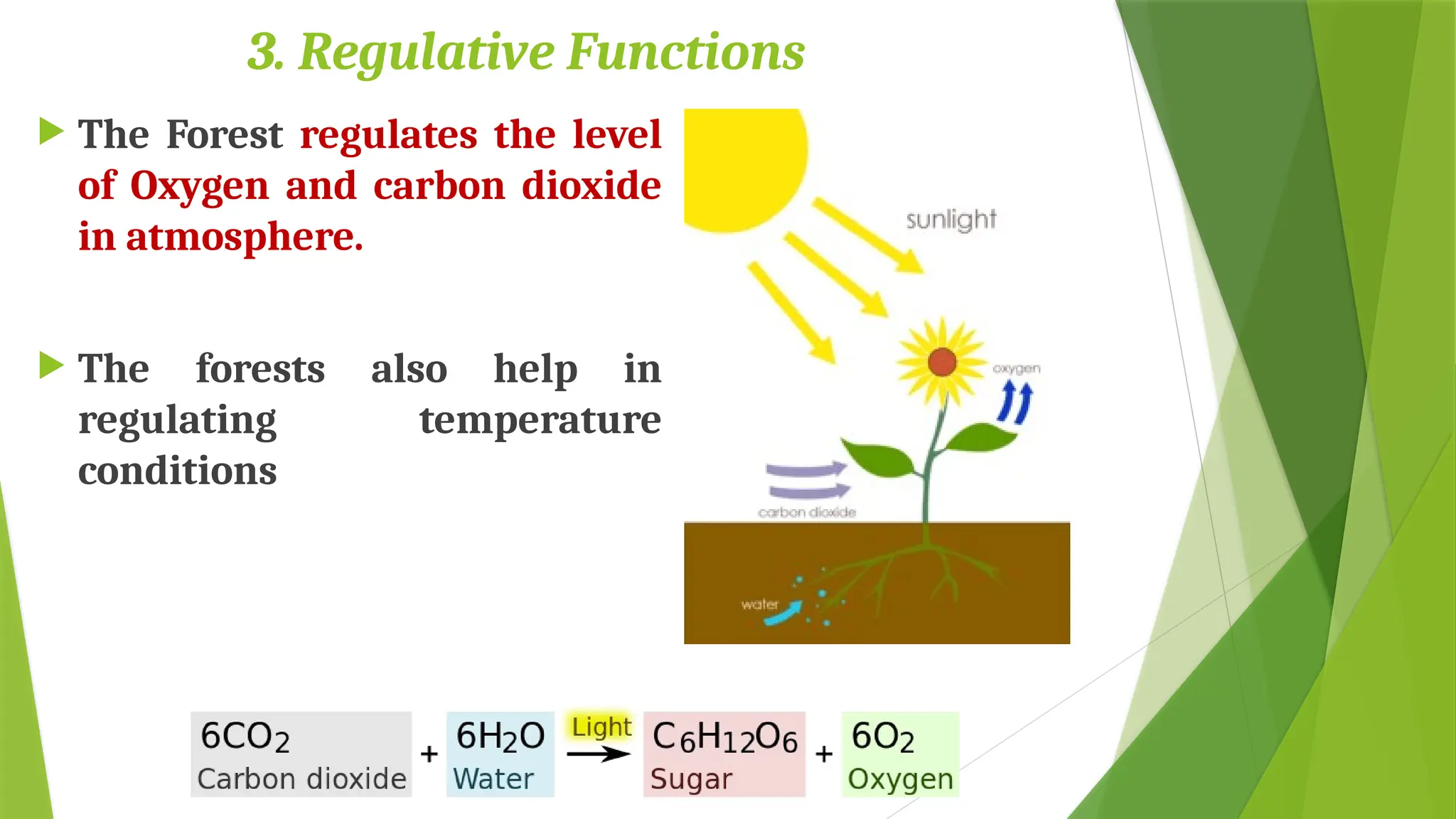
3. Regulative Functions
 The Forest regulates the level
of Oxygen and carbon dioxide
in atmosphere.
 The forests also help in
regulating temperature
conditions
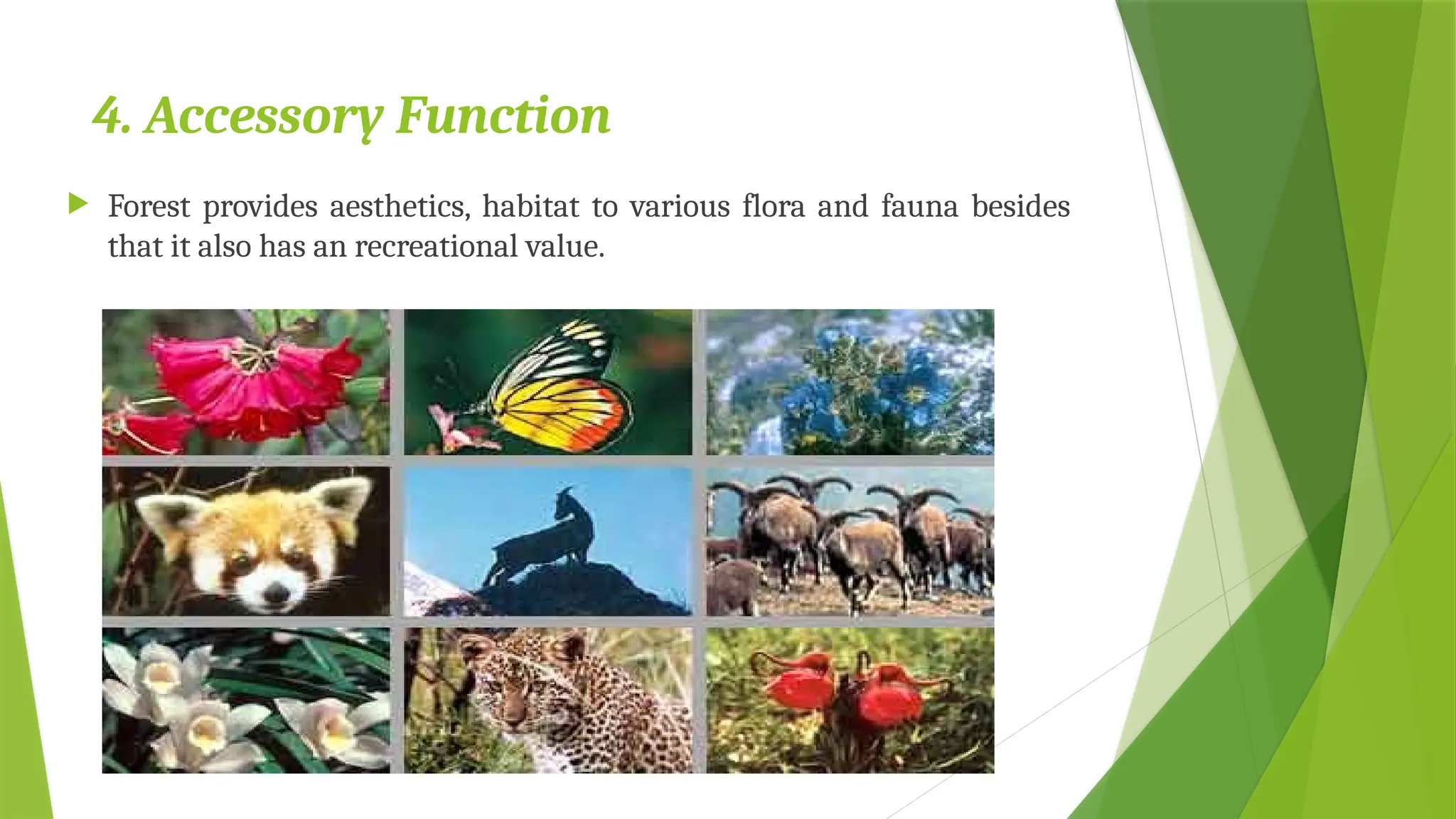
4. Accessory Function
 Forest provides aesthetics, habitat to various flora and fauna besides
that it also has an recreational value.
Ecological Importance or uses of Forests
 Regulation of global climate and temperature
 Forest play a crucial role in regulation of global climate and temperature
as forest cover absorb the solar radiations that would otherwise be
reflected back into the atmosphere by bare surface of the earth.
 Transpiration of plants increases the atmosphere humidity which
affects the rainfall, cools the atmosphere and thus regulate the
hydrological cycle
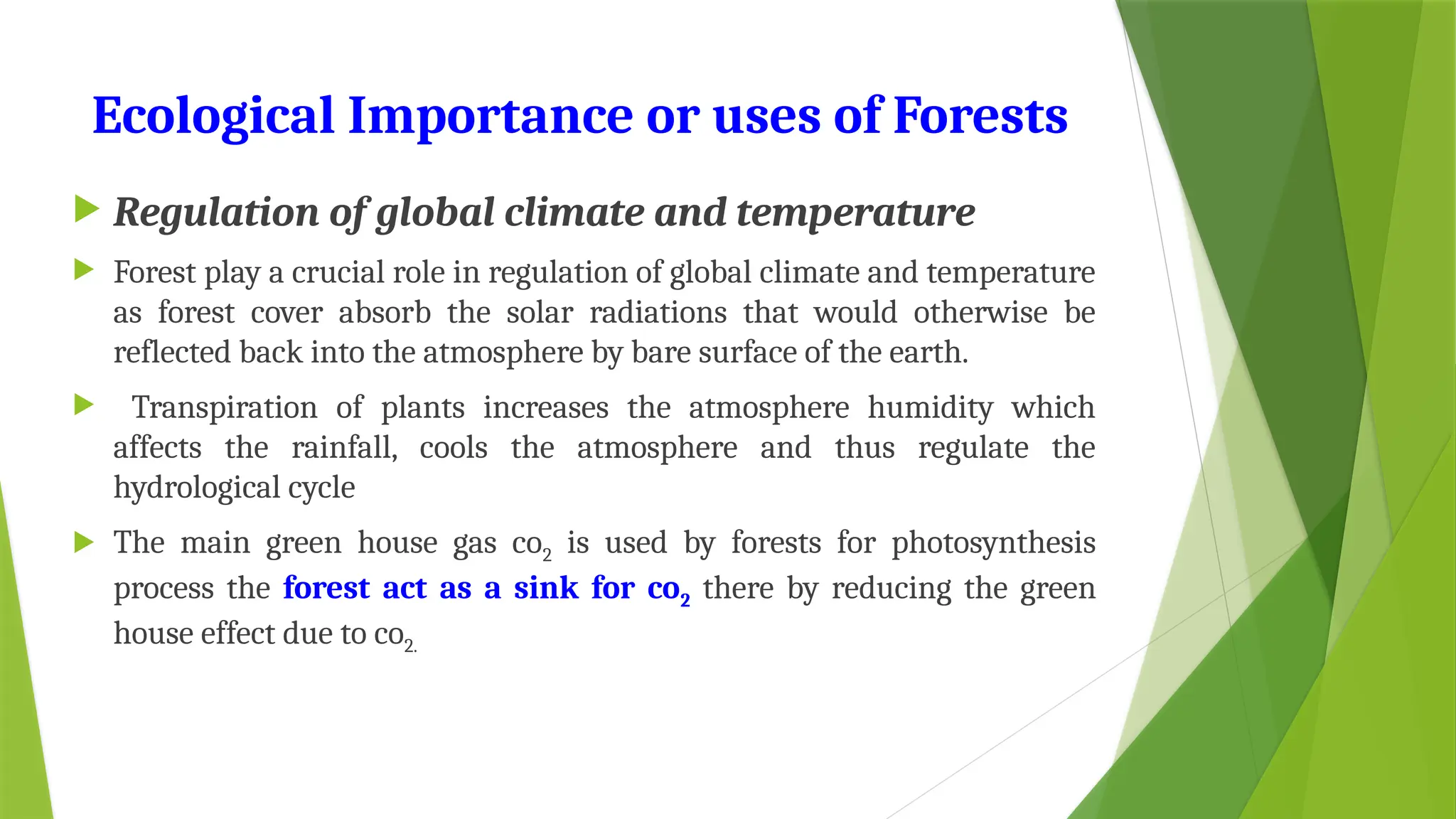
 The main green house gas co2 is used by forests for photosynthesis
process the forest act as a sink for co2 there by reducing the green
house effect due to co2.
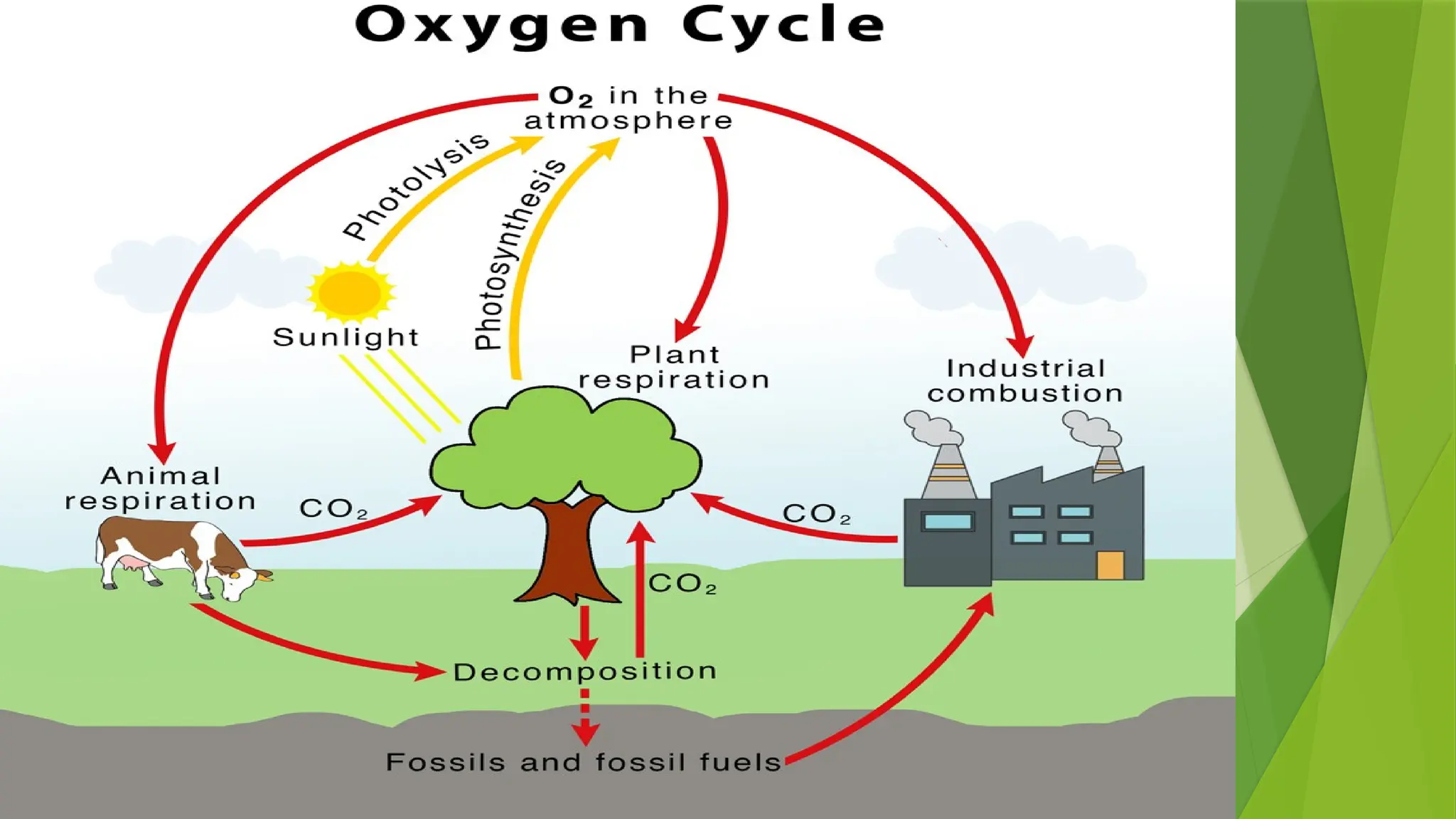
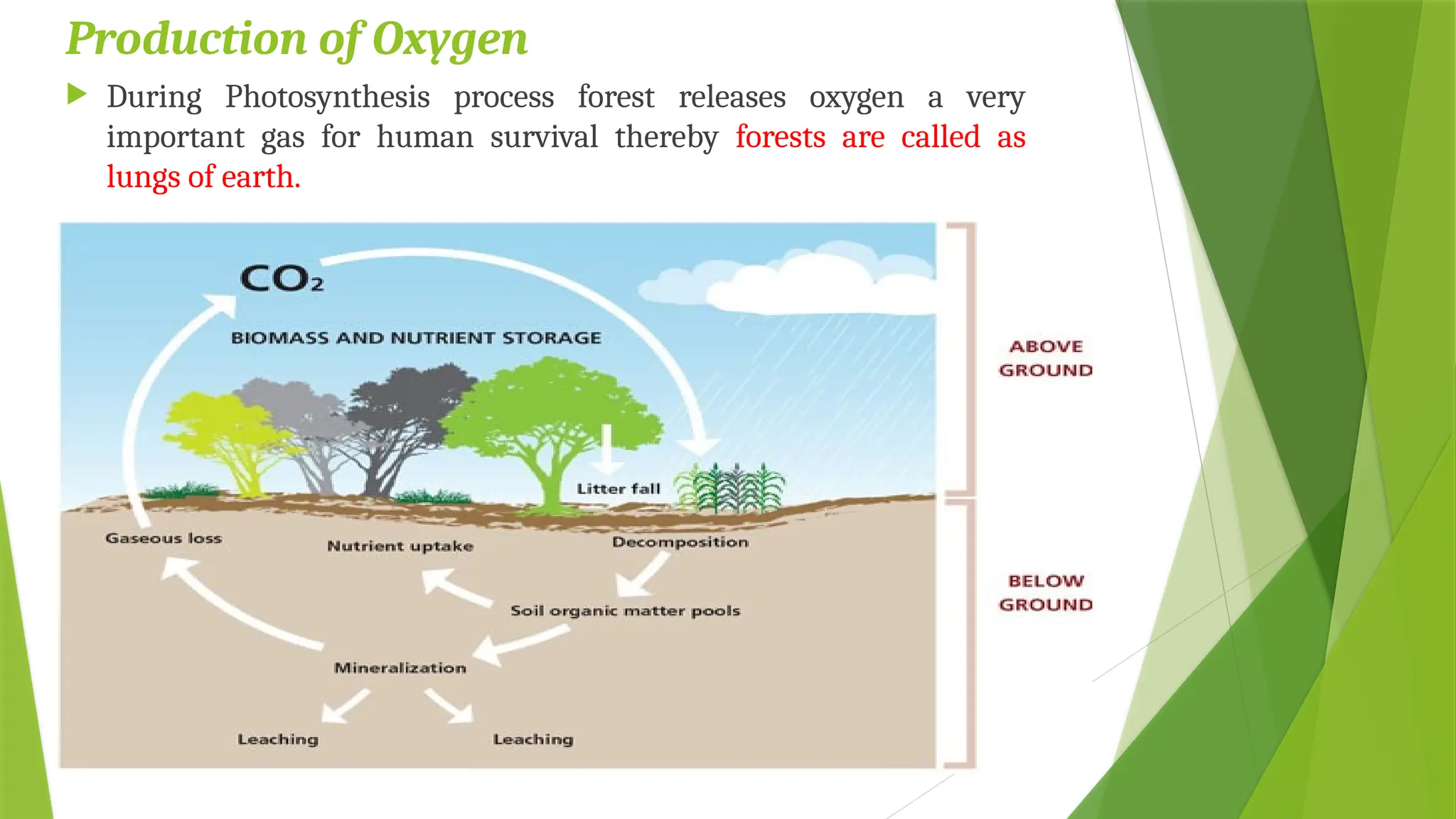
Production of Oxygen
 During Photosynthesis process forest releases oxygen a very
important gas for human survival thereby forests are called as
lungs of earth.
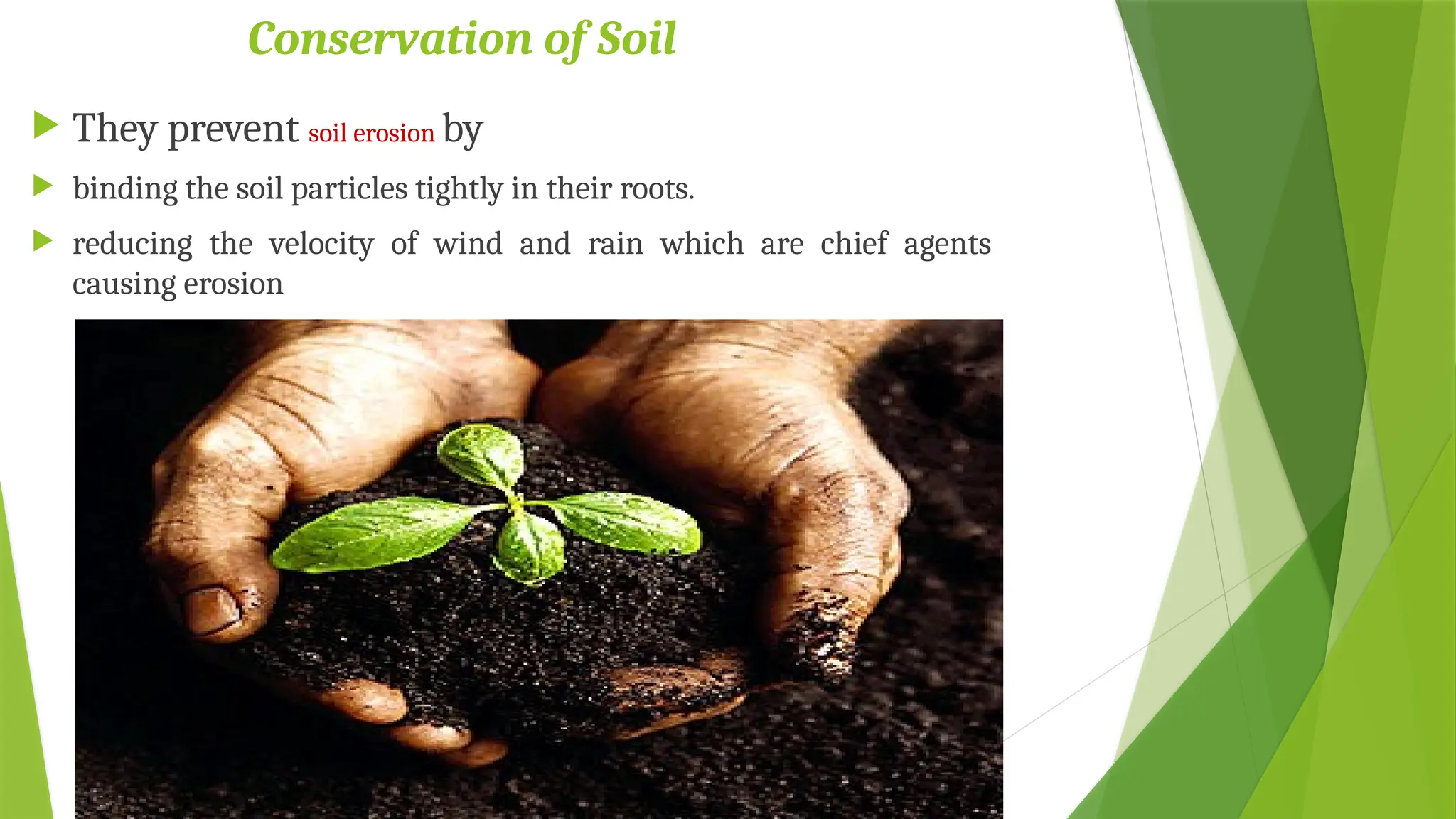
Conservation of Soil
 They prevent soil erosion by
 binding the soil particles tightly in their roots.
 reducing the velocity of wind and rain which are chief agents
causing erosion
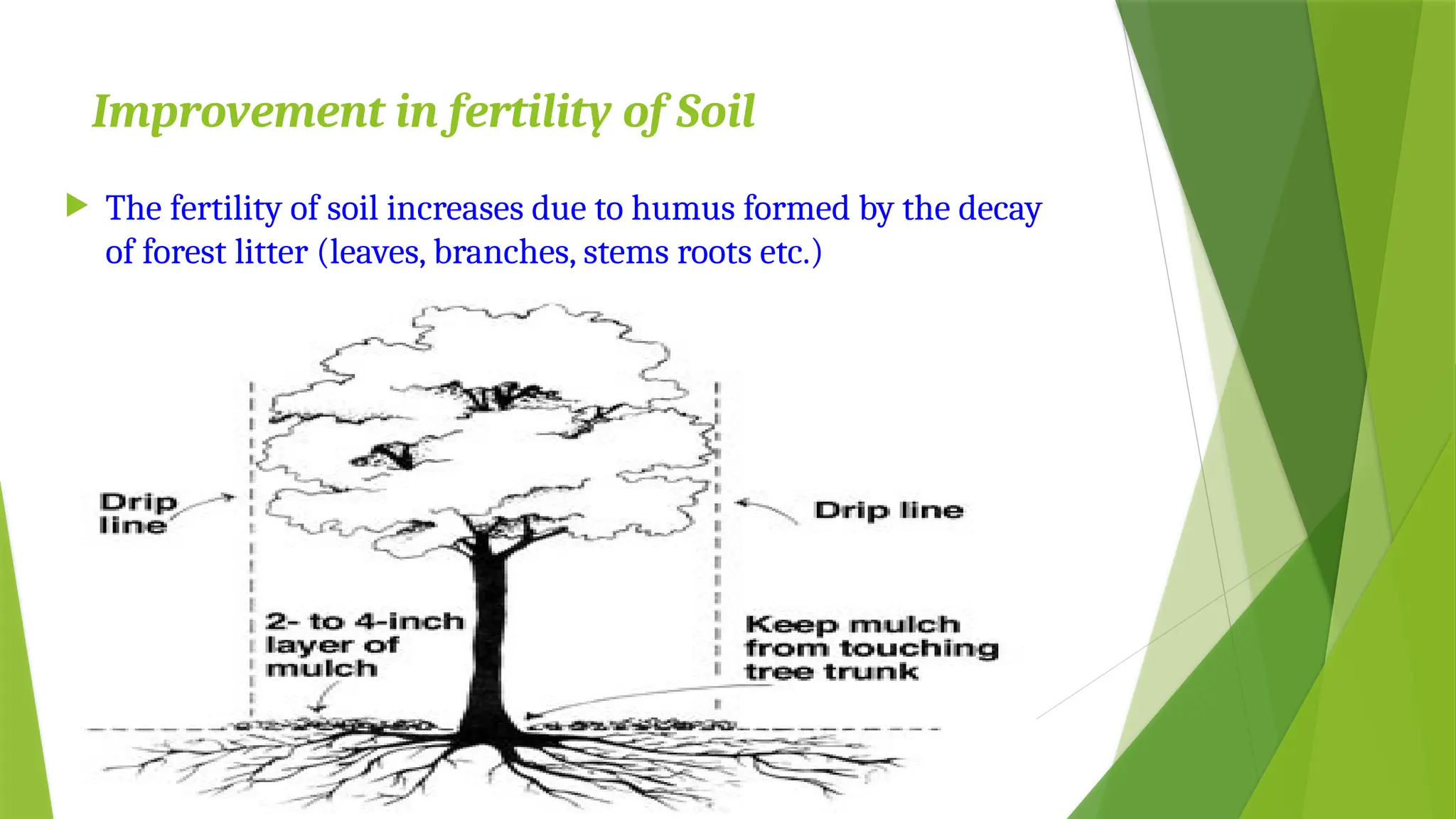
Improvement in fertility of Soil
 The fertility of soil increases due to humus formed by the decay
of forest litter (leaves, branches, stems roots etc.)
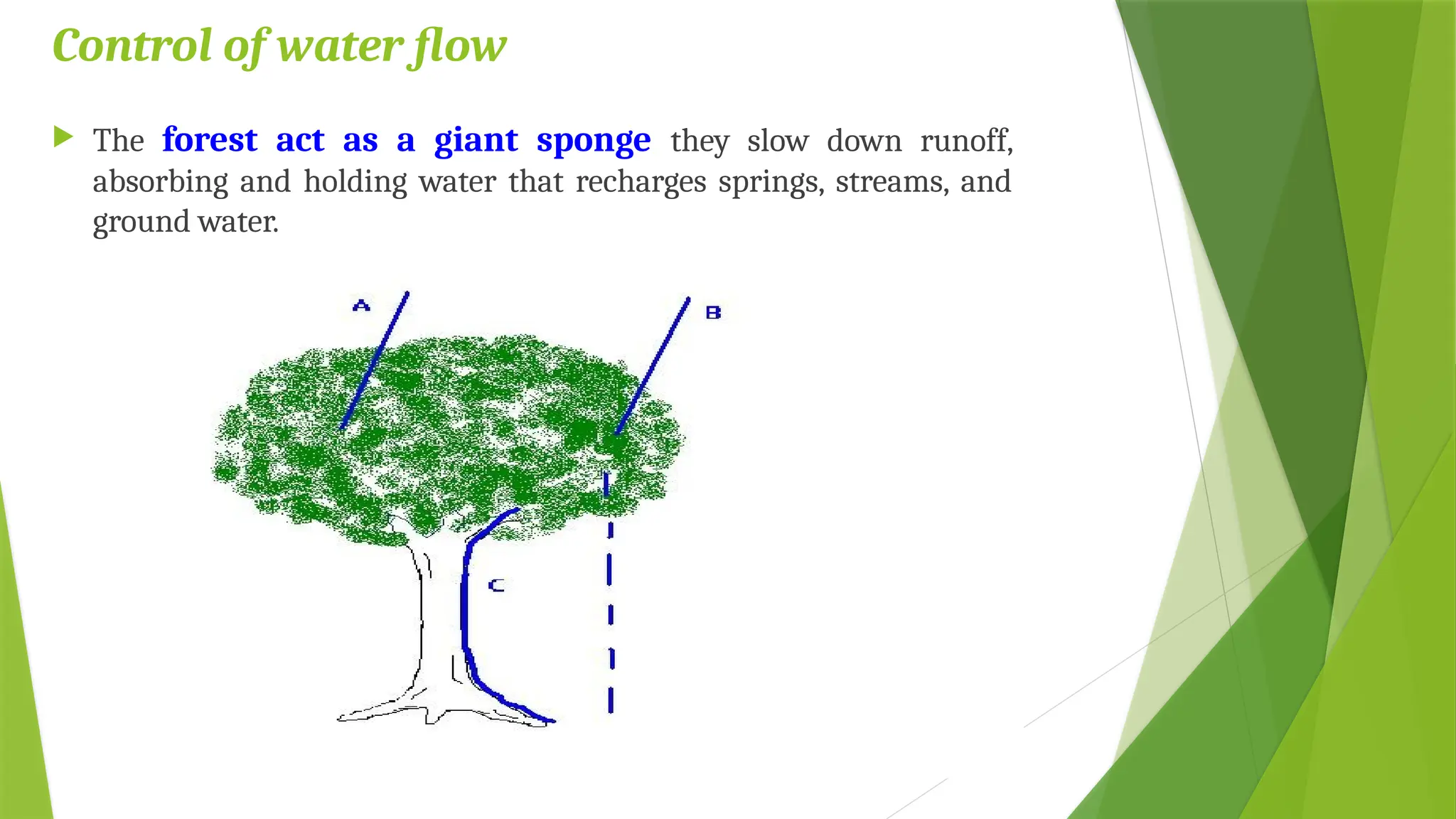
Control of water flow
 The forest act as a giant sponge they slow down runoff,
absorbing and holding water that recharges springs, streams, and
ground water.
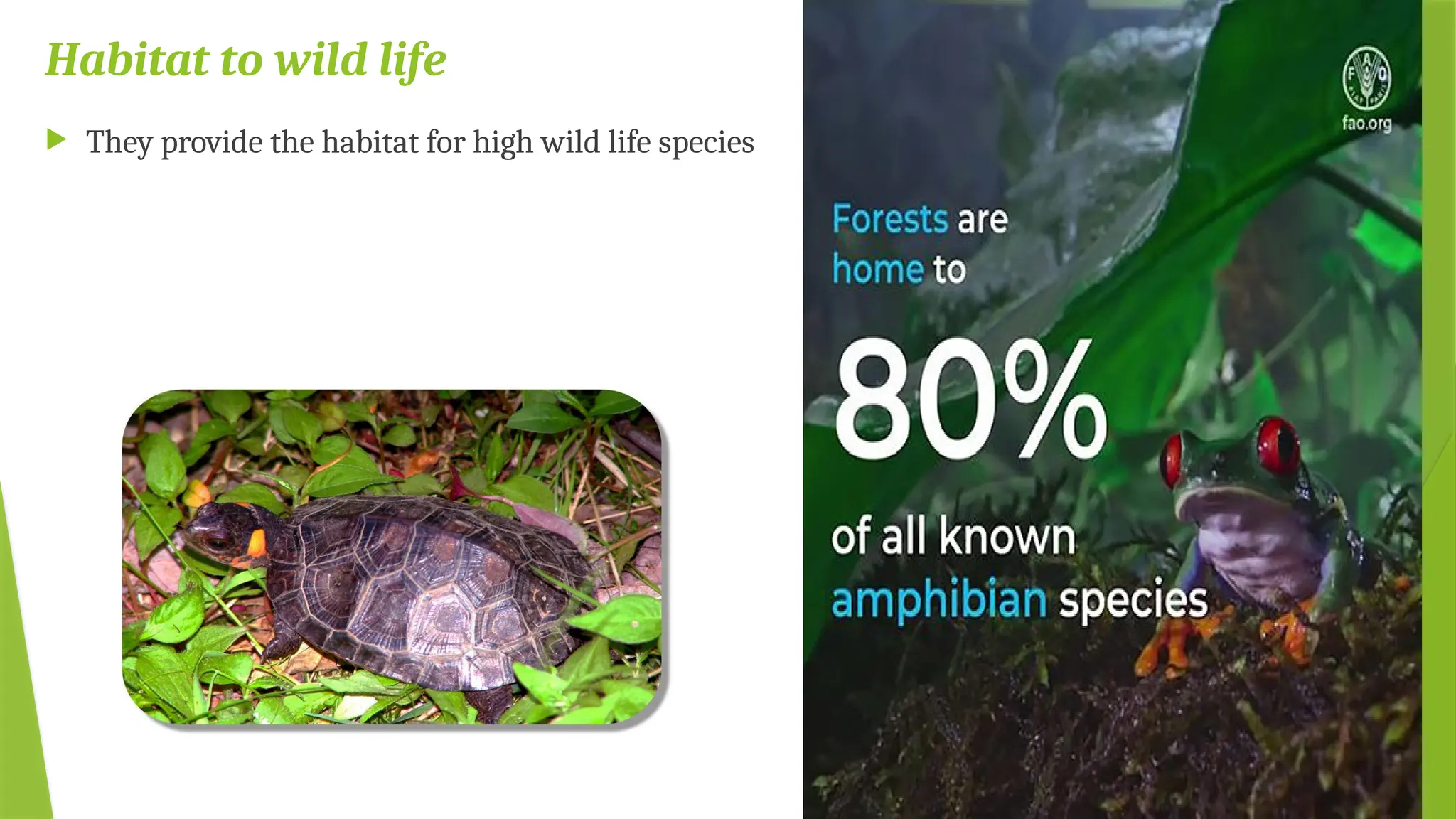
Habitat to wild life
 They provide the habitat for high wild life species
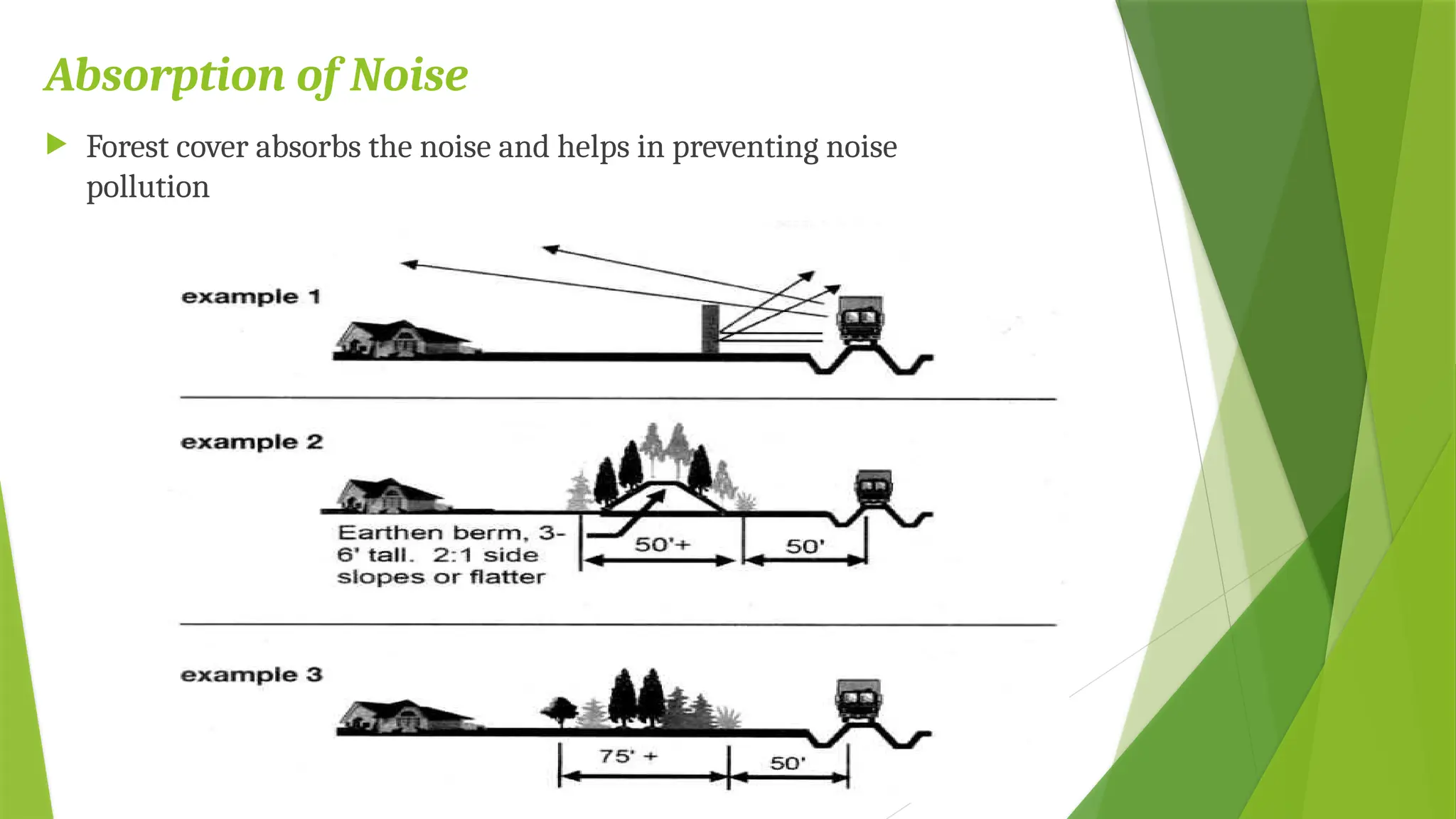
Absorption of Noise
 Forest cover absorbs the noise and helps in preventing noise
pollution
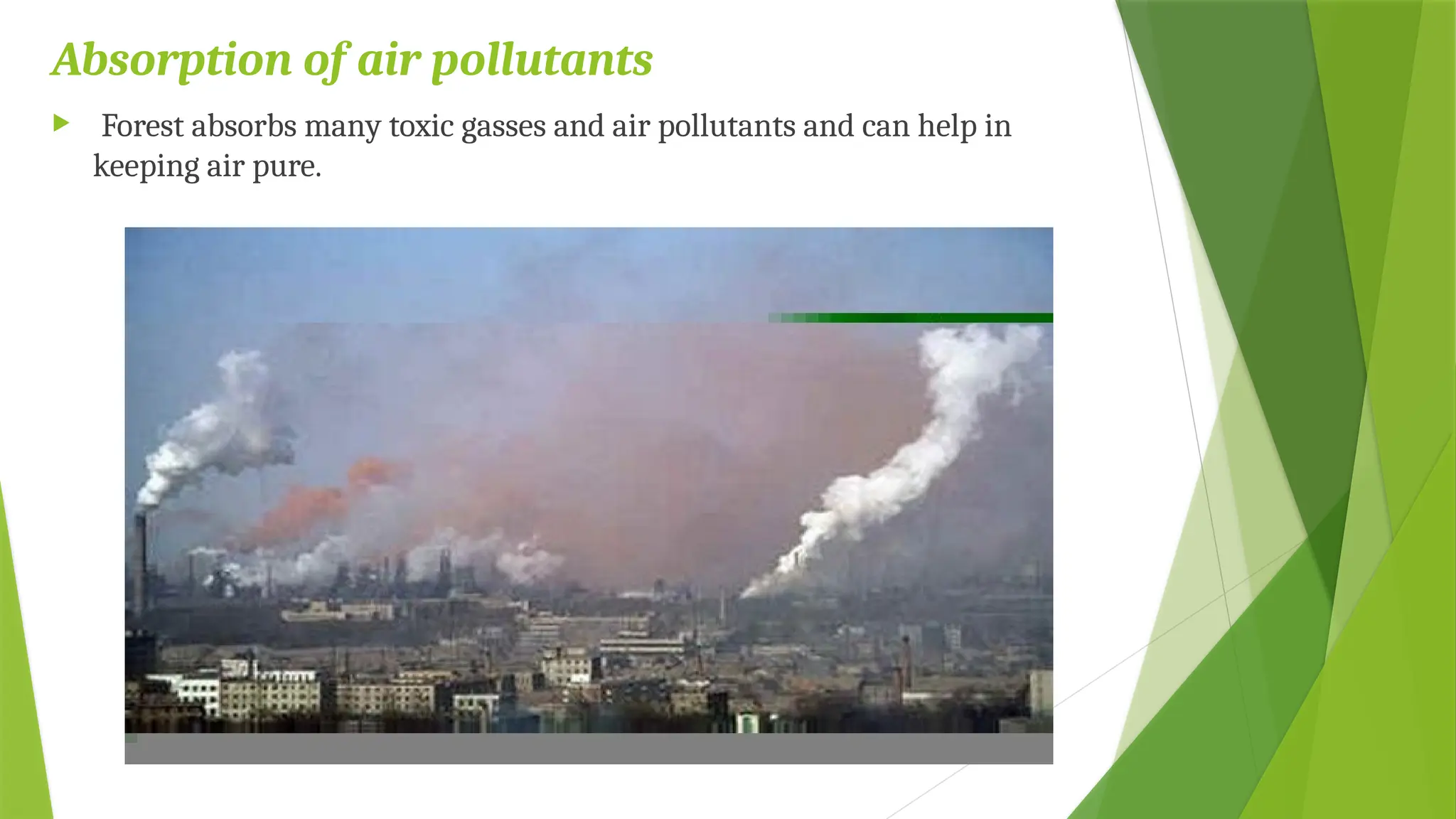
Absorption of air pollutants
 Forest absorbs many toxic gasses and air pollutants and can help in
keeping air pure.
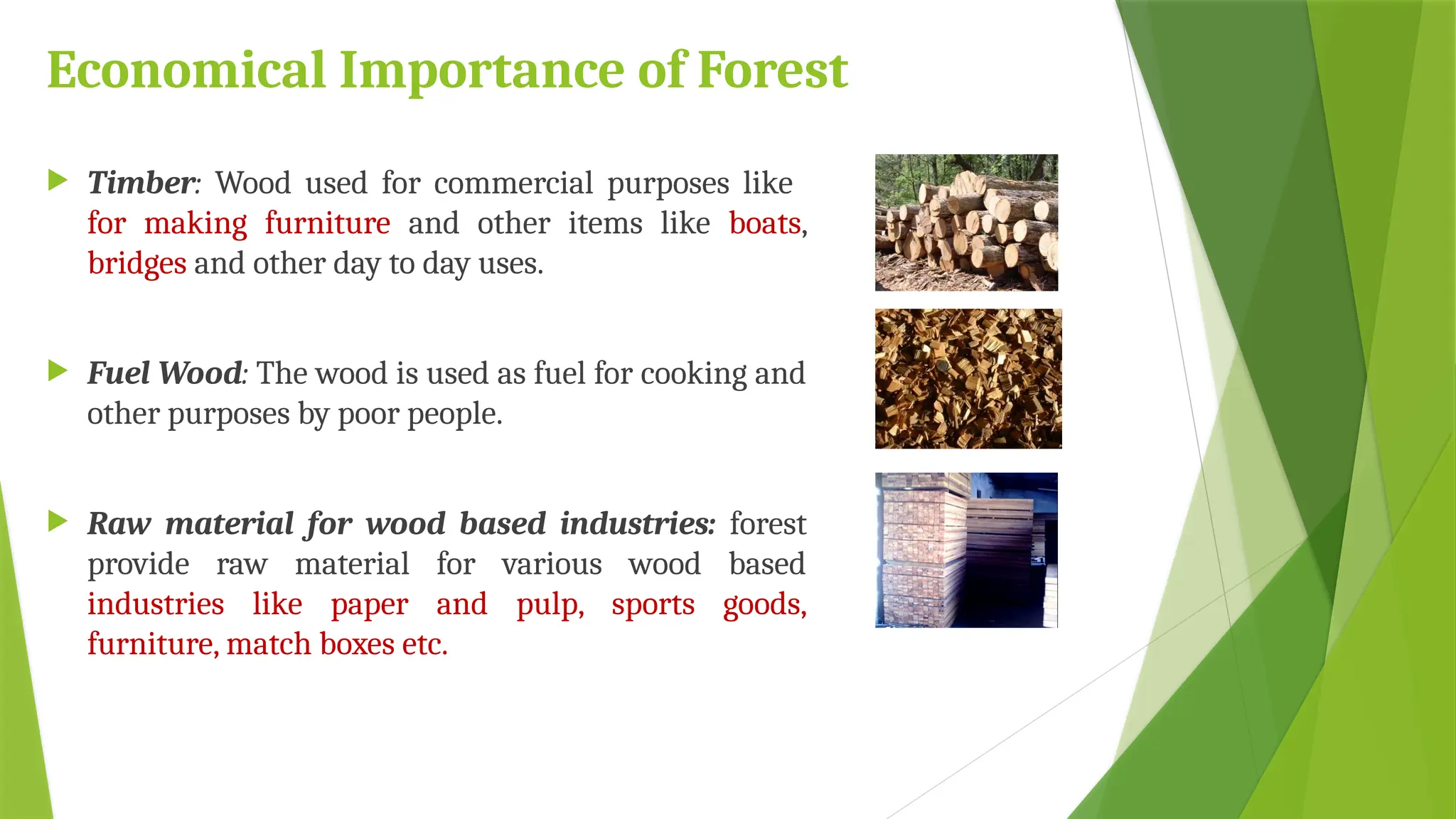
Economical Importance of Forest
 Timber: Wood used for commercial purposes like
for making furniture and other items like boats,
bridges and other day to day uses.
 Fuel Wood: The wood is used as fuel for cooking and
other purposes by poor people.
 Raw material for wood based industries: forest
provide raw material for various wood based
industries like paper and pulp, sports goods,
furniture, match boxes etc.
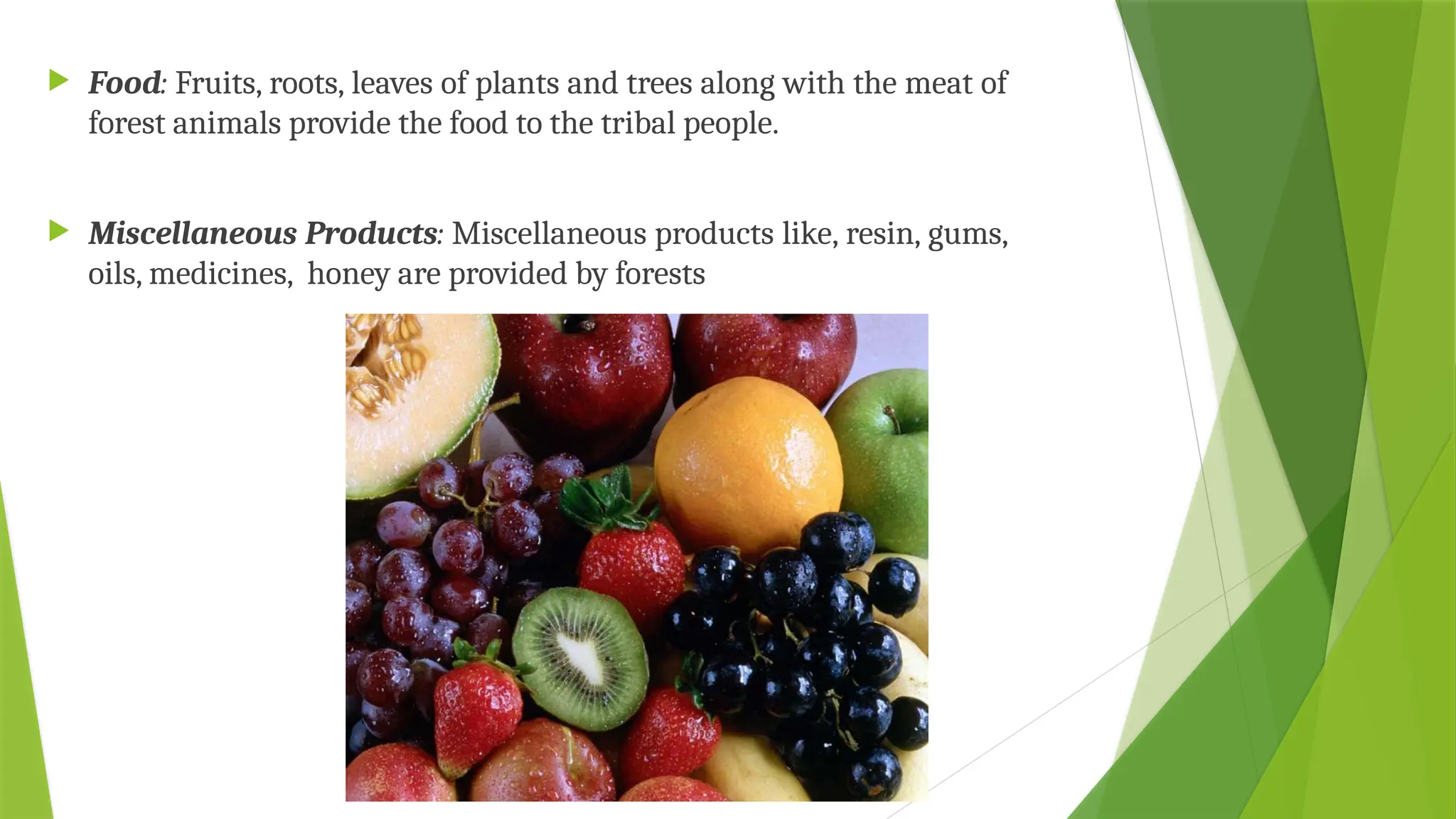
 Food: Fruits, roots, leaves of plants and trees along with the meat of
forest animals provide the food to the tribal people.
 Miscellaneous Products: Miscellaneous products like, resin, gums,
oils, medicines, honey are provided by forests
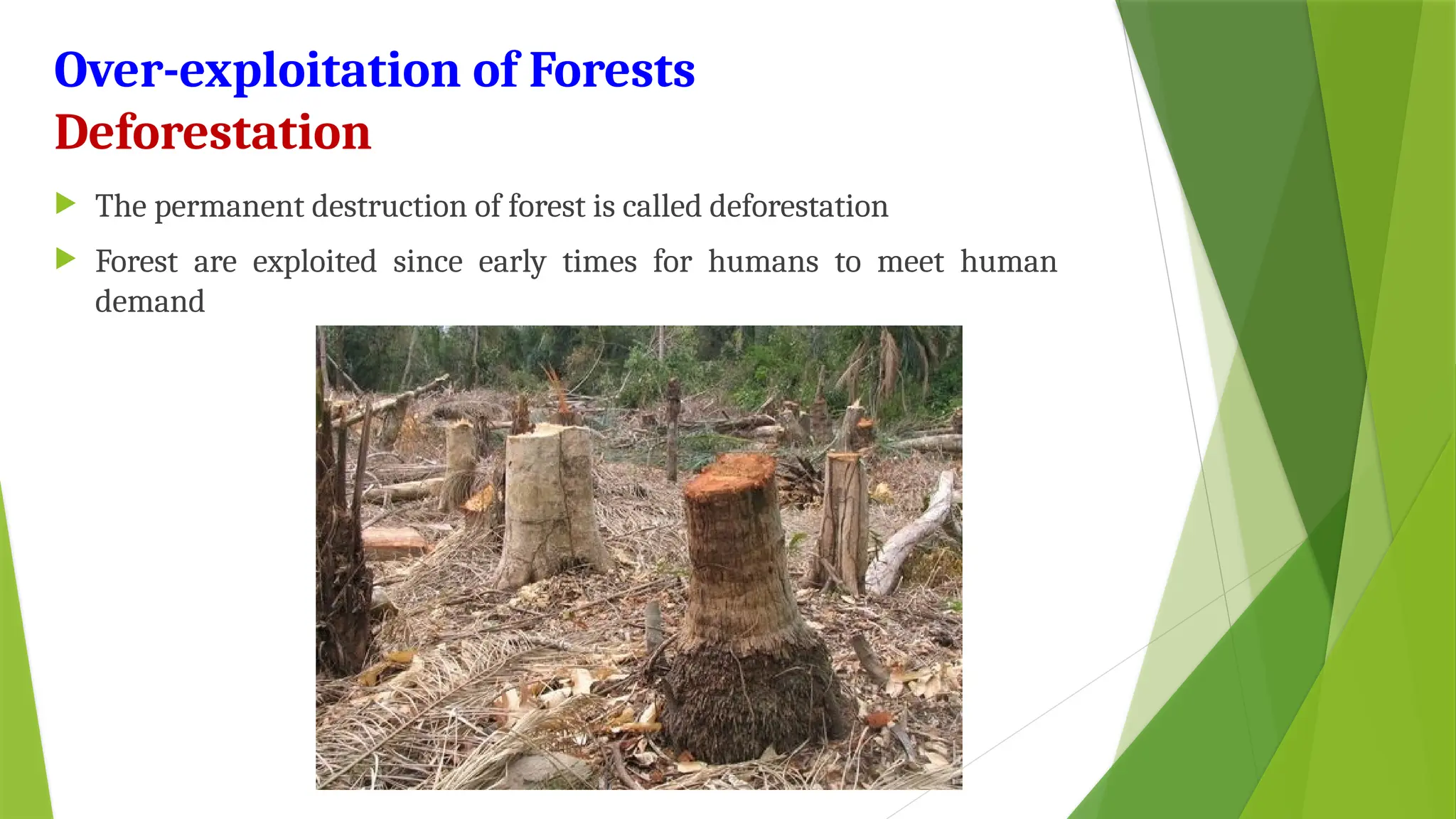
Over-exploitation of Forests
Deforestation
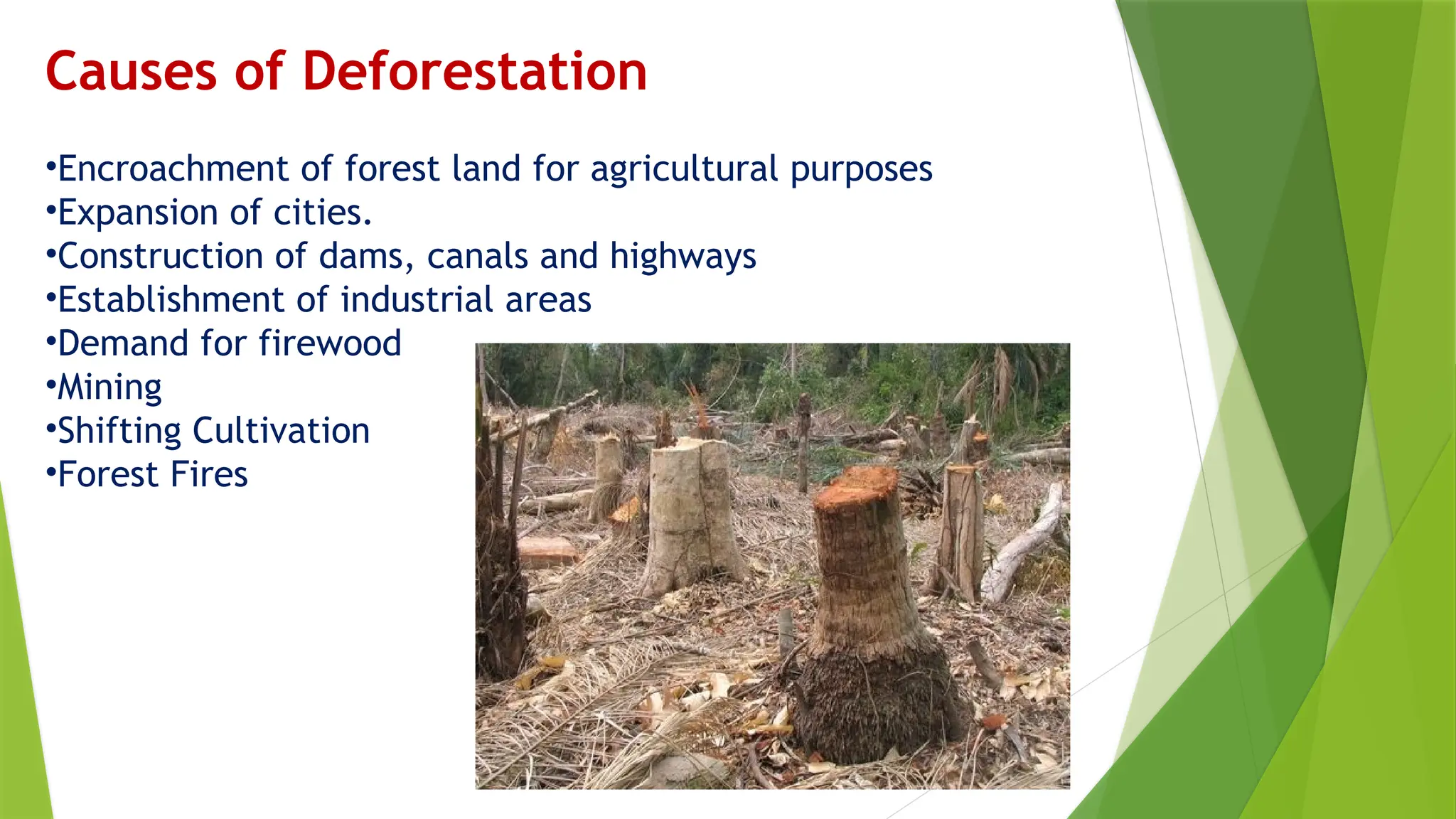
 The permanent destruction of forest is called deforestation
 Forest are exploited since early times for humans to meet human
demand
Causes of Deforestation
•Encroachment of forest land for agricultural purposes
•Expansion of cities.
•Construction of dams, canals and highways
•Establishment of industrial areas
•Demand for firewood
•Mining
•Shifting Cultivation
•Forest Fires
Causes of Deforestation
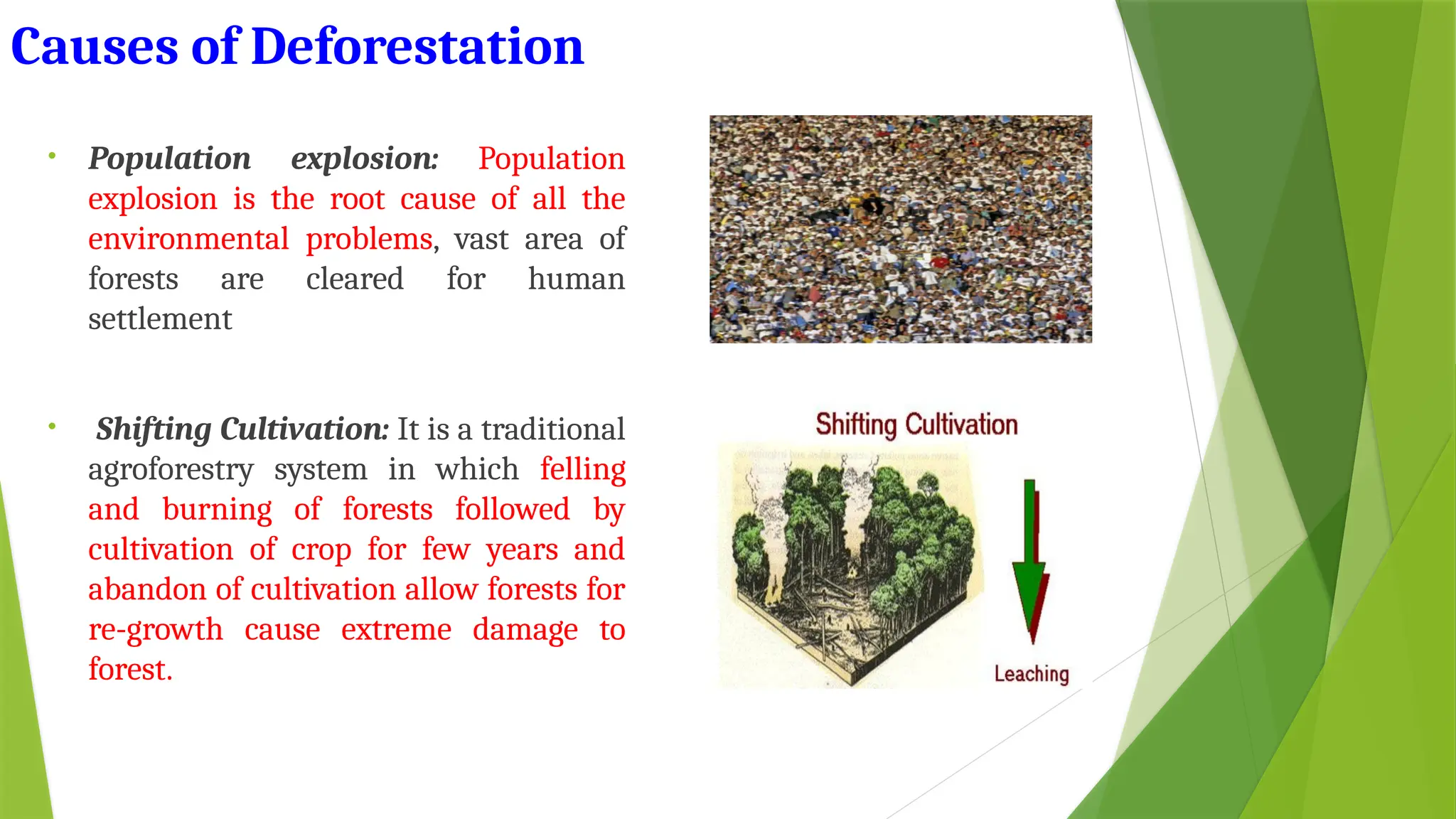
• Population explosion: Population
explosion is the root cause of all the
environmental problems, vast area of
forests are cleared for human
settlement
• Shifting Cultivation: It is a traditional
agroforestry system in which felling
and burning of forests followed by
cultivation of crop for few years and
abandon of cultivation allow forests for
re-growth cause extreme damage to
forest.
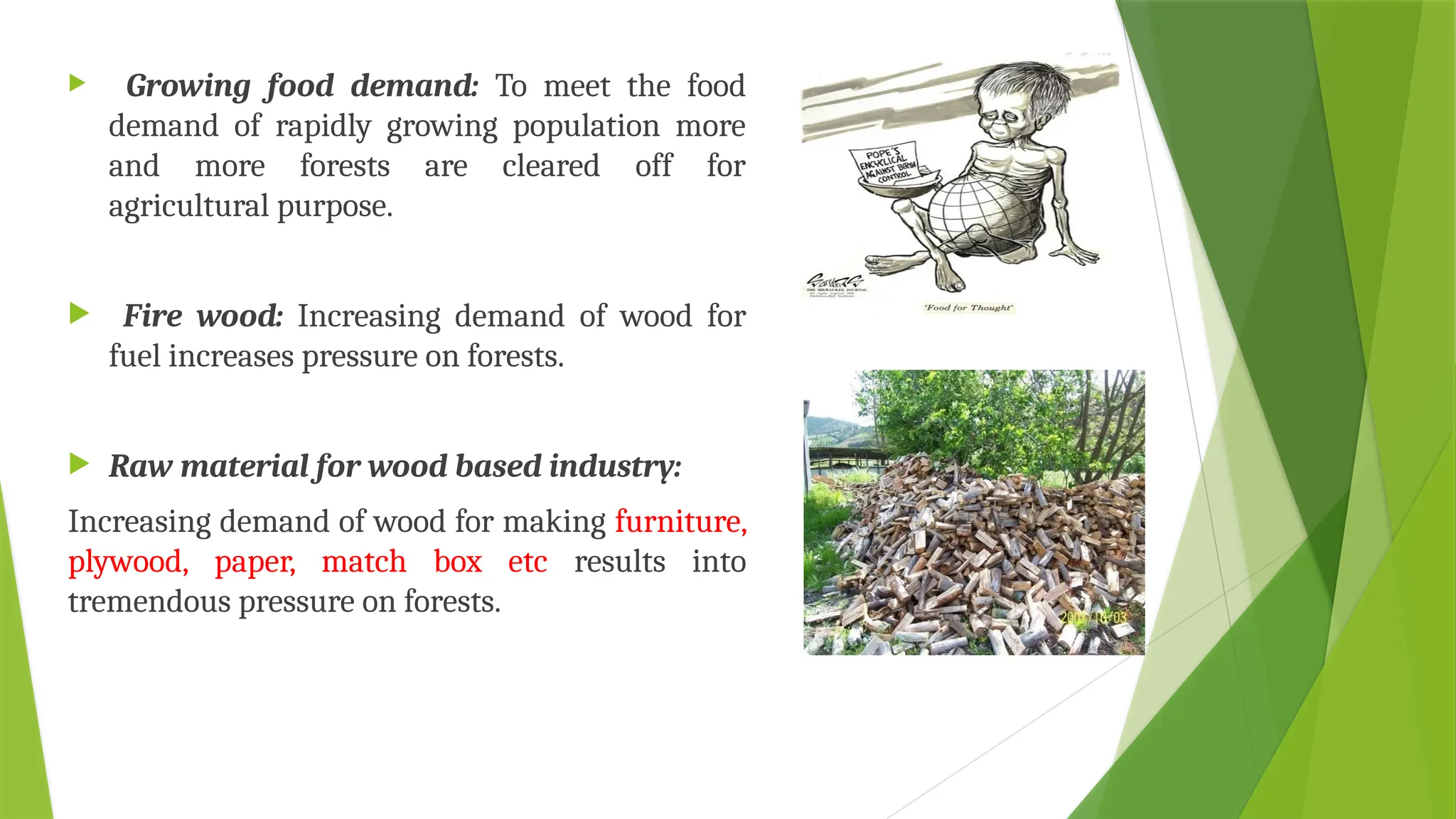
 Growing food demand: To meet the food
demand of rapidly growing population more
and more forests are cleared off for
agricultural purpose.
 Fire wood: Increasing demand of wood for
fuel increases pressure on forests.
 Raw material for wood based industry:
Increasing demand of wood for making furniture,
plywood, paper, match box etc results into
tremendous pressure on forests.
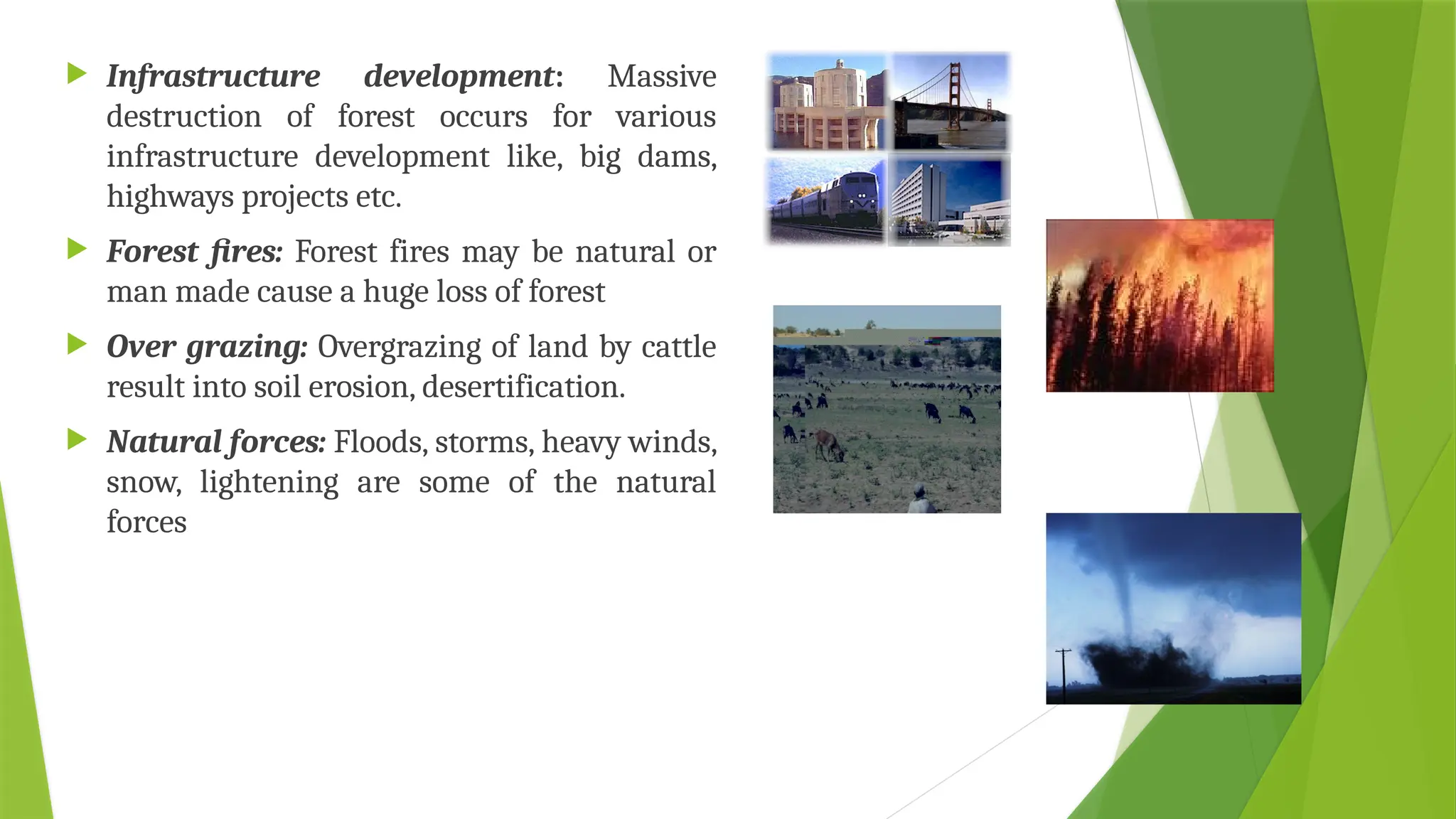
 Infrastructure development: Massive
destruction of forest occurs for various
infrastructure development like, big dams,
highways projects etc.
 Forest fires: Forest fires may be natural or
man made cause a huge loss of forest
 Over grazing: Overgrazing of land by cattle
result into soil erosion, desertification.
 Natural forces: Floods, storms, heavy winds,
snow, lightening are some of the natural
forces
Effects of Deforestation
Large scale of destruction of forests leads to a number of adverse
environmental effects.
•Loss of natural habitat of wild animals and plants
•Increased intensity and frequency of natural disasters
•Land Degradation
•Loss of forest products
•Change in climatic conditions
•Siltation of rivers and canals
•Loss of revenue
•Change in water cycle and reduced rainfall
•Increase socio economic problems
Effects of Deforestation
 Deforestation adversely affects and
damages the environment
 The adverse effect of deforestation are
discussed below:
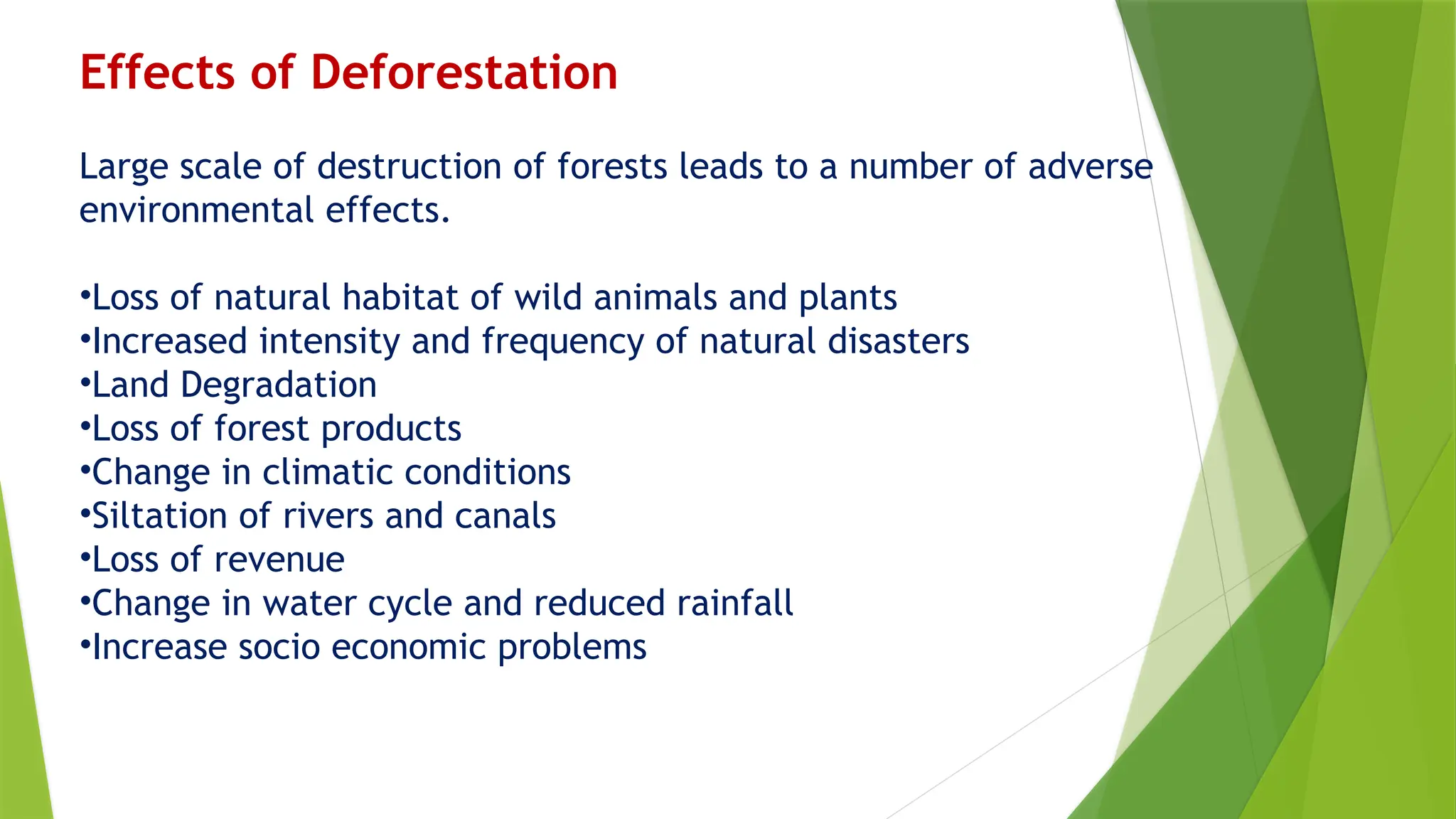
 Soil erosion: The soil gets washed
away with rain water on sloppy areas in
the absence of trees leading to soil
erosion.
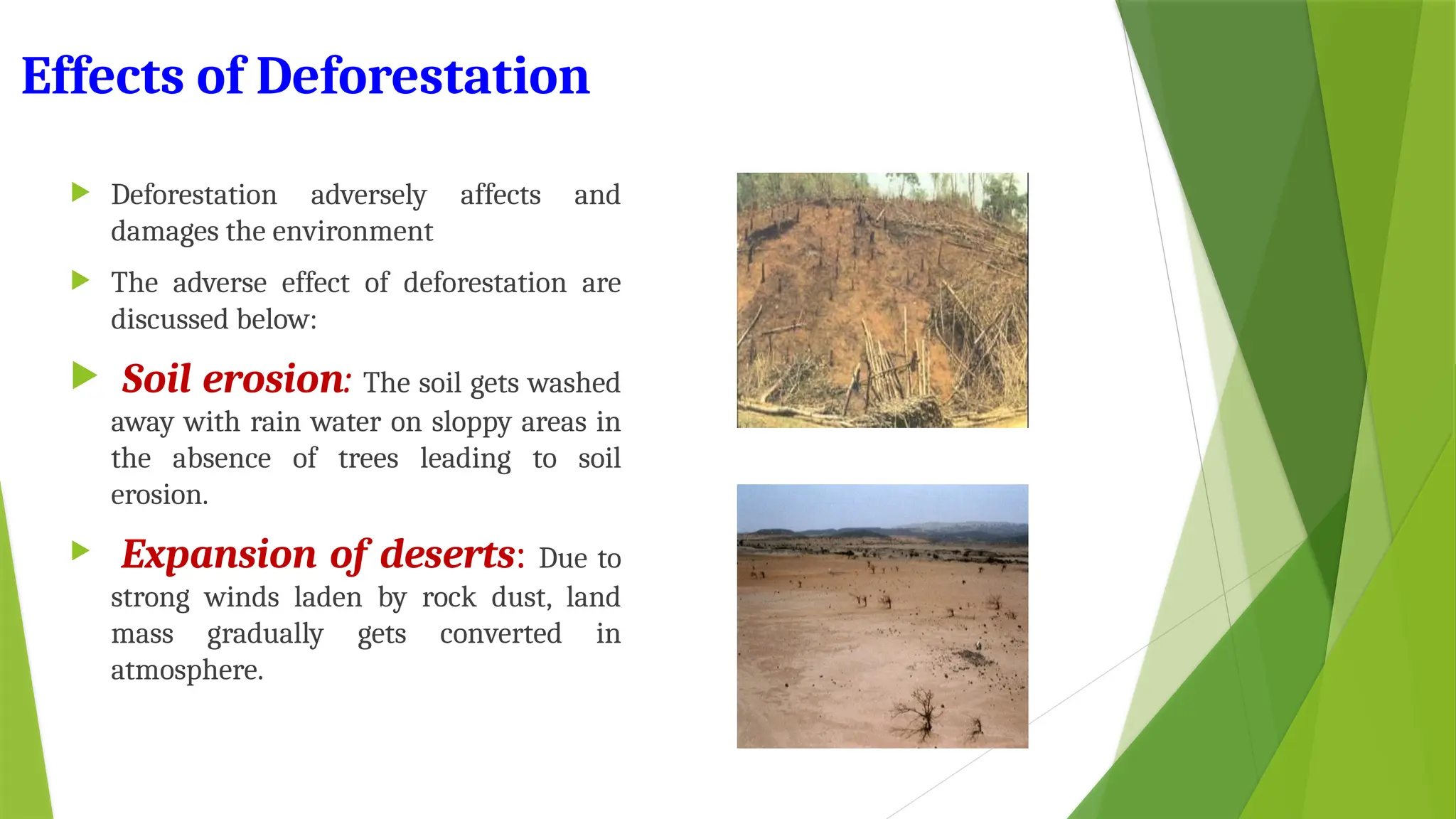
 Expansion of deserts: Due to
strong winds laden by rock dust, land
mass gradually gets converted in
atmosphere.
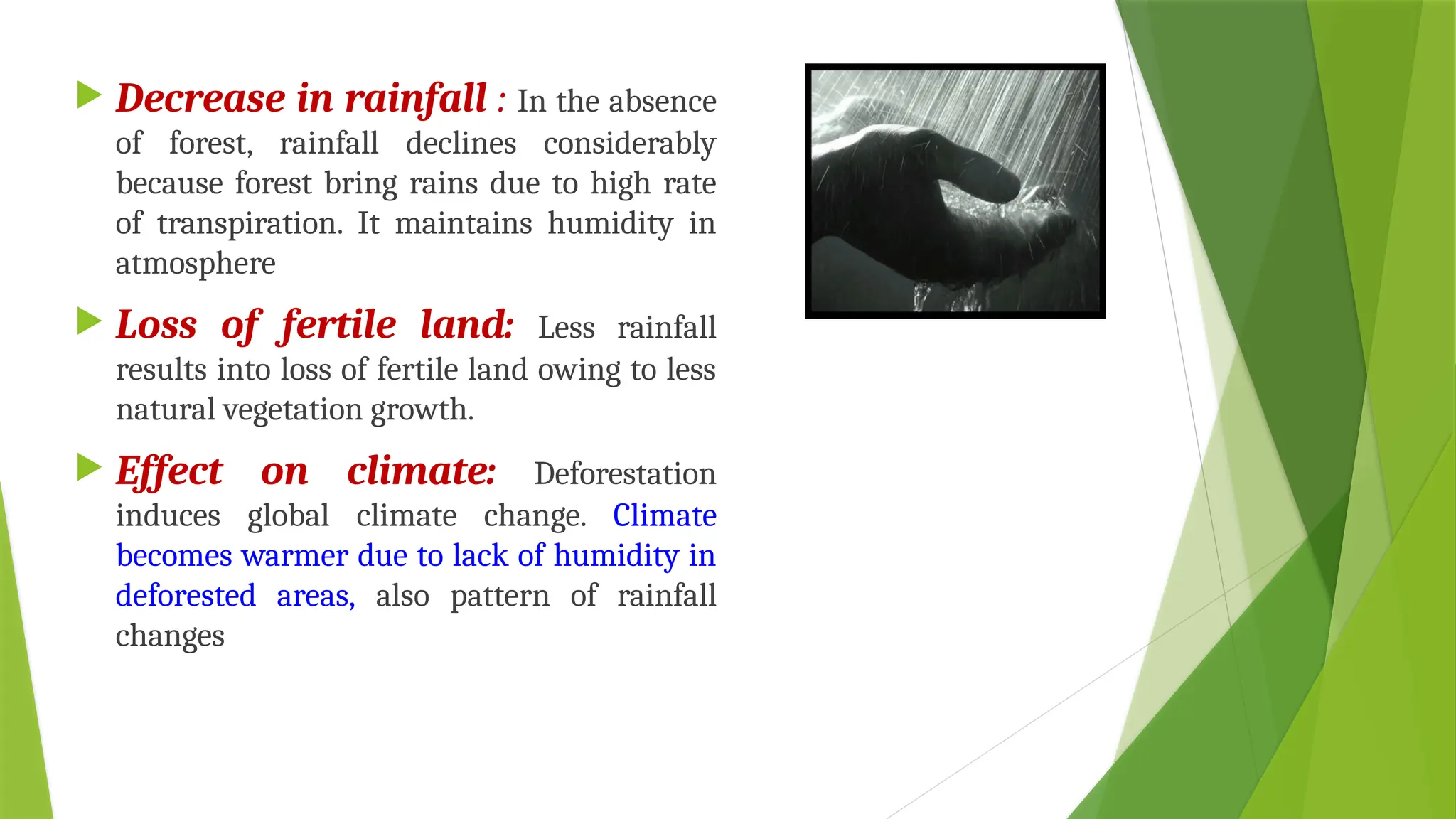
 Decrease in rainfall : In the absence
of forest, rainfall declines considerably
because forest bring rains due to high rate
of transpiration. It maintains humidity in
atmosphere
 Loss of fertile land: Less rainfall
results into loss of fertile land owing to less
natural vegetation growth.
 Effect on climate: Deforestation
induces global climate change. Climate
becomes warmer due to lack of humidity in
deforested areas, also pattern of rainfall
changes
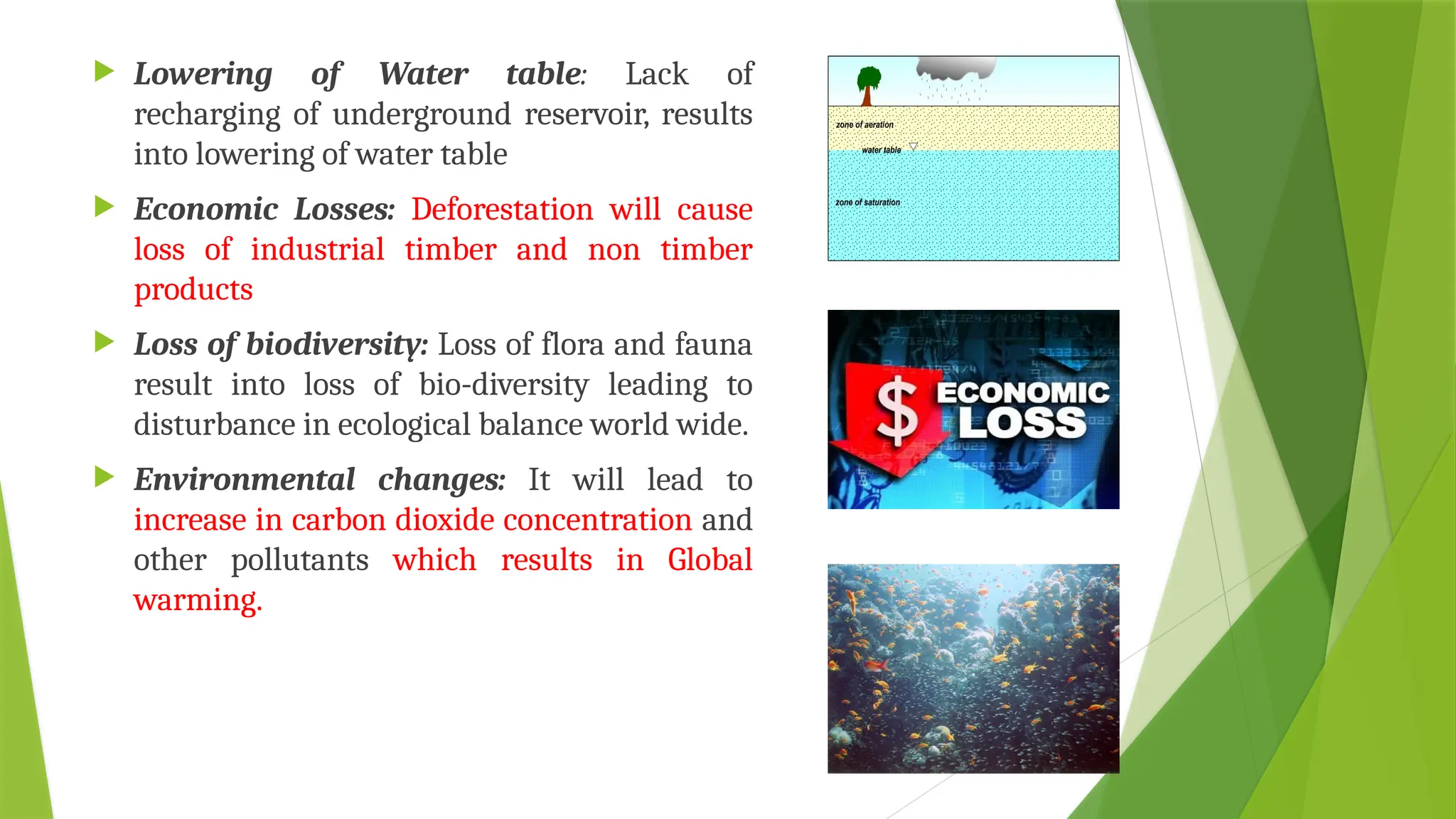
 Lowering of Water table: Lack of
recharging of underground reservoir, results
into lowering of water table
 Economic Losses: Deforestation will cause
loss of industrial timber and non timber
products
 Loss of biodiversity: Loss of flora and fauna
result into loss of bio-diversity leading to
disturbance in ecological balance world wide.
 Environmental changes: It will lead to
increase in carbon dioxide concentration and
other pollutants which results in Global
warming.
Control of Deforestation
 Mining activities should be prohibited.
 Cutting of trees should be followed by massive plantation.
 Strict environmental laws should be imposed.
 Forest extension should be carried out.
 Public awareness regarding medicinal, environmental and
economical significance.
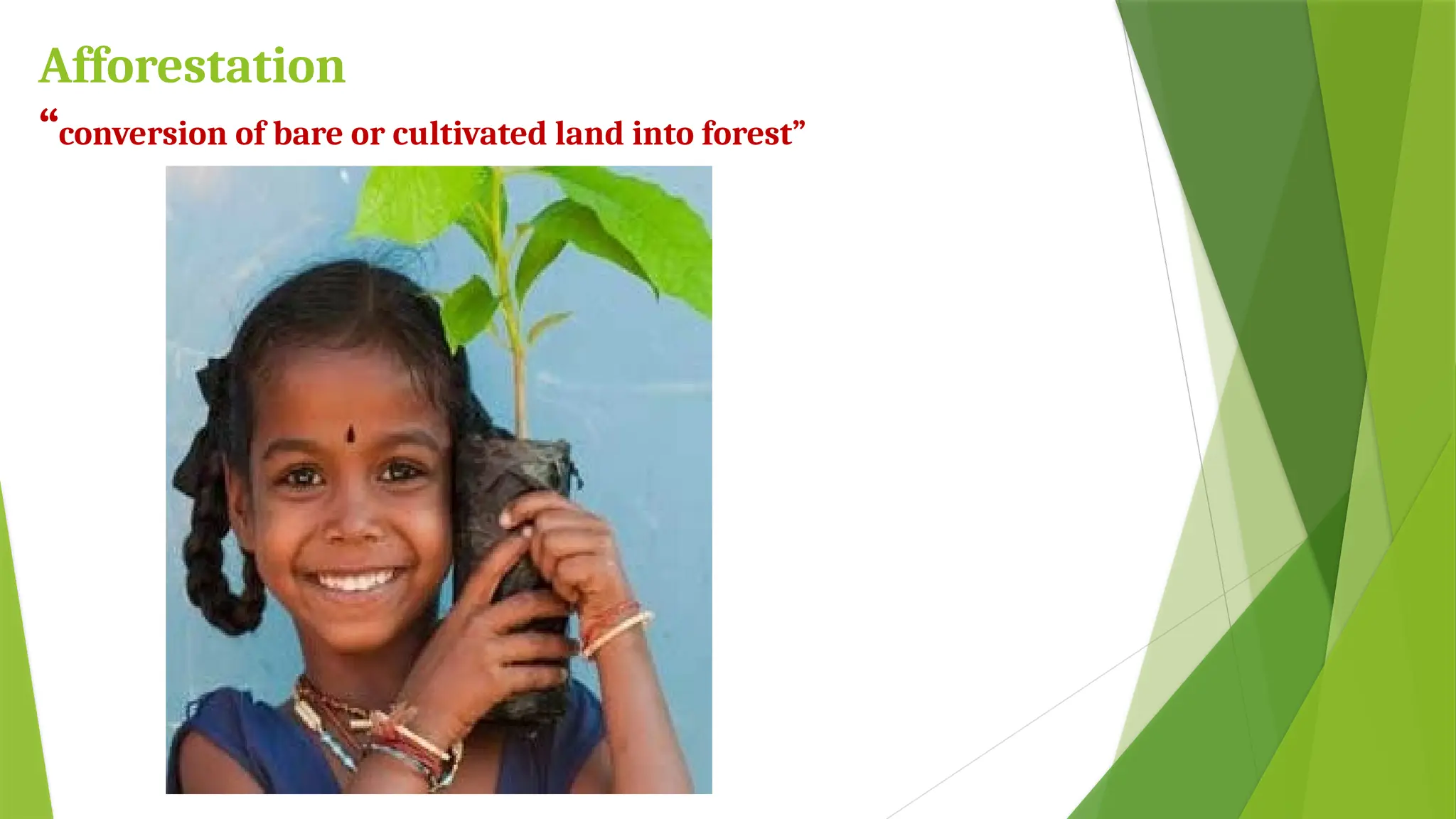
Afforestation
“conversion of bare or cultivated land into forest”
Afforestation
 The conservation measure against the
deforestation is afforestation. The development
of forest by planting trees on waste land is
called afforestation
 The main objective of afforestation:
 To control the deforestation
 To prevent soil erosion
 To regulate rainfall and
maintain temperature
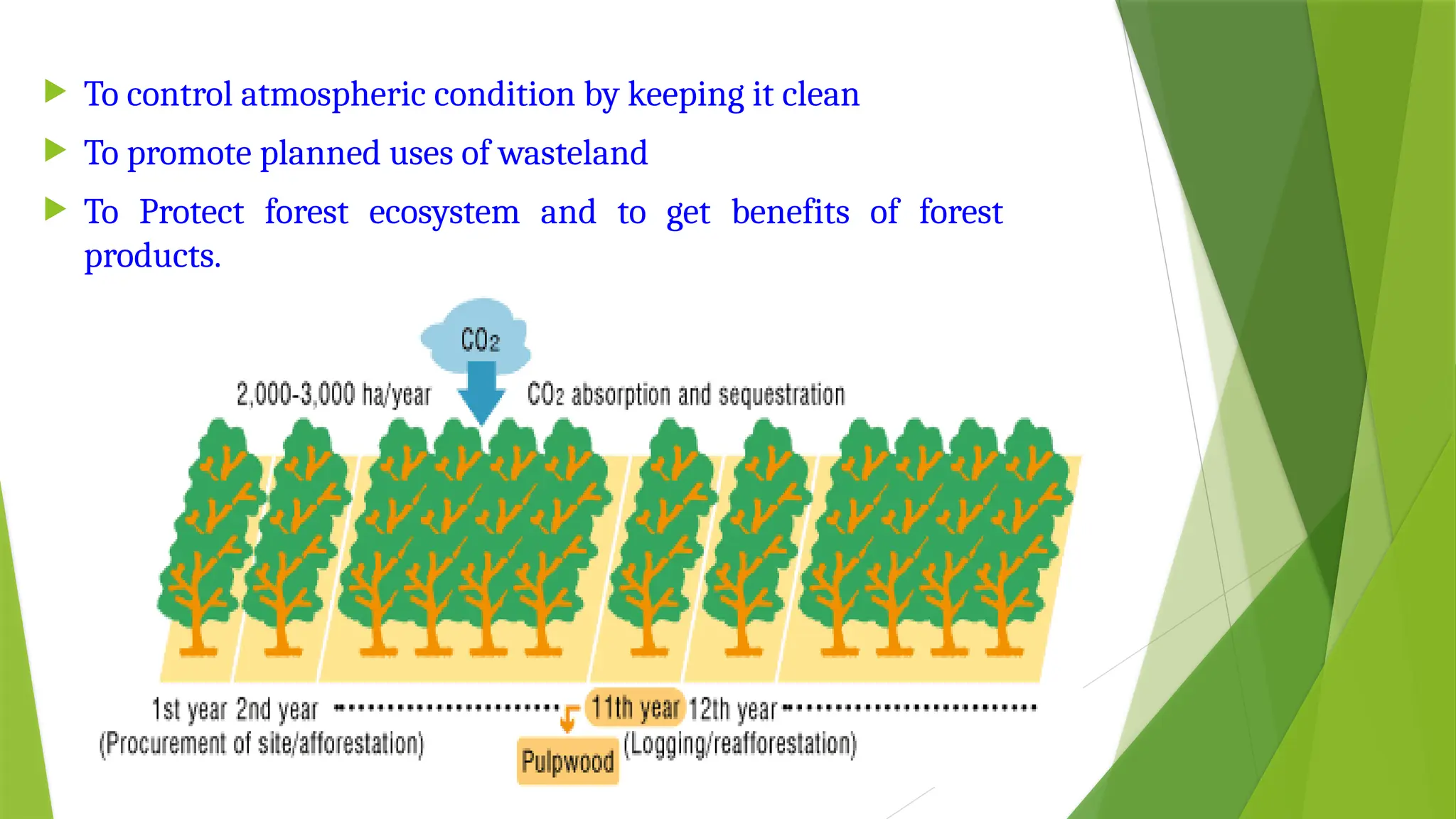
 To control atmospheric condition by keeping it clean
 To promote planned uses of wasteland
 To Protect forest ecosystem and to get benefits of forest
products.
Impact of Human Activities on Forests
 The clearing and burning of the forests result in:
 loss of biodiversity
 extinction of species
 soil erosion
 disturbance of the carbon cycle leading to global warming.
 landslides and floods
 increased siltation of rivers.
 Many forests affected by acid deposition originating from industries.
 Harvesting of old growth forests destroys habitat for endangered
species.
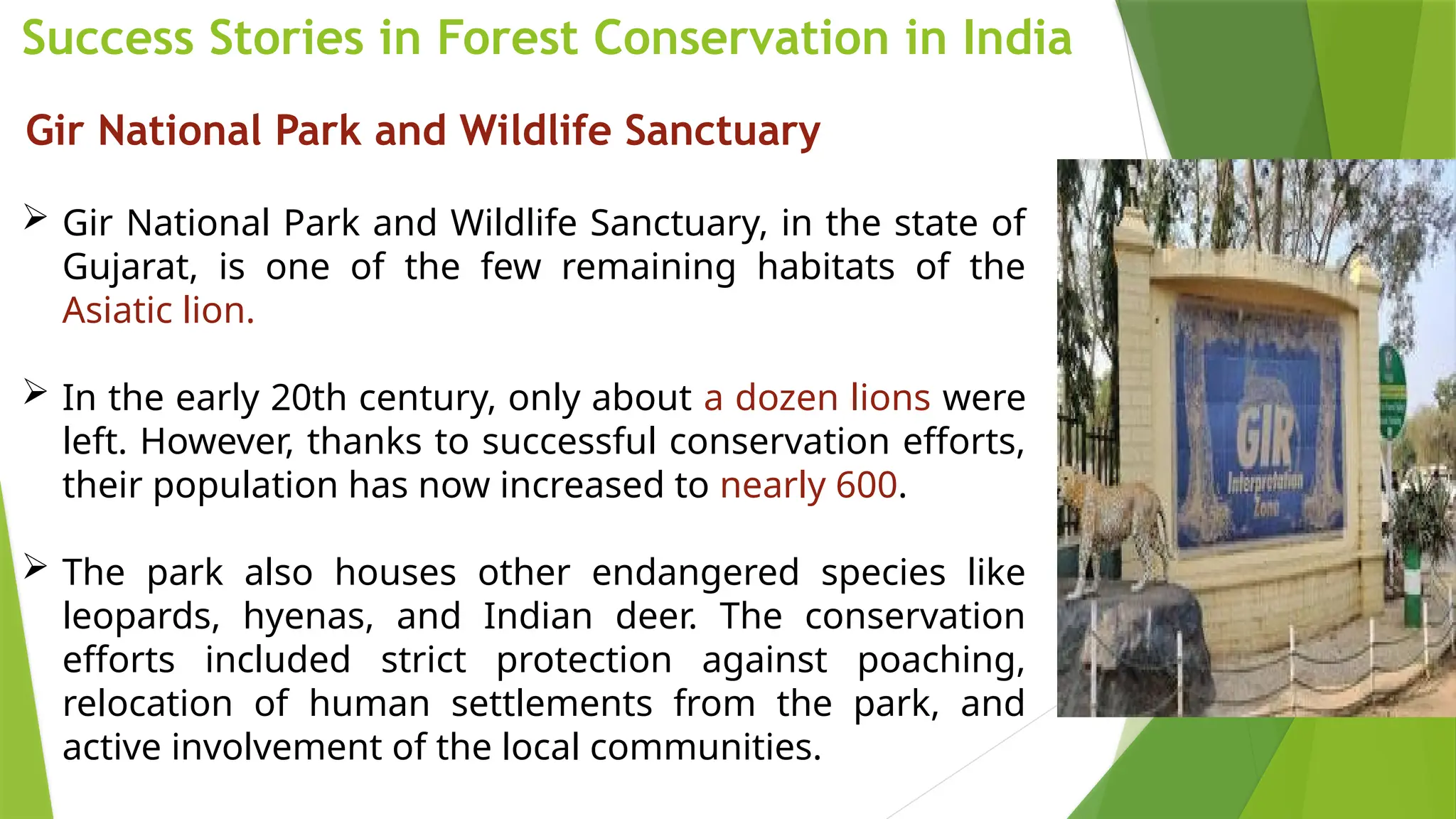
Success Stories in Forest Conservation in India
Gir National Park and Wildlife Sanctuary
 Gir National Park and Wildlife Sanctuary, in the state of
Gujarat, is one of the few remaining habitats of the
Asiatic lion.
 In the early 20th century, only about a dozen lions were
left. However, thanks to successful conservation efforts,
their population has now increased to nearly 600.
 The park also houses other endangered species like
leopards, hyenas, and Indian deer. The conservation
efforts included strict protection against poaching,
relocation of human settlements from the park, and
active involvement of the local communities.
Innovation in Forestry
1. Forest Mapping
Forest mapping is the major technology trend in the forestry industry. It provides
data-driven insights on tree cover, woodland resources, and landscape
developments. Forest mapping enables forest conservation and forest resource
analysis as well as accelerates climate tech solutions.
2. Tree Monitoring
There are strong relationships between tree cover and ecosystem health. Tree
monitoring systems allow authorities to keep track and count of the trees in the forest.
Foresters attach sensors to selected trees within the forest to measure various eco-
physiological and biological parameters that indicate the health of tree foliage.
3. Forest Risk Mitigation
Forest risk management solutions tackle the risk of fires and damages due to climate
change and natural disasters. Canadian start-up 4pi Lab detects early wildfires. The
start-up uses satellites to detect wildfires from space. The start-up provides the
constellation of sixteen satellites orbiting around the earth to send real-time updates
related to fire. It has high-performance cameras that identify wildfires that are as small
as 5 to 10 meters in diameter in addition to the precision geo-location targeting for
location accuracy.
Innovation in Forestry
4. Data-driven Forest Management
With technologies such as satellite sensing and sensors, there is a large amount of
data now available on forests. These are enabling foresters to take data-driven
decisions to support all aspects of forest management.
5. Harvesting Optimization
Harvesting optimization ensures that the correct number of trees are cut down, while also
maximizing the number of usable goods recovered.
Swedish start-up Deep Forestry uses machine learning and robotics to assess and predict
the growth of trees in forests. The start-up's drone scans every tree in a forest and
enables precision planning for foresters. This makes the forestry industry more efficient
by providing data-driven insights about where and how to harvest timber.
6. Forest Supply Chain Management
The forest supply chain comprises different stages including production facilities,
inventory control, transportation, and logistics for forest products.
Innovation in Forestry
7. Agroforestry and Silvopasture:
Agroforestry integrates trees into agricultural landscapes, offering multiple benefits such
as soil conservation, biodiversity enhancement, and carbon sequestration. Silvopasture, a
form of agroforestry, combines trees with livestock grazing, providing shade for animals
while improving soil fertility and carbon storage.
8. Bioacoustics Monitoring:
Bioacoustics monitoring involves using sound recordings to track wildlife populations and
assess ecosystem health. Automated acoustic monitoring systems can detect and analyze
animal vocalizations, aiding in the conservation of endangered species and monitoring
changes in biodiversity over time.
9. Genetic Conservation: Genetic technologies are increasingly being used to conserve
and restore forest biodiversity. Techniques like cryopreservation of seeds and tissue
culture propagation enable the preservation of rare and endangered plant species,
contributing to ex-situ conservation efforts.
10. Remote Sensing and GIS:
Remote sensing technologies, such as satellites and drones, coupled with Geographic
Information Systems (GIS), enable accurate monitoring and assessment of forest cover,
deforestation rates, and biodiversity. This data helps conservationists and policymakers
make informed decisions and target interventions effectively.
Please, Help to Reduce Global Warming!
Plant a Tree Now
Save Forest
Save Life
Thank You
FOREST DAY presentation Sengunthar Engineering college

  • 1.
    INTERNATIONAL DAY OFFOREST 2024 March - 21 Date: 21-03-2024 Prof. P.Thangarasu, AsP/Chemistry, Sengunthar Engineering College
  • 2.
     The UNGeneral Assembly (UNGA) proclaimed 21 March as the International Day of Forests in 2012.  The Day celebrates and raises awareness of the importance of all types of forests.  International Day of Forests 2024 will be celebrated on the theme, ‘Forests and Innovation: New Solutions for a Better World’
  • 3.
  • 4.
    Forest Resources  Theword forest is derived from a Latin word  “ Foris” means Outside  Forest are one of the most important natural resources of the earth.  Forests cover one-third of the Earth's landmass, performing vital functions around the world.  Around 1.6 billion people - depend on forests for their livelihoods, medicines, fuel, food and shelter. Forests are the most biologically diverse ecosystems on land, home to more than 80% of the terrestrial species of animals, plants and insects.  Tree forests cover approximately 9.4 percent of the Earth's surface (or 30 percent of total land area i.e., Approximately 1/3rd of the earth’s total land area ).  India is one of the ten most forest-rich countries of the world along with the Russian Federation, Brazil, Canada, United States of America, China, Democratic Republic of the Congo, Australia, Indonesia and Sudan.
  • 5.
    Forest Cover inthe World
  • 7.
    Indian Scenario  Thecountry’s forest span 72 million hectares (0.7 million square kilometers), approximately twice Germany’s total land area.  India’s forests account for 1.8% of the world’s total forest area and 22% of the country’s geographical area. The country hopes to achieve a 33% or one-third forest cover by 2030.  India’s state with the largest forest cover are 1. Madhya Pradesh (77,400 ha), 2. Arunachal Pradesh (67,000 ha), 3. Chhattisgarh 55,550 ha), and 4. Odisha (51,345 ha).
  • 9.
    Indian top fivestates with largest area under forest cover According to India's 2013 forest survey report, thus obtained and published by the Government of India suggests the top five states with largest area under forest cover: Madhya Pradesh: 7.75 million hectares Arunachal Pradesh: 6.73 million hectares Chhattisgarh: 5.6 million hectares Maharashtra: 5.06 million hectares Odisha: 5.03 million hectares The seven north-eastern States of India have nearly 1/4 th of the country’s forest cover.
  • 10.
    Forest Degradation inIndia  At the beginning of 20th century about 30 % of land in India was covered with forests but by the end of 20th century the forest cover was reduced to 19.4%.  As a result of exploitation, the tropical forest cover in India, is now only reduced to coastal western Ghats and northern India.  The National forest policy has recommended 33 % forest area for plains and 67 % for hills
  • 12.
    Importance of Forests Timber (plywood, door, windows, sports goods etc.)  Raw material (forest based industries: bee keeping, furniture, beedi, sal seed oil, bamboo sticks etc.)  Edible product (fruits, seeds, nuts, spices etc.)  They provide natural habitat to tribal people.  Manure and fuel wood (India is the world's largest consumer of fuel- wood)  They are an important source of national income.  Medicinal plants  Tourism: Ecotourism  Employment opportunities Direct Benefits
  • 13.
    Indirect Benefits  Forestshelp in minimizing natural hazards (Flood, drought).  They help in reducing soil erosion and siltation of downstream water bodies.  They help in reducing desertification and land degradation.  They help in maintaining biodiversity by providing habitat to wild animals.  They help in regulating hydrological cycle.  They help in regulating the gases in atmosphere.
  • 14.
    Functions of Forests The functions of forest may broadly classified into following categories  Protective Function  Productive Function  Regulative Function  Accessory Function
  • 15.
    1. Protective Functions Forest Provide protection against  Soil erosion,  Droughts,  Floods,  Noise,  Radiations Soil erosion Floods Soil erosion Droughts
  • 16.
    2. Productive Functions Forest Provide various products like, gum resins, medicines, honey, pulp, bamboo, timber, Vegetables and fruits. https://youtu.be/3ukshFP0Ddg
  • 17.
    3. Regulative Functions The Forest regulates the level of Oxygen and carbon dioxide in atmosphere.  The forests also help in regulating temperature conditions
  • 19.
    4. Accessory Function Forest provides aesthetics, habitat to various flora and fauna besides that it also has an recreational value.
  • 20.
    Ecological Importance oruses of Forests  Regulation of global climate and temperature  Forest play a crucial role in regulation of global climate and temperature as forest cover absorb the solar radiations that would otherwise be reflected back into the atmosphere by bare surface of the earth.  Transpiration of plants increases the atmosphere humidity which affects the rainfall, cools the atmosphere and thus regulate the hydrological cycle  The main green house gas co2 is used by forests for photosynthesis process the forest act as a sink for co2 there by reducing the green house effect due to co2.
  • 21.
    Production of Oxygen During Photosynthesis process forest releases oxygen a very important gas for human survival thereby forests are called as lungs of earth.
  • 22.
    Conservation of Soil They prevent soil erosion by  binding the soil particles tightly in their roots.  reducing the velocity of wind and rain which are chief agents causing erosion
  • 23.
    Improvement in fertilityof Soil  The fertility of soil increases due to humus formed by the decay of forest litter (leaves, branches, stems roots etc.)
  • 24.
    Control of waterflow  The forest act as a giant sponge they slow down runoff, absorbing and holding water that recharges springs, streams, and ground water.
  • 25.
    Habitat to wildlife  They provide the habitat for high wild life species
  • 26.
    Absorption of Noise Forest cover absorbs the noise and helps in preventing noise pollution
  • 27.
    Absorption of airpollutants  Forest absorbs many toxic gasses and air pollutants and can help in keeping air pure.
  • 28.
    Economical Importance ofForest  Timber: Wood used for commercial purposes like for making furniture and other items like boats, bridges and other day to day uses.  Fuel Wood: The wood is used as fuel for cooking and other purposes by poor people.  Raw material for wood based industries: forest provide raw material for various wood based industries like paper and pulp, sports goods, furniture, match boxes etc.
  • 29.
     Food: Fruits,roots, leaves of plants and trees along with the meat of forest animals provide the food to the tribal people.  Miscellaneous Products: Miscellaneous products like, resin, gums, oils, medicines, honey are provided by forests
  • 30.
    Over-exploitation of Forests Deforestation The permanent destruction of forest is called deforestation  Forest are exploited since early times for humans to meet human demand
  • 31.
    Causes of Deforestation •Encroachmentof forest land for agricultural purposes •Expansion of cities. •Construction of dams, canals and highways •Establishment of industrial areas •Demand for firewood •Mining •Shifting Cultivation •Forest Fires
  • 32.
    Causes of Deforestation •Population explosion: Population explosion is the root cause of all the environmental problems, vast area of forests are cleared for human settlement • Shifting Cultivation: It is a traditional agroforestry system in which felling and burning of forests followed by cultivation of crop for few years and abandon of cultivation allow forests for re-growth cause extreme damage to forest.
  • 33.
     Growing fooddemand: To meet the food demand of rapidly growing population more and more forests are cleared off for agricultural purpose.  Fire wood: Increasing demand of wood for fuel increases pressure on forests.  Raw material for wood based industry: Increasing demand of wood for making furniture, plywood, paper, match box etc results into tremendous pressure on forests.
  • 34.
     Infrastructure development:Massive destruction of forest occurs for various infrastructure development like, big dams, highways projects etc.  Forest fires: Forest fires may be natural or man made cause a huge loss of forest  Over grazing: Overgrazing of land by cattle result into soil erosion, desertification.  Natural forces: Floods, storms, heavy winds, snow, lightening are some of the natural forces
  • 35.
    Effects of Deforestation Largescale of destruction of forests leads to a number of adverse environmental effects. •Loss of natural habitat of wild animals and plants •Increased intensity and frequency of natural disasters •Land Degradation •Loss of forest products •Change in climatic conditions •Siltation of rivers and canals •Loss of revenue •Change in water cycle and reduced rainfall •Increase socio economic problems
  • 36.
    Effects of Deforestation Deforestation adversely affects and damages the environment  The adverse effect of deforestation are discussed below:  Soil erosion: The soil gets washed away with rain water on sloppy areas in the absence of trees leading to soil erosion.  Expansion of deserts: Due to strong winds laden by rock dust, land mass gradually gets converted in atmosphere.
  • 37.
     Decrease inrainfall : In the absence of forest, rainfall declines considerably because forest bring rains due to high rate of transpiration. It maintains humidity in atmosphere  Loss of fertile land: Less rainfall results into loss of fertile land owing to less natural vegetation growth.  Effect on climate: Deforestation induces global climate change. Climate becomes warmer due to lack of humidity in deforested areas, also pattern of rainfall changes
  • 38.
     Lowering ofWater table: Lack of recharging of underground reservoir, results into lowering of water table  Economic Losses: Deforestation will cause loss of industrial timber and non timber products  Loss of biodiversity: Loss of flora and fauna result into loss of bio-diversity leading to disturbance in ecological balance world wide.  Environmental changes: It will lead to increase in carbon dioxide concentration and other pollutants which results in Global warming.
  • 39.
    Control of Deforestation Mining activities should be prohibited.  Cutting of trees should be followed by massive plantation.  Strict environmental laws should be imposed.  Forest extension should be carried out.  Public awareness regarding medicinal, environmental and economical significance.
  • 40.
    Afforestation “conversion of bareor cultivated land into forest”
  • 41.
    Afforestation  The conservationmeasure against the deforestation is afforestation. The development of forest by planting trees on waste land is called afforestation  The main objective of afforestation:  To control the deforestation  To prevent soil erosion  To regulate rainfall and maintain temperature
  • 42.
     To controlatmospheric condition by keeping it clean  To promote planned uses of wasteland  To Protect forest ecosystem and to get benefits of forest products.
  • 43.
    Impact of HumanActivities on Forests  The clearing and burning of the forests result in:  loss of biodiversity  extinction of species  soil erosion  disturbance of the carbon cycle leading to global warming.  landslides and floods  increased siltation of rivers.  Many forests affected by acid deposition originating from industries.  Harvesting of old growth forests destroys habitat for endangered species.
  • 44.
    Success Stories inForest Conservation in India Gir National Park and Wildlife Sanctuary  Gir National Park and Wildlife Sanctuary, in the state of Gujarat, is one of the few remaining habitats of the Asiatic lion.  In the early 20th century, only about a dozen lions were left. However, thanks to successful conservation efforts, their population has now increased to nearly 600.  The park also houses other endangered species like leopards, hyenas, and Indian deer. The conservation efforts included strict protection against poaching, relocation of human settlements from the park, and active involvement of the local communities.
  • 45.
    Innovation in Forestry 1.Forest Mapping Forest mapping is the major technology trend in the forestry industry. It provides data-driven insights on tree cover, woodland resources, and landscape developments. Forest mapping enables forest conservation and forest resource analysis as well as accelerates climate tech solutions. 2. Tree Monitoring There are strong relationships between tree cover and ecosystem health. Tree monitoring systems allow authorities to keep track and count of the trees in the forest. Foresters attach sensors to selected trees within the forest to measure various eco- physiological and biological parameters that indicate the health of tree foliage. 3. Forest Risk Mitigation Forest risk management solutions tackle the risk of fires and damages due to climate change and natural disasters. Canadian start-up 4pi Lab detects early wildfires. The start-up uses satellites to detect wildfires from space. The start-up provides the constellation of sixteen satellites orbiting around the earth to send real-time updates related to fire. It has high-performance cameras that identify wildfires that are as small as 5 to 10 meters in diameter in addition to the precision geo-location targeting for location accuracy.
  • 46.
    Innovation in Forestry 4.Data-driven Forest Management With technologies such as satellite sensing and sensors, there is a large amount of data now available on forests. These are enabling foresters to take data-driven decisions to support all aspects of forest management. 5. Harvesting Optimization Harvesting optimization ensures that the correct number of trees are cut down, while also maximizing the number of usable goods recovered. Swedish start-up Deep Forestry uses machine learning and robotics to assess and predict the growth of trees in forests. The start-up's drone scans every tree in a forest and enables precision planning for foresters. This makes the forestry industry more efficient by providing data-driven insights about where and how to harvest timber. 6. Forest Supply Chain Management The forest supply chain comprises different stages including production facilities, inventory control, transportation, and logistics for forest products.
  • 47.
    Innovation in Forestry 7.Agroforestry and Silvopasture: Agroforestry integrates trees into agricultural landscapes, offering multiple benefits such as soil conservation, biodiversity enhancement, and carbon sequestration. Silvopasture, a form of agroforestry, combines trees with livestock grazing, providing shade for animals while improving soil fertility and carbon storage. 8. Bioacoustics Monitoring: Bioacoustics monitoring involves using sound recordings to track wildlife populations and assess ecosystem health. Automated acoustic monitoring systems can detect and analyze animal vocalizations, aiding in the conservation of endangered species and monitoring changes in biodiversity over time. 9. Genetic Conservation: Genetic technologies are increasingly being used to conserve and restore forest biodiversity. Techniques like cryopreservation of seeds and tissue culture propagation enable the preservation of rare and endangered plant species, contributing to ex-situ conservation efforts. 10. Remote Sensing and GIS: Remote sensing technologies, such as satellites and drones, coupled with Geographic Information Systems (GIS), enable accurate monitoring and assessment of forest cover, deforestation rates, and biodiversity. This data helps conservationists and policymakers make informed decisions and target interventions effectively.
  • 49.
    Please, Help toReduce Global Warming! Plant a Tree Now Save Forest Save Life Thank You