Importance of Mesh Independence
CFD Analysis of Combustion Systems
www.heatflux.com
Study Objective
❖ Objective: Identify the level of refinement required for accurate combustion CFD
results using mesh independence strategy
❖ Lots of parameters impact the CFD results. This presentation demonstrates the impact
of domain discretisation on the combustion results.
❖ Line of action for domain discretisation:
▪ A single burner in a box heater was identified as a basis for mesh independence study
▪ Three different meshes were created:
• Base case: Mesh count of 0.5 million (0.5 M)
• 1.5 M mesh: Mesh count of 1.5 million
• 3.0 M mesh: Mesh count of 3.0 million
▪ Mesh was refined in the entire domain in the subsequent cases
▪ Higher the degree of discretisation, greater will be the solution accuracy
Outline of the Steps
www.heatflux.com
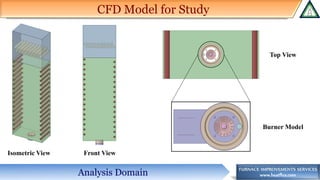
Top View
Front View
CFD Model for Study
Analysis Domain
Isometric View
Burner Model
www.heatflux.com
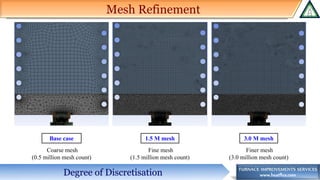
Base case 1.5 M mesh 3.0 M mesh
Coarse mesh
(0.5 million mesh count)
Fine mesh
(1.5 million mesh count)
Finer mesh
(3.0 million mesh count)
Mesh Refinement
Degree of Discretisation
www.heatflux.com
[Min.]
[Max.]
Base case 1.5 M mesh 3.0 M mesh
Average throat velocity ~ 31 ft/s Average throat velocity ~ 23 ft/s Average throat velocity ~ 23 ft/s
Velocity Contours at Burner Throat
❖ Observations:
▪ Base case to 1.5 M case: Significant difference in the velocity distribution at burner throat and average throat velocity.
▪ 1.5 M to 3.0 M case: Almost similar velocity distribution at burner throat.
❖ Conclusion:
▪ Base case (coarse mesh) does not give an ideal depiction of throat velocity distribution. Mesh refinement gives more accurate
distribution. An accurate throat velocity distribution will give an accurate flame pattern.
CFD Result: Velocity Distribution
www.heatflux.com
[Min.]
[Max.]
Flue Gas Velocity Contours
❖ As the mesh refinement is increased, the
flow from primary and staged tips become
more distinguished.
❖ Base case shows a combined flow pattern
which indicates that the flame would be from
a combined flow of tips.
❖ Velocity pattern for the other two cases show
that there will be lobes of staged fuel and a
central flame region due to primary fuel.
CFD Result: Velocity Distribution
Base case 1.5 M mesh 3.0 M mesh
www.heatflux.com
[Min.]
[Max.]
Flue Gas Velocity Contours
❖ Significant difference in the velocity profile
in the heater with a change in mesh
resolution.
❖ Ideal profile: Higher velocity at the center
with recirculated flow near the tubes and
walls
▪ This is obtained in 3.0 M mesh case.
▪ 1.5 M mesh case has flow tilted in one direction
▪ Base case has flow tilted towards the unshielded wall
CFD Result: Velocity Distribution
Base case 1.5 M mesh 3.0 M mesh
www.heatflux.com
Large recirculation on
one side
[Min.]
[Max.]
Flue Gas Velocity Vectors
❖ The density of vector in the images is
indicative of the mesh resolution.
❖ 3.0 M mesh case shows the best recirculation
pattern along with a more accurate depiction
of gas mixing from burner.
CFD Result: Velocity Flow Profile
Base case 1.5 M mesh 3.0 M mesh
www.heatflux.com
[Min.]
[Max.]
Flue Gas Temperature Contours
❖ Significant difference in the temperature
profile in the heater with a change in mesh
resolution.
❖ High flue gas temperature is observed near
the tubes in the first two cases (highlighted
regions)
CFD Result: Temperature Distribution
Base case 1.5 M mesh 3.0 M mesh
www.heatflux.com
Flame Height:
5.7 ft
(Based on an iso-
surface of CO)
Flame Height:
6.0 ft
Flame Height:
7.2 ft
[Min.]
[Max.]
Flame Height
❖ Large difference in the flame pattern
observed in the three cases
❖ Cases 2 and 3 with more refined meshes
indicate formation of lobes of the flame iso-
surface.
CFD Result: Flame Profile
Base case 1.5 M mesh 3.0 M mesh
www.heatflux.com
[Min.]
[Max.]
Radiant Tube Temperature Profile
❖ Mesh refinement has little impact on the
temperature pattern. However, most refined
mesh (3.0 M) indicates a value lower by 8 ºF.
❖ Slight difference in the temperature pattern is
observed on the highlighted tubes
CFD Result: Heat Distribution on Tubes
Base case 1.5 M mesh 3.0 M mesh
www.heatflux.com
Observations
❖ Following quantities were observed to be similar for all the three cases
▪ Air and fuel side pressure drops
▪ Overall average heat flux
▪ Flue gas temperature at the domain outlet
▪ Average oxygen and unburnt CO at the domain outlet
❖ Most refined mesh (3.0 M mesh) gives a better qualitative indication of the overall
results
▪ More uniform throat velocity distribution
▪ Better flame pattern
▪ Better recirculation profile
▪ Accurate tube temperature predictions
❖ Drawback: Higher degree of discretisation increases the computation time
▪ 3.0 M mesh case took almost twice the time of the base case with coarse mesh
Mesh Independence: Pros and Cons

Importance of mesh independence study

  • 1.
    Importance of MeshIndependence CFD Analysis of Combustion Systems
  • 2.
    www.heatflux.com Study Objective ❖ Objective:Identify the level of refinement required for accurate combustion CFD results using mesh independence strategy ❖ Lots of parameters impact the CFD results. This presentation demonstrates the impact of domain discretisation on the combustion results. ❖ Line of action for domain discretisation: ▪ A single burner in a box heater was identified as a basis for mesh independence study ▪ Three different meshes were created: • Base case: Mesh count of 0.5 million (0.5 M) • 1.5 M mesh: Mesh count of 1.5 million • 3.0 M mesh: Mesh count of 3.0 million ▪ Mesh was refined in the entire domain in the subsequent cases ▪ Higher the degree of discretisation, greater will be the solution accuracy Outline of the Steps
  • 3.
    www.heatflux.com Top View Front View CFDModel for Study Analysis Domain Isometric View Burner Model
  • 4.
    www.heatflux.com Base case 1.5M mesh 3.0 M mesh Coarse mesh (0.5 million mesh count) Fine mesh (1.5 million mesh count) Finer mesh (3.0 million mesh count) Mesh Refinement Degree of Discretisation
  • 5.
    www.heatflux.com [Min.] [Max.] Base case 1.5M mesh 3.0 M mesh Average throat velocity ~ 31 ft/s Average throat velocity ~ 23 ft/s Average throat velocity ~ 23 ft/s Velocity Contours at Burner Throat ❖ Observations: ▪ Base case to 1.5 M case: Significant difference in the velocity distribution at burner throat and average throat velocity. ▪ 1.5 M to 3.0 M case: Almost similar velocity distribution at burner throat. ❖ Conclusion: ▪ Base case (coarse mesh) does not give an ideal depiction of throat velocity distribution. Mesh refinement gives more accurate distribution. An accurate throat velocity distribution will give an accurate flame pattern. CFD Result: Velocity Distribution
  • 6.
    www.heatflux.com [Min.] [Max.] Flue Gas VelocityContours ❖ As the mesh refinement is increased, the flow from primary and staged tips become more distinguished. ❖ Base case shows a combined flow pattern which indicates that the flame would be from a combined flow of tips. ❖ Velocity pattern for the other two cases show that there will be lobes of staged fuel and a central flame region due to primary fuel. CFD Result: Velocity Distribution Base case 1.5 M mesh 3.0 M mesh
  • 7.
    www.heatflux.com [Min.] [Max.] Flue Gas VelocityContours ❖ Significant difference in the velocity profile in the heater with a change in mesh resolution. ❖ Ideal profile: Higher velocity at the center with recirculated flow near the tubes and walls ▪ This is obtained in 3.0 M mesh case. ▪ 1.5 M mesh case has flow tilted in one direction ▪ Base case has flow tilted towards the unshielded wall CFD Result: Velocity Distribution Base case 1.5 M mesh 3.0 M mesh
  • 8.
    www.heatflux.com Large recirculation on oneside [Min.] [Max.] Flue Gas Velocity Vectors ❖ The density of vector in the images is indicative of the mesh resolution. ❖ 3.0 M mesh case shows the best recirculation pattern along with a more accurate depiction of gas mixing from burner. CFD Result: Velocity Flow Profile Base case 1.5 M mesh 3.0 M mesh
  • 9.
    www.heatflux.com [Min.] [Max.] Flue Gas TemperatureContours ❖ Significant difference in the temperature profile in the heater with a change in mesh resolution. ❖ High flue gas temperature is observed near the tubes in the first two cases (highlighted regions) CFD Result: Temperature Distribution Base case 1.5 M mesh 3.0 M mesh
  • 10.
    www.heatflux.com Flame Height: 5.7 ft (Basedon an iso- surface of CO) Flame Height: 6.0 ft Flame Height: 7.2 ft [Min.] [Max.] Flame Height ❖ Large difference in the flame pattern observed in the three cases ❖ Cases 2 and 3 with more refined meshes indicate formation of lobes of the flame iso- surface. CFD Result: Flame Profile Base case 1.5 M mesh 3.0 M mesh
  • 11.
    www.heatflux.com [Min.] [Max.] Radiant Tube TemperatureProfile ❖ Mesh refinement has little impact on the temperature pattern. However, most refined mesh (3.0 M) indicates a value lower by 8 ºF. ❖ Slight difference in the temperature pattern is observed on the highlighted tubes CFD Result: Heat Distribution on Tubes Base case 1.5 M mesh 3.0 M mesh
  • 12.
    www.heatflux.com Observations ❖ Following quantitieswere observed to be similar for all the three cases ▪ Air and fuel side pressure drops ▪ Overall average heat flux ▪ Flue gas temperature at the domain outlet ▪ Average oxygen and unburnt CO at the domain outlet ❖ Most refined mesh (3.0 M mesh) gives a better qualitative indication of the overall results ▪ More uniform throat velocity distribution ▪ Better flame pattern ▪ Better recirculation profile ▪ Accurate tube temperature predictions ❖ Drawback: Higher degree of discretisation increases the computation time ▪ 3.0 M mesh case took almost twice the time of the base case with coarse mesh Mesh Independence: Pros and Cons