1
2
• Located 42 km from central Bangkok
• 330 acre (130 Ha) green campus
• Adjacent to Thammasat University &
Thailand Science Park, Thailand’s
National Science and Technology
Development Agency (NSTDA)
• Home to 2500+ faculty, staff, students
from 50+ countries
AIT Campus
2
3
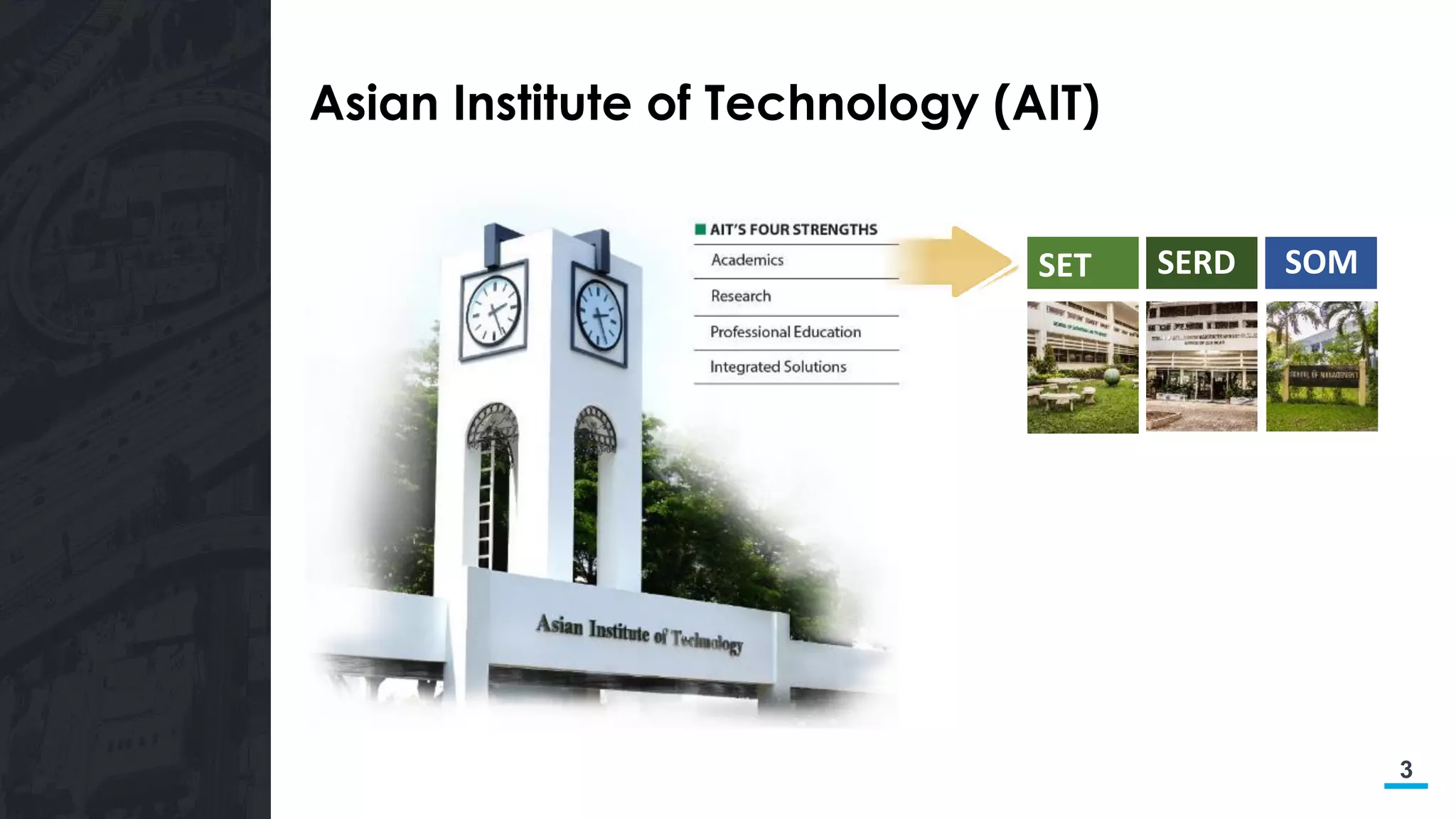
Asian Institute of Technology (AIT)
SET SERD SOM
4
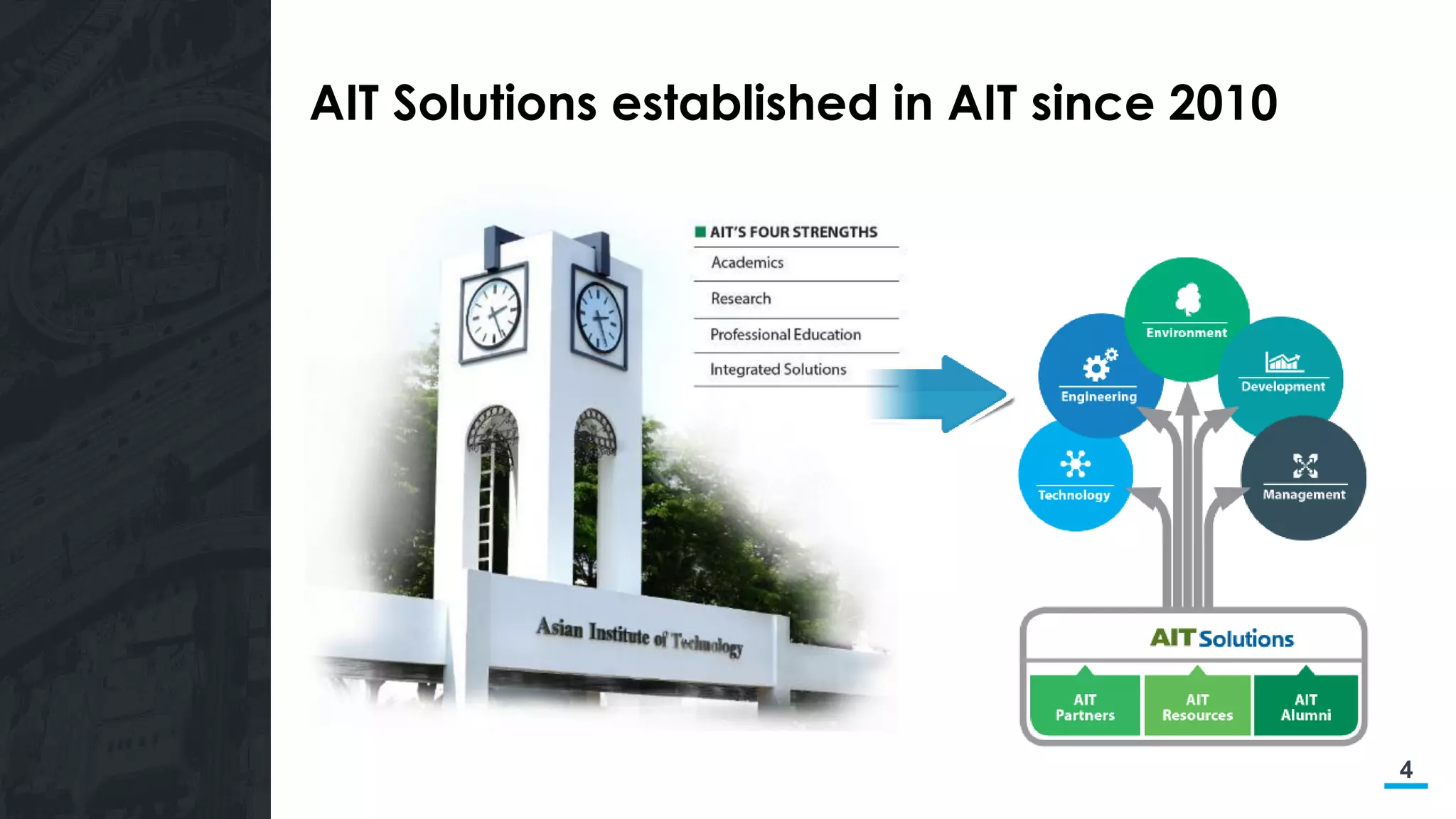
AIT Solutions established in AIT since 2010
5
Pls replace the text in the circle with our
mission (next slide)
“Building upon
AIT schools, labs, research
centers, and alumni resources
to advance technological
development of the region”
6
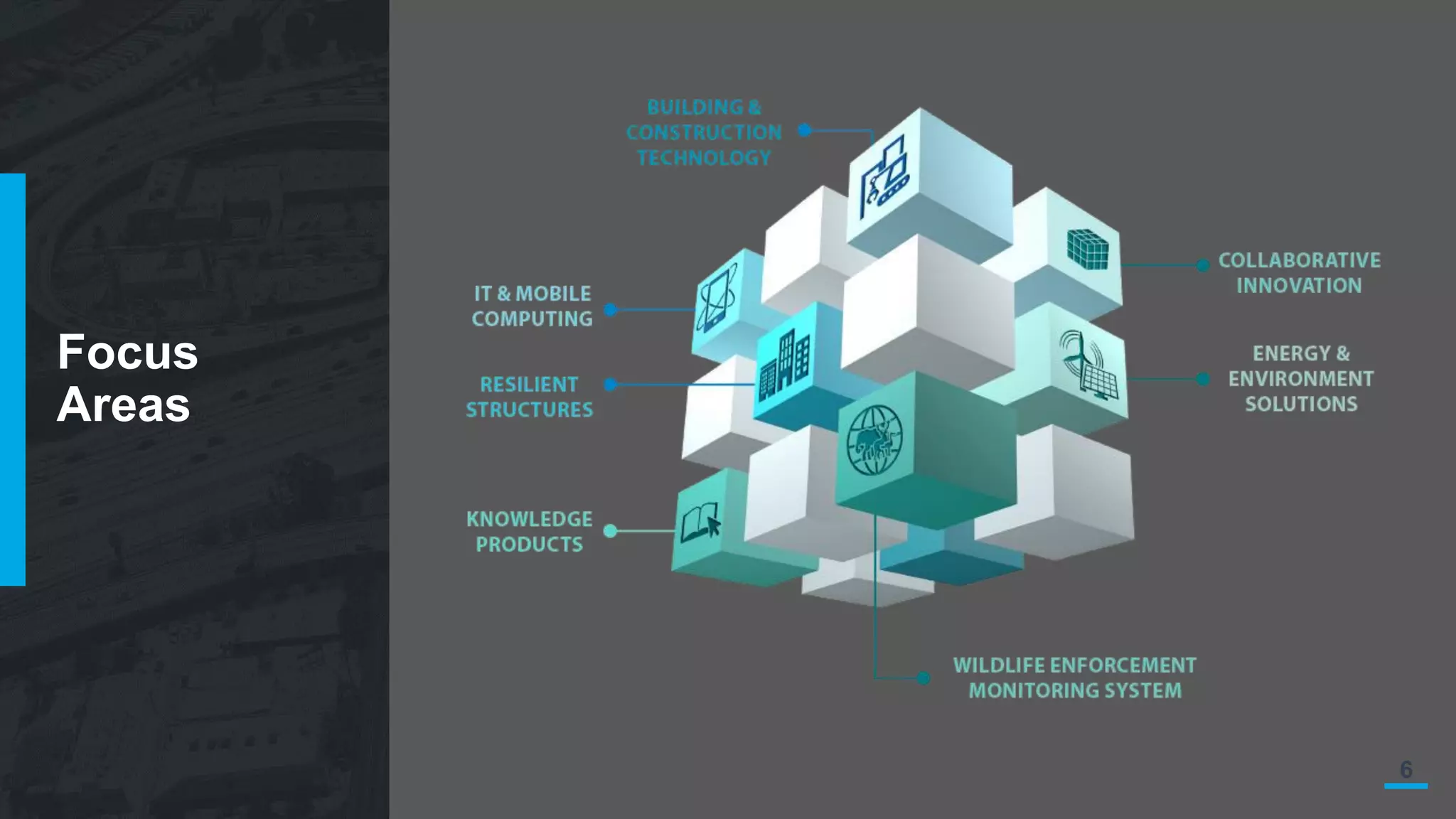
Focus
Areas
7
Resilient Structures
8
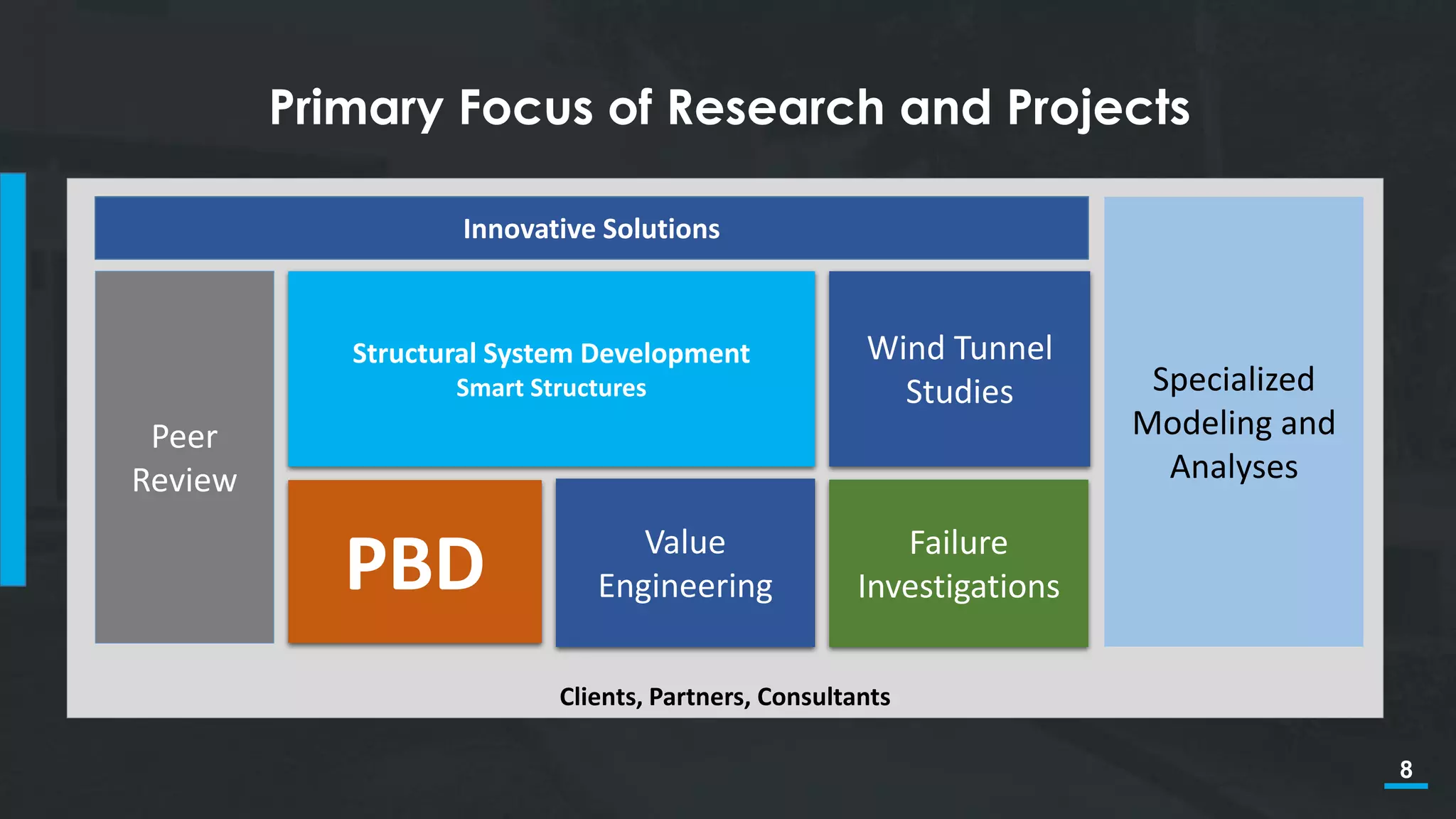
Primary Focus of Research and Projects
Clients, Partners, Consultants
PBD Value
Engineering
Peer
Review
Structural System Development
Smart Structures
Wind Tunnel
Studies
Failure
Investigations
Innovative Solutions
Specialized
Modeling and
Analyses
9
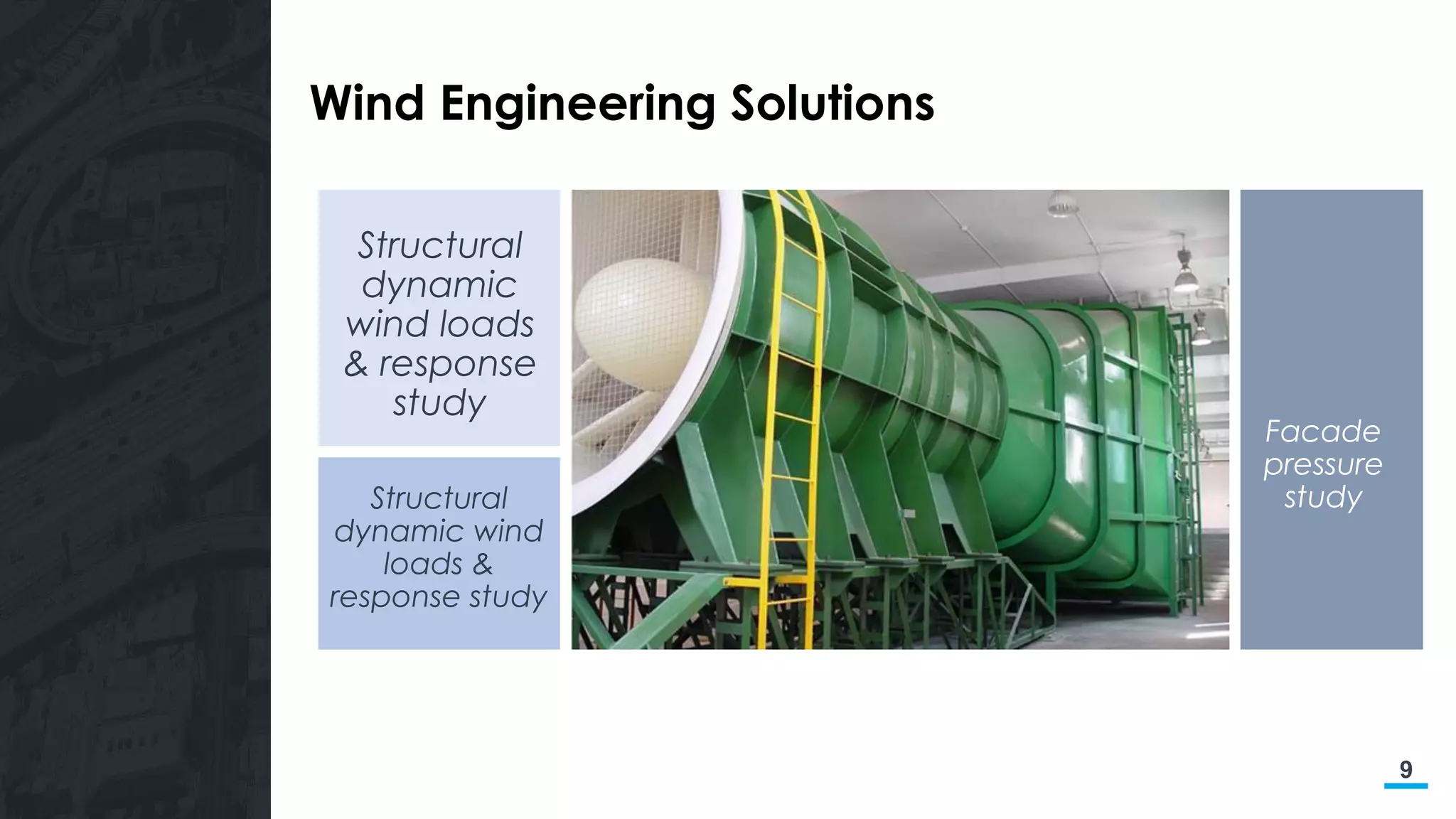
Wind Engineering Solutions
Structural
dynamic
wind loads
& response
study
Structural
dynamic wind
loads &
response study
Facade
pressure
study
10
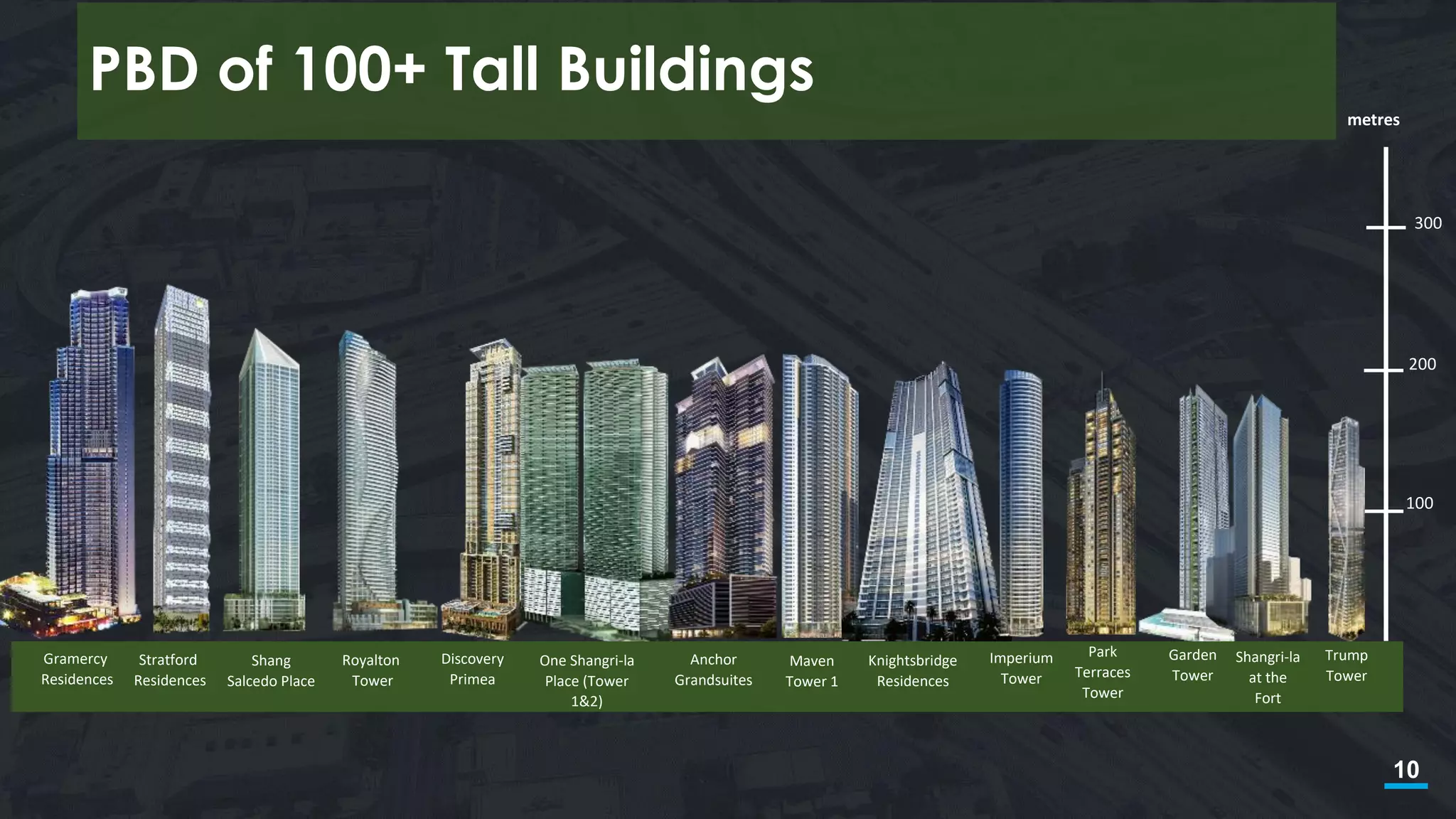
100
200
300
metres
PBD of 100+ Tall Buildings
Gramercy
Residences
Stratford
Residences
Shang
Salcedo Place
Royalton
Tower
Discovery
Primea
One Shangri-la
Place (Tower
1&2)
Anchor
Grandsuites
Maven
Tower 1
Knightsbridge
Residences
Imperium
Tower
Park
Terraces
Tower
Garden
Tower
Shangri-la
at the
Fort
Trump
Tower
11
11
Why this Seminar?
And why are these topics important
12
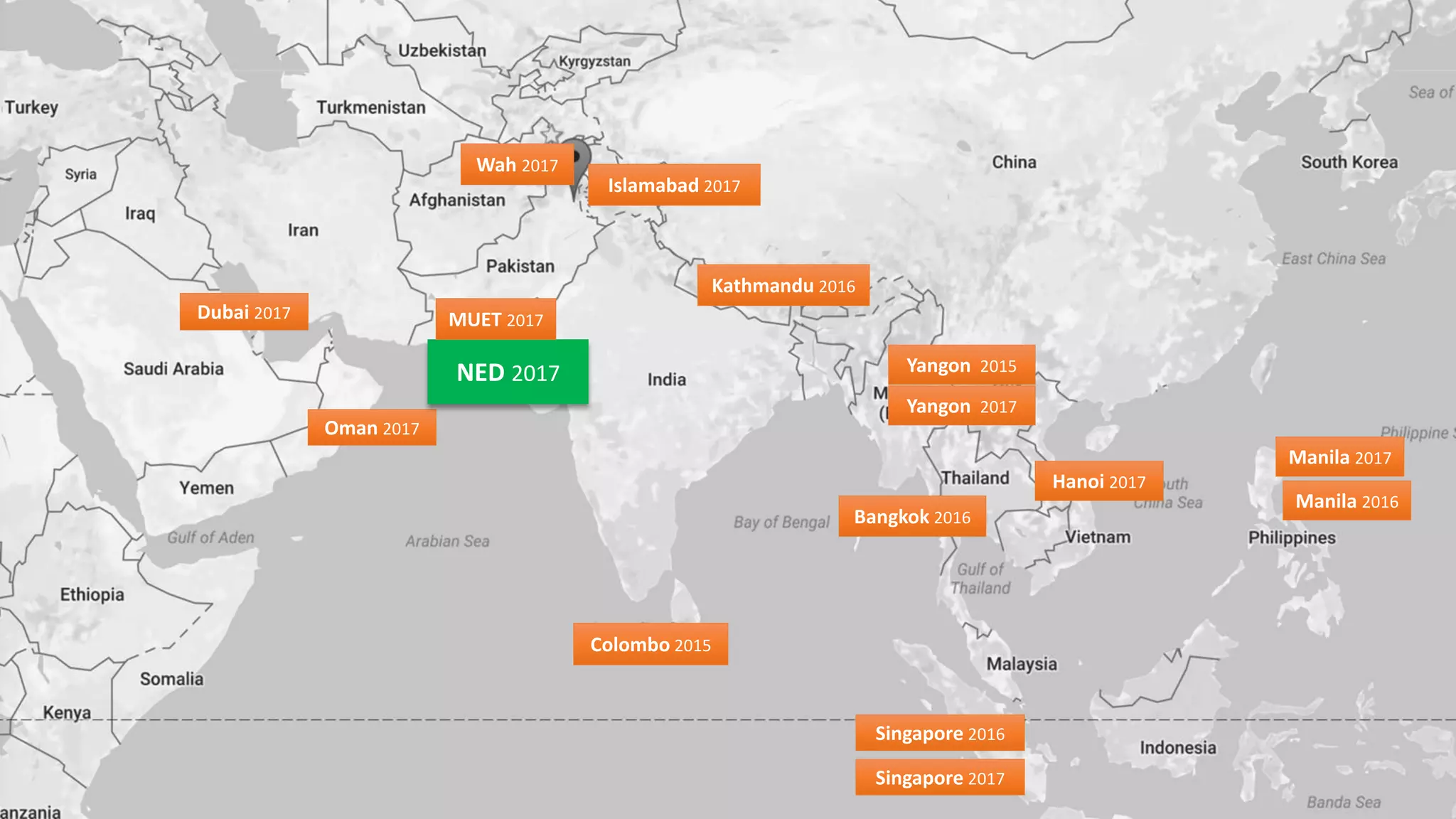
Colombo 2015
Kathmandu 2016
Bangkok 2016
Singapore 2016
Manila 2016
Oman 2017
Dubai 2017
Yangon 2015
Islamabad 2017
Wah 2017
NED 2017
Manila 2017
Hanoi 2017
Singapore 2017
Yangon 2017
MUET 2017
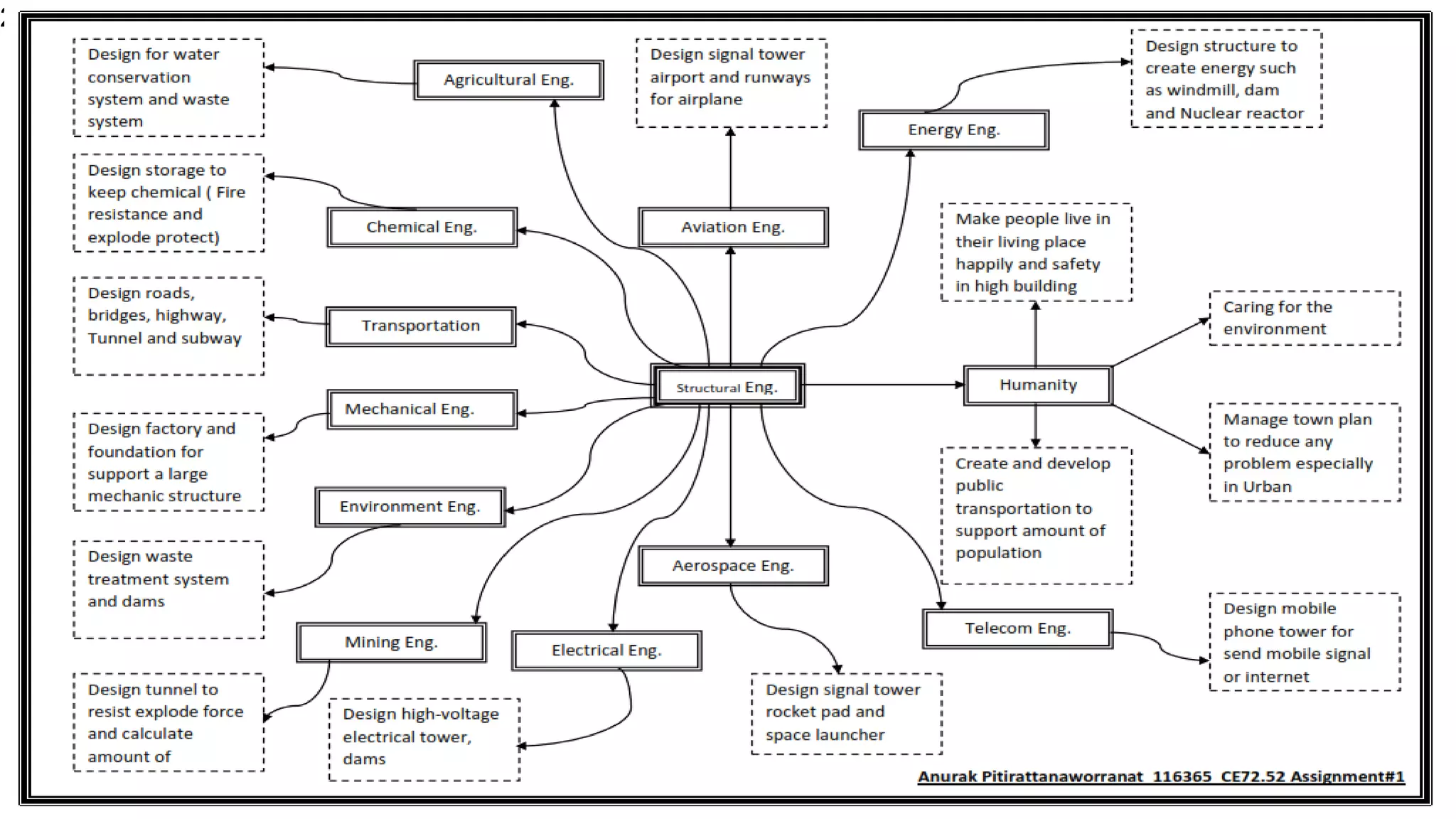
Structural Engineering is the
Basis for Built Environment
14
14
15
15
16
16
17
17
18
18
19
19
20
20
21
21
22
22
23
23
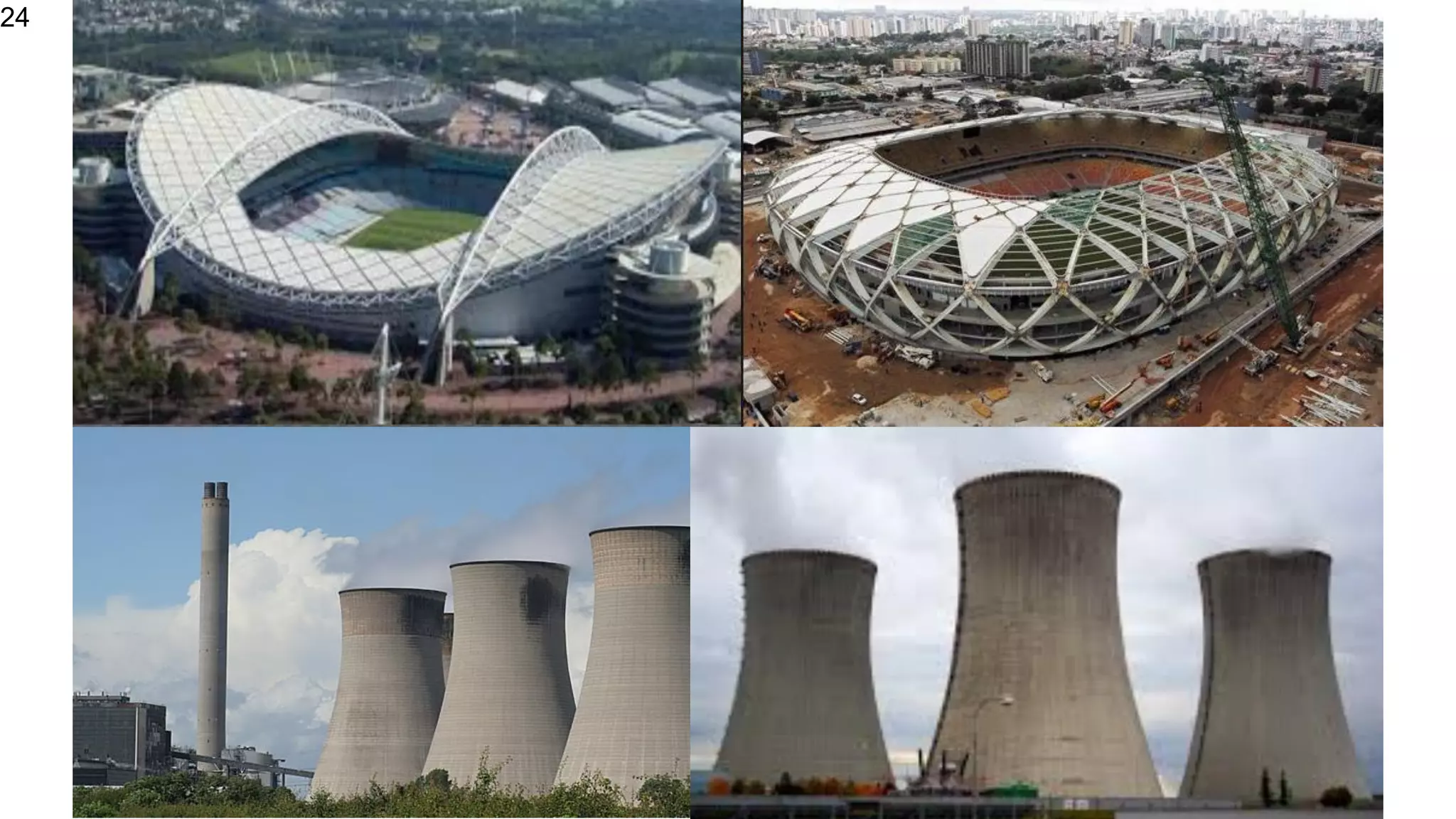
24
24
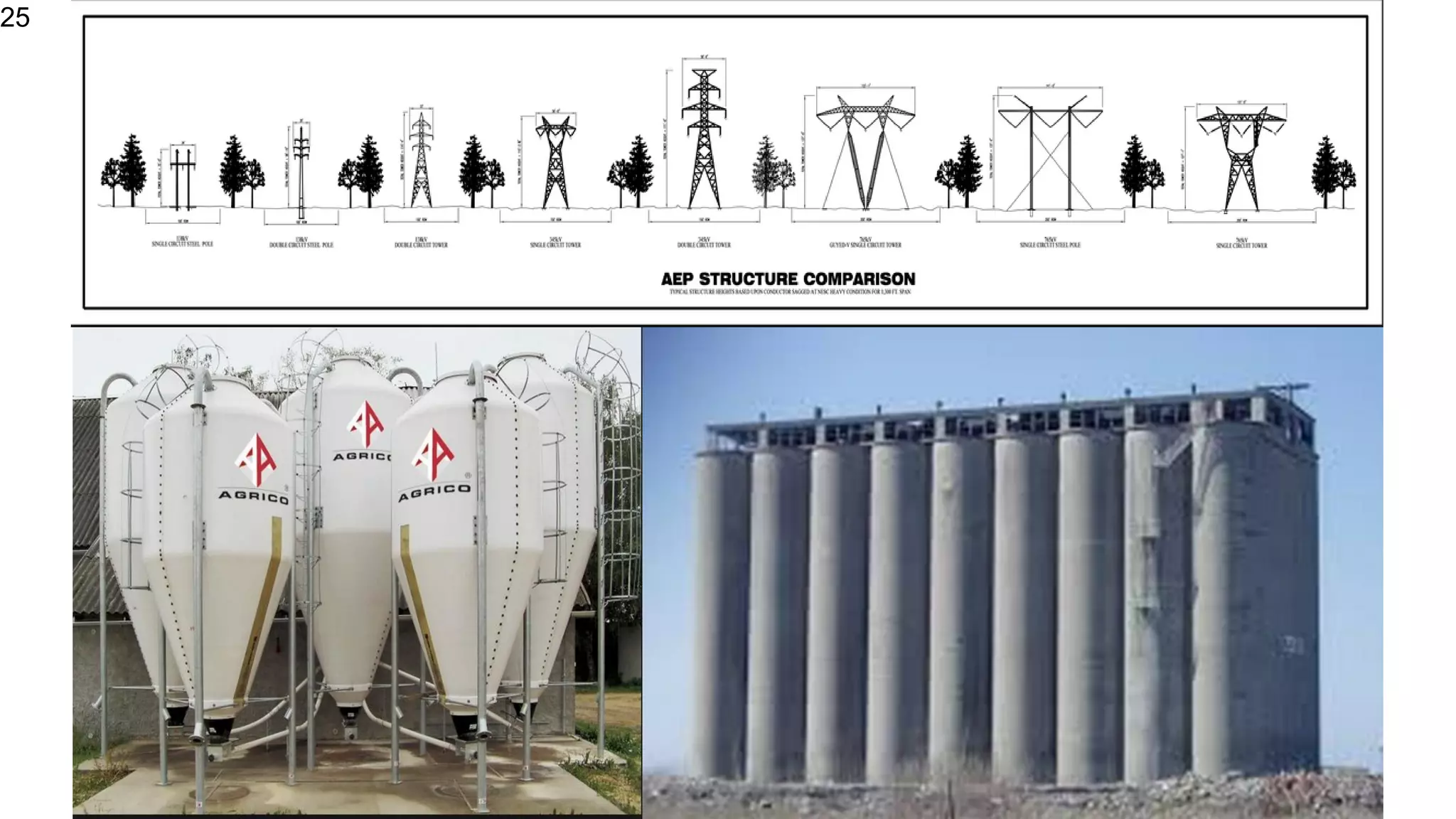
25
25
26
26
27
27
A MUST read for structural Engineers
Demand and Complexity is Increasing
for the Built Environment
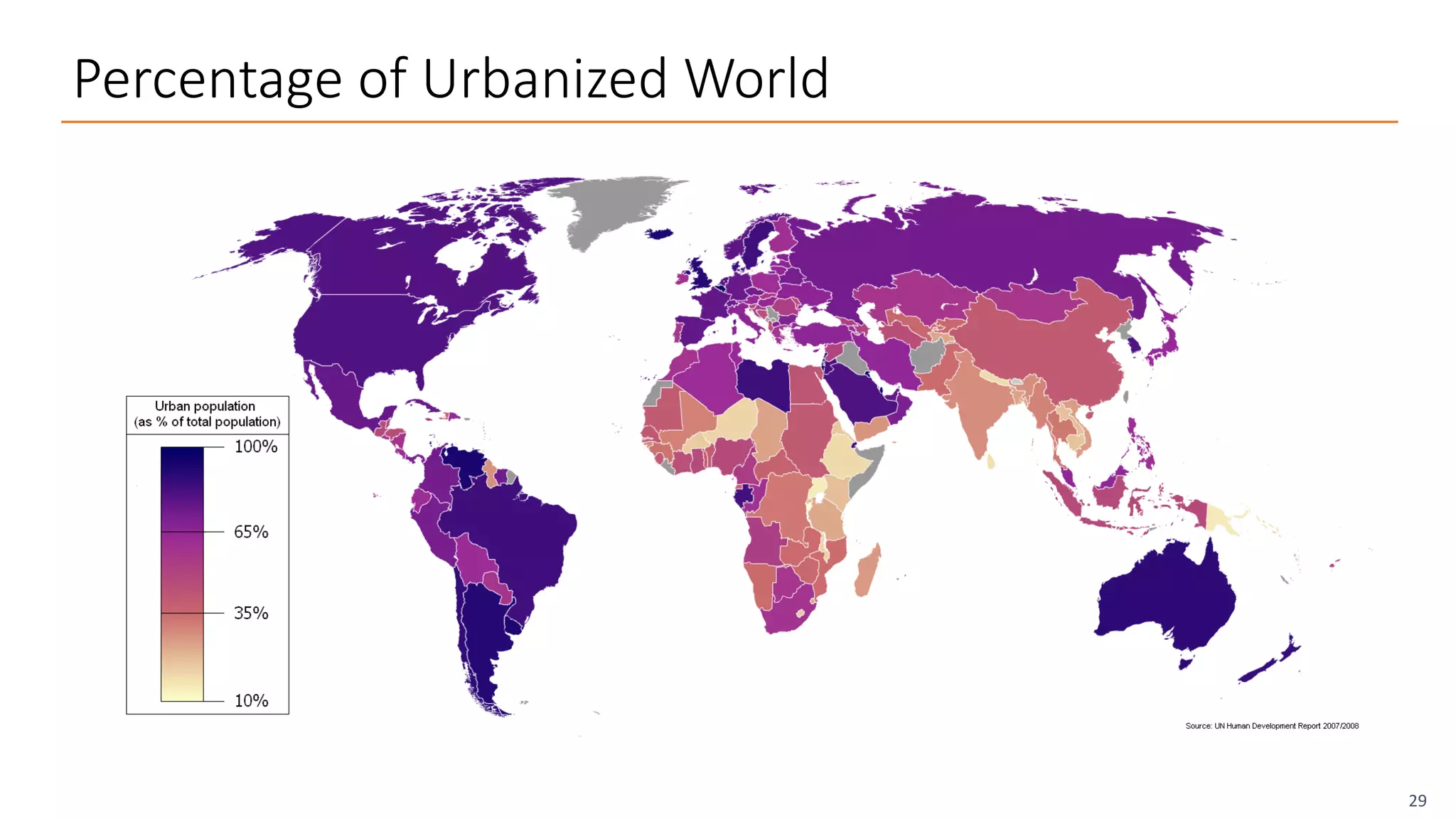
Percentage of Urbanized World
29
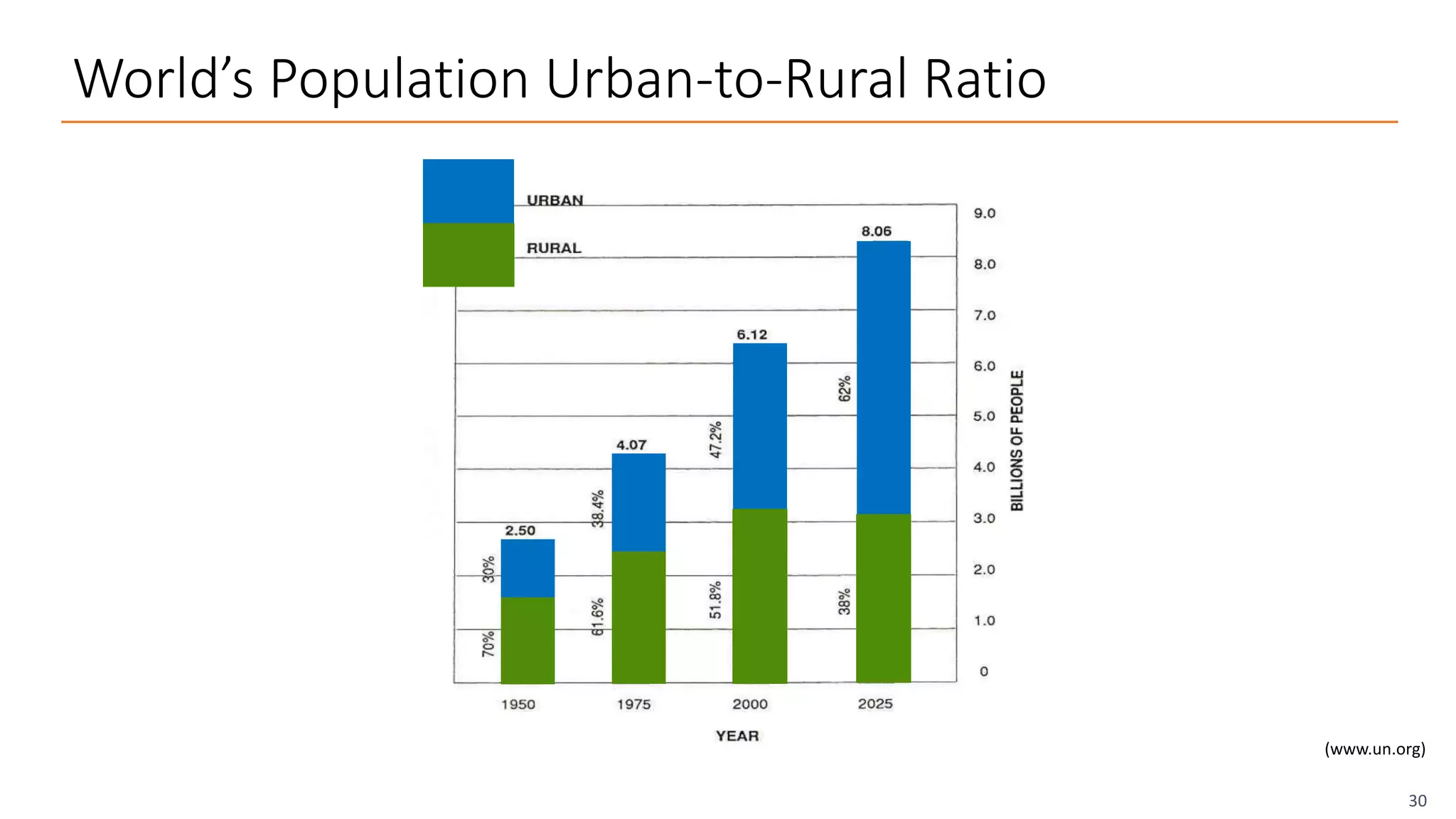
World’s Population Urban-to-Rural Ratio
30
(www.un.org)
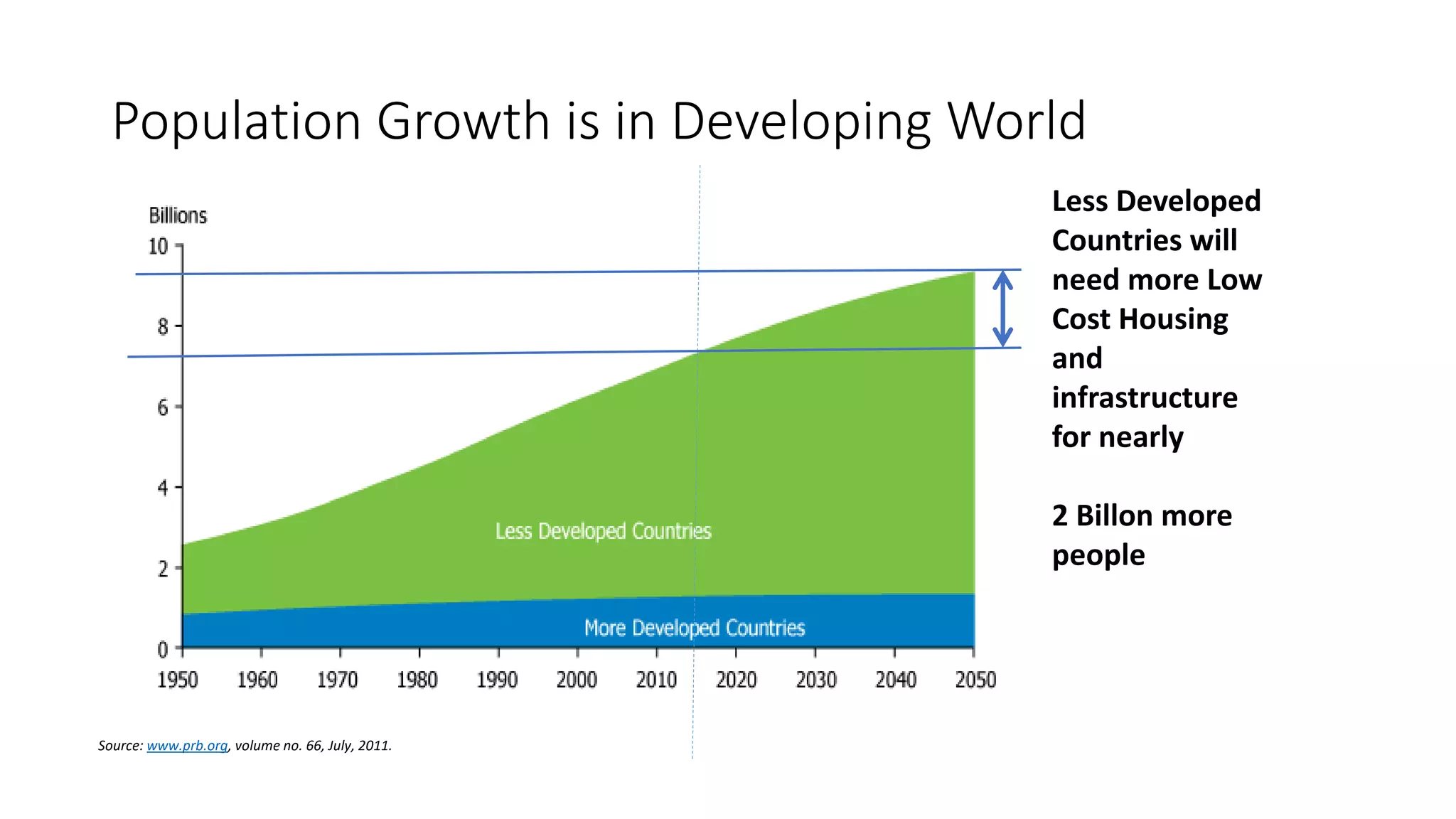
Population Growth is in Developing World
31
Source: www.prb.org, volume no. 66, July, 2011.
Less Developed
Countries will
need more Low
Cost Housing
and
infrastructure
for nearly
2 Billon more
people
Visions for the Future are for “Vertical Cities”
32
Japan, 4000m Sky Mile Tower, 1700 m JapanDubai City Tower, 2400 m One Dubai Tower,
1008 m
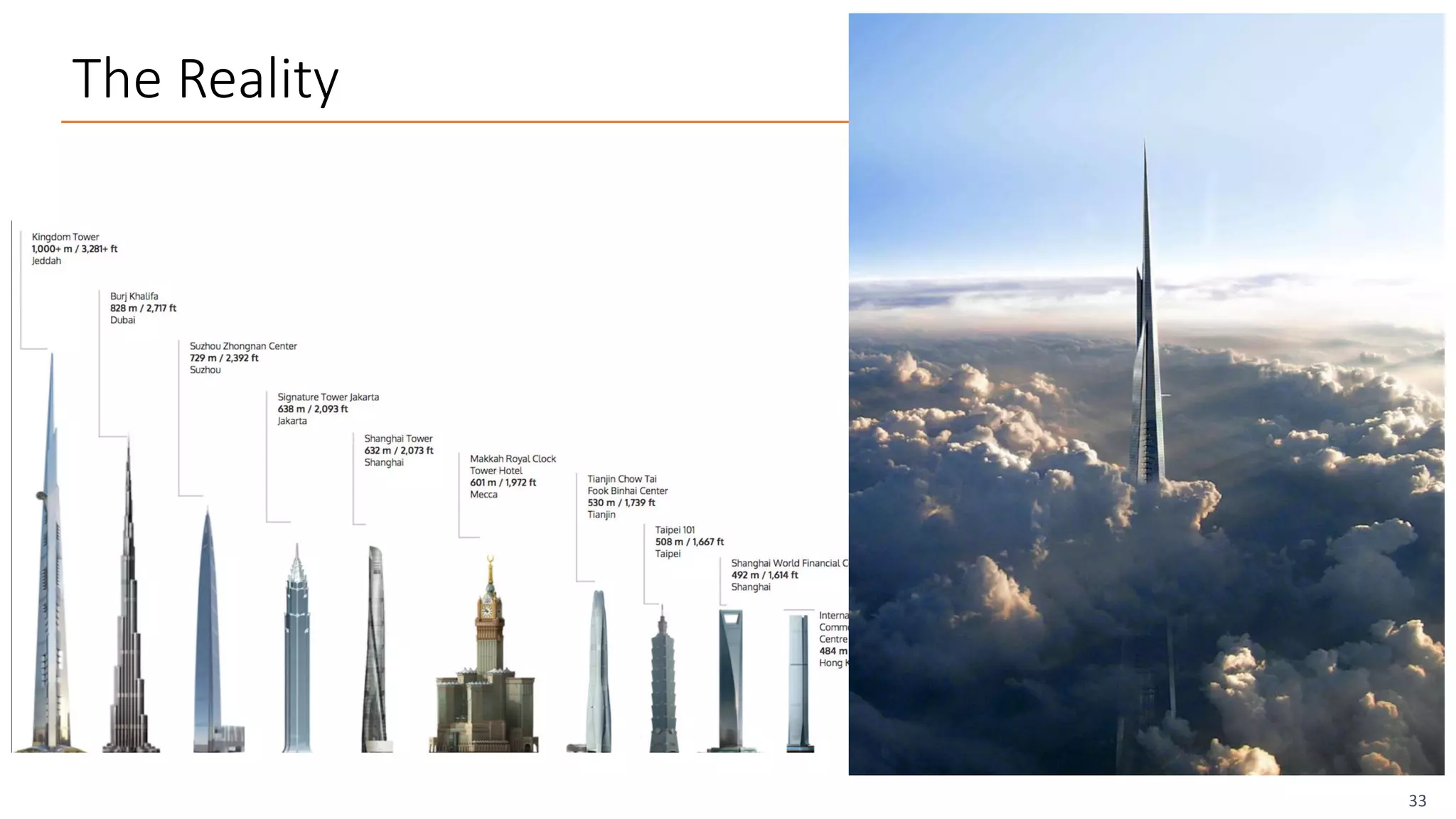
The Reality
33
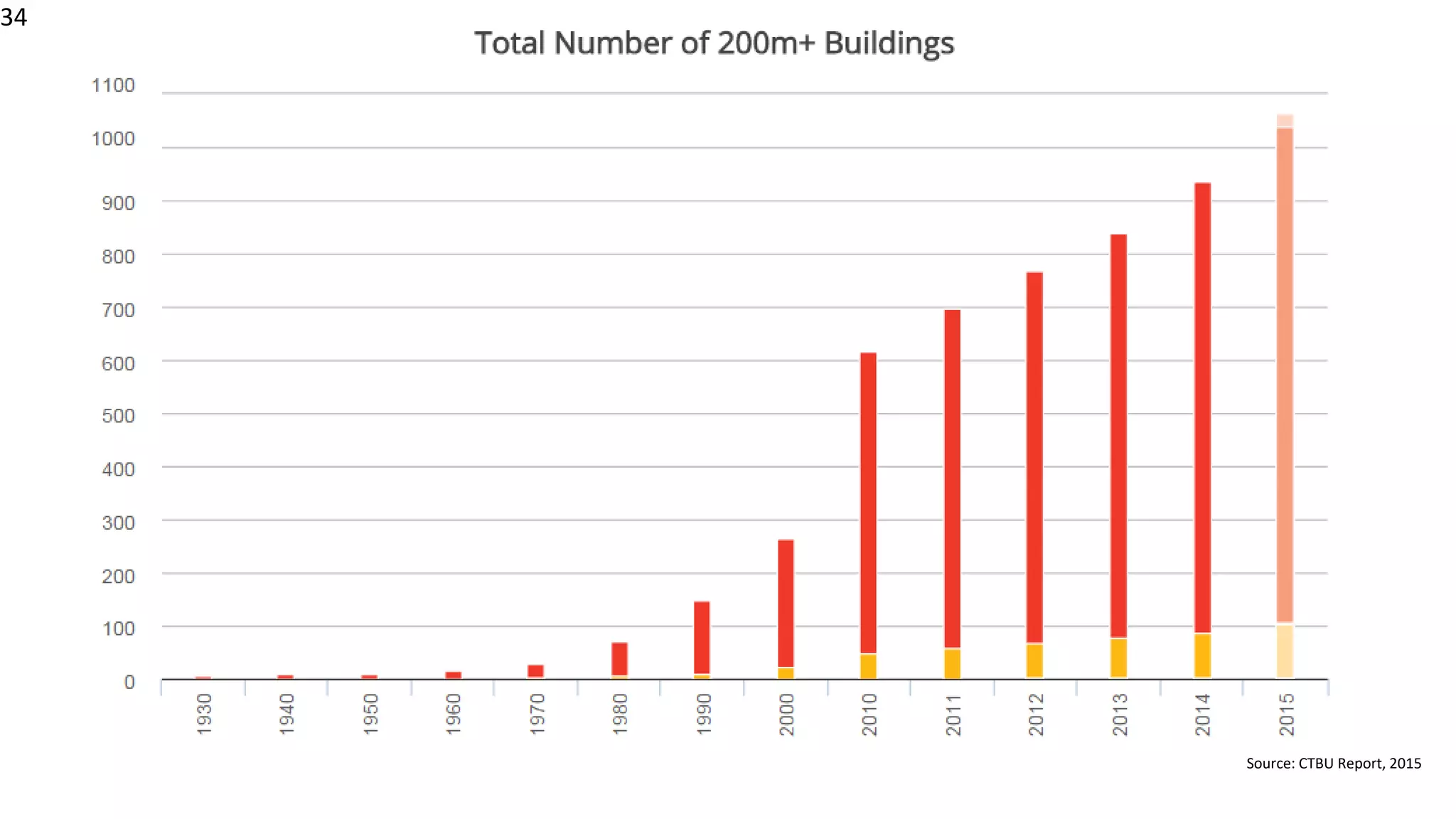
34
34
Source: CTBU Report, 2015
35
35
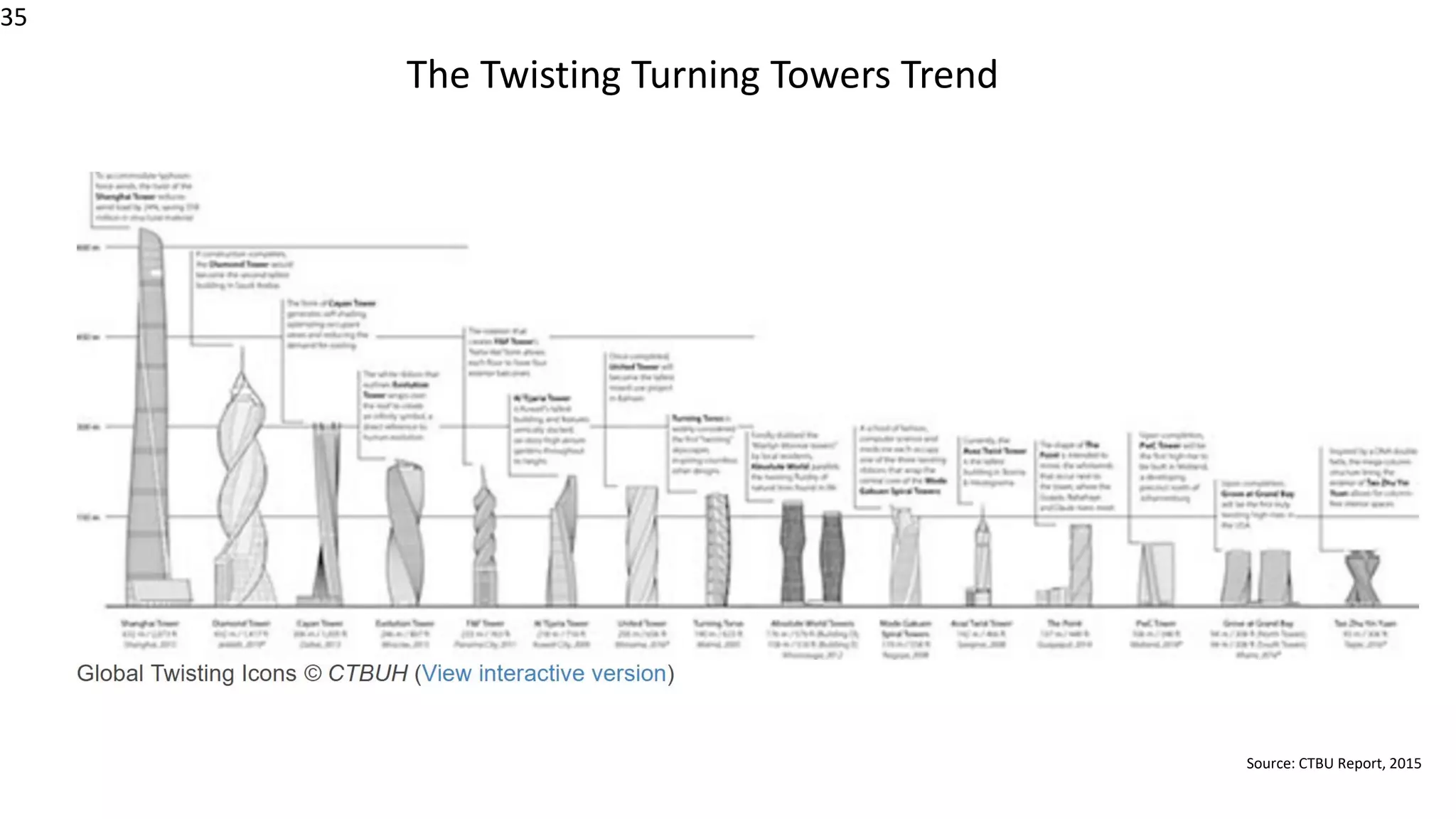
The Twisting Turning Towers Trend
Source: CTBU Report, 2015
36
36
37
Buildings and Structures are expected to be
• Safe
• Secure
• Serviceable
• Reliable
• The contents of the structures are often much more valuable than
structure itself
• The loss of service/operations/business is a often larger than repair costs
• Protective
• Friendly
• Sustainable
• Affordable
38
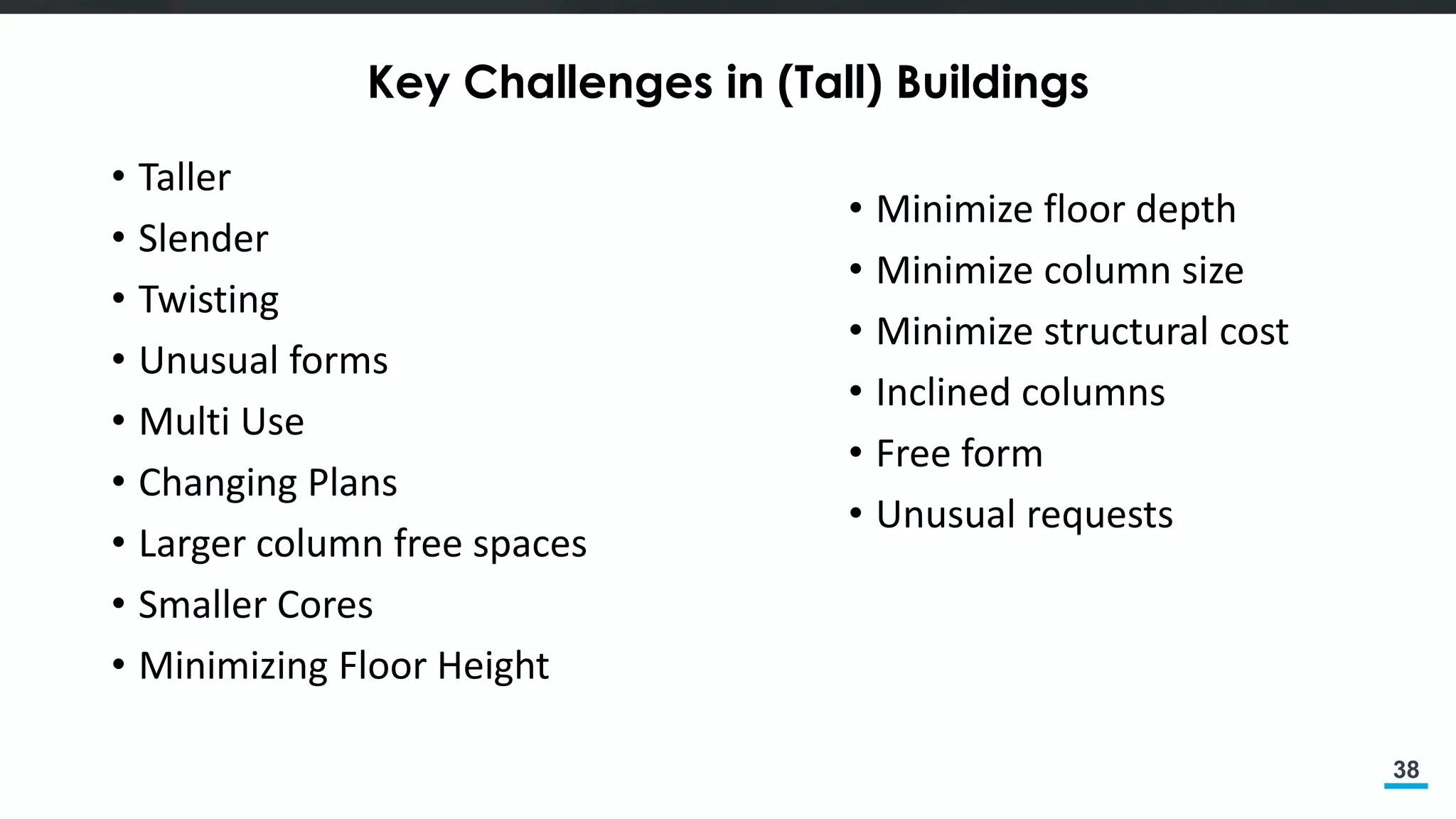
Key Challenges in (Tall) Buildings
• Taller
• Slender
• Twisting
• Unusual forms
• Multi Use
• Changing Plans
• Larger column free spaces
• Smaller Cores
• Minimizing Floor Height
• Minimize floor depth
• Minimize column size
• Minimize structural cost
• Inclined columns
• Free form
• Unusual requests
39
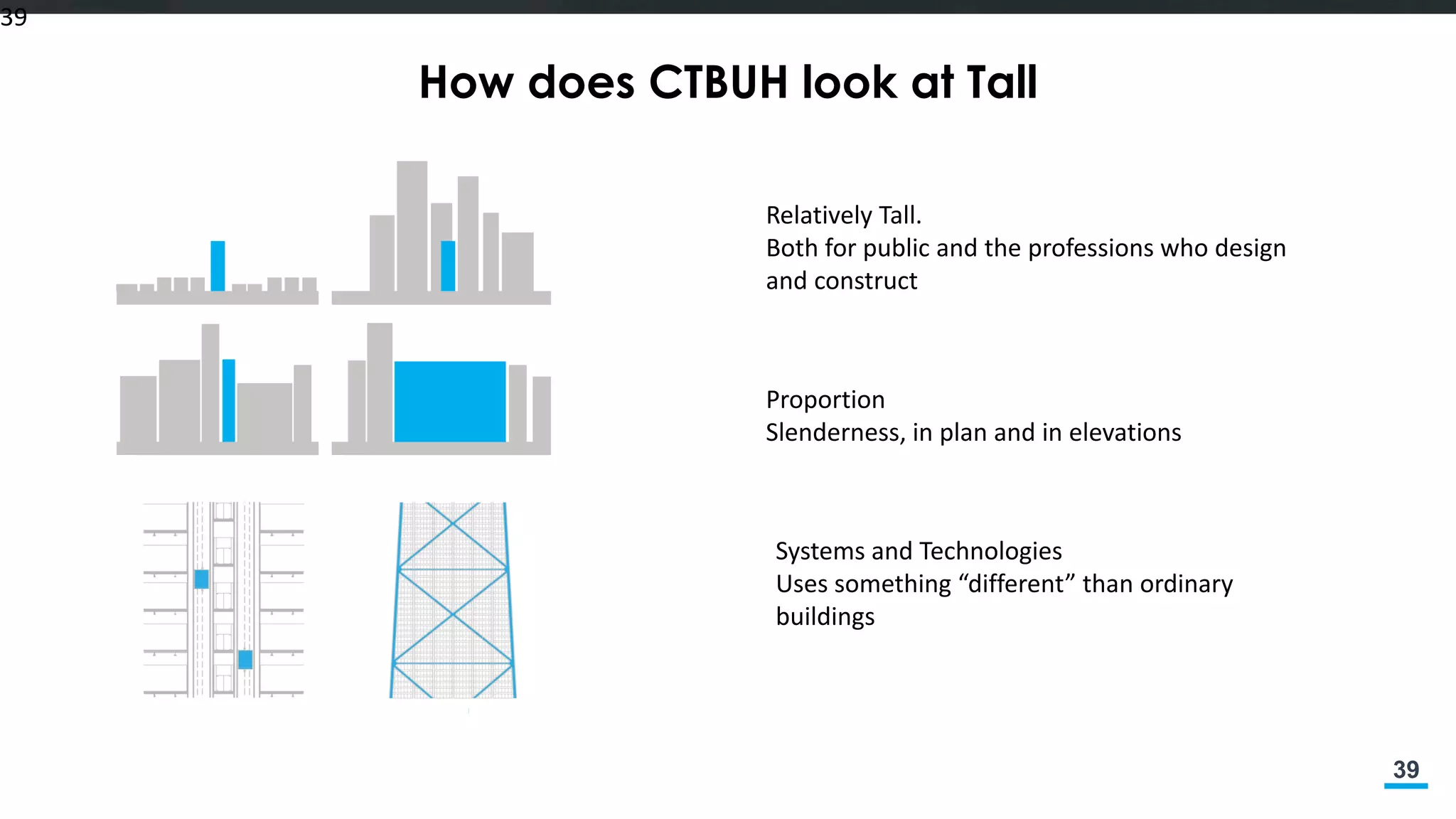
How does CTBUH look at Tall
39
Relatively Tall.
Both for public and the professions who design
and construct
Proportion
Slenderness, in plan and in elevations
Systems and Technologies
Uses something “different” than ordinary
buildings
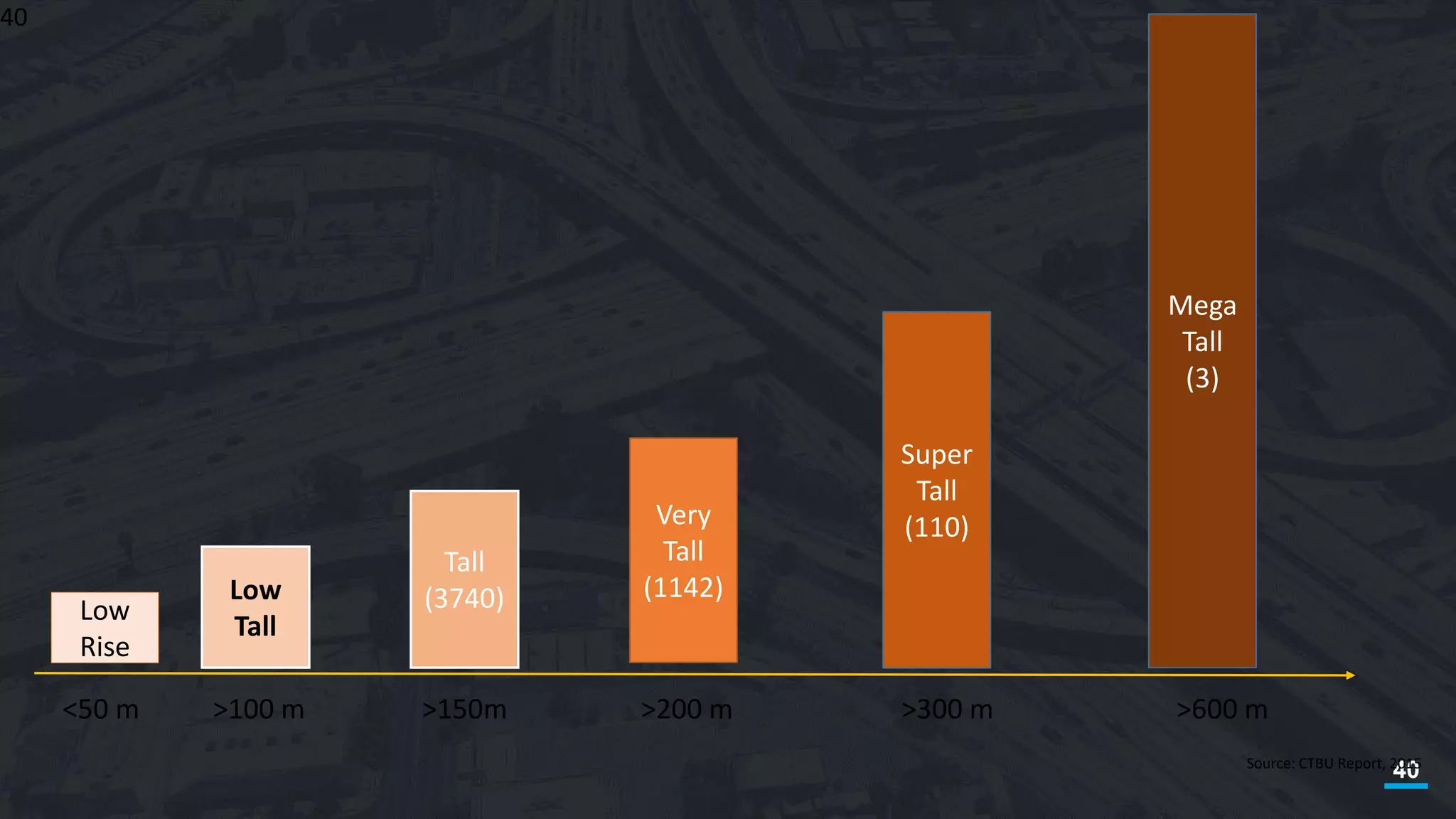
40
40
Very
Tall
(1142)
Super
Tall
(110)
Mega
Tall
(3)
Low
Tall
Low
Rise
>600 m>300 m>200 m>100 m<50 m
Tall
(3740)
>150m
Source: CTBU Report, 2015
41
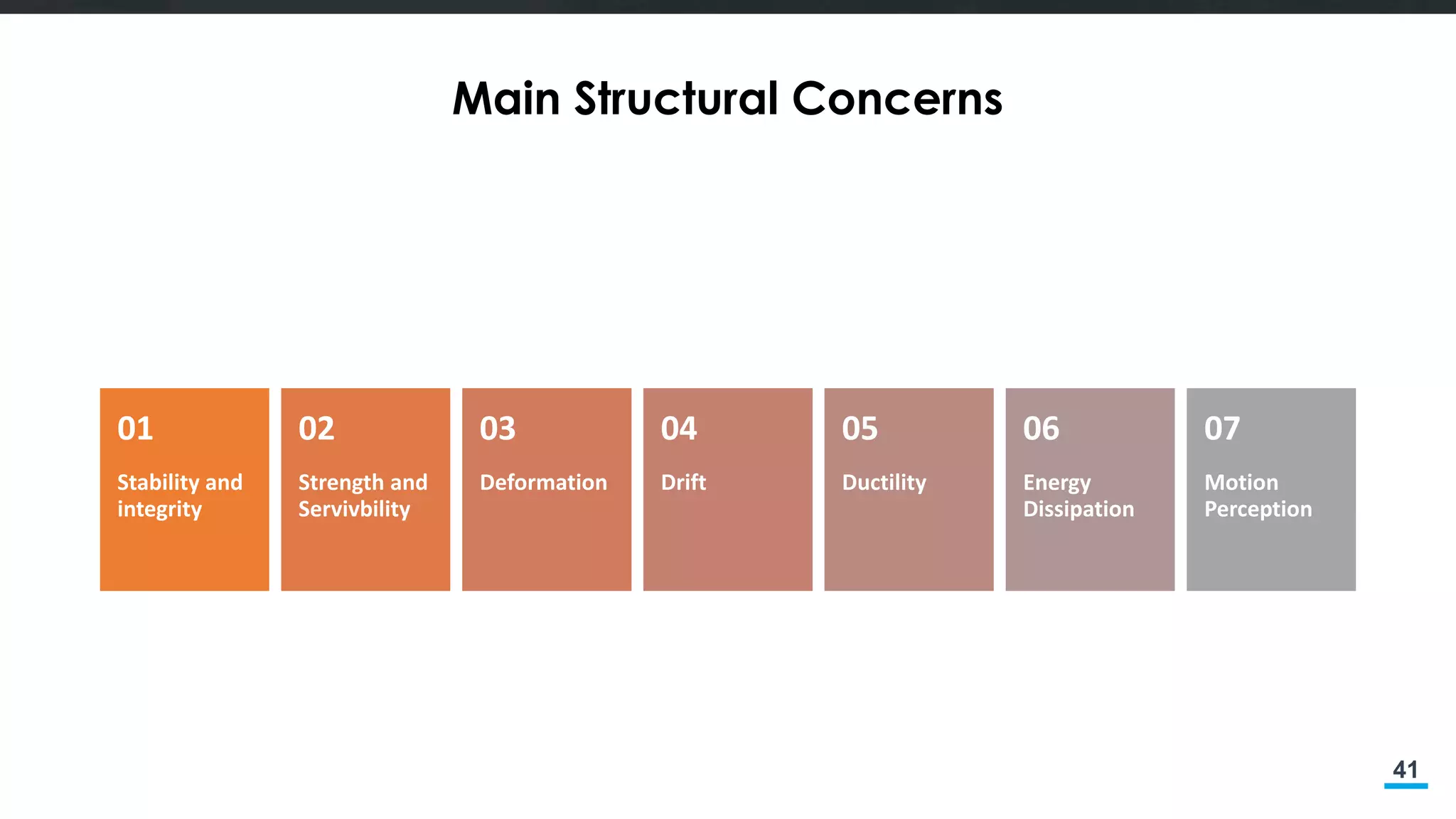
Main Structural Concerns
Stability and
integrity
01
Strength and
Servivbility
02
Deformation
03
Drift
04
Ductility
05
Energy
Dissipation
06
Motion
Perception
07
42
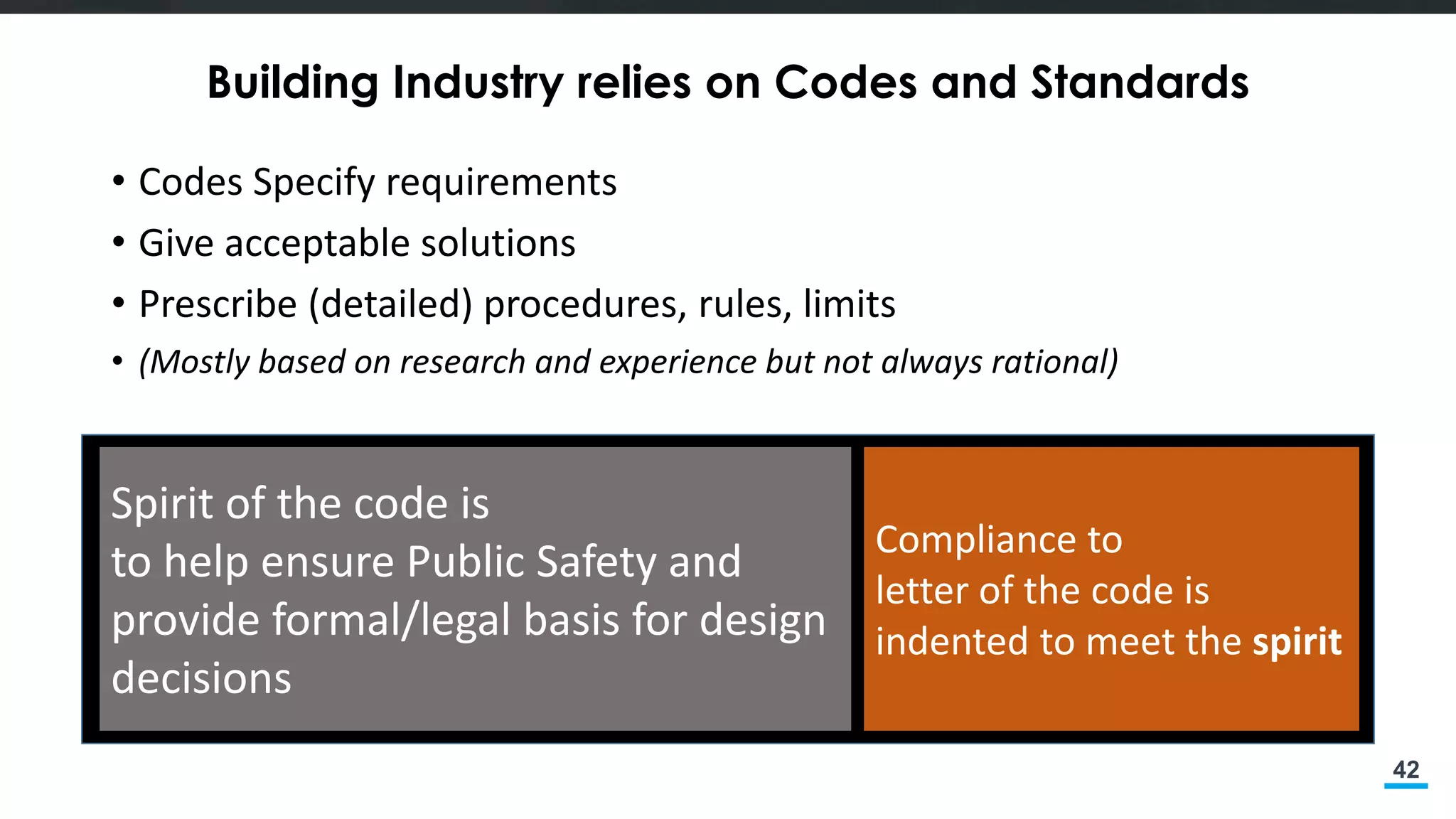
Building Industry relies on Codes and Standards
• Codes Specify requirements
• Give acceptable solutions
• Prescribe (detailed) procedures, rules, limits
• (Mostly based on research and experience but not always rational)
Spirit of the code is
to help ensure Public Safety and
provide formal/legal basis for design
decisions
Compliance to
letter of the code is
indented to meet the spirit
43
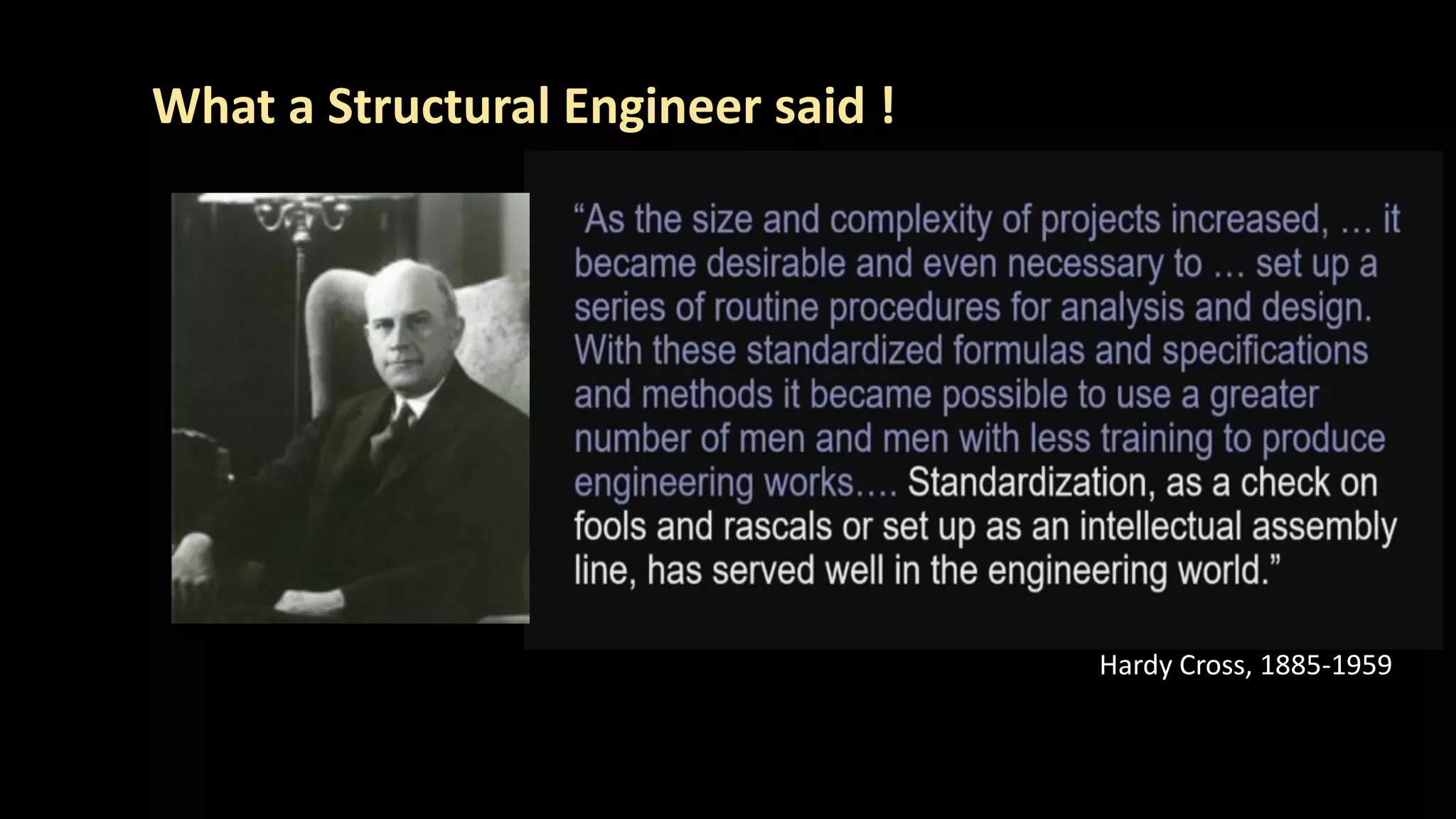
What a Structural Engineer said !
Hardy Cross, 1885-1959
44
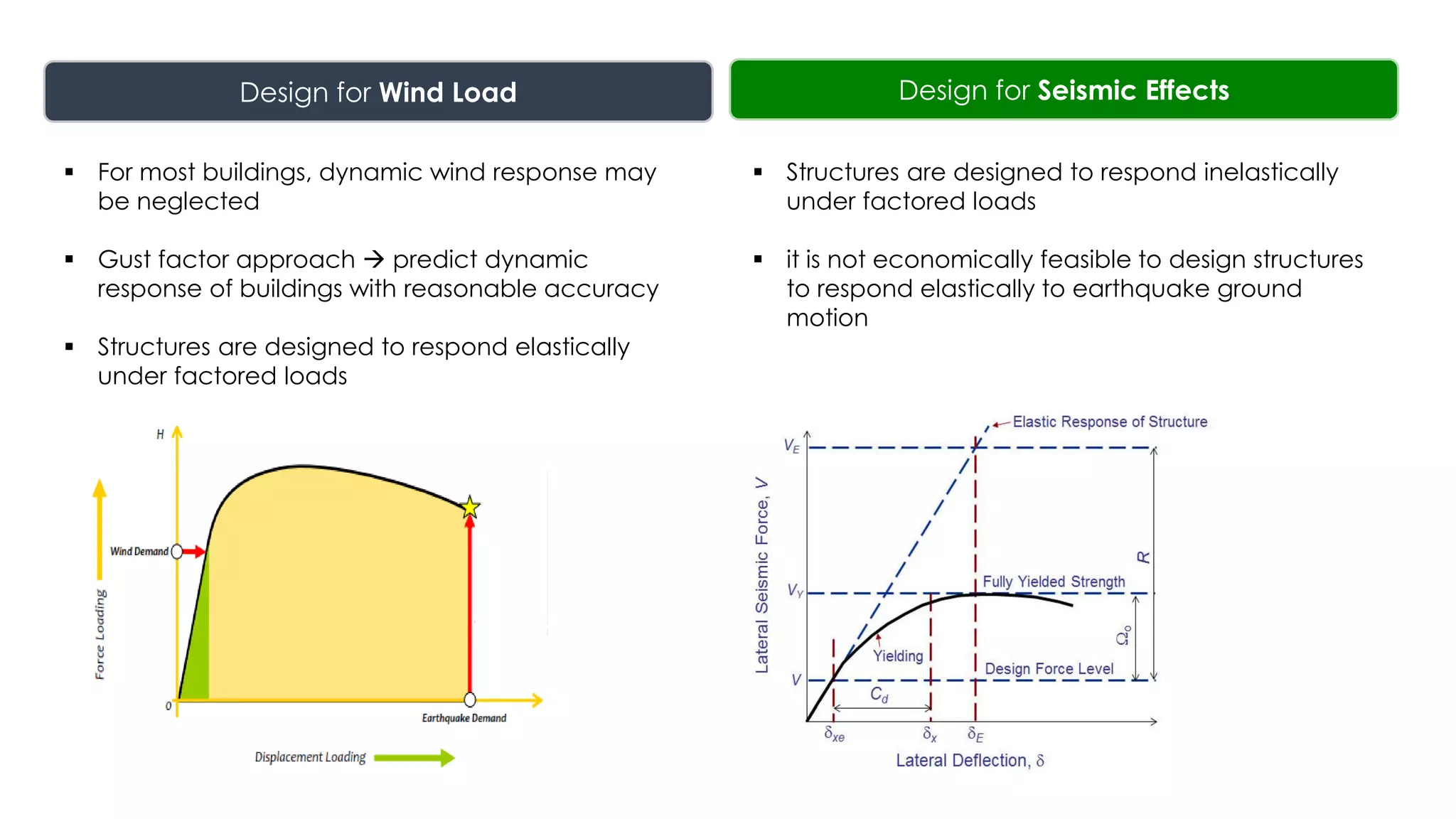
 For most buildings, dynamic wind response may
be neglected
 Gust factor approach  predict dynamic
response of buildings with reasonable accuracy
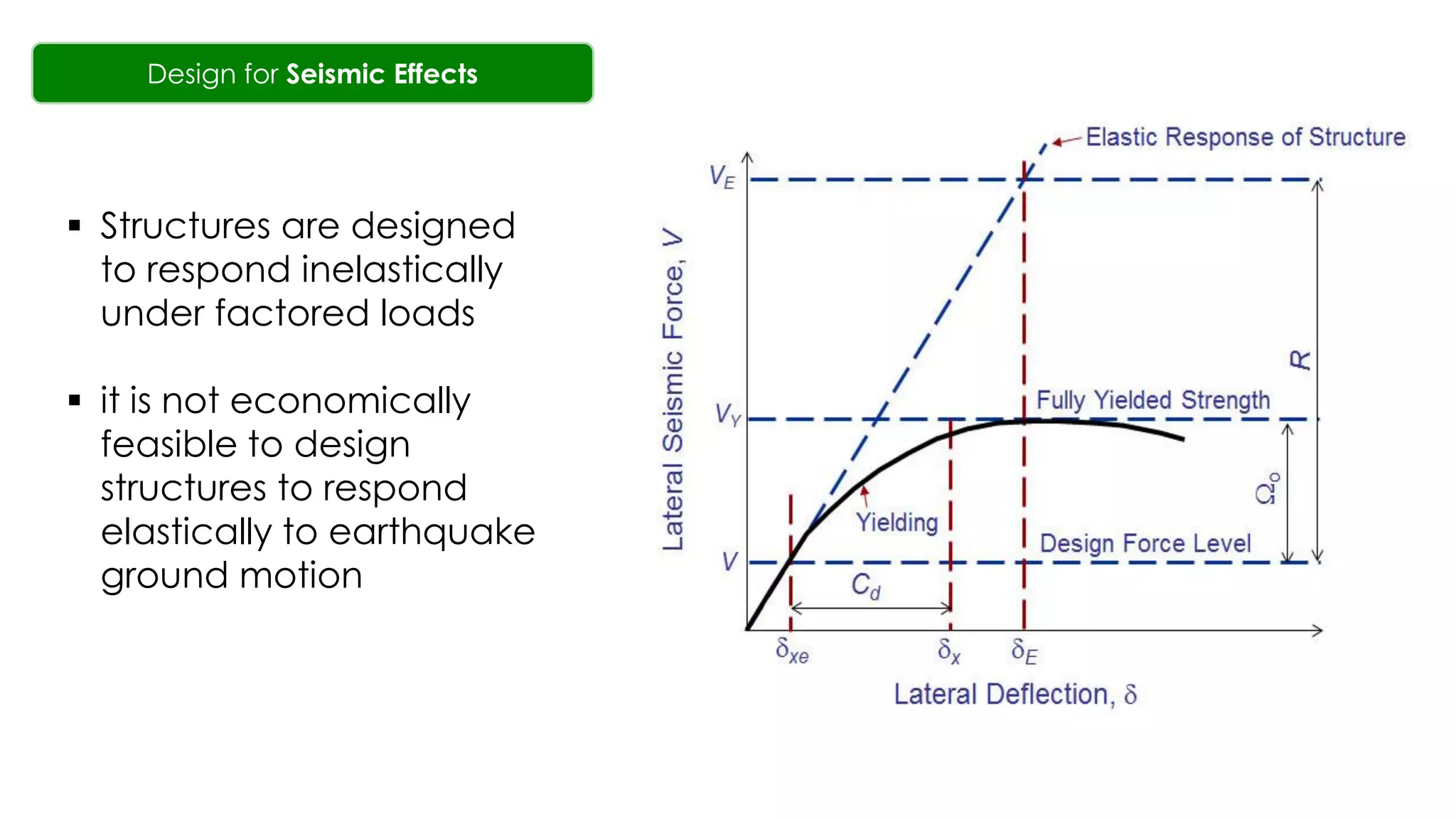
 Structures are designed to respond elastically
under factored loads
 Structures are designed to respond inelastically
under factored loads
 it is not economically feasible to design structures
to respond elastically to earthquake ground
motion
Design for Seismic EffectsDesign for Wind Load
45
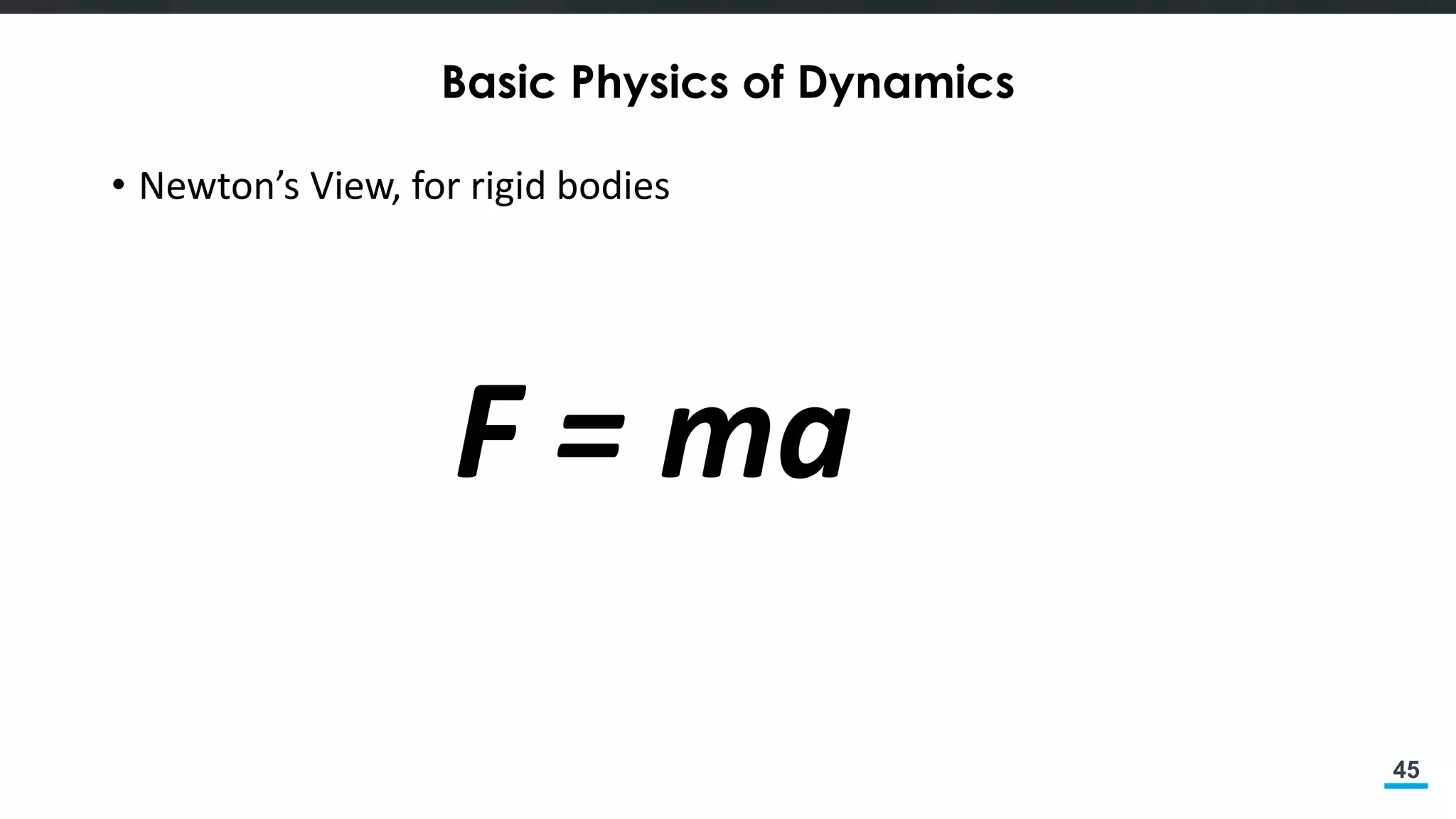
Basic Physics of Dynamics
• Newton’s View, for rigid bodies
F = ma
46
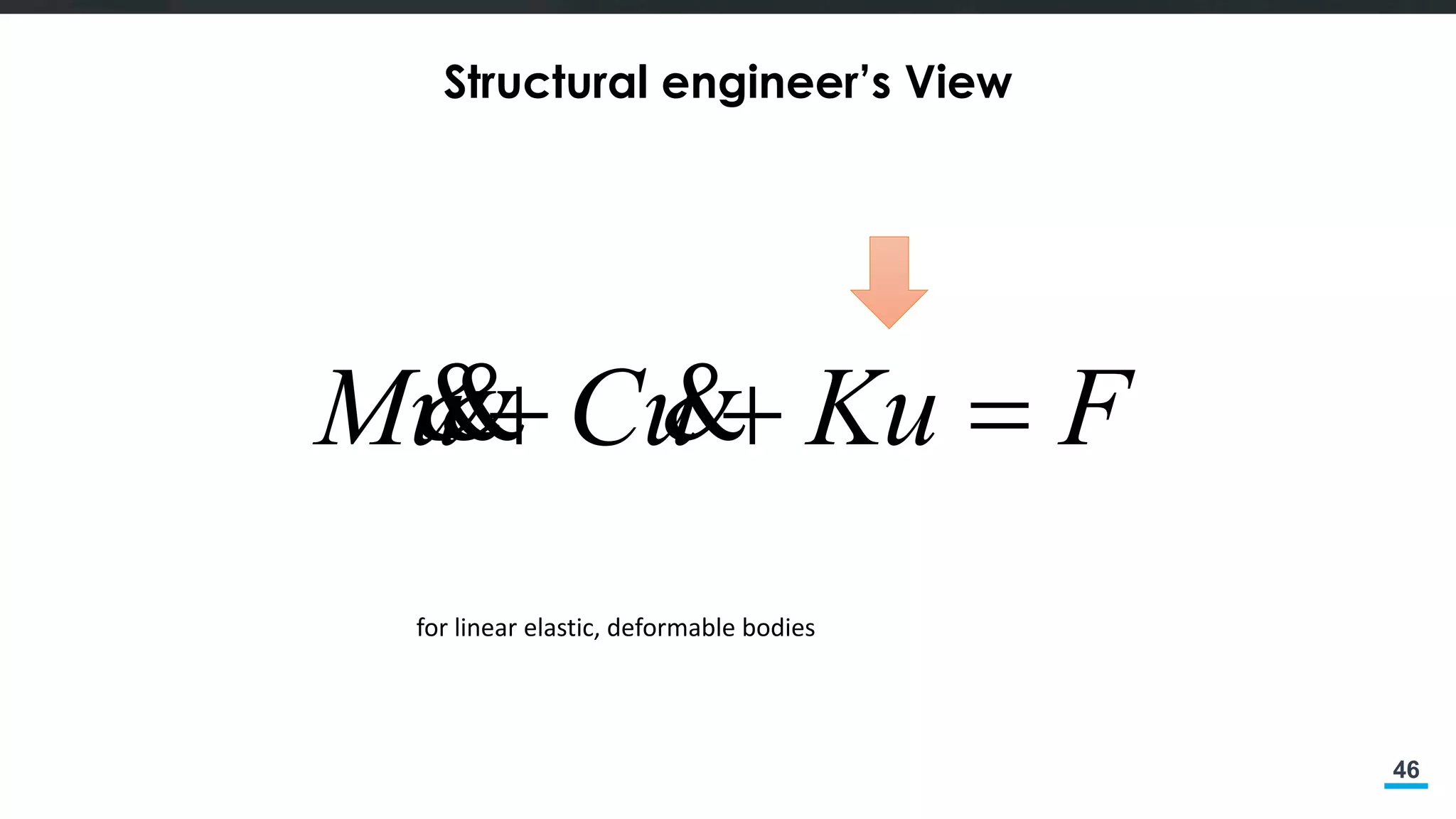
Structural engineer’s View
FKuuCuM  
for linear elastic, deformable bodies
47
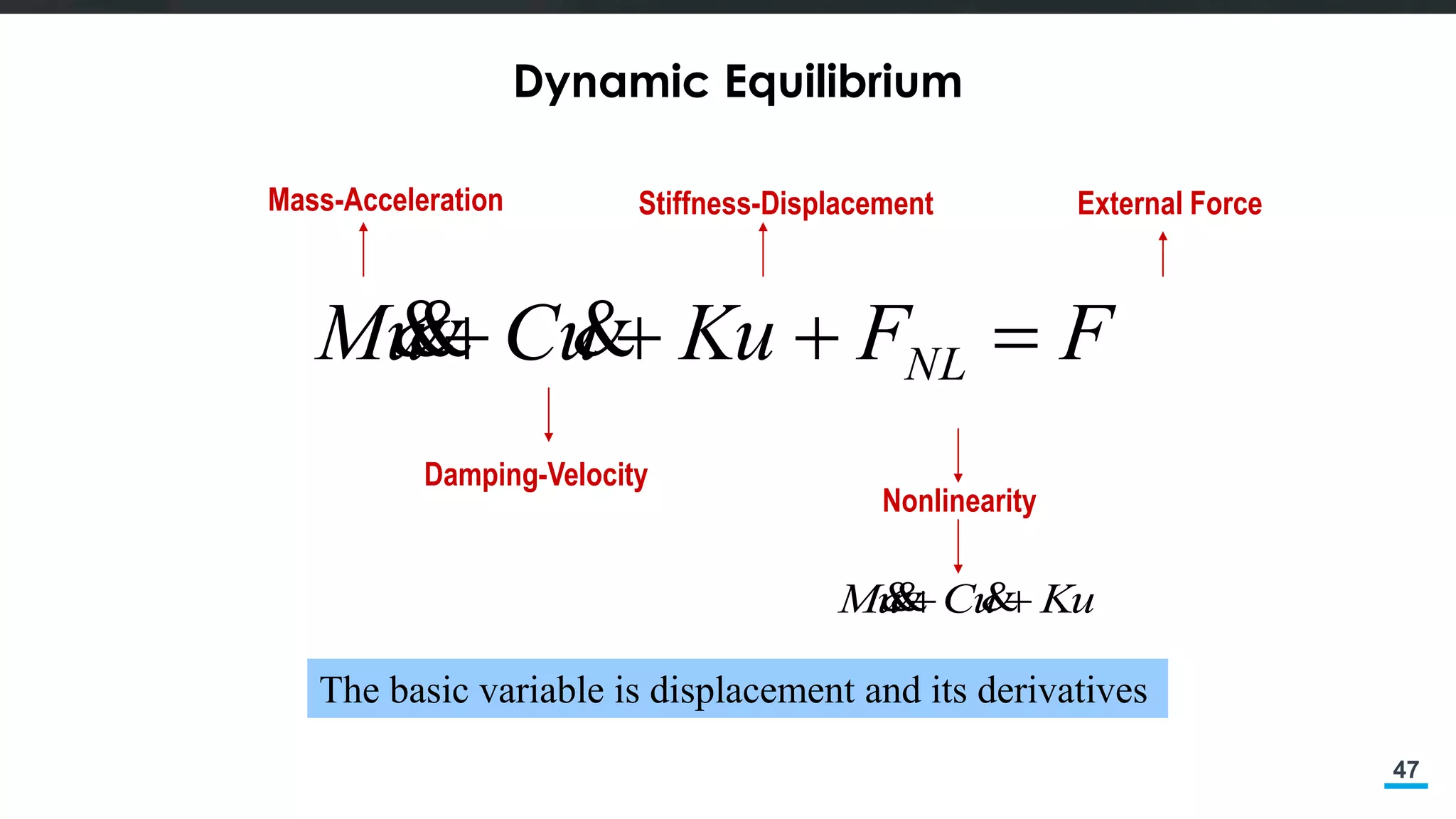
Dynamic Equilibrium
FFKuuCuM NL  
Damping-Velocity
Mass-Acceleration Stiffness-Displacement
Nonlinearity
External Force
KuuCuM  
The basic variable is displacement and its derivatives
48
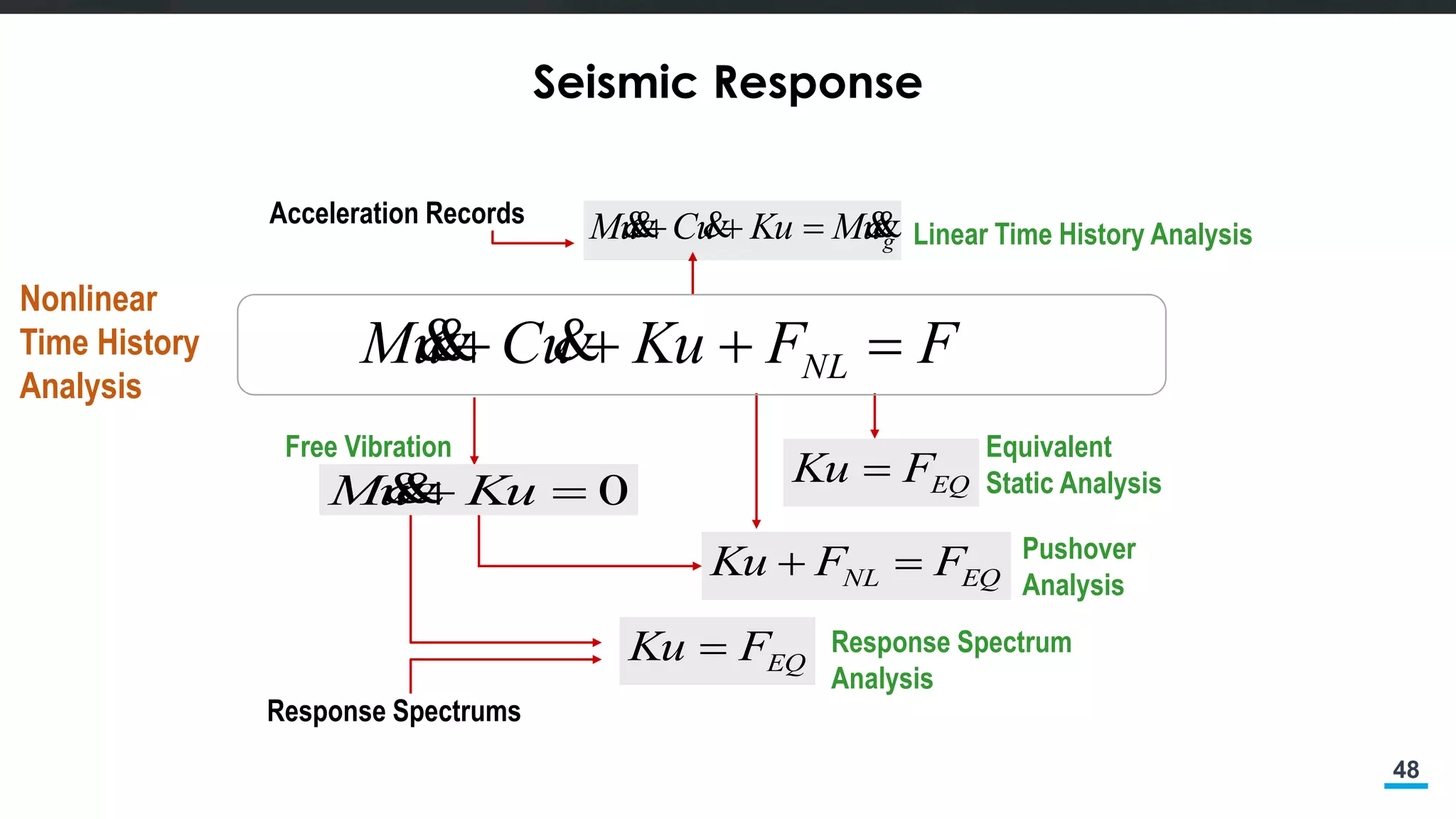
Seismic Response
FFKuuCuM NL  
Linear Time History Analysis
0 KuuM 
EQNL FFKu 
Free Vibration
Pushover
Analysis
EQFKu 
Equivalent
Static Analysis
EQFKu 
Response Spectrums
Response Spectrum
Analysis
Acceleration Records
guMKuuCuM  
Nonlinear
Time History
Analysis
49
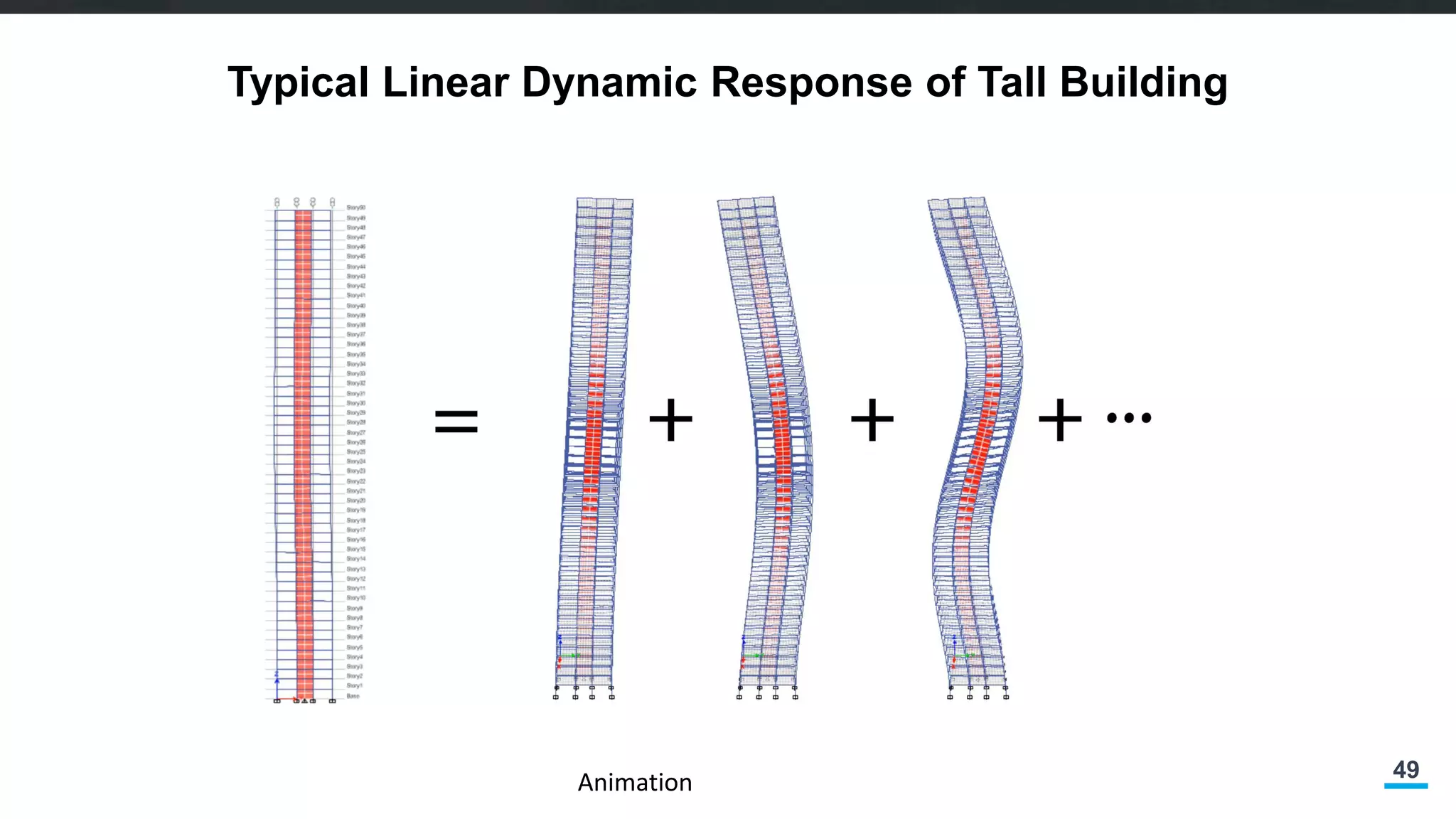
Typical Linear Dynamic Response of Tall Building
Animation
50
 Structures are designed
to respond inelastically
under factored loads
 it is not economically
feasible to design
structures to respond
elastically to earthquake
ground motion
Design for Seismic Effects
Introducing AIT Solutions
51
0
5
10
15
20
25
30
35
40
45
0 10 20 30 40 50 60
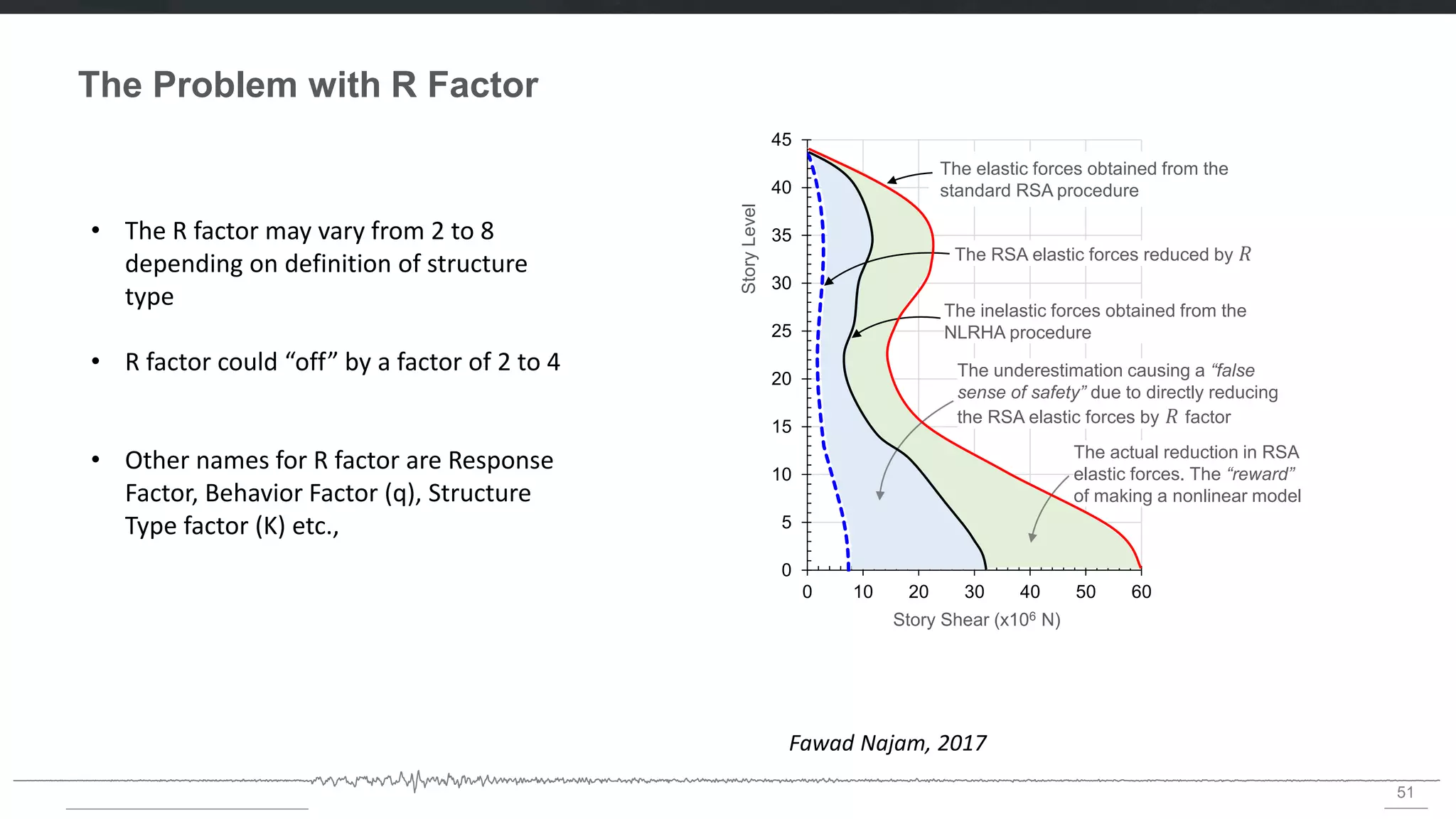
The Problem with R Factor
The elastic forces obtained from the
standard RSA procedure
The RSA elastic forces reduced by 𝑅
The inelastic forces obtained from the
NLRHA procedure
The actual reduction in RSA
elastic forces. The “reward”
of making a nonlinear model
The underestimation causing a “false
sense of safety” due to directly reducing
the RSA elastic forces by 𝑅 factor
Story Shear (x106 N)
StoryLevel
• The R factor may vary from 2 to 8
depending on definition of structure
type
• R factor could “off” by a factor of 2 to 4
• Other names for R factor are Response
Factor, Behavior Factor (q), Structure
Type factor (K) etc.,
Fawad Najam, 2017
52
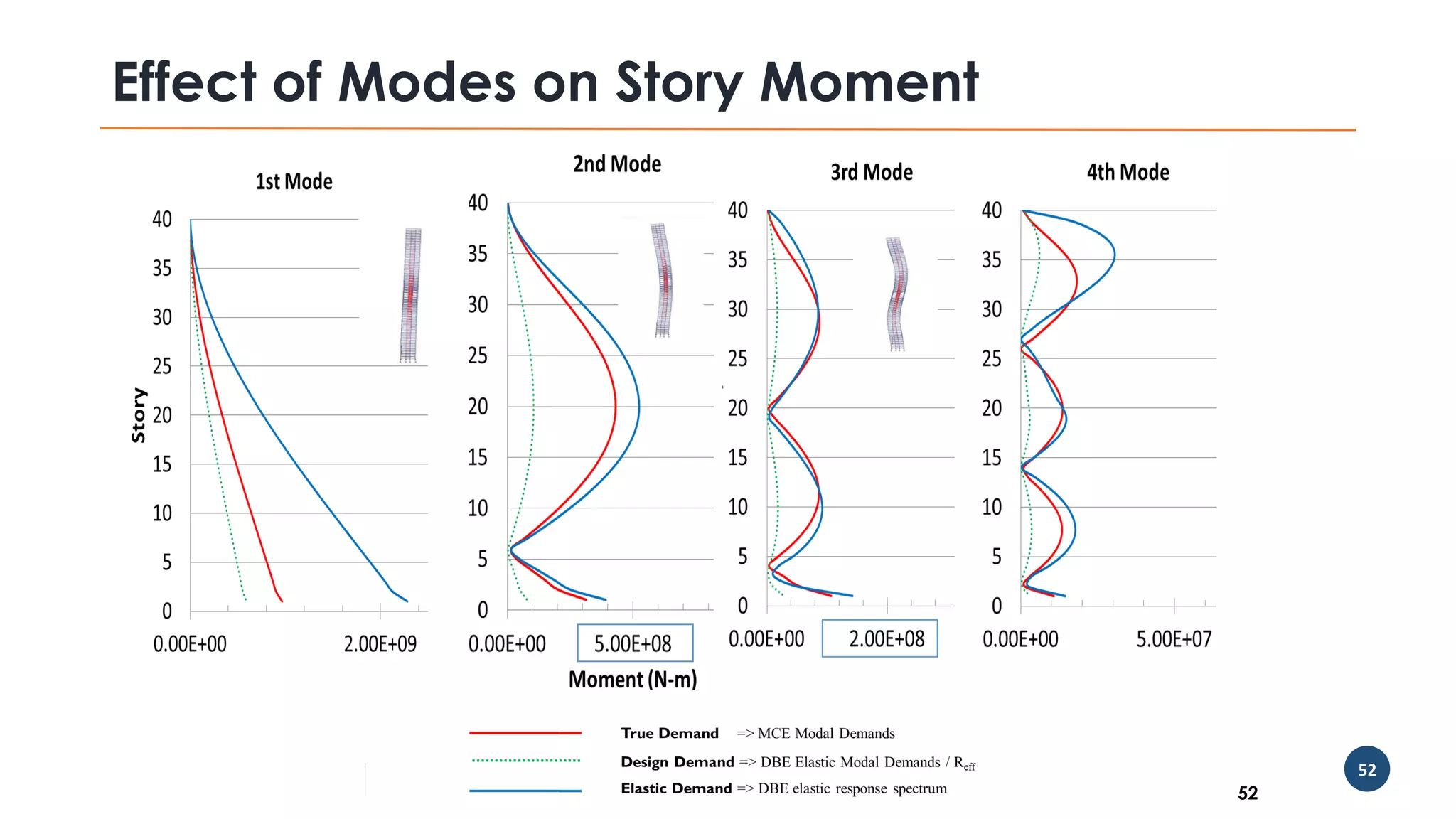
Effect of Modes on Story Moment
52
53
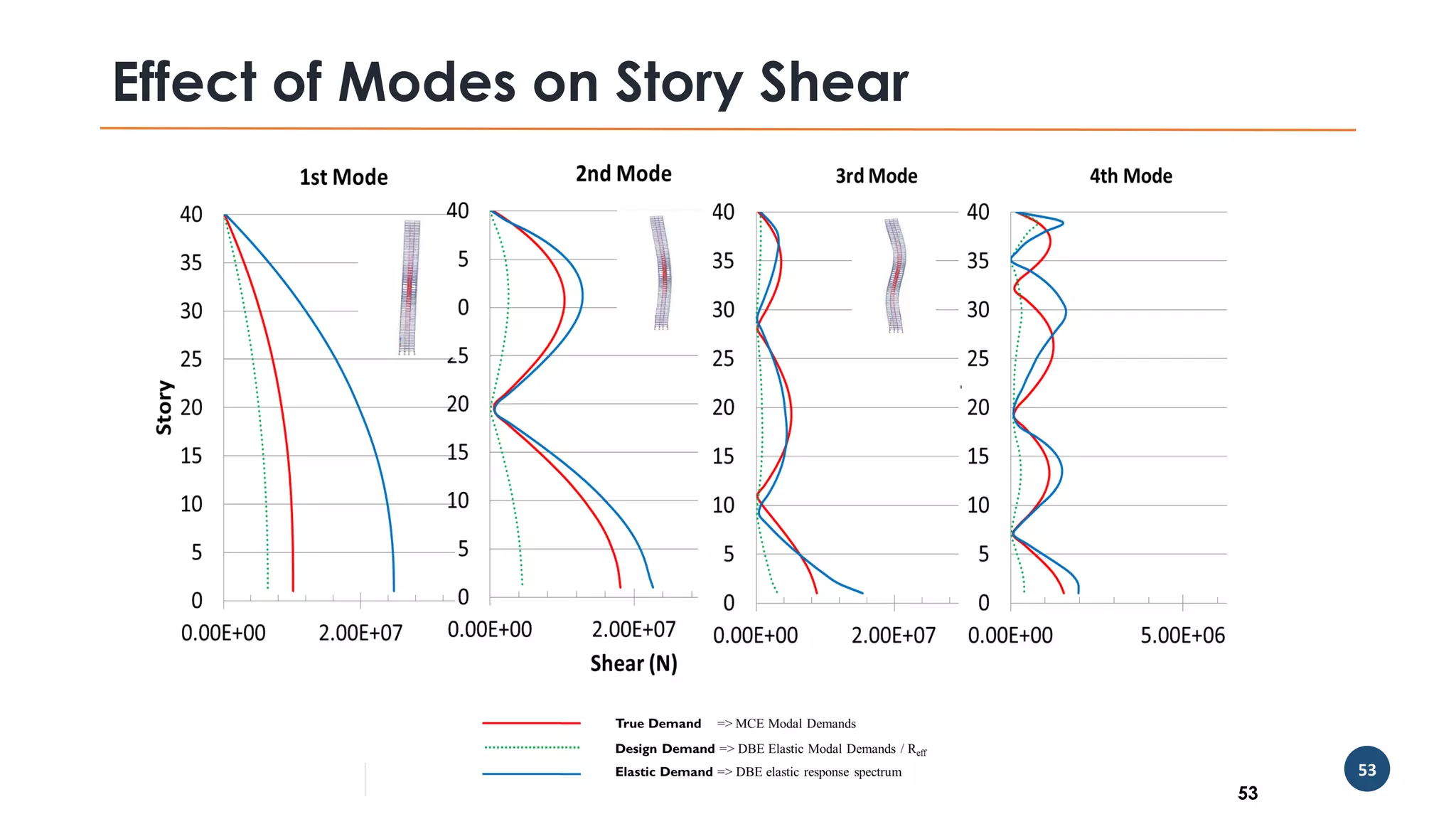
Effect of Modes on Story Shear
53
54
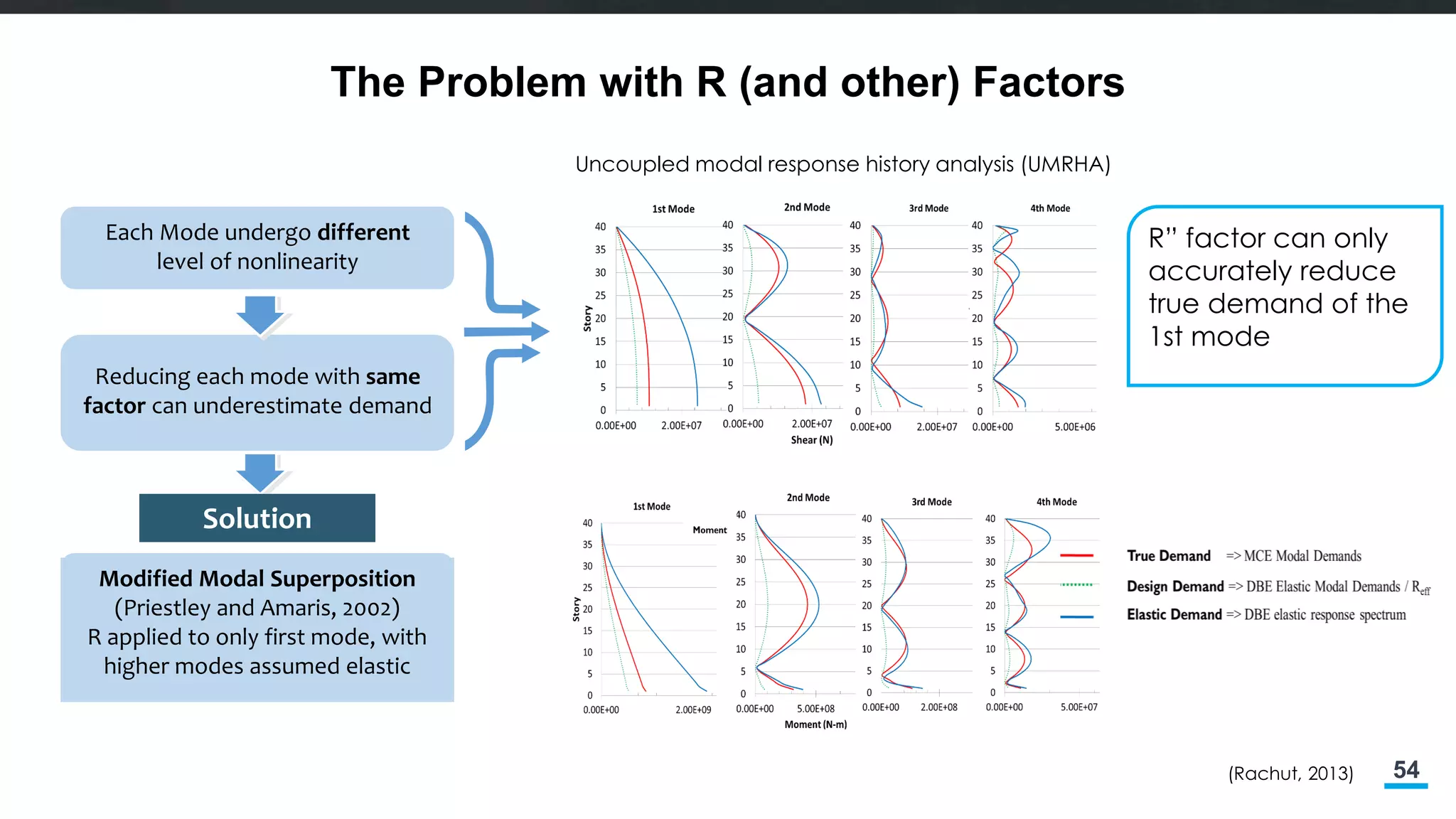
The Problem with R (and other) Factors
Reducing each mode with same
factor can underestimate demand
Each Mode undergo different
level of nonlinearity
Modified Modal Superposition
(Priestley and Amaris, 2002)
R applied to only first mode, with
higher modes assumed elastic
Solution
(Rachut, 2013)
Uncoupled modal response history analysis (UMRHA)
R” factor can only
accurately reduce
true demand of the
1st mode
55
Are All
Buildings
Codes
Correct ?
• All codes have different values of R and other factors
• If they differ, can all of them be correct ?
• Did we inform the structures to follow which code when
earthquake or hurricane strikes ?
• Codes change every 3 or years, should we upgrade our
structures every 3 or 5 years to conform ?
56
Code
Comparison for
Seismic
Performance
• Compare Performance of buildings designed to
different codes
• ACI 318-14 + ASCE 7-10
• BS 8110-1997 + EURO-8
• EURO-2-2004 + EURO-8
• For low-seismic and high seismic zone
• Manila > Very High
• Bangkok > Low to medium
• All produce different level or performance in different
components !!
Two MS Thesis, 2016 at AIT
Shift From Prescriptive to
Performance Based Approach
58
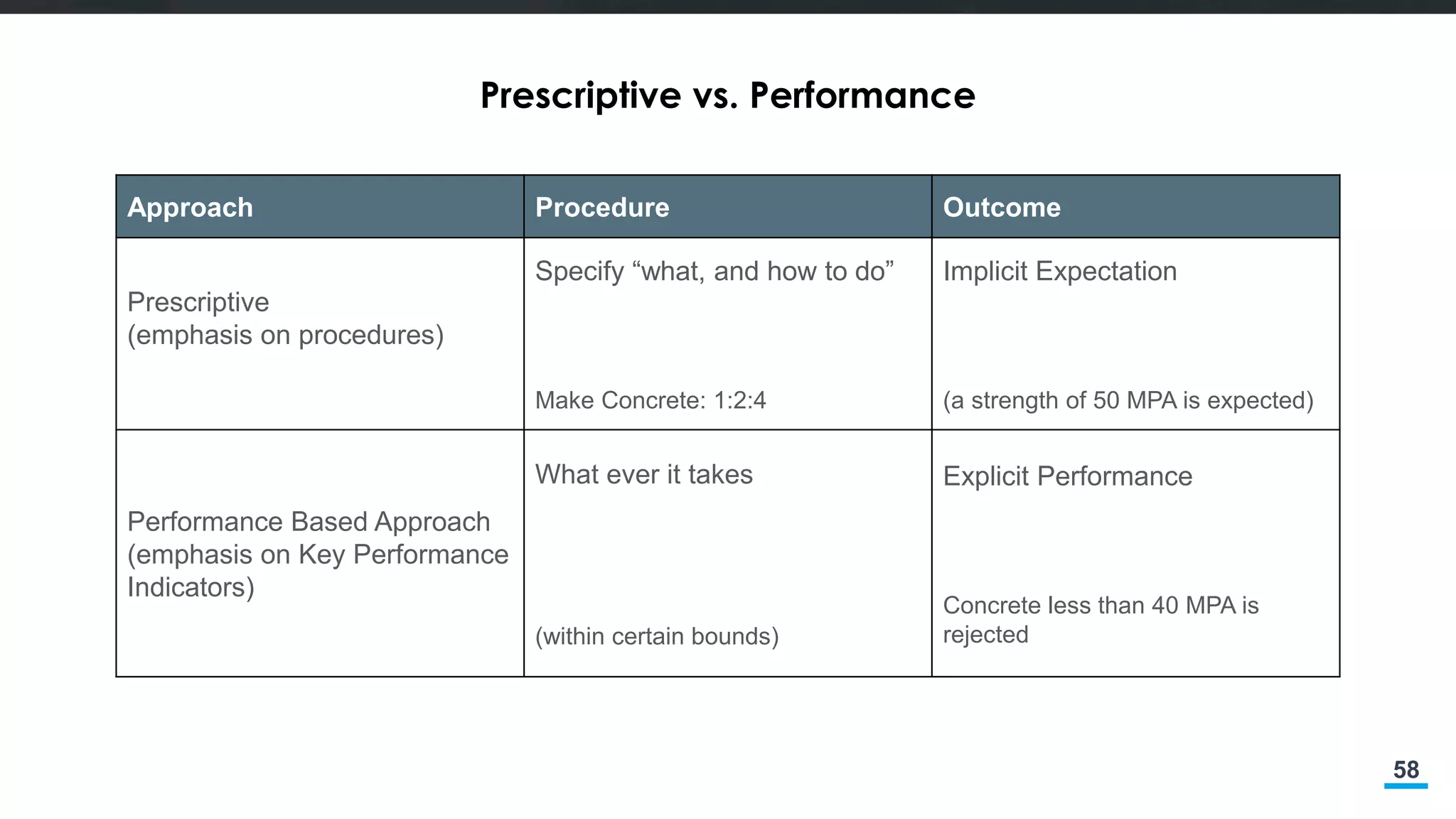
Prescriptive vs. Performance
Approach Procedure Outcome
Prescriptive
(emphasis on procedures)
Specify “what, and how to do”
Make Concrete: 1:2:4
Implicit Expectation
(a strength of 50 MPA is expected)
Performance Based Approach
(emphasis on Key Performance
Indicators)
What ever it takes
(within certain bounds)
Explicit Performance
Concrete less than 40 MPA is
rejected
59
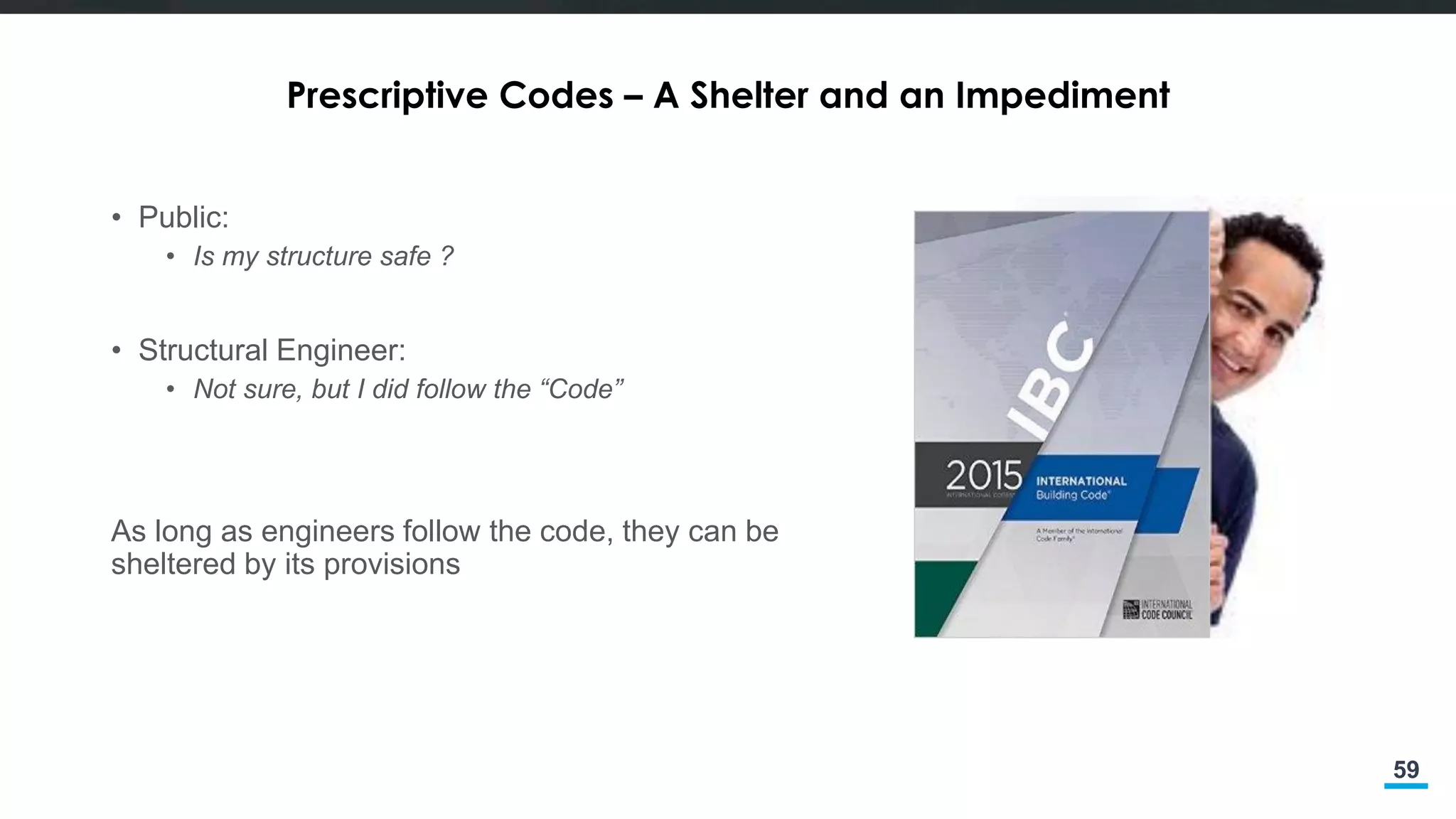
Prescriptive Codes – A Shelter and an Impediment
• Public:
• Is my structure safe ?
• Structural Engineer:
• Not sure, but I did follow the “Code”
As long as engineers follow the code, they can be
sheltered by its provisions
60
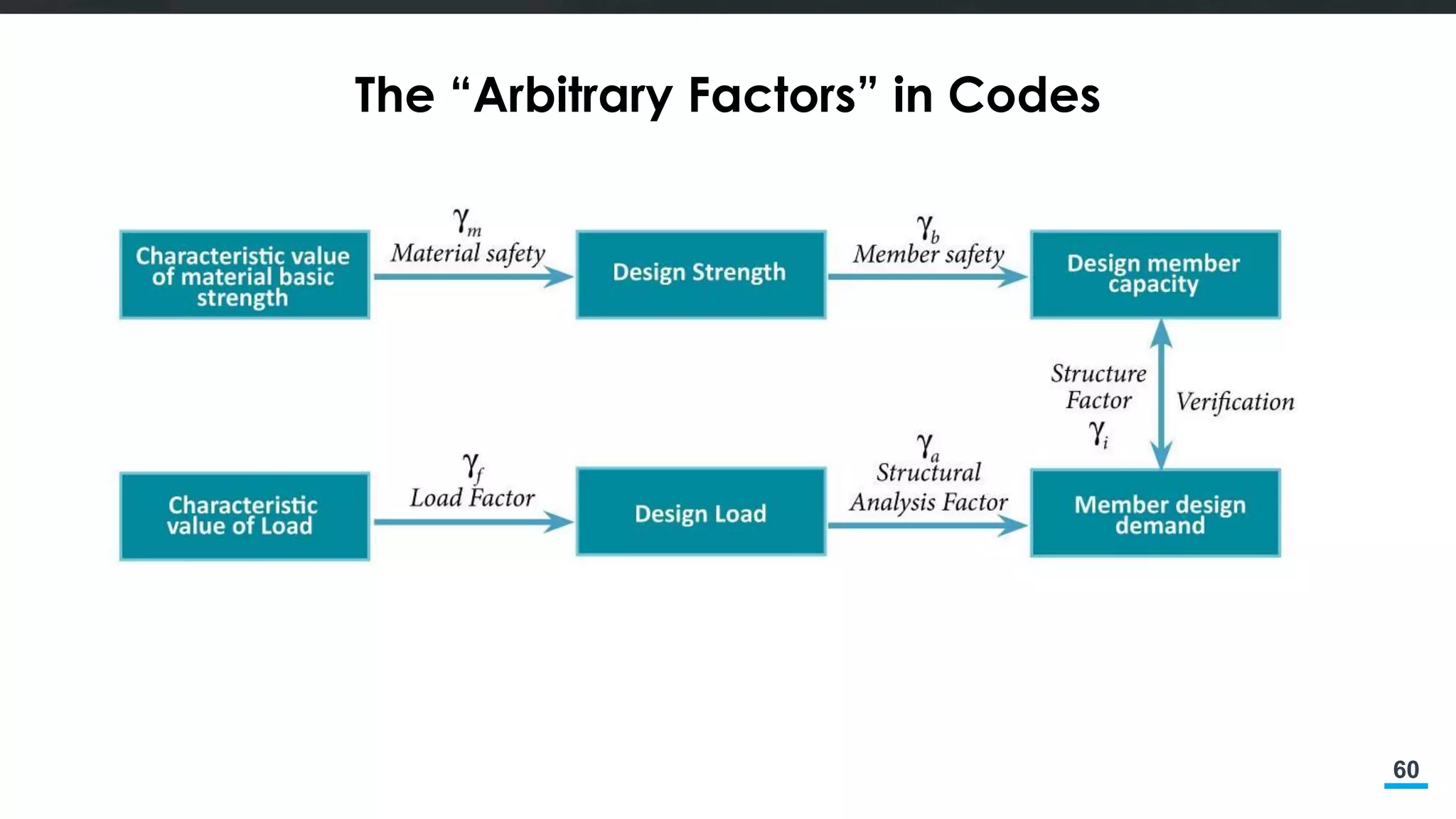
The “Arbitrary Factors” in Codes
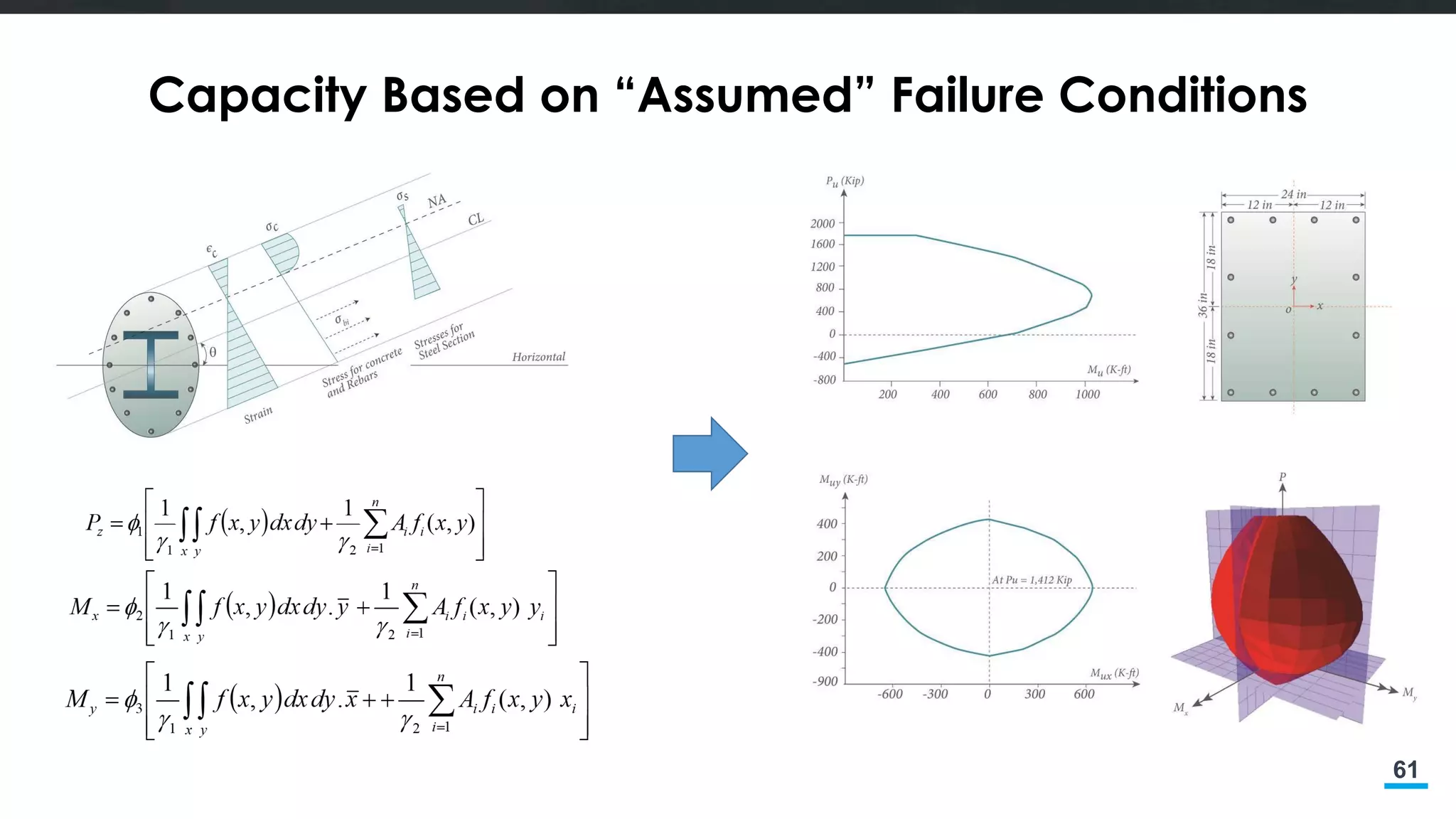
61
Capacity Based on “Assumed” Failure Conditions
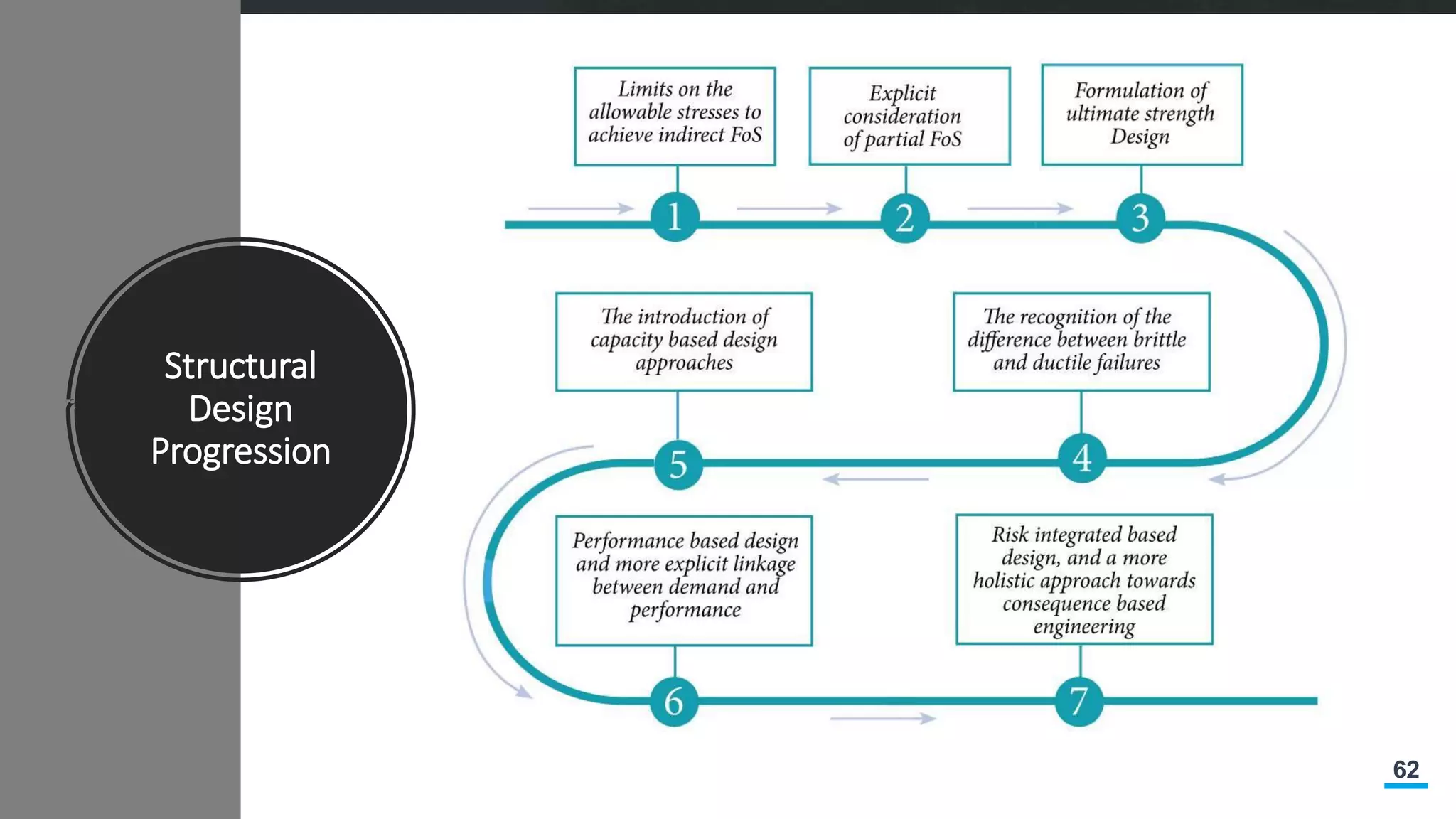
62
Structural
Design
Progression
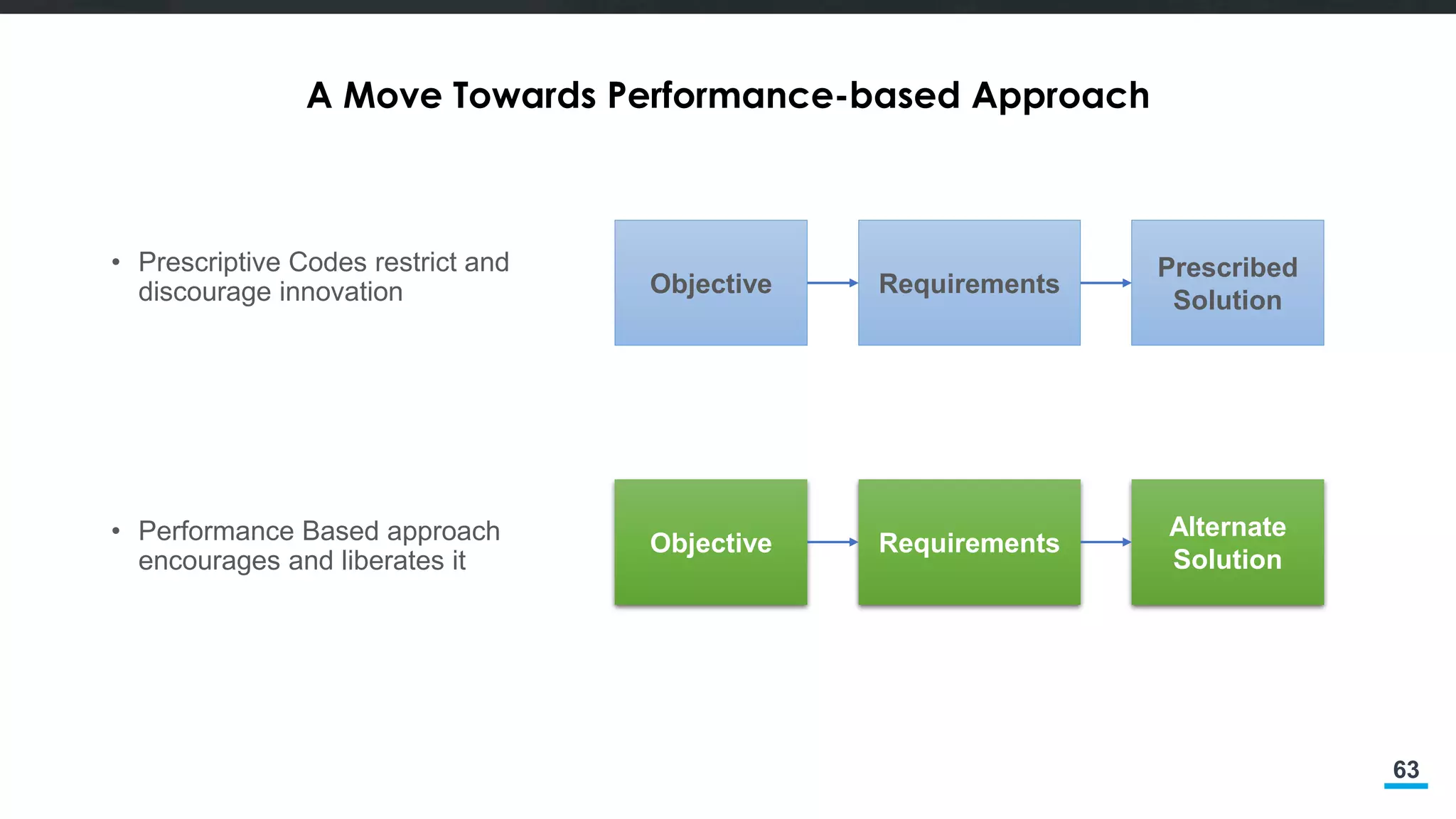
63
A Move Towards Performance-based Approach
• Prescriptive Codes restrict and
discourage innovation Objective Requirements
Prescribed
Solution
Objective Requirements
Alternate
Solution
• Performance Based approach
encourages and liberates it
64
• Lack of explicit performance in design codes is primary
motivation for performance based design
• Performance based methods require the designer to assess
how a building is likely perform extreme events and their
correct application will help to identify unsafe designs.
• Enables arbitrary restrictions to be lifted and provides
scope for the development of innovative, safer and more
cost-effective solutions
65
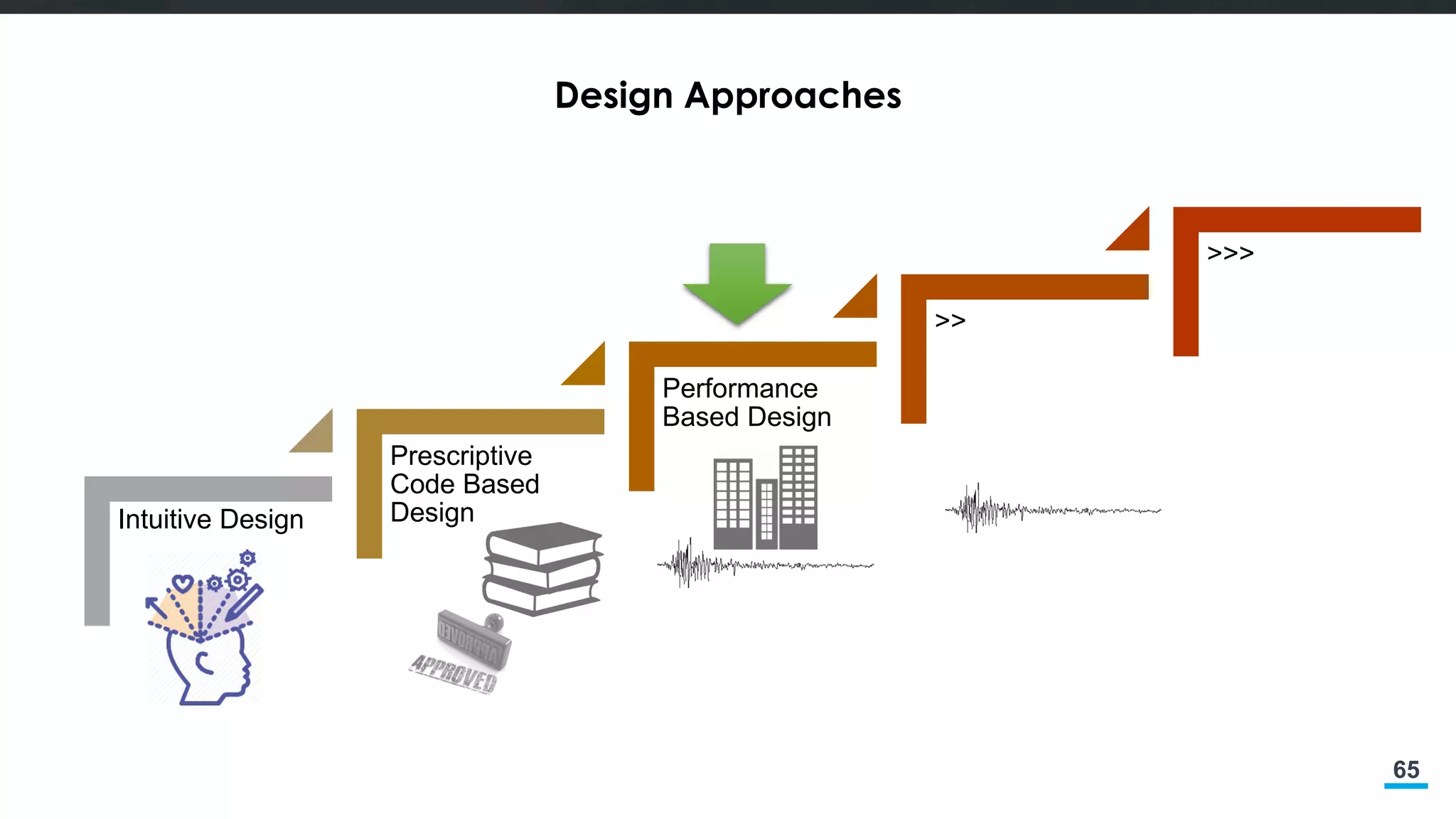
Design Approaches
Intuitive Design
Prescriptive
Code Based
Design
Performance
Based Design
>>
>>>
66
Performance based design can be
applied to any type of loads, but
was initially developed and targeted
for earthquake loads
67
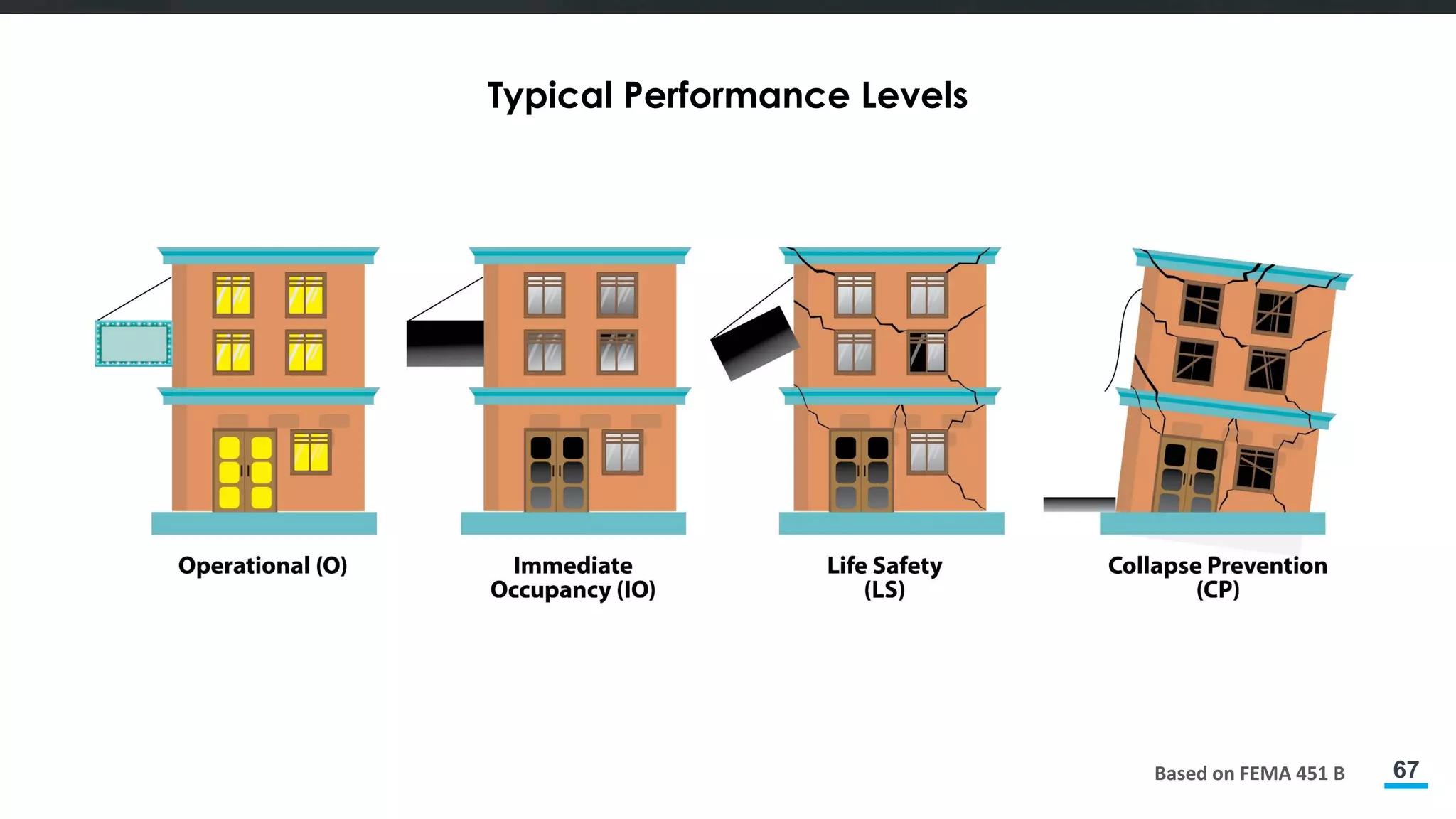
Typical Performance Levels
Based on FEMA 451 B
68
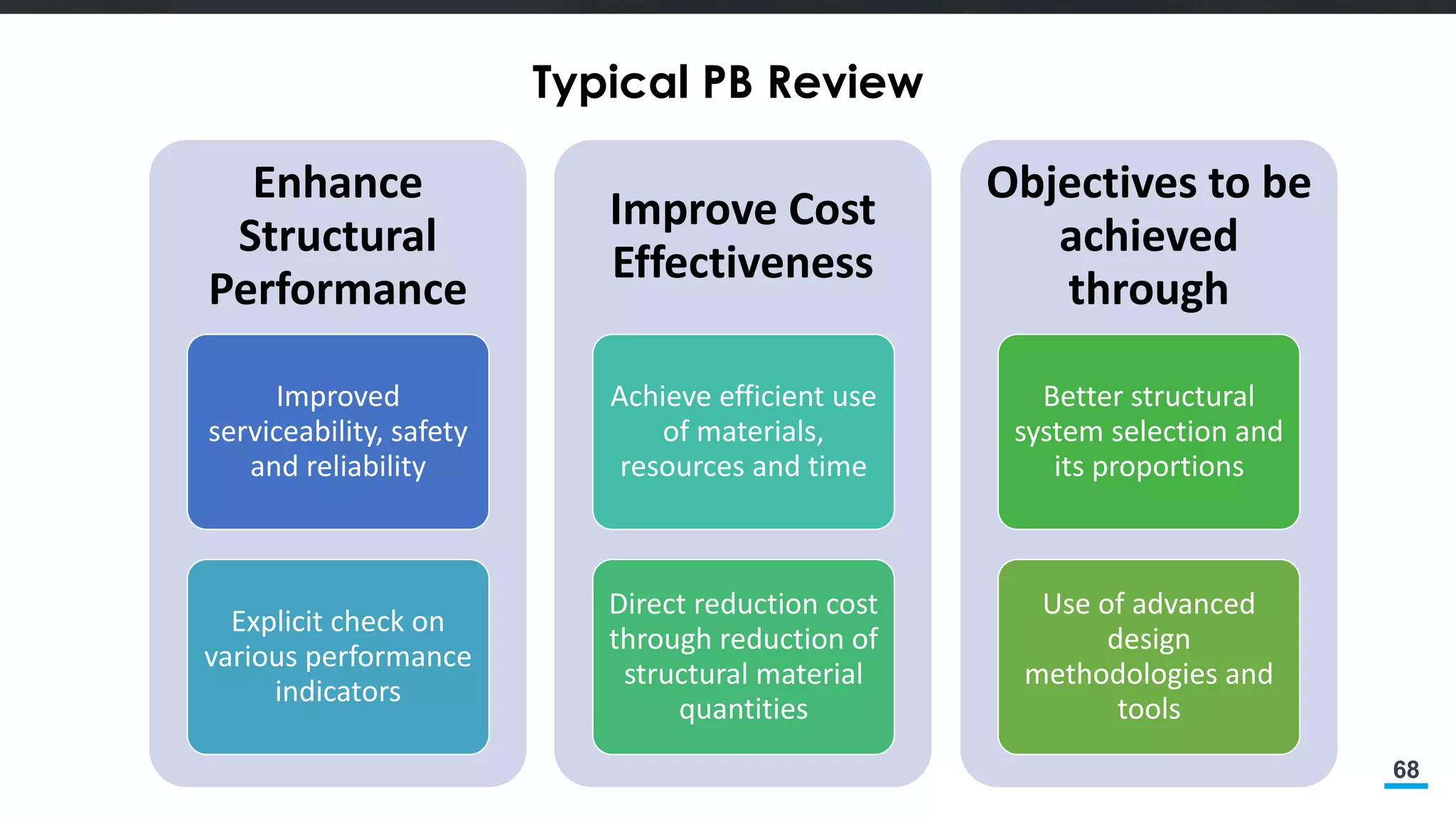
Typical PB Review
Enhance
Structural
Performance
Improved
serviceability, safety
and reliability
Explicit check on
various performance
indicators
Improve Cost
Effectiveness
Achieve efficient use
of materials,
resources and time
Direct reduction cost
through reduction of
structural material
quantities
Objectives to be
achieved
through
Better structural
system selection and
its proportions
Use of advanced
design
methodologies and
tools
69
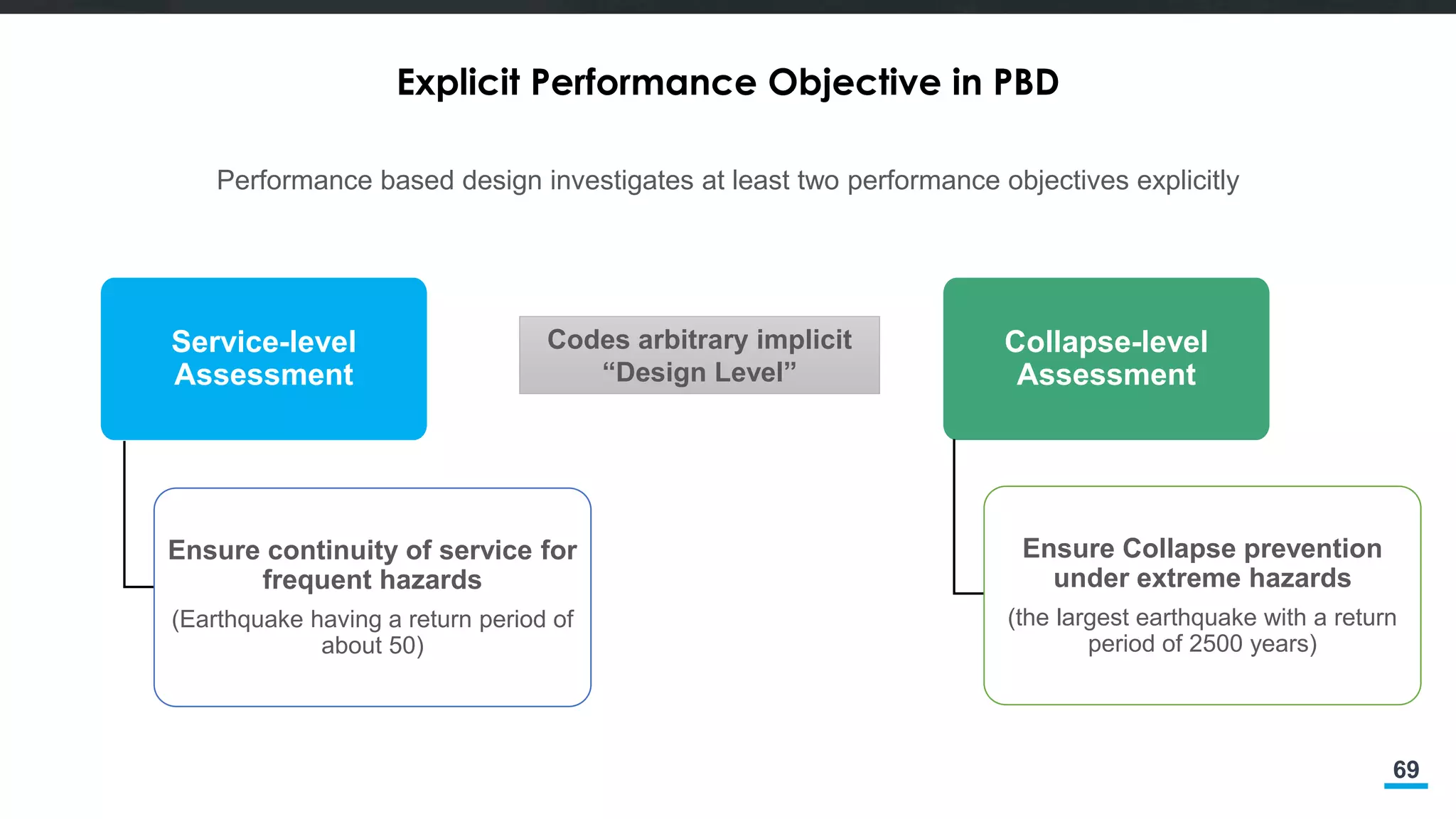
Explicit Performance Objective in PBD
Performance based design investigates at least two performance objectives explicitly
Service-level
Assessment
Ensure continuity of service for
frequent hazards
(Earthquake having a return period of
about 50)
Collapse-level
Assessment
Ensure Collapse prevention
under extreme hazards
(the largest earthquake with a return
period of 2500 years)
Codes arbitrary implicit
“Design Level”
70
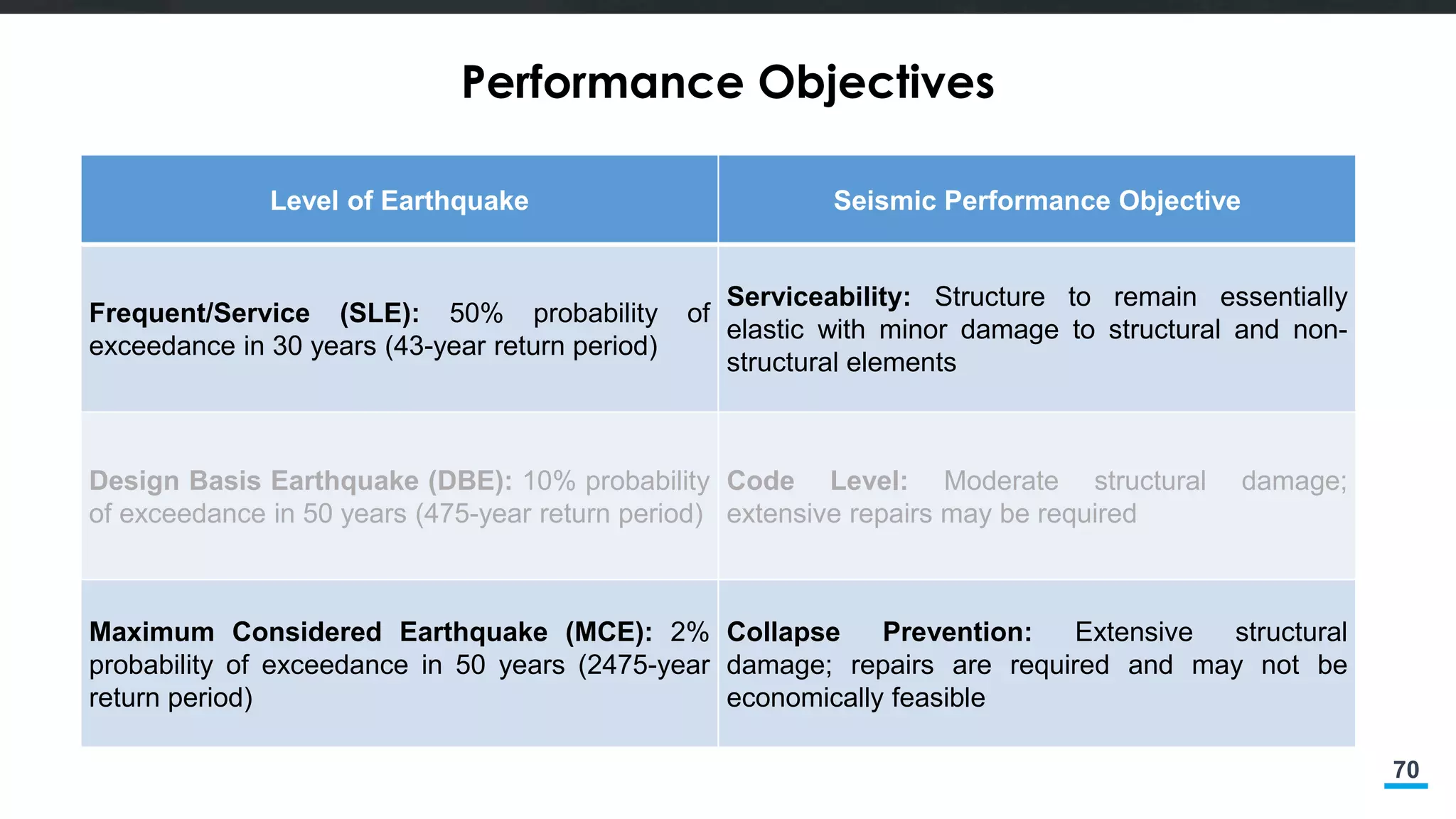
Performance Objectives
Level of Earthquake Seismic Performance Objective
Frequent/Service (SLE): 50% probability of
exceedance in 30 years (43-year return period)
Serviceability: Structure to remain essentially
elastic with minor damage to structural and non-
structural elements
Design Basis Earthquake (DBE): 10% probability
of exceedance in 50 years (475-year return period)
Code Level: Moderate structural damage;
extensive repairs may be required
Maximum Considered Earthquake (MCE): 2%
probability of exceedance in 50 years (2475-year
return period)
Collapse Prevention: Extensive structural
damage; repairs are required and may not be
economically feasible
71
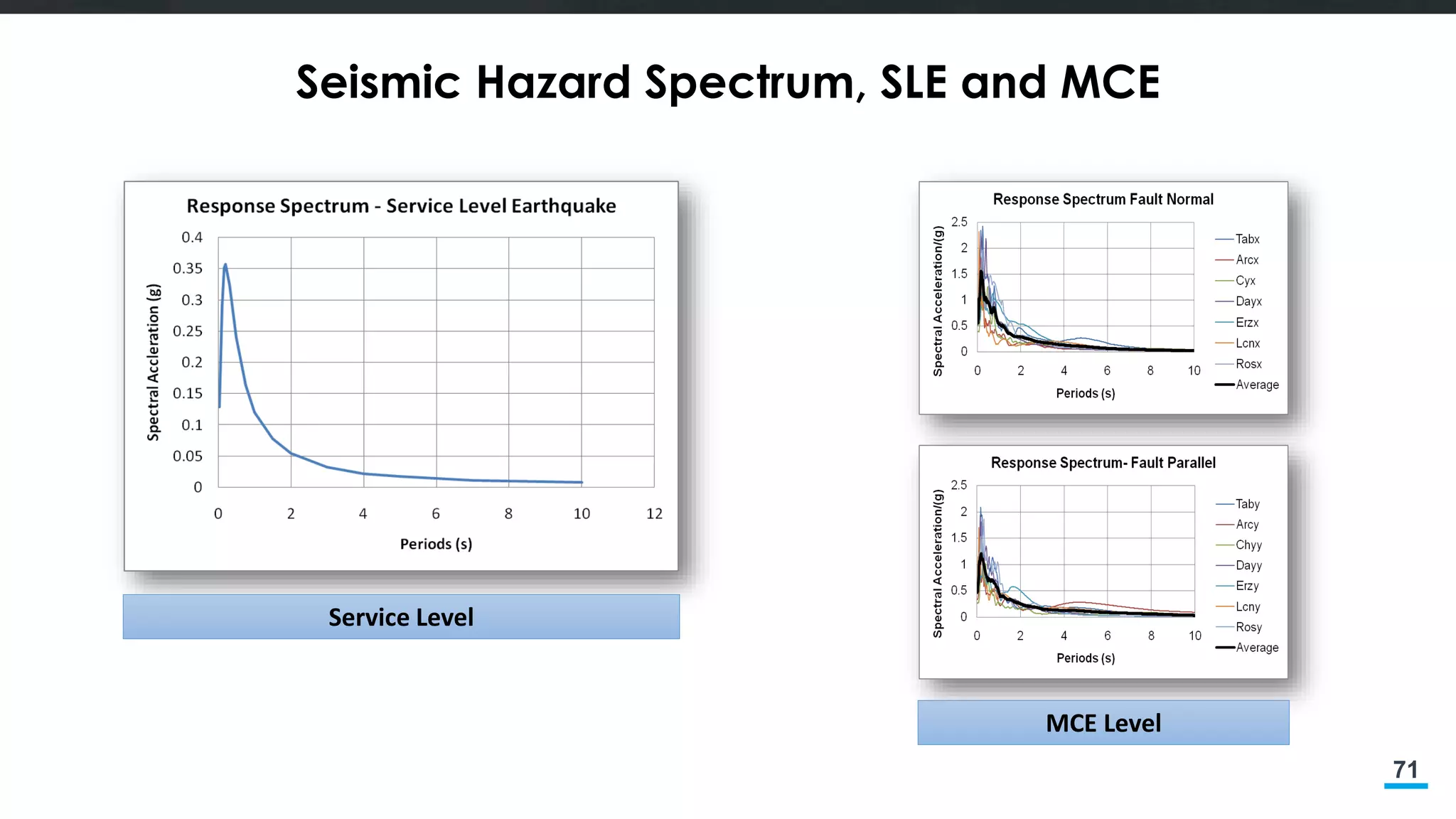
Seismic Hazard Spectrum, SLE and MCE
MCE Level
Service Level
72
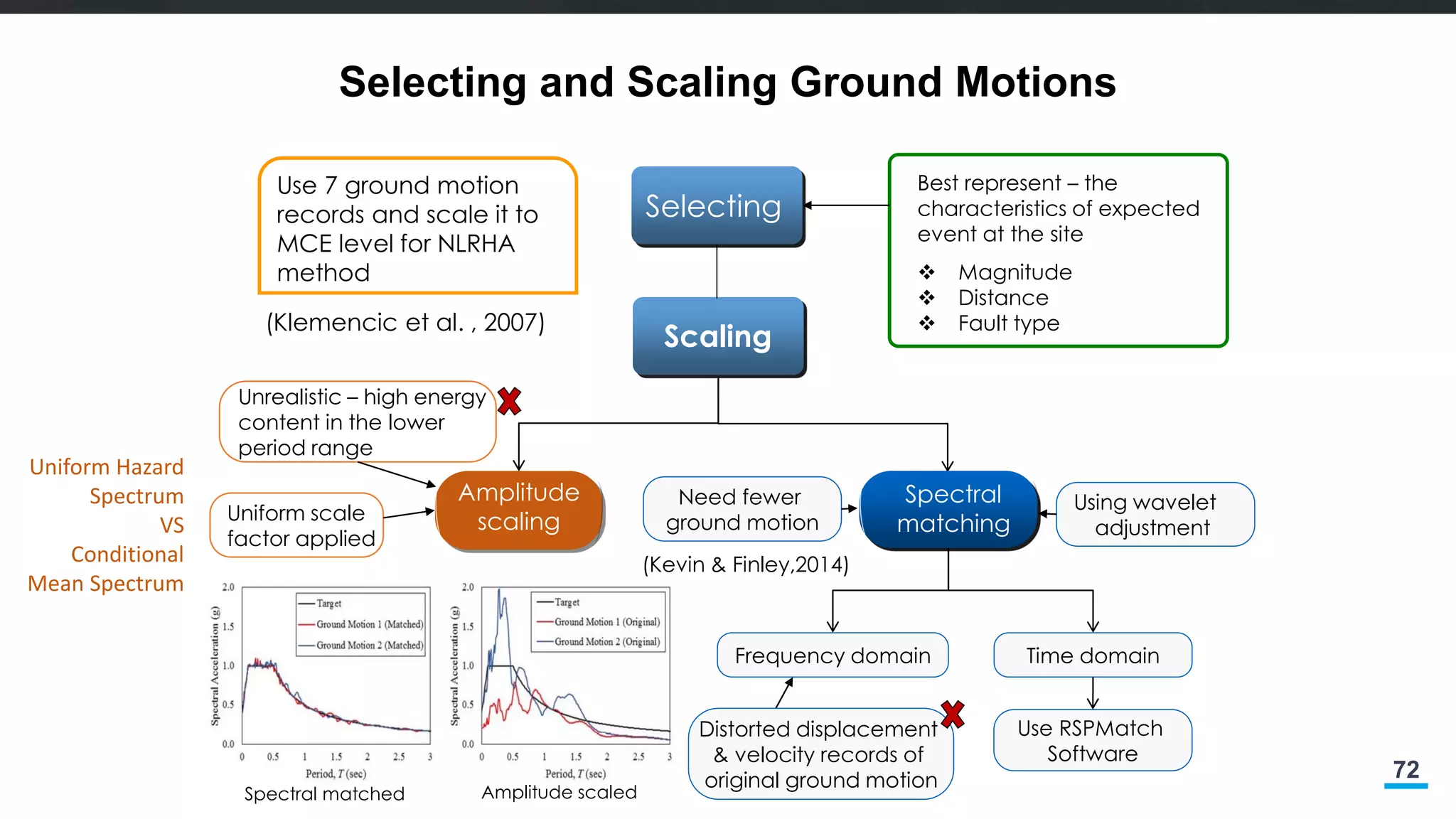
Selecting and Scaling Ground Motions
Best represent – the
characteristics of expected
event at the site
 Magnitude
 Distance
 Fault type
Scaling
Spectral
matchingUniform scale
factor applied
Using wavelet
adjustment
Amplitude
scaling
Need fewer
ground motion
Frequency domain Time domain
Use RSPMatch
Software
Unrealistic – high energy
content in the lower
period range
Distorted displacement
& velocity records of
original ground motion
Selecting
(Kevin & Finley,2014)
Spectral matched Amplitude scaled
Use 7 ground motion
records and scale it to
MCE level for NLRHA
method
(Klemencic et al. , 2007)
Uniform Hazard
Spectrum
VS
Conditional
Mean Spectrum
73
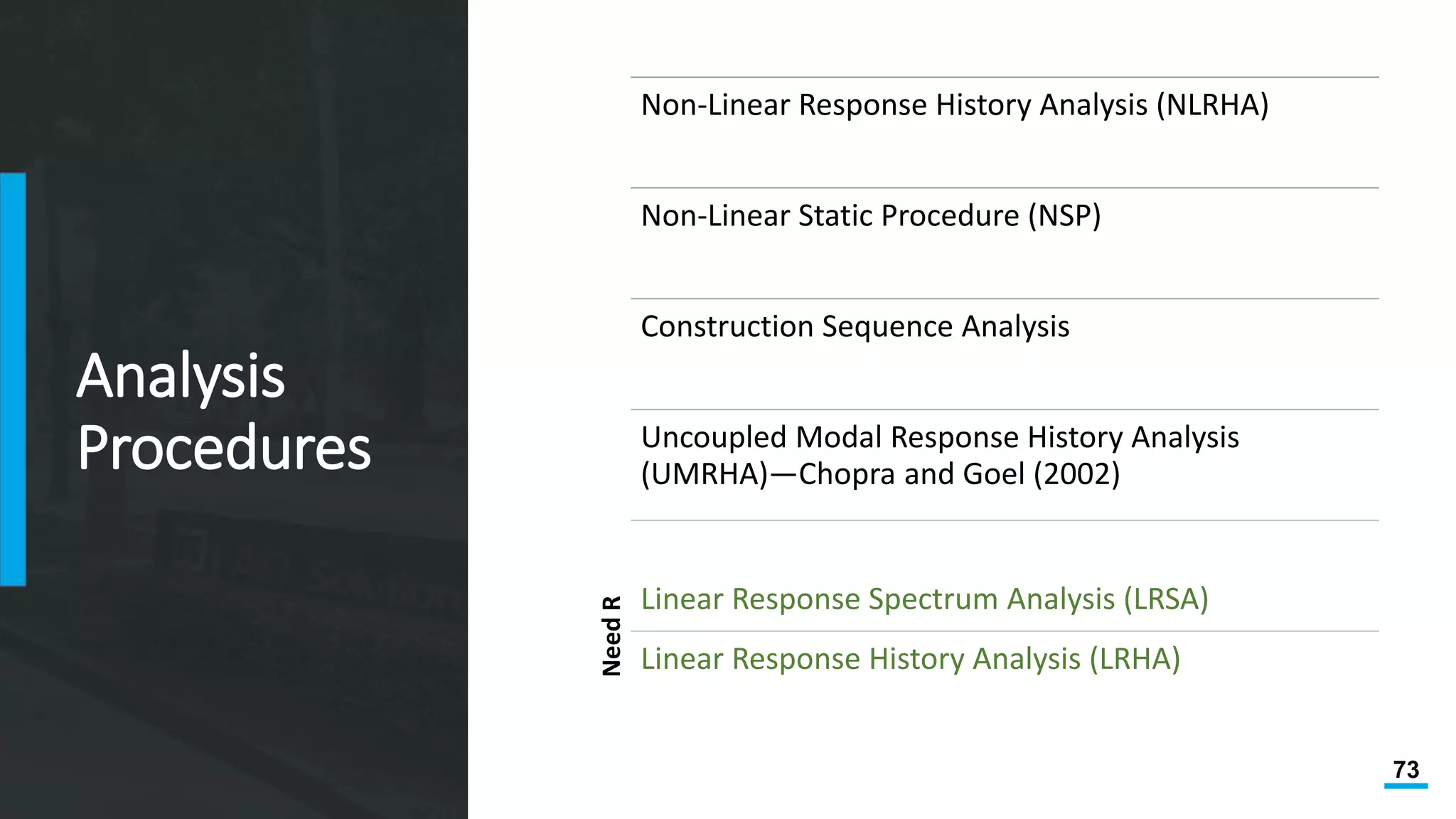
Analysis
Procedures
Non-Linear Response History Analysis (NLRHA)
Non-Linear Static Procedure (NSP)
Construction Sequence Analysis
Uncoupled Modal Response History Analysis
(UMRHA)—Chopra and Goel (2002)
Linear Response Spectrum Analysis (LRSA)
Linear Response History Analysis (LRHA)
NeedR
74
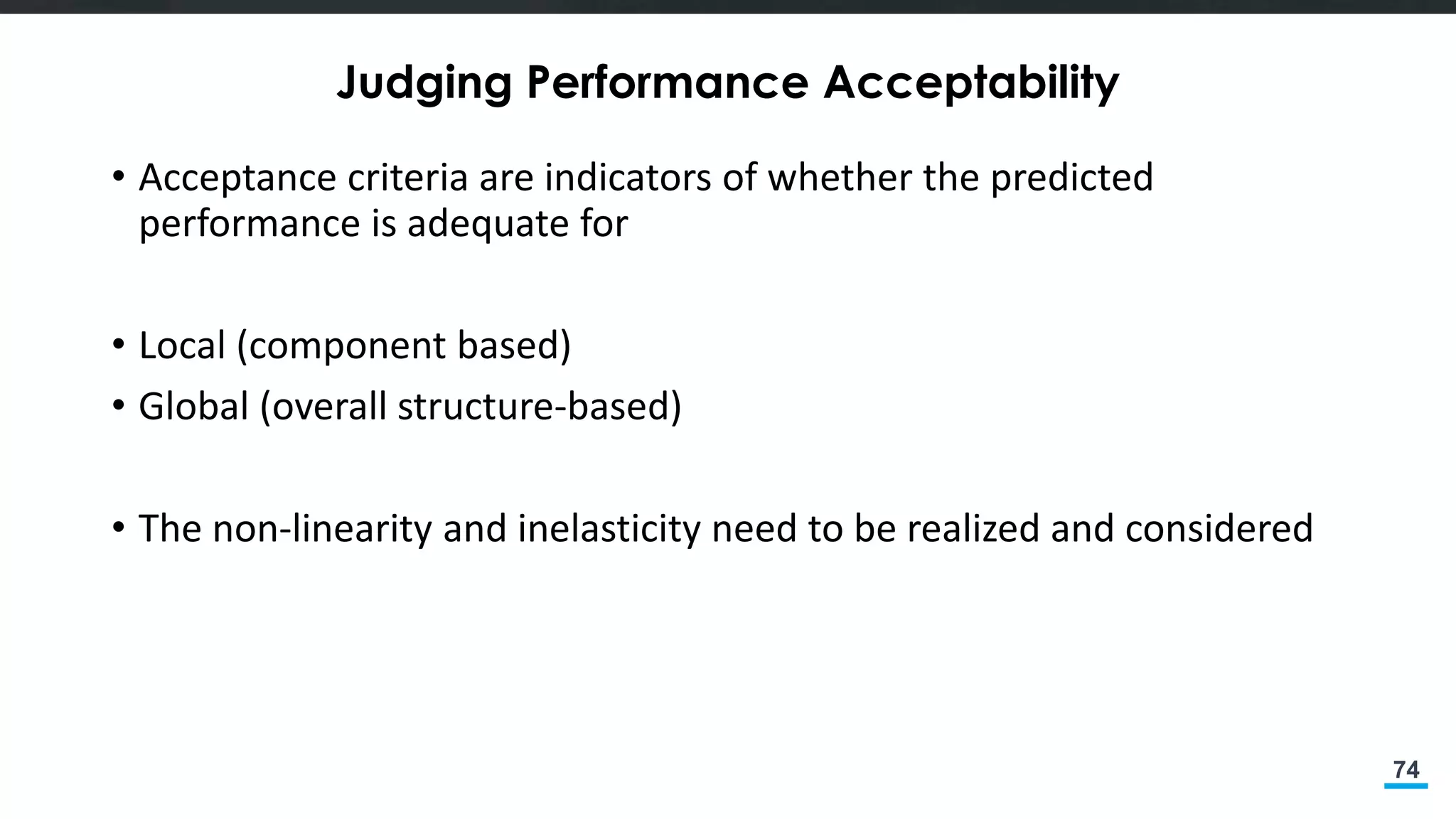
Judging Performance Acceptability
• Acceptance criteria are indicators of whether the predicted
performance is adequate for
• Local (component based)
• Global (overall structure-based)
• The non-linearity and inelasticity need to be realized and considered
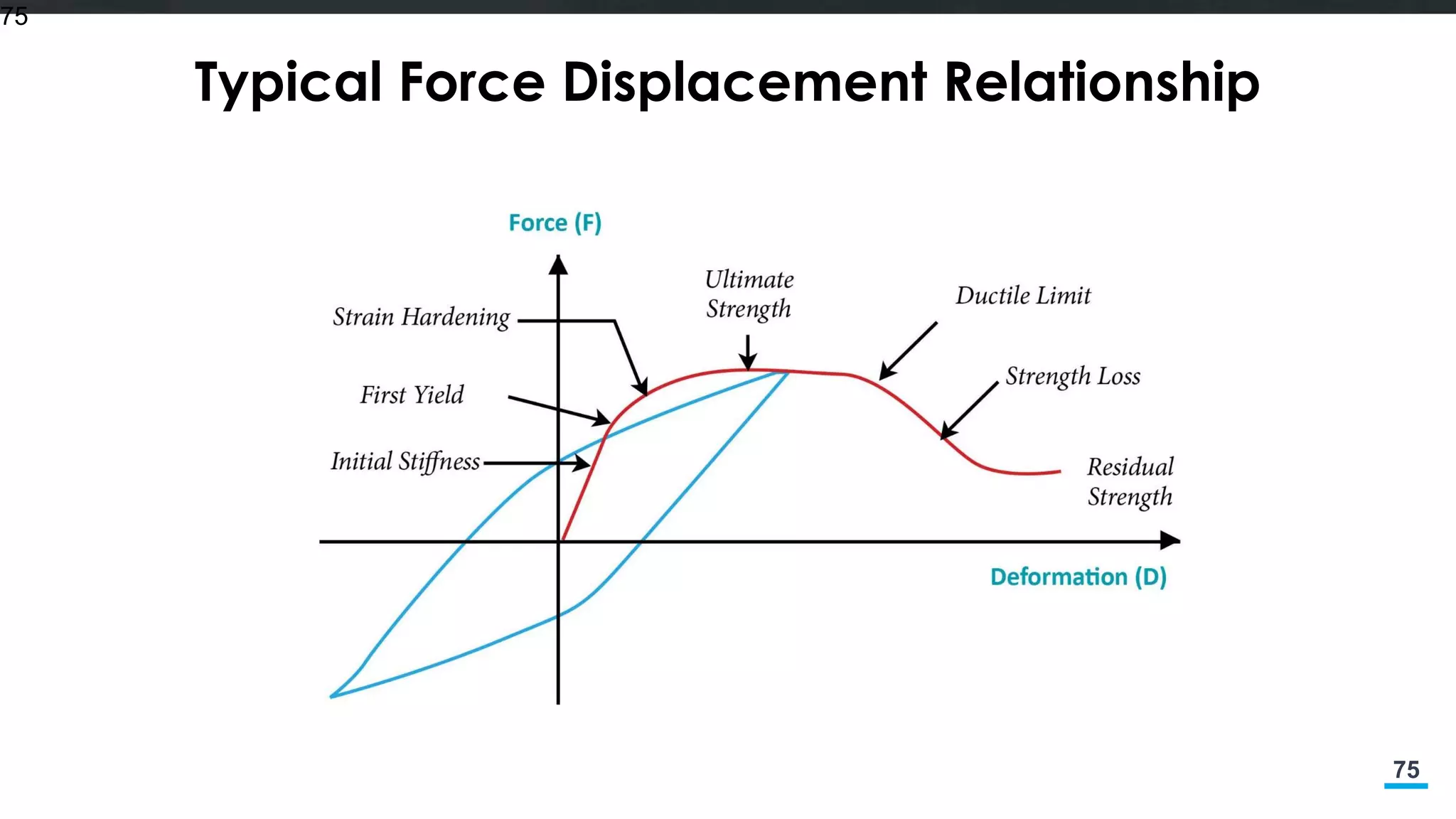
75
Typical Force Displacement Relationship
75
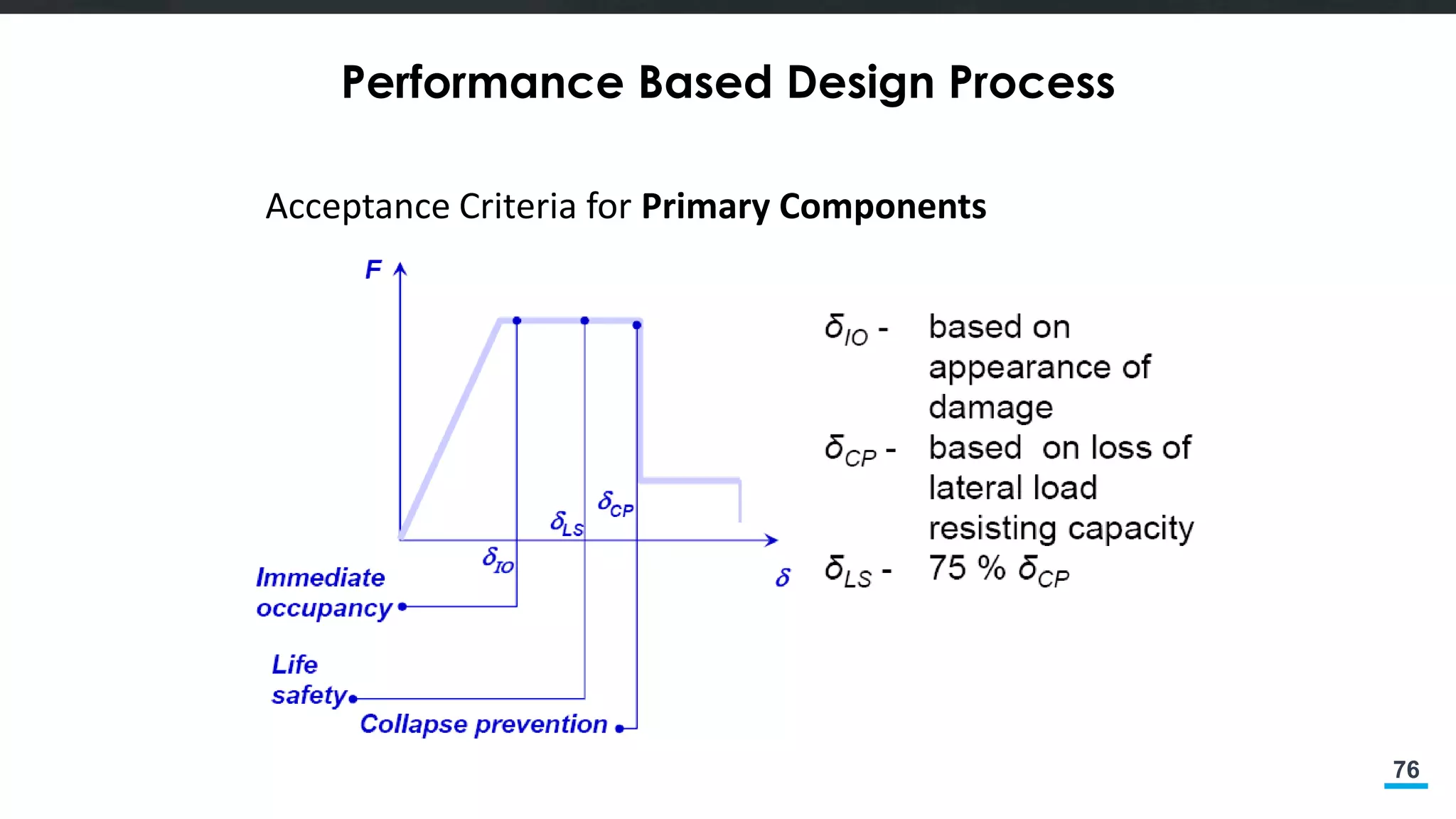
76
Performance Based Design Process
Acceptance Criteria for Primary Components
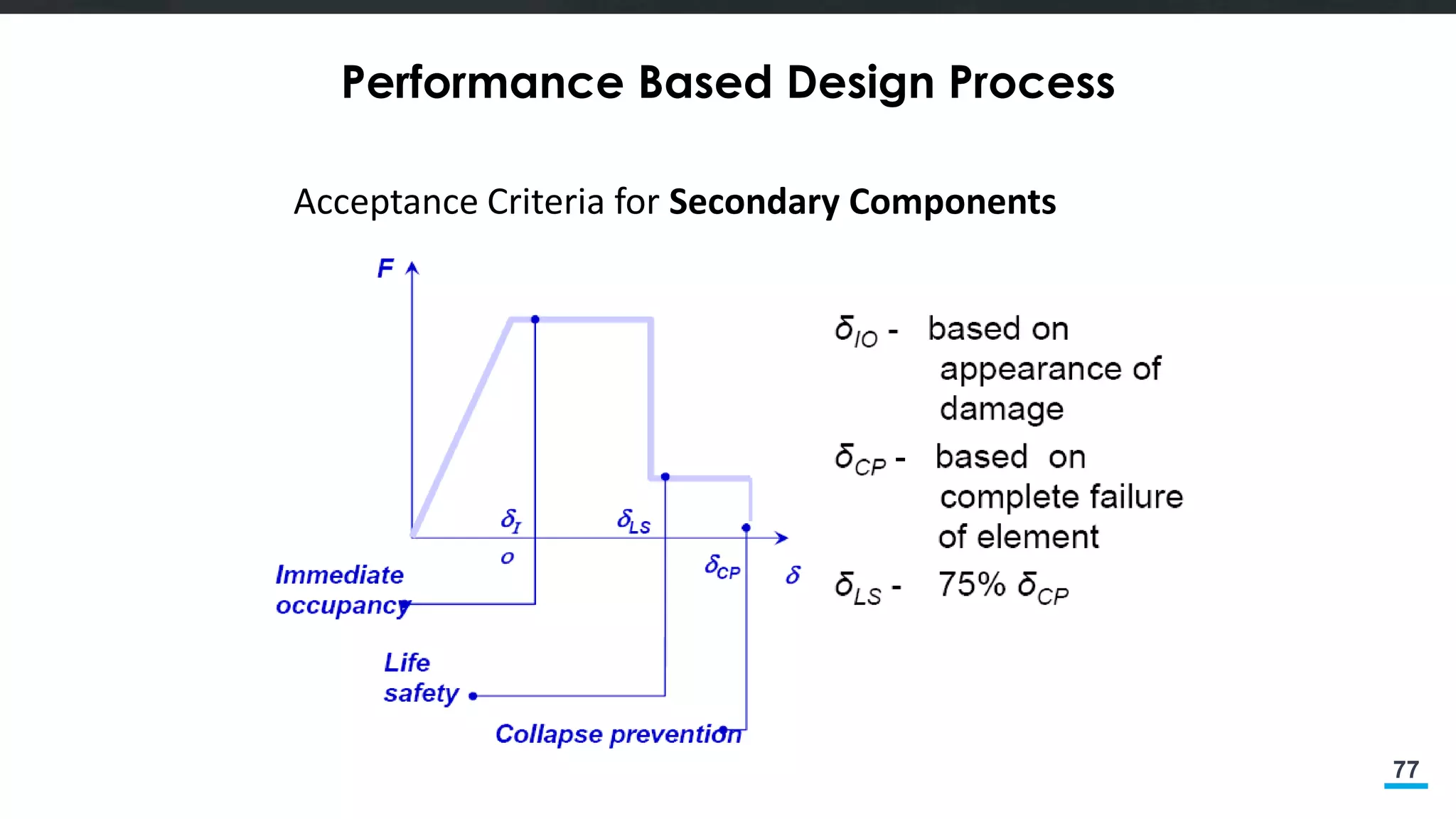
77
Performance Based Design Process
Acceptance Criteria for Secondary Components
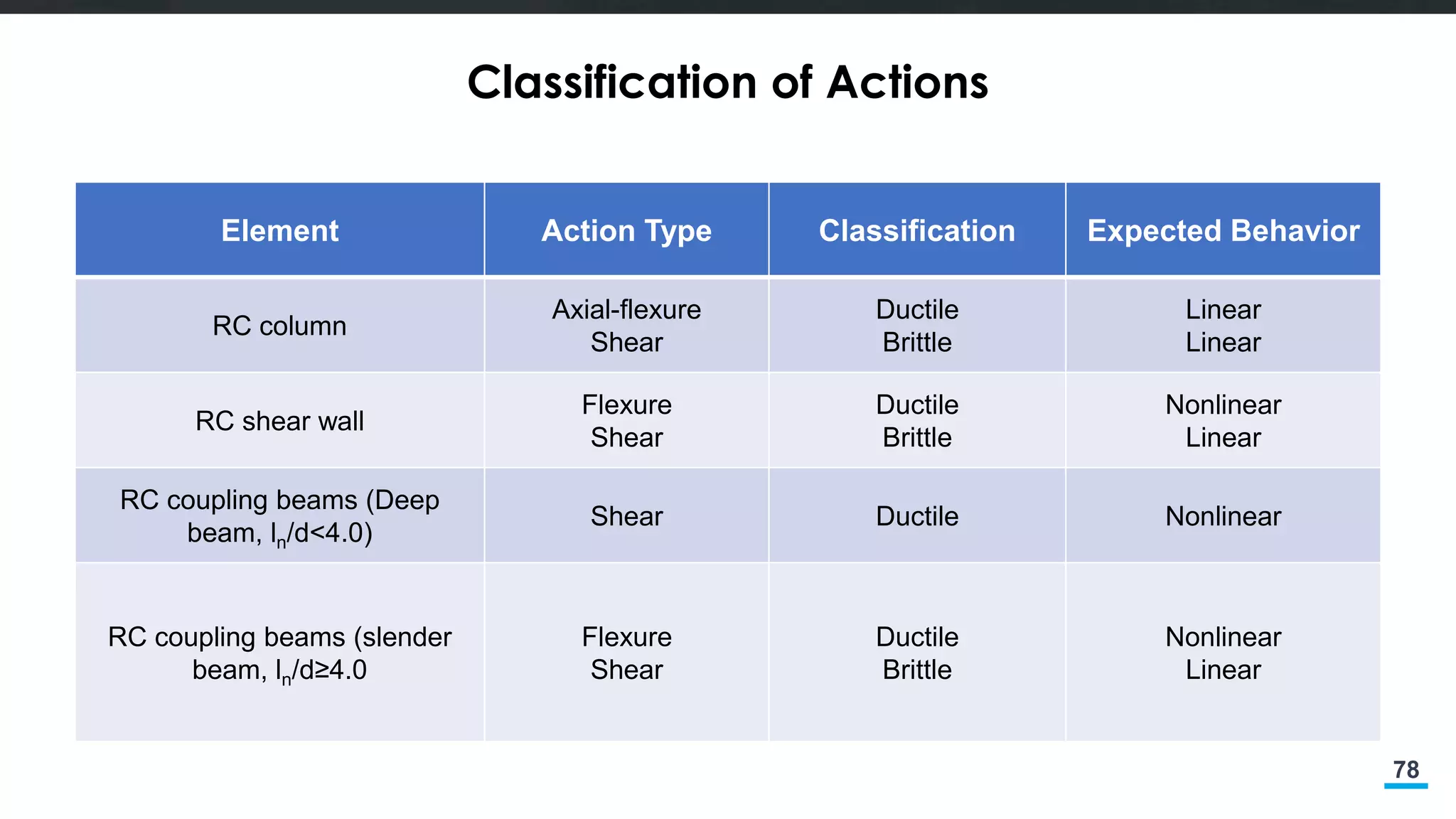
78
Classification of Actions
Element Action Type Classification Expected Behavior
RC column
Axial-flexure
Shear
Ductile
Brittle
Linear
Linear
RC shear wall
Flexure
Shear
Ductile
Brittle
Nonlinear
Linear
RC coupling beams (Deep
beam, ln/d<4.0)
Shear Ductile Nonlinear
RC coupling beams (slender
beam, ln/d≥4.0
Flexure
Shear
Ductile
Brittle
Nonlinear
Linear
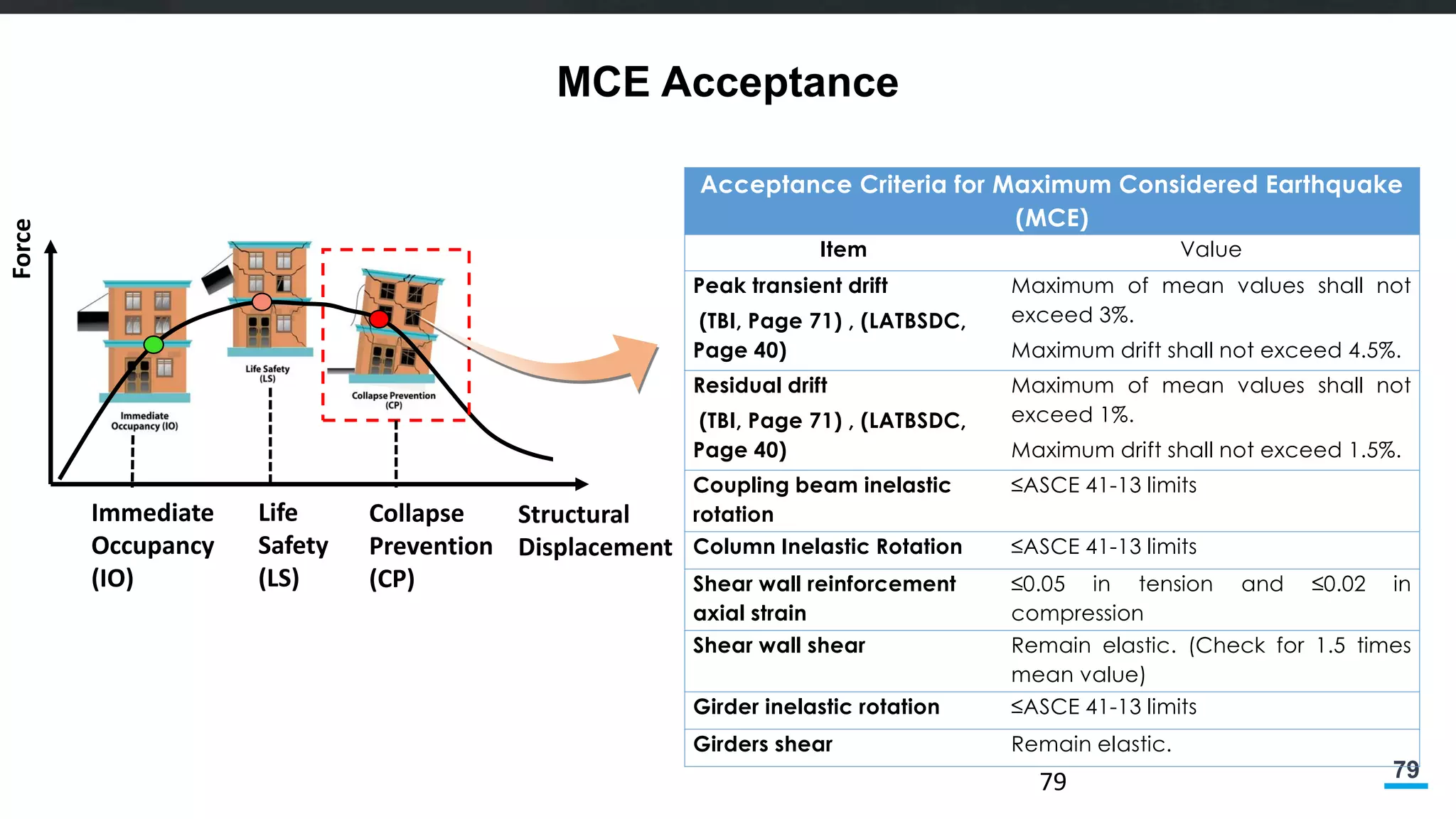
79
MCE Acceptance
79
Acceptance Criteria for Maximum Considered Earthquake
(MCE)
Item Value
Peak transient drift
(TBI, Page 71) , (LATBSDC,
Page 40)
Maximum of mean values shall not
exceed 3%.
Maximum drift shall not exceed 4.5%.
Residual drift
(TBI, Page 71) , (LATBSDC,
Page 40)
Maximum of mean values shall not
exceed 1%.
Maximum drift shall not exceed 1.5%.
Coupling beam inelastic
rotation
≤ASCE 41-13 limits
Column Inelastic Rotation ≤ASCE 41-13 limits
Shear wall reinforcement
axial strain
≤0.05 in tension and ≤0.02 in
compression
Shear wall shear Remain elastic. (Check for 1.5 times
mean value)
Girder inelastic rotation ≤ASCE 41-13 limits
Girders shear Remain elastic.
Force
Structural
Displacement
Immediate
Occupancy
(IO)
Life
Safety
(LS)
Collapse
Prevention
(CP)
80
Demand
Capacity
(DC Ratio)
• Definition of D/C: It is an index that gives an overall
relationship between affects of load and ability of member to
resists those affects.
• This is a normalized factor that means D/C ratio value of 1
indicates that the capacity (strength, deformation etc) member
is just enough to fulfill the load demand.
• Two types of D/C ratio
 Members with brittle behavior D/C is checked by Strength
(Elastic)
 Members with ductile behavior D/C is checked by deformation
(Inelastic)
• Total D/C ratio of the member is combined of these two.
81
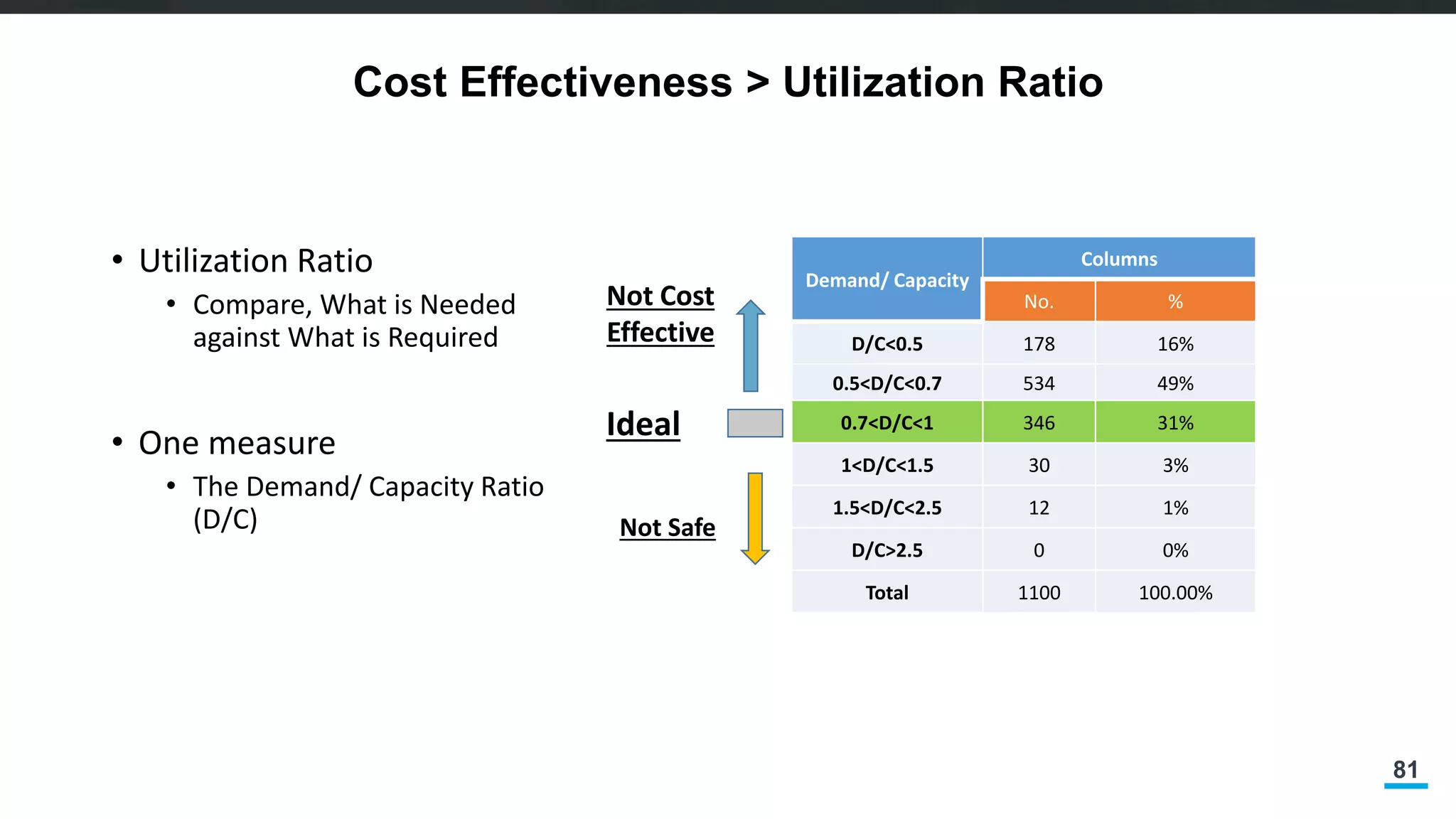
Cost Effectiveness > Utilization Ratio
• Utilization Ratio
• Compare, What is Needed
against What is Required
• One measure
• The Demand/ Capacity Ratio
(D/C)
Demand/ Capacity
Columns
No. %
D/C<0.5 178 16%
0.5<D/C<0.7 534 49%
0.7<D/C<1 346 31%
1<D/C<1.5 30 3%
1.5<D/C<2.5 12 1%
D/C>2.5 0 0%
Total 1100 100.00%
Ideal
Not Cost
Effective
Not Safe
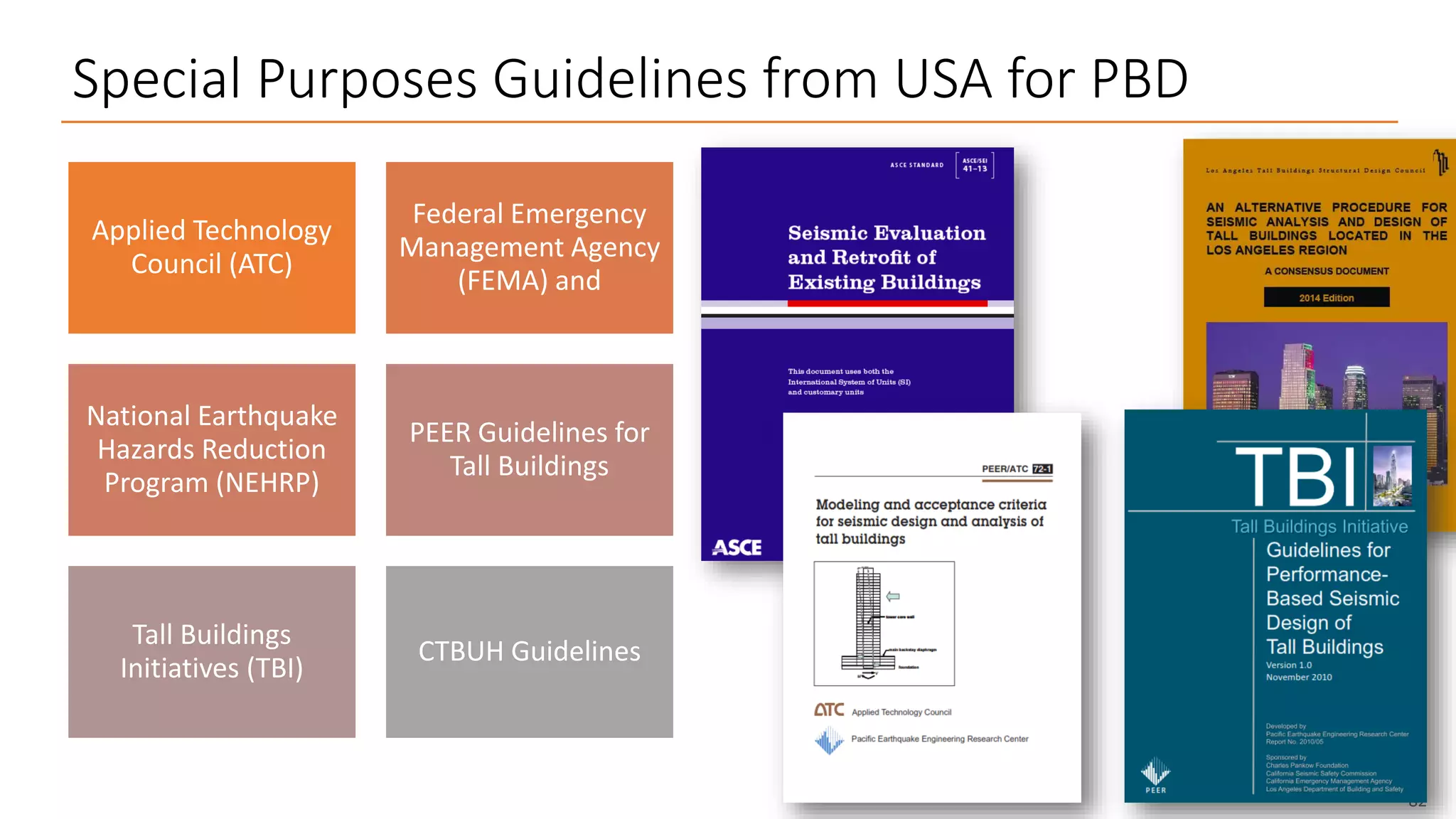
Special Purposes Guidelines from USA for PBD
82
Applied Technology
Council (ATC)
Federal Emergency
Management Agency
(FEMA) and
National Earthquake
Hazards Reduction
Program (NEHRP)
PEER Guidelines for
Tall Buildings
Tall Buildings
Initiatives (TBI)
CTBUH Guidelines
AIT and PBD
• Research labs to support
innovation
• More than 100 tall building
projects in Asia
• Carried out for several
developers and structural
engineers
• Many of which further reviewed
by third-party experts based in
the USA
• More than 50 MS and PhD
Thesis on PBD Tall Buildings
84
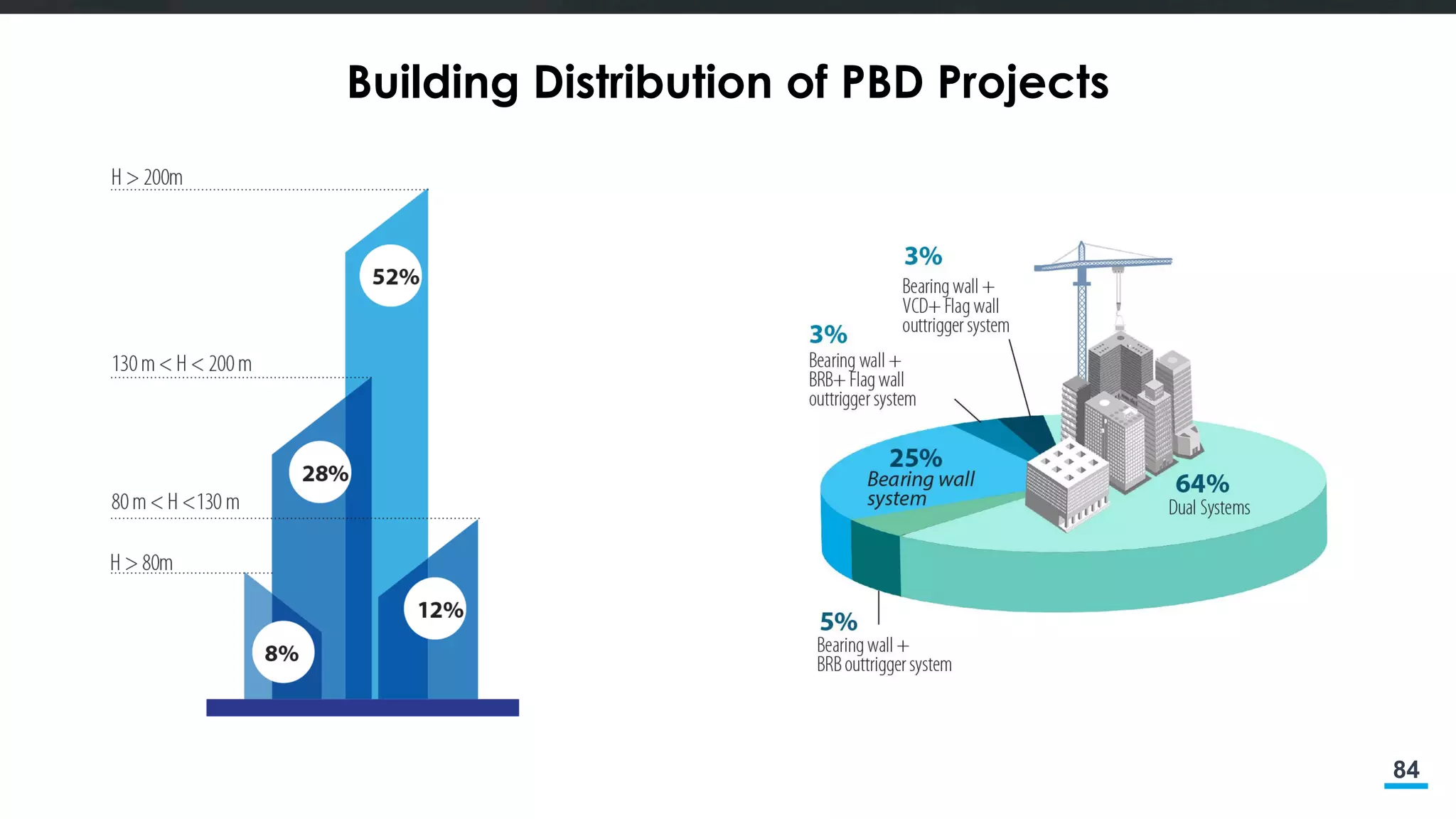
Building Distribution of PBD Projects
85
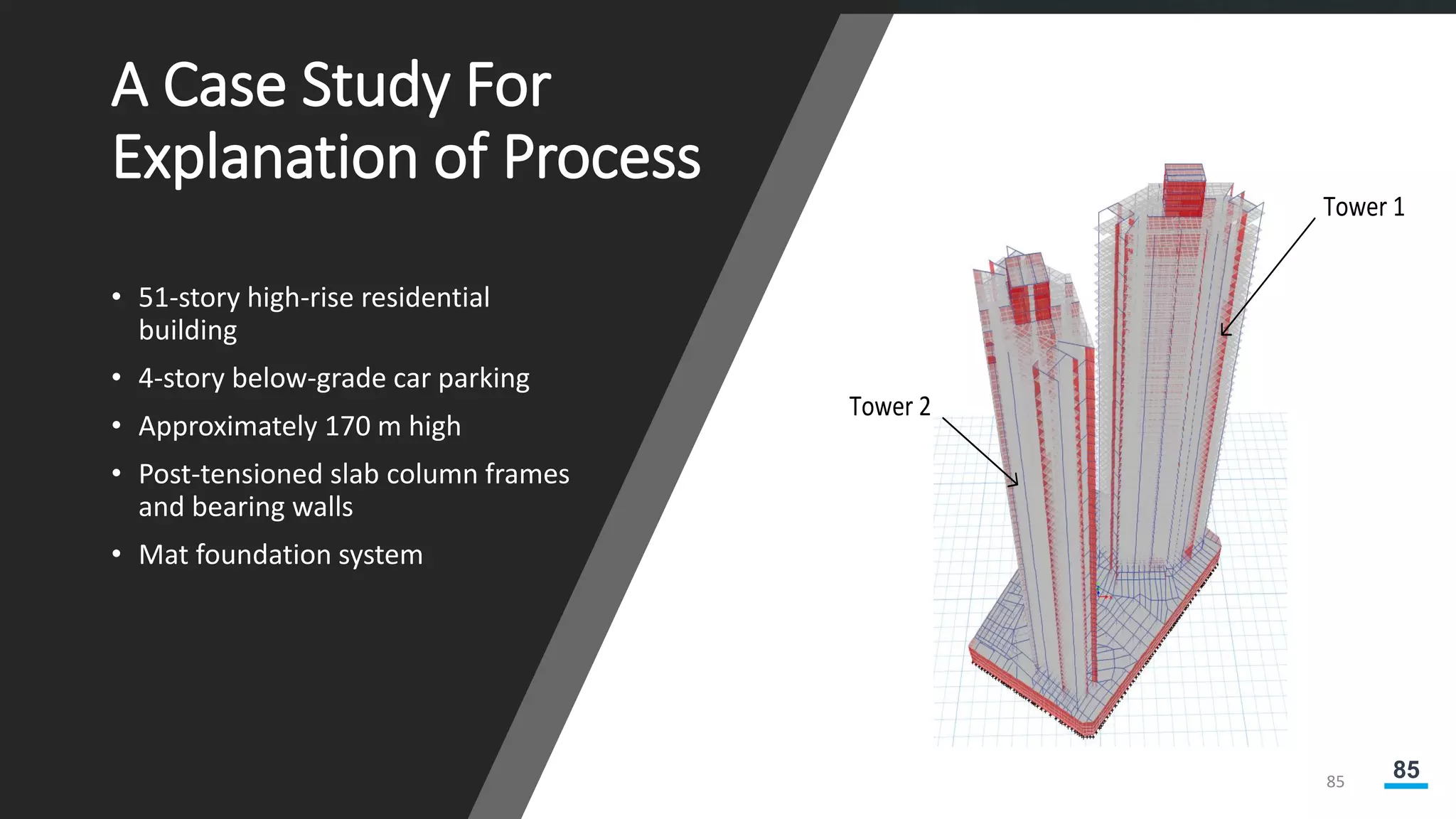
Tower 1
Tower 2
A Case Study For
Explanation of Process
• 51-story high-rise residential
building
• 4-story below-grade car parking
• Approximately 170 m high
• Post-tensioned slab column frames
and bearing walls
• Mat foundation system
85
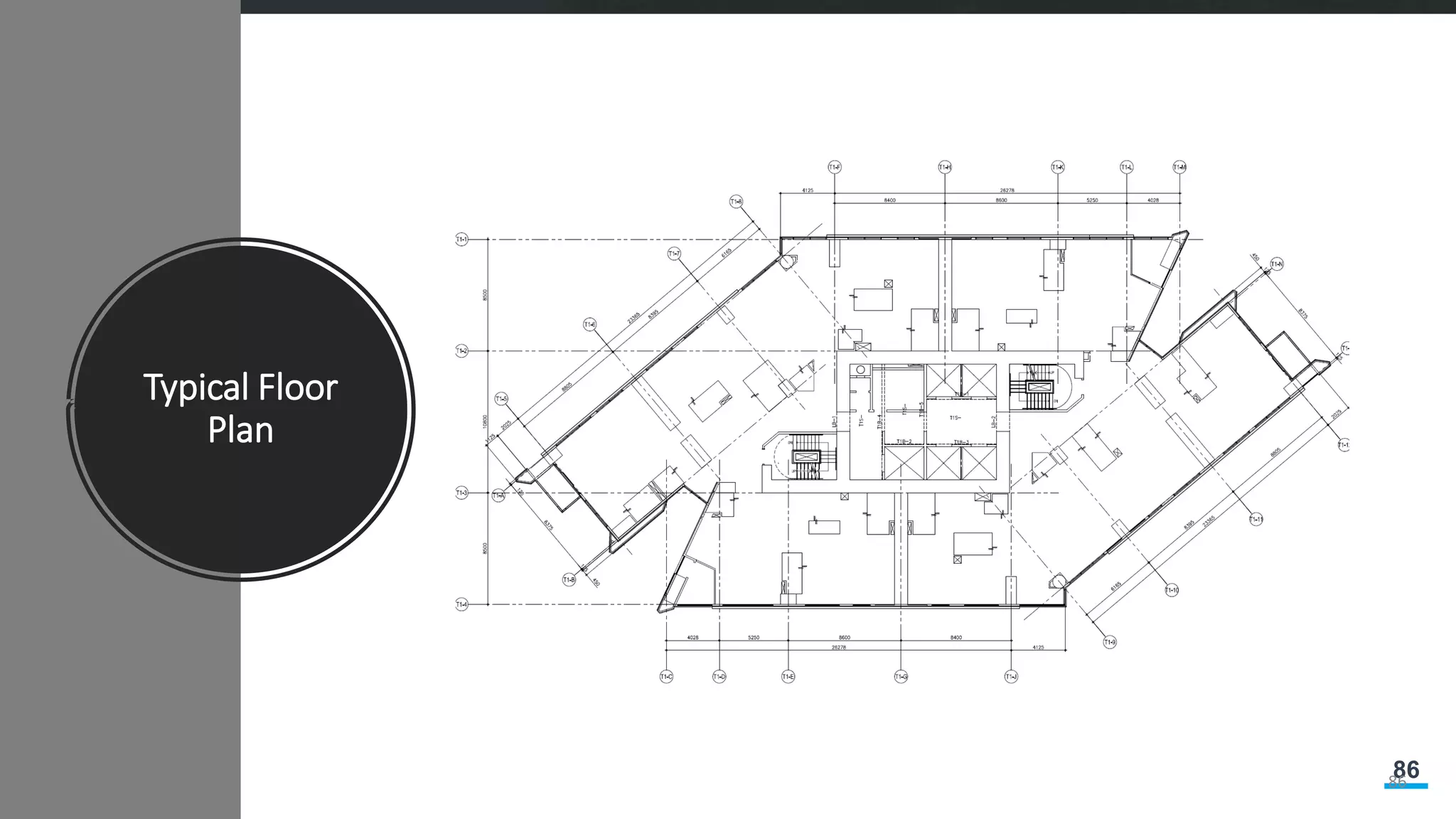
86
Typical Floor
Plan
86
87
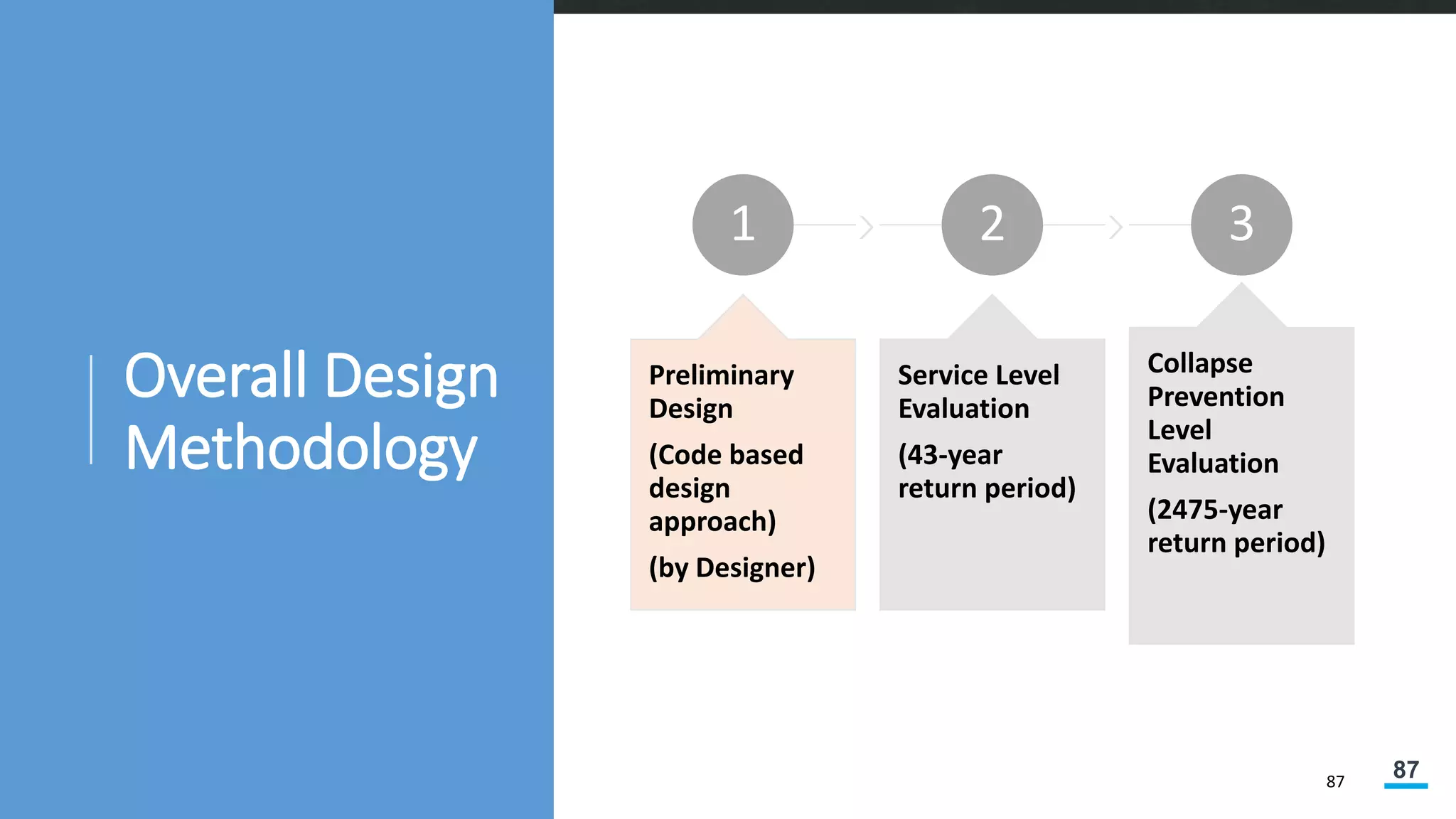
Overall Design
Methodology
87
1
Preliminary
Design
(Code based
design
approach)
(by Designer)
2
Service Level
Evaluation
(43-year
return period)
3
Collapse
Prevention
Level
Evaluation
(2475-year
return period)
88
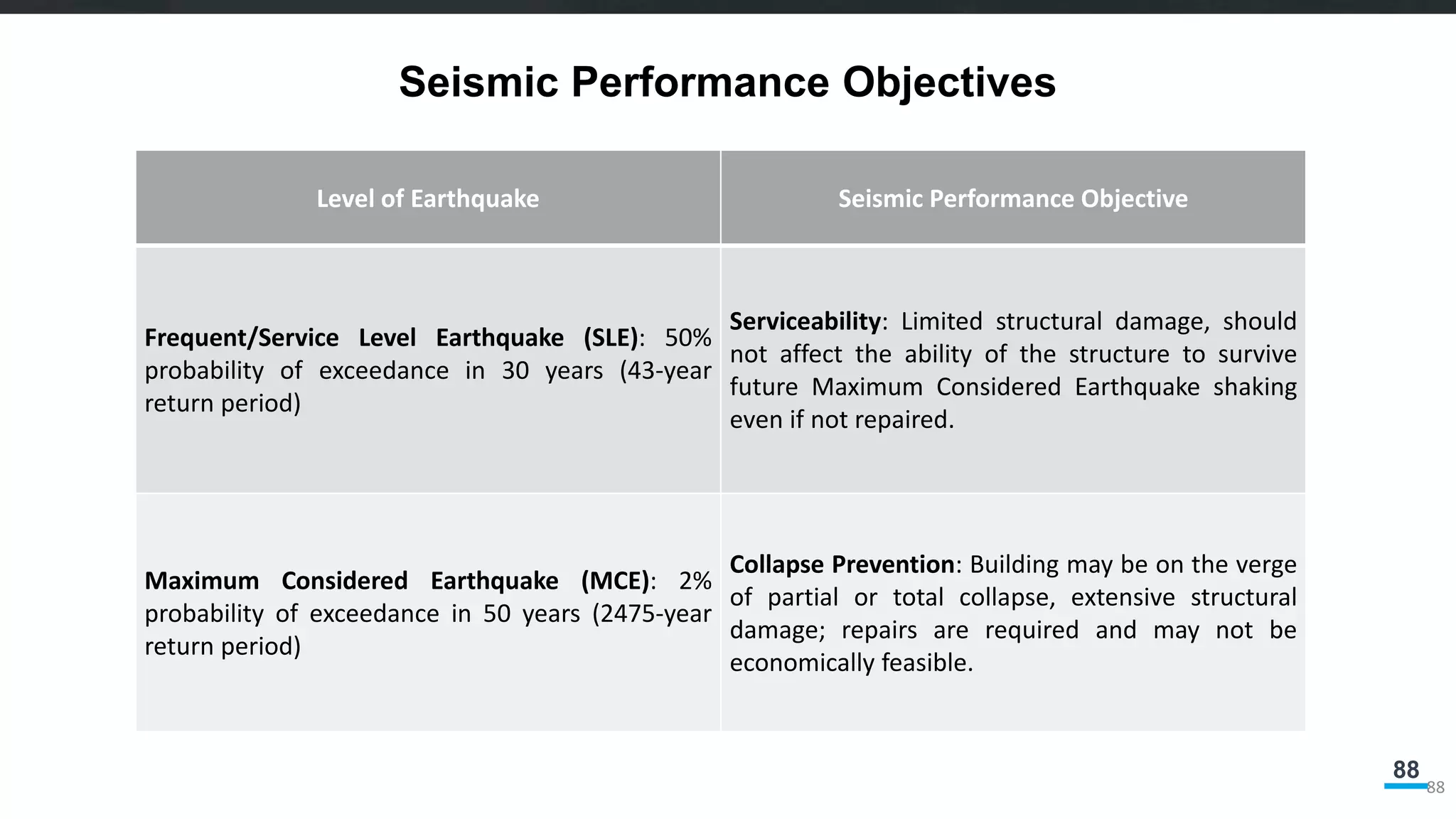
Seismic Performance Objectives
88
Level of Earthquake Seismic Performance Objective
Frequent/Service Level Earthquake (SLE): 50%
probability of exceedance in 30 years (43-year
return period)
Serviceability: Limited structural damage, should
not affect the ability of the structure to survive
future Maximum Considered Earthquake shaking
even if not repaired.
Maximum Considered Earthquake (MCE): 2%
probability of exceedance in 50 years (2475-year
return period)
Collapse Prevention: Building may be on the verge
of partial or total collapse, extensive structural
damage; repairs are required and may not be
economically feasible.
89
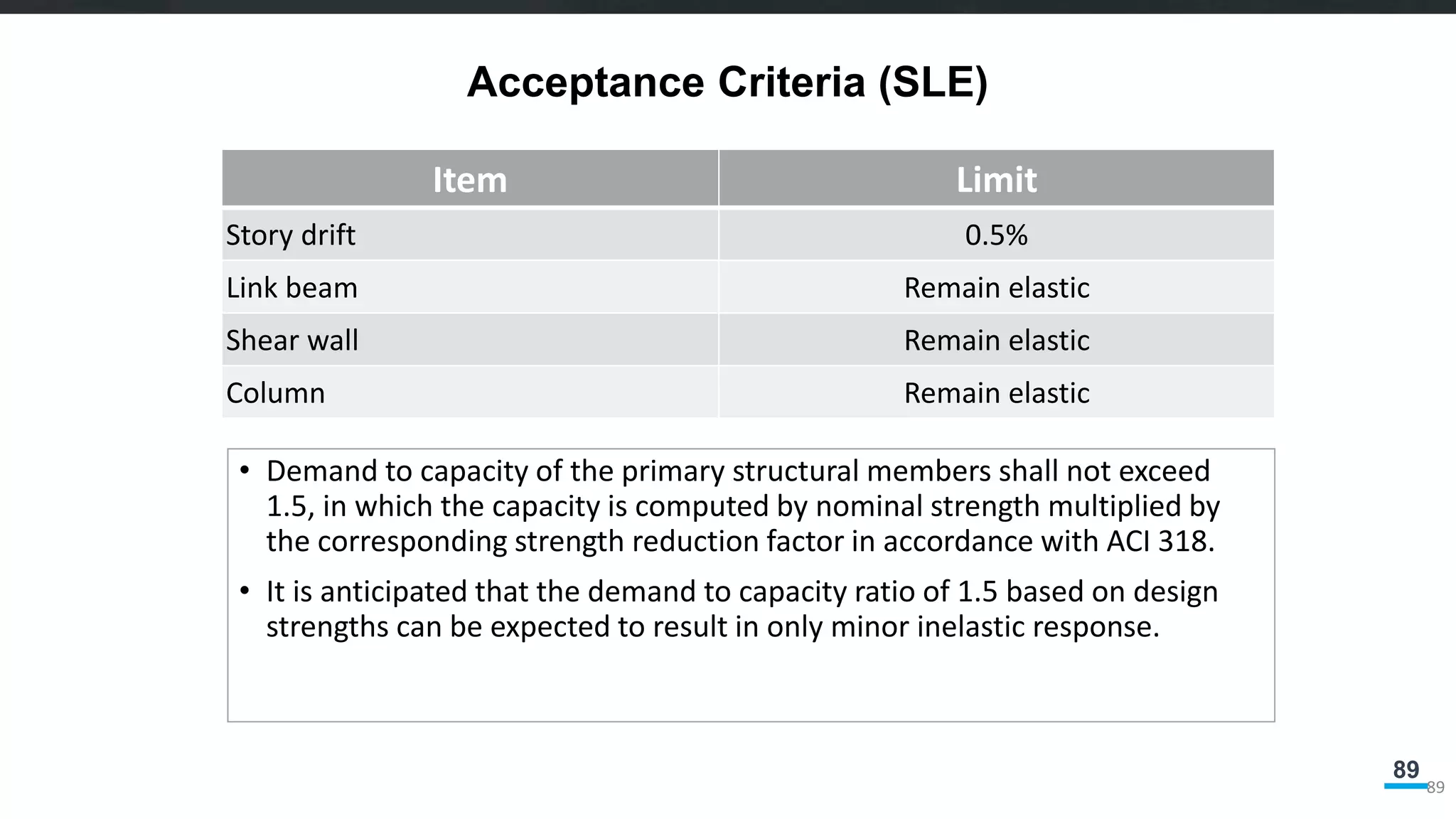
Acceptance Criteria (SLE)
89
Item Limit
Story drift 0.5%
Link beam Remain elastic
Shear wall Remain elastic
Column Remain elastic
• Demand to capacity of the primary structural members shall not exceed
1.5, in which the capacity is computed by nominal strength multiplied by
the corresponding strength reduction factor in accordance with ACI 318.
• It is anticipated that the demand to capacity ratio of 1.5 based on design
strengths can be expected to result in only minor inelastic response.
90
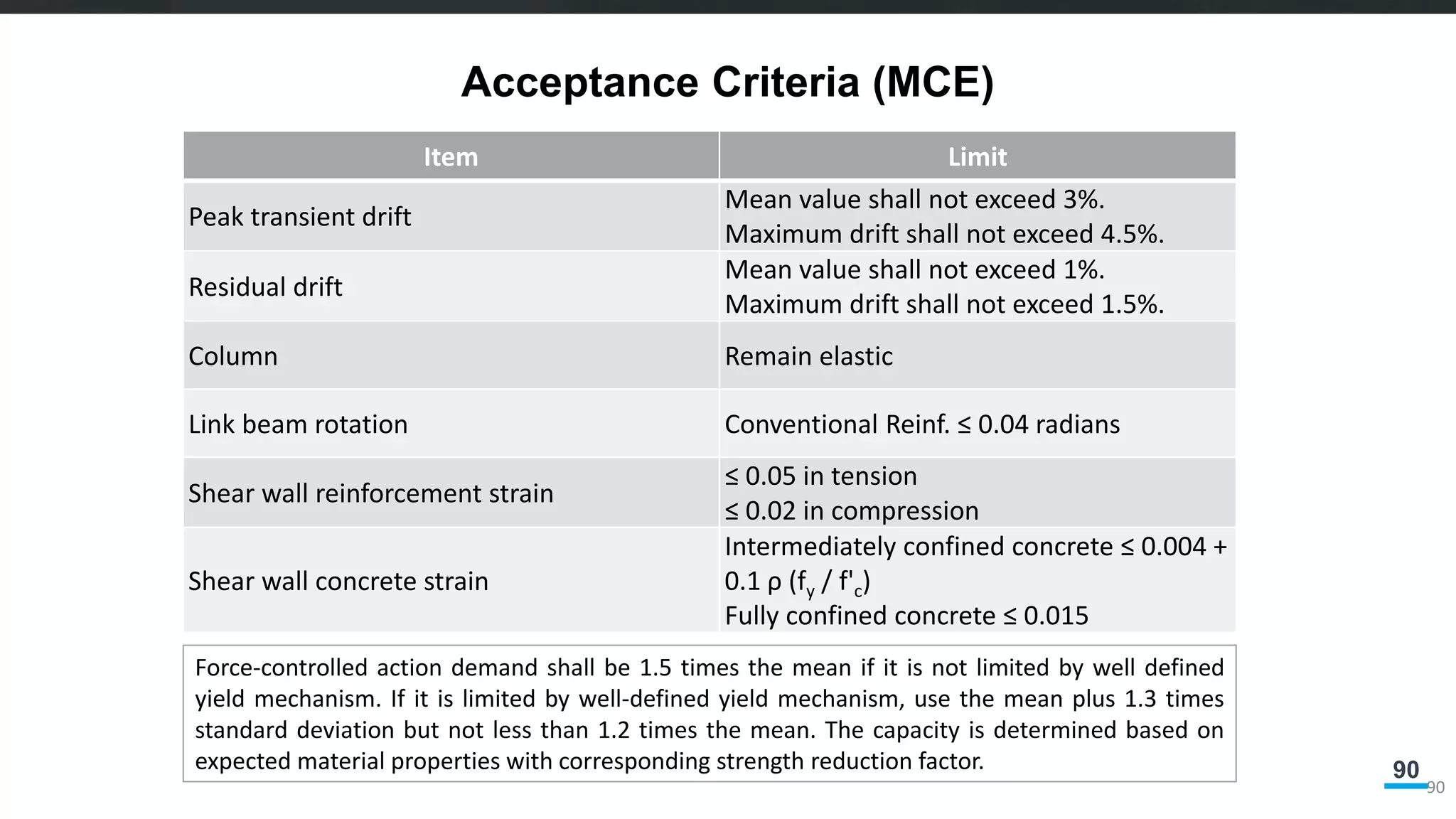
Acceptance Criteria (MCE)
90
Item Limit
Peak transient drift
Mean value shall not exceed 3%.
Maximum drift shall not exceed 4.5%.
Residual drift
Mean value shall not exceed 1%.
Maximum drift shall not exceed 1.5%.
Column Remain elastic
Link beam rotation Conventional Reinf. ≤ 0.04 radians
Shear wall reinforcement strain
≤ 0.05 in tension
≤ 0.02 in compression
Shear wall concrete strain
Intermediately confined concrete ≤ 0.004 +
0.1 ρ (fy / f'c)
Fully confined concrete ≤ 0.015
Force-controlled action demand shall be 1.5 times the mean if it is not limited by well defined
yield mechanism. If it is limited by well-defined yield mechanism, use the mean plus 1.3 times
standard deviation but not less than 1.2 times the mean. The capacity is determined based on
expected material properties with corresponding strength reduction factor.
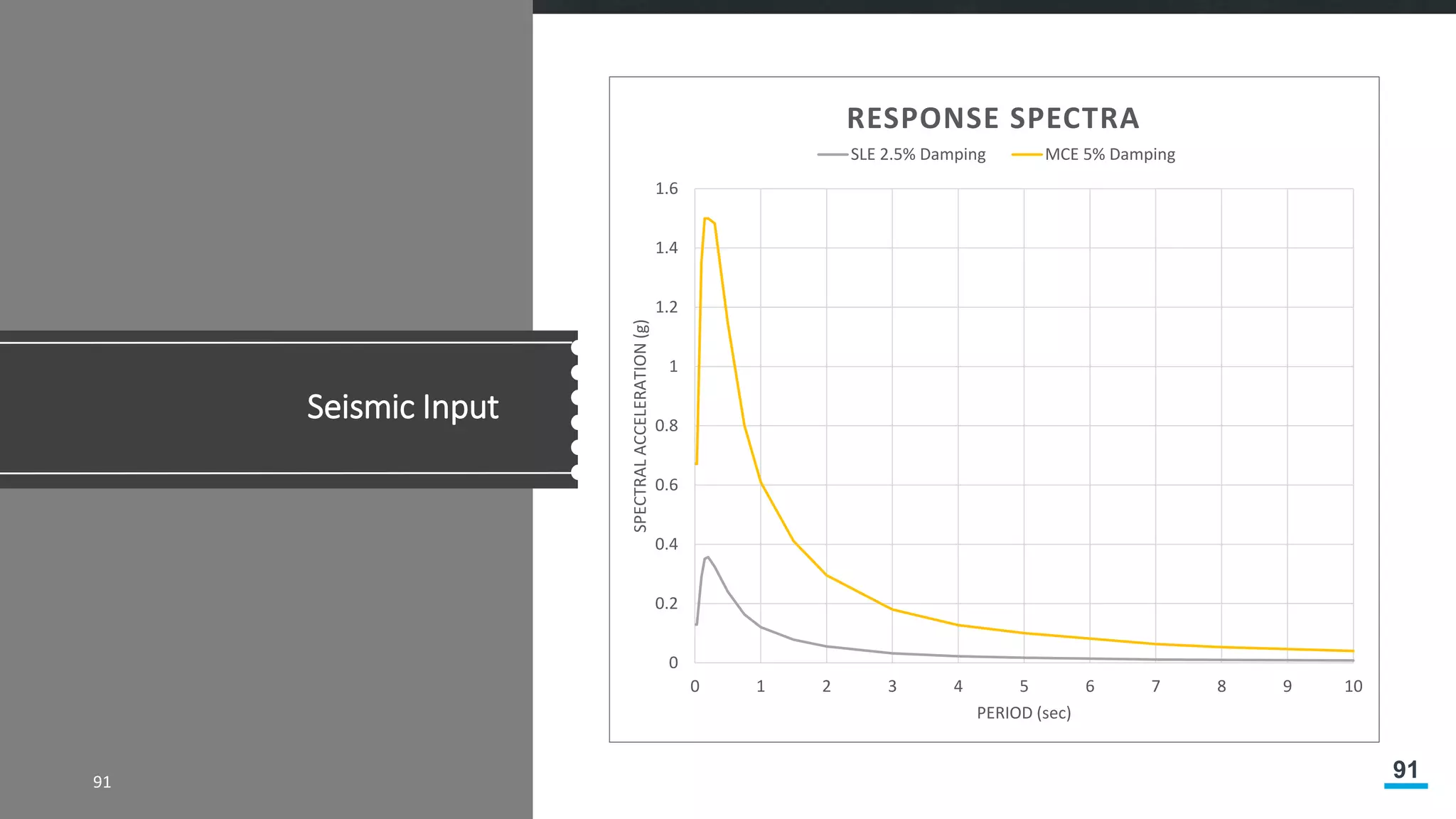
91
Seismic Input
91
0
0.2
0.4
0.6
0.8
1
1.2
1.4
1.6
0 1 2 3 4 5 6 7 8 9 10
SPECTRALACCELERATION(g)
PERIOD (sec)
RESPONSE SPECTRA
SLE 2.5% Damping MCE 5% Damping
92
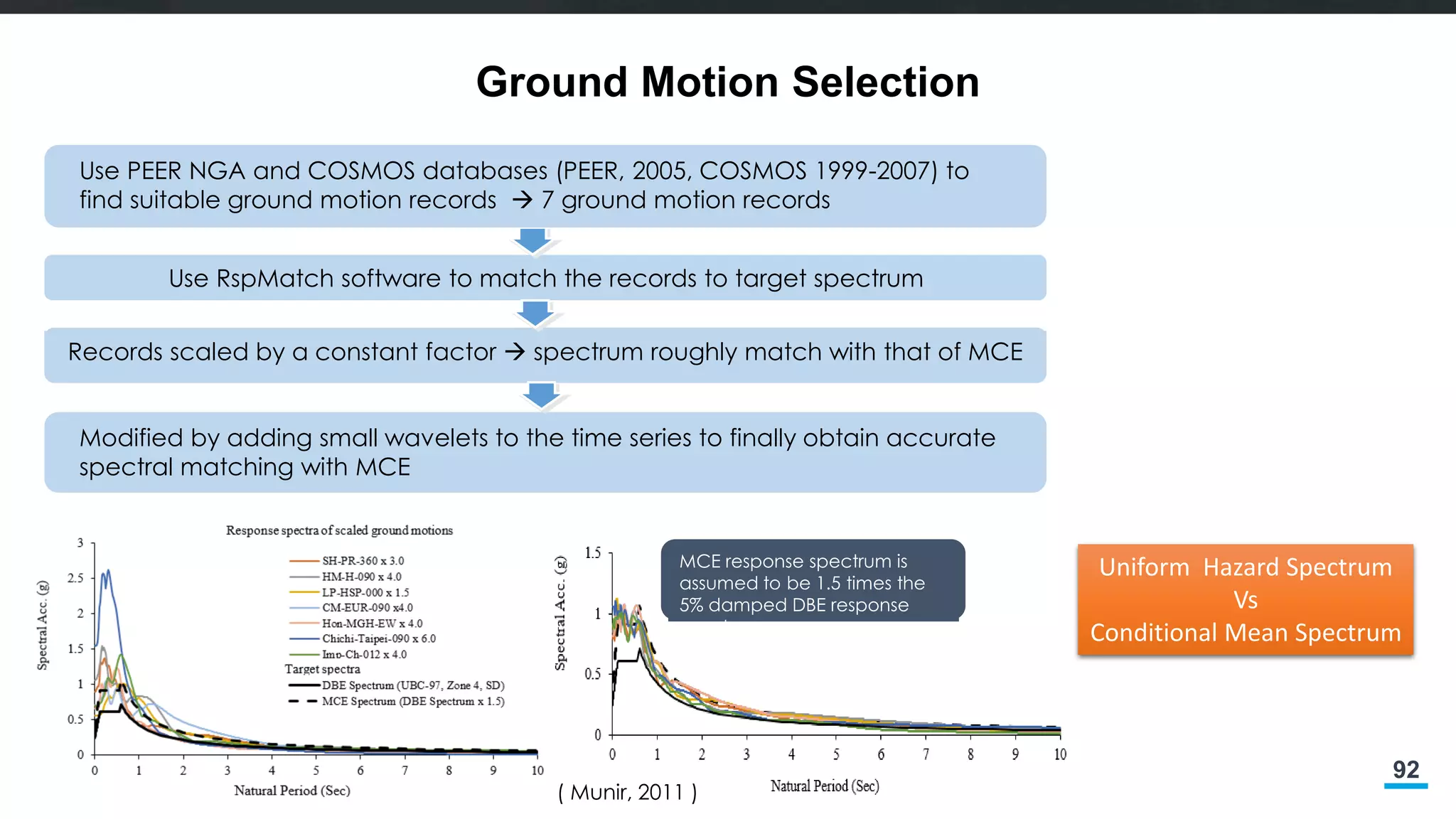
Ground Motion Selection
Modified by adding small wavelets to the time series to finally obtain accurate
spectral matching with MCE
( Munir, 2011 )
Use RspMatch software to match the records to target spectrum
Use PEER NGA and COSMOS databases (PEER, 2005, COSMOS 1999-2007) to
find suitable ground motion records  7 ground motion records
Records scaled by a constant factor  spectrum roughly match with that of MCE
MCE response spectrum is
assumed to be 1.5 times the
5% damped DBE response
spectrum.
Uniform Hazard Spectrum
Vs
Conditional Mean Spectrum
93
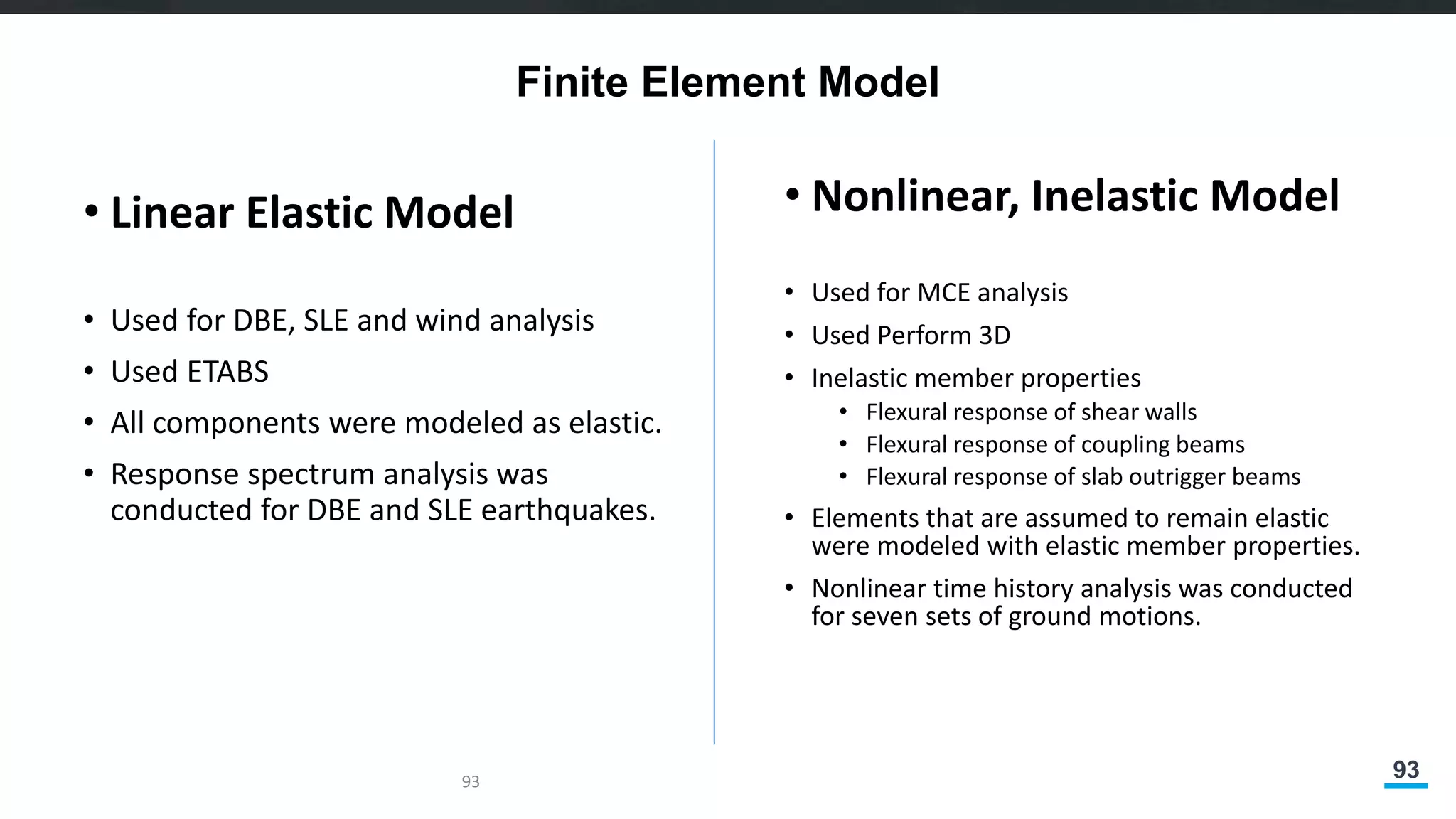
Finite Element Model
• Linear Elastic Model
• Used for DBE, SLE and wind analysis
• Used ETABS
• All components were modeled as elastic.
• Response spectrum analysis was
conducted for DBE and SLE earthquakes.
• Nonlinear, Inelastic Model
• Used for MCE analysis
• Used Perform 3D
• Inelastic member properties
• Flexural response of shear walls
• Flexural response of coupling beams
• Flexural response of slab outrigger beams
• Elements that are assumed to remain elastic
were modeled with elastic member properties.
• Nonlinear time history analysis was conducted
for seven sets of ground motions.
93
94
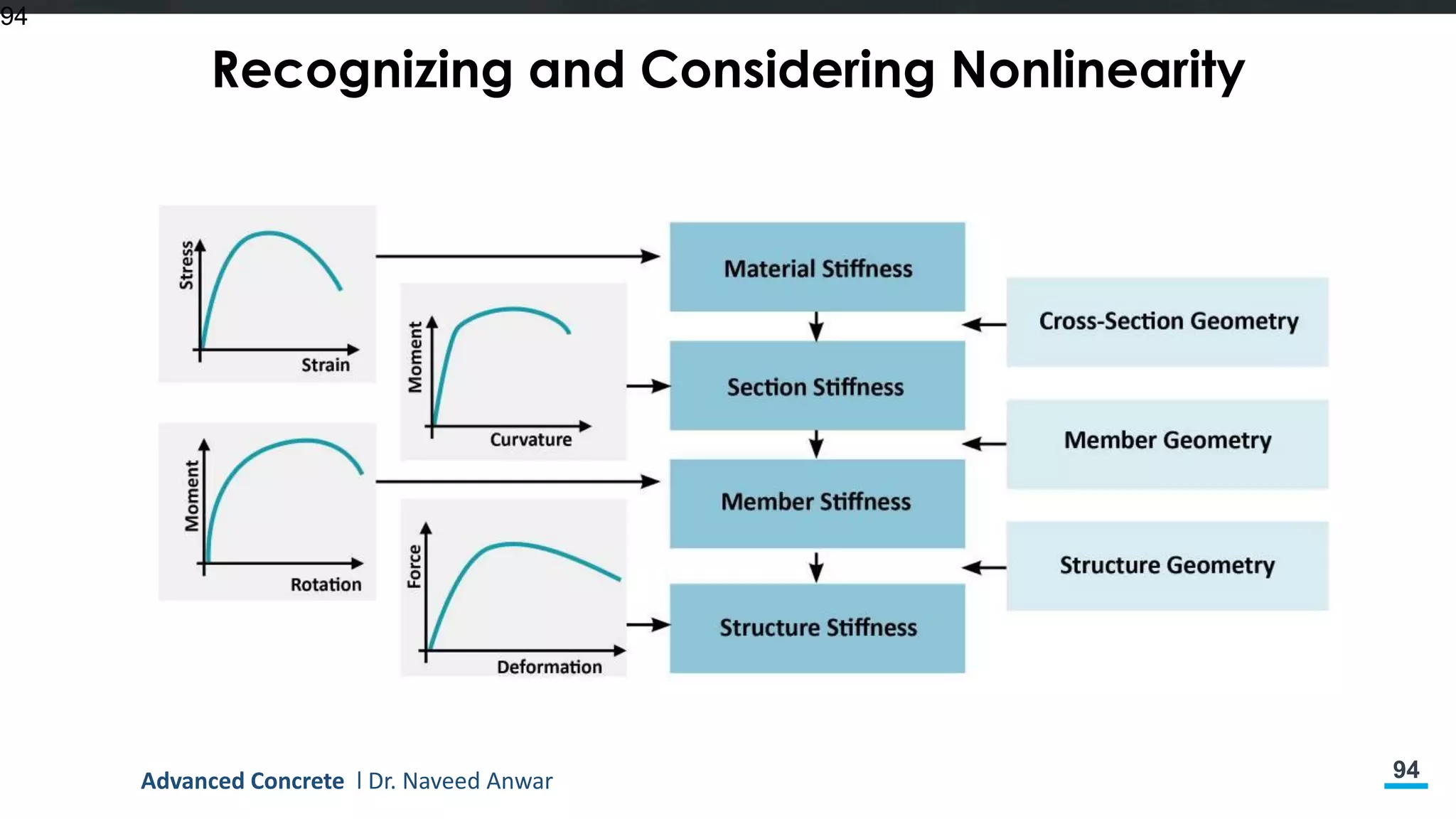
Recognizing and Considering Nonlinearity
94
Advanced Concrete l Dr. Naveed Anwar
95
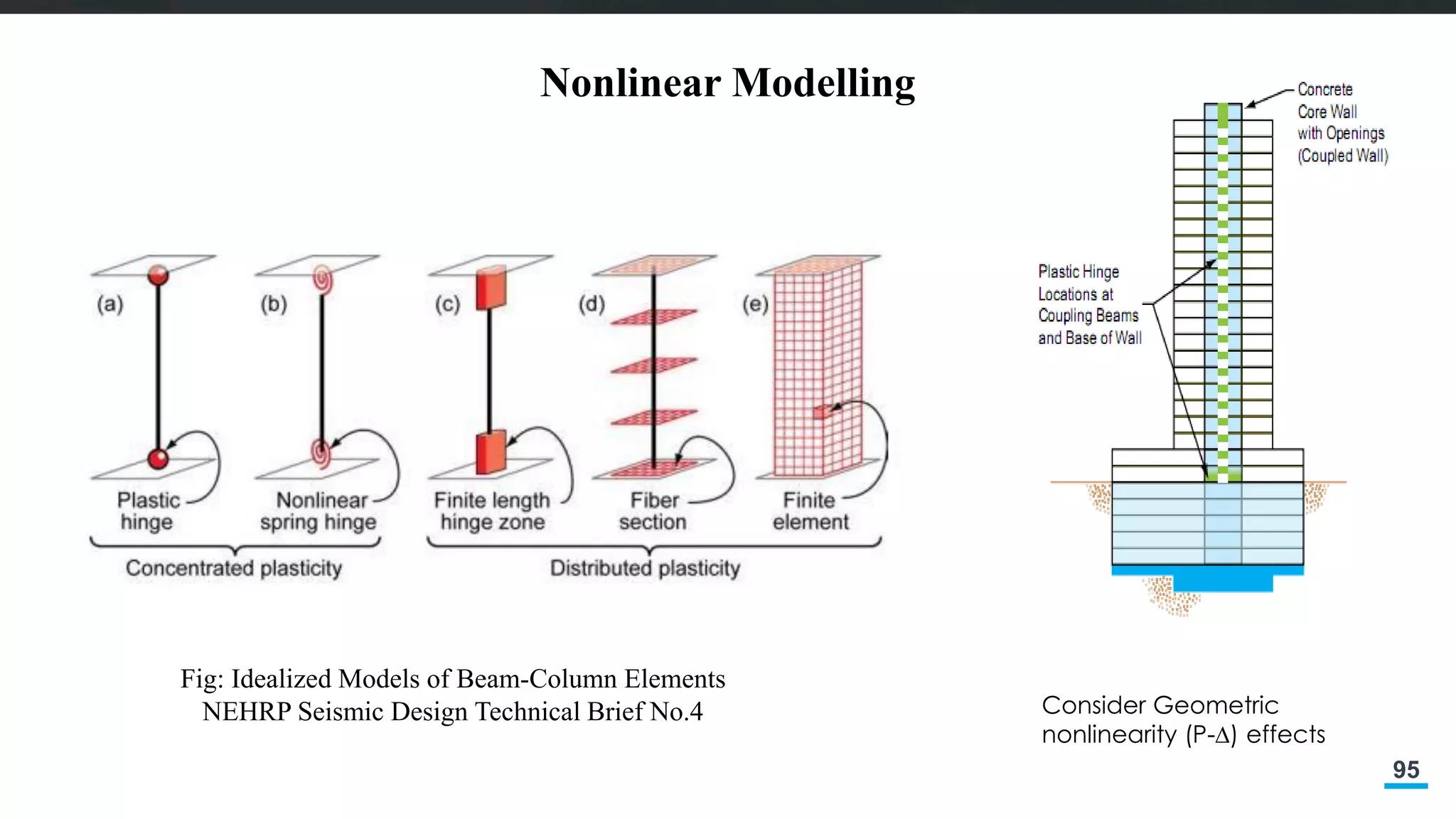
Nonlinear Modelling
Fig: Idealized Models of Beam-Column Elements
NEHRP Seismic Design Technical Brief No.4 Consider Geometric
nonlinearity (P-∆) effects
96
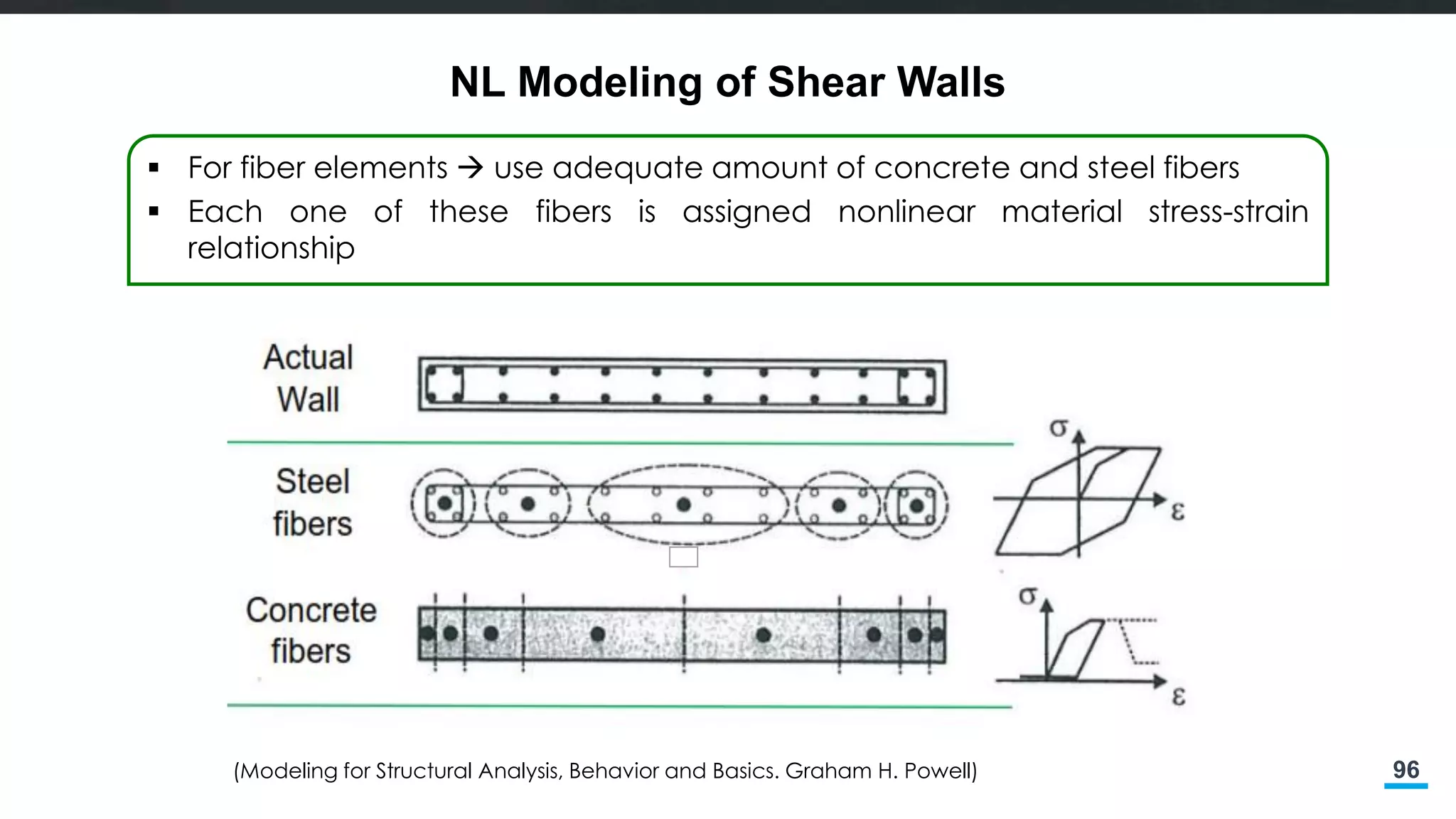
NL Modeling of Shear Walls
 For fiber elements  use adequate amount of concrete and steel fibers
 Each one of these fibers is assigned nonlinear material stress-strain
relationship
(Modeling for Structural Analysis, Behavior and Basics. Graham H. Powell)
97
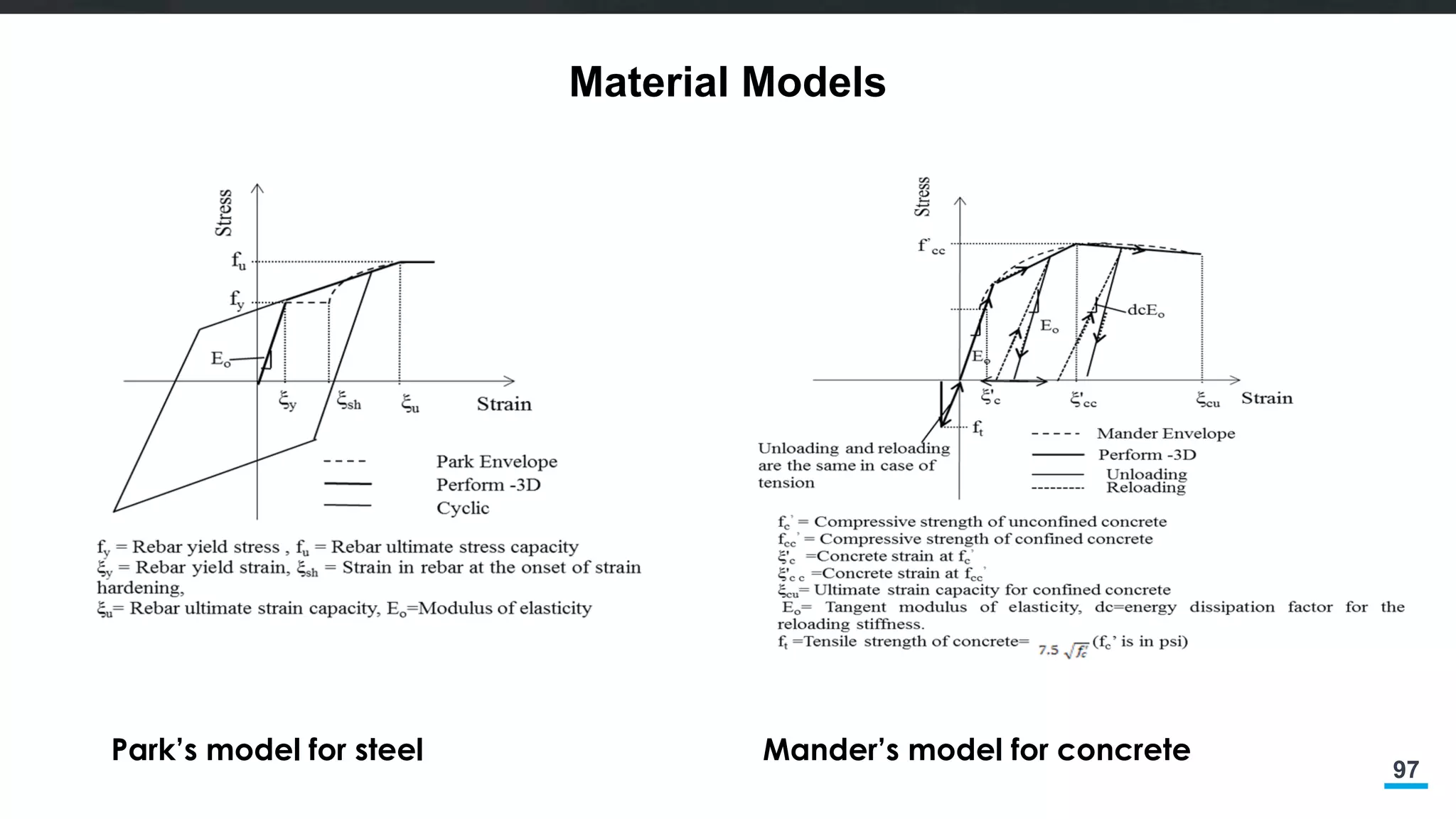
Material Models
Mander’s model for concretePark’s model for steel
99
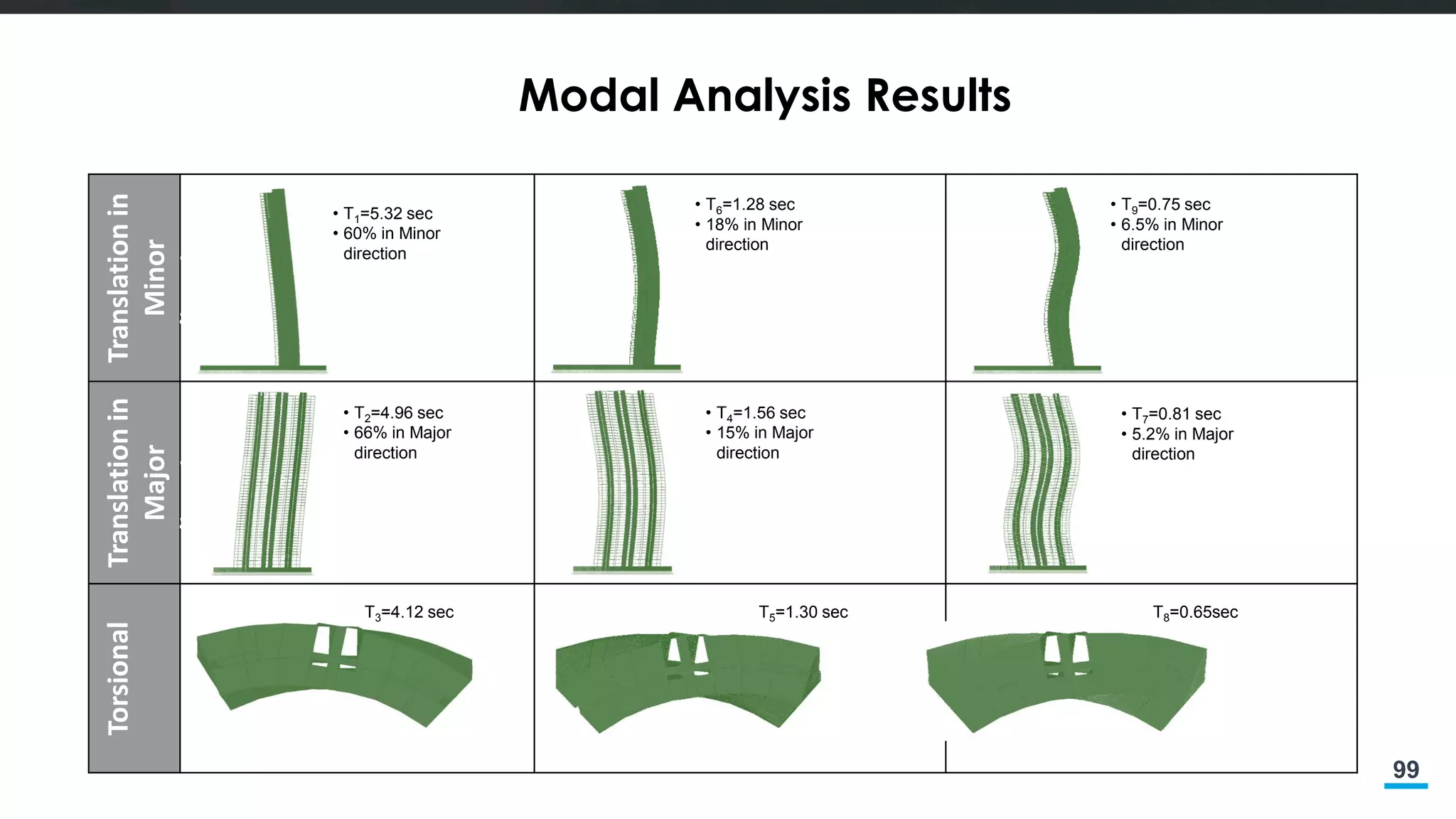
Modal Analysis ResultsTranslationin
Minor
direction
Translationin
Major
direction
Torsional
• T1=5.32 sec
• 60% in Minor
direction
• T6=1.28 sec
• 18% in Minor
direction
• T9=0.75 sec
• 6.5% in Minor
direction
• T2=4.96 sec
• 66% in Major
direction
• T7=0.81 sec
• 5.2% in Major
direction
• T4=1.56 sec
• 15% in Major
direction
T3=4.12 sec T8=0.65secT5=1.30 sec
100
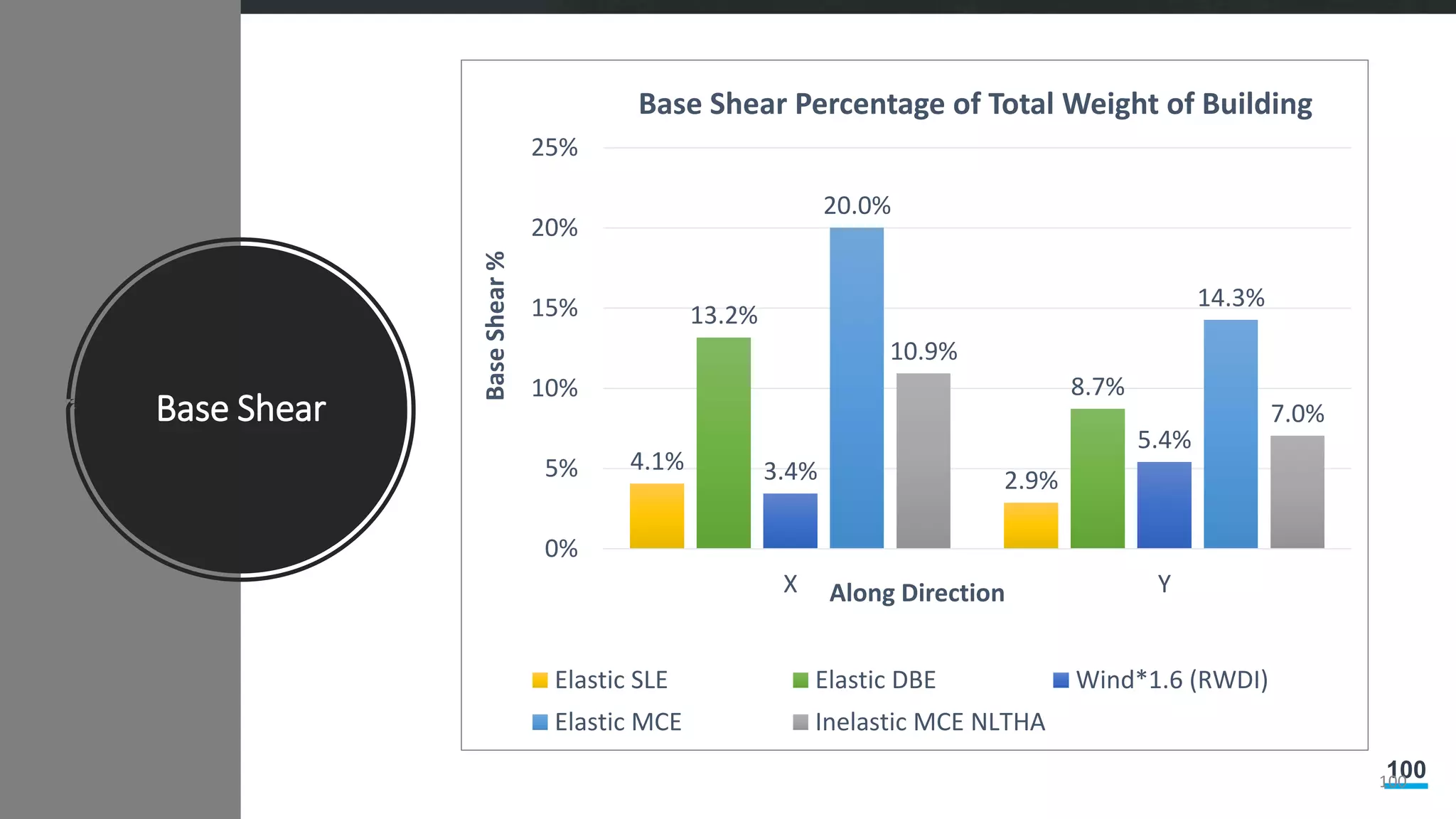
Base Shear
100
4.1%
2.9%
13.2%
8.7%
3.4%
5.4%
20.0%
14.3%
10.9%
7.0%
0%
5%
10%
15%
20%
25%
X Y
BaseShear%
Along Direction
Base Shear Percentage of Total Weight of Building
Elastic SLE Elastic DBE Wind*1.6 (RWDI)
Elastic MCE Inelastic MCE NLTHA
101
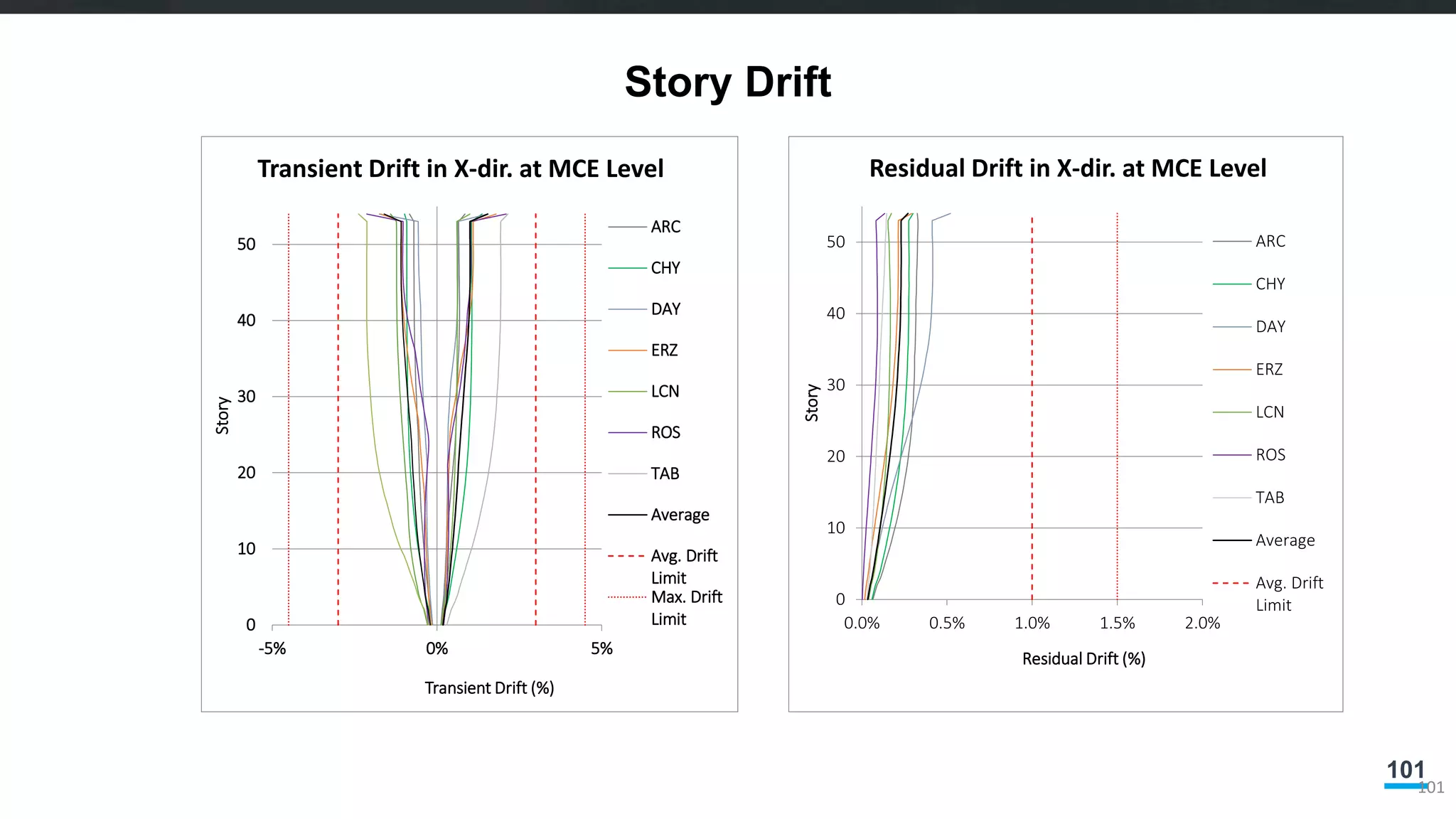
Story Drift
101
0
10
20
30
40
50
-5% 0% 5%
Story
Transient Drift (%)
Transient Drift in X-dir. at MCE Level
ARC
CHY
DAY
ERZ
LCN
ROS
TAB
Average
Avg. Drift
Limit
Max. Drift
Limit
0
10
20
30
40
50
0.0% 0.5% 1.0% 1.5% 2.0%
Story
Residual Drift (%)
Residual Drift in X-dir. at MCE Level
ARC
CHY
DAY
ERZ
LCN
ROS
TAB
Average
Avg. Drift
Limit
102
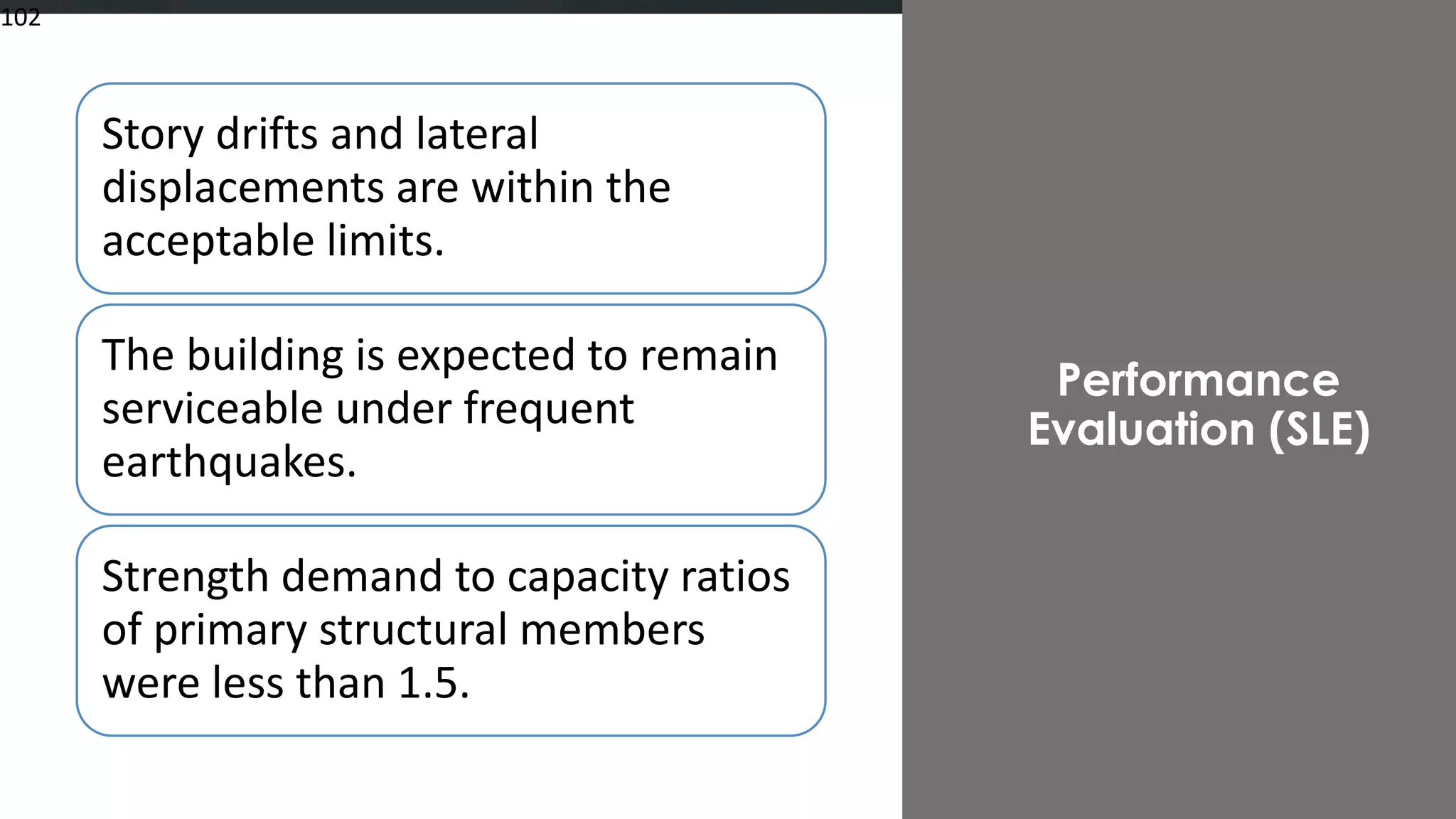
Story drifts and lateral
displacements are within the
acceptable limits.
The building is expected to remain
serviceable under frequent
earthquakes.
Strength demand to capacity ratios
of primary structural members
were less than 1.5.
Performance
Evaluation (SLE)
102
104
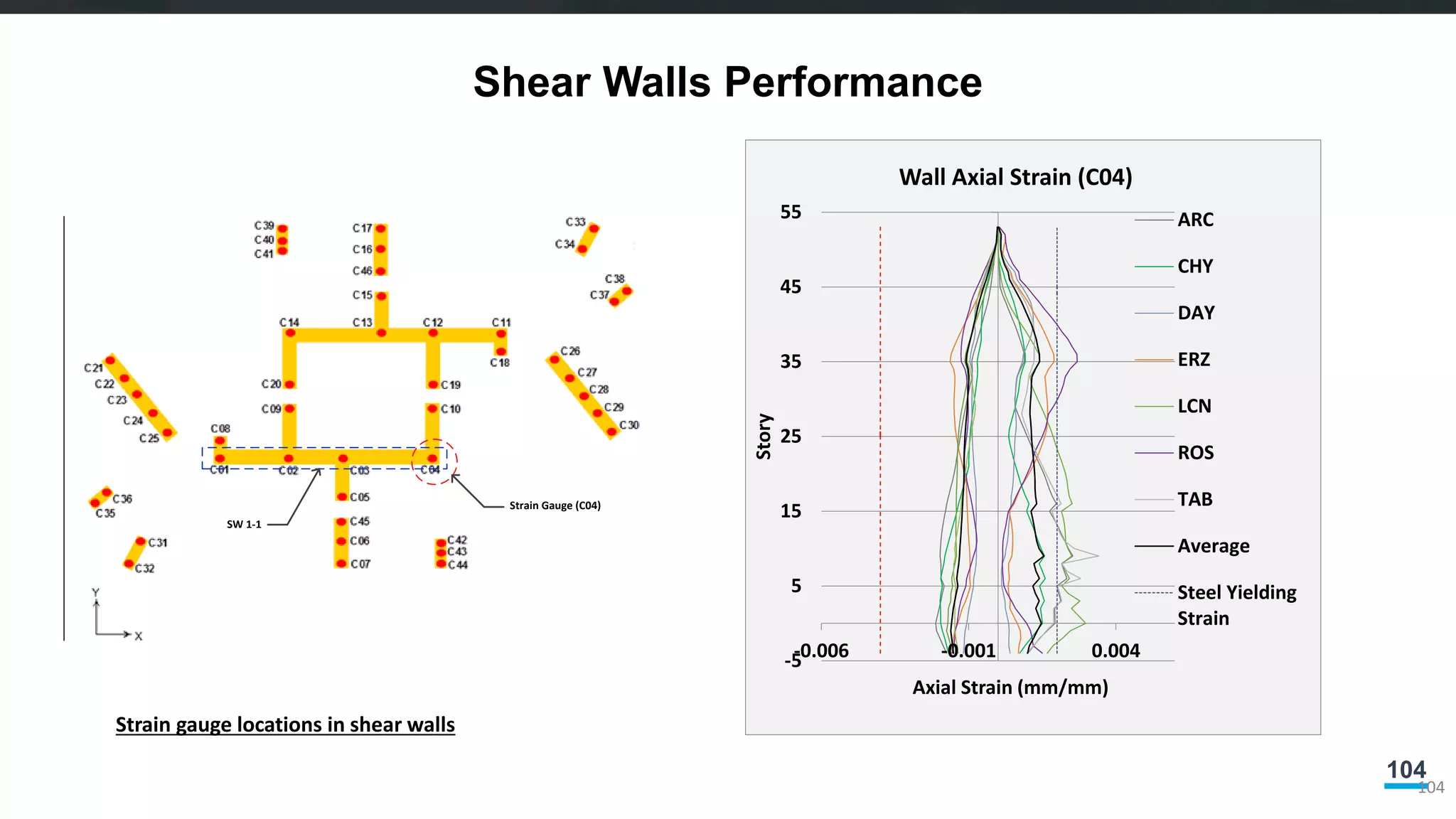
Shear Walls Performance
104
Strain Gauge (C04)
SW 1-1
-5
5
15
25
35
45
55
-0.006 -0.001 0.004
Story
Axial Strain (mm/mm)
Wall Axial Strain (C04)
ARC
CHY
DAY
ERZ
LCN
ROS
TAB
Average
Steel Yielding
Strain
Strain gauge locations in shear walls
105
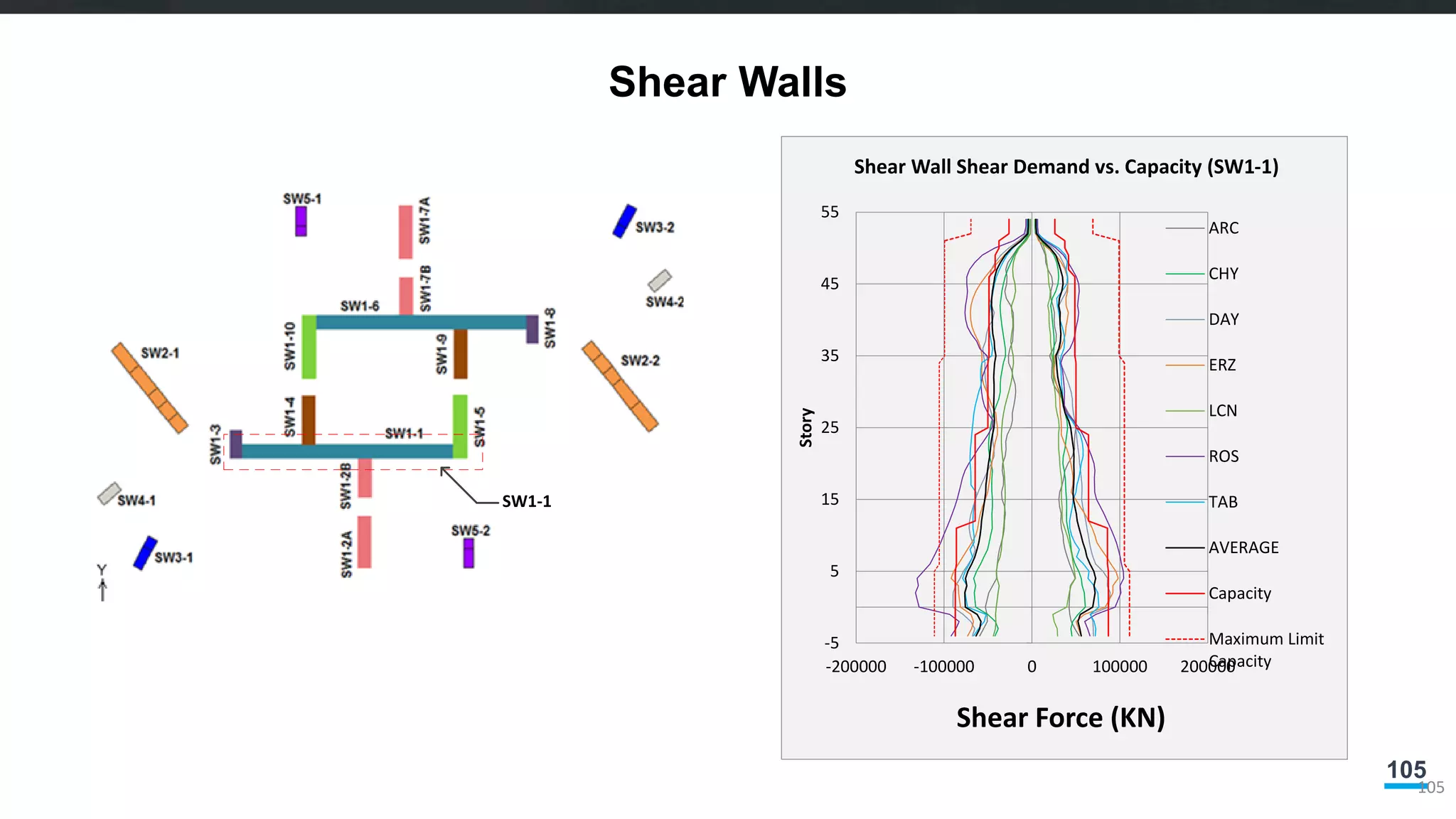
Shear Walls
105
-5
5
15
25
35
45
55
-200000 -100000 0 100000 200000
Story
Shear Force (KN)
Shear Wall Shear Demand vs. Capacity (SW1-1)
ARC
CHY
DAY
ERZ
LCN
ROS
TAB
AVERAGE
Capacity
Maximum Limit
Capacity
SW1-1
106
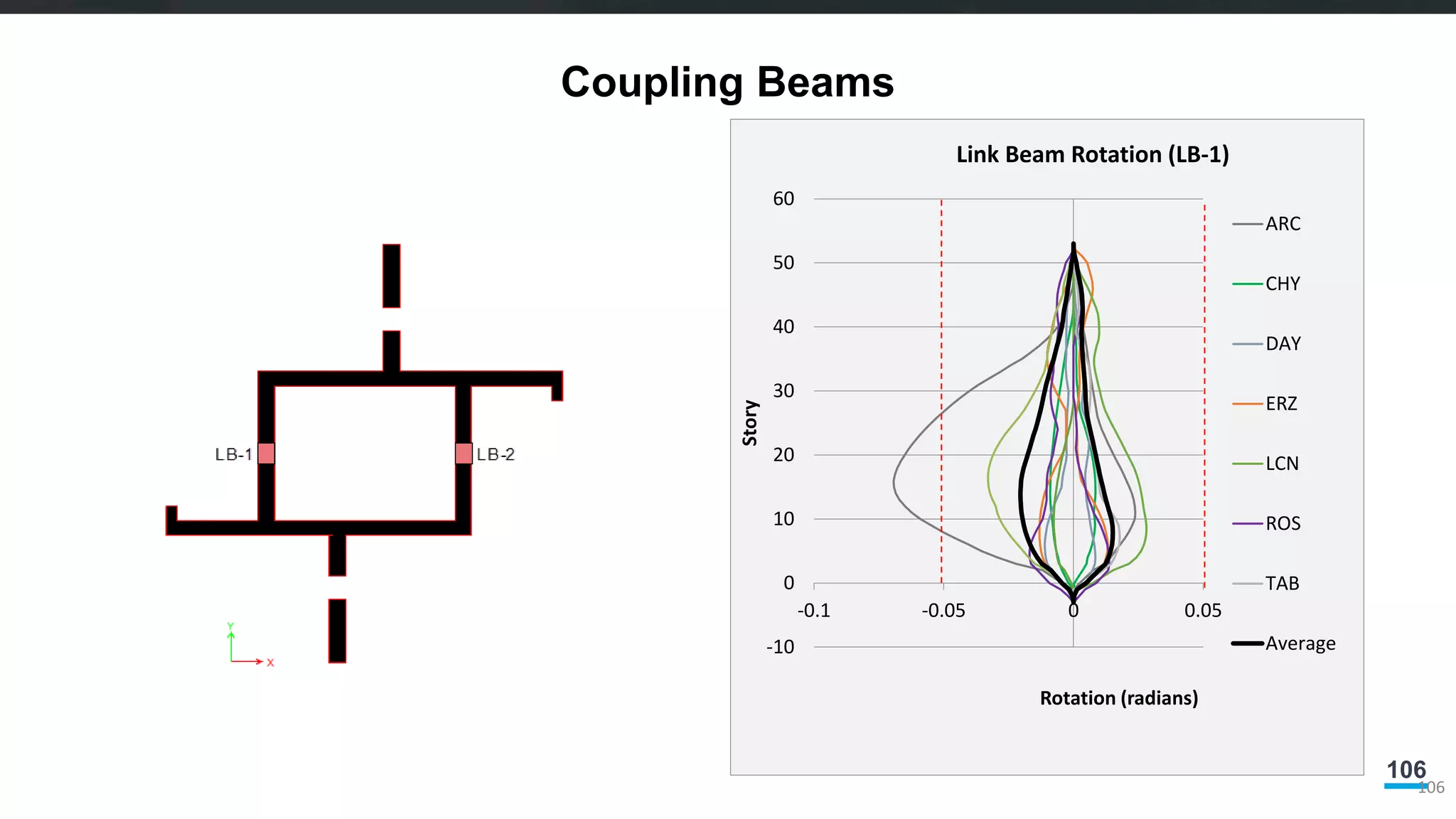
Coupling Beams
106
-10
0
10
20
30
40
50
60
-0.1 -0.05 0 0.05
Story
Rotation (radians)
Link Beam Rotation (LB-1)
ARC
CHY
DAY
ERZ
LCN
ROS
TAB
Average
107
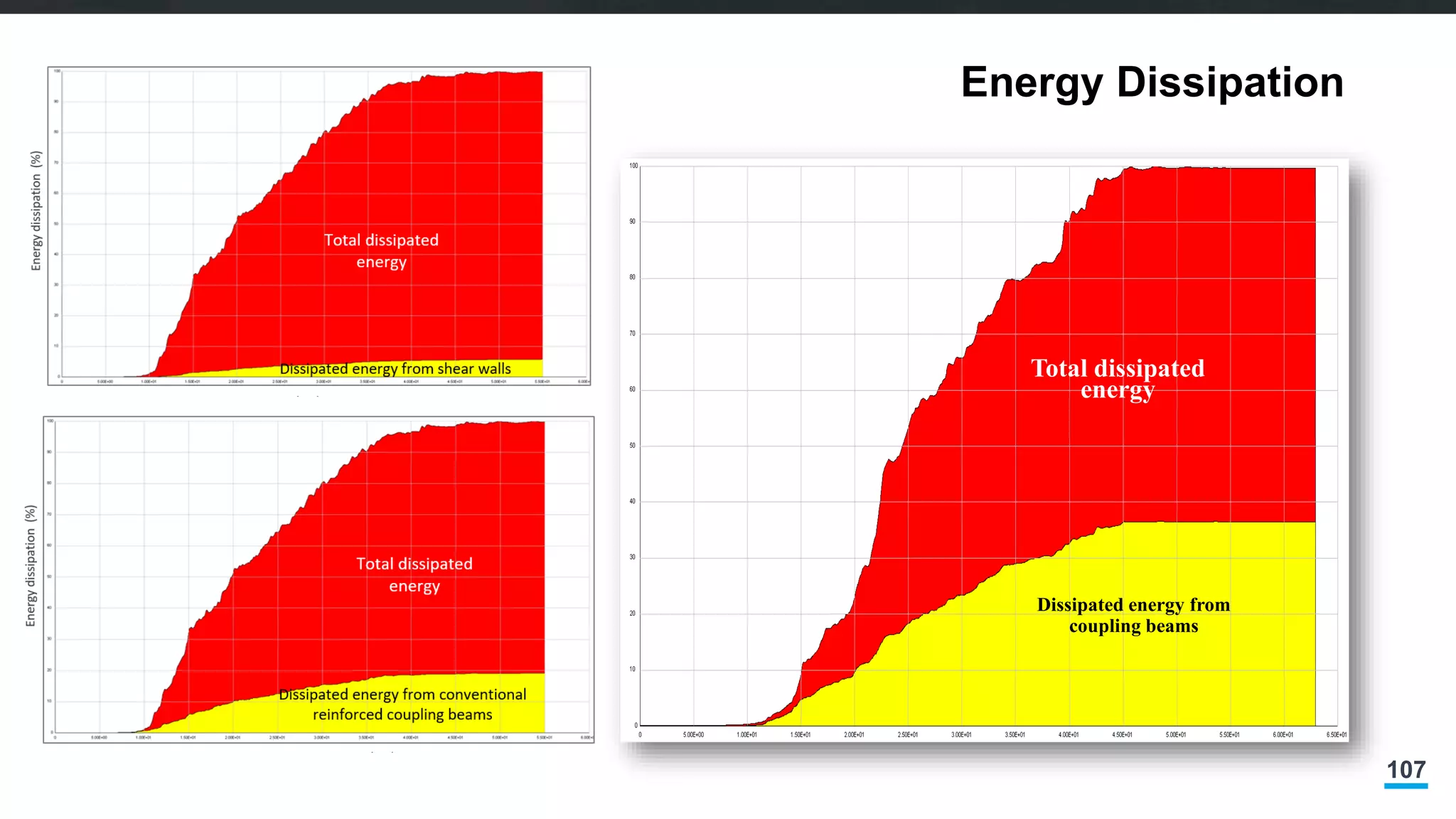
Energy Dissipation
Total dissipated
energy
Dissipated energy from
coupling beams
108
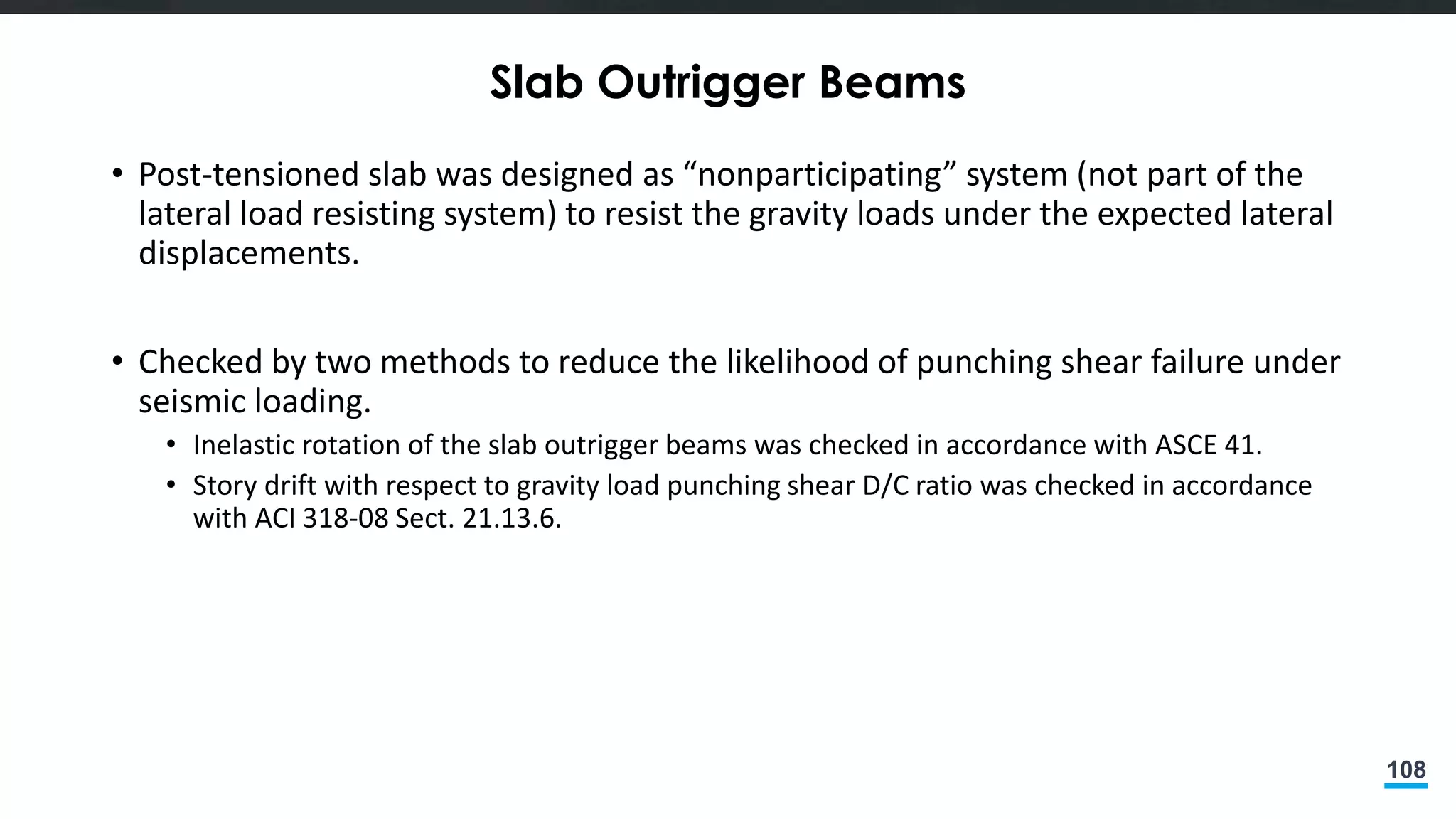
Slab Outrigger Beams
• Post-tensioned slab was designed as “nonparticipating” system (not part of the
lateral load resisting system) to resist the gravity loads under the expected lateral
displacements.
• Checked by two methods to reduce the likelihood of punching shear failure under
seismic loading.
• Inelastic rotation of the slab outrigger beams was checked in accordance with ASCE 41.
• Story drift with respect to gravity load punching shear D/C ratio was checked in accordance
with ACI 318-08 Sect. 21.13.6.
109
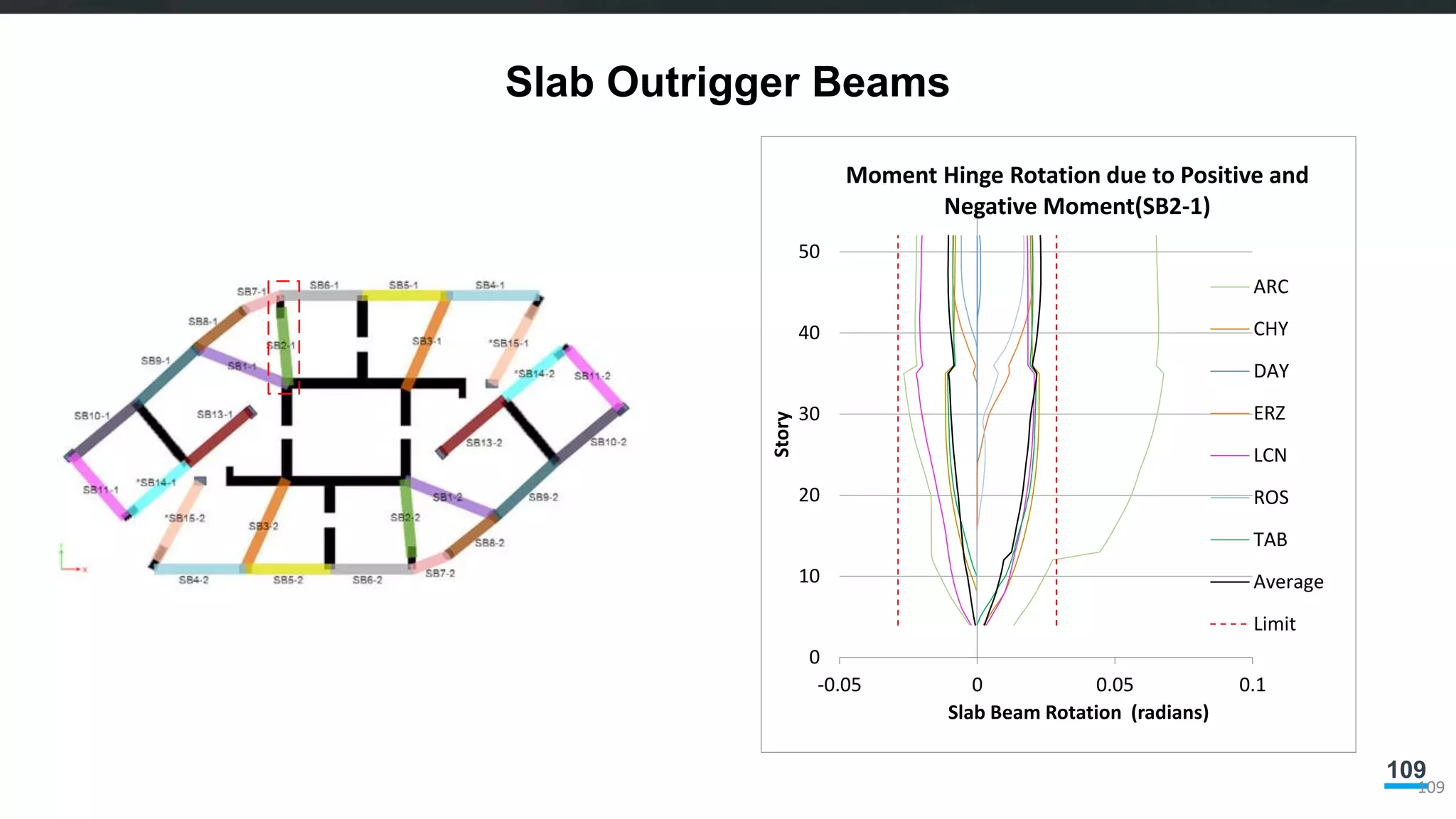
Slab Outrigger Beams
109
0
10
20
30
40
50
-0.05 0 0.05 0.1
Story
Slab Beam Rotation (radians)
Moment Hinge Rotation due to Positive and
Negative Moment(SB2-1)
ARC
CHY
DAY
ERZ
LCN
ROS
TAB
Average
Limit
110
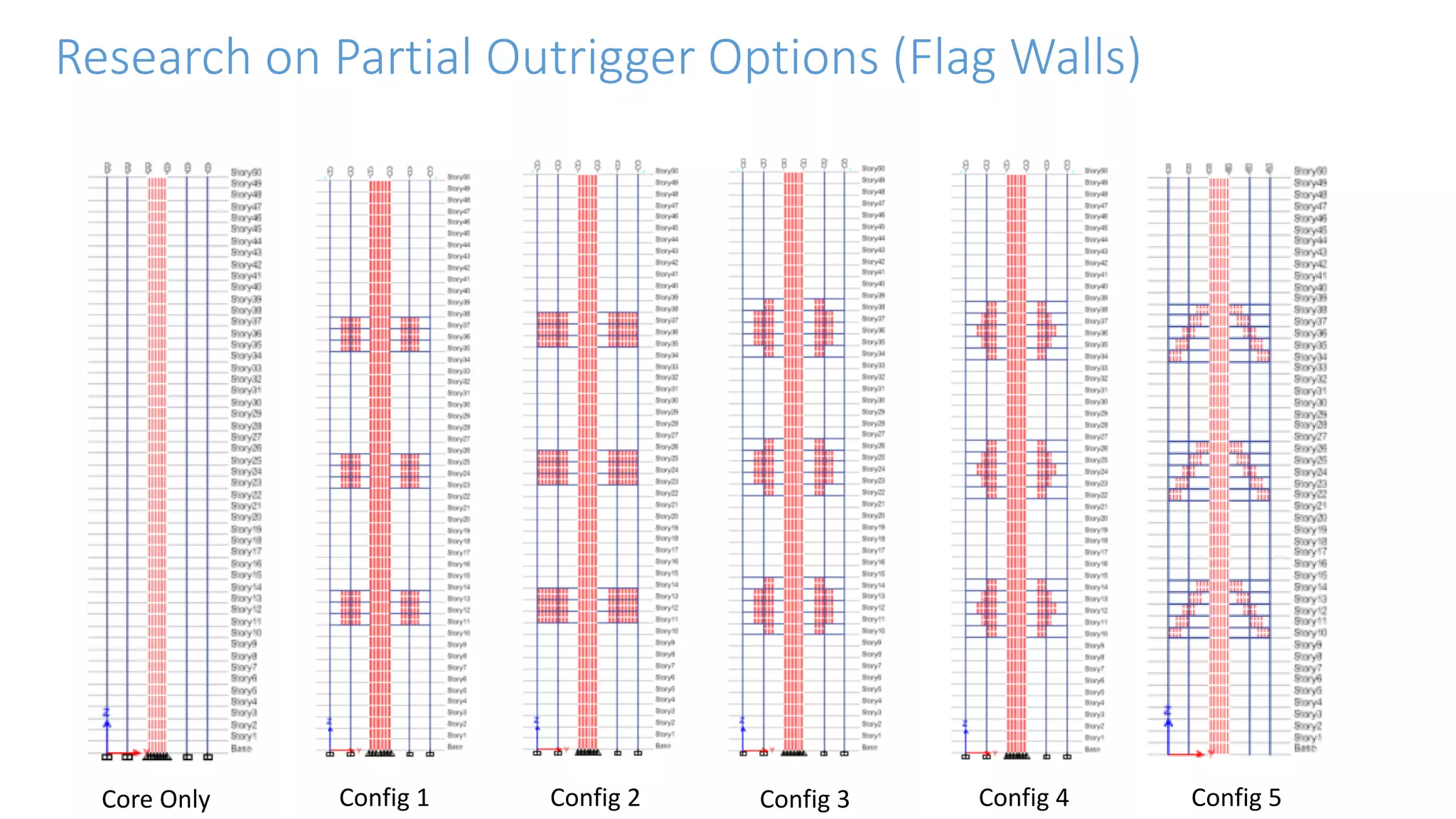
Core Only Config 1 Config 2 Config 3 Config 4 Config 5
Research on Partial Outrigger Options (Flag Walls)
111
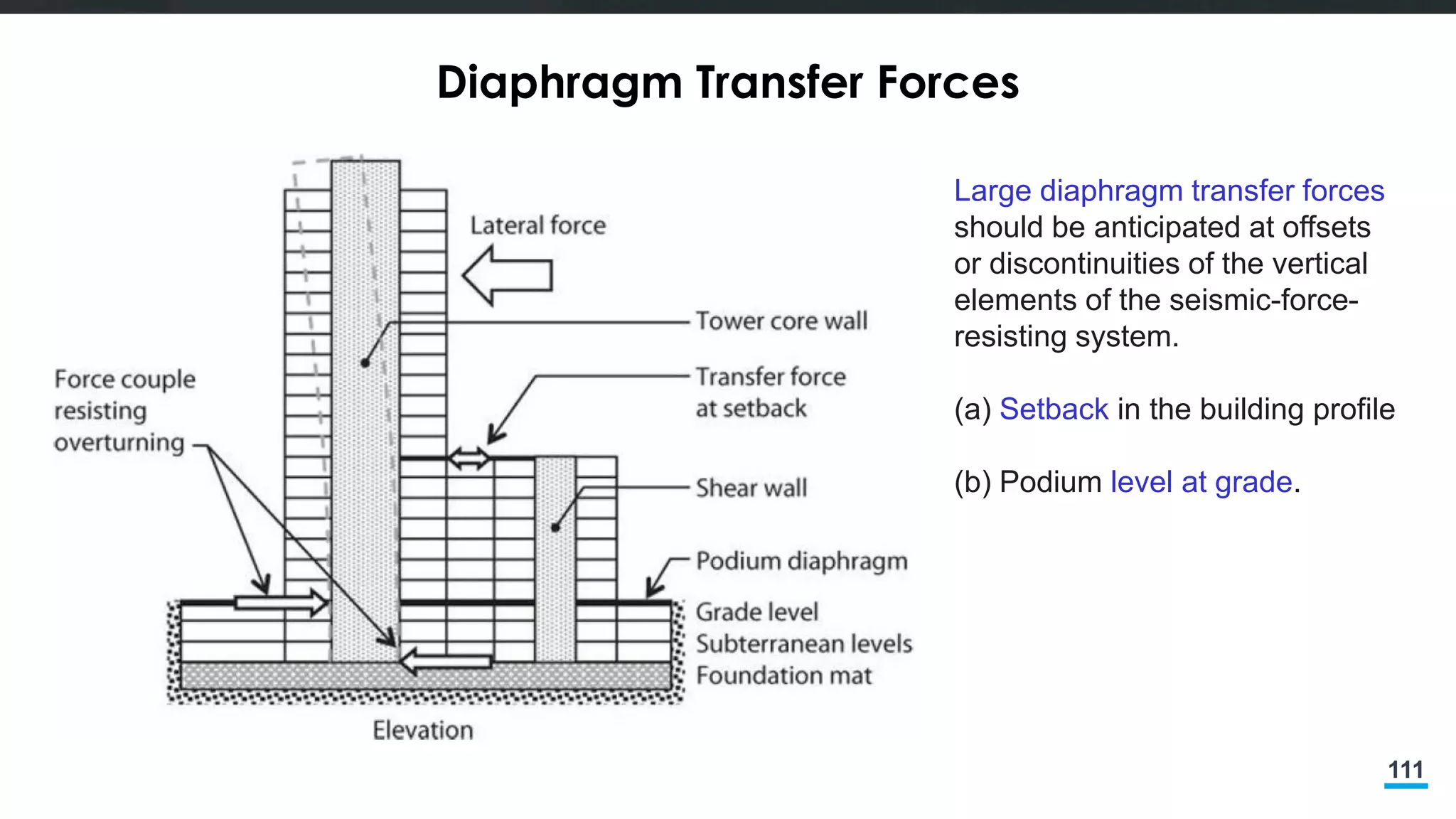
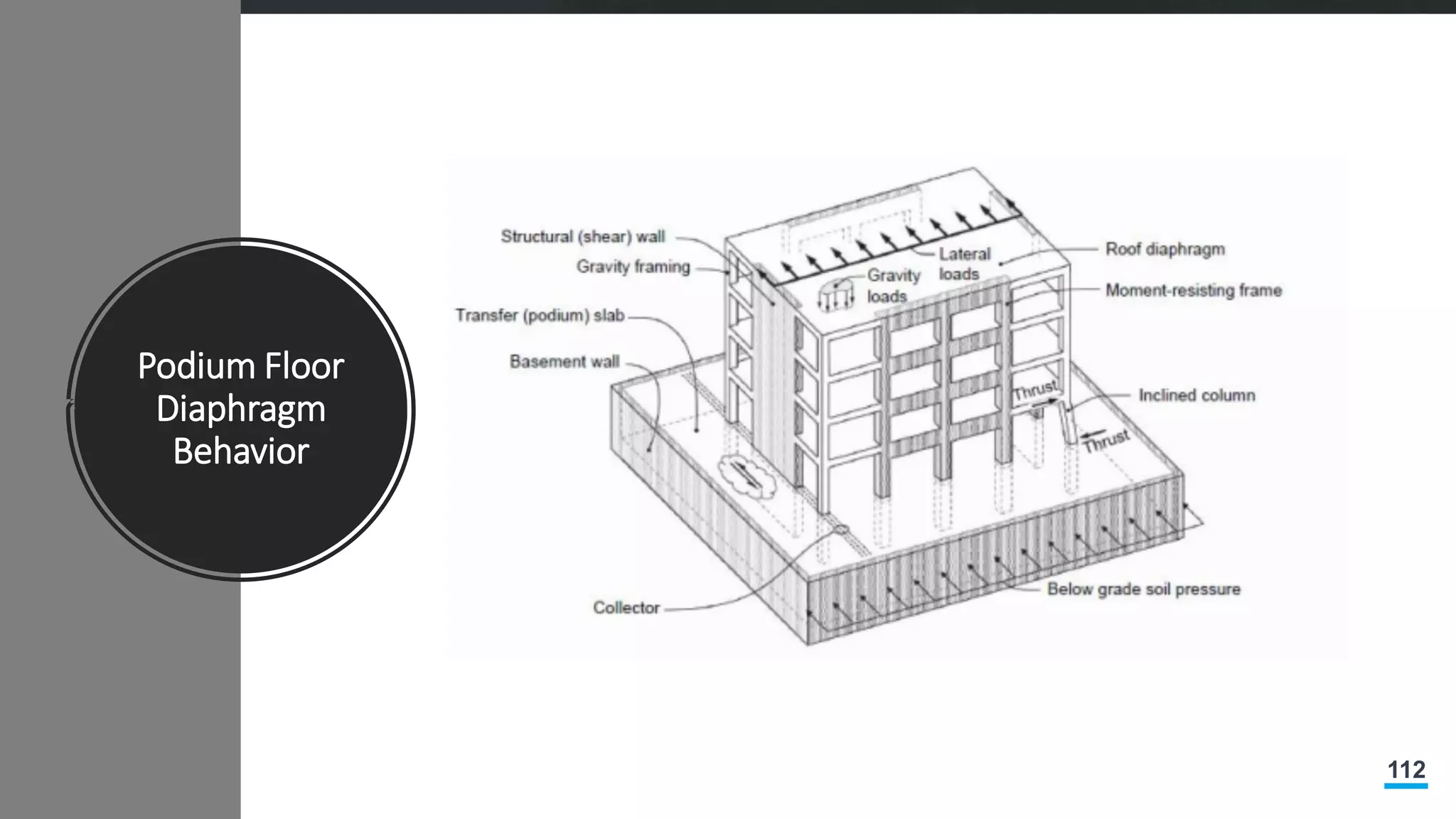
Diaphragm Transfer Forces
Large diaphragm transfer forces
should be anticipated at offsets
or discontinuities of the vertical
elements of the seismic-force-
resisting system.
(a) Setback in the building profile
(b) Podium level at grade.
112
Podium Floor
Diaphragm
Behavior
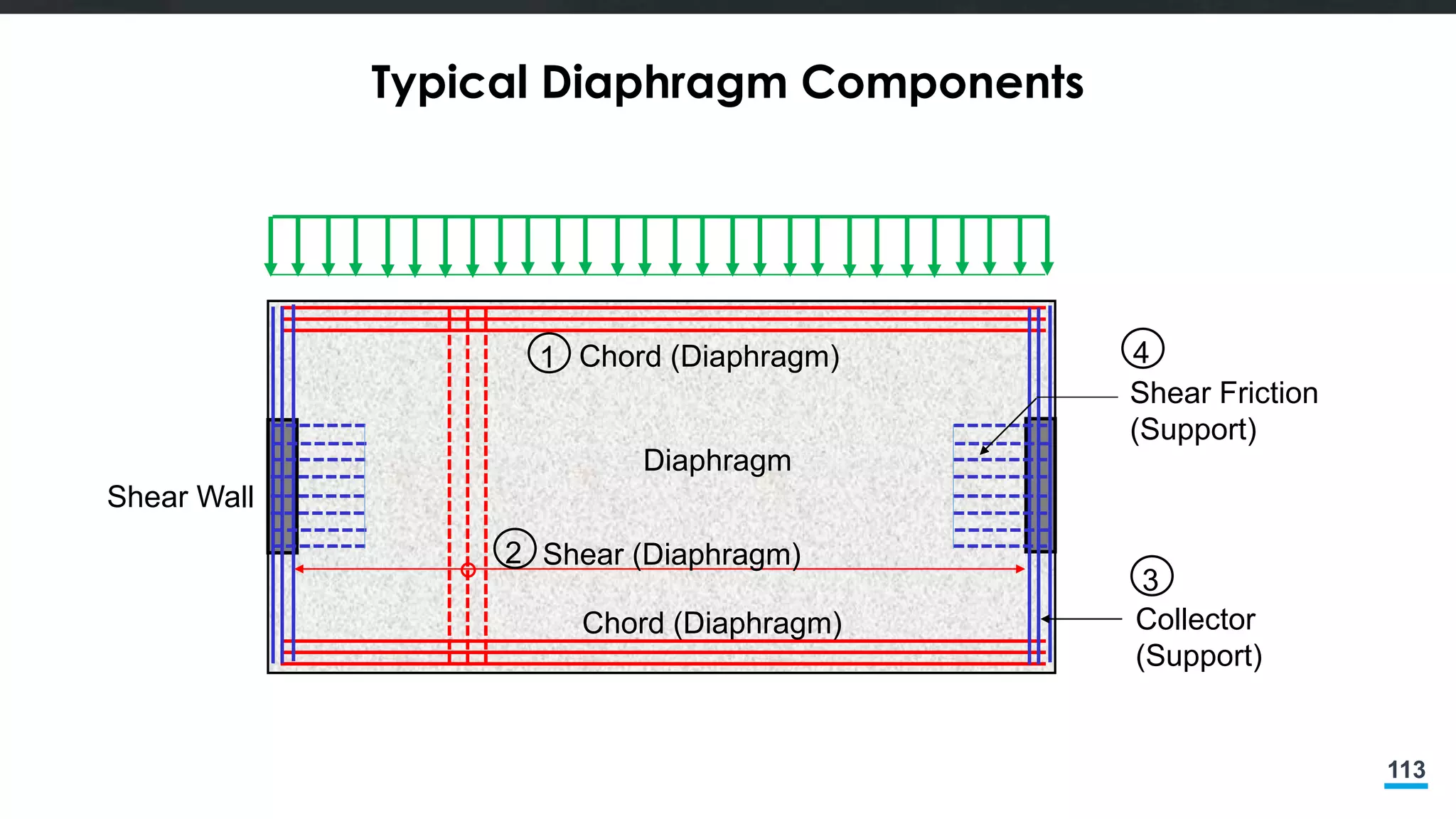
113
Typical Diaphragm Components
Chord (Diaphragm)
Chord (Diaphragm) Collector
(Support)
Shear Friction
(Support)
Shear (Diaphragm)
Shear Wall
Diaphragm
1
2
4
3
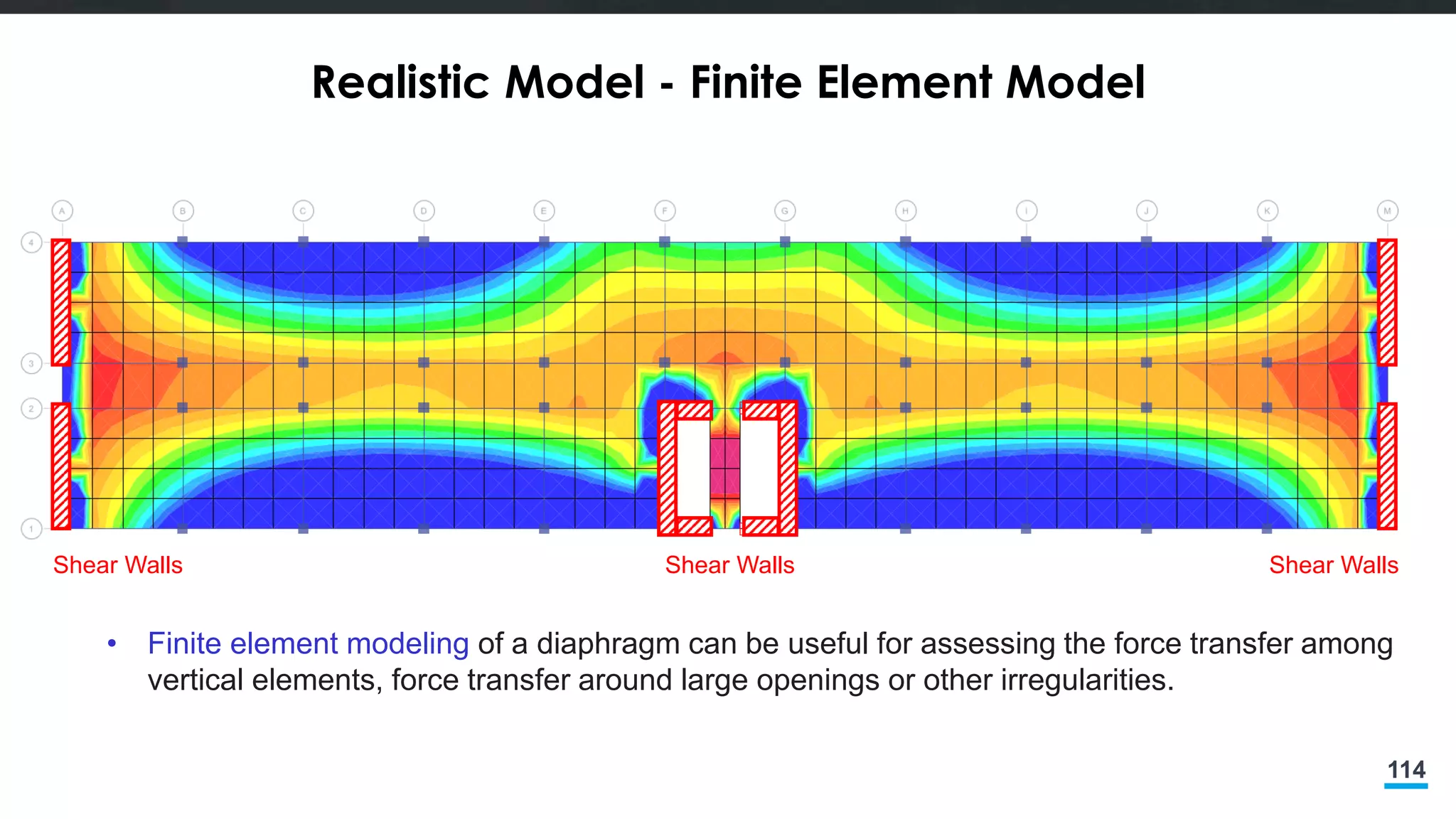
114
Realistic Model - Finite Element Model
• Finite element modeling of a diaphragm can be useful for assessing the force transfer among
vertical elements, force transfer around large openings or other irregularities.
Shear WallsShear Walls Shear Walls
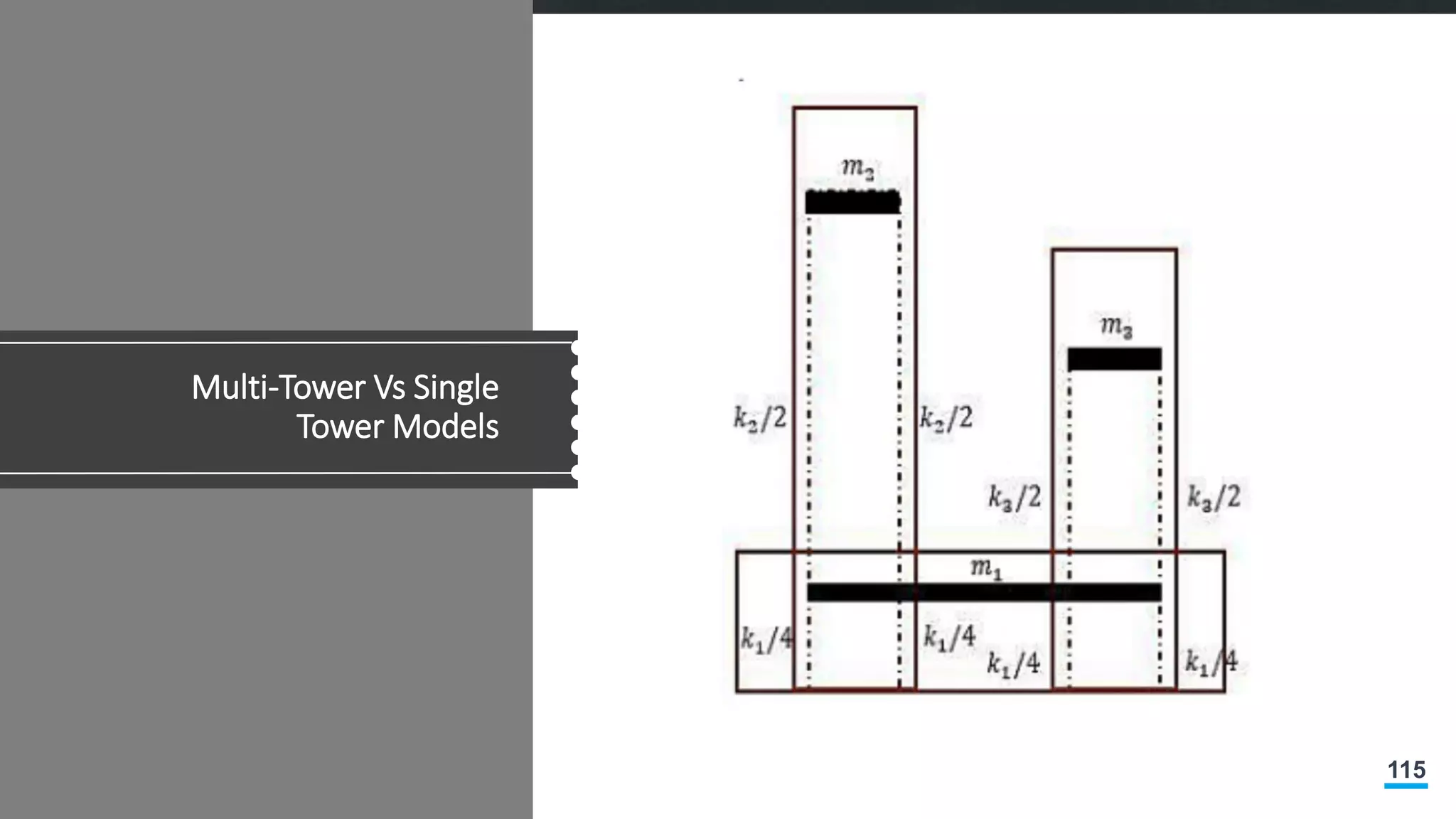
115
Multi-Tower Vs Single
Tower Models
116
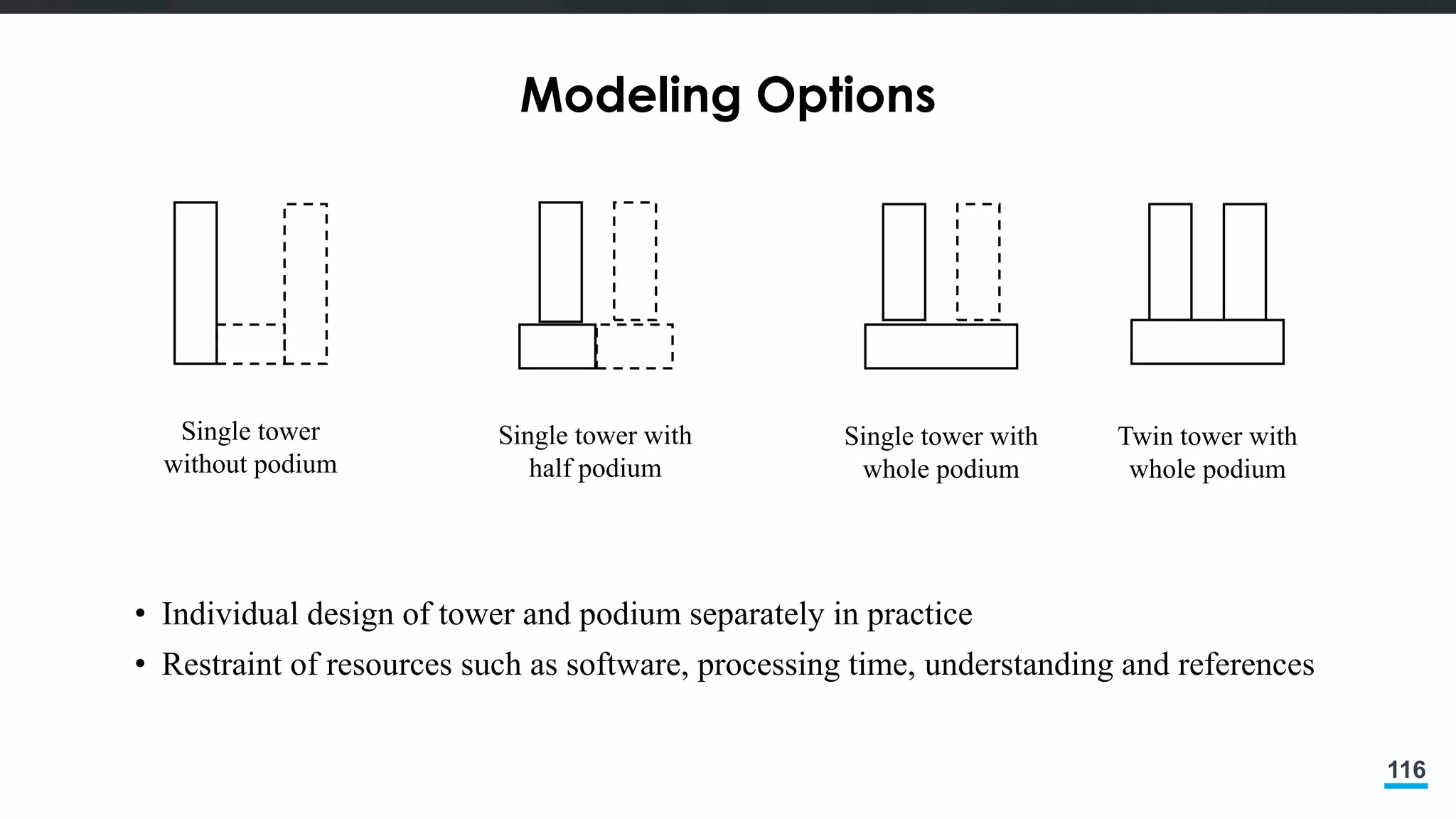
Modeling Options
• Individual design of tower and podium separately in practice
• Restraint of resources such as software, processing time, understanding and references
Single tower
without podium
Single tower with
half podium
Single tower with
whole podium
Twin tower with
whole podium
117
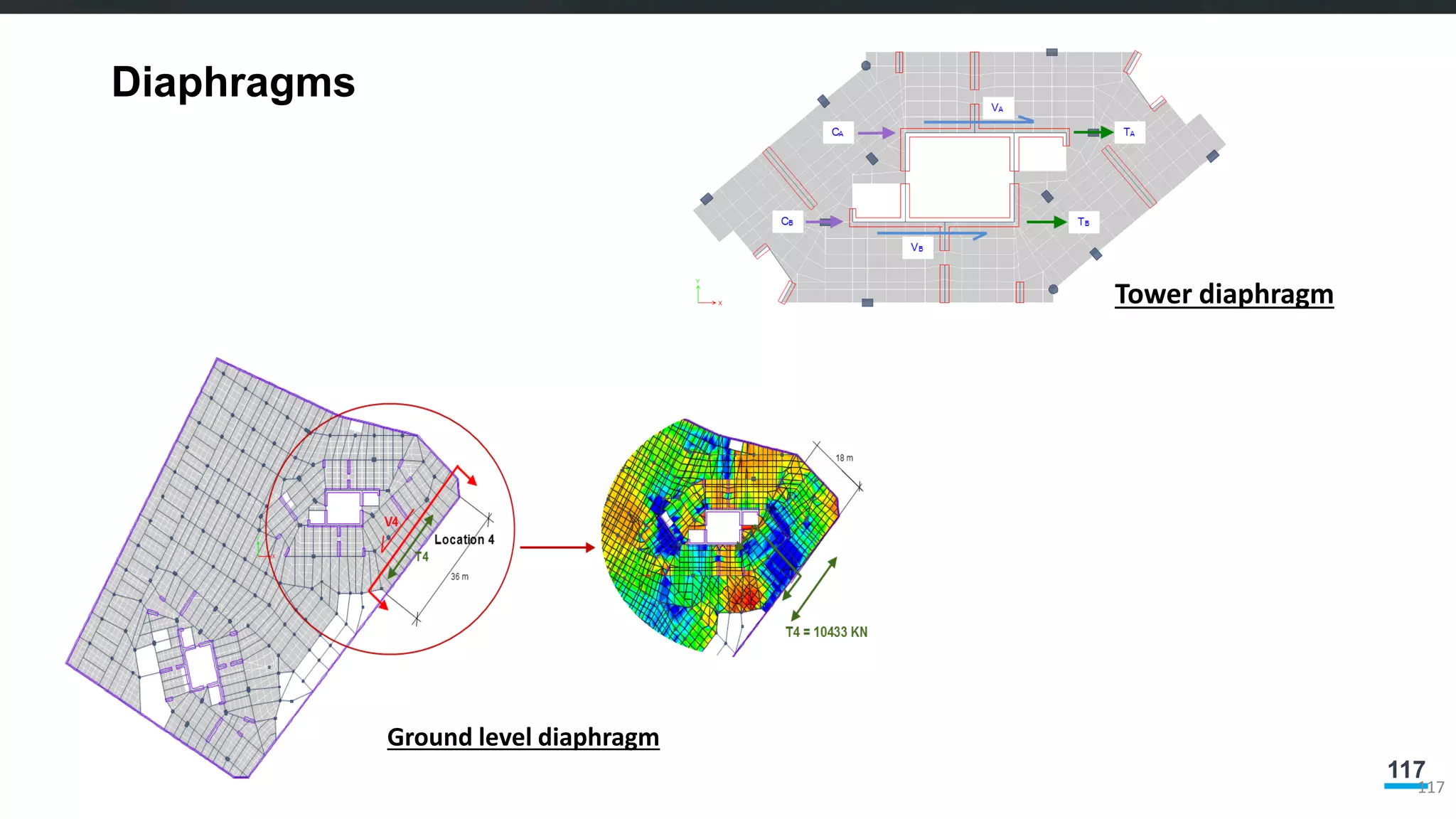
Diaphragms
117
Tower diaphragm
Ground level diaphragm
118
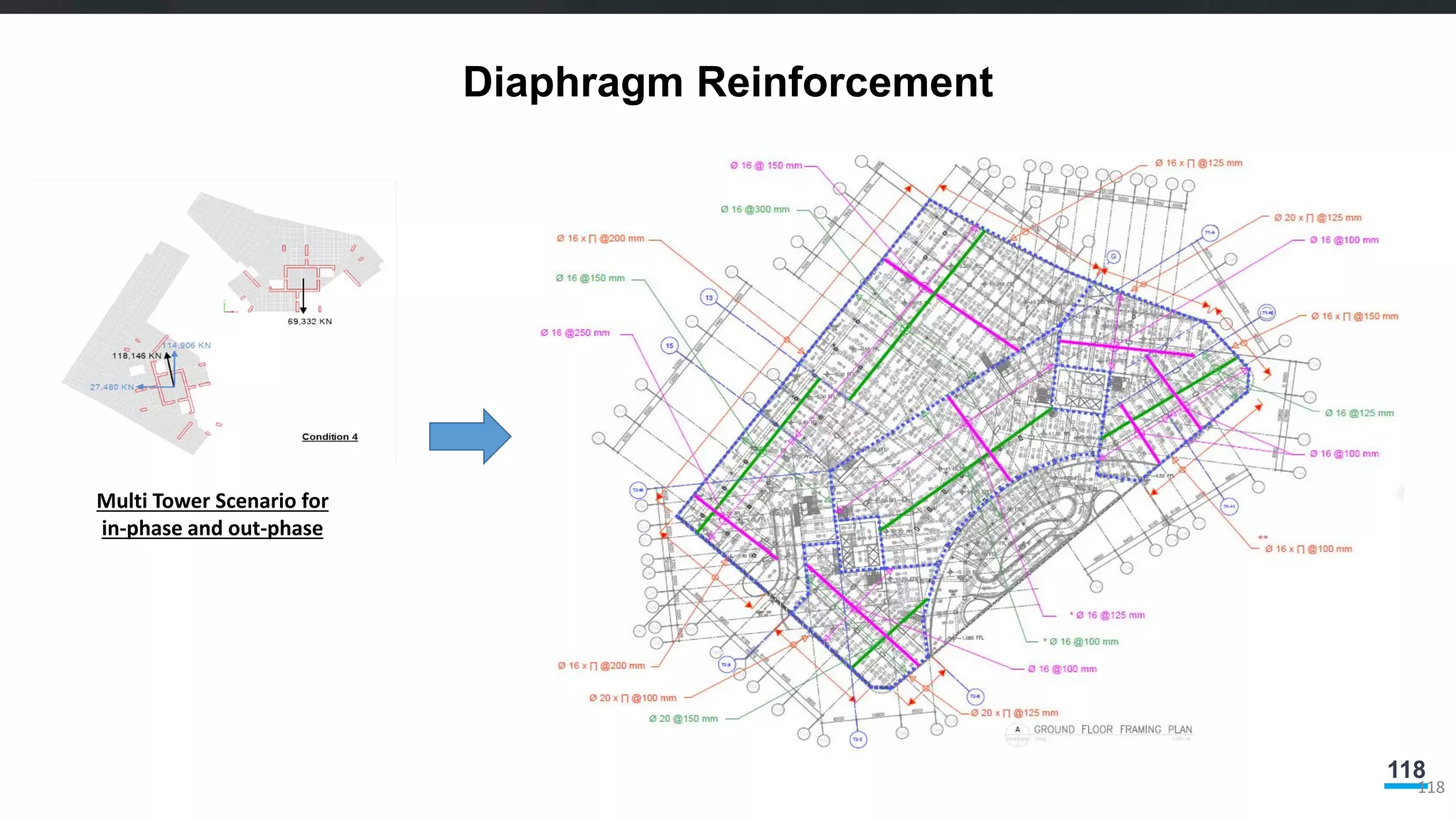
Diaphragm Reinforcement
118
Multi Tower Scenario for
in-phase and out-phase
119
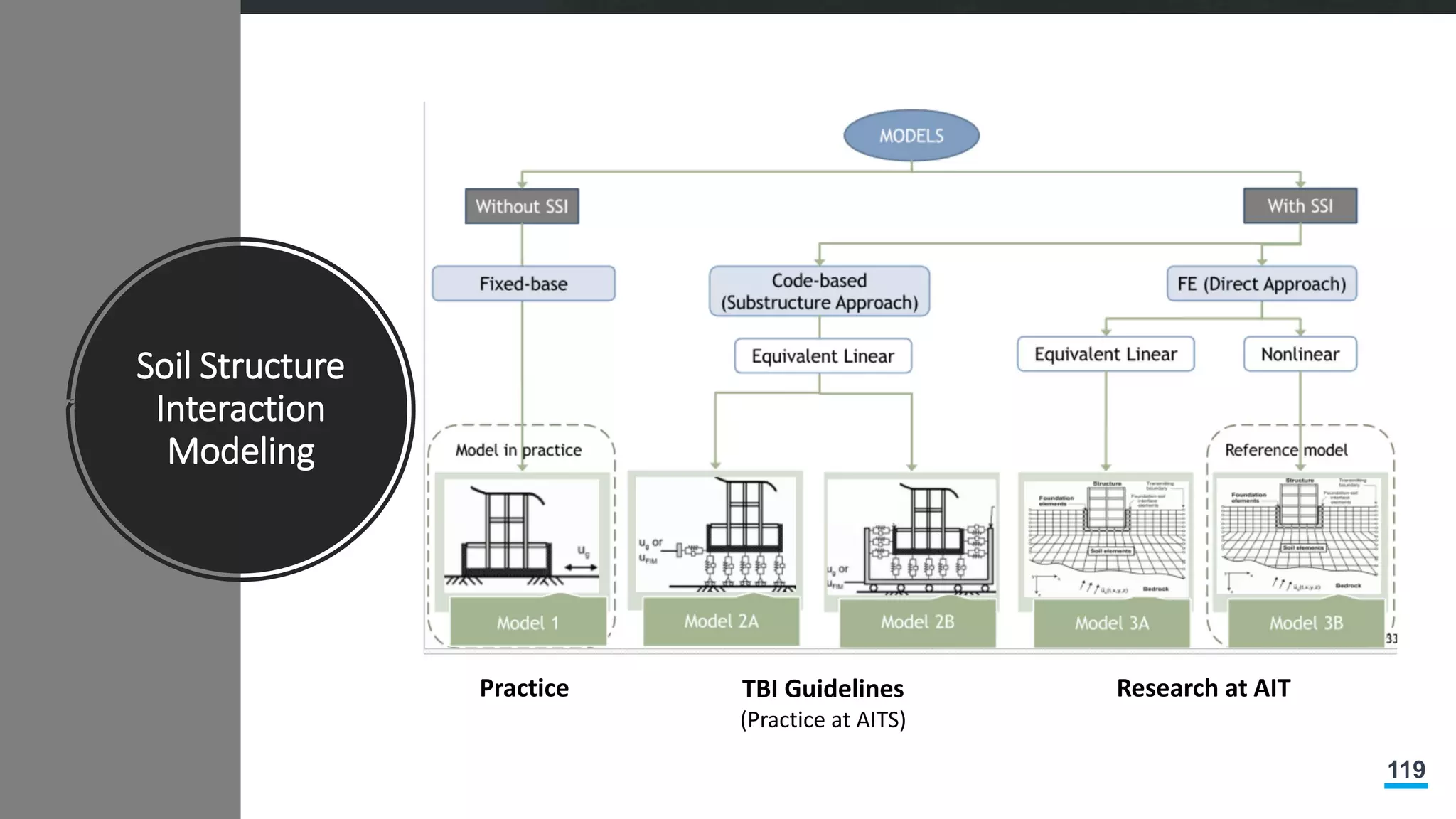
Soil Structure
Interaction
Modeling
TBI Guidelines
(Practice at AITS)
Practice Research at AIT
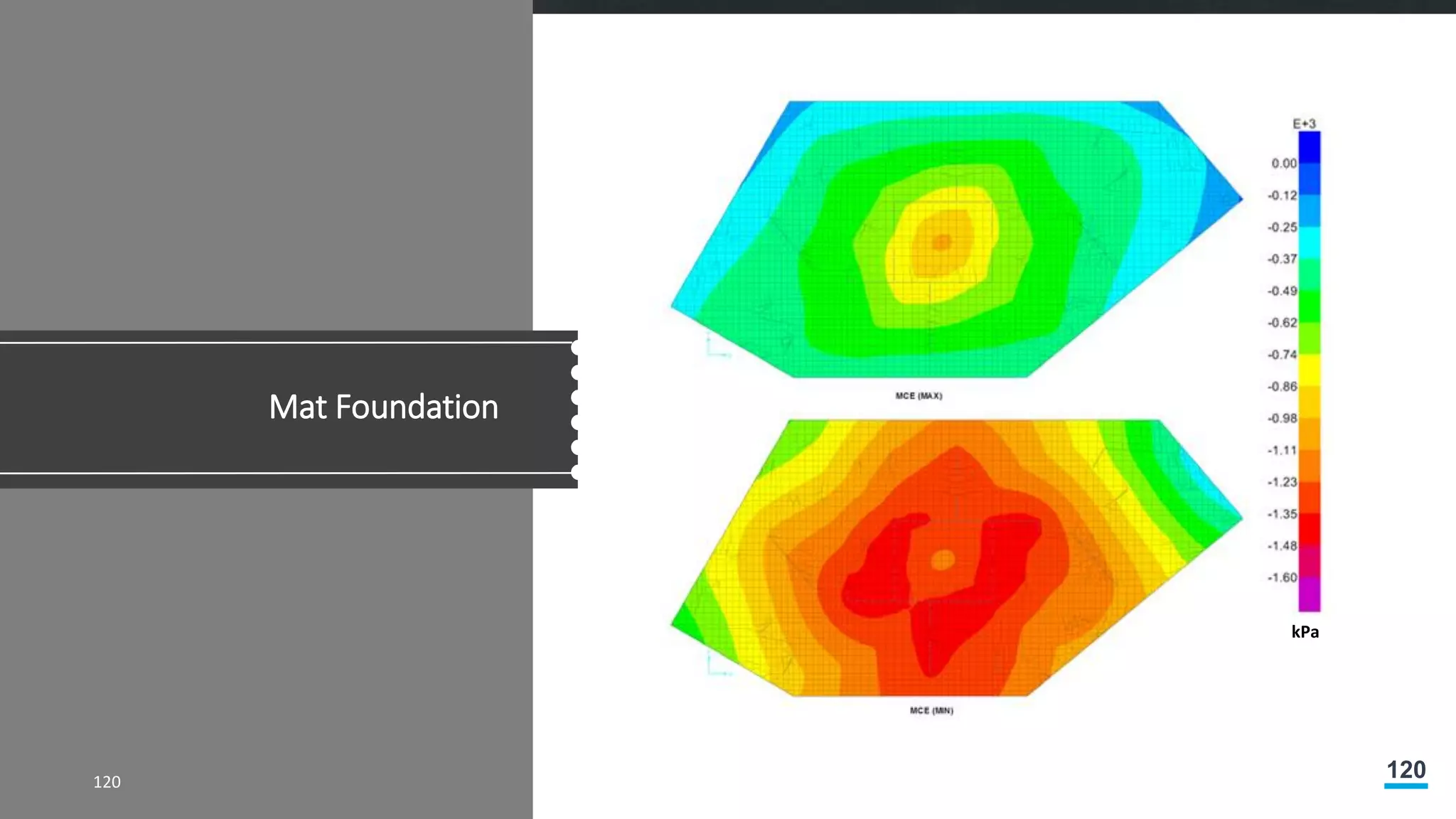
120
kPa
Mat Foundation
120
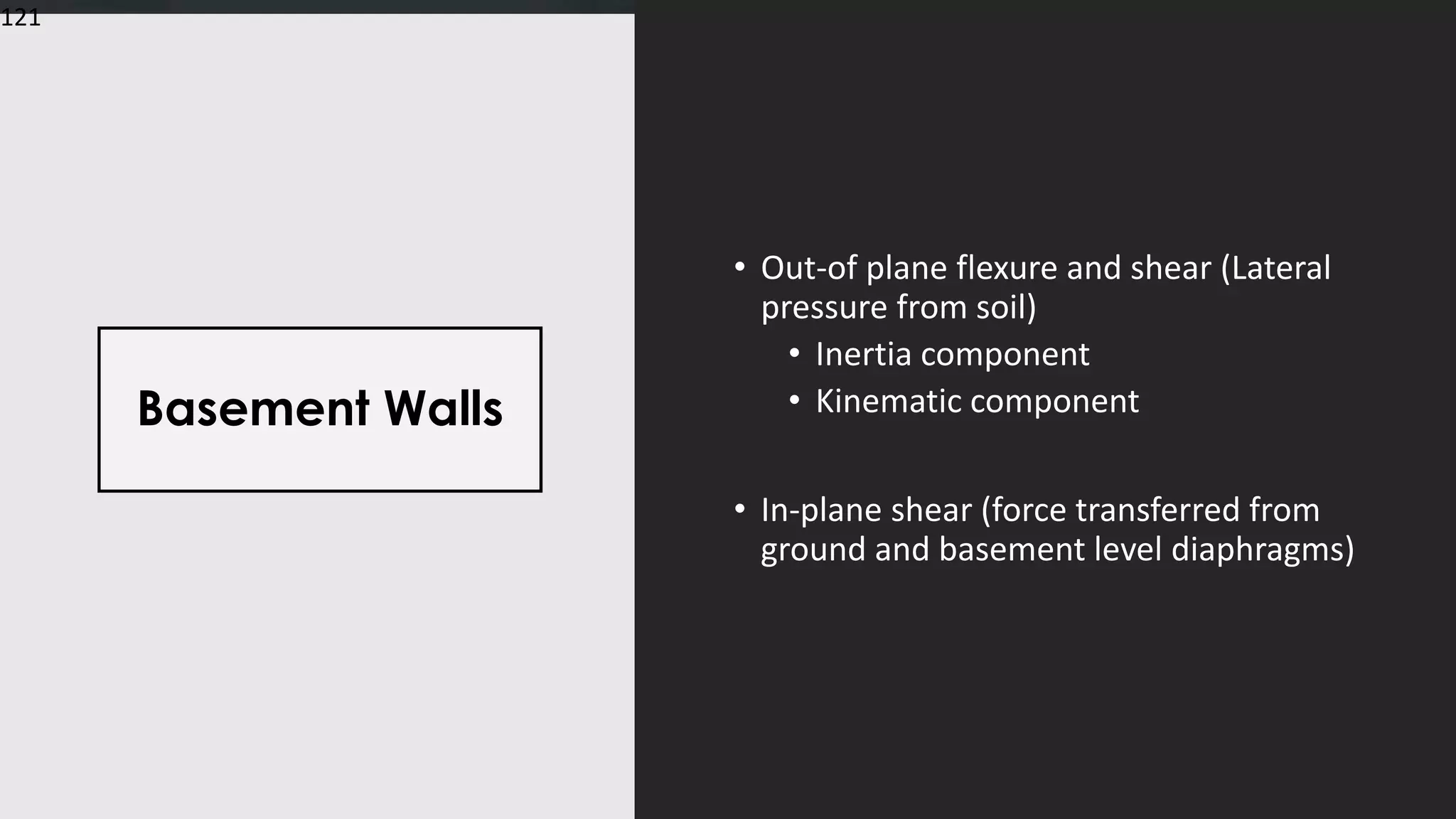
121
• Out-of plane flexure and shear (Lateral
pressure from soil)
• Inertia component
• Kinematic component
• In-plane shear (force transferred from
ground and basement level diaphragms)
Basement Walls
121
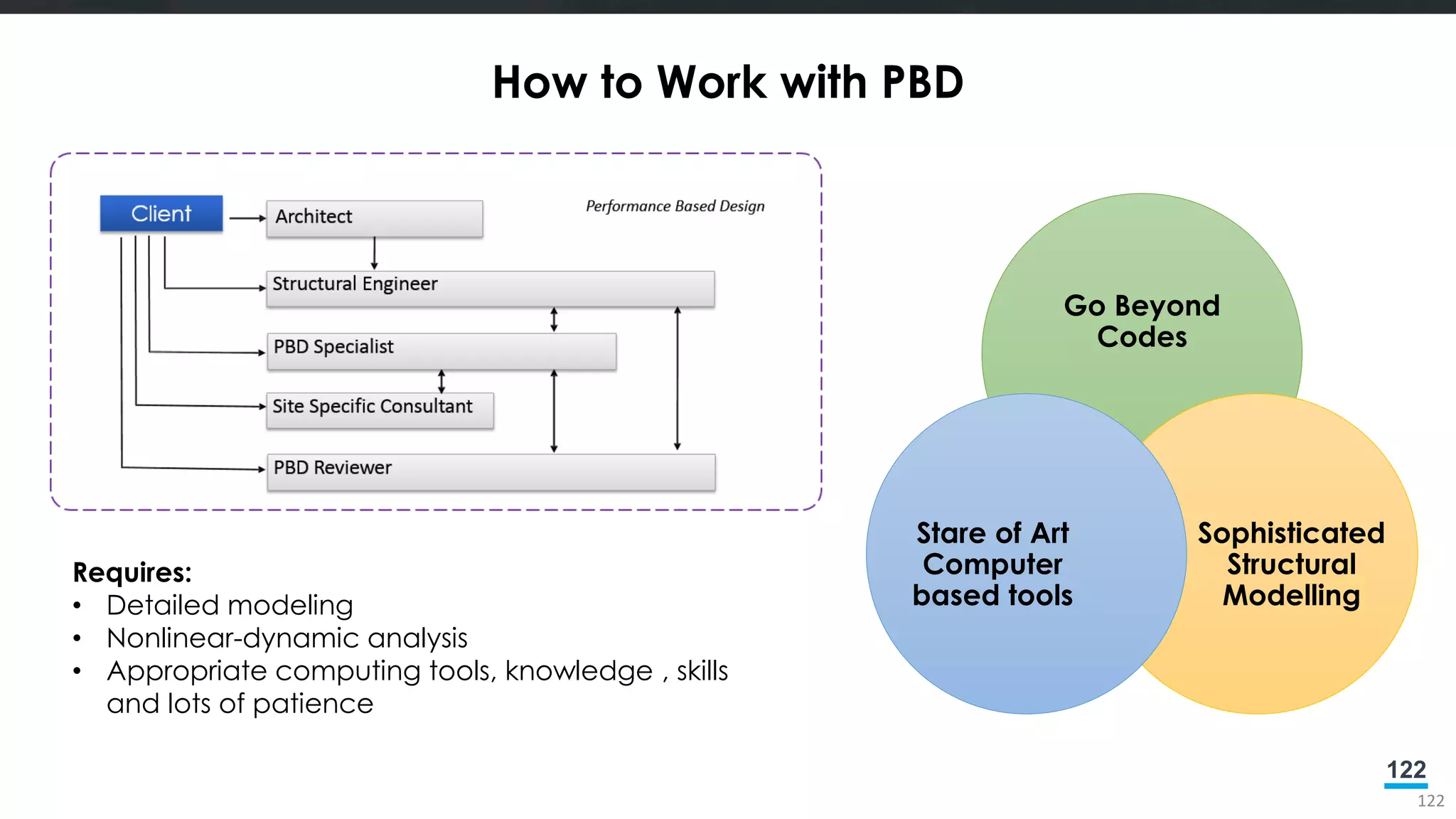
122
How to Work with PBD
122
Requires:
• Detailed modeling
• Nonlinear-dynamic analysis
• Appropriate computing tools, knowledge , skills
and lots of patience
Go Beyond
Codes
Sophisticated
Structural
Modelling
Stare of Art
Computer
based tools
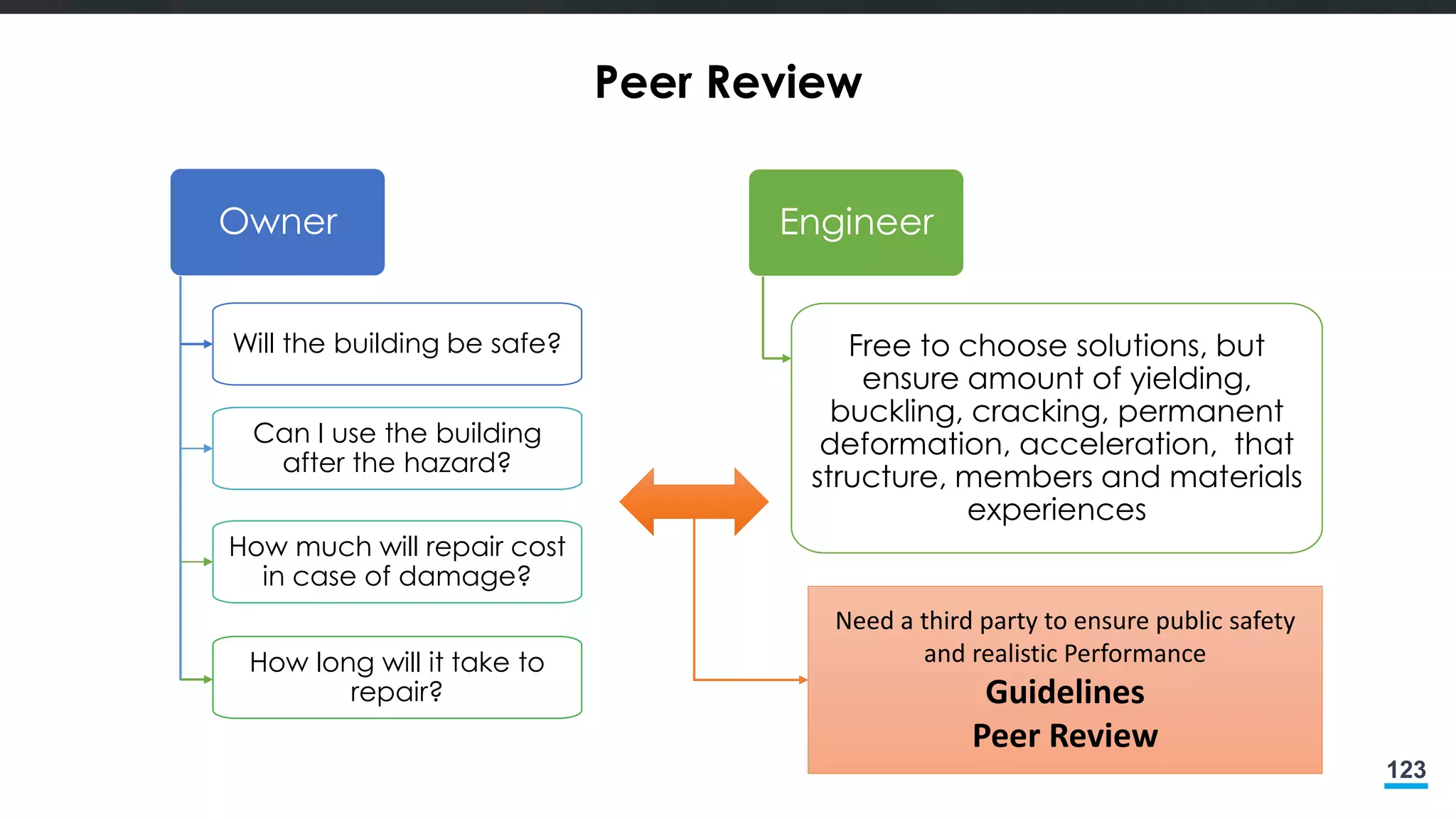
123
Peer Review
Owner
Will the building be safe?
Can I use the building
after the hazard?
How much will repair cost
in case of damage?
How long will it take to
repair?
Engineer
Free to choose solutions, but
ensure amount of yielding,
buckling, cracking, permanent
deformation, acceleration, that
structure, members and materials
experiences
Need a third party to ensure public safety
and realistic Performance
Guidelines
Peer Review
Going Beyond PBD
125
Non-Structural Damage
Assessment of Tall Buildings
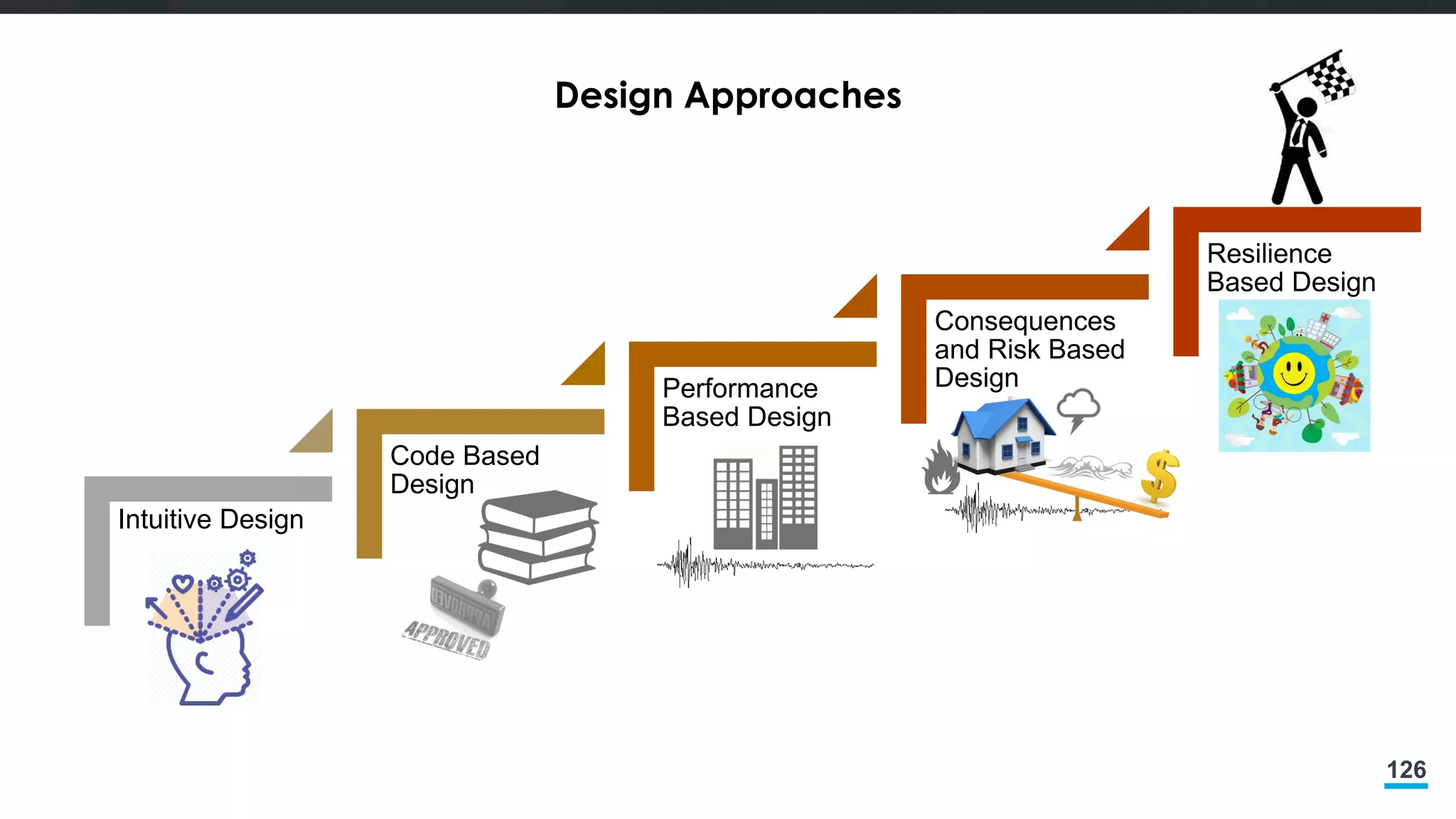
126
Design Approaches
Intuitive Design
Code Based
Design
Performance
Based Design
Consequences
and Risk Based
Design
Resilience
Based Design
127Source: Arup, Supported by USRC and many others
Green Buildings Resilient Buildings
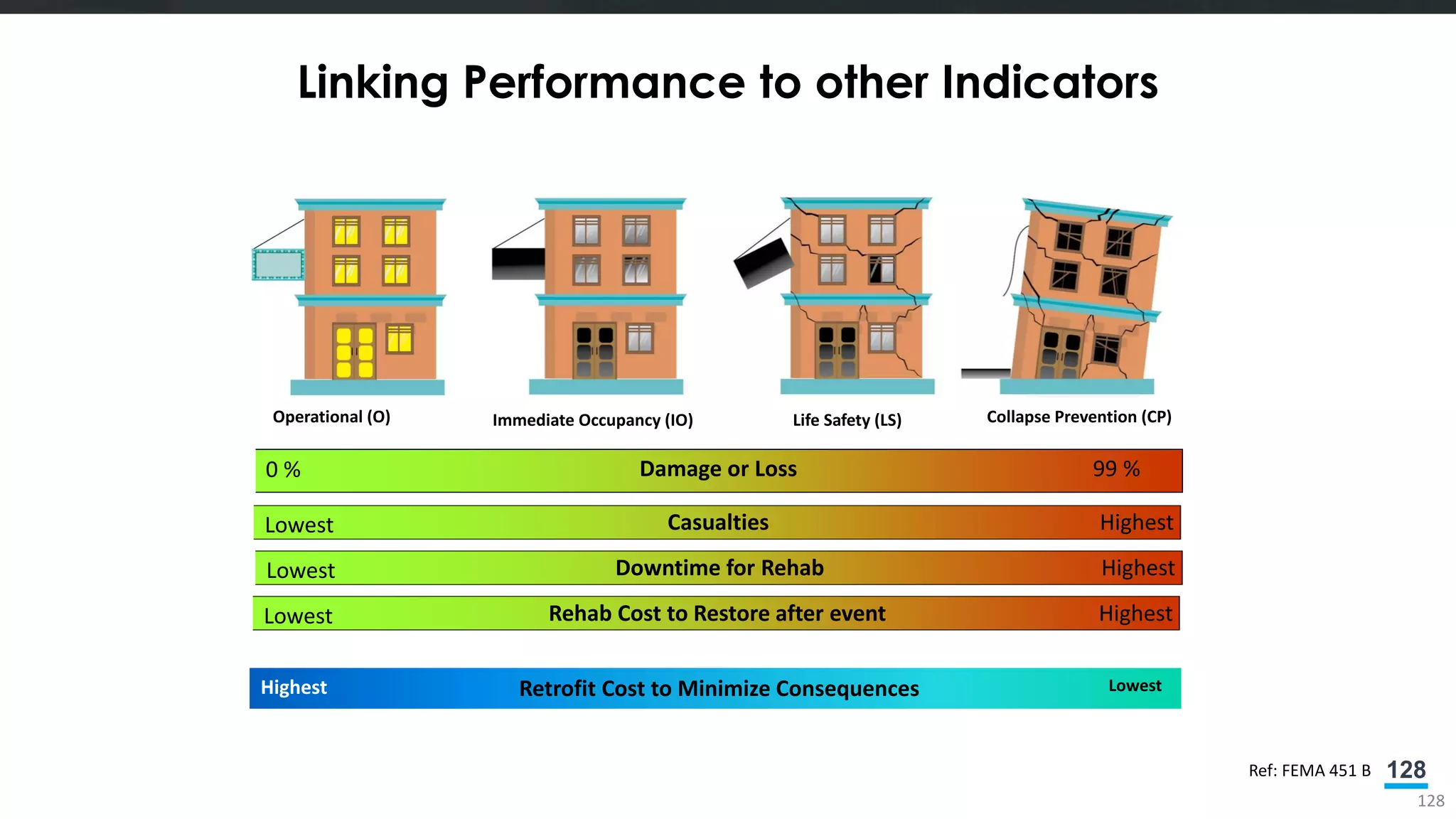
128
Linking Performance to other Indicators
128
Operational (O) Immediate Occupancy (IO) Life Safety (LS) Collapse Prevention (CP)
0 % Damage or Loss 99 %
Ref: FEMA 451 B
CasualtiesLowest Highest
Rehab Cost to Restore after eventLowest Highest
Retrofit Cost to Minimize ConsequencesHighest Lowest
Downtime for RehabLowest Highest
129
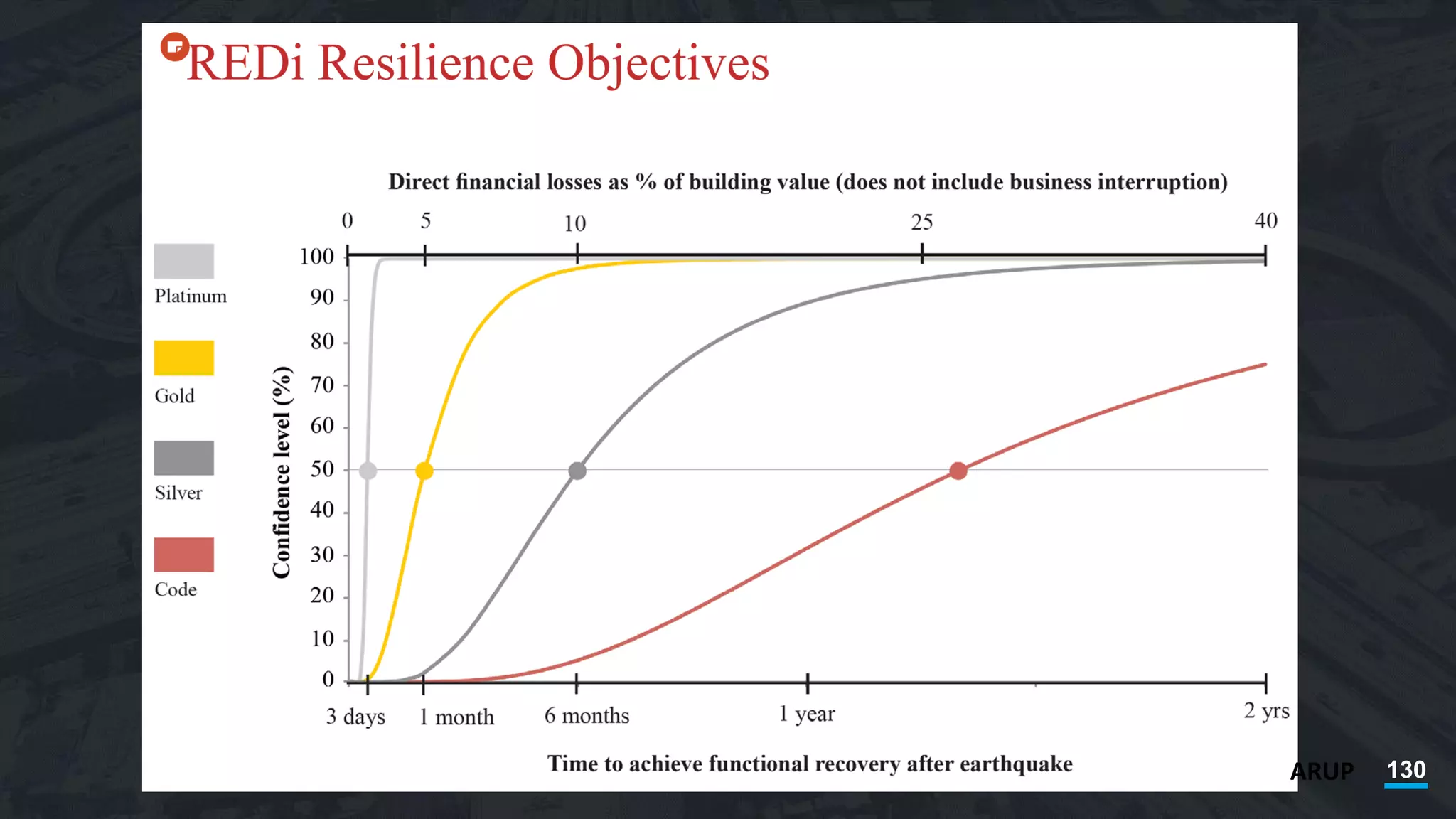
• A holistic approach which seeks to identify all
hazard-induced risks (including those outside the
building envelope) and mitigate them using
integrated multi-disciplinary design and
contingency planning to achieve swift recovery
objectives in the aftermath of a major earthquake.
• The key principle in resilience-based design is to limit
expected damage to structural and architectural
components and egress systems (elevators, stairs,
and doors)
Resilience Based Earthquake
Design
130ARUP
131
Two Levels of
Seismic
Hazard is
Considered
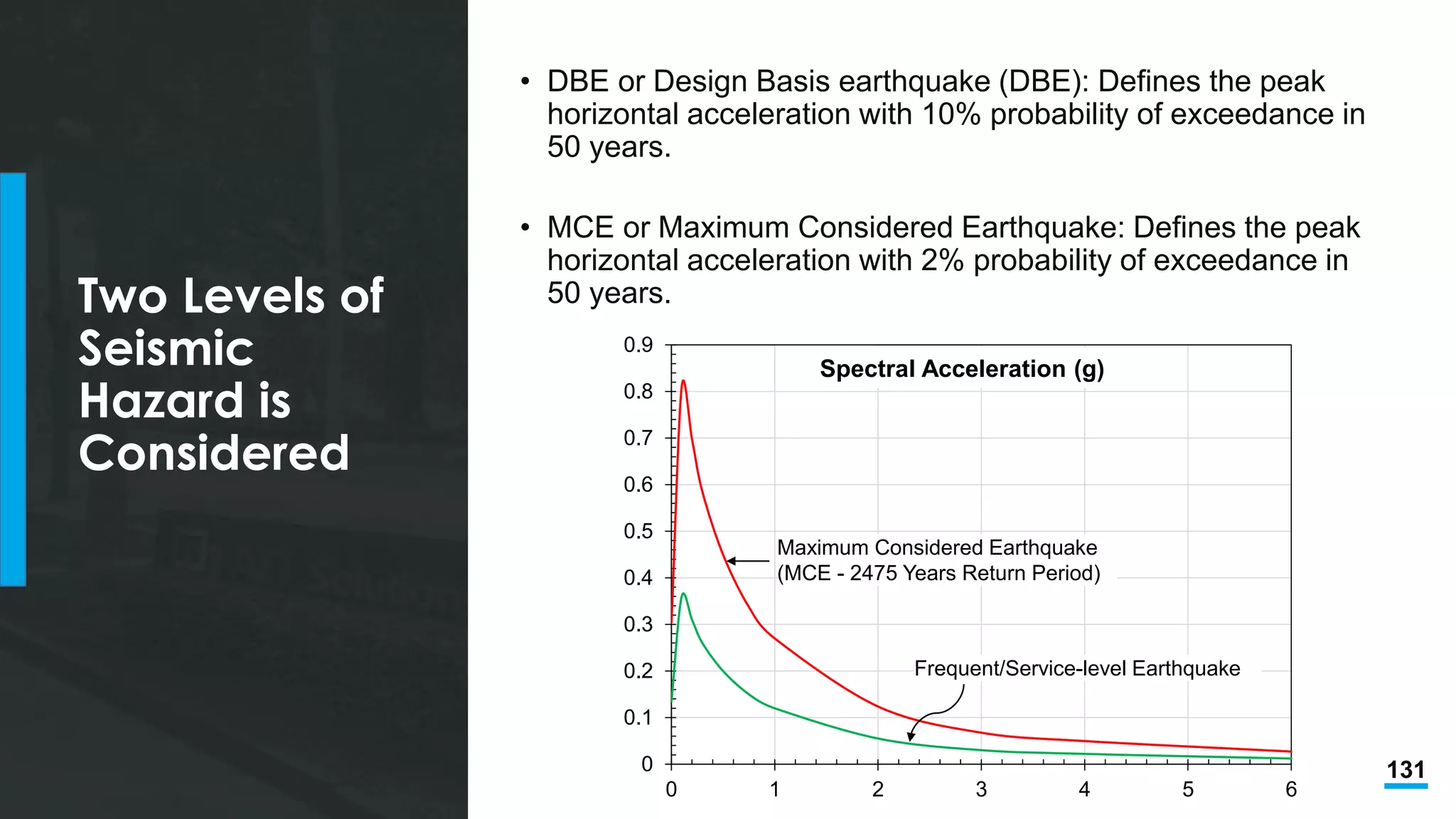
• DBE or Design Basis earthquake (DBE): Defines the peak
horizontal acceleration with 10% probability of exceedance in
50 years.
• MCE or Maximum Considered Earthquake: Defines the peak
horizontal acceleration with 2% probability of exceedance in
50 years.
0
0.1
0.2
0.3
0.4
0.5
0.6
0.7
0.8
0.9
0 1 2 3 4 5 6
Frequent/Service-level Earthquake
Spectral Acceleration (g)
Maximum Considered Earthquake
(MCE - 2475 Years Return Period)
132
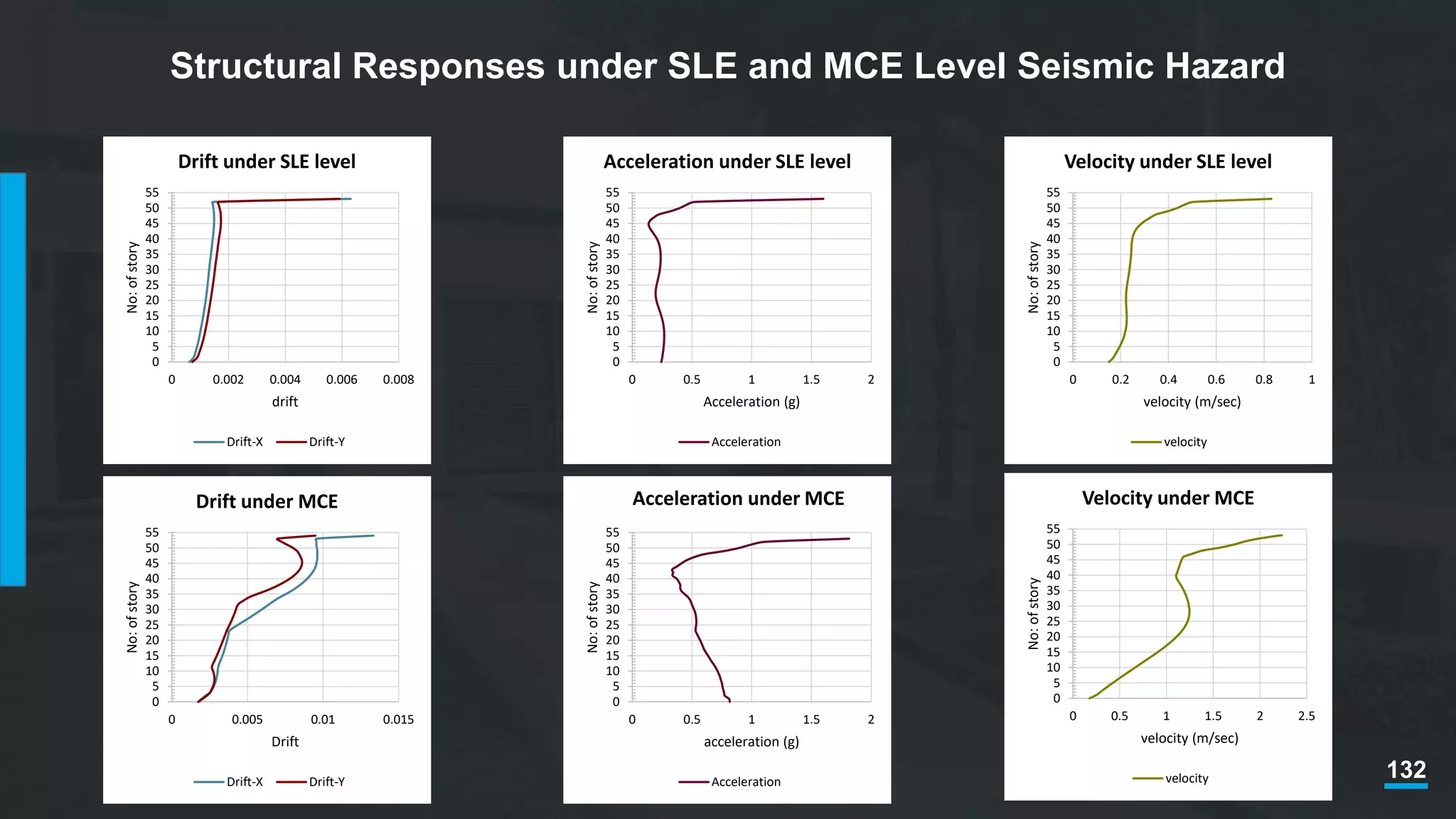
Structural Responses under SLE and MCE Level Seismic Hazard
0
5
10
15
20
25
30
35
40
45
50
55
0 0.002 0.004 0.006 0.008
No:ofstory
drift
Drift under SLE level
Drift-X Drift-Y
0
5
10
15
20
25
30
35
40
45
50
55
0 0.5 1 1.5 2
No:ofstory
Acceleration (g)
Acceleration under SLE level
Acceleration
0
5
10
15
20
25
30
35
40
45
50
55
0 0.2 0.4 0.6 0.8 1
No:ofstory
velocity (m/sec)
Velocity under SLE level
velocity
0
5
10
15
20
25
30
35
40
45
50
55
0 0.005 0.01 0.015
No:ofstory
Drift
Drift under MCE
Drift-X Drift-Y
0
5
10
15
20
25
30
35
40
45
50
55
0 0.5 1 1.5 2
No:ofstory
acceleration (g)
Acceleration under MCE
Acceleration
0
5
10
15
20
25
30
35
40
45
50
55
0 0.5 1 1.5 2 2.5
No:ofstory
velocity (m/sec)
Velocity under MCE
velocity
133
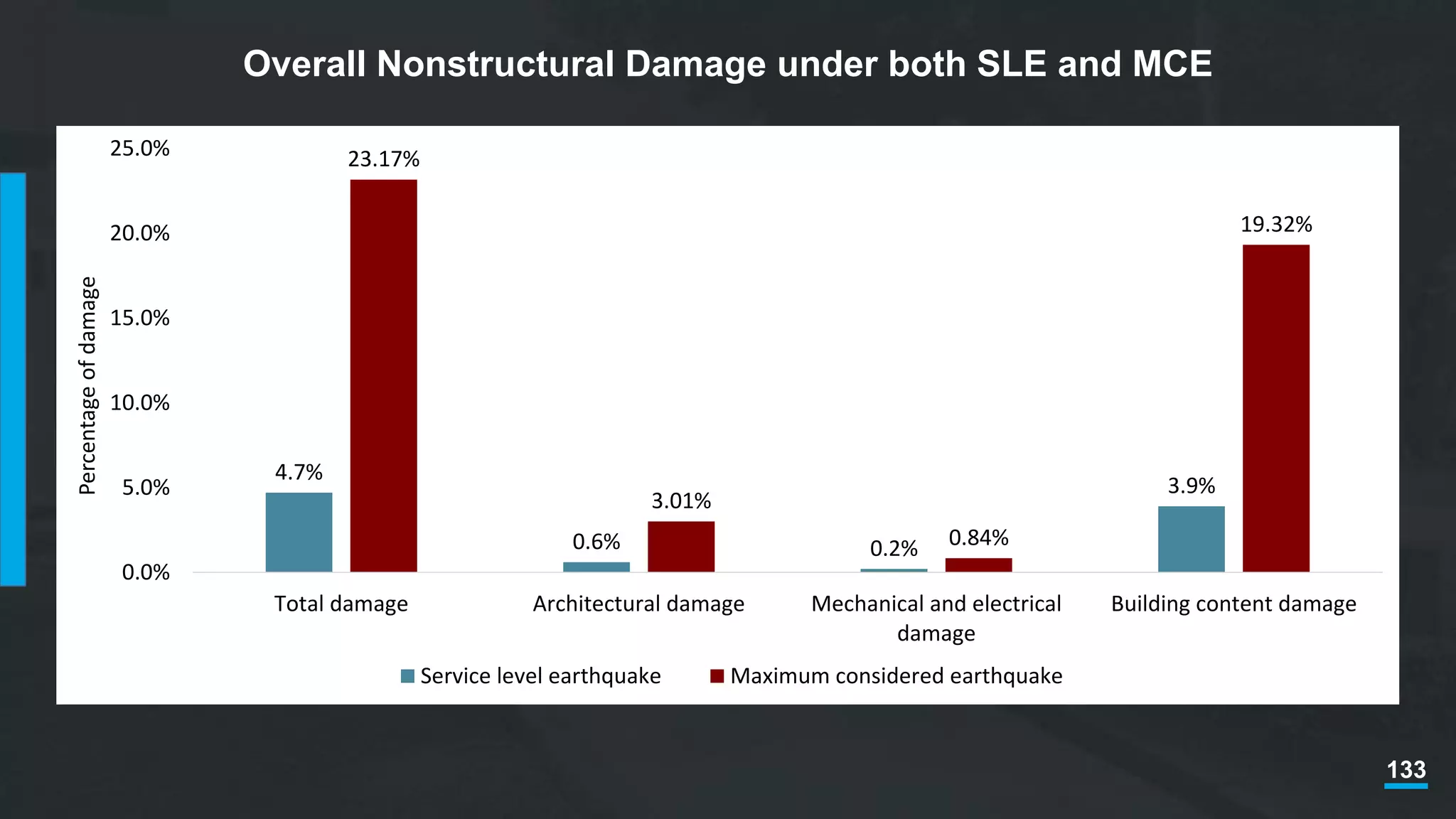
Overall Nonstructural Damage under both SLE and MCE
4.7%
0.6% 0.2%
3.9%
23.17%
3.01%
0.84%
19.32%
0.0%
5.0%
10.0%
15.0%
20.0%
25.0%
Total damage Architectural damage Mechanical and electrical
damage
Building content damage
Percentageofdamage
Service level earthquake Maximum considered earthquake
134
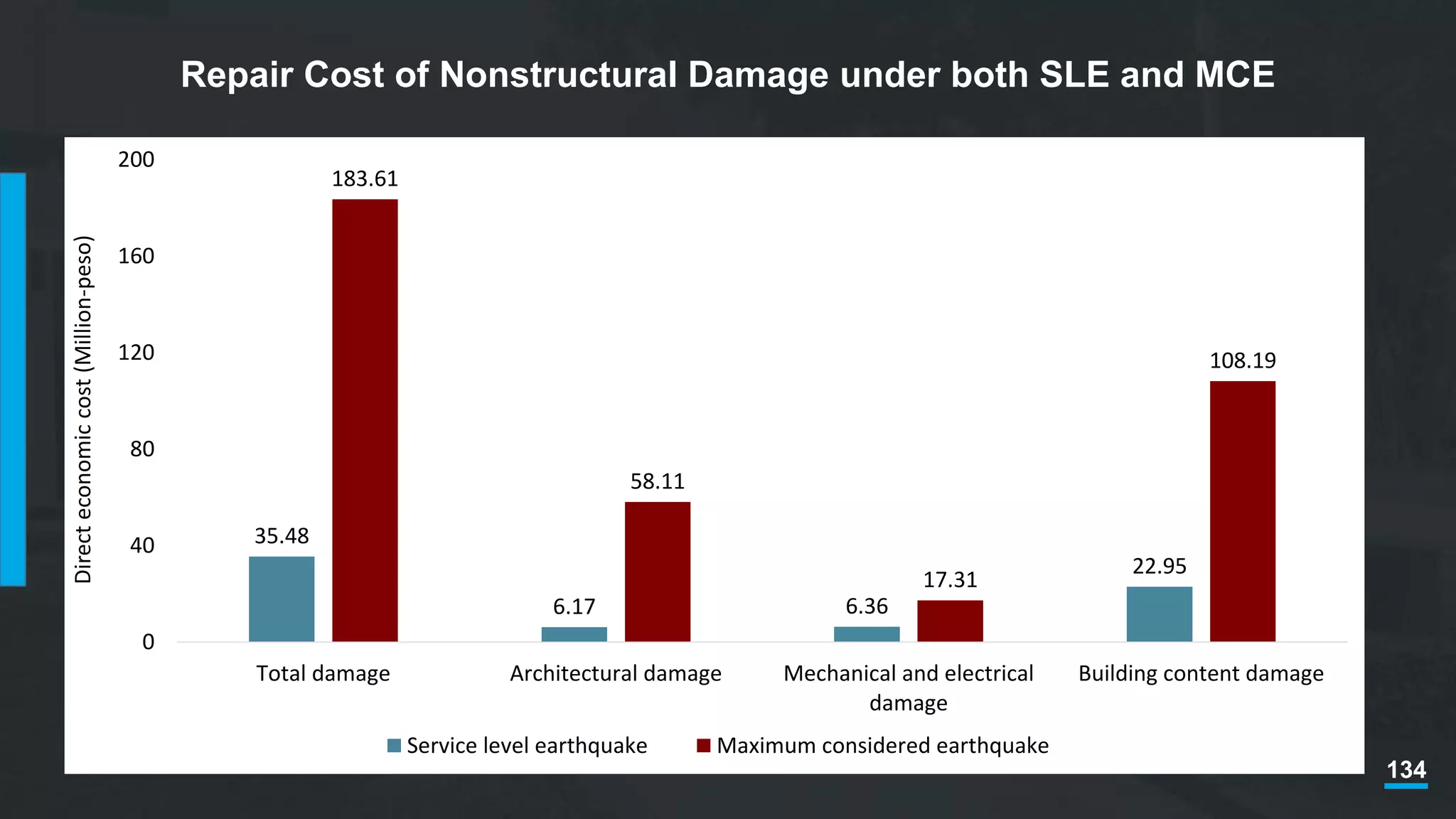
Repair Cost of Nonstructural Damage under both SLE and MCE
35.48
6.17 6.36
22.95
183.61
58.11
17.31
108.19
0
40
80
120
160
200
Total damage Architectural damage Mechanical and electrical
damage
Building content damage
Directeconomiccost(Million-peso)
Service level earthquake Maximum considered earthquake
135
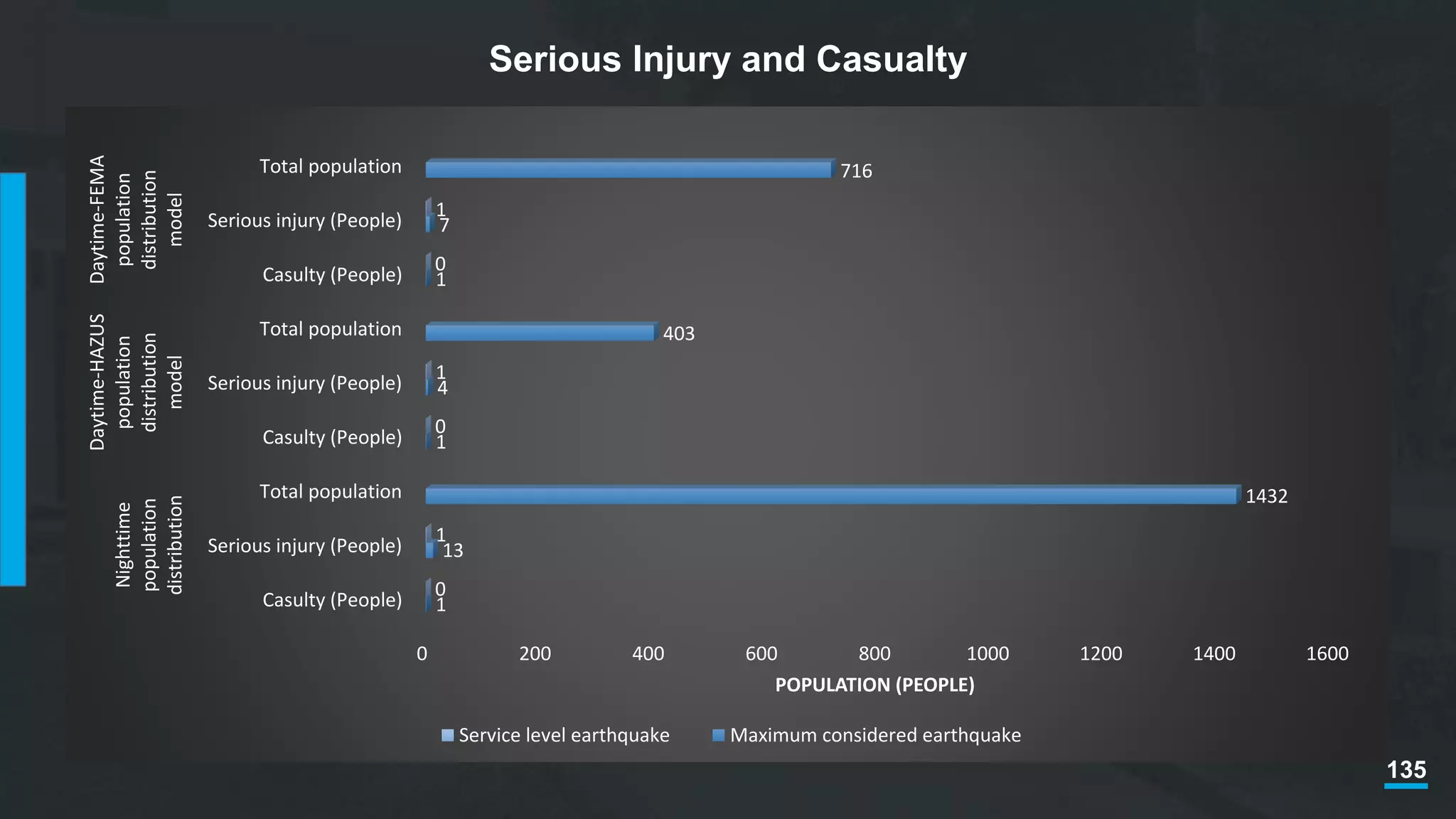
Serious Injury and Casualty
0 200 400 600 800 1000 1200 1400 1600
Casulty (People)
Serious injury (People)
Total population
Casulty (People)
Serious injury (People)
Total population
Casulty (People)
Serious injury (People)
Total population
Nighttime
population
distribution
Daytime-HAZUS
population
distribution
model
Daytime-FEMA
population
distribution
model
1
13
1432
1
4
403
1
7
716
0
1
0
1
0
1
POPULATION (PEOPLE)
Service level earthquake Maximum considered earthquake
Using AI ad Machine Learning
137
A Swing Towards the AI
• Rich Pictures
• Analytical Hierarchy Process (AHP)
• Artificial Neural Networks (ANN)
• Genetic Algorithms (GA)
• Expert Systems (ES)
• Machine learning (ML)
• Fuzzy Logic
• Deep Thinking
• Big Data and Data Mining
137
138
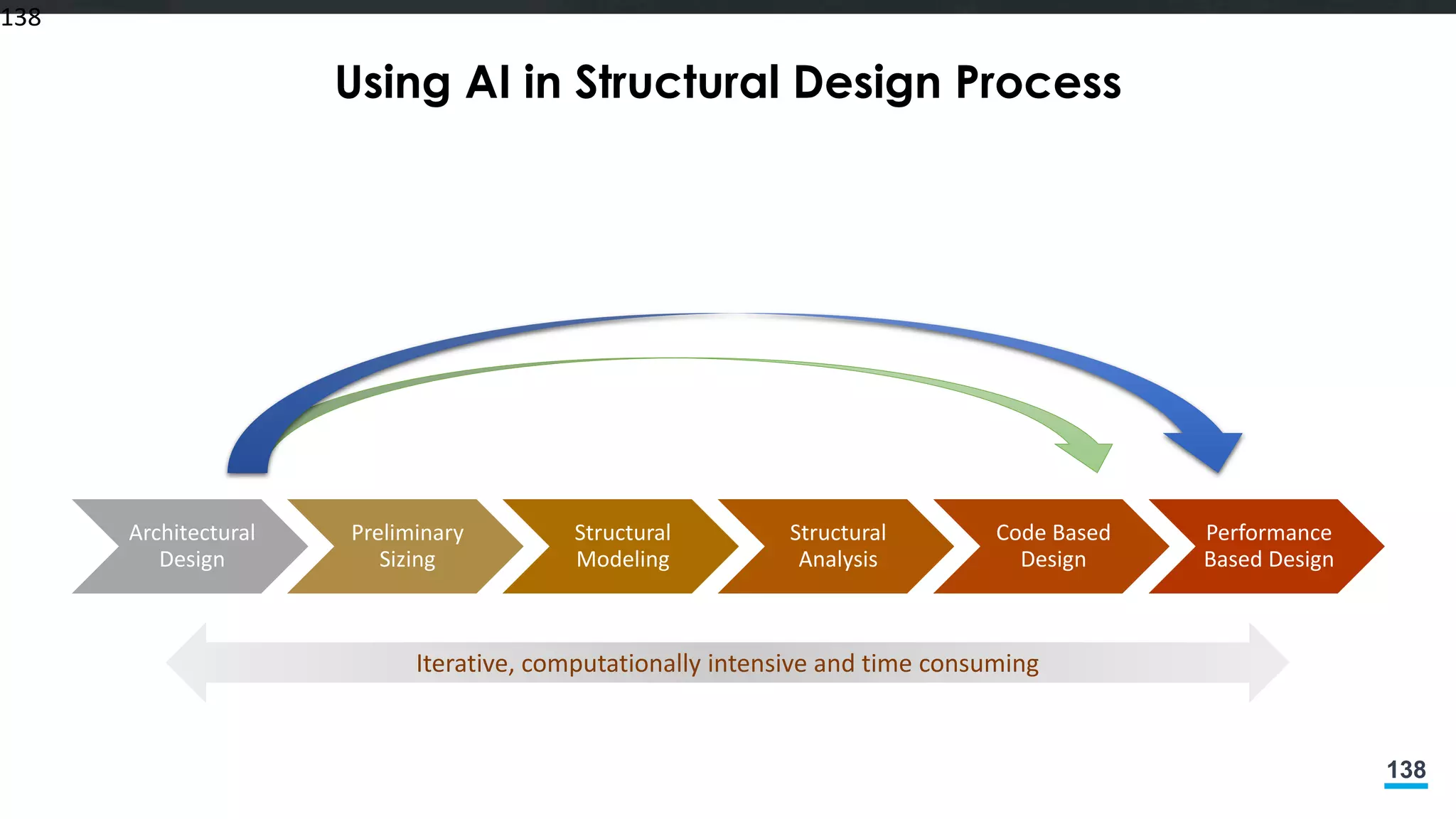
Using AI in Structural Design Process
Architectural
Design
Preliminary
Sizing
Structural
Modeling
Structural
Analysis
Code Based
Design
Performance
Based Design
138
Iterative, computationally intensive and time consuming
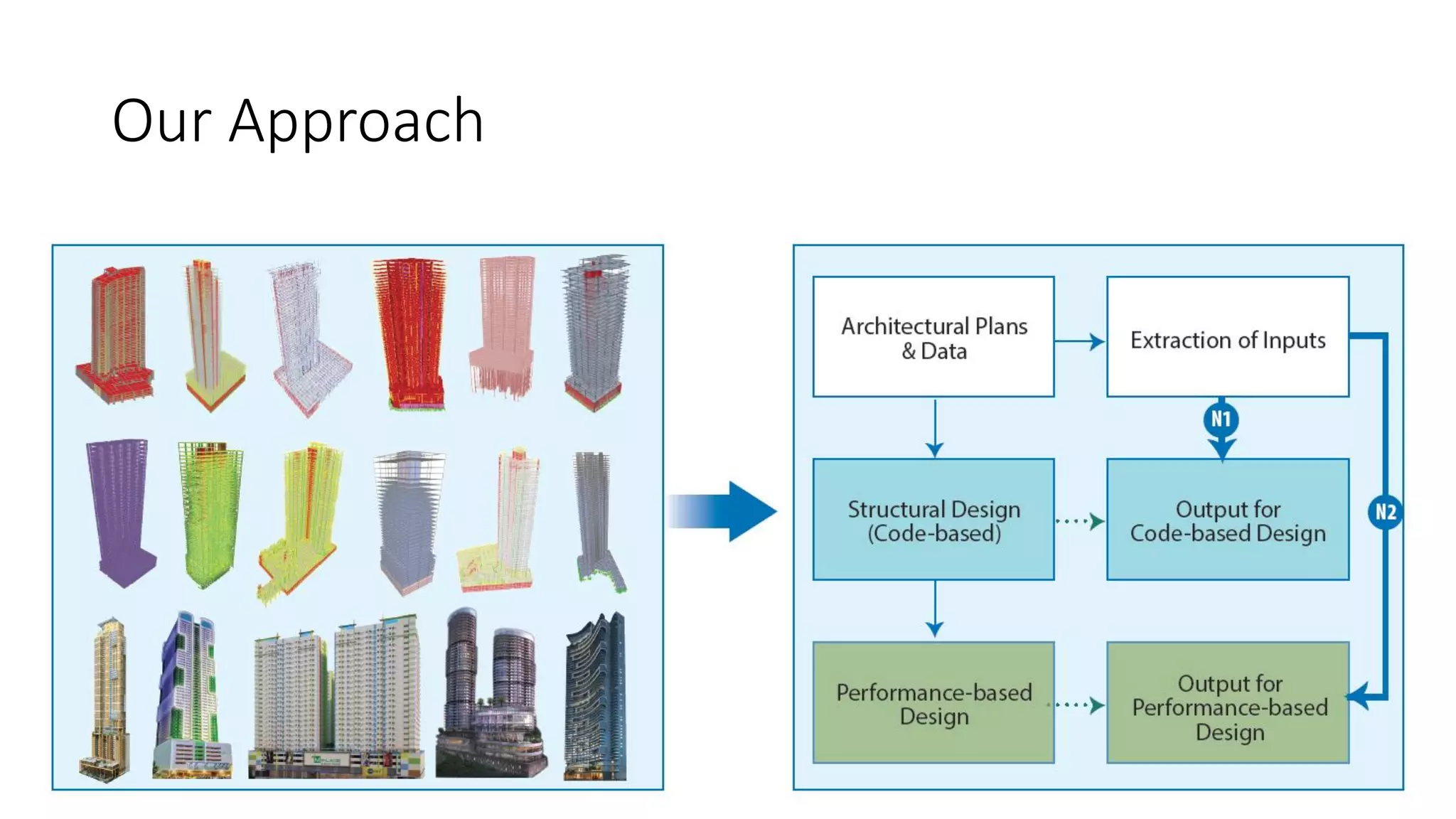
Our Approach
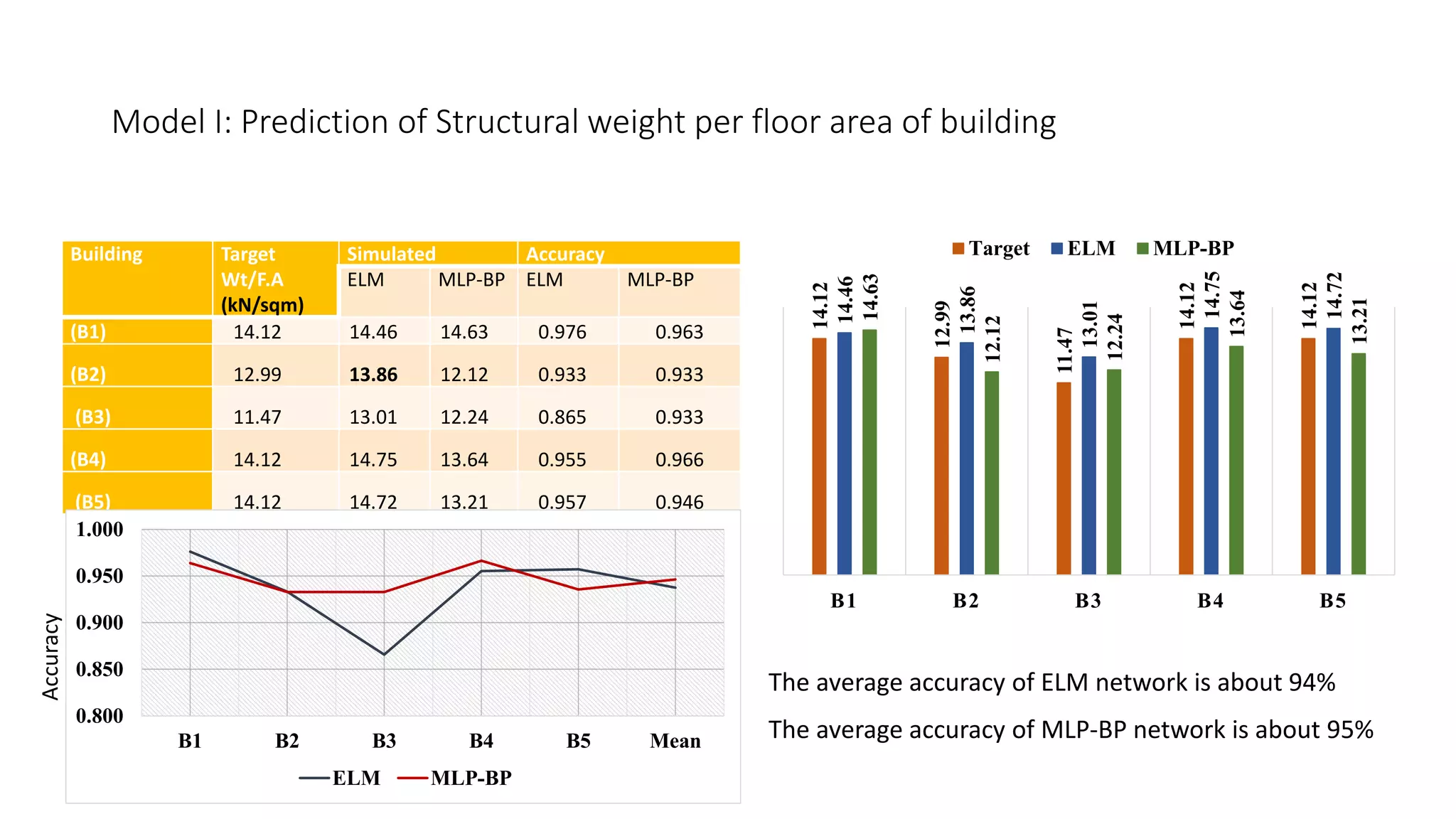
Model I: Prediction of Structural weight per floor area of building
Building Target
Wt/F.A
(kN/sqm)
Simulated Accuracy
ELM MLP-BP ELM MLP-BP
(B1) 14.12 14.46 14.63 0.976 0.963
(B2) 12.99 13.86 12.12 0.933 0.933
(B3) 11.47 13.01 12.24 0.865 0.933
(B4) 14.12 14.75 13.64 0.955 0.966
(B5) 14.12 14.72 13.21 0.957 0.946
14.12
12.99
11.47
14.12
14.12
14.46
13.86
13.01
14.75
14.72
14.63
12.12
12.24
13.64
13.21
B1 B2 B3 B4 B5
Target ELM MLP-BP
0.800
0.850
0.900
0.950
1.000
B1 B2 B3 B4 B5 Mean
ELM MLP-BP
The average accuracy of ELM network is about 94%
The average accuracy of MLP-BP network is about 95%
Accuracy
142
Post-earthquake Solutions
143
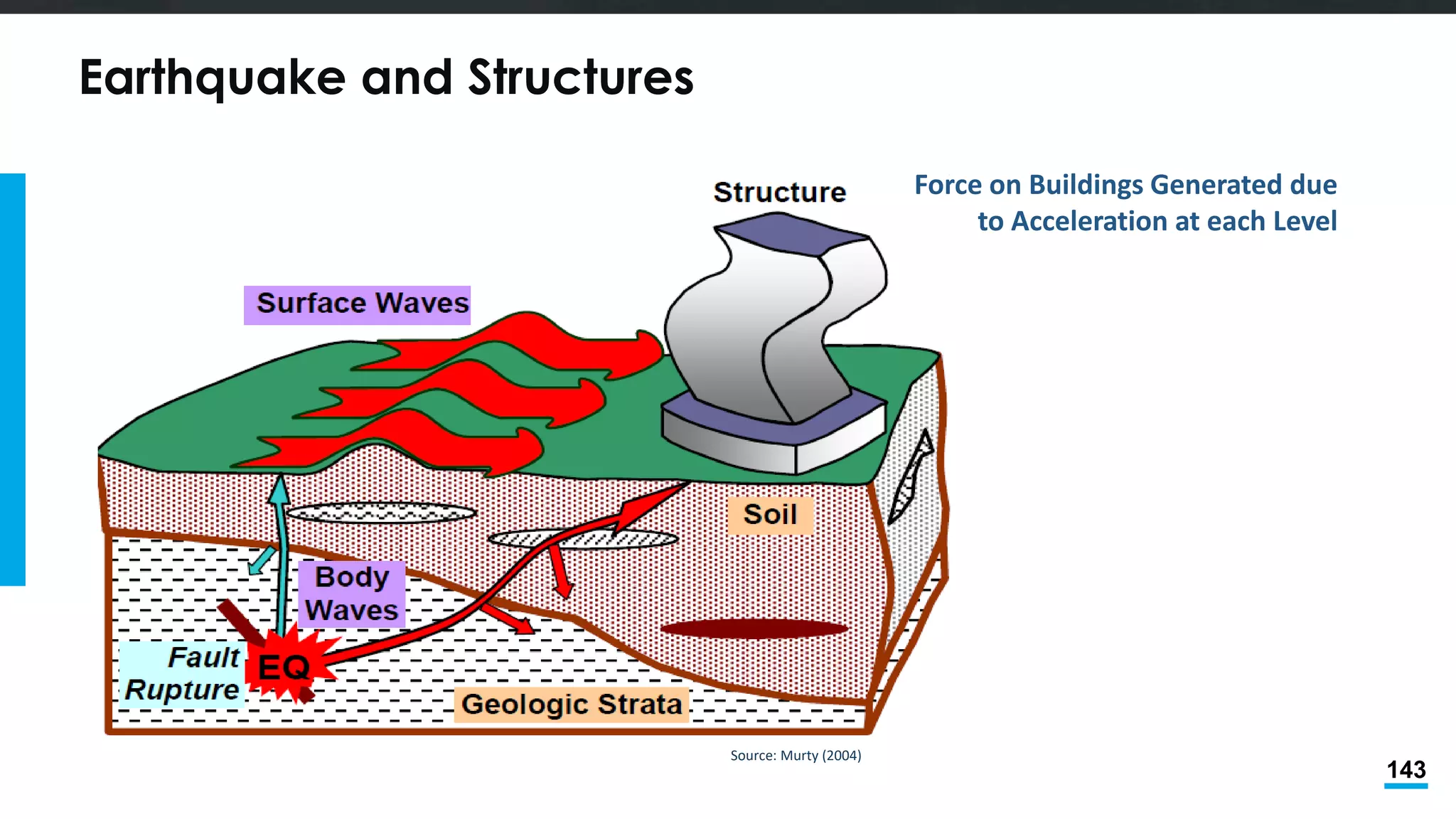
Earthquake and Structures
Source: Murty (2004)
Force on Buildings Generated due
to Acceleration at each Level
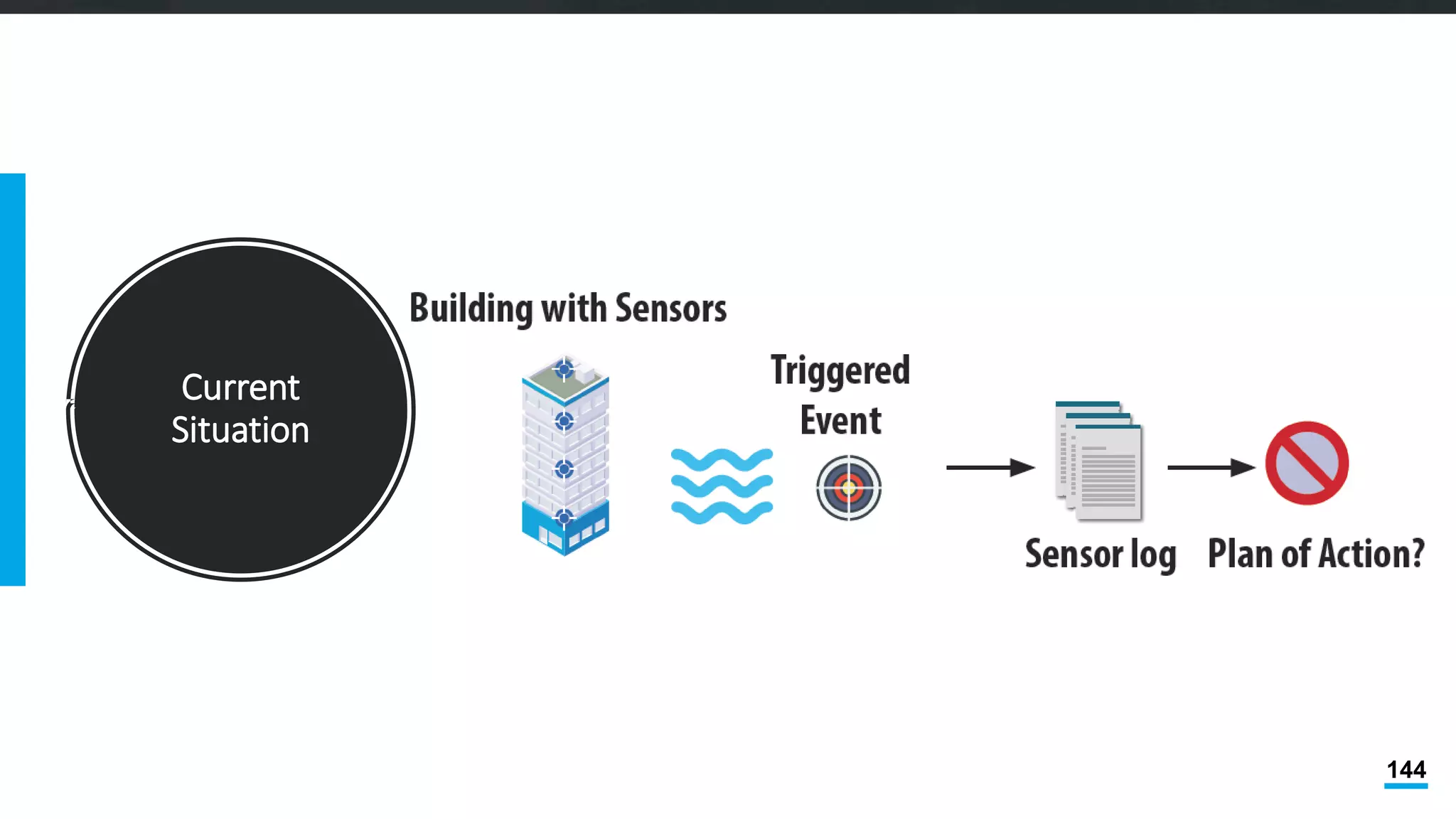
144
Current
Situation
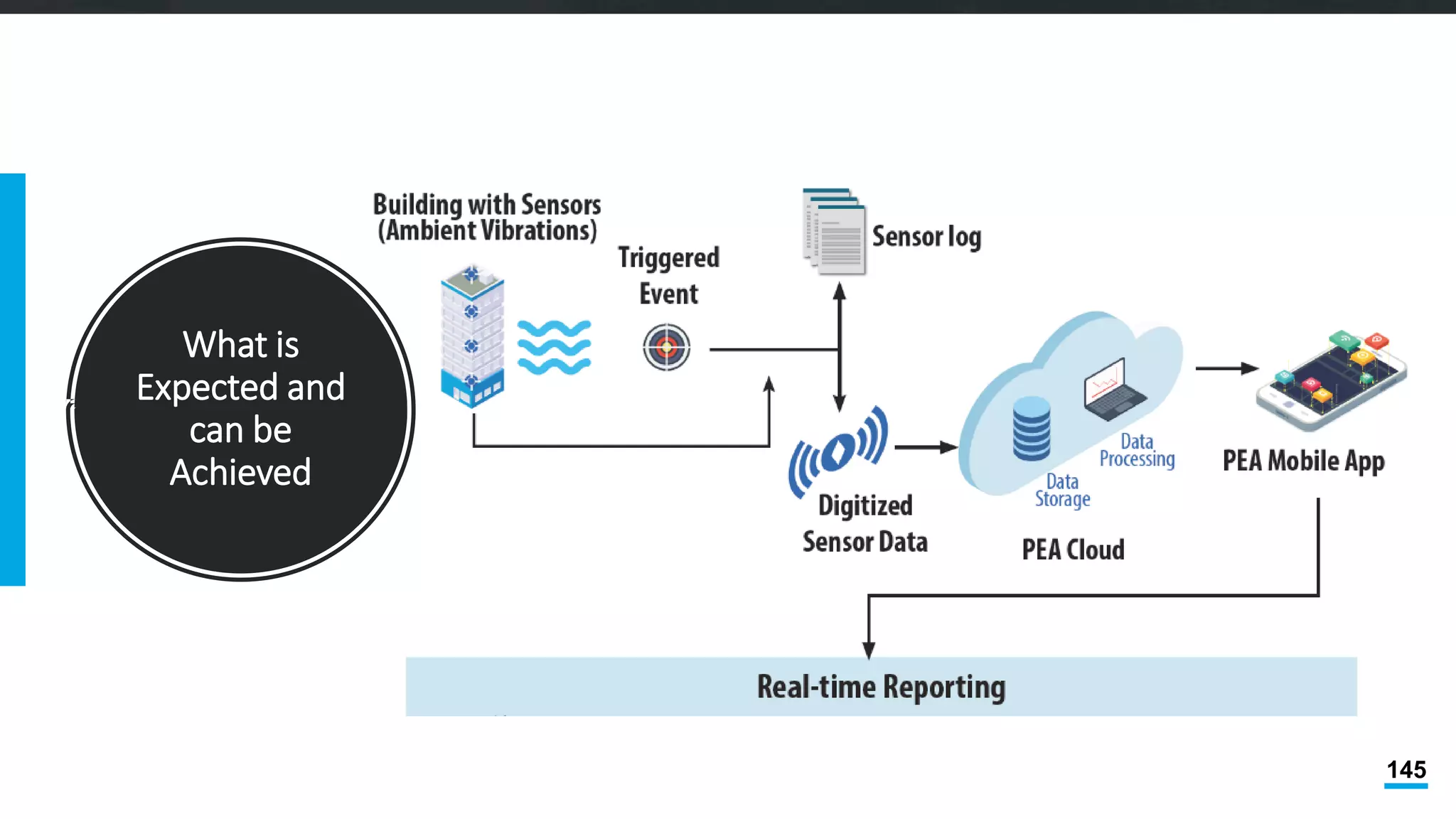
145
What is
Expected and
can be
Achieved
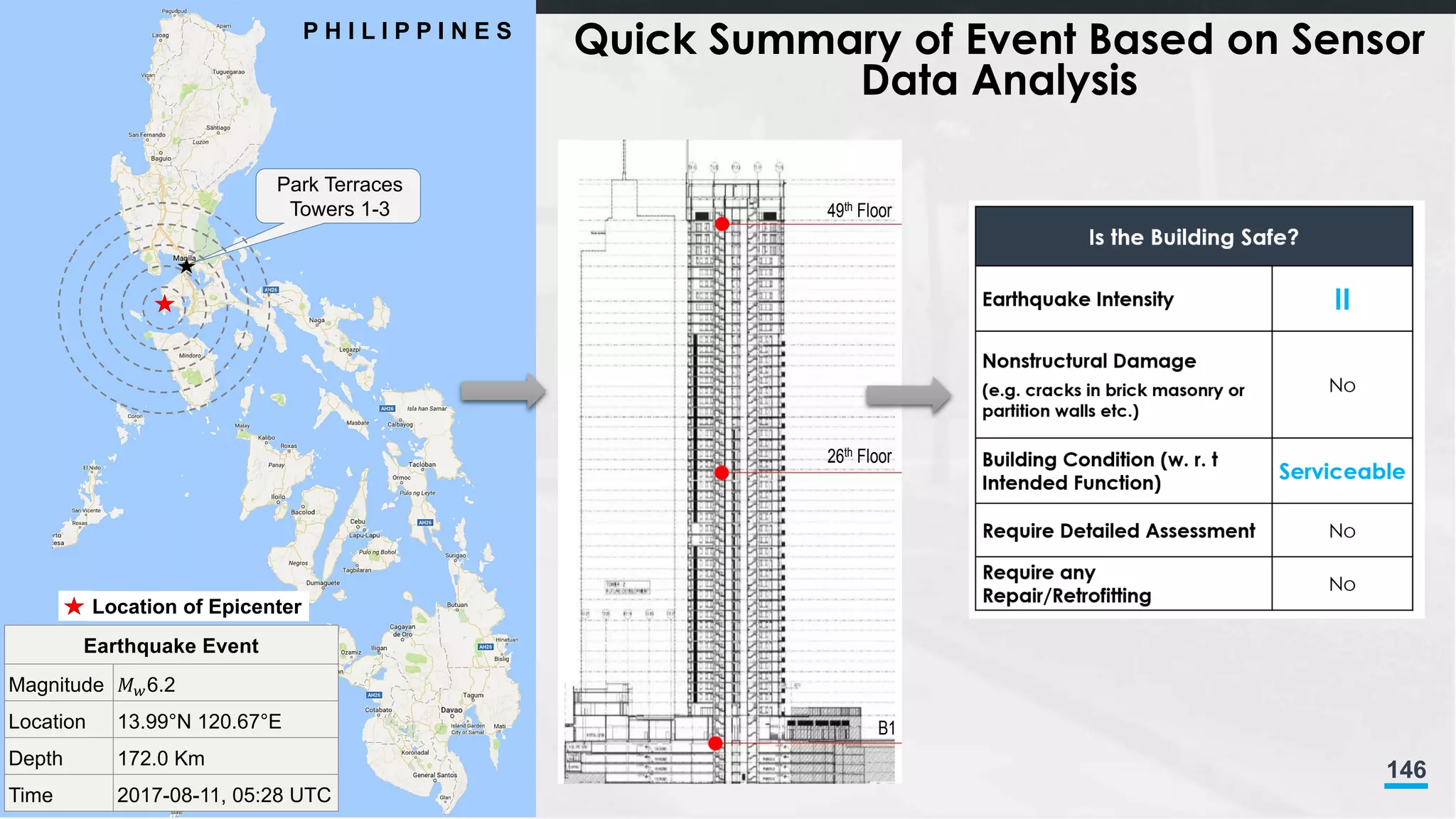
146
49th Floor
26th Floor
B1
Quick Summary of Event Based on Sensor
Data Analysis
Location of Epicenter
Earthquake Event
Magnitude 6.2
Location 13.99 N 120.67 E
Depth 172.0 Km
Time 2017-08-11, 05:28 UTC
P H I L I P P I N E S
Park Terraces
Towers 1-3
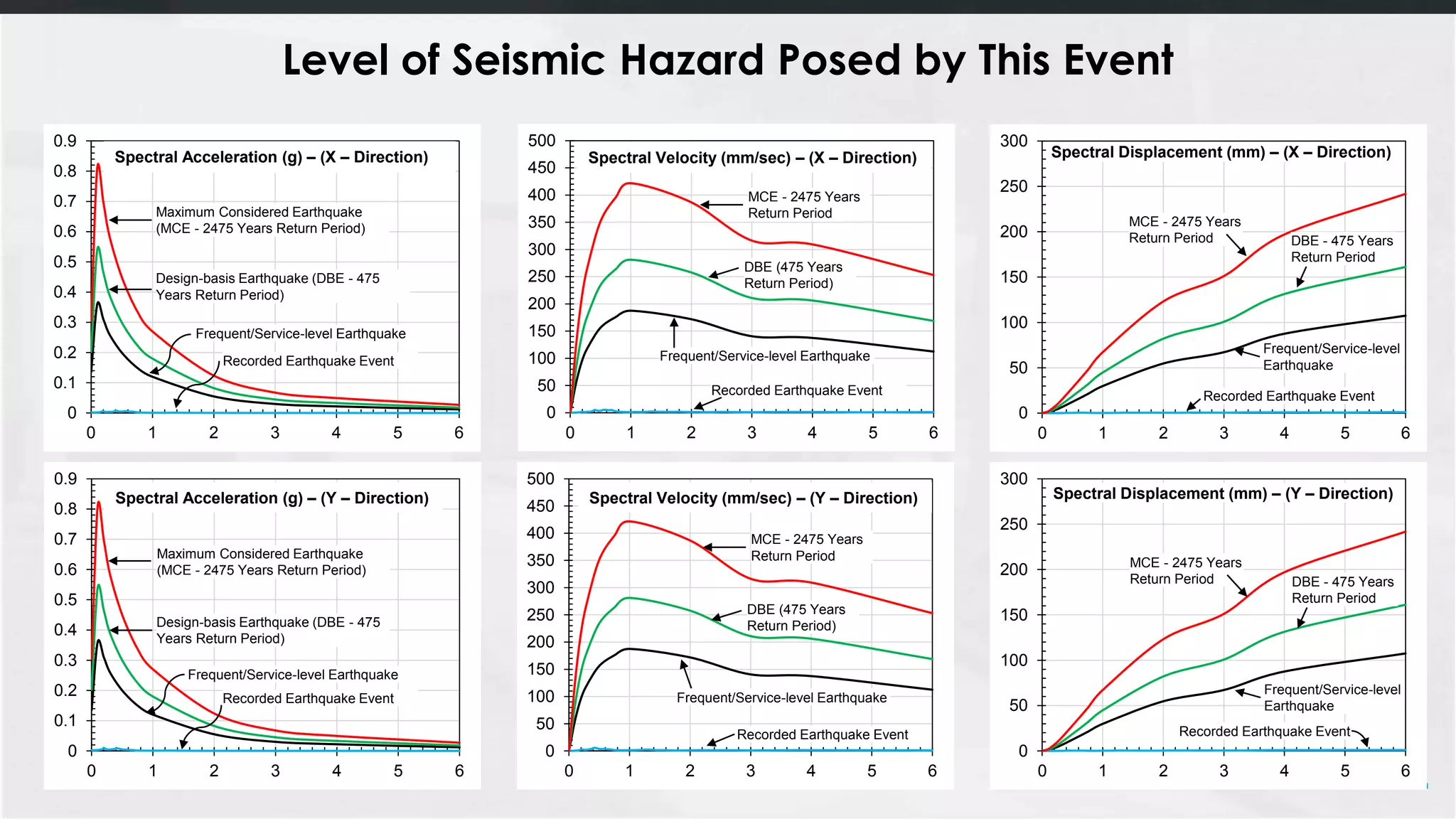
147
0
0.1
0.2
0.3
0.4
0.5
0.6
0.7
0.8
0.9
0 1 2 3 4 5 6
0
0.1
0.2
0.3
0.4
0.5
0.6
0.7
0.8
0.9
0 1 2 3 4 5 6
0
50
100
150
200
250
300
0 1 2 3 4 5 6
0
50
100
150
200
250
300
0 1 2 3 4 5 6
0
50
100
150
200
250
300
350
400
450
500
0 1 2 3 4 5 6
0
50
100
150
200
250
300
350
400
450
500
0 1 2 3 4 5 6
Frequent/Service-level Earthquake
Recorded Earthquake Event
Spectral Acceleration (g) – (X – Direction)
Design-basis Earthquake (DBE - 475
Years Return Period)
Maximum Considered Earthquake
(MCE - 2475 Years Return Period)
Frequent/Service-level Earthquake
Recorded Earthquake Event
Spectral Acceleration (g) – (Y – Direction)
Design-basis Earthquake (DBE - 475
Years Return Period)
Maximum Considered Earthquake
(MCE - 2475 Years Return Period)
Frequent/Service-level Earthquake
Recorded Earthquake Event
Spectral Velocity (mm/sec) – (X – Direction)
DBE (475 Years
Return Period)
MCE - 2475 Years
Return Period
Spectral Velocity (mm/sec) – (Y – Direction)
Frequent/Service-level Earthquake
Recorded Earthquake Event
DBE (475 Years
Return Period)
MCE - 2475 Years
Return Period
Frequent/Service-level
Earthquake
Recorded Earthquake Event
Spectral Displacement (mm) – (X – Direction)
DBE - 475 Years
Return Period
MCE - 2475 Years
Return Period
Spectral Displacement (mm) – (Y – Direction)
Frequent/Service-level
Earthquake
Recorded Earthquake Event
DBE - 475 Years
Return Period
MCE - 2475 Years
Return Period
Level of Seismic Hazard Posed by This Event
148
In the view of practicing structural engineer a gap
between what is taught and what is needed to
practice in performance based design is filled by on
job learning and knowledge acquired from
experienced engineers
Thank you for your kind
attention
View publication statsView publication stats

Overview of Performance Based Design and AIT Experience

  • 1.
  • 2.
    2 • Located 42km from central Bangkok • 330 acre (130 Ha) green campus • Adjacent to Thammasat University & Thailand Science Park, Thailand’s National Science and Technology Development Agency (NSTDA) • Home to 2500+ faculty, staff, students from 50+ countries AIT Campus 2
  • 3.
    3 Asian Institute ofTechnology (AIT) SET SERD SOM
  • 4.
    4 AIT Solutions establishedin AIT since 2010
  • 5.
    5 Pls replace thetext in the circle with our mission (next slide) “Building upon AIT schools, labs, research centers, and alumni resources to advance technological development of the region”
  • 6.
  • 7.
  • 8.
    8 Primary Focus ofResearch and Projects Clients, Partners, Consultants PBD Value Engineering Peer Review Structural System Development Smart Structures Wind Tunnel Studies Failure Investigations Innovative Solutions Specialized Modeling and Analyses

  • 9.
    9 Wind Engineering Solutions Structural dynamic windloads & response study Structural dynamic wind loads & response study Facade pressure study
  • 10.
    10 100 200 300 metres PBD of 100+Tall Buildings Gramercy Residences Stratford Residences Shang Salcedo Place Royalton Tower Discovery Primea One Shangri-la Place (Tower 1&2) Anchor Grandsuites Maven Tower 1 Knightsbridge Residences Imperium Tower Park Terraces Tower Garden Tower Shangri-la at the Fort Trump Tower
  • 11.
    11 11 Why this Seminar? Andwhy are these topics important
  • 12.
    12 Colombo 2015 Kathmandu 2016 Bangkok2016 Singapore 2016 Manila 2016 Oman 2017 Dubai 2017 Yangon 2015 Islamabad 2017 Wah 2017 NED 2017 Manila 2017 Hanoi 2017 Singapore 2017 Yangon 2017 MUET 2017
  • 13.
    Structural Engineering isthe Basis for Built Environment
  • 14.
  • 15.
  • 16.
  • 17.
  • 18.
  • 19.
  • 20.
  • 21.
  • 22.
  • 23.
  • 24.
  • 25.
  • 26.
  • 27.
    27 27 A MUST readfor structural Engineers
  • 28.
    Demand and Complexityis Increasing for the Built Environment
  • 29.
  • 30.
  • 31.
    Population Growth isin Developing World 31 Source: www.prb.org, volume no. 66, July, 2011. Less Developed Countries will need more Low Cost Housing and infrastructure for nearly 2 Billon more people
  • 32.
    Visions for theFuture are for “Vertical Cities” 32 Japan, 4000m Sky Mile Tower, 1700 m JapanDubai City Tower, 2400 m One Dubai Tower, 1008 m
  • 33.
  • 34.
  • 35.
    35 35 The Twisting TurningTowers Trend Source: CTBU Report, 2015
  • 36.
  • 37.
    37 Buildings and Structuresare expected to be • Safe • Secure • Serviceable • Reliable • The contents of the structures are often much more valuable than structure itself • The loss of service/operations/business is a often larger than repair costs • Protective • Friendly • Sustainable • Affordable
  • 38.
    38 Key Challenges in(Tall) Buildings • Taller • Slender • Twisting • Unusual forms • Multi Use • Changing Plans • Larger column free spaces • Smaller Cores • Minimizing Floor Height • Minimize floor depth • Minimize column size • Minimize structural cost • Inclined columns • Free form • Unusual requests
  • 39.
    39 How does CTBUHlook at Tall 39 Relatively Tall. Both for public and the professions who design and construct Proportion Slenderness, in plan and in elevations Systems and Technologies Uses something “different” than ordinary buildings
  • 40.
  • 41.
    41 Main Structural Concerns Stabilityand integrity 01 Strength and Servivbility 02 Deformation 03 Drift 04 Ductility 05 Energy Dissipation 06 Motion Perception 07
  • 42.
    42 Building Industry relieson Codes and Standards • Codes Specify requirements • Give acceptable solutions • Prescribe (detailed) procedures, rules, limits • (Mostly based on research and experience but not always rational) Spirit of the code is to help ensure Public Safety and provide formal/legal basis for design decisions Compliance to letter of the code is indented to meet the spirit
  • 43.
    43 What a StructuralEngineer said ! Hardy Cross, 1885-1959
  • 44.
    44  For mostbuildings, dynamic wind response may be neglected  Gust factor approach  predict dynamic response of buildings with reasonable accuracy  Structures are designed to respond elastically under factored loads  Structures are designed to respond inelastically under factored loads  it is not economically feasible to design structures to respond elastically to earthquake ground motion Design for Seismic EffectsDesign for Wind Load
  • 45.
    45 Basic Physics ofDynamics • Newton’s View, for rigid bodies F = ma
  • 46.
    46 Structural engineer’s View FKuuCuM  for linear elastic, deformable bodies
  • 47.
    47 Dynamic Equilibrium FFKuuCuM NL  Damping-Velocity Mass-Acceleration Stiffness-Displacement Nonlinearity External Force KuuCuM   The basic variable is displacement and its derivatives
  • 48.
    48 Seismic Response FFKuuCuM NL  Linear Time History Analysis 0 KuuM  EQNL FFKu  Free Vibration Pushover Analysis EQFKu  Equivalent Static Analysis EQFKu  Response Spectrums Response Spectrum Analysis Acceleration Records guMKuuCuM   Nonlinear Time History Analysis
  • 49.
    49 Typical Linear DynamicResponse of Tall Building Animation
  • 50.
    50  Structures aredesigned to respond inelastically under factored loads  it is not economically feasible to design structures to respond elastically to earthquake ground motion Design for Seismic Effects
  • 51.
    Introducing AIT Solutions 51 0 5 10 15 20 25 30 35 40 45 010 20 30 40 50 60 The Problem with R Factor The elastic forces obtained from the standard RSA procedure The RSA elastic forces reduced by 𝑅 The inelastic forces obtained from the NLRHA procedure The actual reduction in RSA elastic forces. The “reward” of making a nonlinear model The underestimation causing a “false sense of safety” due to directly reducing the RSA elastic forces by 𝑅 factor Story Shear (x106 N) StoryLevel • The R factor may vary from 2 to 8 depending on definition of structure type • R factor could “off” by a factor of 2 to 4 • Other names for R factor are Response Factor, Behavior Factor (q), Structure Type factor (K) etc., Fawad Najam, 2017
  • 52.
    52 Effect of Modeson Story Moment 52
  • 53.
    53 Effect of Modeson Story Shear 53
  • 54.
    54 The Problem withR (and other) Factors Reducing each mode with same factor can underestimate demand Each Mode undergo different level of nonlinearity Modified Modal Superposition (Priestley and Amaris, 2002) R applied to only first mode, with higher modes assumed elastic Solution (Rachut, 2013) Uncoupled modal response history analysis (UMRHA) R” factor can only accurately reduce true demand of the 1st mode
  • 55.
    55 Are All Buildings Codes Correct ? •All codes have different values of R and other factors • If they differ, can all of them be correct ? • Did we inform the structures to follow which code when earthquake or hurricane strikes ? • Codes change every 3 or years, should we upgrade our structures every 3 or 5 years to conform ?
  • 56.
    56 Code Comparison for Seismic Performance • ComparePerformance of buildings designed to different codes • ACI 318-14 + ASCE 7-10 • BS 8110-1997 + EURO-8 • EURO-2-2004 + EURO-8 • For low-seismic and high seismic zone • Manila > Very High • Bangkok > Low to medium • All produce different level or performance in different components !! Two MS Thesis, 2016 at AIT
  • 57.
    Shift From Prescriptiveto Performance Based Approach
  • 58.
    58 Prescriptive vs. Performance ApproachProcedure Outcome Prescriptive (emphasis on procedures) Specify “what, and how to do” Make Concrete: 1:2:4 Implicit Expectation (a strength of 50 MPA is expected) Performance Based Approach (emphasis on Key Performance Indicators) What ever it takes (within certain bounds) Explicit Performance Concrete less than 40 MPA is rejected
  • 59.
    59 Prescriptive Codes –A Shelter and an Impediment • Public: • Is my structure safe ? • Structural Engineer: • Not sure, but I did follow the “Code” As long as engineers follow the code, they can be sheltered by its provisions
  • 60.
  • 61.
    61 Capacity Based on“Assumed” Failure Conditions
  • 62.
  • 63.
    63 A Move TowardsPerformance-based Approach • Prescriptive Codes restrict and discourage innovation Objective Requirements Prescribed Solution Objective Requirements Alternate Solution • Performance Based approach encourages and liberates it
  • 64.
    64 • Lack ofexplicit performance in design codes is primary motivation for performance based design • Performance based methods require the designer to assess how a building is likely perform extreme events and their correct application will help to identify unsafe designs. • Enables arbitrary restrictions to be lifted and provides scope for the development of innovative, safer and more cost-effective solutions
  • 65.
    65 Design Approaches Intuitive Design Prescriptive CodeBased Design Performance Based Design >> >>>
  • 66.
    66 Performance based designcan be applied to any type of loads, but was initially developed and targeted for earthquake loads
  • 67.
  • 68.
    68 Typical PB Review Enhance Structural Performance Improved serviceability,safety and reliability Explicit check on various performance indicators Improve Cost Effectiveness Achieve efficient use of materials, resources and time Direct reduction cost through reduction of structural material quantities Objectives to be achieved through Better structural system selection and its proportions Use of advanced design methodologies and tools
  • 69.
    69 Explicit Performance Objectivein PBD Performance based design investigates at least two performance objectives explicitly Service-level Assessment Ensure continuity of service for frequent hazards (Earthquake having a return period of about 50) Collapse-level Assessment Ensure Collapse prevention under extreme hazards (the largest earthquake with a return period of 2500 years) Codes arbitrary implicit “Design Level”
  • 70.
    70 Performance Objectives Level ofEarthquake Seismic Performance Objective Frequent/Service (SLE): 50% probability of exceedance in 30 years (43-year return period) Serviceability: Structure to remain essentially elastic with minor damage to structural and non- structural elements Design Basis Earthquake (DBE): 10% probability of exceedance in 50 years (475-year return period) Code Level: Moderate structural damage; extensive repairs may be required Maximum Considered Earthquake (MCE): 2% probability of exceedance in 50 years (2475-year return period) Collapse Prevention: Extensive structural damage; repairs are required and may not be economically feasible
  • 71.
    71 Seismic Hazard Spectrum,SLE and MCE MCE Level Service Level
  • 72.
    72 Selecting and ScalingGround Motions Best represent – the characteristics of expected event at the site  Magnitude  Distance  Fault type Scaling Spectral matchingUniform scale factor applied Using wavelet adjustment Amplitude scaling Need fewer ground motion Frequency domain Time domain Use RSPMatch Software Unrealistic – high energy content in the lower period range Distorted displacement & velocity records of original ground motion Selecting (Kevin & Finley,2014) Spectral matched Amplitude scaled Use 7 ground motion records and scale it to MCE level for NLRHA method (Klemencic et al. , 2007) Uniform Hazard Spectrum VS Conditional Mean Spectrum
  • 73.
    73 Analysis Procedures Non-Linear Response HistoryAnalysis (NLRHA) Non-Linear Static Procedure (NSP) Construction Sequence Analysis Uncoupled Modal Response History Analysis (UMRHA)—Chopra and Goel (2002) Linear Response Spectrum Analysis (LRSA) Linear Response History Analysis (LRHA) NeedR
  • 74.
    74 Judging Performance Acceptability •Acceptance criteria are indicators of whether the predicted performance is adequate for • Local (component based) • Global (overall structure-based) • The non-linearity and inelasticity need to be realized and considered
  • 75.
  • 76.
    76 Performance Based DesignProcess Acceptance Criteria for Primary Components
  • 77.
    77 Performance Based DesignProcess Acceptance Criteria for Secondary Components
  • 78.
    78 Classification of Actions ElementAction Type Classification Expected Behavior RC column Axial-flexure Shear Ductile Brittle Linear Linear RC shear wall Flexure Shear Ductile Brittle Nonlinear Linear RC coupling beams (Deep beam, ln/d<4.0) Shear Ductile Nonlinear RC coupling beams (slender beam, ln/d≥4.0 Flexure Shear Ductile Brittle Nonlinear Linear
  • 79.
    79 MCE Acceptance 79 Acceptance Criteriafor Maximum Considered Earthquake (MCE) Item Value Peak transient drift (TBI, Page 71) , (LATBSDC, Page 40) Maximum of mean values shall not exceed 3%. Maximum drift shall not exceed 4.5%. Residual drift (TBI, Page 71) , (LATBSDC, Page 40) Maximum of mean values shall not exceed 1%. Maximum drift shall not exceed 1.5%. Coupling beam inelastic rotation ≤ASCE 41-13 limits Column Inelastic Rotation ≤ASCE 41-13 limits Shear wall reinforcement axial strain ≤0.05 in tension and ≤0.02 in compression Shear wall shear Remain elastic. (Check for 1.5 times mean value) Girder inelastic rotation ≤ASCE 41-13 limits Girders shear Remain elastic. Force Structural Displacement Immediate Occupancy (IO) Life Safety (LS) Collapse Prevention (CP)
  • 80.
    80 Demand Capacity (DC Ratio) • Definitionof D/C: It is an index that gives an overall relationship between affects of load and ability of member to resists those affects. • This is a normalized factor that means D/C ratio value of 1 indicates that the capacity (strength, deformation etc) member is just enough to fulfill the load demand. • Two types of D/C ratio  Members with brittle behavior D/C is checked by Strength (Elastic)  Members with ductile behavior D/C is checked by deformation (Inelastic) • Total D/C ratio of the member is combined of these two.
  • 81.
    81 Cost Effectiveness >Utilization Ratio • Utilization Ratio • Compare, What is Needed against What is Required • One measure • The Demand/ Capacity Ratio (D/C) Demand/ Capacity Columns No. % D/C<0.5 178 16% 0.5<D/C<0.7 534 49% 0.7<D/C<1 346 31% 1<D/C<1.5 30 3% 1.5<D/C<2.5 12 1% D/C>2.5 0 0% Total 1100 100.00% Ideal Not Cost Effective Not Safe
  • 82.
    Special Purposes Guidelinesfrom USA for PBD 82 Applied Technology Council (ATC) Federal Emergency Management Agency (FEMA) and National Earthquake Hazards Reduction Program (NEHRP) PEER Guidelines for Tall Buildings Tall Buildings Initiatives (TBI) CTBUH Guidelines
  • 83.
    AIT and PBD •Research labs to support innovation • More than 100 tall building projects in Asia • Carried out for several developers and structural engineers • Many of which further reviewed by third-party experts based in the USA • More than 50 MS and PhD Thesis on PBD Tall Buildings
  • 84.
  • 85.
    85 Tower 1 Tower 2 ACase Study For Explanation of Process • 51-story high-rise residential building • 4-story below-grade car parking • Approximately 170 m high • Post-tensioned slab column frames and bearing walls • Mat foundation system 85
  • 86.
  • 87.
    87 Overall Design Methodology 87 1 Preliminary Design (Code based design approach) (byDesigner) 2 Service Level Evaluation (43-year return period) 3 Collapse Prevention Level Evaluation (2475-year return period)
  • 88.
    88 Seismic Performance Objectives 88 Levelof Earthquake Seismic Performance Objective Frequent/Service Level Earthquake (SLE): 50% probability of exceedance in 30 years (43-year return period) Serviceability: Limited structural damage, should not affect the ability of the structure to survive future Maximum Considered Earthquake shaking even if not repaired. Maximum Considered Earthquake (MCE): 2% probability of exceedance in 50 years (2475-year return period) Collapse Prevention: Building may be on the verge of partial or total collapse, extensive structural damage; repairs are required and may not be economically feasible.
  • 89.
    89 Acceptance Criteria (SLE) 89 ItemLimit Story drift 0.5% Link beam Remain elastic Shear wall Remain elastic Column Remain elastic • Demand to capacity of the primary structural members shall not exceed 1.5, in which the capacity is computed by nominal strength multiplied by the corresponding strength reduction factor in accordance with ACI 318. • It is anticipated that the demand to capacity ratio of 1.5 based on design strengths can be expected to result in only minor inelastic response.
  • 90.
    90 Acceptance Criteria (MCE) 90 ItemLimit Peak transient drift Mean value shall not exceed 3%. Maximum drift shall not exceed 4.5%. Residual drift Mean value shall not exceed 1%. Maximum drift shall not exceed 1.5%. Column Remain elastic Link beam rotation Conventional Reinf. ≤ 0.04 radians Shear wall reinforcement strain ≤ 0.05 in tension ≤ 0.02 in compression Shear wall concrete strain Intermediately confined concrete ≤ 0.004 + 0.1 ρ (fy / f'c) Fully confined concrete ≤ 0.015 Force-controlled action demand shall be 1.5 times the mean if it is not limited by well defined yield mechanism. If it is limited by well-defined yield mechanism, use the mean plus 1.3 times standard deviation but not less than 1.2 times the mean. The capacity is determined based on expected material properties with corresponding strength reduction factor.
  • 91.
    91 Seismic Input 91 0 0.2 0.4 0.6 0.8 1 1.2 1.4 1.6 0 12 3 4 5 6 7 8 9 10 SPECTRALACCELERATION(g) PERIOD (sec) RESPONSE SPECTRA SLE 2.5% Damping MCE 5% Damping
  • 92.
    92 Ground Motion Selection Modifiedby adding small wavelets to the time series to finally obtain accurate spectral matching with MCE ( Munir, 2011 ) Use RspMatch software to match the records to target spectrum Use PEER NGA and COSMOS databases (PEER, 2005, COSMOS 1999-2007) to find suitable ground motion records  7 ground motion records Records scaled by a constant factor  spectrum roughly match with that of MCE MCE response spectrum is assumed to be 1.5 times the 5% damped DBE response spectrum. Uniform Hazard Spectrum Vs Conditional Mean Spectrum
  • 93.
    93 Finite Element Model •Linear Elastic Model • Used for DBE, SLE and wind analysis • Used ETABS • All components were modeled as elastic. • Response spectrum analysis was conducted for DBE and SLE earthquakes. • Nonlinear, Inelastic Model • Used for MCE analysis • Used Perform 3D • Inelastic member properties • Flexural response of shear walls • Flexural response of coupling beams • Flexural response of slab outrigger beams • Elements that are assumed to remain elastic were modeled with elastic member properties. • Nonlinear time history analysis was conducted for seven sets of ground motions. 93
  • 94.
    94 Recognizing and ConsideringNonlinearity 94 Advanced Concrete l Dr. Naveed Anwar
  • 95.
    95 Nonlinear Modelling Fig: IdealizedModels of Beam-Column Elements NEHRP Seismic Design Technical Brief No.4 Consider Geometric nonlinearity (P-∆) effects
  • 96.
    96 NL Modeling ofShear Walls  For fiber elements  use adequate amount of concrete and steel fibers  Each one of these fibers is assigned nonlinear material stress-strain relationship (Modeling for Structural Analysis, Behavior and Basics. Graham H. Powell)
  • 97.
    97 Material Models Mander’s modelfor concretePark’s model for steel
  • 99.
    99 Modal Analysis ResultsTranslationin Minor direction Translationin Major direction Torsional •T1=5.32 sec • 60% in Minor direction • T6=1.28 sec • 18% in Minor direction • T9=0.75 sec • 6.5% in Minor direction • T2=4.96 sec • 66% in Major direction • T7=0.81 sec • 5.2% in Major direction • T4=1.56 sec • 15% in Major direction T3=4.12 sec T8=0.65secT5=1.30 sec
  • 100.
    100 Base Shear 100 4.1% 2.9% 13.2% 8.7% 3.4% 5.4% 20.0% 14.3% 10.9% 7.0% 0% 5% 10% 15% 20% 25% X Y BaseShear% AlongDirection Base Shear Percentage of Total Weight of Building Elastic SLE Elastic DBE Wind*1.6 (RWDI) Elastic MCE Inelastic MCE NLTHA
  • 101.
    101 Story Drift 101 0 10 20 30 40 50 -5% 0%5% Story Transient Drift (%) Transient Drift in X-dir. at MCE Level ARC CHY DAY ERZ LCN ROS TAB Average Avg. Drift Limit Max. Drift Limit 0 10 20 30 40 50 0.0% 0.5% 1.0% 1.5% 2.0% Story Residual Drift (%) Residual Drift in X-dir. at MCE Level ARC CHY DAY ERZ LCN ROS TAB Average Avg. Drift Limit
  • 102.
    102 Story drifts andlateral displacements are within the acceptable limits. The building is expected to remain serviceable under frequent earthquakes. Strength demand to capacity ratios of primary structural members were less than 1.5. Performance Evaluation (SLE) 102
  • 104.
    104 Shear Walls Performance 104 StrainGauge (C04) SW 1-1 -5 5 15 25 35 45 55 -0.006 -0.001 0.004 Story Axial Strain (mm/mm) Wall Axial Strain (C04) ARC CHY DAY ERZ LCN ROS TAB Average Steel Yielding Strain Strain gauge locations in shear walls
  • 105.
    105 Shear Walls 105 -5 5 15 25 35 45 55 -200000 -1000000 100000 200000 Story Shear Force (KN) Shear Wall Shear Demand vs. Capacity (SW1-1) ARC CHY DAY ERZ LCN ROS TAB AVERAGE Capacity Maximum Limit Capacity SW1-1
  • 106.
    106 Coupling Beams 106 -10 0 10 20 30 40 50 60 -0.1 -0.050 0.05 Story Rotation (radians) Link Beam Rotation (LB-1) ARC CHY DAY ERZ LCN ROS TAB Average
  • 107.
  • 108.
    108 Slab Outrigger Beams •Post-tensioned slab was designed as “nonparticipating” system (not part of the lateral load resisting system) to resist the gravity loads under the expected lateral displacements. • Checked by two methods to reduce the likelihood of punching shear failure under seismic loading. • Inelastic rotation of the slab outrigger beams was checked in accordance with ASCE 41. • Story drift with respect to gravity load punching shear D/C ratio was checked in accordance with ACI 318-08 Sect. 21.13.6.
  • 109.
    109 Slab Outrigger Beams 109 0 10 20 30 40 50 -0.050 0.05 0.1 Story Slab Beam Rotation (radians) Moment Hinge Rotation due to Positive and Negative Moment(SB2-1) ARC CHY DAY ERZ LCN ROS TAB Average Limit
  • 110.
    110 Core Only Config1 Config 2 Config 3 Config 4 Config 5 Research on Partial Outrigger Options (Flag Walls)
  • 111.
    111 Diaphragm Transfer Forces Largediaphragm transfer forces should be anticipated at offsets or discontinuities of the vertical elements of the seismic-force- resisting system. (a) Setback in the building profile (b) Podium level at grade.
  • 112.
  • 113.
    113 Typical Diaphragm Components Chord(Diaphragm) Chord (Diaphragm) Collector (Support) Shear Friction (Support) Shear (Diaphragm) Shear Wall Diaphragm 1 2 4 3
  • 114.
    114 Realistic Model -Finite Element Model • Finite element modeling of a diaphragm can be useful for assessing the force transfer among vertical elements, force transfer around large openings or other irregularities. Shear WallsShear Walls Shear Walls
  • 115.
  • 116.
    116 Modeling Options • Individualdesign of tower and podium separately in practice • Restraint of resources such as software, processing time, understanding and references Single tower without podium Single tower with half podium Single tower with whole podium Twin tower with whole podium
  • 117.
  • 118.
    118 Diaphragm Reinforcement 118 Multi TowerScenario for in-phase and out-phase
  • 119.
  • 120.
  • 121.
    121 • Out-of planeflexure and shear (Lateral pressure from soil) • Inertia component • Kinematic component • In-plane shear (force transferred from ground and basement level diaphragms) Basement Walls 121
  • 122.
    122 How to Workwith PBD 122 Requires: • Detailed modeling • Nonlinear-dynamic analysis • Appropriate computing tools, knowledge , skills and lots of patience Go Beyond Codes Sophisticated Structural Modelling Stare of Art Computer based tools
  • 123.
    123 Peer Review Owner Will thebuilding be safe? Can I use the building after the hazard? How much will repair cost in case of damage? How long will it take to repair? Engineer Free to choose solutions, but ensure amount of yielding, buckling, cracking, permanent deformation, acceleration, that structure, members and materials experiences Need a third party to ensure public safety and realistic Performance Guidelines Peer Review
  • 124.
  • 125.
  • 126.
    126 Design Approaches Intuitive Design CodeBased Design Performance Based Design Consequences and Risk Based Design Resilience Based Design
  • 127.
    127Source: Arup, Supportedby USRC and many others Green Buildings Resilient Buildings
  • 128.
    128 Linking Performance toother Indicators 128 Operational (O) Immediate Occupancy (IO) Life Safety (LS) Collapse Prevention (CP) 0 % Damage or Loss 99 % Ref: FEMA 451 B CasualtiesLowest Highest Rehab Cost to Restore after eventLowest Highest Retrofit Cost to Minimize ConsequencesHighest Lowest Downtime for RehabLowest Highest
  • 129.
    129 • A holisticapproach which seeks to identify all hazard-induced risks (including those outside the building envelope) and mitigate them using integrated multi-disciplinary design and contingency planning to achieve swift recovery objectives in the aftermath of a major earthquake. • The key principle in resilience-based design is to limit expected damage to structural and architectural components and egress systems (elevators, stairs, and doors) Resilience Based Earthquake Design
  • 130.
  • 131.
    131 Two Levels of Seismic Hazardis Considered • DBE or Design Basis earthquake (DBE): Defines the peak horizontal acceleration with 10% probability of exceedance in 50 years. • MCE or Maximum Considered Earthquake: Defines the peak horizontal acceleration with 2% probability of exceedance in 50 years. 0 0.1 0.2 0.3 0.4 0.5 0.6 0.7 0.8 0.9 0 1 2 3 4 5 6 Frequent/Service-level Earthquake Spectral Acceleration (g) Maximum Considered Earthquake (MCE - 2475 Years Return Period)
  • 132.
    132 Structural Responses underSLE and MCE Level Seismic Hazard 0 5 10 15 20 25 30 35 40 45 50 55 0 0.002 0.004 0.006 0.008 No:ofstory drift Drift under SLE level Drift-X Drift-Y 0 5 10 15 20 25 30 35 40 45 50 55 0 0.5 1 1.5 2 No:ofstory Acceleration (g) Acceleration under SLE level Acceleration 0 5 10 15 20 25 30 35 40 45 50 55 0 0.2 0.4 0.6 0.8 1 No:ofstory velocity (m/sec) Velocity under SLE level velocity 0 5 10 15 20 25 30 35 40 45 50 55 0 0.005 0.01 0.015 No:ofstory Drift Drift under MCE Drift-X Drift-Y 0 5 10 15 20 25 30 35 40 45 50 55 0 0.5 1 1.5 2 No:ofstory acceleration (g) Acceleration under MCE Acceleration 0 5 10 15 20 25 30 35 40 45 50 55 0 0.5 1 1.5 2 2.5 No:ofstory velocity (m/sec) Velocity under MCE velocity
  • 133.
    133 Overall Nonstructural Damageunder both SLE and MCE 4.7% 0.6% 0.2% 3.9% 23.17% 3.01% 0.84% 19.32% 0.0% 5.0% 10.0% 15.0% 20.0% 25.0% Total damage Architectural damage Mechanical and electrical damage Building content damage Percentageofdamage Service level earthquake Maximum considered earthquake
  • 134.
    134 Repair Cost ofNonstructural Damage under both SLE and MCE 35.48 6.17 6.36 22.95 183.61 58.11 17.31 108.19 0 40 80 120 160 200 Total damage Architectural damage Mechanical and electrical damage Building content damage Directeconomiccost(Million-peso) Service level earthquake Maximum considered earthquake
  • 135.
    135 Serious Injury andCasualty 0 200 400 600 800 1000 1200 1400 1600 Casulty (People) Serious injury (People) Total population Casulty (People) Serious injury (People) Total population Casulty (People) Serious injury (People) Total population Nighttime population distribution Daytime-HAZUS population distribution model Daytime-FEMA population distribution model 1 13 1432 1 4 403 1 7 716 0 1 0 1 0 1 POPULATION (PEOPLE) Service level earthquake Maximum considered earthquake
  • 136.
    Using AI adMachine Learning
  • 137.
    137 A Swing Towardsthe AI • Rich Pictures • Analytical Hierarchy Process (AHP) • Artificial Neural Networks (ANN) • Genetic Algorithms (GA) • Expert Systems (ES) • Machine learning (ML) • Fuzzy Logic • Deep Thinking • Big Data and Data Mining 137
  • 138.
    138 Using AI inStructural Design Process Architectural Design Preliminary Sizing Structural Modeling Structural Analysis Code Based Design Performance Based Design 138 Iterative, computationally intensive and time consuming
  • 139.
  • 141.
    Model I: Predictionof Structural weight per floor area of building Building Target Wt/F.A (kN/sqm) Simulated Accuracy ELM MLP-BP ELM MLP-BP (B1) 14.12 14.46 14.63 0.976 0.963 (B2) 12.99 13.86 12.12 0.933 0.933 (B3) 11.47 13.01 12.24 0.865 0.933 (B4) 14.12 14.75 13.64 0.955 0.966 (B5) 14.12 14.72 13.21 0.957 0.946 14.12 12.99 11.47 14.12 14.12 14.46 13.86 13.01 14.75 14.72 14.63 12.12 12.24 13.64 13.21 B1 B2 B3 B4 B5 Target ELM MLP-BP 0.800 0.850 0.900 0.950 1.000 B1 B2 B3 B4 B5 Mean ELM MLP-BP The average accuracy of ELM network is about 94% The average accuracy of MLP-BP network is about 95% Accuracy
  • 142.
  • 143.
    143 Earthquake and Structures Source:Murty (2004) Force on Buildings Generated due to Acceleration at each Level
  • 144.
  • 145.
  • 146.
    146 49th Floor 26th Floor B1 QuickSummary of Event Based on Sensor Data Analysis Location of Epicenter Earthquake Event Magnitude 6.2 Location 13.99 N 120.67 E Depth 172.0 Km Time 2017-08-11, 05:28 UTC P H I L I P P I N E S Park Terraces Towers 1-3
  • 147.
    147 0 0.1 0.2 0.3 0.4 0.5 0.6 0.7 0.8 0.9 0 1 23 4 5 6 0 0.1 0.2 0.3 0.4 0.5 0.6 0.7 0.8 0.9 0 1 2 3 4 5 6 0 50 100 150 200 250 300 0 1 2 3 4 5 6 0 50 100 150 200 250 300 0 1 2 3 4 5 6 0 50 100 150 200 250 300 350 400 450 500 0 1 2 3 4 5 6 0 50 100 150 200 250 300 350 400 450 500 0 1 2 3 4 5 6 Frequent/Service-level Earthquake Recorded Earthquake Event Spectral Acceleration (g) – (X – Direction) Design-basis Earthquake (DBE - 475 Years Return Period) Maximum Considered Earthquake (MCE - 2475 Years Return Period) Frequent/Service-level Earthquake Recorded Earthquake Event Spectral Acceleration (g) – (Y – Direction) Design-basis Earthquake (DBE - 475 Years Return Period) Maximum Considered Earthquake (MCE - 2475 Years Return Period) Frequent/Service-level Earthquake Recorded Earthquake Event Spectral Velocity (mm/sec) – (X – Direction) DBE (475 Years Return Period) MCE - 2475 Years Return Period Spectral Velocity (mm/sec) – (Y – Direction) Frequent/Service-level Earthquake Recorded Earthquake Event DBE (475 Years Return Period) MCE - 2475 Years Return Period Frequent/Service-level Earthquake Recorded Earthquake Event Spectral Displacement (mm) – (X – Direction) DBE - 475 Years Return Period MCE - 2475 Years Return Period Spectral Displacement (mm) – (Y – Direction) Frequent/Service-level Earthquake Recorded Earthquake Event DBE - 475 Years Return Period MCE - 2475 Years Return Period Level of Seismic Hazard Posed by This Event
  • 148.
    148 In the viewof practicing structural engineer a gap between what is taught and what is needed to practice in performance based design is filled by on job learning and knowledge acquired from experienced engineers
  • 149.
    Thank you foryour kind attention View publication statsView publication stats