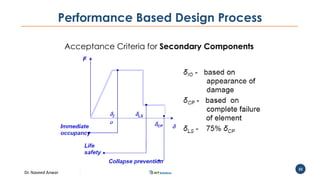
Performance Based Design, Value Engineering, and Peer Review
The document discusses the importance of performance-based design (PBD) and value engineering in the construction of tall buildings, emphasizing the need for enhanced structural safety and sustainability. It identifies key stakeholders and their interests, explores the shortcomings of traditional prescriptive building codes, and advocates for PBD as a means to achieve specified performance objectives under extreme conditions. Additionally, it highlights the necessity of peer review in ensuring design quality and improving overall building performance.
Performance Based Design, Value Engineering, and Peer Review
1.
Dr. Naveed Anwar
PerformanceBased Design, Value
Engineering and Peer Review
Design of Tall Buildings: Trends and Advancements for
Structural Performance
Bangkok-Thailand
November 7-11, 2016
Naveed Anwar, PhD
2.
Dr. Naveed Anwar
2
Isthis acceptable?
(For the people who purchased apartment and lived here)
3.
Dr. Naveed Anwar
3
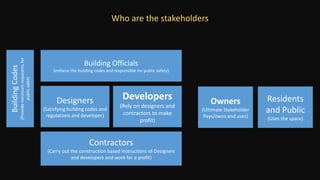
Whoare the stakeholders
Developers
(Rely on designers and
contractors to make
profit)
Designers
(Satisfying building codes and
regulations and developer)
Owners
(Ultimate Stakeholder
Pays/owns and uses)
Building Officials
(enforce the building codes and responsible for public safety)
BuildingCodes
(Provideminimumrequiremsfor
publicsafet)
Contractors
(Carry out the construction based instructions of Designers
and developers and work for a profit)
Residents
and Public
(Uses the space)
4.
Dr. Naveed Anwar
4
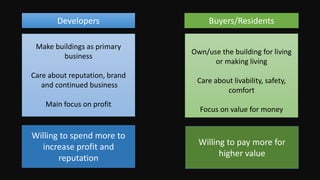
Makebuildings as primary
business
Care about reputation, brand
and continued business
Main focus on profit
Own/use the building for living
or making living
Care about livability, safety,
comfort
Focus on value for money
Developers Buyers/Residents
Willing to spend more to
increase profit and
reputation
Willing to pay more for
higher value
5.
Dr. Naveed Anwar
5
Howcan we increase the value so
the buyers are willing to pay more
And the developer gets higher profit
Public gets a better building
Everyone wins!
6.
Dr. Naveed Anwar
6
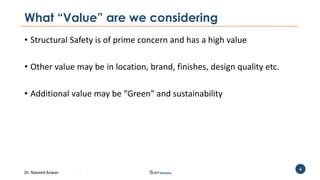
What“Value” are we considering
• Structural Safety is of prime concern and has a high value
• Other value may be in location, brand, finishes, design quality etc.
• Additional value may be “Green” and sustainability
7.
Dr. Naveed Anwar
7
•A safer and high performance building is more environmentally
sustainable
• People pay more for higher sustainability so should pay more for
higher and performance
8.
Dr. Naveed Anwar
8
•Compare Value Engineering and PBD
• What the developers want
• Increase profit
• Reputation/ branding
• Reducing cost is one way > Value Engineering
• PBD - increasing safety, value, selling price and branding is another
• Give example of cost /Sq m and cost of review, PBD etc
• How PBD Works
9.
Dr. Naveed Anwar
9
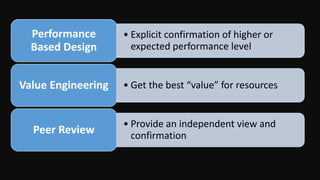
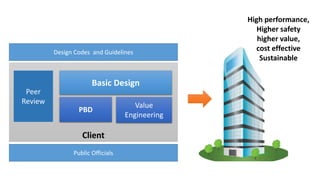
•Explicit confirmation of higher or
expected performance level
Performance
Based Design
• Get the best “value” for resourcesValue Engineering
• Provide an independent view and
confirmation
Peer Review
Dr. Naveed Anwar
11
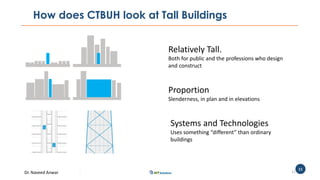
Howdoes CTBUH look at Tall Buildings
11
Relatively Tall.
Both for public and the professions who design
and construct
Proportion
Slenderness, in plan and in elevations
Systems and Technologies
Uses something “different” than ordinary
buildings
12.
Dr. Naveed Anwar
12
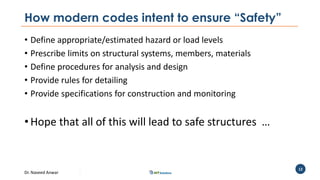
Howmodern codes intent to ensure “Safety”
• Define appropriate/estimated hazard or load levels
• Prescribe limits on structural systems, members, materials
• Define procedures for analysis and design
• Provide rules for detailing
• Provide specifications for construction and monitoring
• Hope that all of this will lead to safe structures …
13.
Dr. Naveed Anwar
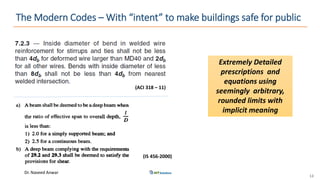
TheModern Codes – With “intent” to make buildings safe for public
13
(ACI 318 – 11)
Extremely Detailed
prescriptions and
equations using
seemingly arbitrary,
rounded limits with
implicit meaning
(IS 456-2000)
14.
Dr. Naveed Anwar
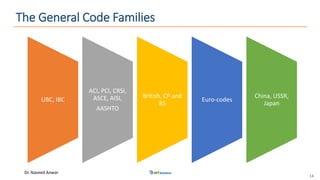
TheGeneral Code Families
14
UBC, IBC
ACI, PCI, CRSI,
ASCE, AISI,
AASHTO
British, CP and
BS
Euro-codes
China, USSR,
Japan
15.
Dr. Naveed Anwar
15
AreAll Buildings Codes Correct ?
• If they differ, can all of them be correct ?
• Did we inform the structures to follow which code when earthquake or hurricane
strikes ?
• Codes change every 3 or years, should we upgrade our structures every 3 or 5
years to conform ?
16.
Dr. Naveed Anwar
16
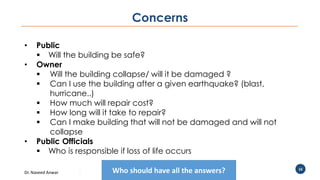
Concerns
•Public
Will the building be safe?
• Owner
Will the building collapse/ will it be damaged ?
Can I use the building after a given earthquake? (blast,
hurricane..)
How much will repair cost?
How long will it take to repair?
Can I make building that will not be damaged and will not
collapse
• Public Officials
Who is responsible if loss of life occurs
Who should have all the answers?
17.
Dr. Naveed Anwar
17
StructuralEngineer’s Dilemma
• Can not answer most of the these questions explicitly
• Answers are always qualified
• There is no warranty for the structure
• There are too many unknowns
• Public understanding and engineers understanding of safety is
different
• Has to hide behind the design codes
18.
Dr. Naveed Anwar
18
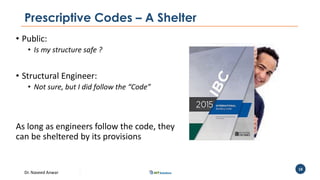
PrescriptiveCodes – A Shelter
• Public:
• Is my structure safe ?
• Structural Engineer:
• Not sure, but I did follow the “Code”
As long as engineers follow the code, they
can be sheltered by its provisions
19.
Dr. Naveed Anwar
19
Shortcomingsof Code Based Design for Tall Buildings
• Traditional codes govern design of general, normal buildings
Over 95% buildings are covered, which are less than about 50 m
• Not specifically developed for tall buildings > 50 m tall
• Prescriptive in nature, no explicit check on outcome
• Permit a limited number of structural systems
• Do not include framing systems appropriate for high-rise
• Based on elastic methods of analysis
• Enforce uniform detailing rules on all members
• Enforce unreasonable demand distribution rules
• Do not take advantage of recent computing tools
20.
Dr. Naveed Anwar
20
Motivationfor PBD
• Lack of explicit performance in design codes is primary motivation
for performance based design
• Performance based methods require the designer to assess how a
building is likely perform under earthquake shaking and other
extreme events and their correct application will help to identify
unsafe designs.
• At the same time this approach enables arbitrary restrictions to be
lifted and provides scope for the development of safer and more
cost-effective structural solutions
21.
Dr. Naveed Anwar
21
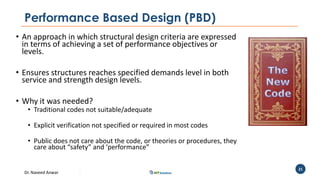
PerformanceBased Design (PBD)
• An approach in which structural design criteria are expressed
in terms of achieving a set of performance objectives or
levels.
• Ensures structures reaches specified demands level in both
service and strength design levels.
• Why it was needed?
• Traditional codes not suitable/adequate
• Explicit verification not specified or required in most codes
• Public does not care about the code, or theories or procedures, they
care about “safety” and ‘performance”
22.
Dr. Naveed Anwar
22
Performancebased design
can be applied to any type
of loads, but is typically
suitable and targeted for
earthquake loads
23.
Dr. Naveed Anwar
23
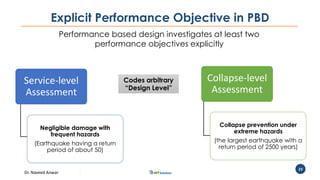
ExplicitPerformance Objective in PBD
Performance based design investigates at least two
performance objectives explicitly
Service-level
Assessment
Negligible damage with
frequent hazards
(Earthquake having a return
period of about 50)
Collapse-level
Assessment
Collapse prevention under
extreme hazards
(the largest earthquake with a
return period of 2500 years)
Codes arbitrary
“Design Level”
24.
Dr. Naveed Anwar
24
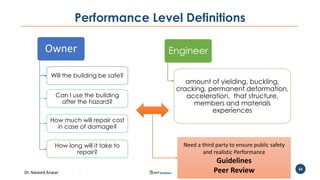
PerformanceLevel Definitions
Owner
Will the building be safe?
Can I use the building
after the hazard?
How much will repair cost
in case of damage?
How long will it take to
repair?
Engineer
amount of yielding, buckling,
cracking, permanent deformation,
acceleration, that structure,
members and materials
experiences
Need a third party to ensure public safety
and realistic Performance
Guidelines
Peer Review
25.
Dr. Naveed Anwar
25
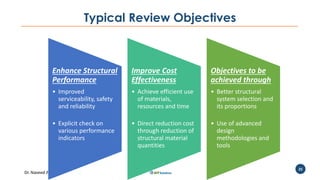
TypicalReview Objectives
Enhance Structural
Performance
• Improved
serviceability, safety
and reliability
• Explicit check on
various performance
indicators
Improve Cost
Effectiveness
• Achieve efficient use
of materials,
resources and time
• Direct reduction cost
through reduction of
structural material
quantities
Objectives to be
achieved through
• Better structural
system selection and
its proportions
• Use of advanced
design
methodologies and
tools
26.
Dr. Naveed Anwar
26
TypicalReview Objectives
Enhancement of Performance
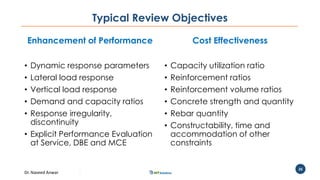
• Dynamic response parameters
• Lateral load response
• Vertical load response
• Demand and capacity ratios
• Response irregularity,
discontinuity
• Explicit Performance Evaluation
at Service, DBE and MCE
Cost Effectiveness
• Capacity utilization ratio
• Reinforcement ratios
• Reinforcement volume ratios
• Concrete strength and quantity
• Rebar quantity
• Constructability, time and
accommodation of other
constraints
27.
Dr. Naveed Anwar
27
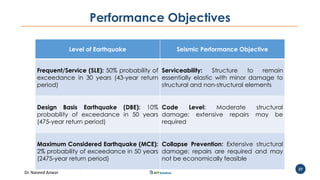
PerformanceObjectives
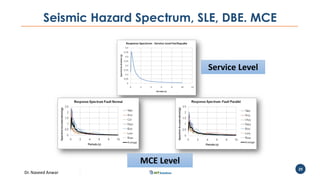
Level of Earthquake Seismic Performance Objective
Frequent/Service (SLE): 50% probability of
exceedance in 30 years (43-year return
period)
Serviceability: Structure to remain
essentially elastic with minor damage to
structural and non-structural elements
Design Basis Earthquake (DBE): 10%
probability of exceedance in 50 years
(475-year return period)
Code Level: Moderate structural
damage; extensive repairs may be
required
Maximum Considered Earthquake (MCE):
2% probability of exceedance in 50 years
(2475-year return period)
Collapse Prevention: Extensive structural
damage; repairs are required and may
not be economically feasible
Dr. Naveed Anwar
30
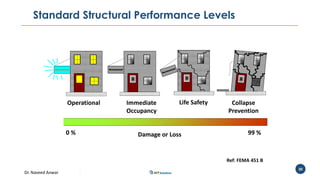
StandardStructural Performance Levels
Restaurant Restaurant
Restaurant
Operational Immediate
Occupancy
Life Safety Collapse
Prevention
0 % Damage or Loss 99 %
Ref: FEMA 451 B
31.
Dr. Naveed Anwar
31
JudgingPerformance Acceptability
• Acceptance criteria are indicators of whether the predicted
performance is adequate for
• Local (component based)
Example: Drift ratio, structural component deformation
• Global (overall structure-based)
Example: Roof drift , base shear
Dr. Naveed Anwar
34
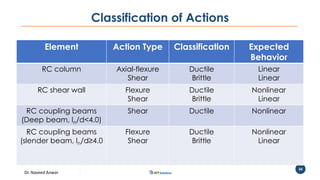
Classificationof Actions
Element Action Type Classification Expected
Behavior
RC column Axial-flexure
Shear
Ductile
Brittle
Linear
Linear
RC shear wall Flexure
Shear
Ductile
Brittle
Nonlinear
Linear
RC coupling beams
(Deep beam, ln/d<4.0)
Shear Ductile Nonlinear
RC coupling beams
(slender beam, ln/d≥4.0
Flexure
Shear
Ductile
Brittle
Nonlinear
Linear
35.
Dr. Naveed Anwar
35
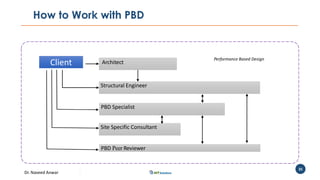
Howto Work with PBD
Architect
Structural Engineer
PBD Specialist
PBD Peer Reviewer
Site Specific Consultant
Performance Based Design
Client
Dr. Naveed Anwar
37
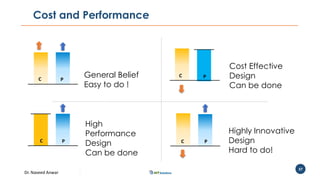
Costand Performance
PCC
Cost Effective
Design
Can be done
PC
General Belief
Easy to do !
PC
Highly Innovative
Design
Hard to do!
PC
High
Performance
Design
Can be done
38.
Dr. Naveed Anwar
38
Whatis the Cost of a Project?
• Cost may include
– Financial Cost (loan, interest, etc)
– Planning and Design Cost
– Direct Construction Cost
– Maintenance Cost
– Incidental Cost
– Liquidated Cost (lost profit etc)
– Opportunistic Cost
– Environmental Cost
– Emotional Cost
– Non-determinist Resources
Cost may be:
“Consumption of
Particular Resources, at
Particular Time”
Sustainability may be:
<Consumption of all
resources, and their impacts
through throughout the life
cycle>
39.
Dr. Naveed Anwar
39
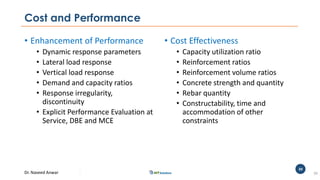
Costand Performance
• Enhancement of Performance
• Dynamic response parameters
• Lateral load response
• Vertical load response
• Demand and capacity ratios
• Response irregularity,
discontinuity
• Explicit Performance Evaluation at
Service, DBE and MCE
• Cost Effectiveness
• Capacity utilization ratio
• Reinforcement ratios
• Reinforcement volume ratios
• Concrete strength and quantity
• Rebar quantity
• Constructability, time and
accommodation of other
constraints
39
40.
Dr. Naveed Anwar
40
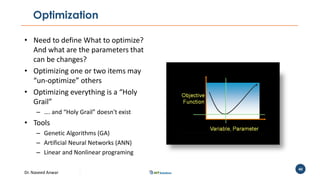
Optimization
•Need to define What to optimize?
And what are the parameters that
can be changes?
• Optimizing one or two items may
“un-optimize” others
• Optimizing everything is a “Holy
Grail”
– …. and “Holy Grail” doesn't exist
• Tools
– Genetic Algorithms (GA)
– Artificial Neural Networks (ANN)
– Linear and Nonlinear programing
41.
Dr. Naveed Anwar
41
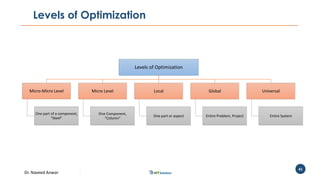
Levelsof Optimization
Levels of Optimization
Micro-Micro Level
One part of a component,
“Steel”
Micro Level
One Component,
“Column”
Local
One part or aspect
Global
Entire Problem, Project
Universal
Entire System
42.
Dr. Naveed Anwar
42
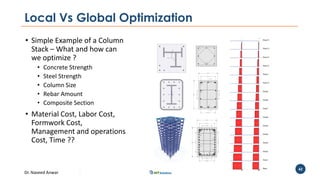
•Simple Example of a Column
Stack – What and how can
we optimize ?
• Concrete Strength
• Steel Strength
• Column Size
• Rebar Amount
• Composite Section
• Material Cost, Labor Cost,
Formwork Cost,
Management and operations
Cost, Time ??
Local Vs Global Optimization
43.
Dr. Naveed Anwar
43
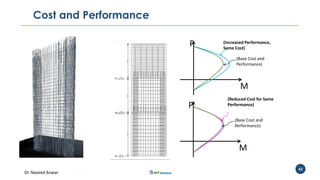
Costand Performance
(Base Cost and
Performance)
(Increased Performance,
Same Cost)
(Base Cost and
Performance)
(Reduced Cost for Same
Performance)
P
M
P
M
44.
Dr. Naveed Anwar
44
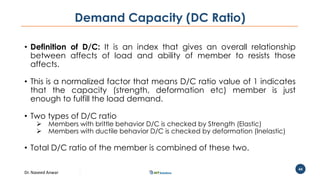
DemandCapacity (DC Ratio)
• Definition of D/C: It is an index that gives an overall relationship
between affects of load and ability of member to resists those
affects.
• This is a normalized factor that means D/C ratio value of 1 indicates
that the capacity (strength, deformation etc) member is just
enough to fulfill the load demand.
• Two types of D/C ratio
Members with brittle behavior D/C is checked by Strength (Elastic)
Members with ductile behavior D/C is checked by deformation (Inelastic)
• Total D/C ratio of the member is combined of these two.
45.
Dr. Naveed Anwar
45
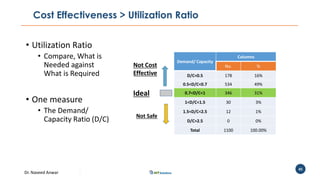
CostEffectiveness > Utilization Ratio
• Utilization Ratio
• Compare, What is
Needed against
What is Required
• One measure
• The Demand/
Capacity Ratio (D/C)
Demand/ Capacity
Columns
No. %
D/C<0.5 178 16%
0.5<D/C<0.7 534 49%
0.7<D/C<1 346 31%
1<D/C<1.5 30 3%
1.5<D/C<2.5 12 1%
D/C>2.5 0 0%
Total 1100 100.00%
Ideal
Not Cost
Effective
Not Safe
Dr. Naveed Anwar
PeerReview
To ensure Basic Design the Performance Evaluation
and Value Enginering are done right
48.
Dr. Naveed Anwar
48
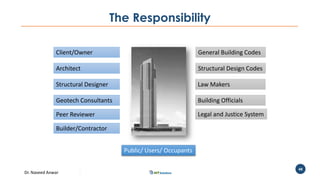
TheResponsibility
Building Officials
Structural Designer
Architect Structural Design Codes
General Building Codes
Legal and Justice System
Public/ Users/ Occupants
Client/Owner
Law Makers
Builder/Contractor
Peer Reviewer
Geotech Consultants
49.
Dr. Naveed Anwar
49
PeerReview
• What exactly is design peer review?
• It is a process whereby a design project (or aspect of) is reviewed and
evaluated by a person, or team, not directly involved with the project, but
appropriately qualified to provide input that will either reinforce a design
solution, or provide a route to an improved alternative.
• Why is it so important?
• Very few can claim to be all-encompassing experts. The invaluable input from
broad base and independent experience at each stage of a design project will
often result in technical improvements, lower costs, avoidance of sourcing
issues, and improved performance.
50.
Dr. Naveed Anwar
50
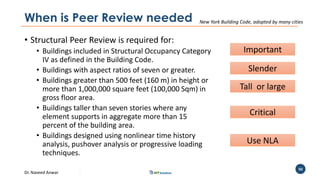
Whenis Peer Review needed
• Structural Peer Review is required for:
• Buildings included in Structural Occupancy Category
IV as defined in the Building Code.
• Buildings with aspect ratios of seven or greater.
• Buildings greater than 500 feet (160 m) in height or
more than 1,000,000 square feet (100,000 Sqm) in
gross floor area.
• Buildings taller than seven stories where any
element supports in aggregate more than 15
percent of the building area.
• Buildings designed using nonlinear time history
analysis, pushover analysis or progressive loading
techniques.
New York Building Code, adopted by many cities
Important
Slender
Tall or large
Critical
Use NLA
51.
Dr. Naveed Anwar
51
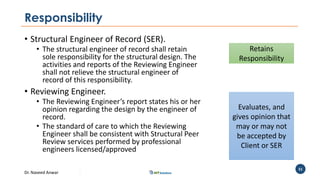
Responsibility
•Structural Engineer of Record (SER).
• The structural engineer of record shall retain
sole responsibility for the structural design. The
activities and reports of the Reviewing Engineer
shall not relieve the structural engineer of
record of this responsibility.
• Reviewing Engineer.
• The Reviewing Engineer’s report states his or her
opinion regarding the design by the engineer of
record.
• The standard of care to which the Reviewing
Engineer shall be consistent with Structural Peer
Review services performed by professional
engineers licensed/approved
Retains
Responsibility
Evaluates, and
gives opinion that
may or may not
be accepted by
Client or SER
52.
Dr. Naveed Anwar
52
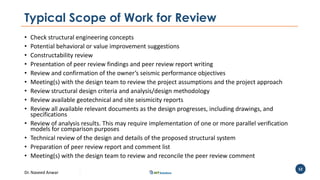
TypicalScope of Work for Review
• Check structural engineering concepts
• Potential behavioral or value improvement suggestions
• Constructability review
• Presentation of peer review findings and peer review report writing
• Review and confirmation of the owner’s seismic performance objectives
• Meeting(s) with the design team to review the project assumptions and the project approach
• Review structural design criteria and analysis/design methodology
• Review available geotechnical and site seismicity reports
• Review all available relevant documents as the design progresses, including drawings, and
specifications
• Review of analysis results. This may require implementation of one or more parallel verification
models for comparison purposes
• Technical review of the design and details of the proposed structural system
• Preparation of peer review report and comment list
• Meeting(s) with the design team to review and reconcile the peer review comment