Defending a (marginalised) school subject: the
views of different education stakeholders
Alison Hardy
November 25, 2015 2
Outline
•Context:
–National Curriculum
–Teacher Training
–School league tables
•Potential consequences and opportunities for D&T
(and other subjects)
•Curriculum development
National Curriculum: Design and Technology
November 25, 2015 3
November 25, 2015 4
Context
National Curriculum: ICT/ Computing
November 25, 2015 5
November 25, 2015 6
Teacher Training
November 25, 2015 7
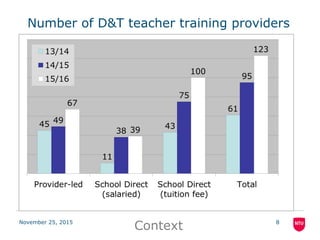
Number of D&T teacher training providers
8November 25, 2015
Context
November 25, 2015 9
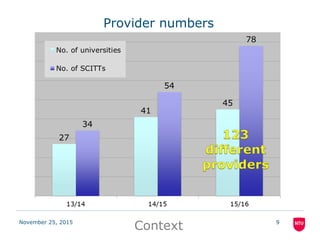
Provider numbers
Context
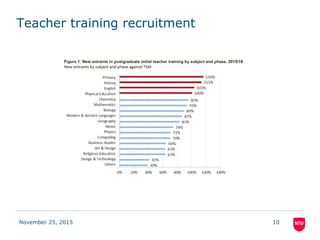
Teacher training recruitment
November 25, 2015 10
School league tables
November 25, 2015 11
• Ebacc: five subjects measured
1. English
2. Maths
3. Science
4. Humanities (Geography or History)
5. Language
• No creative subjects included
November 25, 2015 12
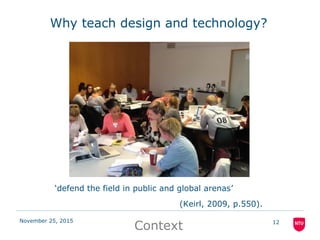
Why teach design and technology?
‘defend the field in public and global arenas’
(Keirl, 2009, p.550).
Context
November 25, 2015 13
What is the
value of D&T
to pupils and
society, today
and in the
future?
Previous research
Findings: same values
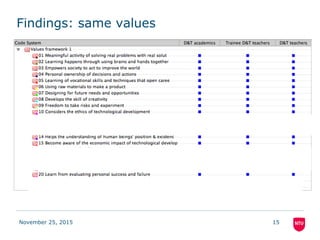
• 22 D&T values (Hardy 2013, 2015):
– Academics = 15
– Trainee teachers = 19
– Teachers = 22
• 13 values held by all groups
• Academics & teachers have 13 in common
• Academics & trainees have 13 in common
• Teachers and trainees have 19 in common
November 25, 2015 15
November 25, 2015 16
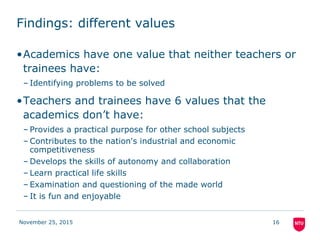
Findings: different values
•Academics have one value that neither teachers or
trainees have:
– Identifying problems to be solved
•Teachers and trainees have 6 values that the
academics don’t have:
– Provides a practical purpose for other school subjects
– Contributes to the nation's industrial and economic
competitiveness
– Develops the skills of autonomy and collaboration
– Learn practical life skills
– Examination and questioning of the made world
– It is fun and enjoyable
November 25, 2015 18
So what?
Teachers and Trainees:
•Smooth relationship or less challenge?
Teachers/ Trainees and Academics:
•Challenging relationship or subject-focused?
Teachers and Academics:
•Effect on National Curriculum and GCSE implementation?
•Teachers focus on here & now
•Academics focus on subject’s unique contribution
Teachers becoming Teacher Educators:
•Focus more on engagement and attainment than D&T’s purpose
Analysis
What next for D&T subject development?
•Joined up thinking needed:
– Currently 31 schools have D&T SLEs;
•Greater role for subject associations and advisors
to engage new teacher educators with the new
curriculum – specifically its purpose and aim;
•Development of curriculum resources;
•Values framework could support in-school
reflection and discussions.
November 25, 2015 19
Working With You
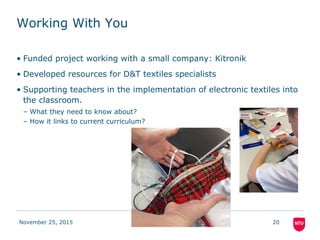
• Funded project working with a small company: Kitronik
• Developed resources for D&T textiles specialists
• Supporting teachers in the implementation of electronic textiles into
the classroom.
– What they need to know about?
– How it links to current curriculum?
November 25, 2015 20
Supporting teachers
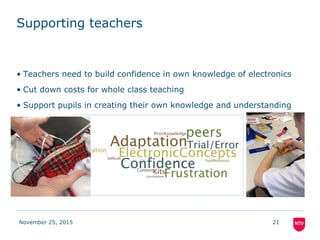
• Teachers need to build confidence in own knowledge of electronics
• Cut down costs for whole class teaching
• Support pupils in creating their own knowledge and understanding
November 25, 2015 21
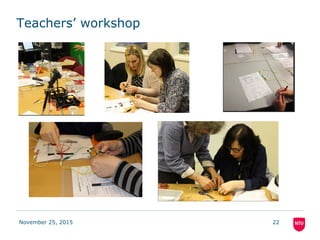
Teachers’ workshop
November 25, 2015 22
• http://wwyresearchproject.tumblr.com/
• https://uk.pinterest.com/sdsdavies/
• http://ntudte.blogspot.co.uk/
• http://www.instructables.com/id/eTextile-wristband/
• http://www.instructables.com/id/LED-PurseWallet/
Sarah Davies: www.about.me/Sdsdavies
Alison Hardy: www.about.me/alisonhardy
November 25, 2015 24
Related publications
• HARDY, A., 2013. Starting the journey: discovering the point of
D&T. In: PATT27 Conference: Technology Education for the Future:
A Play on Sustainability, Christchurch, New Zealand, 2-6 December
2013, pp. 222-228.
• HARDY, A., GYEKYE, K. and WAINWRIGHT, C., 2015. What do
others think is the point of design and technology education? In:
PATT29 Plurality and Complementarity of Approaches in Design &
Technology Education, Marseille, France, 7-10 April 2015.
• HARDY, A., 2015. What’s D&T for? Gathering and comparing the
values of design and technology academics and trainee teachers.
Design and Technology Education: An International Journal. Vol
20(2), p.10-21.
Previous research

Defending a school subject (Sweden)

  • 1.
    Defending a (marginalised)school subject: the views of different education stakeholders Alison Hardy
  • 2.
    November 25, 20152 Outline •Context: –National Curriculum –Teacher Training –School league tables •Potential consequences and opportunities for D&T (and other subjects) •Curriculum development
  • 3.
    National Curriculum: Designand Technology November 25, 2015 3
  • 4.
  • 5.
    National Curriculum: ICT/Computing November 25, 2015 5
  • 6.
  • 7.
  • 8.
    Number of D&Tteacher training providers 8November 25, 2015 Context
  • 9.
    November 25, 20159 Provider numbers Context
  • 10.
  • 11.
    School league tables November25, 2015 11 • Ebacc: five subjects measured 1. English 2. Maths 3. Science 4. Humanities (Geography or History) 5. Language • No creative subjects included
  • 12.
    November 25, 201512 Why teach design and technology? ‘defend the field in public and global arenas’ (Keirl, 2009, p.550). Context
  • 13.
    November 25, 201513 What is the value of D&T to pupils and society, today and in the future? Previous research
  • 14.
    Findings: same values •22 D&T values (Hardy 2013, 2015): – Academics = 15 – Trainee teachers = 19 – Teachers = 22 • 13 values held by all groups • Academics & teachers have 13 in common • Academics & trainees have 13 in common • Teachers and trainees have 19 in common November 25, 2015 15
  • 15.
    November 25, 201516 Findings: different values •Academics have one value that neither teachers or trainees have: – Identifying problems to be solved •Teachers and trainees have 6 values that the academics don’t have: – Provides a practical purpose for other school subjects – Contributes to the nation's industrial and economic competitiveness – Develops the skills of autonomy and collaboration – Learn practical life skills – Examination and questioning of the made world – It is fun and enjoyable
  • 16.
    November 25, 201518 So what? Teachers and Trainees: •Smooth relationship or less challenge? Teachers/ Trainees and Academics: •Challenging relationship or subject-focused? Teachers and Academics: •Effect on National Curriculum and GCSE implementation? •Teachers focus on here & now •Academics focus on subject’s unique contribution Teachers becoming Teacher Educators: •Focus more on engagement and attainment than D&T’s purpose Analysis
  • 17.
    What next forD&T subject development? •Joined up thinking needed: – Currently 31 schools have D&T SLEs; •Greater role for subject associations and advisors to engage new teacher educators with the new curriculum – specifically its purpose and aim; •Development of curriculum resources; •Values framework could support in-school reflection and discussions. November 25, 2015 19
  • 18.
    Working With You •Funded project working with a small company: Kitronik • Developed resources for D&T textiles specialists • Supporting teachers in the implementation of electronic textiles into the classroom. – What they need to know about? – How it links to current curriculum? November 25, 2015 20
  • 19.
    Supporting teachers • Teachersneed to build confidence in own knowledge of electronics • Cut down costs for whole class teaching • Support pupils in creating their own knowledge and understanding November 25, 2015 21
  • 20.
  • 21.
    • http://wwyresearchproject.tumblr.com/ • https://uk.pinterest.com/sdsdavies/ •http://ntudte.blogspot.co.uk/ • http://www.instructables.com/id/eTextile-wristband/ • http://www.instructables.com/id/LED-PurseWallet/ Sarah Davies: www.about.me/Sdsdavies Alison Hardy: www.about.me/alisonhardy
  • 22.
    November 25, 201524 Related publications • HARDY, A., 2013. Starting the journey: discovering the point of D&T. In: PATT27 Conference: Technology Education for the Future: A Play on Sustainability, Christchurch, New Zealand, 2-6 December 2013, pp. 222-228. • HARDY, A., GYEKYE, K. and WAINWRIGHT, C., 2015. What do others think is the point of design and technology education? In: PATT29 Plurality and Complementarity of Approaches in Design & Technology Education, Marseille, France, 7-10 April 2015. • HARDY, A., 2015. What’s D&T for? Gathering and comparing the values of design and technology academics and trainee teachers. Design and Technology Education: An International Journal. Vol 20(2), p.10-21. Previous research

Editor's Notes

  • #3 Context Developing nature of D&T since inception in 1990 Curriculum changes in 2013 – horticulture and computing
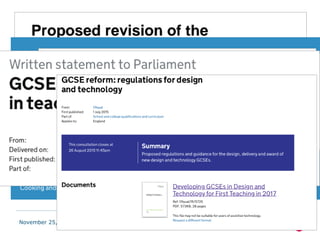
  • #5 Started with curriculum review and expert panel report: weak epistemological links Then new curriculum – debate around that – aimed at ‘domestic’ New curriculum Food and nutrition – out of D&T New GCSE Consultation Pushed back Consultation started last week
  • #7 Changes to Computing NC and implications for D&T
  • #9 This data includes all routes and all types of providers, i.e. HEI and SCITTS, including Teaching Alliances and Training Schools Not all providers offer all types of routes, shown by 123 providers does not add up to 67+39+100 2013/14 different to analyse because SCITTs received an allocation seperately There is overlap – some providers are offering both SD routes Some HEIs are involved in SD routes Some HEIs only offer SD routes
  • #10 2013/14 data 27 HEIs in total offering provider led, only one below 5 places allocated Only five non-HEI provider with 5+ 2014/15 data 25 HEIs offer direct routes (provider led), only one below 5 places allocated 16 providers only offer SD routes – only 4 are doing this with 5+ school partners 2015/16 data 26 HEIs offer direct routes (provider led), only one below 5 places allocated 19 offer only SD routes, only 6 are doing this with 5+ school partners – likely to be one D&T specialist delivering the subject knowledge? One of these does have a D&T specialist at the university, at lest one has a product design department but there are no guarantees that these in-uni departments are involved in teaching on the courses
  • #16 Academics & teachers have 13 in common Academics & trainees have 13 in common (10 the same as 1. but 3 different from 1) Teachers and trainees have 19 in common
  • #17 Academics have one value that neither teachers nor trainees have: ‘Identifying problems to be solved’ – part of the NC Teachers and trainees have 6 values that the academics don’t have: Provides a practical purpose for other school subjects Contributes to the nation's industrial and economic competitiveness Develops the skills of autonomy and collaboration Learn practical life skills Examination and questioning of the made world It is fun and enjoyable All 6 are not unique to D&T, although 5. cold be seen as product analysis
  • #19 Teachers and Trainees: Smooth relationship or less challenge? Less likely to question? Teachers/ Trainees and Academics: Challenging relationship or subject-focused? Academics not in schools – ivory tower? T/TR face the challenges daily of engagement, attainment Teachers and Academics: Effect on National Curriculum and GCSE implementation? More academics there than teachers – does this matter Teachers focus on here & now Academics focus on subject’s unique contribution