How to Import
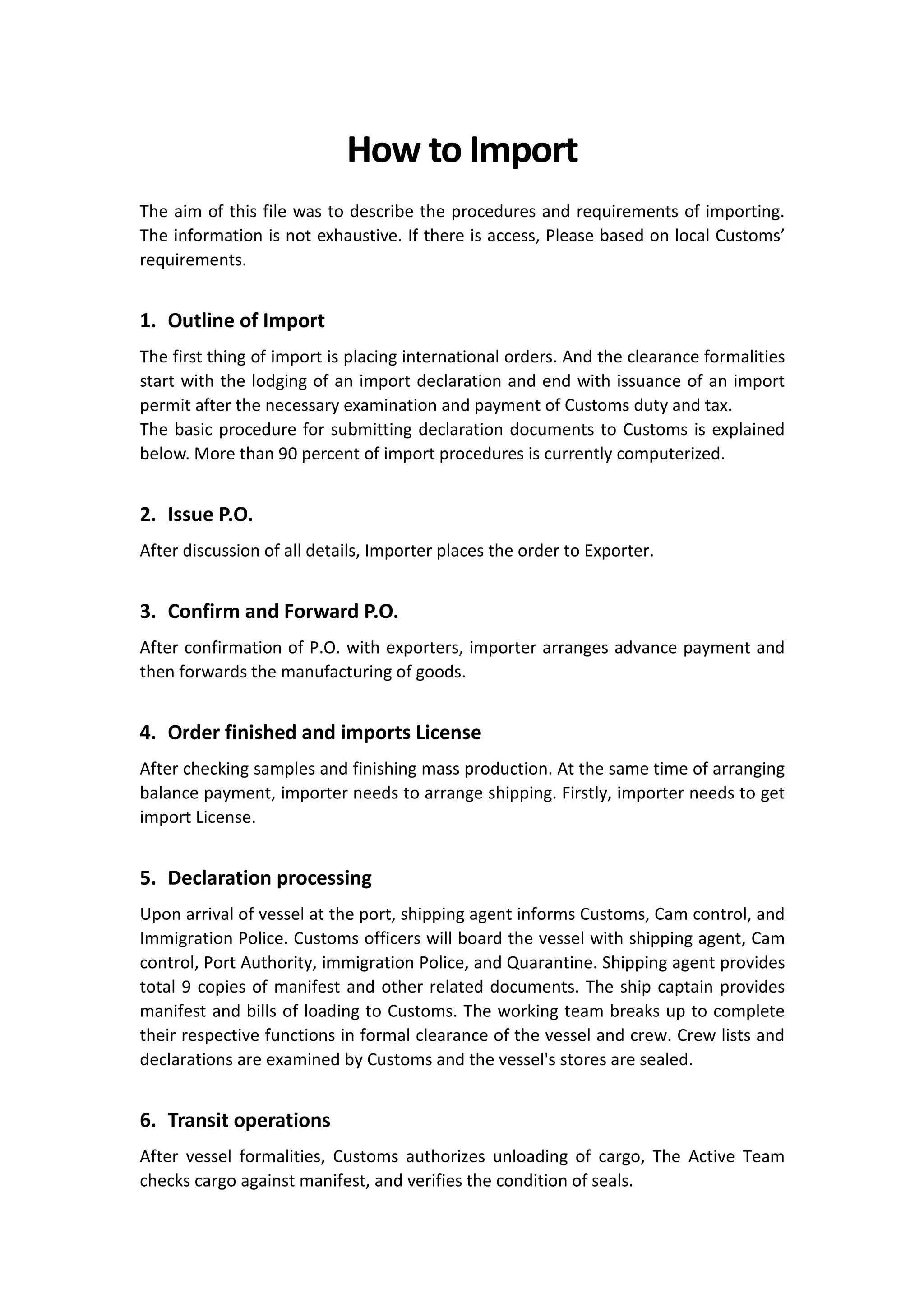
The aim of this file was to describe the procedures and requirements of importing.
The information is not exhaustive. If there is access, Please based on local Customs’
requirements.
1. Outline of Import
The first thing of import is placing international orders. And the clearance formalities
start with the lodging of an import declaration and end with issuance of an import
permit after the necessary examination and payment of Customs duty and tax.
The basic procedure for submitting declaration documents to Customs is explained
below. More than 90 percent of import procedures is currently computerized.
2. Issue P.O.
After discussion of all details, Importer places the order to Exporter.
3. Confirm and Forward P.O.
After confirmation of P.O. with exporters, importer arranges advance payment and
then forwards the manufacturing of goods.
4. Order finished and imports License
After checking samples and finishing mass production. At the same time of arranging
balance payment, importer needs to arrange shipping. Firstly, importer needs to get
import License.
5. Declaration processing
Upon arrival of vessel at the port, shipping agent informs Customs, Cam control, and
Immigration Police. Customs officers will board the vessel with shipping agent, Cam
control, Port Authority, immigration Police, and Quarantine. Shipping agent provides
total 9 copies of manifest and other related documents. The ship captain provides
manifest and bills of loading to Customs. The working team breaks up to complete
their respective functions in formal clearance of the vessel and crew. Crew lists and
declarations are examined by Customs and the vessel's stores are sealed.
6. Transit operations
After vessel formalities, Customs authorizes unloading of cargo, The Active Team
checks cargo against manifest, and verifies the condition of seals.
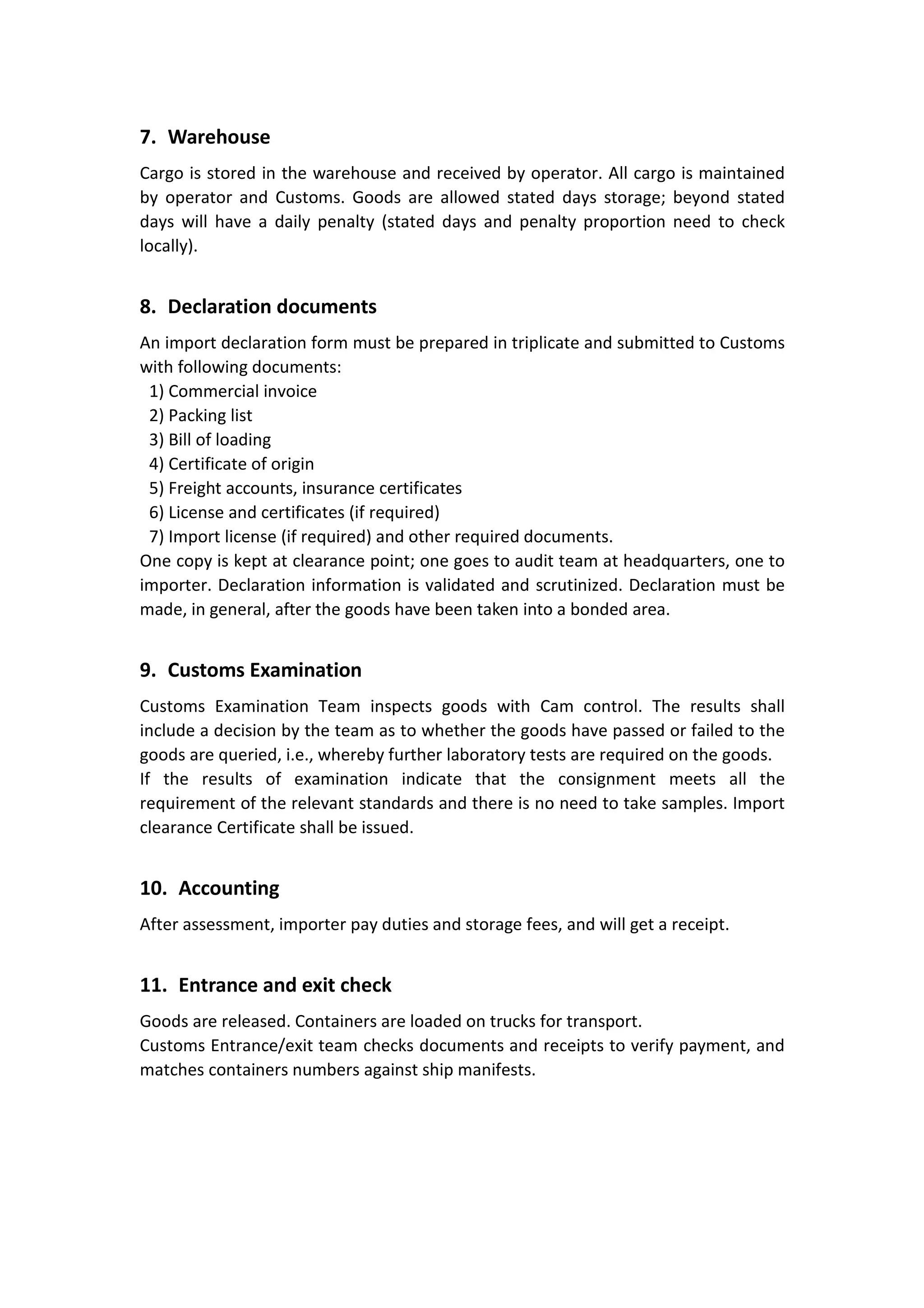
7. Warehouse
Cargo is stored in the warehouse and received by operator. All cargo is maintained
by operator and Customs. Goods are allowed stated days storage; beyond stated
days will have a daily penalty (stated days and penalty proportion need to check
locally).
8. Declaration documents
An import declaration form must be prepared in triplicate and submitted to Customs
with following documents:
1) Commercial invoice
2) Packing list
3) Bill of loading
4) Certificate of origin
5) Freight accounts, insurance certificates
6) License and certificates (if required)
7) Import license (if required) and other required documents.
One copy is kept at clearance point; one goes to audit team at headquarters, one to
importer. Declaration information is validated and scrutinized. Declaration must be
made, in general, after the goods have been taken into a bonded area.
9. Customs Examination
Customs Examination Team inspects goods with Cam control. The results shall
include a decision by the team as to whether the goods have passed or failed to the
goods are queried, i.e., whereby further laboratory tests are required on the goods.
If the results of examination indicate that the consignment meets all the
requirement of the relevant standards and there is no need to take samples. Import
clearance Certificate shall be issued.
10. Accounting
After assessment, importer pay duties and storage fees, and will get a receipt.
11. Entrance and exit check
Goods are released. Containers are loaded on trucks for transport.
Customs Entrance/exit team checks documents and receipts to verify payment, and
matches containers numbers against ship manifests.

How To Import

  • 1.
    How to Import Theaim of this file was to describe the procedures and requirements of importing. The information is not exhaustive. If there is access, Please based on local Customs’ requirements. 1. Outline of Import The first thing of import is placing international orders. And the clearance formalities start with the lodging of an import declaration and end with issuance of an import permit after the necessary examination and payment of Customs duty and tax. The basic procedure for submitting declaration documents to Customs is explained below. More than 90 percent of import procedures is currently computerized. 2. Issue P.O. After discussion of all details, Importer places the order to Exporter. 3. Confirm and Forward P.O. After confirmation of P.O. with exporters, importer arranges advance payment and then forwards the manufacturing of goods. 4. Order finished and imports License After checking samples and finishing mass production. At the same time of arranging balance payment, importer needs to arrange shipping. Firstly, importer needs to get import License. 5. Declaration processing Upon arrival of vessel at the port, shipping agent informs Customs, Cam control, and Immigration Police. Customs officers will board the vessel with shipping agent, Cam control, Port Authority, immigration Police, and Quarantine. Shipping agent provides total 9 copies of manifest and other related documents. The ship captain provides manifest and bills of loading to Customs. The working team breaks up to complete their respective functions in formal clearance of the vessel and crew. Crew lists and declarations are examined by Customs and the vessel's stores are sealed. 6. Transit operations After vessel formalities, Customs authorizes unloading of cargo, The Active Team checks cargo against manifest, and verifies the condition of seals.
  • 2.
    7. Warehouse Cargo isstored in the warehouse and received by operator. All cargo is maintained by operator and Customs. Goods are allowed stated days storage; beyond stated days will have a daily penalty (stated days and penalty proportion need to check locally). 8. Declaration documents An import declaration form must be prepared in triplicate and submitted to Customs with following documents: 1) Commercial invoice 2) Packing list 3) Bill of loading 4) Certificate of origin 5) Freight accounts, insurance certificates 6) License and certificates (if required) 7) Import license (if required) and other required documents. One copy is kept at clearance point; one goes to audit team at headquarters, one to importer. Declaration information is validated and scrutinized. Declaration must be made, in general, after the goods have been taken into a bonded area. 9. Customs Examination Customs Examination Team inspects goods with Cam control. The results shall include a decision by the team as to whether the goods have passed or failed to the goods are queried, i.e., whereby further laboratory tests are required on the goods. If the results of examination indicate that the consignment meets all the requirement of the relevant standards and there is no need to take samples. Import clearance Certificate shall be issued. 10. Accounting After assessment, importer pay duties and storage fees, and will get a receipt. 11. Entrance and exit check Goods are released. Containers are loaded on trucks for transport. Customs Entrance/exit team checks documents and receipts to verify payment, and matches containers numbers against ship manifests.