School Safety and Security National Crime Prevention Council 2006
Objectives School safety and security issues Factors affecting school safety Key components of school safety planning Engaging the community for safer schools
School Crime and Violence Youth are the most victimized people in the United States. Youth were victims of about 1.9 million nonfatal crimes while at school in 2003. Two-thirds of student victimization was by theft. One-third of student victimization was by violent crime. Source:  Indicators of School Crime and Violence,  U.S. Department of Education, 2005
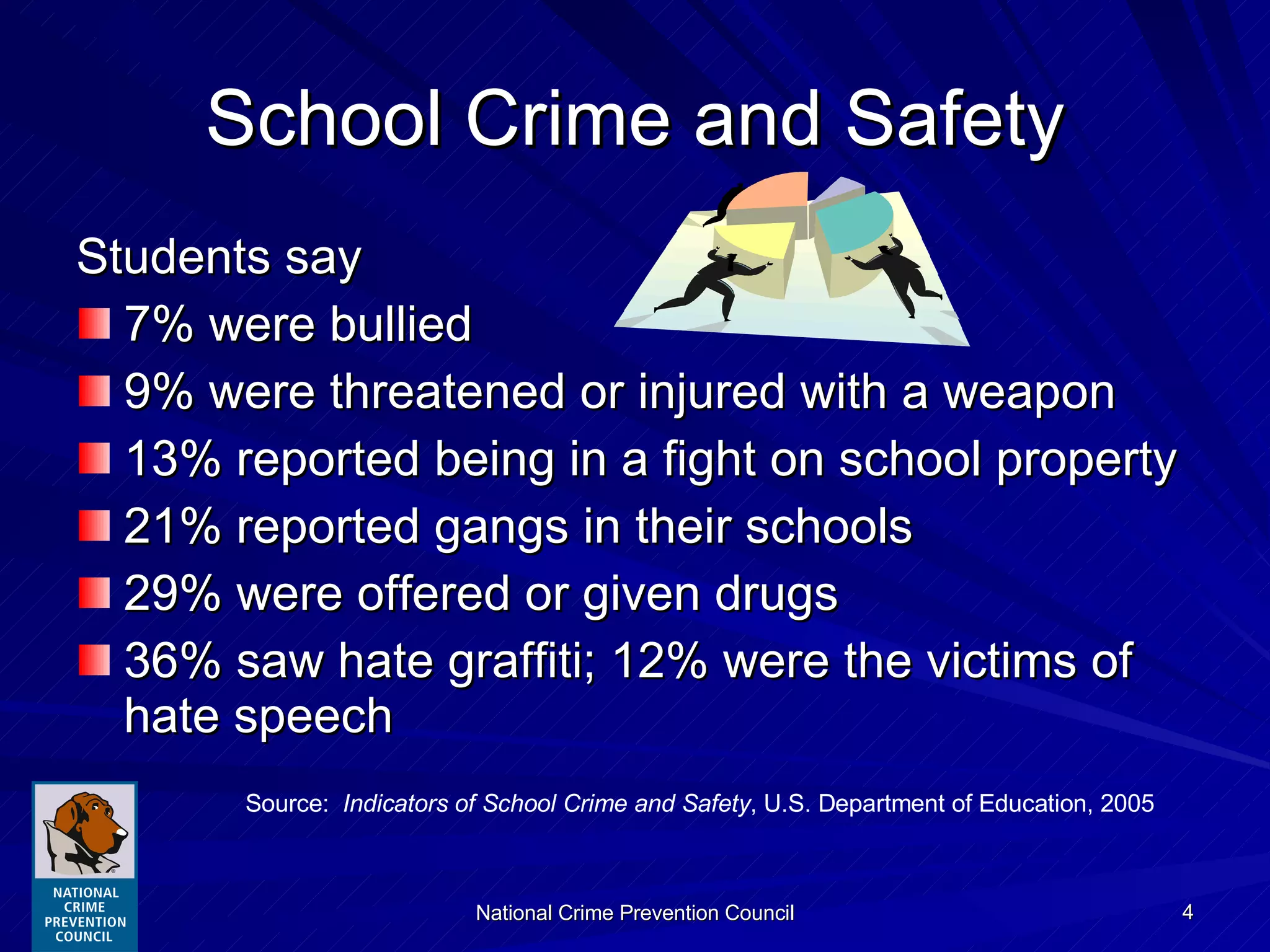
School Crime and Safety Students say 7% were bullied 9% were threatened or injured with a weapon 13% reported being in a fight on school property 21% reported gangs in their schools 29% were offered or given drugs 36% saw hate graffiti; 12% were the victims of hate speech Source:  Indicators of School Crime and Safety ,   U.S. Department of Education, 2005
School Crime and Safety *Violence includes rape, sexual assault, robbery, simple assault, and aggravated assault.   Source:  Indicators of School Crime and Violence , U.S. Department of Education, 2005
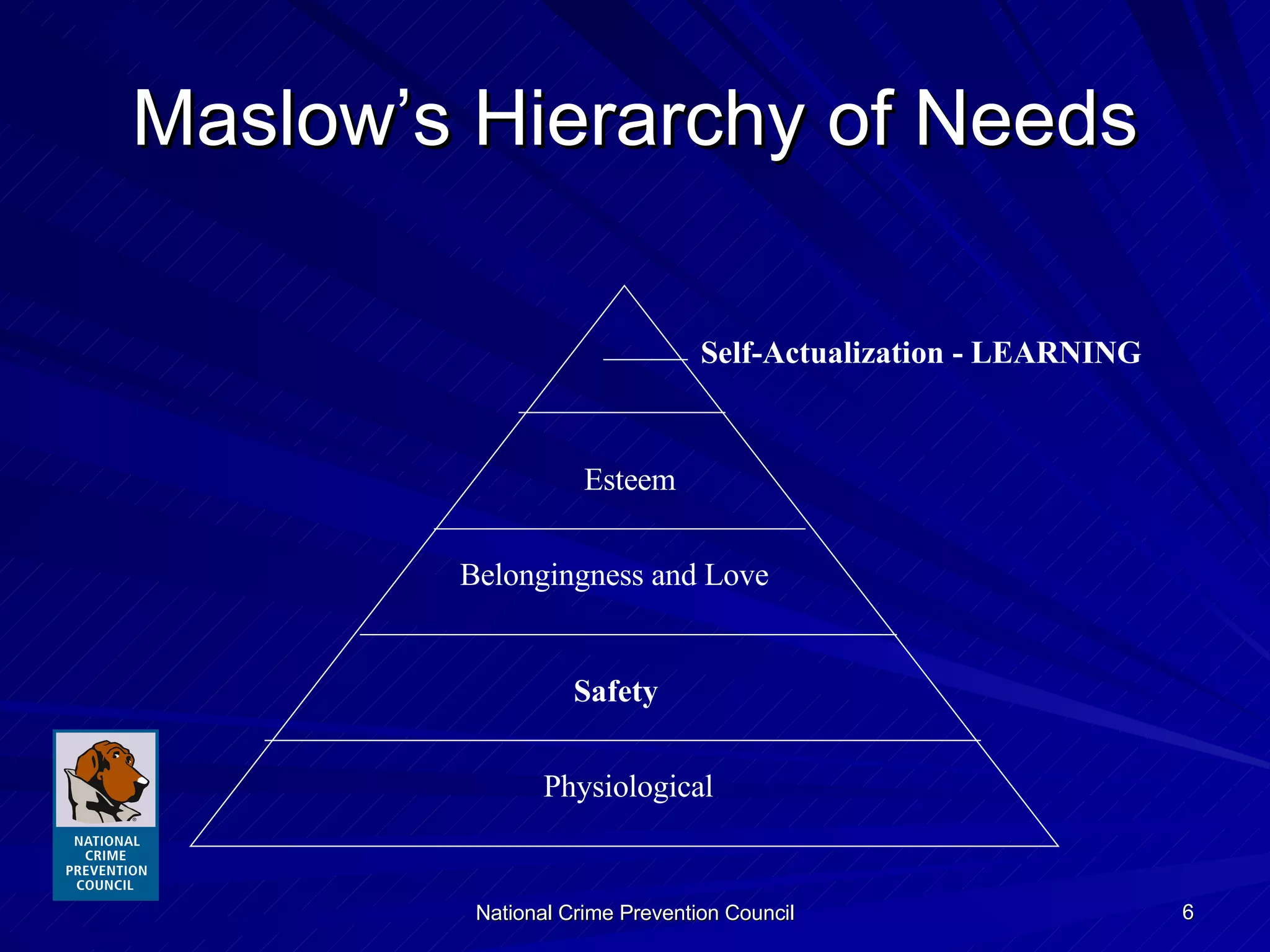
Maslow’s Hierarchy of Needs Physiological Safety Belongingness and Love Esteem Self-Actualization - LEARNING
Impact on Achievement “Theft and violence at school and while going to and from school can lead to a disruptive and threatening environment, physical injury, and emotional stress, and can be an obstacle to student achievement.” Source:  Elliott, Hamburg, and Williams , 1998
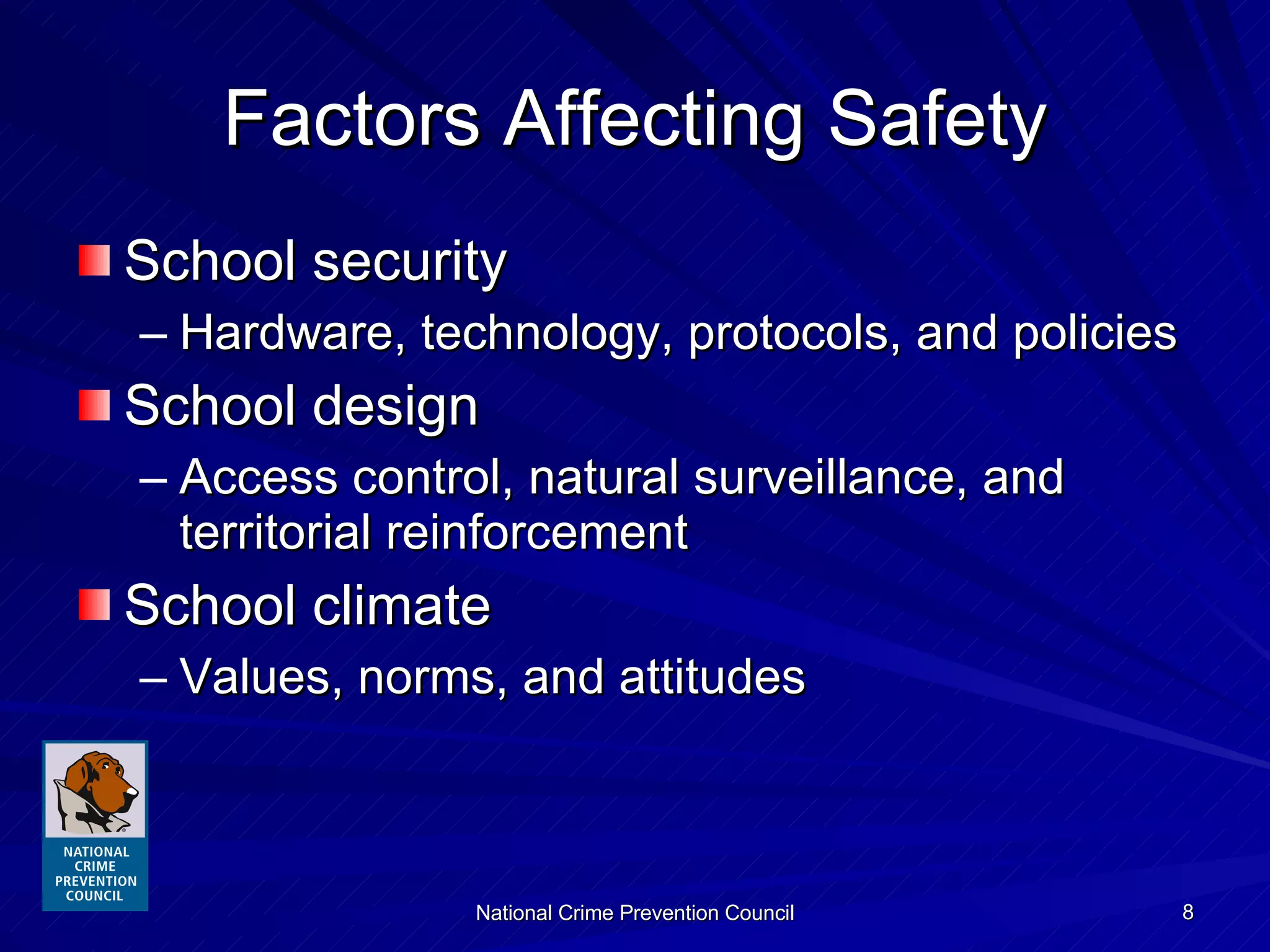
Factors Affecting Safety School security Hardware, technology, protocols, and policies School design Access control, natural surveillance, and territorial reinforcement School climate Values, norms, and attitudes
School Climate Issues Bullying, intimidation, and isolation Harassment and prejudice Social cliques  Theft and graffiti Lack of connectedness Disrespect between teachers/staff and students Lack of student reporting of crime and safety issues
Safe Schools Positive school climate and atmosphere Clear and high academic and disciplinary expectations of students Strong student attachment to the school  High levels of both student participation and parent involvement Values and practices that make everyone feel included; appreciation of diversity Source:  Trends and Issues Affecting School Safety,  2001
Safe Schools Building and grounds are well maintained. Students feel safe reporting crime and safety problems to staff. Disciplinary and safety problems are quickly and appropriately addressed. Access is controlled and visitors are monitored. All staff actively supervise students both inside and outside the classroom. All areas are safe by design or by staff supervision.
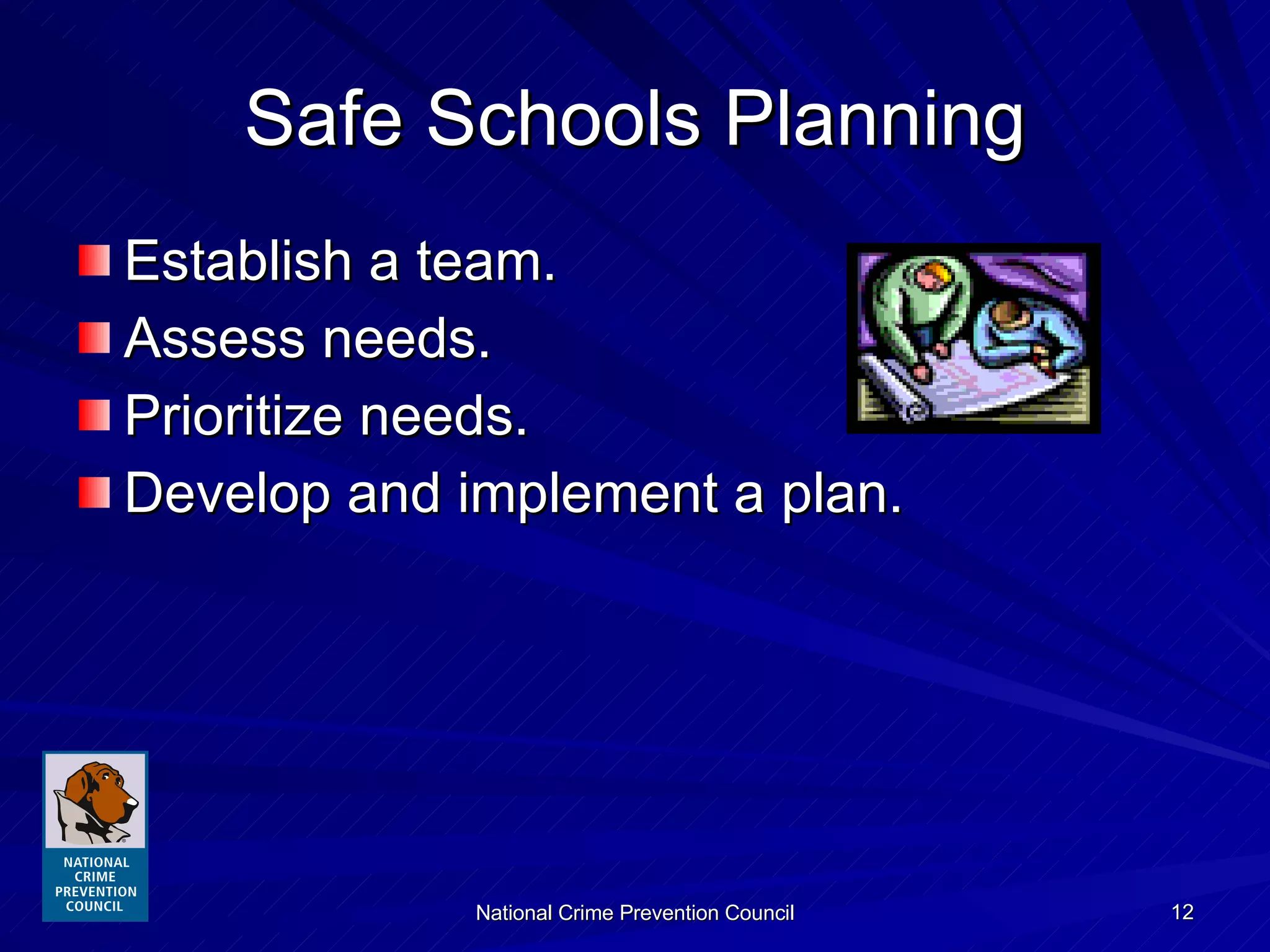
Safe Schools Planning Establish a team. Assess needs. Prioritize needs. Develop and implement a plan.
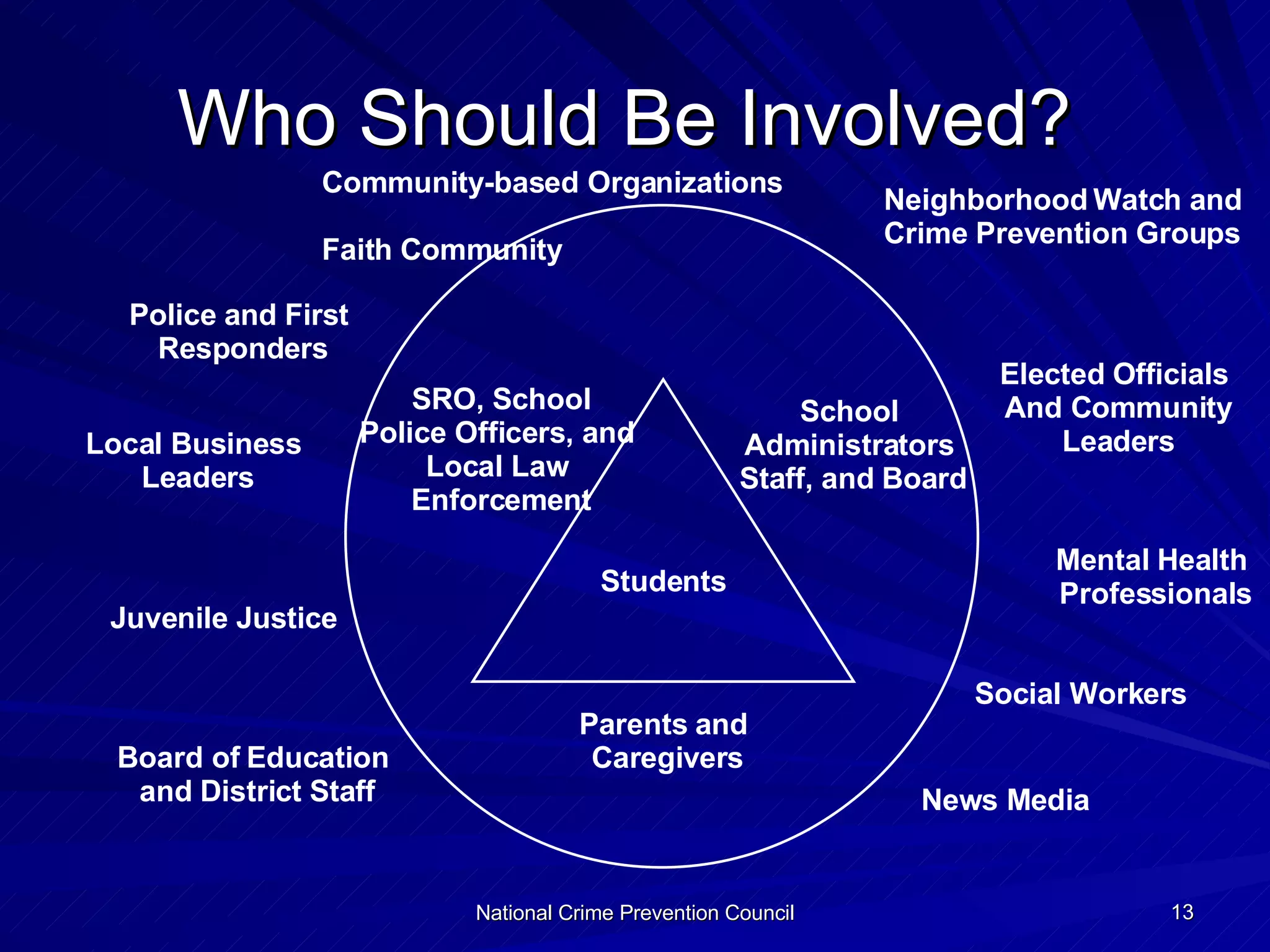
Who Should Be Involved?  Students School  Administrators  Staff, and Board Parents and  Caregivers SRO, School Police Officers, and  Local Law  Enforcement Police and First  Responders Elected Officials  And Community Leaders Mental Health  Professionals Social Workers Board of Education  and District Staff Local Business  Leaders Community-based Organizations Faith Community Juvenile   Justice Neighborhood Watch and  Crime Prevention Groups News Media
Needs Assessment Collect existing indicator data. Survey parents, staff, and students about their safety concerns. Assess climate, security, and design. Conduct an inventory of assets.
Prioritize Needs What’s important? What’s feasible?
Develop a Plan Set measurable objectives that include Time frame Desired change.  Select effective programs and strategies. Break the plan down step-by-step.
Engaging the Community Involve community members on the planning team. Gather their feedback through surveys. Involve them through a forum. Consult them as needed for expertise. Ask for their support of measures.
Parents and Caregivers Program development and implementation Cultural/diversity programming Mentoring and volunteering (can serve as hallway, playground, and lunchroom monitors) Visitor check-in table  Safety patrols to and from school Advocacy to elected officials and school board
Community Service Providers Identifying learning and behavioral problems Counseling Resolving conflicts and providing alternatives to violence Conducting parent education programs Teaching social skills Providing afterschool and in-school programming Providing safe havens for kids
Law Enforcement and  First Responders  Information-sharing and collaboration Training for staff in emergency response Training for staff and School Resource Officers in warning signs Law-related education for students CPR and first aid classes for staff and students Mentoring and tutoring
Legal and Business Communities Legal alternatives and advice Supervise student courts and train students how to run them Afterschool employment or internships In-kind or monetary donations Mentoring and volunteering Staff training and education Safe havens for kids
Community and State Leaders  Speak at awareness-building events Provide influential leadership Build support in the community Provide expertise on available alternative and supplementary resources
Resources  Stopping School Violence: A Dozen Things  – A set of six reproducible tip sheets, one each for parents, students, teachers, law enforcement, principals, and others  Caregivers’ Guide to School Safety and Security  –  An informational guide for parents and community members Safer Schools: Strategies for Educators and Law Enforcement Seeking To Prevent Violence Within Schools School Safety and Security Toolkit   – A step-by-step guide to school safety planning; includes tools for assessing needs and developing an action plan (CD-ROM)
Resources  National Crime Prevention Council www.ncpc.org   Youth Crime Watch of America  www.ycwa.org National Criminal Justice Reference Service  www.ncjrs.gov
National Crime Prevention Council  1000 Connecticut Avenue, NW Thirteenth Floor Washington, DC  20036 202-466-6272 www.ncpc.org www.mcgruff.org
Presenter Contact Information

School Safety And Security

  • 1.
    School Safety andSecurity National Crime Prevention Council 2006
  • 2.
    Objectives School safetyand security issues Factors affecting school safety Key components of school safety planning Engaging the community for safer schools
  • 3.
    School Crime andViolence Youth are the most victimized people in the United States. Youth were victims of about 1.9 million nonfatal crimes while at school in 2003. Two-thirds of student victimization was by theft. One-third of student victimization was by violent crime. Source: Indicators of School Crime and Violence, U.S. Department of Education, 2005
  • 4.
    School Crime andSafety Students say 7% were bullied 9% were threatened or injured with a weapon 13% reported being in a fight on school property 21% reported gangs in their schools 29% were offered or given drugs 36% saw hate graffiti; 12% were the victims of hate speech Source: Indicators of School Crime and Safety , U.S. Department of Education, 2005
  • 5.
    School Crime andSafety *Violence includes rape, sexual assault, robbery, simple assault, and aggravated assault. Source: Indicators of School Crime and Violence , U.S. Department of Education, 2005
  • 6.
    Maslow’s Hierarchy ofNeeds Physiological Safety Belongingness and Love Esteem Self-Actualization - LEARNING
  • 7.
    Impact on Achievement“Theft and violence at school and while going to and from school can lead to a disruptive and threatening environment, physical injury, and emotional stress, and can be an obstacle to student achievement.” Source: Elliott, Hamburg, and Williams , 1998
  • 8.
    Factors Affecting SafetySchool security Hardware, technology, protocols, and policies School design Access control, natural surveillance, and territorial reinforcement School climate Values, norms, and attitudes
  • 9.
    School Climate IssuesBullying, intimidation, and isolation Harassment and prejudice Social cliques Theft and graffiti Lack of connectedness Disrespect between teachers/staff and students Lack of student reporting of crime and safety issues
  • 10.
    Safe Schools Positiveschool climate and atmosphere Clear and high academic and disciplinary expectations of students Strong student attachment to the school High levels of both student participation and parent involvement Values and practices that make everyone feel included; appreciation of diversity Source: Trends and Issues Affecting School Safety, 2001
  • 11.
    Safe Schools Buildingand grounds are well maintained. Students feel safe reporting crime and safety problems to staff. Disciplinary and safety problems are quickly and appropriately addressed. Access is controlled and visitors are monitored. All staff actively supervise students both inside and outside the classroom. All areas are safe by design or by staff supervision.
  • 12.
    Safe Schools PlanningEstablish a team. Assess needs. Prioritize needs. Develop and implement a plan.
  • 13.
    Who Should BeInvolved? Students School Administrators Staff, and Board Parents and Caregivers SRO, School Police Officers, and Local Law Enforcement Police and First Responders Elected Officials And Community Leaders Mental Health Professionals Social Workers Board of Education and District Staff Local Business Leaders Community-based Organizations Faith Community Juvenile Justice Neighborhood Watch and Crime Prevention Groups News Media
  • 14.
    Needs Assessment Collectexisting indicator data. Survey parents, staff, and students about their safety concerns. Assess climate, security, and design. Conduct an inventory of assets.
  • 15.
    Prioritize Needs What’simportant? What’s feasible?
  • 16.
    Develop a PlanSet measurable objectives that include Time frame Desired change. Select effective programs and strategies. Break the plan down step-by-step.
  • 17.
    Engaging the CommunityInvolve community members on the planning team. Gather their feedback through surveys. Involve them through a forum. Consult them as needed for expertise. Ask for their support of measures.
  • 18.
    Parents and CaregiversProgram development and implementation Cultural/diversity programming Mentoring and volunteering (can serve as hallway, playground, and lunchroom monitors) Visitor check-in table Safety patrols to and from school Advocacy to elected officials and school board
  • 19.
    Community Service ProvidersIdentifying learning and behavioral problems Counseling Resolving conflicts and providing alternatives to violence Conducting parent education programs Teaching social skills Providing afterschool and in-school programming Providing safe havens for kids
  • 20.
    Law Enforcement and First Responders Information-sharing and collaboration Training for staff in emergency response Training for staff and School Resource Officers in warning signs Law-related education for students CPR and first aid classes for staff and students Mentoring and tutoring
  • 21.
    Legal and BusinessCommunities Legal alternatives and advice Supervise student courts and train students how to run them Afterschool employment or internships In-kind or monetary donations Mentoring and volunteering Staff training and education Safe havens for kids
  • 22.
    Community and StateLeaders Speak at awareness-building events Provide influential leadership Build support in the community Provide expertise on available alternative and supplementary resources
  • 23.
    Resources StoppingSchool Violence: A Dozen Things – A set of six reproducible tip sheets, one each for parents, students, teachers, law enforcement, principals, and others Caregivers’ Guide to School Safety and Security – An informational guide for parents and community members Safer Schools: Strategies for Educators and Law Enforcement Seeking To Prevent Violence Within Schools School Safety and Security Toolkit – A step-by-step guide to school safety planning; includes tools for assessing needs and developing an action plan (CD-ROM)
  • 24.
    Resources NationalCrime Prevention Council www.ncpc.org Youth Crime Watch of America www.ycwa.org National Criminal Justice Reference Service www.ncjrs.gov
  • 25.
    National Crime PreventionCouncil 1000 Connecticut Avenue, NW Thirteenth Floor Washington, DC 20036 202-466-6272 www.ncpc.org www.mcgruff.org
  • 26.

Editor's Notes

  • #2 Introduce yourself and your copresenter; be sure to explain your connection to school safety and/or the audience. Mention that the National Crime Prevention Council in partnership with the Bureau of Justice Assistance is the creator of this PowerPoint. Refer participants to NCPC’s main website, www.ncpc.org, and to www.mcgruff.org, its website for children.