1
A Framework for Safe and Successful Schools
Executive Summary
This joint statement provides a framework supported by educators for improving school safety and increasing
access to mental health supports for children and youth. Efforts to improve school climate, safety, and learning
are not separate endeavors. They must be designed, funded, and implemented as a comprehensive school-wide
approach that facilitates interdisciplinary collaboration and builds on a multitiered system of supports. We
caution against seemingly quick and potentially harmful solutions, such as arming school personnel, and urge
policy leaders to support the following guidance to enact policies that will equip America’s schools to educate
and safeguard our children over the long term.
POLICY RECOMMENDATIONS TO SUPPORT EFFECTIVE SCHOOL SAFETY
1. Allow for blended, flexible use of funding streams in education and mental health services;
2. Improve staffing ratios to allow for the delivery of a full range of services and effective school–community
partnerships;
3. Develop evidence-based standards for district-level policies to promote effective school discipline and positive
behavior;
4. Fund continuous and sustainable crisis and emergency preparedness, response, and recovery planning and
training that uses evidence-based models;
5. Provide incentives for intra- and interagency collaboration; and
6. Support multitiered systems of support (MTSS).
BEST PRACTICES FOR CREATING SAFE AND SUCCESSFUL SCHOOLS
1. Fully integrate learning supports (e.g., behavioral, mental health, and social services), instruction, and school
management within a comprehensive, cohesive approach that facilitates multidisciplinary collaboration.
2. Implement multitiered systems of support (MTSS) that encompass prevention, wellness promotion, and
interventions that increase with intensity based on student need, and that promote close school–
community collaboration.
3. Improve access to school-based mental health supports by ensuring adequate staffing levels in terms of
school-employed mental health professionals who are trained to infuse prevention and intervention services
into the learning process and to help integrate services provided through school–community partnerships
into existing school initiatives.
4. Integrate ongoing positive climate and safety efforts with crisis prevention, preparedness, response, and
recovery to ensure that crisis training and plans: (a) are relevant to the school context, (b) reinforce
learning, (c) make maximum use of existing staff resources, (d) facilitate effective threat assessment, and
(e) are consistently reviewed and practiced.
2
5. Balance physical and psychological safety to avoid overly restrictive measures (e.g., armed guards and metal
detectors) that can undermine the learning environment and instead combine reasonable physical security
measures (e.g., locked doors and monitored public spaces) with efforts to enhance school climate, build
trusting relationships, and encourage students and adults to report potential threats. If a school determines
the need for armed security, properly trained school resource officers (SROs) are the only school personnel
of any type who should be armed.
6. Employ effective, positive school discipline that: (a) functions in concert with efforts to address school
safety and climate; (b) is not simply punitive (e.g., zero tolerance); (c) is clear, consistent, and equitable; and
(d) reinforces positive behaviors. Using security personnel or SROs primarily as a substitute for effective
discipline policies does not contribute to school safety and can perpetuate the school-to-prison pipeline.
7. Consider the context of each school and district and provide services that are most needed, appropriate,
and culturally sensitive to a school’s unique student populations and learning communities.
8. Acknowledge that sustainable and effective change takes time, and that individual schools will vary in their
readiness to implement improvements and should be afforded the time and resources to sustain change
over time.
Creating safe, orderly, and welcoming learning environments is critical to educating and preparing all of our
children and youth to achieve their highest potential and contribute to society. We all share this responsibility
and look forward to working with the Administration, Congress, and state and local policy makers to shape
policies based on these best practices in school safety and climate, student mental health, instructional
leadership, teaching, and learning.
3
A Framework for Safe and Successful Schools
The author organizations and cosigners of this joint statement applaud the President and Congress for
acknowledging that additional actions must be taken to prevent violence in America’s schools and communities.
We represent the educators who work day in and day out to keep our children safe, ensure their well-being, and
promote learning. This joint statement provides a framework supported by educators for improving school
safety and increasing access to mental health supports for children and youth.
We created these policy and practice recommendations to help provide further guidance to the Administration,
Congress, and state and local agencies as they reflect upon evidence for best practices in school safety and
climate, student mental health and well-being, instructional leadership, teaching, and learning. Further, the
partnership between our organizations seeks to reinforce the interdisciplinary, collaborative, and cohesive
approach that is required to create and sustain genuinely safe, supportive schools that meet the needs of the
whole child. Efforts to improve school climate, safety, and learning are not separate endeavors and must be
designed, funded, and implemented as a comprehensive school-wide approach. Ensuring that mental health and
safety programming and services are appropriately integrated into the overall multitiered system of supports is
essential for successful and sustainable improvements in school safety and academic achievement.
Specifically, effective school safety efforts:
 Begin with proactive principal leadership.
 Allow school leaders to deploy human and financial resources in a manner that best meets the needs of
their school and community.
 Provide a team-based framework to facilitate effective coordination of services and interventions.
 Balance the needs for physical and psychological safety.
 Employ the necessary and appropriately trained school-employed mental health and safety personnel.
 Provide relevant and ongoing professional development for all staff.
 Integrate a continuum of mental health supports within a multitiered system of supports.
 Engage families and community providers as meaningful partners.
 Remain grounded in the mission and purpose of schools: teaching and learning.
Although the focus of this document is on policies and practices that schools can use to ensure safety, we must
acknowledge the importance of policies and practices that make our communities safer as well. This includes
increased access to mental health services, improved interagency collaboration, and reduced exposure of
children to community violence. Additionally, our organizations support efforts designed to reduce youth access
to firearms. Finally, many local school districts and state boards of education are considering policies that would
allow school staff to carry a weapon. Our organizations believe that arming educators would cause more harm
than good, and we advise decision makers to approach these policies with extreme caution.
We urge policy leaders to support the following guidance to promote safe and supportive schools. We look
forward to working with the Administration, Congress, and state and local agencies to shape and enact
meaningful policies that will genuinely equip America’s schools to educate and safeguard our children over the
long term.
4
POLICY RECOMMENDATIONS TO SUPPORT EFFECTIVE SCHOOL SAFETY
1. Allow for blended, flexible use of funding streams. The Department of Education should work with the
Department of Health and Human Services and Congress to release guidance that gives schools' access to
various funding streams (e.g., SAMHSA and Title I) to ensure adequate and sustained funding dedicated to
improving school safety. One-time grants are beneficial in some circumstances; however, one-time
allotments of money for schools are insufficient for sustained change to occur. Similarly, district
superintendents must be able to anticipate the availability of future funding in order to collaborate with
school principals to effectively plan for and implement meaningful changes that will result in positive,
sustainable outcomes for students.
2. Strive to improve staffing ratios to allow for the delivery of a full range of services, including school–
community partnerships, and set standards that will help schools effectively and accurately assess their
needs. This will require providing additional funding for key personnel such as school counselors, school
psychologists, school social workers, and school nurses.
3. Outline standards for district-level policies to promote effective school discipline and positive behavior.
Although it has been briefly discussed in this document, we urge the Department to release guidance
regarding effective school discipline policies. Far too many schools continue to use punitive discipline
measures, such as zero-tolerance policies, that result in negative outcomes for students and contribute to
the school-to-prison pipeline.
4. Provide funding for continuous and sustainable crisis and emergency preparedness, response and
recovery planning and training (utilizing evidence-based models). The minimum standards include:
a. establishment of a school safety and crisis team that includes the principal, school-employed mental
health professionals, school security personnel, and appropriate community first responders;
b. a balanced focus on promoting and protecting both physical and psychological safety;
c. a crisis team and plan based on the Department of Homeland Security’s Incident Command Structure;
d. ongoing professional development for all school employees to help identify key indicators of students’
mental health problems as well as employees’ specific roles in implementation of crisis response plans;
e. professional development for school-employed mental health professionals and other relevant staff
(e.g., key administrators, school resource officers) on how to implement effective crisis prevention,
intervention, and postvention strategies, including the critical mental health components of recovery.
5. Provide incentives for intra- and inter-agency collaboration. All levels of government need to take
preemptive measures to strengthen the ability of schools to provide coordinated services to address mental
health and school safety. We urge the federal government to set the standard and issue guidance on how
various government, law enforcement, and community agencies can work together to provide services to
students and families. At all levels, we must remove the barriers between education and health service
agencies. Schools serve as the ideal “hub” for service delivery; however, schools must be adequately staffed
with school counselors, school psychologists, school social workers, and school nurses who can provide the
proper services in the school setting, connect students and families to the appropriate services in the
community, and work collaboratively with external agencies to ensure streamlined service delivery and
avoid redundancy.
6. Support multitiered systems of supports. A full continuum of services ranging from building-level supports
for all students to more intensive student-level services is necessary to effectively address school safety and
student mental health.
5
BEST PRACTICES FOR CREATING SAFE AND SUCCESSFUL SCHOOLS
School safety and positive school climate are not achieved by singular actions like purchasing a designated
program or piece of equipment but rather by effective comprehensive and collaborative efforts requiring the
dedication and commitment of all school staff and relevant community members. Schools require consistent
and effective approaches to prevent violence and promote learning, sufficient time to implement these
approaches, and ongoing evaluation.
1. Integrate Services Through Collaboration
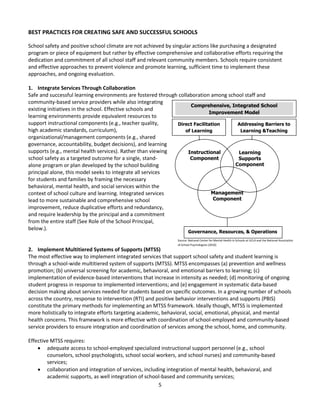
Safe and successful learning environments are fostered through collaboration among school staff and
community-based service providers while also integrating
existing initiatives in the school. Effective schools and
learning environments provide equivalent resources to
support instructional components (e.g., teacher quality,
high academic standards, curriculum),
organizational/management components (e.g., shared
governance, accountability, budget decisions), and learning
supports (e.g., mental health services). Rather than viewing
school safety as a targeted outcome for a single, stand-
alone program or plan developed by the school building
principal alone, this model seeks to integrate all services
for students and families by framing the necessary
behavioral, mental health, and social services within the
context of school culture and learning. Integrated services
lead to more sustainable and comprehensive school
improvement, reduce duplicative efforts and redundancy,
and require leadership by the principal and a commitment
from the entire staff (See Role of the School Principal,
below.).
2. Implement Multitiered Systems of Supports (MTSS)
The most effective way to implement integrated services that support school safety and student learning is
through a school-wide multitiered system of supports (MTSS). MTSS encompasses (a) prevention and wellness
promotion; (b) universal screening for academic, behavioral, and emotional barriers to learning; (c)
implementation of evidence-based interventions that increase in intensity as needed; (d) monitoring of ongoing
student progress in response to implemented interventions; and (e) engagement in systematic data-based
decision making about services needed for students based on specific outcomes. In a growing number of schools
across the country, response to intervention (RTI) and positive behavior interventions and supports (PBIS)
constitute the primary methods for implementing an MTSS framework. Ideally though, MTSS is implemented
more holistically to integrate efforts targeting academic, behavioral, social, emotional, physical, and mental
health concerns. This framework is more effective with coordination of school-employed and community-based
service providers to ensure integration and coordination of services among the school, home, and community.
Effective MTSS requires:
 adequate access to school-employed specialized instructional support personnel (e.g., school
counselors, school psychologists, school social workers, and school nurses) and community-based
services;
 collaboration and integration of services, including integration of mental health, behavioral, and
academic supports, as well integration of school-based and community services;
Source: National Center for Mental Health in Schools at UCLA and the National Association
of School Psychologists (2010).
Instructional
Component
Learning
Supports
Component
Management
Component
Direct Facilitation
of Learning
Governance, Resources, & Operations
Addressing Barriers to
Learning &Teaching
Comprehensive, Integrated School
Improvement Model
6
 adequate staff time for planning and problem solving;
 effective collection, evaluation,
interpretation, and use of data; and
 patience, commitment, and strong
leadership.
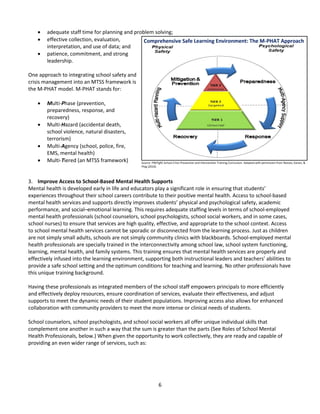
One approach to integrating school safety and
crisis management into an MTSS framework is
the M-PHAT model. M-PHAT stands for:
 Multi-Phase (prevention,
preparedness, response, and
recovery)
 Multi-Hazard (accidental death,
school violence, natural disasters,
terrorism)
 Multi-Agency (school, police, fire,
EMS, mental health)
 Multi-Tiered (an MTSS framework)
3. Improve Access to School-Based Mental Health Supports
Mental health is developed early in life and educators play a significant role in ensuring that students’
experiences throughout their school careers contribute to their positive mental health. Access to school-based
mental health services and supports directly improves students’ physical and psychological safety, academic
performance, and social–emotional learning. This requires adequate staffing levels in terms of school-employed
mental health professionals (school counselors, school psychologists, school social workers, and in some cases,
school nurses) to ensure that services are high quality, effective, and appropriate to the school context. Access
to school mental health services cannot be sporadic or disconnected from the learning process. Just as children
are not simply small adults, schools are not simply community clinics with blackboards. School-employed mental
health professionals are specially trained in the interconnectivity among school law, school system functioning,
learning, mental health, and family systems. This training ensures that mental health services are properly and
effectively infused into the learning environment, supporting both instructional leaders and teachers’ abilities to
provide a safe school setting and the optimum conditions for teaching and learning. No other professionals have
this unique training background.
Having these professionals as integrated members of the school staff empowers principals to more efficiently
and effectively deploy resources, ensure coordination of services, evaluate their effectiveness, and adjust
supports to meet the dynamic needs of their student populations. Improving access also allows for enhanced
collaboration with community providers to meet the more intense or clinical needs of students.
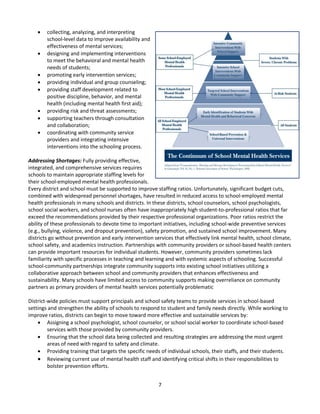
School counselors, school psychologists, and school social workers all offer unique individual skills that
complement one another in such a way that the sum is greater than the parts (See Roles of School Mental
Health Professionals, below.) When given the opportunity to work collectively, they are ready and capable of
providing an even wider range of services, such as:
Comprehensive Safe Learning Environment: The M-PHAT Approach
Source: PREPaRE School Crisis Prevention and Intervention Training Curriculum. Adapted with permission from Reeves, Kanan, &
Plog (2010).
7
 collecting, analyzing, and interpreting
school-level data to improve availability and
effectiveness of mental services;
 designing and implementing interventions
to meet the behavioral and mental health
needs of students;
 promoting early intervention services;
 providing individual and group counseling;
 providing staff development related to
positive discipline, behavior, and mental
health (including mental health first aid);
 providing risk and threat assessments;
 supporting teachers through consultation
and collaboration;
 coordinating with community service
providers and integrating intensive
interventions into the schooling process.
Addressing Shortages: Fully providing effective,
integrated, and comprehensive services requires
schools to maintain appropriate staffing levels for
their school-employed mental health professionals.
Every district and school must be supported to improve staffing ratios. Unfortunately, significant budget cuts,
combined with widespread personnel shortages, have resulted in reduced access to school-employed mental
health professionals in many schools and districts. In these districts, school counselors, school psychologists,
school social workers, and school nurses often have inappropriately high student-to-professional ratios that far
exceed the recommendations provided by their respective professional organizations. Poor ratios restrict the
ability of these professionals to devote time to important initiatives, including school-wide preventive services
(e.g., bullying, violence, and dropout prevention), safety promotion, and sustained school improvement. Many
districts go without prevention and early intervention services that effectively link mental health, school climate,
school safety, and academics instruction. Partnerships with community providers or school-based health centers
can provide important resources for individual students. However, community providers sometimes lack
familiarity with specific processes in teaching and learning and with systemic aspects of schooling. Successful
school-community partnerships integrate community supports into existing school initiatives utilizing a
collaborative approach between school and community providers that enhances effectiveness and
sustainability. Many schools have limited access to community supports making overreliance on community
partners as primary providers of mental health services potentially problematic
District-wide policies must support principals and school safety teams to provide services in school-based
settings and strengthen the ability of schools to respond to student and family needs directly. While working to
improve ratios, districts can begin to move toward more effective and sustainable services by:
 Assigning a school psychologist, school counselor, or school social worker to coordinate school-based
services with those provided by community providers.
 Ensuring that the school data being collected and resulting strategies are addressing the most urgent
areas of need with regard to safety and climate.
 Providing training that targets the specific needs of individual schools, their staffs, and their students.
 Reviewing current use of mental health staff and identifying critical shifts in their responsibilities to
bolster prevention efforts.
8
4. Integrate School Safety and Crisis/Emergency Prevention, Preparedness, Response, and Recovery
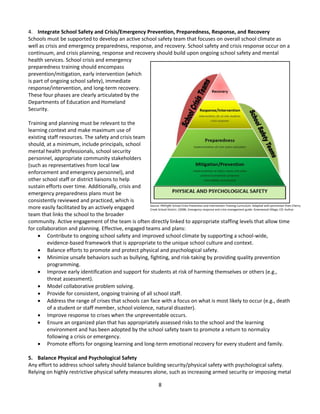
Schools must be supported to develop an active school safety team that focuses on overall school climate as
well as crisis and emergency preparedness, response, and recovery. School safety and crisis response occur on a
continuum, and crisis planning, response and recovery should build upon ongoing school safety and mental
health services. School crisis and emergency
preparedness training should encompass
prevention/mitigation, early intervention (which
is part of ongoing school safety), immediate
response/intervention, and long-term recovery.
These four phases are clearly articulated by the
Departments of Education and Homeland
Security.
Training and planning must be relevant to the
learning context and make maximum use of
existing staff resources. The safety and crisis team
should, at a minimum, include principals, school
mental health professionals, school security
personnel, appropriate community stakeholders
(such as representatives from local law
enforcement and emergency personnel), and
other school staff or district liaisons to help
sustain efforts over time. Additionally, crisis and
emergency preparedness plans must be
consistently reviewed and practiced, which is
more easily facilitated by an actively engaged
team that links the school to the broader
community. Active engagement of the team is often directly linked to appropriate staffing levels that allow time
for collaboration and planning. Effective, engaged teams and plans:
 Contribute to ongoing school safety and improved school climate by supporting a school-wide,
evidence-based framework that is appropriate to the unique school culture and context.
 Balance efforts to promote and protect physical and psychological safety.
 Minimize unsafe behaviors such as bullying, fighting, and risk-taking by providing quality prevention
programming.
 Improve early identification and support for students at risk of harming themselves or others (e.g.,
threat assessment).
 Model collaborative problem solving.
 Provide for consistent, ongoing training of all school staff.
 Address the range of crises that schools can face with a focus on what is most likely to occur (e.g., death
of a student or staff member, school violence, natural disaster).
 Improve response to crises when the unpreventable occurs.
 Ensure an organized plan that has appropriately assessed risks to the school and the learning
environment and has been adopted by the school safety team to promote a return to normalcy
following a crisis or emergency.
 Promote efforts for ongoing learning and long-term emotional recovery for every student and family.
5. Balance Physical and Psychological Safety
Any effort to address school safety should balance building security/physical safety with psychological safety.
Relying on highly restrictive physical safety measures alone, such as increasing armed security or imposing metal
Source: PREPaRE School Crisis Prevention and Intervention Training Curriculum. Adapted with permission from Cherry
Creek School District. (2008). Emergency response and crisis management guide. Greenwood Village, CO: Author.
9
detectors, typically does not objectively improve school safety. In fact, such measures may cause students to
feel less safe and more fearful at school, and could undermine the learning environment. In contrast, combining
reasonable physical security measures with efforts to enhance school climate more fully promotes overall school
safety. Effectively balancing physical and psychological safety entails:
 Assessing the physical security features of the campus, such as access points to the school grounds,
parking lots and buildings, and the lighting and adult supervision in lobbies, hallways, parking lots, and
open spaces.
 Employing environmental design techniques, such as ensuring that playgrounds and sports fields are
surrounded by fences or other natural barriers, to limit visual and physical access by non-school
personnel.
 Evaluating policies and practices to ensure that students are well monitored, school guests are
appropriately identified and escorted, and potential risks and threats are addressed quickly.
 Building trusting, respectful relationships among students, staff, and families.
 Providing access to school mental health services and educating students and staff on how and when to
seek help.
 Providing a confidential way for students and other members of the school community to report
potential threats, because educating students on “breaking the code of silence” is one of our most
effective safety measures.
Schools also should carefully weigh the unique needs of their communities when determining the need to hire
additional security personnel or school resource officers (SROs). It is important to recognize that SROs differ
from other school security personnel or armed guards. SROs are commissioned law enforcement officers who
are specially trained to work within the school community to help implement school safety initiatives as part of
the school safety leadership team. They should be integral participants in school life and student learning.
Additionally, if a school determines that it needs to have an armed professional on school grounds, SROs are the
only school personnel of any type who should be armed. (See Role of the School Resource Officer, below.)
6. Employ Effective, Positive School Discipline
School discipline policies are ultimately the responsibility of the school principal; however, all school staff play a
role in their effective development and implementation. Discipline practices should function in concert with
efforts to address school safety/climate. When positive discipline is incorporated into the overall MTSS, students
feel respected and supported, positive behavior is continually reinforced, and school climate improves.
Additionally, this structure allows for the use of restorative practices that seek to build positive relationships
within the school community. In contrast, overly harsh and punitive measures, such as zero tolerance policies,
lead to reduced safety, connectedness, and feelings of belonging, and have historically been unsuccessful at
improving student behavior or the overall school climate. Additionally, utilizing SROs or other security personnel
primarily as a substitute for effective discipline policies is inappropriate, does not contribute to school safety or
students’ perceptions of being safe, and can perpetuate the school-to-prison pipeline. Effective school discipline:
 is viewed within the context of a learning opportunity and seeks to teach and reinforce positive
behaviors to replace negative behaviors;
 is clear, consistent, and equitably applied to all students;
 employs culturally competent practices;
 safeguards the well-being of all students and staff;
 keeps students in school and out of the juvenile justice system; and
 incorporates family involvement.
7. Allow for the Consideration of Context
There is no one-size-fits-all approach to creating safe and successful schools. To be most effective, schools
should assess the structures and resources already in place and determine what additional resources are
10
needed. Schools should provide universal, secondary, and tertiary interventions that are most appropriate and
culturally sensitive to their unique student populations and learning communities. Additionally, decisions
regarding appropriate security measures, including the use of SROs, should be determined by each school’s
leadership team and not via universal mandate.
8. Acknowledge That Sustainable and Effective Improvement Takes Patience and Commitment
School districts will vary considerably in their readiness to change and in their ability to accept the suggestions
included within this document. Recognizing that sustainable change takes time both to improve acceptability
and allow for full implementation will help set districts up for success rather than setting unrealistic goals.
Efforts for change should not be abandoned if goals are not immediately met, as frequent programmatic
changes lead to more resistance to change among school personnel in the future.
ROLES OF KEY LEADERSHIP PERSONNEL REGARDING SCHOOL SAFETY AND CLIMATE
Role of School Principals
Effective principals and assistant principals recognize the potential they have to create a school environment
where teachers thrive and students achieve their greatest potential in a safe and nurturing school setting. As
instructional leaders, principals maintain a constant presence in the school and in classrooms, listening to and
observing what is taking place, assessing needs, and getting to know teachers and students. Principals set high
expectations and standards for the academic, social, emotional, and physical development of all students. They
bring together a wide range of stakeholders within the school community, take into account the aspirations, and
work to create a vision that reflects the full range and value of a school’s mission. Principals encourage the
development of the whole child by supporting the physical and mental health of children, as well as their social
and emotional well-being, which is reinforced by a sense of safety and self-confidence. High-quality early
childhood education and learning experiences are crucial to an elementary level principal's shared vision to
shape the school culture and instructional leadership. School leaders must mobilize the staff, students, parents,
and community around the mission and shared values, as well as school improvement goals and set the
parameters of high expectations for the school. Effective practice requires:
 building consensus on a vision that reflects the core values of the school community to support student
safety and well-being;
 valuing and using diversity to enhance the learning of the entire school community;
 broadening the framework for child development beyond academics; and
 developing a learning culture that is adaptive, collaborative, innovative, and supportive by taking into
account the contributions of every member of the school staff.
Roles of School-Employed Mental Health Professionals
Many professionals within a school help to support students’ positive mental health. This includes school
counselors, school psychologists, school social workers, school nurses, and other specialized instructional
support personnel. For the purposes of these recommendations, however, we are focusing on the mental health
professionals who should serve in critical leadership roles in terms of school safety, positive school climate, and
providing school-based mental health services: school counselors, school psychologists, and school social
workers. Their training and expertise help link mental health, behavior, environmental factors (e.g., family,
classroom, school, community), instruction, and learning. Each of these professionals helps to create school
environments that are safe, supportive, and conducive to learning. Each may deliver similar services such as
counseling, social–emotional skill instruction, and consultation with families and teachers; however, each
profession has its own unique focus based upon its specializations, which result in different, albeit interrelated,
services. The specific services and expertise of individual practitioners may vary, but the following describes the
core competencies and specialized instructional services of each profession.
11
School counselors have a minimum of a master's degree in school counseling. School counselors are
generally the first school-employed mental health professional to interact with students as they commonly
are involved in the provision of universal learning supports to the whole school population. School
counselors have specialized knowledge of curriculum and instruction and help screen students for the basic
skills needed for successful transition from cradle to college and career. School counselors focus on helping
students' address their academic, personal/social, and career development goals and needs by designing,
implementing, and evaluating a comprehensive school counseling program that promotes and enhances
student success. School counselors work to promote safe learning environments for all members of the
school community and regularly monitor and respond to behavior issues that impact school climate, such as
bullying, student interpersonal struggles, and student–teacher conflicts. Effective school counseling
programs are a collaborative effort between the school counselor, teachers, families, and other educators to
create an environment promoting student achievement, active engagement, equitable access to educational
opportunities, and a rigorous curriculum for all students.
School psychologists have a minimum of a specialist-level degree (60 graduate semester hour minimum) in
school psychology, which combines the disciplines of psychology and education. They typically have
extensive knowledge of learning, motivation, behavior, childhood disabilities, assessment, evaluation, and
school law. School psychologists specialize in analyzing complex student and school problems and selecting
and implementing appropriate evidence-based interventions to improve outcomes at home and school.
School psychologists consult with teachers and parents to provide coordinated services and supports for
students struggling with learning disabilities, emotional and behavioral problems, and those experiencing
anxiety, depression, emotional trauma, grief, and loss. They are regular members of school crisis teams and
collaborate with school administrators and other educators to prevent and respond to crises. They have
specialized training in conducting risk and threat assessments designed to identify students at-risk for
harming themselves or others. School psychologists’ training in evaluation, data collection, and
interpretation can help ensure that decisions made about students, the school system, and related
programs and learning supports are based on appropriate evidence.
School social workers have master’s degrees in social work. They have special expertise in understanding
family and community systems and linking students and their families with the community services that are
essential for promoting student success. School social workers' training includes specialized preparation in
cultural diversity, systems theory, social justice, risk assessment and intervention, consultation and
collaboration, and clinical intervention strategies to address the mental health needs of students. They work
to remedy barriers to learning created as a result of poverty, inadequate health care, and neighborhood
violence. School social workers often focus on providing supports to vulnerable populations of students that
have a high risk for truancy and dropping out of school, such as homeless and foster children, migrant
populations, students transitioning between school and treatment programs or the juvenile justice system,
or students experiencing domestic violence. They work closely with teachers, administrators, parents, and
other educators to provide coordinated interventions and consultation designed to keep students in school
and help their families access the supports needed to promote student success.
Roles of School Resource Officers
The presence of school resource officers in schools has become an important part of the duty to protect
students and staff on campus. Families and school officials in communities around the country benefit from a
more effective relationship with local police as part of a school safety plan. Specialized knowledge of the law,
local and national crime trends and safety threats, people and places in the community, and the local juvenile
justice system combine to make SROs critical members of schools' policy-making teams when it comes to
environmental safety planning and facilities management, school-safety policy, and emergency response
preparedness.
12
In order to fully realize the benefits of the presence of local police, the SROs must be trained properly. Officers'
law-enforcement knowledge and skill combine with specialized SRO training for their duties in the education
setting. This training focuses on the special nature of school campuses, student needs and characteristics, and
the educational and custodial interests of school personnel. SROs, as a result, possess a skill set unique among
both law enforcement and education personnel that enables SROs to protect the community and the campus
while supporting schools’ educational mission. In addition to traditional law enforcement tasks, such as
investigating whether drugs have been brought onto campus, SROs’ daily activities cover a wide range of
supportive activities and programs depending upon the type of school to which an SRO is assigned. This can
include conducting law-related education sessions in the classroom, meeting with the school safety team,
conducting safety assessments of the campus, and problem-solving with students or faculty. Trained and
committed SROs are well suited to effectively protect and serve the school community. They contribute to the
safe-schools team by ensuring a safe and secure campus, educating students about law-related topics, and
mentoring students as informal counselors and role models.
ACTIONS PRINCIPALS CAN TAKE NOW TO PROMOTE SAFE AND SUCCESSFUL SCHOOLS
Policies and funding that support comprehensive school safety and mental health efforts are critical to
ensuring universal and long-term sustainability. However, school leaders can work toward more effective
approaches now by taking the following actions.
 Establish a school leadership team that includes key personnel: principals, teachers, school-
employed mental health professionals, instruction/curriculum professionals, school
resource/safety officer, and a staff member skilled in data collection and analysis.
 Assess and identify needs, strengths, and gaps in existing services and supports (e.g., availability
of school and community resources, unmet student mental health needs) that address the
physical and psychological safety of the school community.
 Evaluate the safety of the school building and school grounds by examining the physical security
features of the campus.
 Review how current resources are being applied, for example:
o Are school employed mental health professionals providing training to teachers and
support staff regarding resiliency and risk factors?
o Do mental health staff participate in grade-level team meetings and provide ideas on
how to effectively meet students’ needs?
o Is there redundancy in service delivery?
o Are multiple overlapping initiatives occurring in different parts of the school or being
applied to different sets of students?
 Implement an integrated approach that connects behavioral and mental health services and
academic instruction and learning (e.g., are mental health interventions being integrated into an
effective discipline or classroom management plan?).
 Provide adequate time for staff planning and problem solving via regular team meetings and
professional learning communities. Identify existing and potential community partners, develop
memoranda of understanding to clarify roles and responsibilities, and assign appropriate school
staff to guide these partnerships, such as school-employed mental health professionals and
principals.
 Provide professional development for school staff and community partners addressing school
climate and safety, positive behavior, and crisis prevention, preparedness, and response.
 Engage students and families as partners in developing and implementing policies and practices
that create and maintain a safe school environment.
13
SUMMARY
Modern-day schools are highly complex and unique organizations that operate with an urgent imperative:
Educate and prepare all children and youth to achieve their highest potential and contribute to society, no
matter their socioeconomic background or geographic location. Creating safe, orderly, warm, and inviting school
environments is critical to ensuring that all of our schools meet this goal. In order to create this type of
environment, schools must work towards integrating services (academic, behavioral, social, emotional, and
mental health) through collaboration using a multitiered system of support. Schools should strive to increase
access to mental health services, increase the number of school employed mental health staff, and ensure that
measures to improve school safety balance physical safety with psychological safety. To further support student
safety, schools must develop effective emergency preparedness and crisis prevention, intervention, and
response plans that are coordinated with local first responders. We look forward to working with the
Administration, Congress, and state and local policy makers to help ensure that all schools are safe, supportive,
and conducive to learning.
GUIDELINES FOR EFFECTIVE PRACTICE
ASCA: http://www.ascanationalmodel.org/
 ASCA National Model, 2008
NAESP: http://www.naesp.org/resources/1/Pdfs/LLC2-ES.pdf
 Leading Learning Communities: Standards for What Principals Should Know and Be Able to Do, 2008
NASP Professional Standards: http://www.nasponline.org/standards/2010standards.aspx
 Model for Comprehensive and Integrated School Psychological Services, 2010
NASRO: http://www.nasro.org/sites/default/files/pdf_files/NASRO_Protect_and_Educate.pdf
 To Protect and Educate: The School Resource Officer and the Prevention of Violence in Schools, 2012
NASSP: http://www.nassp.org/school-improvement
 Breaking Ranks: The Comprehensive Framework for School Improvement, 2011
SSWAA: http://sswaa.org/associations/13190/files/naswschoolsocialworkstandards.pdf
 NASW School Social Work Standards, 2012
SUPPORTING RESEARCH AND RESOURCES
Addington, L. A. (2009). Cops and cameras: Public school security as a policy response to Columbine. American Behavioral
Scientist, 52, 1424–1446.
Bachman, R., Randolph, A., & Brown, B. L. (2011). Predicting perceptions of fear at school and going to and from school for
African American and White students: The effects of school security measures. Youth & Society, 43, 705–726.
Borum, R., Cornell, D. G., Modzeleski, W., & Jimerson, S. R. (2010). What can be done about school shootings? A review of
the evidence. Educational Researcher, 39, 27–37.
Brock, S. (2011). PREPaRE: Crisis Intervention & Recovery: The Roles of the School-Based Mental Health Professional (2nd
ed.). Bethesda, MD: National Association of School Psychologists.
Bruns, E. J., Walrath, C., Glass-Siegel, M., & Weist, M. D. (2004). School-based mental health services in Baltimore:
Association with school climate and special education referrals. Behavior Modification, 28, 491–512.
Casella, R. (2006). Selling us the fortress: The promotion of techno-security equipment in schools. New York, NY: Routledge.
Garcia, C. A. (2003). School safety technology in America: Current use and perceived effectiveness. Criminal Justice Policy
Review, 14, 30–54.
Hussey, D. L., & Guo, S. (2003). Measuring behavior change in young children receiving intensive school-based mental
health services. Journal of Community Psychology, 31, 629–639.
Jackson, A. (2002). Police-school resource officers’ and students’ perception of the police and offending. Policing, 25, 631–
650.
Lapan, R. T., Gysbers, N. C., & Petroski, G. F. (2001). Helping seventh graders be safe and successful: A statewide study of
the impact of comprehensive guidance and counseling programs. Journal of Counseling & Development, 79, 320–330.
14
Lapan, R. T., Gysbers, N. C., & Sun, Y. (1997). The impact of more fully implemented guidance programs on the school
experiences of students: A statewide evaluation study. Journal of Counseling & Development, 75, 292–302.
Mayer, M. J., & Leaone, P. E. (1999). A structural analysis of school violence and disruption: Implications for creating safer
schools. Education and Treatment of Children, 22, 333–356.
National Association of School Psychologists. (2013). Conducting Crisis Exercises and Drills: Guidelines for Schools. Retrieved
from http://www.nasponline.org/resources/crisis_safety/drills_guidance.pdf.
National Association of School Psychologists. (2013). Research on School Security: The Impact of Security Measures on
Students. Retrieved from http://www.nasponline.org/advocacy/schoolsecurity.pdf.
National Association of School Psychologists. (2013). Youth Gun Violence Fact Sheet. Retrieved from
http://www.nasponline.org/resources/crisis_safety/Youth_Gun_Violence_Fact_Sheet.pdf.
Nickerson, A. B., & Martens, M. R. (2008). School violence: Associations with control, security/enforcement,
educational/therapeutic approaches, and demographic factors. School Psychology Review, 37, 228–243.
Otwell, P. S., & Mullis, F. (1997). Academic achievement and counselor accountability. Elementary School Guidance and
Counseling, 31, 343–348.
Phaneuf, S. W. (2009). Security in schools: Its effect on students. El Paso, TX: LFB Scholarly Publishing LLC.
Reeves, M. A., Nickerson, A. B., Conolly-Wilson, C. N., Susan, M. K., Lazzaro, B. R., Jimerson, S. R., & Pesce, R. C.(2012). Crisis
Prevention & Preparedness: Comprehensive school safety planning (2nd ed.). Bethesda, MD: National Association of
School Psychologists.
Rossen, E., & Cowan, K. C. (2012). A framework for school-wide bullying prevention and safety [Brief]. Bethesda, MD:
National Association of School Psychologists.
Schreck, C. J., & Miller, J. M., & Gibson, C. L. (2003). Trouble in the school yard: A study of the risk factors of victimization at
school. Crime & Delinquency, 49, 460–484.
Theriot, M. T. (2009). School resource officers and the criminalization of student behavior. Journal of Criminal Justice, 37,
280–287.
Wilson, S. J., Lipsey, M. W., & Derzon, J. H. (2003). The effects of school-based intervention programs on aggressive
behavior: A meta-analysis. Journal of Consulting and Clinical Psychology, 71, 136–149.
Written by:
Katherine C. Cowan, Director of Communications; Kelly Vaillancourt, PhD, NCSP, Director of Government
Relations; and Eric Rossen, PhD, NCSP, Director of Professional Development and Standards, National
Association of School Psychologists; and Kelly Pollitt, Associate Executive Director, Advocacy, Policy, and Special
Projects, National Association of Elementary School Principals
Author Organizations:
American School Counselor Association (ASCA): www.schoolcounselor.org
National Association of Elementary School Principals (NAESP): www.naesp.org
National Association of School Psychologists (NASP): www.nasponline.org
National Association of School Resource Officers (NASRO): www.nasro.org
National Association of Secondary School Principals (NASSP): www.nassp.org
School Social Work Association of America (SSWAA): www.sswaa.org
Endorsing Organizations:
National Organizations
American Association of School Administrators
American Camp Association, Inc.
American Council for School Social Work
American Dance Therapy Association
American School Health Association
Born This Way Foundation
Character Education Partnership
Child Mind Institute
Coalition for Community Schools
15
Collaborative for Academic, Social, and Emotional
Learning,
Committee for Children
Council for Children with Behavioral Disorders
Council for Exceptional Children
Division-16, American Psychological Association
International School Psychology Association
Mental Health America
Midwest Symposium for Leadership in Behavior
Disorders
National Association of School Nurses
National Association of School Safety and Law
Enforcement Officials
National Association of Social Workers
National Association of State Directors of Special
Education
National Center for School Engagement
National Education Association
National Federation of Families for Children’s
Mental Health
National Network of Safe and Drug-Free Schools
National Organizations for Youth Safety
Pride Surveys
Safe and Civil Schools
The Trevor Project
State Associations
Alabama School Counselor Association
Alaska School Counselor Association
Arizona School Counselors Association
Association of School Psychologists of Pennsylvania
California Association of School Social Workers
Colorado School Counselor Association
Connecticut Association of School Psychologists
Connecticut School Counselor Association
Delaware Association of School Psychologists
Florida Association of School Social Workers
Florida School Counselor Association
Georgia Association of School
Georgia Association of School Psychologists
Georgia School Counselors Association
Hawaii School Counselor Association
Idaho School Counselor Association
Idaho School Psychology Association
Illinois Association of School Social Workers
Illinois School Counselor Association
Illinois School Psychologists Association
Indiana Association of School Psychologists
Indiana School Counselor Association
Iowa School Counselor Association
Kentucky Association of Psychology in the Schools
Maine Association of School Psychology
Maine Counseling Association
Maine School Counselor Association
Maryland School Counselor Association
Massachusetts School Psychologist association
Massachusetts School Counselors Association
Michigan School Counselor Association
Minnesota School Counselors Association
Minnesota School Psychologists Association
Missouri Association of School Psychologists
Missouri School Counselor Association
Montana School Counselor Association
Nebraska School Psychology Association
New Jersey Association of School Social Workers
New Jersey School Counselor Association
New Mexico School Counselor Association
New York Association of School Psychologists
New York State School Counselor Association
North Dakota School Counselor Association
Ohio School Psychologist Association
Oklahoma School Counselors Association
Oregon School Psychologists Association
Pennsylvania School Counselors Association
Rhode Island School Counselor Association
School Social Work Association of Arizona
School Social Workers Association of Missouri
School Social Workers in Arkansas
School Social Workers in Maryland.
South Carolina Association of School Psychologists
South Carolina Association of School Social
Workers
South Carolina School Counselor Association
South Dakota School Counselor Association
Tennessee School Counselor Association
Utah School Counselor Association
Vermont Association of School Psychologist
Virginia Academy of School Psychology
Virginia Association of Visiting Teachers/School
Social Worker
Virginia School Counselor Association
Wisconsin School Counselor Association
Wisconsin School Social Workers Association
16
Endorsing Individuals:
Howard Adelman, PhD
George Bear, PhD
Dewey Cornell, PhD
Maurice Elias, PhD
Dorothy Espelage, PhD
Michael Furlong, PhD, NCSP
Shane Jimerson, PhD, NCSP
David Osher, PhD
William Pfohl, PhD, NCSP
Sue Swearer, PhD
Please cite as: Cowan, K. C., Vaillancourt, K., Rossen, E., & Pollitt, K. (2013). A framework for safe and successful
schools [Brief]. Bethesda, MD: National Association of School Psychologists.
Available online at www.nasponline.org/schoolsafetyframework.
© 2013, National Association of School Psychologists, 4340 East West Highway, Suite 402, Bethesda, MD
20814, (301) 657-0270 www.nasponline.org

Framework for Safe and Successful School Environments_FINAL..pdf

  • 1.
    1 A Framework forSafe and Successful Schools Executive Summary This joint statement provides a framework supported by educators for improving school safety and increasing access to mental health supports for children and youth. Efforts to improve school climate, safety, and learning are not separate endeavors. They must be designed, funded, and implemented as a comprehensive school-wide approach that facilitates interdisciplinary collaboration and builds on a multitiered system of supports. We caution against seemingly quick and potentially harmful solutions, such as arming school personnel, and urge policy leaders to support the following guidance to enact policies that will equip America’s schools to educate and safeguard our children over the long term. POLICY RECOMMENDATIONS TO SUPPORT EFFECTIVE SCHOOL SAFETY 1. Allow for blended, flexible use of funding streams in education and mental health services; 2. Improve staffing ratios to allow for the delivery of a full range of services and effective school–community partnerships; 3. Develop evidence-based standards for district-level policies to promote effective school discipline and positive behavior; 4. Fund continuous and sustainable crisis and emergency preparedness, response, and recovery planning and training that uses evidence-based models; 5. Provide incentives for intra- and interagency collaboration; and 6. Support multitiered systems of support (MTSS). BEST PRACTICES FOR CREATING SAFE AND SUCCESSFUL SCHOOLS 1. Fully integrate learning supports (e.g., behavioral, mental health, and social services), instruction, and school management within a comprehensive, cohesive approach that facilitates multidisciplinary collaboration. 2. Implement multitiered systems of support (MTSS) that encompass prevention, wellness promotion, and interventions that increase with intensity based on student need, and that promote close school– community collaboration. 3. Improve access to school-based mental health supports by ensuring adequate staffing levels in terms of school-employed mental health professionals who are trained to infuse prevention and intervention services into the learning process and to help integrate services provided through school–community partnerships into existing school initiatives. 4. Integrate ongoing positive climate and safety efforts with crisis prevention, preparedness, response, and recovery to ensure that crisis training and plans: (a) are relevant to the school context, (b) reinforce learning, (c) make maximum use of existing staff resources, (d) facilitate effective threat assessment, and (e) are consistently reviewed and practiced.
  • 2.
    2 5. Balance physicaland psychological safety to avoid overly restrictive measures (e.g., armed guards and metal detectors) that can undermine the learning environment and instead combine reasonable physical security measures (e.g., locked doors and monitored public spaces) with efforts to enhance school climate, build trusting relationships, and encourage students and adults to report potential threats. If a school determines the need for armed security, properly trained school resource officers (SROs) are the only school personnel of any type who should be armed. 6. Employ effective, positive school discipline that: (a) functions in concert with efforts to address school safety and climate; (b) is not simply punitive (e.g., zero tolerance); (c) is clear, consistent, and equitable; and (d) reinforces positive behaviors. Using security personnel or SROs primarily as a substitute for effective discipline policies does not contribute to school safety and can perpetuate the school-to-prison pipeline. 7. Consider the context of each school and district and provide services that are most needed, appropriate, and culturally sensitive to a school’s unique student populations and learning communities. 8. Acknowledge that sustainable and effective change takes time, and that individual schools will vary in their readiness to implement improvements and should be afforded the time and resources to sustain change over time. Creating safe, orderly, and welcoming learning environments is critical to educating and preparing all of our children and youth to achieve their highest potential and contribute to society. We all share this responsibility and look forward to working with the Administration, Congress, and state and local policy makers to shape policies based on these best practices in school safety and climate, student mental health, instructional leadership, teaching, and learning.
  • 3.
    3 A Framework forSafe and Successful Schools The author organizations and cosigners of this joint statement applaud the President and Congress for acknowledging that additional actions must be taken to prevent violence in America’s schools and communities. We represent the educators who work day in and day out to keep our children safe, ensure their well-being, and promote learning. This joint statement provides a framework supported by educators for improving school safety and increasing access to mental health supports for children and youth. We created these policy and practice recommendations to help provide further guidance to the Administration, Congress, and state and local agencies as they reflect upon evidence for best practices in school safety and climate, student mental health and well-being, instructional leadership, teaching, and learning. Further, the partnership between our organizations seeks to reinforce the interdisciplinary, collaborative, and cohesive approach that is required to create and sustain genuinely safe, supportive schools that meet the needs of the whole child. Efforts to improve school climate, safety, and learning are not separate endeavors and must be designed, funded, and implemented as a comprehensive school-wide approach. Ensuring that mental health and safety programming and services are appropriately integrated into the overall multitiered system of supports is essential for successful and sustainable improvements in school safety and academic achievement. Specifically, effective school safety efforts:  Begin with proactive principal leadership.  Allow school leaders to deploy human and financial resources in a manner that best meets the needs of their school and community.  Provide a team-based framework to facilitate effective coordination of services and interventions.  Balance the needs for physical and psychological safety.  Employ the necessary and appropriately trained school-employed mental health and safety personnel.  Provide relevant and ongoing professional development for all staff.  Integrate a continuum of mental health supports within a multitiered system of supports.  Engage families and community providers as meaningful partners.  Remain grounded in the mission and purpose of schools: teaching and learning. Although the focus of this document is on policies and practices that schools can use to ensure safety, we must acknowledge the importance of policies and practices that make our communities safer as well. This includes increased access to mental health services, improved interagency collaboration, and reduced exposure of children to community violence. Additionally, our organizations support efforts designed to reduce youth access to firearms. Finally, many local school districts and state boards of education are considering policies that would allow school staff to carry a weapon. Our organizations believe that arming educators would cause more harm than good, and we advise decision makers to approach these policies with extreme caution. We urge policy leaders to support the following guidance to promote safe and supportive schools. We look forward to working with the Administration, Congress, and state and local agencies to shape and enact meaningful policies that will genuinely equip America’s schools to educate and safeguard our children over the long term.
  • 4.
    4 POLICY RECOMMENDATIONS TOSUPPORT EFFECTIVE SCHOOL SAFETY 1. Allow for blended, flexible use of funding streams. The Department of Education should work with the Department of Health and Human Services and Congress to release guidance that gives schools' access to various funding streams (e.g., SAMHSA and Title I) to ensure adequate and sustained funding dedicated to improving school safety. One-time grants are beneficial in some circumstances; however, one-time allotments of money for schools are insufficient for sustained change to occur. Similarly, district superintendents must be able to anticipate the availability of future funding in order to collaborate with school principals to effectively plan for and implement meaningful changes that will result in positive, sustainable outcomes for students. 2. Strive to improve staffing ratios to allow for the delivery of a full range of services, including school– community partnerships, and set standards that will help schools effectively and accurately assess their needs. This will require providing additional funding for key personnel such as school counselors, school psychologists, school social workers, and school nurses. 3. Outline standards for district-level policies to promote effective school discipline and positive behavior. Although it has been briefly discussed in this document, we urge the Department to release guidance regarding effective school discipline policies. Far too many schools continue to use punitive discipline measures, such as zero-tolerance policies, that result in negative outcomes for students and contribute to the school-to-prison pipeline. 4. Provide funding for continuous and sustainable crisis and emergency preparedness, response and recovery planning and training (utilizing evidence-based models). The minimum standards include: a. establishment of a school safety and crisis team that includes the principal, school-employed mental health professionals, school security personnel, and appropriate community first responders; b. a balanced focus on promoting and protecting both physical and psychological safety; c. a crisis team and plan based on the Department of Homeland Security’s Incident Command Structure; d. ongoing professional development for all school employees to help identify key indicators of students’ mental health problems as well as employees’ specific roles in implementation of crisis response plans; e. professional development for school-employed mental health professionals and other relevant staff (e.g., key administrators, school resource officers) on how to implement effective crisis prevention, intervention, and postvention strategies, including the critical mental health components of recovery. 5. Provide incentives for intra- and inter-agency collaboration. All levels of government need to take preemptive measures to strengthen the ability of schools to provide coordinated services to address mental health and school safety. We urge the federal government to set the standard and issue guidance on how various government, law enforcement, and community agencies can work together to provide services to students and families. At all levels, we must remove the barriers between education and health service agencies. Schools serve as the ideal “hub” for service delivery; however, schools must be adequately staffed with school counselors, school psychologists, school social workers, and school nurses who can provide the proper services in the school setting, connect students and families to the appropriate services in the community, and work collaboratively with external agencies to ensure streamlined service delivery and avoid redundancy. 6. Support multitiered systems of supports. A full continuum of services ranging from building-level supports for all students to more intensive student-level services is necessary to effectively address school safety and student mental health.
  • 5.
    5 BEST PRACTICES FORCREATING SAFE AND SUCCESSFUL SCHOOLS School safety and positive school climate are not achieved by singular actions like purchasing a designated program or piece of equipment but rather by effective comprehensive and collaborative efforts requiring the dedication and commitment of all school staff and relevant community members. Schools require consistent and effective approaches to prevent violence and promote learning, sufficient time to implement these approaches, and ongoing evaluation. 1. Integrate Services Through Collaboration Safe and successful learning environments are fostered through collaboration among school staff and community-based service providers while also integrating existing initiatives in the school. Effective schools and learning environments provide equivalent resources to support instructional components (e.g., teacher quality, high academic standards, curriculum), organizational/management components (e.g., shared governance, accountability, budget decisions), and learning supports (e.g., mental health services). Rather than viewing school safety as a targeted outcome for a single, stand- alone program or plan developed by the school building principal alone, this model seeks to integrate all services for students and families by framing the necessary behavioral, mental health, and social services within the context of school culture and learning. Integrated services lead to more sustainable and comprehensive school improvement, reduce duplicative efforts and redundancy, and require leadership by the principal and a commitment from the entire staff (See Role of the School Principal, below.). 2. Implement Multitiered Systems of Supports (MTSS) The most effective way to implement integrated services that support school safety and student learning is through a school-wide multitiered system of supports (MTSS). MTSS encompasses (a) prevention and wellness promotion; (b) universal screening for academic, behavioral, and emotional barriers to learning; (c) implementation of evidence-based interventions that increase in intensity as needed; (d) monitoring of ongoing student progress in response to implemented interventions; and (e) engagement in systematic data-based decision making about services needed for students based on specific outcomes. In a growing number of schools across the country, response to intervention (RTI) and positive behavior interventions and supports (PBIS) constitute the primary methods for implementing an MTSS framework. Ideally though, MTSS is implemented more holistically to integrate efforts targeting academic, behavioral, social, emotional, physical, and mental health concerns. This framework is more effective with coordination of school-employed and community-based service providers to ensure integration and coordination of services among the school, home, and community. Effective MTSS requires:  adequate access to school-employed specialized instructional support personnel (e.g., school counselors, school psychologists, school social workers, and school nurses) and community-based services;  collaboration and integration of services, including integration of mental health, behavioral, and academic supports, as well integration of school-based and community services; Source: National Center for Mental Health in Schools at UCLA and the National Association of School Psychologists (2010). Instructional Component Learning Supports Component Management Component Direct Facilitation of Learning Governance, Resources, & Operations Addressing Barriers to Learning &Teaching Comprehensive, Integrated School Improvement Model
  • 6.
    6  adequate stafftime for planning and problem solving;  effective collection, evaluation, interpretation, and use of data; and  patience, commitment, and strong leadership. One approach to integrating school safety and crisis management into an MTSS framework is the M-PHAT model. M-PHAT stands for:  Multi-Phase (prevention, preparedness, response, and recovery)  Multi-Hazard (accidental death, school violence, natural disasters, terrorism)  Multi-Agency (school, police, fire, EMS, mental health)  Multi-Tiered (an MTSS framework) 3. Improve Access to School-Based Mental Health Supports Mental health is developed early in life and educators play a significant role in ensuring that students’ experiences throughout their school careers contribute to their positive mental health. Access to school-based mental health services and supports directly improves students’ physical and psychological safety, academic performance, and social–emotional learning. This requires adequate staffing levels in terms of school-employed mental health professionals (school counselors, school psychologists, school social workers, and in some cases, school nurses) to ensure that services are high quality, effective, and appropriate to the school context. Access to school mental health services cannot be sporadic or disconnected from the learning process. Just as children are not simply small adults, schools are not simply community clinics with blackboards. School-employed mental health professionals are specially trained in the interconnectivity among school law, school system functioning, learning, mental health, and family systems. This training ensures that mental health services are properly and effectively infused into the learning environment, supporting both instructional leaders and teachers’ abilities to provide a safe school setting and the optimum conditions for teaching and learning. No other professionals have this unique training background. Having these professionals as integrated members of the school staff empowers principals to more efficiently and effectively deploy resources, ensure coordination of services, evaluate their effectiveness, and adjust supports to meet the dynamic needs of their student populations. Improving access also allows for enhanced collaboration with community providers to meet the more intense or clinical needs of students. School counselors, school psychologists, and school social workers all offer unique individual skills that complement one another in such a way that the sum is greater than the parts (See Roles of School Mental Health Professionals, below.) When given the opportunity to work collectively, they are ready and capable of providing an even wider range of services, such as: Comprehensive Safe Learning Environment: The M-PHAT Approach Source: PREPaRE School Crisis Prevention and Intervention Training Curriculum. Adapted with permission from Reeves, Kanan, & Plog (2010).
  • 7.
    7  collecting, analyzing,and interpreting school-level data to improve availability and effectiveness of mental services;  designing and implementing interventions to meet the behavioral and mental health needs of students;  promoting early intervention services;  providing individual and group counseling;  providing staff development related to positive discipline, behavior, and mental health (including mental health first aid);  providing risk and threat assessments;  supporting teachers through consultation and collaboration;  coordinating with community service providers and integrating intensive interventions into the schooling process. Addressing Shortages: Fully providing effective, integrated, and comprehensive services requires schools to maintain appropriate staffing levels for their school-employed mental health professionals. Every district and school must be supported to improve staffing ratios. Unfortunately, significant budget cuts, combined with widespread personnel shortages, have resulted in reduced access to school-employed mental health professionals in many schools and districts. In these districts, school counselors, school psychologists, school social workers, and school nurses often have inappropriately high student-to-professional ratios that far exceed the recommendations provided by their respective professional organizations. Poor ratios restrict the ability of these professionals to devote time to important initiatives, including school-wide preventive services (e.g., bullying, violence, and dropout prevention), safety promotion, and sustained school improvement. Many districts go without prevention and early intervention services that effectively link mental health, school climate, school safety, and academics instruction. Partnerships with community providers or school-based health centers can provide important resources for individual students. However, community providers sometimes lack familiarity with specific processes in teaching and learning and with systemic aspects of schooling. Successful school-community partnerships integrate community supports into existing school initiatives utilizing a collaborative approach between school and community providers that enhances effectiveness and sustainability. Many schools have limited access to community supports making overreliance on community partners as primary providers of mental health services potentially problematic District-wide policies must support principals and school safety teams to provide services in school-based settings and strengthen the ability of schools to respond to student and family needs directly. While working to improve ratios, districts can begin to move toward more effective and sustainable services by:  Assigning a school psychologist, school counselor, or school social worker to coordinate school-based services with those provided by community providers.  Ensuring that the school data being collected and resulting strategies are addressing the most urgent areas of need with regard to safety and climate.  Providing training that targets the specific needs of individual schools, their staffs, and their students.  Reviewing current use of mental health staff and identifying critical shifts in their responsibilities to bolster prevention efforts.
  • 8.
    8 4. Integrate SchoolSafety and Crisis/Emergency Prevention, Preparedness, Response, and Recovery Schools must be supported to develop an active school safety team that focuses on overall school climate as well as crisis and emergency preparedness, response, and recovery. School safety and crisis response occur on a continuum, and crisis planning, response and recovery should build upon ongoing school safety and mental health services. School crisis and emergency preparedness training should encompass prevention/mitigation, early intervention (which is part of ongoing school safety), immediate response/intervention, and long-term recovery. These four phases are clearly articulated by the Departments of Education and Homeland Security. Training and planning must be relevant to the learning context and make maximum use of existing staff resources. The safety and crisis team should, at a minimum, include principals, school mental health professionals, school security personnel, appropriate community stakeholders (such as representatives from local law enforcement and emergency personnel), and other school staff or district liaisons to help sustain efforts over time. Additionally, crisis and emergency preparedness plans must be consistently reviewed and practiced, which is more easily facilitated by an actively engaged team that links the school to the broader community. Active engagement of the team is often directly linked to appropriate staffing levels that allow time for collaboration and planning. Effective, engaged teams and plans:  Contribute to ongoing school safety and improved school climate by supporting a school-wide, evidence-based framework that is appropriate to the unique school culture and context.  Balance efforts to promote and protect physical and psychological safety.  Minimize unsafe behaviors such as bullying, fighting, and risk-taking by providing quality prevention programming.  Improve early identification and support for students at risk of harming themselves or others (e.g., threat assessment).  Model collaborative problem solving.  Provide for consistent, ongoing training of all school staff.  Address the range of crises that schools can face with a focus on what is most likely to occur (e.g., death of a student or staff member, school violence, natural disaster).  Improve response to crises when the unpreventable occurs.  Ensure an organized plan that has appropriately assessed risks to the school and the learning environment and has been adopted by the school safety team to promote a return to normalcy following a crisis or emergency.  Promote efforts for ongoing learning and long-term emotional recovery for every student and family. 5. Balance Physical and Psychological Safety Any effort to address school safety should balance building security/physical safety with psychological safety. Relying on highly restrictive physical safety measures alone, such as increasing armed security or imposing metal Source: PREPaRE School Crisis Prevention and Intervention Training Curriculum. Adapted with permission from Cherry Creek School District. (2008). Emergency response and crisis management guide. Greenwood Village, CO: Author.
  • 9.
    9 detectors, typically doesnot objectively improve school safety. In fact, such measures may cause students to feel less safe and more fearful at school, and could undermine the learning environment. In contrast, combining reasonable physical security measures with efforts to enhance school climate more fully promotes overall school safety. Effectively balancing physical and psychological safety entails:  Assessing the physical security features of the campus, such as access points to the school grounds, parking lots and buildings, and the lighting and adult supervision in lobbies, hallways, parking lots, and open spaces.  Employing environmental design techniques, such as ensuring that playgrounds and sports fields are surrounded by fences or other natural barriers, to limit visual and physical access by non-school personnel.  Evaluating policies and practices to ensure that students are well monitored, school guests are appropriately identified and escorted, and potential risks and threats are addressed quickly.  Building trusting, respectful relationships among students, staff, and families.  Providing access to school mental health services and educating students and staff on how and when to seek help.  Providing a confidential way for students and other members of the school community to report potential threats, because educating students on “breaking the code of silence” is one of our most effective safety measures. Schools also should carefully weigh the unique needs of their communities when determining the need to hire additional security personnel or school resource officers (SROs). It is important to recognize that SROs differ from other school security personnel or armed guards. SROs are commissioned law enforcement officers who are specially trained to work within the school community to help implement school safety initiatives as part of the school safety leadership team. They should be integral participants in school life and student learning. Additionally, if a school determines that it needs to have an armed professional on school grounds, SROs are the only school personnel of any type who should be armed. (See Role of the School Resource Officer, below.) 6. Employ Effective, Positive School Discipline School discipline policies are ultimately the responsibility of the school principal; however, all school staff play a role in their effective development and implementation. Discipline practices should function in concert with efforts to address school safety/climate. When positive discipline is incorporated into the overall MTSS, students feel respected and supported, positive behavior is continually reinforced, and school climate improves. Additionally, this structure allows for the use of restorative practices that seek to build positive relationships within the school community. In contrast, overly harsh and punitive measures, such as zero tolerance policies, lead to reduced safety, connectedness, and feelings of belonging, and have historically been unsuccessful at improving student behavior or the overall school climate. Additionally, utilizing SROs or other security personnel primarily as a substitute for effective discipline policies is inappropriate, does not contribute to school safety or students’ perceptions of being safe, and can perpetuate the school-to-prison pipeline. Effective school discipline:  is viewed within the context of a learning opportunity and seeks to teach and reinforce positive behaviors to replace negative behaviors;  is clear, consistent, and equitably applied to all students;  employs culturally competent practices;  safeguards the well-being of all students and staff;  keeps students in school and out of the juvenile justice system; and  incorporates family involvement. 7. Allow for the Consideration of Context There is no one-size-fits-all approach to creating safe and successful schools. To be most effective, schools should assess the structures and resources already in place and determine what additional resources are
  • 10.
    10 needed. Schools shouldprovide universal, secondary, and tertiary interventions that are most appropriate and culturally sensitive to their unique student populations and learning communities. Additionally, decisions regarding appropriate security measures, including the use of SROs, should be determined by each school’s leadership team and not via universal mandate. 8. Acknowledge That Sustainable and Effective Improvement Takes Patience and Commitment School districts will vary considerably in their readiness to change and in their ability to accept the suggestions included within this document. Recognizing that sustainable change takes time both to improve acceptability and allow for full implementation will help set districts up for success rather than setting unrealistic goals. Efforts for change should not be abandoned if goals are not immediately met, as frequent programmatic changes lead to more resistance to change among school personnel in the future. ROLES OF KEY LEADERSHIP PERSONNEL REGARDING SCHOOL SAFETY AND CLIMATE Role of School Principals Effective principals and assistant principals recognize the potential they have to create a school environment where teachers thrive and students achieve their greatest potential in a safe and nurturing school setting. As instructional leaders, principals maintain a constant presence in the school and in classrooms, listening to and observing what is taking place, assessing needs, and getting to know teachers and students. Principals set high expectations and standards for the academic, social, emotional, and physical development of all students. They bring together a wide range of stakeholders within the school community, take into account the aspirations, and work to create a vision that reflects the full range and value of a school’s mission. Principals encourage the development of the whole child by supporting the physical and mental health of children, as well as their social and emotional well-being, which is reinforced by a sense of safety and self-confidence. High-quality early childhood education and learning experiences are crucial to an elementary level principal's shared vision to shape the school culture and instructional leadership. School leaders must mobilize the staff, students, parents, and community around the mission and shared values, as well as school improvement goals and set the parameters of high expectations for the school. Effective practice requires:  building consensus on a vision that reflects the core values of the school community to support student safety and well-being;  valuing and using diversity to enhance the learning of the entire school community;  broadening the framework for child development beyond academics; and  developing a learning culture that is adaptive, collaborative, innovative, and supportive by taking into account the contributions of every member of the school staff. Roles of School-Employed Mental Health Professionals Many professionals within a school help to support students’ positive mental health. This includes school counselors, school psychologists, school social workers, school nurses, and other specialized instructional support personnel. For the purposes of these recommendations, however, we are focusing on the mental health professionals who should serve in critical leadership roles in terms of school safety, positive school climate, and providing school-based mental health services: school counselors, school psychologists, and school social workers. Their training and expertise help link mental health, behavior, environmental factors (e.g., family, classroom, school, community), instruction, and learning. Each of these professionals helps to create school environments that are safe, supportive, and conducive to learning. Each may deliver similar services such as counseling, social–emotional skill instruction, and consultation with families and teachers; however, each profession has its own unique focus based upon its specializations, which result in different, albeit interrelated, services. The specific services and expertise of individual practitioners may vary, but the following describes the core competencies and specialized instructional services of each profession.
  • 11.
    11 School counselors havea minimum of a master's degree in school counseling. School counselors are generally the first school-employed mental health professional to interact with students as they commonly are involved in the provision of universal learning supports to the whole school population. School counselors have specialized knowledge of curriculum and instruction and help screen students for the basic skills needed for successful transition from cradle to college and career. School counselors focus on helping students' address their academic, personal/social, and career development goals and needs by designing, implementing, and evaluating a comprehensive school counseling program that promotes and enhances student success. School counselors work to promote safe learning environments for all members of the school community and regularly monitor and respond to behavior issues that impact school climate, such as bullying, student interpersonal struggles, and student–teacher conflicts. Effective school counseling programs are a collaborative effort between the school counselor, teachers, families, and other educators to create an environment promoting student achievement, active engagement, equitable access to educational opportunities, and a rigorous curriculum for all students. School psychologists have a minimum of a specialist-level degree (60 graduate semester hour minimum) in school psychology, which combines the disciplines of psychology and education. They typically have extensive knowledge of learning, motivation, behavior, childhood disabilities, assessment, evaluation, and school law. School psychologists specialize in analyzing complex student and school problems and selecting and implementing appropriate evidence-based interventions to improve outcomes at home and school. School psychologists consult with teachers and parents to provide coordinated services and supports for students struggling with learning disabilities, emotional and behavioral problems, and those experiencing anxiety, depression, emotional trauma, grief, and loss. They are regular members of school crisis teams and collaborate with school administrators and other educators to prevent and respond to crises. They have specialized training in conducting risk and threat assessments designed to identify students at-risk for harming themselves or others. School psychologists’ training in evaluation, data collection, and interpretation can help ensure that decisions made about students, the school system, and related programs and learning supports are based on appropriate evidence. School social workers have master’s degrees in social work. They have special expertise in understanding family and community systems and linking students and their families with the community services that are essential for promoting student success. School social workers' training includes specialized preparation in cultural diversity, systems theory, social justice, risk assessment and intervention, consultation and collaboration, and clinical intervention strategies to address the mental health needs of students. They work to remedy barriers to learning created as a result of poverty, inadequate health care, and neighborhood violence. School social workers often focus on providing supports to vulnerable populations of students that have a high risk for truancy and dropping out of school, such as homeless and foster children, migrant populations, students transitioning between school and treatment programs or the juvenile justice system, or students experiencing domestic violence. They work closely with teachers, administrators, parents, and other educators to provide coordinated interventions and consultation designed to keep students in school and help their families access the supports needed to promote student success. Roles of School Resource Officers The presence of school resource officers in schools has become an important part of the duty to protect students and staff on campus. Families and school officials in communities around the country benefit from a more effective relationship with local police as part of a school safety plan. Specialized knowledge of the law, local and national crime trends and safety threats, people and places in the community, and the local juvenile justice system combine to make SROs critical members of schools' policy-making teams when it comes to environmental safety planning and facilities management, school-safety policy, and emergency response preparedness.
  • 12.
    12 In order tofully realize the benefits of the presence of local police, the SROs must be trained properly. Officers' law-enforcement knowledge and skill combine with specialized SRO training for their duties in the education setting. This training focuses on the special nature of school campuses, student needs and characteristics, and the educational and custodial interests of school personnel. SROs, as a result, possess a skill set unique among both law enforcement and education personnel that enables SROs to protect the community and the campus while supporting schools’ educational mission. In addition to traditional law enforcement tasks, such as investigating whether drugs have been brought onto campus, SROs’ daily activities cover a wide range of supportive activities and programs depending upon the type of school to which an SRO is assigned. This can include conducting law-related education sessions in the classroom, meeting with the school safety team, conducting safety assessments of the campus, and problem-solving with students or faculty. Trained and committed SROs are well suited to effectively protect and serve the school community. They contribute to the safe-schools team by ensuring a safe and secure campus, educating students about law-related topics, and mentoring students as informal counselors and role models. ACTIONS PRINCIPALS CAN TAKE NOW TO PROMOTE SAFE AND SUCCESSFUL SCHOOLS Policies and funding that support comprehensive school safety and mental health efforts are critical to ensuring universal and long-term sustainability. However, school leaders can work toward more effective approaches now by taking the following actions.  Establish a school leadership team that includes key personnel: principals, teachers, school- employed mental health professionals, instruction/curriculum professionals, school resource/safety officer, and a staff member skilled in data collection and analysis.  Assess and identify needs, strengths, and gaps in existing services and supports (e.g., availability of school and community resources, unmet student mental health needs) that address the physical and psychological safety of the school community.  Evaluate the safety of the school building and school grounds by examining the physical security features of the campus.  Review how current resources are being applied, for example: o Are school employed mental health professionals providing training to teachers and support staff regarding resiliency and risk factors? o Do mental health staff participate in grade-level team meetings and provide ideas on how to effectively meet students’ needs? o Is there redundancy in service delivery? o Are multiple overlapping initiatives occurring in different parts of the school or being applied to different sets of students?  Implement an integrated approach that connects behavioral and mental health services and academic instruction and learning (e.g., are mental health interventions being integrated into an effective discipline or classroom management plan?).  Provide adequate time for staff planning and problem solving via regular team meetings and professional learning communities. Identify existing and potential community partners, develop memoranda of understanding to clarify roles and responsibilities, and assign appropriate school staff to guide these partnerships, such as school-employed mental health professionals and principals.  Provide professional development for school staff and community partners addressing school climate and safety, positive behavior, and crisis prevention, preparedness, and response.  Engage students and families as partners in developing and implementing policies and practices that create and maintain a safe school environment.
  • 13.
    13 SUMMARY Modern-day schools arehighly complex and unique organizations that operate with an urgent imperative: Educate and prepare all children and youth to achieve their highest potential and contribute to society, no matter their socioeconomic background or geographic location. Creating safe, orderly, warm, and inviting school environments is critical to ensuring that all of our schools meet this goal. In order to create this type of environment, schools must work towards integrating services (academic, behavioral, social, emotional, and mental health) through collaboration using a multitiered system of support. Schools should strive to increase access to mental health services, increase the number of school employed mental health staff, and ensure that measures to improve school safety balance physical safety with psychological safety. To further support student safety, schools must develop effective emergency preparedness and crisis prevention, intervention, and response plans that are coordinated with local first responders. We look forward to working with the Administration, Congress, and state and local policy makers to help ensure that all schools are safe, supportive, and conducive to learning. GUIDELINES FOR EFFECTIVE PRACTICE ASCA: http://www.ascanationalmodel.org/  ASCA National Model, 2008 NAESP: http://www.naesp.org/resources/1/Pdfs/LLC2-ES.pdf  Leading Learning Communities: Standards for What Principals Should Know and Be Able to Do, 2008 NASP Professional Standards: http://www.nasponline.org/standards/2010standards.aspx  Model for Comprehensive and Integrated School Psychological Services, 2010 NASRO: http://www.nasro.org/sites/default/files/pdf_files/NASRO_Protect_and_Educate.pdf  To Protect and Educate: The School Resource Officer and the Prevention of Violence in Schools, 2012 NASSP: http://www.nassp.org/school-improvement  Breaking Ranks: The Comprehensive Framework for School Improvement, 2011 SSWAA: http://sswaa.org/associations/13190/files/naswschoolsocialworkstandards.pdf  NASW School Social Work Standards, 2012 SUPPORTING RESEARCH AND RESOURCES Addington, L. A. (2009). Cops and cameras: Public school security as a policy response to Columbine. American Behavioral Scientist, 52, 1424–1446. Bachman, R., Randolph, A., & Brown, B. L. (2011). Predicting perceptions of fear at school and going to and from school for African American and White students: The effects of school security measures. Youth & Society, 43, 705–726. Borum, R., Cornell, D. G., Modzeleski, W., & Jimerson, S. R. (2010). What can be done about school shootings? A review of the evidence. Educational Researcher, 39, 27–37. Brock, S. (2011). PREPaRE: Crisis Intervention & Recovery: The Roles of the School-Based Mental Health Professional (2nd ed.). Bethesda, MD: National Association of School Psychologists. Bruns, E. J., Walrath, C., Glass-Siegel, M., & Weist, M. D. (2004). School-based mental health services in Baltimore: Association with school climate and special education referrals. Behavior Modification, 28, 491–512. Casella, R. (2006). Selling us the fortress: The promotion of techno-security equipment in schools. New York, NY: Routledge. Garcia, C. A. (2003). School safety technology in America: Current use and perceived effectiveness. Criminal Justice Policy Review, 14, 30–54. Hussey, D. L., & Guo, S. (2003). Measuring behavior change in young children receiving intensive school-based mental health services. Journal of Community Psychology, 31, 629–639. Jackson, A. (2002). Police-school resource officers’ and students’ perception of the police and offending. Policing, 25, 631– 650. Lapan, R. T., Gysbers, N. C., & Petroski, G. F. (2001). Helping seventh graders be safe and successful: A statewide study of the impact of comprehensive guidance and counseling programs. Journal of Counseling & Development, 79, 320–330.
  • 14.
    14 Lapan, R. T.,Gysbers, N. C., & Sun, Y. (1997). The impact of more fully implemented guidance programs on the school experiences of students: A statewide evaluation study. Journal of Counseling & Development, 75, 292–302. Mayer, M. J., & Leaone, P. E. (1999). A structural analysis of school violence and disruption: Implications for creating safer schools. Education and Treatment of Children, 22, 333–356. National Association of School Psychologists. (2013). Conducting Crisis Exercises and Drills: Guidelines for Schools. Retrieved from http://www.nasponline.org/resources/crisis_safety/drills_guidance.pdf. National Association of School Psychologists. (2013). Research on School Security: The Impact of Security Measures on Students. Retrieved from http://www.nasponline.org/advocacy/schoolsecurity.pdf. National Association of School Psychologists. (2013). Youth Gun Violence Fact Sheet. Retrieved from http://www.nasponline.org/resources/crisis_safety/Youth_Gun_Violence_Fact_Sheet.pdf. Nickerson, A. B., & Martens, M. R. (2008). School violence: Associations with control, security/enforcement, educational/therapeutic approaches, and demographic factors. School Psychology Review, 37, 228–243. Otwell, P. S., & Mullis, F. (1997). Academic achievement and counselor accountability. Elementary School Guidance and Counseling, 31, 343–348. Phaneuf, S. W. (2009). Security in schools: Its effect on students. El Paso, TX: LFB Scholarly Publishing LLC. Reeves, M. A., Nickerson, A. B., Conolly-Wilson, C. N., Susan, M. K., Lazzaro, B. R., Jimerson, S. R., & Pesce, R. C.(2012). Crisis Prevention & Preparedness: Comprehensive school safety planning (2nd ed.). Bethesda, MD: National Association of School Psychologists. Rossen, E., & Cowan, K. C. (2012). A framework for school-wide bullying prevention and safety [Brief]. Bethesda, MD: National Association of School Psychologists. Schreck, C. J., & Miller, J. M., & Gibson, C. L. (2003). Trouble in the school yard: A study of the risk factors of victimization at school. Crime & Delinquency, 49, 460–484. Theriot, M. T. (2009). School resource officers and the criminalization of student behavior. Journal of Criminal Justice, 37, 280–287. Wilson, S. J., Lipsey, M. W., & Derzon, J. H. (2003). The effects of school-based intervention programs on aggressive behavior: A meta-analysis. Journal of Consulting and Clinical Psychology, 71, 136–149. Written by: Katherine C. Cowan, Director of Communications; Kelly Vaillancourt, PhD, NCSP, Director of Government Relations; and Eric Rossen, PhD, NCSP, Director of Professional Development and Standards, National Association of School Psychologists; and Kelly Pollitt, Associate Executive Director, Advocacy, Policy, and Special Projects, National Association of Elementary School Principals Author Organizations: American School Counselor Association (ASCA): www.schoolcounselor.org National Association of Elementary School Principals (NAESP): www.naesp.org National Association of School Psychologists (NASP): www.nasponline.org National Association of School Resource Officers (NASRO): www.nasro.org National Association of Secondary School Principals (NASSP): www.nassp.org School Social Work Association of America (SSWAA): www.sswaa.org Endorsing Organizations: National Organizations American Association of School Administrators American Camp Association, Inc. American Council for School Social Work American Dance Therapy Association American School Health Association Born This Way Foundation Character Education Partnership Child Mind Institute Coalition for Community Schools
  • 15.
    15 Collaborative for Academic,Social, and Emotional Learning, Committee for Children Council for Children with Behavioral Disorders Council for Exceptional Children Division-16, American Psychological Association International School Psychology Association Mental Health America Midwest Symposium for Leadership in Behavior Disorders National Association of School Nurses National Association of School Safety and Law Enforcement Officials National Association of Social Workers National Association of State Directors of Special Education National Center for School Engagement National Education Association National Federation of Families for Children’s Mental Health National Network of Safe and Drug-Free Schools National Organizations for Youth Safety Pride Surveys Safe and Civil Schools The Trevor Project State Associations Alabama School Counselor Association Alaska School Counselor Association Arizona School Counselors Association Association of School Psychologists of Pennsylvania California Association of School Social Workers Colorado School Counselor Association Connecticut Association of School Psychologists Connecticut School Counselor Association Delaware Association of School Psychologists Florida Association of School Social Workers Florida School Counselor Association Georgia Association of School Georgia Association of School Psychologists Georgia School Counselors Association Hawaii School Counselor Association Idaho School Counselor Association Idaho School Psychology Association Illinois Association of School Social Workers Illinois School Counselor Association Illinois School Psychologists Association Indiana Association of School Psychologists Indiana School Counselor Association Iowa School Counselor Association Kentucky Association of Psychology in the Schools Maine Association of School Psychology Maine Counseling Association Maine School Counselor Association Maryland School Counselor Association Massachusetts School Psychologist association Massachusetts School Counselors Association Michigan School Counselor Association Minnesota School Counselors Association Minnesota School Psychologists Association Missouri Association of School Psychologists Missouri School Counselor Association Montana School Counselor Association Nebraska School Psychology Association New Jersey Association of School Social Workers New Jersey School Counselor Association New Mexico School Counselor Association New York Association of School Psychologists New York State School Counselor Association North Dakota School Counselor Association Ohio School Psychologist Association Oklahoma School Counselors Association Oregon School Psychologists Association Pennsylvania School Counselors Association Rhode Island School Counselor Association School Social Work Association of Arizona School Social Workers Association of Missouri School Social Workers in Arkansas School Social Workers in Maryland. South Carolina Association of School Psychologists South Carolina Association of School Social Workers South Carolina School Counselor Association South Dakota School Counselor Association Tennessee School Counselor Association Utah School Counselor Association Vermont Association of School Psychologist Virginia Academy of School Psychology Virginia Association of Visiting Teachers/School Social Worker Virginia School Counselor Association Wisconsin School Counselor Association Wisconsin School Social Workers Association
  • 16.
    16 Endorsing Individuals: Howard Adelman,PhD George Bear, PhD Dewey Cornell, PhD Maurice Elias, PhD Dorothy Espelage, PhD Michael Furlong, PhD, NCSP Shane Jimerson, PhD, NCSP David Osher, PhD William Pfohl, PhD, NCSP Sue Swearer, PhD Please cite as: Cowan, K. C., Vaillancourt, K., Rossen, E., & Pollitt, K. (2013). A framework for safe and successful schools [Brief]. Bethesda, MD: National Association of School Psychologists. Available online at www.nasponline.org/schoolsafetyframework. © 2013, National Association of School Psychologists, 4340 East West Highway, Suite 402, Bethesda, MD 20814, (301) 657-0270 www.nasponline.org