Collecting Metrics to Measure
Impact Outside Academia
Research Librarian Support Day 2015
http://www.uws.edu.au/
http://www.uws.edu.au/hie/hie
www.tilligerryhabitat.org.au
www.weekendnotes.com
www.earthtimes.org
www.whitehorseps.vic.edu.au
www.isramedical.com.au
Susan Robbins
Research Services Coordinator
University of Western Sydney Library
s.robbins@uws.edu.au
Research impact is the demonstrable contribution that
research makes to the economy, society, culture,
national security, public policy or services, health, the
environment, or quality of life, beyond academia.
http://www.arc.gov.au/pdf/DP16/DP16_instructions_to_applicants_DP16.pdf
Track record section of ARC Discovery application is worth 40%
of proposal
http://www.arc.gov.au/pdf/DP16/DP_Discovery_Program_2015-16_funding_rules.pdf
http://www.uws.edu.au/
Community/Industry/Policy Impact
Has your research/data been used to inform government policy, i.e. classroom
numbers, new school locations, medical intern hours, infrastructure, food or bio
safety ...? www.pixgood.com
Has your research/data been used to inform current practice, i.e. advancement in
medical practice, classroom practice, economic practice, healthy living, mobile
phone etiquette, mental health services, natural disaster communication …?
www.aragec.com
http://www.uws.edu.au/
Research Dissemination/Public Education
• Are your research papers open access? If so who could benefit from this? Consider
scientists/researchers in non-academic contexts, third world countries and low social economic
areas.
• Could your research be used to solve wider international problems both within and external to your
specific discipline?
• Are your publications on school or university reading lists?
• Do you have Altmetrics (alternative metrics) which demonstrate evidence of wide research
dissemination in and outside academia? For example:
• If you have a Twitter account, how many followers do you have and from what areas are they ie
researchers, government, general public?
• If you have a blog/professional Facebook site how many followers do you have? Do you have any
examples of blog comments that illustrate impact?
• Has your work been widely shared by Mendeley users?
• Is your work referenced in Wikipedia, or do you maintain a public information site on Wikipedia
relating to your research?
• How many views and downloads of your papers have occurred on academic networking sites such
as Academia.edu or ResearchGate?
• Has your work been discussed in the media (by yourself or others), including ‘The Conversation’?
Do you have a regular media timeslot/column?
http://www.uws.edu.au/www.dphotographer.co.uk
Subscribed Resources
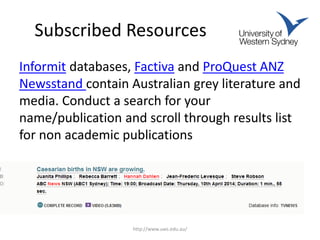
Informit databases, Factiva and ProQuest ANZ
Newsstand contain Australian grey literature and
media. Conduct a search for your
name/publication and scroll through results list
for non academic publications
http://www.uws.edu.au/
Google Scholar
www.elevategfblogs.com
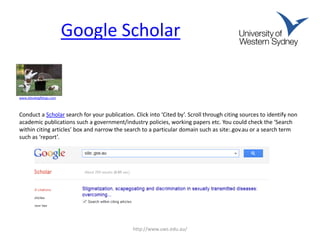
Conduct a Scholar search for your publication. Click into ‘Cited by’. Scroll through citing sources to identify non
academic publications such a government/industry policies, working papers etc. You could check the ‘Search
within citing articles’ box and narrow the search to a particular domain such as site:.gov.au or a search term
such as ‘report’.
http://www.uws.edu.au/
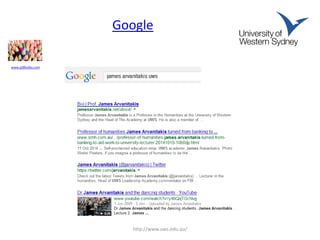
Google
http://www.uws.edu.au/
www.jeffbullas.com
Australian Policy Online
http://www.uws.edu.au/
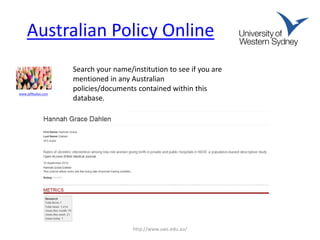
Search your name/institution to see if you are
mentioned in any Australian
policies/documents contained within this
database.
www.jeffbullas.com
Open Access
• Is your research/data open access? If so, where (Figshare,
Dryad, Research Repository, Academia.edu) and what
potential uses could it have?
• Is your data (open or mediated access) described in Research
Data Australia to enhance discoverability
If your open data has a DOI, put that into Google/Google Scholar
to identify any citations. Data Citation Index (Thomson) is a
subscribed resource for this purpose.
http://www.uws.edu.au/
Patents/IP licenses
If you have a patent/IP, is it being cited/used by
government/industry/researchers?
Locating/Measuring this Impact:
Research Performance of University Patenting in
Australia: A Pilot Assessment has some excellent
suggestions
http://www.uws.edu.au/
www.noroip.com
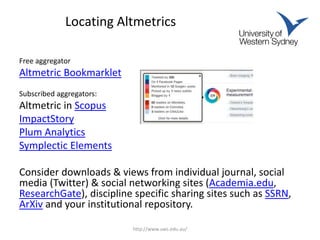
Locating Altmetrics
Free aggregator
Altmetric Bookmarklet
Subscribed aggregators:
Altmetric in Scopus
ImpactStory
Plum Analytics
Symplectic Elements
Consider downloads & views from individual journal, social
media (Twitter) & social networking sites (Academia.edu,
ResearchGate), discipline specific sharing sites such as SSRN,
ArXiv and your institutional repository.
http://www.uws.edu.au/
Follow up opportunities
• Assistance to create a compelling narrative
using the raw metrics
• Open Access (publications & data) advice
• Social media/online academic profile advice
• Identity management advice
“While I was compiling your metrics I noticed…”
http://www.uws.edu.au/www.quickanddirtytips.com
Further reading
Tinkler, J (2012) Moved to measure the ‘impact’ of research on society, University World News,
Issue 246
Holbrook, J.B., Barr, K.R., Brown, K.W. (2013) Research Impact: We need negative metrics too,
Nature, 497 (7450), p. 439
London School of Economics Public Policy Group (2011) Maximizing the Impacts of Your Research:
A handbook for social scientists, Consultation draft 3
Pinowar, H. (2013) Altmetrics: Value all research outputs, Nature, 493, pp.159
Donovan, C. (2008). The Australian Research Quality Framework: A live experiment in capturing
the social, economic, environmental, and cultural returns of publicly funded research. In L
Bornmann (2012) Measuring the societal impact of research, EMBO reports, 13 (8), pp 673-676.
Kenyon, T (2014) Defining and Measuring Research Impact in the Humanities, Social Sciences and
Creative Arts in the Digital Age. Knowledge Organization. 41(3), 249-257
Mapping the Humanities report conclusion

Impact Outside Academia

  • 1.
    Collecting Metrics toMeasure Impact Outside Academia Research Librarian Support Day 2015 http://www.uws.edu.au/ http://www.uws.edu.au/hie/hie www.tilligerryhabitat.org.au www.weekendnotes.com www.earthtimes.org www.whitehorseps.vic.edu.au www.isramedical.com.au Susan Robbins Research Services Coordinator University of Western Sydney Library s.robbins@uws.edu.au
  • 2.
    Research impact isthe demonstrable contribution that research makes to the economy, society, culture, national security, public policy or services, health, the environment, or quality of life, beyond academia. http://www.arc.gov.au/pdf/DP16/DP16_instructions_to_applicants_DP16.pdf Track record section of ARC Discovery application is worth 40% of proposal http://www.arc.gov.au/pdf/DP16/DP_Discovery_Program_2015-16_funding_rules.pdf http://www.uws.edu.au/
  • 3.
    Community/Industry/Policy Impact Has yourresearch/data been used to inform government policy, i.e. classroom numbers, new school locations, medical intern hours, infrastructure, food or bio safety ...? www.pixgood.com Has your research/data been used to inform current practice, i.e. advancement in medical practice, classroom practice, economic practice, healthy living, mobile phone etiquette, mental health services, natural disaster communication …? www.aragec.com http://www.uws.edu.au/
  • 4.
    Research Dissemination/Public Education •Are your research papers open access? If so who could benefit from this? Consider scientists/researchers in non-academic contexts, third world countries and low social economic areas. • Could your research be used to solve wider international problems both within and external to your specific discipline? • Are your publications on school or university reading lists? • Do you have Altmetrics (alternative metrics) which demonstrate evidence of wide research dissemination in and outside academia? For example: • If you have a Twitter account, how many followers do you have and from what areas are they ie researchers, government, general public? • If you have a blog/professional Facebook site how many followers do you have? Do you have any examples of blog comments that illustrate impact? • Has your work been widely shared by Mendeley users? • Is your work referenced in Wikipedia, or do you maintain a public information site on Wikipedia relating to your research? • How many views and downloads of your papers have occurred on academic networking sites such as Academia.edu or ResearchGate? • Has your work been discussed in the media (by yourself or others), including ‘The Conversation’? Do you have a regular media timeslot/column? http://www.uws.edu.au/www.dphotographer.co.uk
  • 5.
    Subscribed Resources Informit databases,Factiva and ProQuest ANZ Newsstand contain Australian grey literature and media. Conduct a search for your name/publication and scroll through results list for non academic publications http://www.uws.edu.au/
  • 6.
    Google Scholar www.elevategfblogs.com Conduct aScholar search for your publication. Click into ‘Cited by’. Scroll through citing sources to identify non academic publications such a government/industry policies, working papers etc. You could check the ‘Search within citing articles’ box and narrow the search to a particular domain such as site:.gov.au or a search term such as ‘report’. http://www.uws.edu.au/
  • 7.
  • 8.
    Australian Policy Online http://www.uws.edu.au/ Searchyour name/institution to see if you are mentioned in any Australian policies/documents contained within this database. www.jeffbullas.com
  • 9.
    Open Access • Isyour research/data open access? If so, where (Figshare, Dryad, Research Repository, Academia.edu) and what potential uses could it have? • Is your data (open or mediated access) described in Research Data Australia to enhance discoverability If your open data has a DOI, put that into Google/Google Scholar to identify any citations. Data Citation Index (Thomson) is a subscribed resource for this purpose. http://www.uws.edu.au/
  • 10.
    Patents/IP licenses If youhave a patent/IP, is it being cited/used by government/industry/researchers? Locating/Measuring this Impact: Research Performance of University Patenting in Australia: A Pilot Assessment has some excellent suggestions http://www.uws.edu.au/ www.noroip.com
  • 11.
    Locating Altmetrics Free aggregator AltmetricBookmarklet Subscribed aggregators: Altmetric in Scopus ImpactStory Plum Analytics Symplectic Elements Consider downloads & views from individual journal, social media (Twitter) & social networking sites (Academia.edu, ResearchGate), discipline specific sharing sites such as SSRN, ArXiv and your institutional repository. http://www.uws.edu.au/
  • 12.
    Follow up opportunities •Assistance to create a compelling narrative using the raw metrics • Open Access (publications & data) advice • Social media/online academic profile advice • Identity management advice “While I was compiling your metrics I noticed…” http://www.uws.edu.au/www.quickanddirtytips.com
  • 13.
    Further reading Tinkler, J(2012) Moved to measure the ‘impact’ of research on society, University World News, Issue 246 Holbrook, J.B., Barr, K.R., Brown, K.W. (2013) Research Impact: We need negative metrics too, Nature, 497 (7450), p. 439 London School of Economics Public Policy Group (2011) Maximizing the Impacts of Your Research: A handbook for social scientists, Consultation draft 3 Pinowar, H. (2013) Altmetrics: Value all research outputs, Nature, 493, pp.159 Donovan, C. (2008). The Australian Research Quality Framework: A live experiment in capturing the social, economic, environmental, and cultural returns of publicly funded research. In L Bornmann (2012) Measuring the societal impact of research, EMBO reports, 13 (8), pp 673-676. Kenyon, T (2014) Defining and Measuring Research Impact in the Humanities, Social Sciences and Creative Arts in the Digital Age. Knowledge Organization. 41(3), 249-257 Mapping the Humanities report conclusion