Getting your Work Noticed and Creating Impact outside Academia 
Kaysha Russell 
Humanities & Communication Arts Librarian 
UWS Library 
October 2014 
Hosted by Digital Humanities Research Group
Aim 
• 
increase visibility and get your work noticed 
• 
strategic use of social media 
• 
select, manage and maintain your professional profile 
• 
identify ways to measure impact and start narrative for impact outside academia
Getting Noticed 
UWS Library Website > Researchers > Getting Noticed 
Image - www.extension.ucr.edu 
University of Western Sydney (UWS) Library website has further information
Social Media Handbook 
• 
Build Your Personal Brand 
• 
Get Noticed 
• 
Learn from Others 
• 
Stay Current 
Select the outlet/s best suited to your area and keep it/them current 
NB: UWS Social Media Guidelines
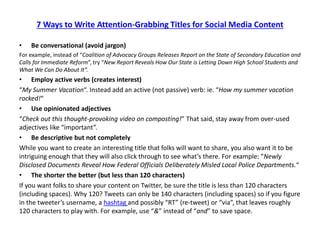
7 Ways to Write Attention-Grabbing Titles for Social Media Content 
• 
Be conversational (avoid jargon) 
For example, instead of “Coalition of Advocacy Groups Releases Report on the State of Secondary Education and Calls for Immediate Reform“, try “New Report Reveals How Our State is Letting Down High School Students and What We Can Do About It”. 
• 
Employ active verbs (creates interest) 
“My Summer Vacation“. Instead add an active (not passive) verb: ie. “How my summer vacation rocked!“ 
• 
Use opinionated adjectives 
“Check out this thought-provoking video on composting!” That said, stay away from over-used adjectives like “important”. 
• 
Be descriptive but not completely 
While you want to create an interesting title that folks will want to share, you also want it to be intriguing enough that they will also click through to see what’s there. For example: “Newly Disclosed Documents Reveal How Federal Officials Deliberately Misled Local Police Departments.“ 
• 
The shorter the better (but less than 120 characters) 
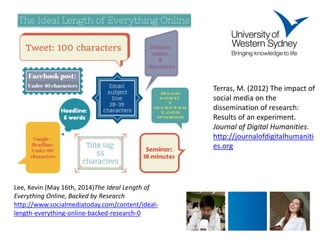
If you want folks to share your content on Twitter, be sure the title is less than 120 characters (including spaces). Why 120? Tweets can only be 140 characters (including spaces) so if you figure in the tweeter’s username, a hashtag and possibly “RT” (re-tweet) or “via”, that leaves roughly 120 characters to play with. For example, use “&” instead of “and” to save space.
Lee, Kevin (May 16th, 2014)The Ideal Length of Everything Online, Backed by Research 
http://www.socialmediatoday.com/content/ideal- length-everything-online-backed-research-0 
Terras, M. (2012) The impact of social media on the dissemination of research: Results of an experiment. Journal of Digital Humanities. http://journalofdigitalhumanities.org
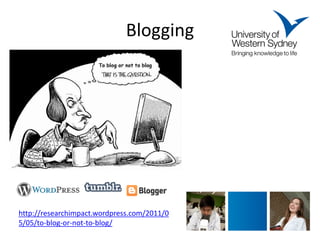
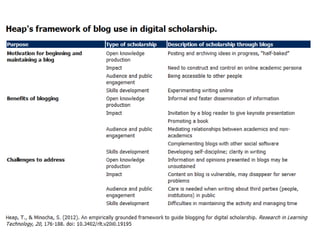
Blogging 
http://researchimpact.wordpress.com/2011/05/05/to-blog-or-not-to-blog/
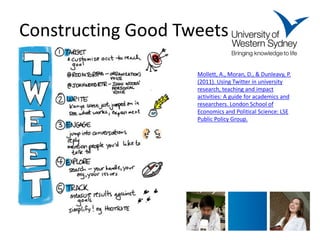
Constructing Good Tweets 
Mollett, A., Moran, D., & Dunleavy, P. (2011). Using Twitter in university research, teaching and impact activities: A guide for academics and researchers. London School of Economics and Political Science: LSE Public Policy Group.
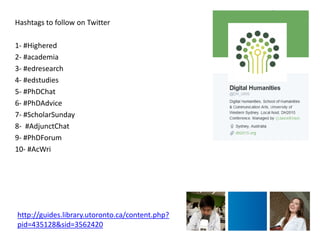
Hashtags to follow on Twitter 
1- #Highered 
2- #academia 
3- #edresearch 
4- #edstudies 
5- #PhDChat 
6- #PhDAdvice 
7- #ScholarSunday 
8- #AdjunctChat 
9- #PhDForum 
10- #AcWri 
http://guides.library.utoronto.ca/content.php? pid=435128&sid=3562420
Other sources 
• 
Minocha, S. & Petre, M. (2012). Vitae Innovate - Handbook of social media for researchers and supervisors - digital technologies for research dialogues. The Open University. http://www.vitae.ac.uk/policy-practice/567271/Handbook- of-social-media-for-researchers-and-supervisors.html 
•Daly, I., & A. B. Haney. (2014). 53 interesting ways to communicate your research. Suffolk, UK: Professional and Higher Partnership. 
•Maximising the impacts of your research: a handbook for social scientists. http://ww.lse.ac.uk/government/.../docs/lse_impact_handbook_april_2011.pdf
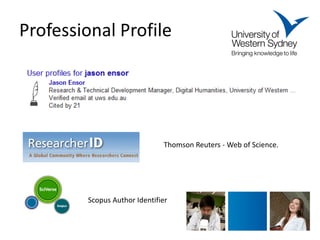
Professional Profile 
Scopus Author Identifier 
Thomson Reuters - Web of Science.
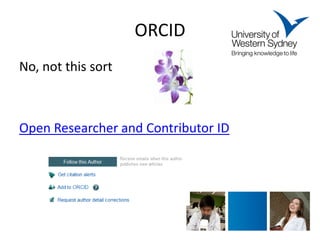
ORCID 
No, not this sort 
Open Researcher and Contributor ID
Impact 
Research impact is the demonstrable contribution that research makes to the economy, society, culture, national security, public policy or services, health, the environment, or quality of life, beyond academia. 
2015 Australian Research Council (ARC) Linkage Instructions for Applicants, pg 27
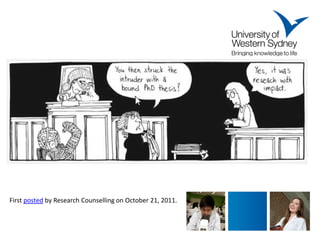
First posted by Research Counselling on October 21, 2011.
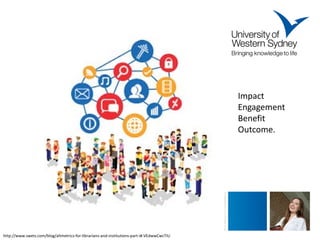
http://www.swets.com/blog/altmetrics-for-librarians-and-institutions-part-i#.VEdwwCwcTIU 
Impact 
Engagement 
Benefit 
Outcome.
• 
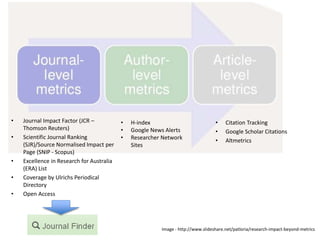
Journal Impact Factor (JCR – Thomson Reuters) 
• 
Scientific Journal Ranking (SJR)/Source Normalised Impact per Page (SNIP - Scopus) 
• 
Excellence in Research for Australia (ERA) List 
• 
Coverage by Ulrichs Periodical Directory 
• 
Open Access 
• 
Citation Tracking 
• 
Google Scholar Citations 
• 
Altmetrics 
• 
H-index 
• 
Google News Alerts 
• 
Researcher Network Sites 
Image - http://www.slideshare.net/patloria/research-impact-beyond-metrics
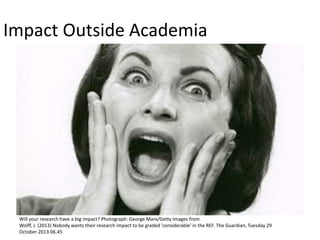
Impact Outside Academia 
Will your research have a big impact? Photograph: George Marx/Getty Images from 
Wolff, J. (2013) Nobody wants their research impact to be graded 'considerable' in the REF. The Guardian, Tuesday 29 October 2013 06.45
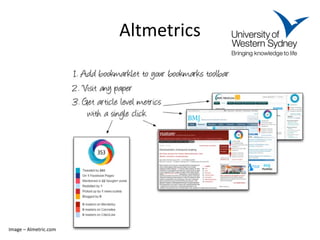
Altmetrics 
Image – Almetric.com
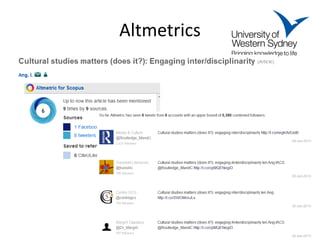
Altmetrics
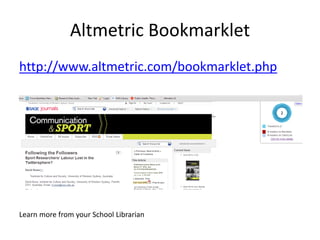
Altmetric Bookmarklet 
http://www.altmetric.com/bookmarklet.php 
Learn more from your School Librarian
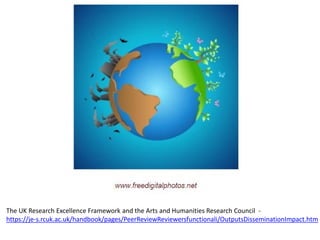
The UK Research Excellence Framework and the Arts and Humanities Research Council - 
https://je-s.rcuk.ac.uk/handbook/pages/PeerReviewReviewersfunctionali/OutputsDisseminationImpact.htm
• 
Inform public policy - Arts and humanities researchers have an important role to play in supporting policy makers across a wide range of subject disciplines and government activities. The Arts and Humanities Council (AHRC) uses a number of methods to increase the exposure of cutting-edge research to policy makers across government. 
•Knowledge Exchange and Partnerships - The AHRC seeks to create opportunities and incentives that increase the flow, value, and impact of world-class arts and humanities research from academia to the UK's private, cultural, and public sectors. 
•International influence - collaboration between top UK researchers and the best researchers from around the world. 
•Public engagement - Arts and humanities research is a vital part of the cultural wealth of this country, engaging millions of people through the exhibitions they visit, the music they listen to, the books they read and the plays and films they watch. 
http://www.ahrc.ac.uk/What-We-Do/Strengthen-research-impact/Pages/Strengthen- Research-Impact.aspx
“benefits of humanities research beyond academia” 
• 
evidence of partnerships with public cultural institutions, theatre companies, museums and galleries 
• 
cases where online archival materials had both created and strengthened the storehouse of cultural memory 
• 
literacy research was shown to influence national policy, and the development of corpora for English-language teaching had clearly had huge impact domestically and internationally 
• 
strength and benefits of research in the humanities, research that transforms the intellectual and cultural landscape, generates commercial capital and sustains citizenship and civil society. 
Simons, J (Nov 11) REF Pilot: humanities impact is evident and can be measured. Timeshighereducation.co.uk
Sources 
• 
Government publications, policy documents and government websites – 
e.g Google - Greg Noble uws site:.gov or .org 
•Media databases - Factiva or TVNews or Google News Alerts 
•Informit databases – Greater Western Sydney
Community/Industry/Policy 
Research Data: 
• 
Is your data relating to Greater Western Sydney? If so it could become part of the Centre for the Development of Western Sydney, which will have demonstrable impact for the region - contact Katrina Trewin (k.trewin@uws.edu.au) 
• 
Has your research data been used to inform government policy, ie classroom numbers, new school locations, intern hours, infrastructure, food or bio safety etc.? 
• 
Has your research data been used to inform current practice, ie advancement in medical practice, classroom practice, economic practice, healthy living, mobile phone etiquette, mental health services, natural disaster communication etc? 
• 
Is your research data open access? If so, where ( Figshare , Dryad etc) and what potential uses could it have? 
• 
Is your data (open or mediated access) described in Research Data Australia to enhance discoverability? - contact Katrina Trewin (k.trewin@uws.edu.au)) 
Computer Software: 
• 
Is code or software you developed openly available, if so where is it stored ( Github etc) and how is it being/could it be potentially used?
Research Reports Grey Literature 
• 
Is your grey literature freely available in the UWS Research Repository to enhance its visibility? If not, you may submit it here. 
•Were you commissioned to write a Research Report? If so, by whom, for what purpose and how were the results used? 
•Were you involved in writing or commenting on any government or industry policies?
Research Dissemination Public Education 
• 
Are your research papers open access? If so who could benefit from this? (scientists/researchers in non- academic contexts, third world countries and low social economic areas) - contact lib-research@uws.edu.au 
•Could your research be used to solve wider international problems both within and external to your specific discipline? 
•Are your publications on school or university reading lists?
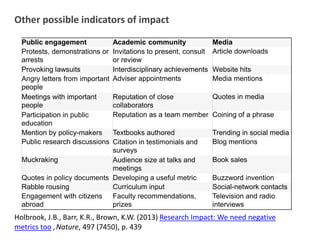
Public engagement 
Academic community 
Media 
Protests, demonstrations or arrests 
Invitations to present, consult or review 
Article downloads 
Provoking lawsuits 
Interdisciplinary achievements 
Website hits 
Angry letters from important people 
Adviser appointments 
Media mentions 
Meetings with important people 
Reputation of close collaborators 
Quotes in media 
Participation in public education 
Reputation as a team member 
Coining of a phrase 
Mention by policy-makers 
Textbooks authored 
Trending in social media 
Public research discussions 
Citation in testimonials and surveys 
Blog mentions 
Muckraking 
Audience size at talks and meetings 
Book sales 
Quotes in policy documents 
Developing a useful metric 
Buzzword invention 
Rabble rousing 
Curriculum input 
Social-network contacts 
Engagement with citizens abroad 
Faculty recommendations, prizes 
Television and radio interviews 
Other possible indicators of impact 
Holbrook, J.B., Barr, K.R., Brown, K.W. (2013) Research Impact: We need negative metrics too , Nature, 497 (7450), p. 439
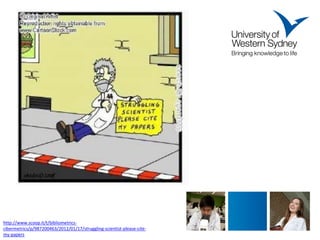
http://www.scoop.it/t/bibliometrics- cibermetrics/p/987200463/2012/01/17/struggling-scientist-please-cite- my-papers
“keep updated an ‘impacts file’ which allows them to list occasions of influence in a recordable and auditable way.” 
“Universities’ events programmes should be re-oriented toward promoting their own research strengths as well as external speakers. Events should be integrated multi-media and multi-stage from the outset and universities should seek to develop ‘zero touch’ technologies to track and better target audience members.” 
“Universities should learn from corporate customer relationship management (CRM) systems to better collect, collate, and analyse information gathered from discrete parts of the university and encourage academics to record their impact- related work with external actors.” 
London School of Economics Public Policy Group (2011) Maximizing the Impacts of Your Research: A handbook for social scientists, Consultation draft 3 
Part B Maximising Research Impacts Beyond the Academy pg 280.
Donovan, C. (2008). The Australian Research Quality Framework: A live experiment 
in capturing the social, economic, environmental, and cultural returns of publicly 
funded research. In L. Bornmann (2012) Measuring the societal impact of research, EMBO reports, 13 (8), pp 673-676. 
“In this context, ‘societal benefits’ refers to the contribution of research to the social capital of a nation, in stimulating new approaches to social issues, or in informing public debate and policy‐making. ‘Cultural benefits’ are those that add to the cultural capital of a nation, for example, by giving insight into how we relate to other societies and cultures, by providing a better understanding of our history and by contributing to cultural preservation and enrichment. ‘Environmental benefits’ benefit the natural capital of a nation, by reducing waste and pollution, and by increasing natural preserves or biodiversity. Finally, ‘economic benefits’ increase the economic capital of a nation by enhancing its skills base and by improving its productivity” (pg. 673) 
Kenyon, T (2014) Defining and Measuring Research Impact in the Humanities, Social Sciences and Creative Arts in the Digital Age. Knowledge Organization. 41(3), 249-257 
“…it is a virtual certainty that research conducted in HSSCA disciplines informs undergraduate teaching in those disciplines, and that the effects of that teaching are manifest in many significant economic, social, cultural, and political effects over the long term and at the population level.” (pg 250)
HCA Impact 
Williams, D. (2000) The Social Impact of Arts Programs: How The Arts Measure Up: Australian research into social impact. COMEDIA. 
http://www.artshunter.com.au/communityarts/papers/Commedia.htm 
Guetzkow, J. (2002). How the Arts Impact Communities: An introduction to the literature on arts impact studies. Taking the Measure of Culture Conference. 
https://www.princeton.edu/~artspol/workpap/WP20%20- %20Guetzkow.pdf 
Arts and Humanities Research Council ( 2011) The Impact of AHRC Research 2010/11. http://www.ahrc.ac.uk/About/Publications/Documents/AHRCImpactReport2011.pdf
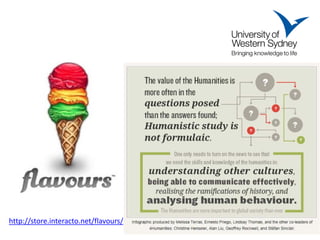
http://store.interacto.net/flavours/
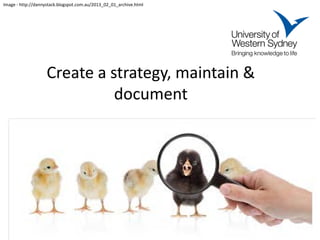
Create a strategy, maintain & document 
Image - http://dannystack.blogspot.com.au/2013_02_01_archive.html
Kaysha Russell 
Humanities and Communication Arts Librarian 
k.j.russell@uws.edu.au 
Image - http://libraryconnect.elsevier.com/sites/default/files/LC_ResearchImpact_infographic_CC.pdf
Questions? Insights? Experiences? Ideas?

Getting Your Work Noticed and Creating Impact Outside Academia

  • 1.
    Getting your WorkNoticed and Creating Impact outside Academia Kaysha Russell Humanities & Communication Arts Librarian UWS Library October 2014 Hosted by Digital Humanities Research Group
  • 2.
    Aim • increasevisibility and get your work noticed • strategic use of social media • select, manage and maintain your professional profile • identify ways to measure impact and start narrative for impact outside academia
  • 3.
    Getting Noticed UWSLibrary Website > Researchers > Getting Noticed Image - www.extension.ucr.edu University of Western Sydney (UWS) Library website has further information
  • 5.
    Social Media Handbook • Build Your Personal Brand • Get Noticed • Learn from Others • Stay Current Select the outlet/s best suited to your area and keep it/them current NB: UWS Social Media Guidelines
  • 6.
    7 Ways toWrite Attention-Grabbing Titles for Social Media Content • Be conversational (avoid jargon) For example, instead of “Coalition of Advocacy Groups Releases Report on the State of Secondary Education and Calls for Immediate Reform“, try “New Report Reveals How Our State is Letting Down High School Students and What We Can Do About It”. • Employ active verbs (creates interest) “My Summer Vacation“. Instead add an active (not passive) verb: ie. “How my summer vacation rocked!“ • Use opinionated adjectives “Check out this thought-provoking video on composting!” That said, stay away from over-used adjectives like “important”. • Be descriptive but not completely While you want to create an interesting title that folks will want to share, you also want it to be intriguing enough that they will also click through to see what’s there. For example: “Newly Disclosed Documents Reveal How Federal Officials Deliberately Misled Local Police Departments.“ • The shorter the better (but less than 120 characters) If you want folks to share your content on Twitter, be sure the title is less than 120 characters (including spaces). Why 120? Tweets can only be 140 characters (including spaces) so if you figure in the tweeter’s username, a hashtag and possibly “RT” (re-tweet) or “via”, that leaves roughly 120 characters to play with. For example, use “&” instead of “and” to save space.
  • 7.
    Lee, Kevin (May16th, 2014)The Ideal Length of Everything Online, Backed by Research http://www.socialmediatoday.com/content/ideal- length-everything-online-backed-research-0 Terras, M. (2012) The impact of social media on the dissemination of research: Results of an experiment. Journal of Digital Humanities. http://journalofdigitalhumanities.org
  • 8.
  • 10.
    Constructing Good Tweets Mollett, A., Moran, D., & Dunleavy, P. (2011). Using Twitter in university research, teaching and impact activities: A guide for academics and researchers. London School of Economics and Political Science: LSE Public Policy Group.
  • 11.
    Hashtags to followon Twitter 1- #Highered 2- #academia 3- #edresearch 4- #edstudies 5- #PhDChat 6- #PhDAdvice 7- #ScholarSunday 8- #AdjunctChat 9- #PhDForum 10- #AcWri http://guides.library.utoronto.ca/content.php? pid=435128&sid=3562420
  • 12.
    Other sources • Minocha, S. & Petre, M. (2012). Vitae Innovate - Handbook of social media for researchers and supervisors - digital technologies for research dialogues. The Open University. http://www.vitae.ac.uk/policy-practice/567271/Handbook- of-social-media-for-researchers-and-supervisors.html •Daly, I., & A. B. Haney. (2014). 53 interesting ways to communicate your research. Suffolk, UK: Professional and Higher Partnership. •Maximising the impacts of your research: a handbook for social scientists. http://ww.lse.ac.uk/government/.../docs/lse_impact_handbook_april_2011.pdf
  • 13.
    Professional Profile ScopusAuthor Identifier Thomson Reuters - Web of Science.
  • 14.
    ORCID No, notthis sort Open Researcher and Contributor ID
  • 15.
    Impact Research impactis the demonstrable contribution that research makes to the economy, society, culture, national security, public policy or services, health, the environment, or quality of life, beyond academia. 2015 Australian Research Council (ARC) Linkage Instructions for Applicants, pg 27
  • 16.
    First posted byResearch Counselling on October 21, 2011.
  • 17.
  • 18.
    • Journal ImpactFactor (JCR – Thomson Reuters) • Scientific Journal Ranking (SJR)/Source Normalised Impact per Page (SNIP - Scopus) • Excellence in Research for Australia (ERA) List • Coverage by Ulrichs Periodical Directory • Open Access • Citation Tracking • Google Scholar Citations • Altmetrics • H-index • Google News Alerts • Researcher Network Sites Image - http://www.slideshare.net/patloria/research-impact-beyond-metrics
  • 19.
    Impact Outside Academia Will your research have a big impact? Photograph: George Marx/Getty Images from Wolff, J. (2013) Nobody wants their research impact to be graded 'considerable' in the REF. The Guardian, Tuesday 29 October 2013 06.45
  • 20.
  • 21.
  • 22.
  • 23.
    The UK ResearchExcellence Framework and the Arts and Humanities Research Council - https://je-s.rcuk.ac.uk/handbook/pages/PeerReviewReviewersfunctionali/OutputsDisseminationImpact.htm
  • 24.
    • Inform publicpolicy - Arts and humanities researchers have an important role to play in supporting policy makers across a wide range of subject disciplines and government activities. The Arts and Humanities Council (AHRC) uses a number of methods to increase the exposure of cutting-edge research to policy makers across government. •Knowledge Exchange and Partnerships - The AHRC seeks to create opportunities and incentives that increase the flow, value, and impact of world-class arts and humanities research from academia to the UK's private, cultural, and public sectors. •International influence - collaboration between top UK researchers and the best researchers from around the world. •Public engagement - Arts and humanities research is a vital part of the cultural wealth of this country, engaging millions of people through the exhibitions they visit, the music they listen to, the books they read and the plays and films they watch. http://www.ahrc.ac.uk/What-We-Do/Strengthen-research-impact/Pages/Strengthen- Research-Impact.aspx
  • 25.
    “benefits of humanitiesresearch beyond academia” • evidence of partnerships with public cultural institutions, theatre companies, museums and galleries • cases where online archival materials had both created and strengthened the storehouse of cultural memory • literacy research was shown to influence national policy, and the development of corpora for English-language teaching had clearly had huge impact domestically and internationally • strength and benefits of research in the humanities, research that transforms the intellectual and cultural landscape, generates commercial capital and sustains citizenship and civil society. Simons, J (Nov 11) REF Pilot: humanities impact is evident and can be measured. Timeshighereducation.co.uk
  • 26.
    Sources • Governmentpublications, policy documents and government websites – e.g Google - Greg Noble uws site:.gov or .org •Media databases - Factiva or TVNews or Google News Alerts •Informit databases – Greater Western Sydney
  • 27.
    Community/Industry/Policy Research Data: • Is your data relating to Greater Western Sydney? If so it could become part of the Centre for the Development of Western Sydney, which will have demonstrable impact for the region - contact Katrina Trewin (k.trewin@uws.edu.au) • Has your research data been used to inform government policy, ie classroom numbers, new school locations, intern hours, infrastructure, food or bio safety etc.? • Has your research data been used to inform current practice, ie advancement in medical practice, classroom practice, economic practice, healthy living, mobile phone etiquette, mental health services, natural disaster communication etc? • Is your research data open access? If so, where ( Figshare , Dryad etc) and what potential uses could it have? • Is your data (open or mediated access) described in Research Data Australia to enhance discoverability? - contact Katrina Trewin (k.trewin@uws.edu.au)) Computer Software: • Is code or software you developed openly available, if so where is it stored ( Github etc) and how is it being/could it be potentially used?
  • 28.
    Research Reports GreyLiterature • Is your grey literature freely available in the UWS Research Repository to enhance its visibility? If not, you may submit it here. •Were you commissioned to write a Research Report? If so, by whom, for what purpose and how were the results used? •Were you involved in writing or commenting on any government or industry policies?
  • 29.
    Research Dissemination PublicEducation • Are your research papers open access? If so who could benefit from this? (scientists/researchers in non- academic contexts, third world countries and low social economic areas) - contact lib-research@uws.edu.au •Could your research be used to solve wider international problems both within and external to your specific discipline? •Are your publications on school or university reading lists?
  • 30.
    Public engagement Academiccommunity Media Protests, demonstrations or arrests Invitations to present, consult or review Article downloads Provoking lawsuits Interdisciplinary achievements Website hits Angry letters from important people Adviser appointments Media mentions Meetings with important people Reputation of close collaborators Quotes in media Participation in public education Reputation as a team member Coining of a phrase Mention by policy-makers Textbooks authored Trending in social media Public research discussions Citation in testimonials and surveys Blog mentions Muckraking Audience size at talks and meetings Book sales Quotes in policy documents Developing a useful metric Buzzword invention Rabble rousing Curriculum input Social-network contacts Engagement with citizens abroad Faculty recommendations, prizes Television and radio interviews Other possible indicators of impact Holbrook, J.B., Barr, K.R., Brown, K.W. (2013) Research Impact: We need negative metrics too , Nature, 497 (7450), p. 439
  • 31.
  • 32.
    “keep updated an‘impacts file’ which allows them to list occasions of influence in a recordable and auditable way.” “Universities’ events programmes should be re-oriented toward promoting their own research strengths as well as external speakers. Events should be integrated multi-media and multi-stage from the outset and universities should seek to develop ‘zero touch’ technologies to track and better target audience members.” “Universities should learn from corporate customer relationship management (CRM) systems to better collect, collate, and analyse information gathered from discrete parts of the university and encourage academics to record their impact- related work with external actors.” London School of Economics Public Policy Group (2011) Maximizing the Impacts of Your Research: A handbook for social scientists, Consultation draft 3 Part B Maximising Research Impacts Beyond the Academy pg 280.
  • 33.
    Donovan, C. (2008).The Australian Research Quality Framework: A live experiment in capturing the social, economic, environmental, and cultural returns of publicly funded research. In L. Bornmann (2012) Measuring the societal impact of research, EMBO reports, 13 (8), pp 673-676. “In this context, ‘societal benefits’ refers to the contribution of research to the social capital of a nation, in stimulating new approaches to social issues, or in informing public debate and policy‐making. ‘Cultural benefits’ are those that add to the cultural capital of a nation, for example, by giving insight into how we relate to other societies and cultures, by providing a better understanding of our history and by contributing to cultural preservation and enrichment. ‘Environmental benefits’ benefit the natural capital of a nation, by reducing waste and pollution, and by increasing natural preserves or biodiversity. Finally, ‘economic benefits’ increase the economic capital of a nation by enhancing its skills base and by improving its productivity” (pg. 673) Kenyon, T (2014) Defining and Measuring Research Impact in the Humanities, Social Sciences and Creative Arts in the Digital Age. Knowledge Organization. 41(3), 249-257 “…it is a virtual certainty that research conducted in HSSCA disciplines informs undergraduate teaching in those disciplines, and that the effects of that teaching are manifest in many significant economic, social, cultural, and political effects over the long term and at the population level.” (pg 250)
  • 34.
    HCA Impact Williams,D. (2000) The Social Impact of Arts Programs: How The Arts Measure Up: Australian research into social impact. COMEDIA. http://www.artshunter.com.au/communityarts/papers/Commedia.htm Guetzkow, J. (2002). How the Arts Impact Communities: An introduction to the literature on arts impact studies. Taking the Measure of Culture Conference. https://www.princeton.edu/~artspol/workpap/WP20%20- %20Guetzkow.pdf Arts and Humanities Research Council ( 2011) The Impact of AHRC Research 2010/11. http://www.ahrc.ac.uk/About/Publications/Documents/AHRCImpactReport2011.pdf
  • 35.
  • 36.
    Create a strategy,maintain & document Image - http://dannystack.blogspot.com.au/2013_02_01_archive.html
  • 37.
    Kaysha Russell Humanitiesand Communication Arts Librarian k.j.russell@uws.edu.au Image - http://libraryconnect.elsevier.com/sites/default/files/LC_ResearchImpact_infographic_CC.pdf
  • 38.