WorldFish Strategy and CGIAR Reform
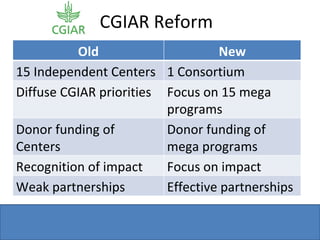
CGIAR Reform Old New 15 Independent Centers 1 Consortium Diffuse CGIAR priorities Focus on 15 mega programs Donor funding of Centers Donor funding of mega programs Recognition of impact Focus on impact Weak partnerships Effective partnerships
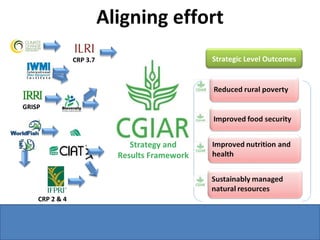
Aligning effort Strategy and Results Framework CRP 3.7 GRISP CRP 2 & 4 Strategic Level Outcomes
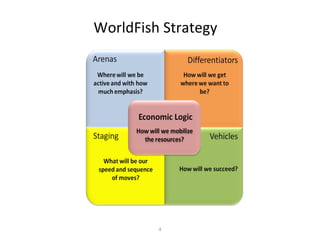
WorldFish Strategy
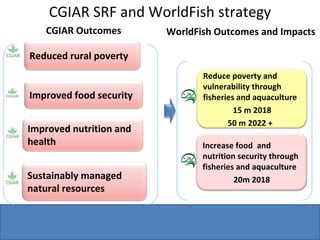
CGIAR SRF and WorldFish strategy CGIAR Outcomes WorldFish Outcomes and Impacts Reduced rural poverty Improved food security Improved nutrition and health Increase food  and nutrition security through fisheries and aquaculture 20m 2018 Reduce poverty and vulnerability through fisheries and aquaculture 15 m 2018 50 m 2022 +  Sustainably managed natural resources
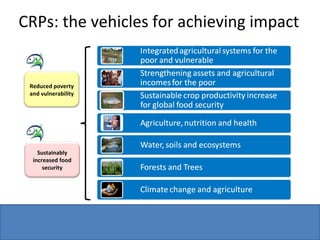
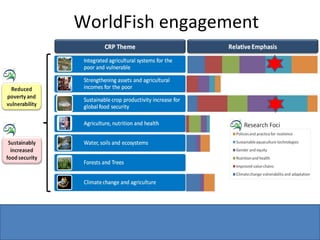
CRPs: the vehicles for achieving impact Sustainably increased food security Reduced poverty and vulnerability
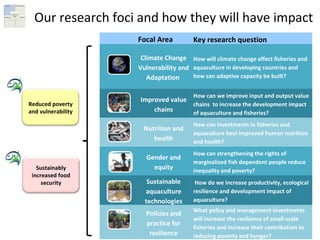
Our research foci and how they will have impact Focal Area Key research question Climate Change Vulnerability and Adaptation  How will climate change affect fisheries and aquaculture in developing countries and how can adaptive capacity be built?  Improved value chains How can we improve input and output value chains  to increase the development impact of aquaculture and fisheries? Nutrition and health How can investments in fisheries and aquaculture best improved human nutrition and health? Gender and equity How can strengthening the rights of marginalized fish dependent people reduce inequality and poverty? Sustainable aquaculture technologies How do we increase productivity, ecological resilience and development impact of aquaculture? Policies and practice for resilience What policy and management investments will increase the resilience of small-scale fisheries and increase their contribution to reducing poverty and hunger? Reduced poverty and vulnerability Sustainably increased food security
WorldFish engagement
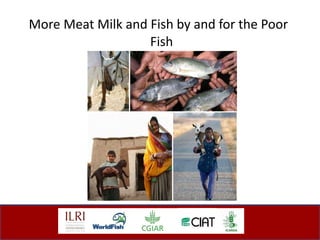
More Meat Milk and Fish by and for the Poor   Fish
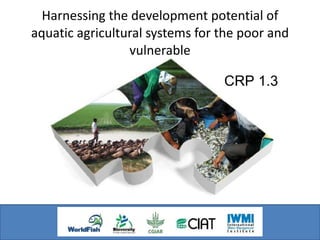
Harnessing the development potential of aquatic agricultural systems for the poor and vulnerable CRP 1.3
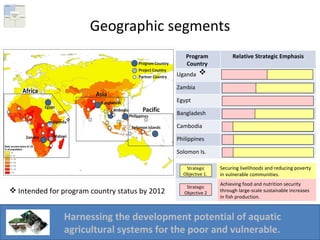
Geographic segments Strategic Objective 2 Strategic Objective 1.  Intended for program country status by 2012 Program Country Relative Strategic Emphasis Uganda Zambia Egypt Bangladesh Cambodia Philippines Solomon Is. Securing livelihoods and reducing poverty in vulnerable communities. Achieving food and nutrition security through large-scale sustainable increases in fish production.
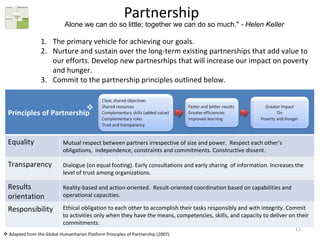
Partnership The primary vehicle for achieving our goals.  Nurture and sustain over the long-term existing partnerships that add value to our efforts. Develop new partnesrhips that will increase our impact on poverty and hunger. Commit to the partnership principles outlined below.  Alone we can do so little; together we can do so much."  - Helen Keller Adapted from the Global Humanitarian Platform Principles of Partnership (2007) Principles of Partnership Equality  Mutual respect between partners irrespective of size and power.  Respect each other's obligations,  independence, constraints and commitments. Constructive dissent.  Transparency Dialogue (on equal footing). Early consultations and early sharing  of information. Increases the level of trust among organizations.  Results orientation Reality-based and action-oriented.  Result-oriented coordination based on capabilities and operational capacities.  Responsibility  Ethical obligation to each other to accomplish their tasks responsibly and with integrity. Commit to activities only when they have the means, competencies, skills, and capacity to deliver on their commitments.
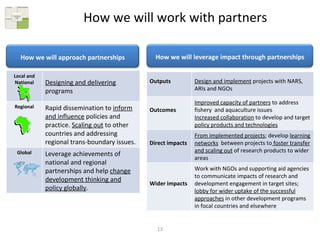
How we will work with partners Outputs Design and implement  projects with NARS, ARIs and NGOs Outcomes Improved capacity of partners  to address fishery  and aquaculture issues Increased collaboration  to develop and target  policy products and technologies Direct impacts From implemented projects ; develop  learning networks   between projects to  foster transfer and scaling out  of research products to wider areas Wider impacts Work with NGOs and supporting aid agencies to communicate impacts of research and development engagement in target sites;  lobby for wider uptake of the successful approaches  in other development programs in focal countries and elsewhere How we will leverage impact through partnerships How we will approach partnerships Local and National Designing and delivering  programs Regional Rapid dissemination to  inform and influence  policies and practice.  Scaling out  to other countries and addressing regional trans-boundary issues. Global Leverage achievements of national and regional partnerships and help  change development thinking and policy globally .
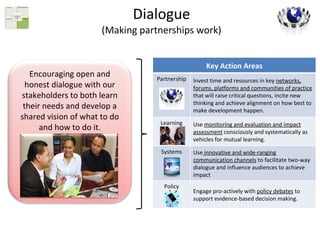
Dialogue (Making partnerships work) Encouraging open and honest dialogue with our stakeholders to both learn their needs and develop a shared vision of what to do and how to do it. Key Action Areas Partnership Invest time and resources in key  networks, forums, platforms and communities of practice  that will raise critical questions, incite new thinking and achieve alignment on how best to make development happen. Learning Use  monitoring and evaluation and impact assessment  consciously and systematically as vehicles for mutual learning. Systems Use  innovative and wide-ranging communication channels  to facilitate two-way dialogue and influence audiences to achieve impact Policy Engage pro-actively with  policy debates  to support evidence-based decision making.
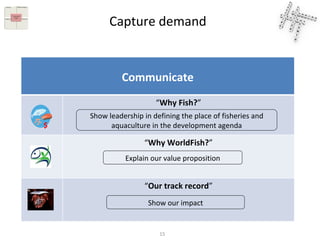
Capture demand Show leadership in defining the place of fisheries and aquaculture in the development agenda Explain our value proposition Show our impact Communicate “ Why Fish? ” “ Why WorldFish? ” “ Our track record ” $

Opening Plenary_WorldFish Strategy_CGIAR Reform_Hall

  • 1.
  • 2.
    CGIAR Reform OldNew 15 Independent Centers 1 Consortium Diffuse CGIAR priorities Focus on 15 mega programs Donor funding of Centers Donor funding of mega programs Recognition of impact Focus on impact Weak partnerships Effective partnerships
  • 3.
    Aligning effort Strategyand Results Framework CRP 3.7 GRISP CRP 2 & 4 Strategic Level Outcomes
  • 4.
  • 5.
    CGIAR SRF andWorldFish strategy CGIAR Outcomes WorldFish Outcomes and Impacts Reduced rural poverty Improved food security Improved nutrition and health Increase food and nutrition security through fisheries and aquaculture 20m 2018 Reduce poverty and vulnerability through fisheries and aquaculture 15 m 2018 50 m 2022 + Sustainably managed natural resources
  • 6.
    CRPs: the vehiclesfor achieving impact Sustainably increased food security Reduced poverty and vulnerability
  • 7.
    Our research fociand how they will have impact Focal Area Key research question Climate Change Vulnerability and Adaptation How will climate change affect fisheries and aquaculture in developing countries and how can adaptive capacity be built? Improved value chains How can we improve input and output value chains to increase the development impact of aquaculture and fisheries? Nutrition and health How can investments in fisheries and aquaculture best improved human nutrition and health? Gender and equity How can strengthening the rights of marginalized fish dependent people reduce inequality and poverty? Sustainable aquaculture technologies How do we increase productivity, ecological resilience and development impact of aquaculture? Policies and practice for resilience What policy and management investments will increase the resilience of small-scale fisheries and increase their contribution to reducing poverty and hunger? Reduced poverty and vulnerability Sustainably increased food security
  • 8.
  • 9.
    More Meat Milkand Fish by and for the Poor  Fish
  • 10.
    Harnessing the developmentpotential of aquatic agricultural systems for the poor and vulnerable CRP 1.3
  • 11.
    Geographic segments StrategicObjective 2 Strategic Objective 1. Intended for program country status by 2012 Program Country Relative Strategic Emphasis Uganda Zambia Egypt Bangladesh Cambodia Philippines Solomon Is. Securing livelihoods and reducing poverty in vulnerable communities. Achieving food and nutrition security through large-scale sustainable increases in fish production.
  • 12.
    Partnership The primaryvehicle for achieving our goals. Nurture and sustain over the long-term existing partnerships that add value to our efforts. Develop new partnesrhips that will increase our impact on poverty and hunger. Commit to the partnership principles outlined below. Alone we can do so little; together we can do so much."  - Helen Keller Adapted from the Global Humanitarian Platform Principles of Partnership (2007) Principles of Partnership Equality Mutual respect between partners irrespective of size and power. Respect each other's obligations, independence, constraints and commitments. Constructive dissent. Transparency Dialogue (on equal footing). Early consultations and early sharing of information. Increases the level of trust among organizations. Results orientation Reality-based and action-oriented. Result-oriented coordination based on capabilities and operational capacities. Responsibility Ethical obligation to each other to accomplish their tasks responsibly and with integrity. Commit to activities only when they have the means, competencies, skills, and capacity to deliver on their commitments.
  • 13.
    How we willwork with partners Outputs Design and implement projects with NARS, ARIs and NGOs Outcomes Improved capacity of partners to address fishery and aquaculture issues Increased collaboration to develop and target policy products and technologies Direct impacts From implemented projects ; develop learning networks between projects to foster transfer and scaling out of research products to wider areas Wider impacts Work with NGOs and supporting aid agencies to communicate impacts of research and development engagement in target sites; lobby for wider uptake of the successful approaches in other development programs in focal countries and elsewhere How we will leverage impact through partnerships How we will approach partnerships Local and National Designing and delivering programs Regional Rapid dissemination to inform and influence policies and practice. Scaling out to other countries and addressing regional trans-boundary issues. Global Leverage achievements of national and regional partnerships and help change development thinking and policy globally .
  • 14.
    Dialogue (Making partnershipswork) Encouraging open and honest dialogue with our stakeholders to both learn their needs and develop a shared vision of what to do and how to do it. Key Action Areas Partnership Invest time and resources in key networks, forums, platforms and communities of practice that will raise critical questions, incite new thinking and achieve alignment on how best to make development happen. Learning Use monitoring and evaluation and impact assessment consciously and systematically as vehicles for mutual learning. Systems Use innovative and wide-ranging communication channels to facilitate two-way dialogue and influence audiences to achieve impact Policy Engage pro-actively with policy debates to support evidence-based decision making.
  • 15.
    Capture demand Showleadership in defining the place of fisheries and aquaculture in the development agenda Explain our value proposition Show our impact Communicate “ Why Fish? ” “ Why WorldFish? ” “ Our track record ” $