Cash transfers for
Prevention of
Malnutrition
UNICEF’s approach to cash
transfers in DRC
Transfer Project Workshop
June 2023
Approach to
cash
transfers
Approach to
cash
transfers
Approach to
cash
transfers
Transitioning
to Social
Protection
6 | Title of Your Presentation
UNICEF DRC Targeting
approach for
prevention of
malnutrition
• Transition from treatment to prevention
approach
• Linking malnutrition treatment as Cash (+)
• Adopting inclusive targeting methods
• Establishing linkages to safety nets
•
Targeting
for
treatment
Targeting for
prevention (0-
23 months,
pregnant and
lactating
women)
Linking
treatment
with
prevention
Thank
you!

Cash Transfers for Prevention of Malnutrition: UNICEF's Approach to Transfers in Democratic Republic of Congo

Editor's Notes

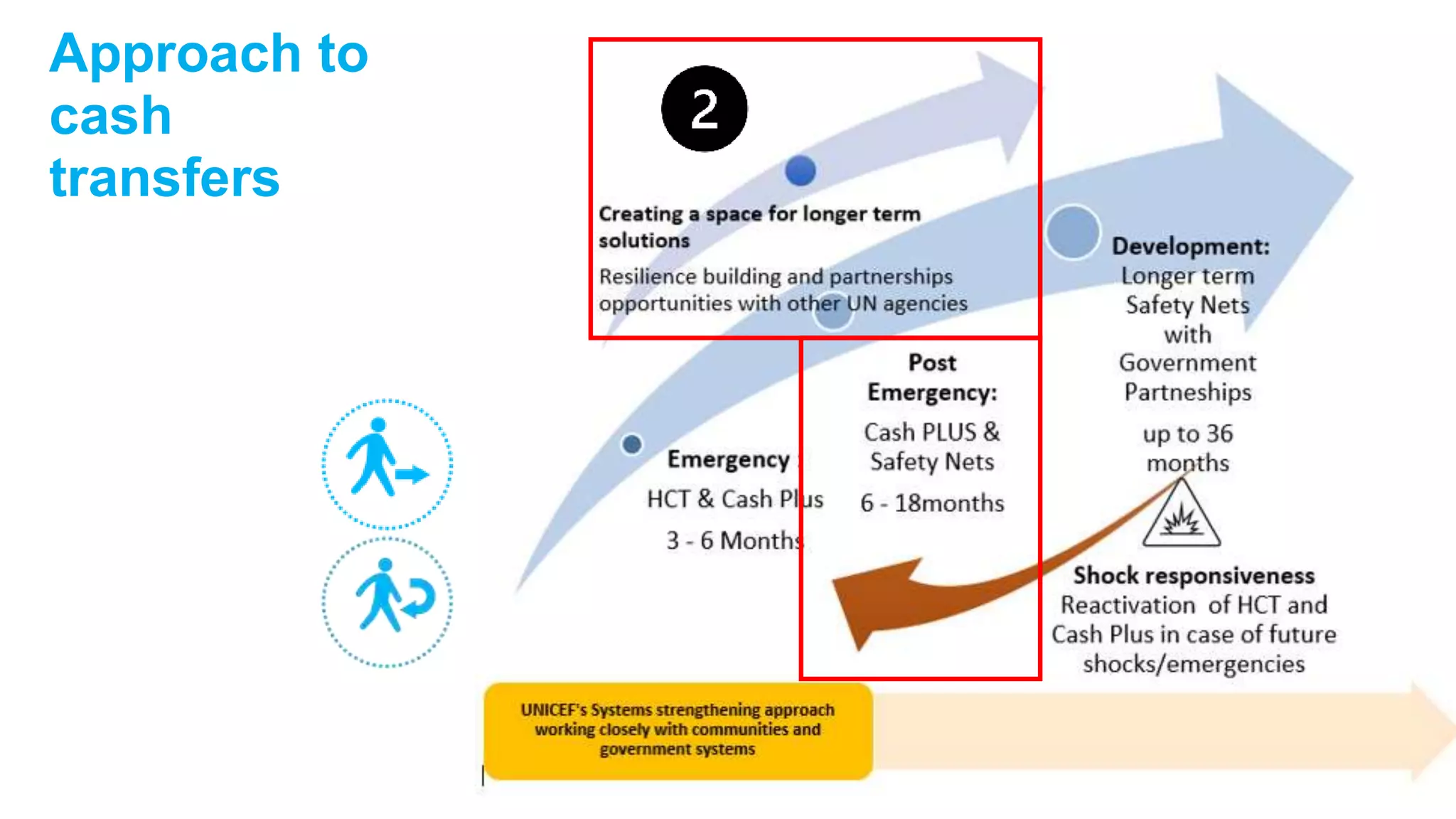
  • #3 The 1st entry point for UNICEF is humanitarian cash transfers linked to sectoral interventions. During this phase UNICEF delivers cash transfers to address life saving needs or humanitarian basic needs. The idea here is to combine and complement multipurpose cash transfers with UNICEF's sectoral responses such as Nutrition, Protection, Health and education to ensure that the basics needs and services are available and accessible to households. Period of assistance is from 3 to 6 months.  3 months generally for rapid response cash programmes for populations on the move and up to 6 months where the populations are more stable and mobile money transfers can be utilized. We prefer cash in hand transfer mechanism for rapid response and mobile money transfers for longer term cash transfers
  • #4 The 2nd phase of the intervention is transitioning into longer term cash transfers programs with a focus on safety nets approach. Generally households who receive cash transfers improve purchasing capacity to access basic needs and services during the period of the intervention. However this capacity gradually decreases after the conclusion of cash transfers while the needs are still persisting.  To avoid this relapse back to pre-assistance baseline levels, UNICEF, as much as possible, transitions beneficiaries of HCT and Cash Plus Programmes into longer term UNICEF administrated cash programs with a shock responsive safety nets approach.  During this phase UNICEF continues to transfer cash assistance household but with a  lower transfer value to make sure that the outcomes of humanitarian programs are protected and in case of further shocks. With the payment systems in place the transfers can be augmented and revised to address needs.  Throughout the 2nd phase, depending on the availability of funds and resources, UNICEF envisions to support communities for periods up to 12 to 18 months.
  • #5  This timeline also provides the opportunity to allow UNICEF to work with other partners such as WFP and FAO to design and implement joint programmes for supporting the vulnerable communities to develop their resilience again further shocks and develop income generating activities. Basically throughout this period, communities have access to basic needs and services through cash plus interventions, protected against further shocks, and have the capacity to invest in longer term solutions decreasing vulnerability on the long term. 
  • #6 In terms of systems strengthening, UNICEF has ongoing partnership with the Ministry of Social Affairs of DRC for developing a Management Information System (MIS) and a Social Registry for the Government of DRC to implement and manage social protection schemes and programmes. Under the framework of this programme UNICEF will work with the Ministry mainly on collection and management of data, targeting methodologies, grievance and complaints management, community engagement and evaluation of outcomes to contribute to government capacity development towards nutrition oriented social protection approach and systems strengthening.