Evaluation Practice and Violence Prevention David S. Robinson, Ed.D. August 22, 2006 Add  Corporate Logo Here Connecting Families - MSPCC Child Sexual Abuse Prevention Project
TOPICS Violence prevention projects & evaluation challenges in the field Evaluation for sustainability Evaluation for dissemination The flattening of the world (ala Thomas Freedman) Final Notes and Implications
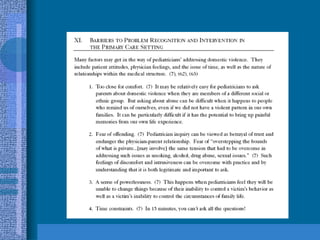
Violence Prevention Projects Child Sexual Abuse Prevention Program Connecting Families – Child Abuse Prevention Evaluation Shaken Baby Syndrome Prevention Program Evaluation Children’s Emotional Health Link Evaluation Teaching practice and program evaluation for prevention science
Massachusetts Child Sexual Abuse Prevention Initiative Evaluation 4 Sites in Massachusetts using Enough Abuse Campaign resources and concepts Community participatory process designed to prevent child sexual abuse perpetration Workshops focus on child safety, how adults can take action to keep children safe, identifying risky situations and “red flags” for concerning behaviors, and understanding and responding to children’s sexual behaviors
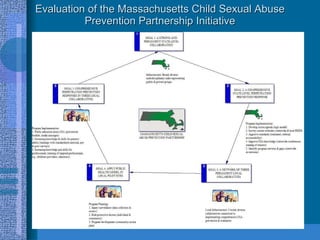
Evaluation of the Massachusetts Child Sexual Abuse Prevention Partnership Initiative
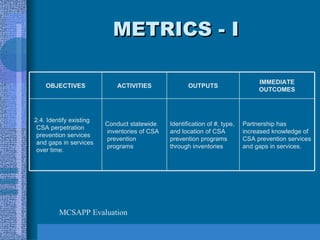
METRICS - I MCSAPP Evaluation Partnership has increased knowledge of CSA prevention services and gaps in services.  Identification of #, type, and location of CSA prevention programs through inventories  Conduct statewide inventories of CSA prevention programs  2.4. Identify existing CSA perpetration prevention services and gaps in services over time.  IMMEDIATE OUTCOMES OUTPUTS ACTIVITIES OBJECTIVES
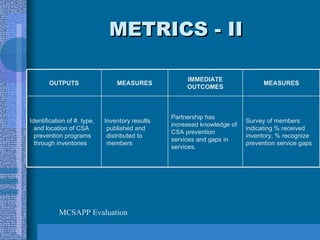
METRICS - II MCSAPP Evaluation Survey of members indicating % received inventory, % recognize prevention service gaps Partnership has increased knowledge of CSA prevention services and gaps in services.  Inventory results published and distributed to members Identification of #, type, and location of CSA prevention programs through inventories  MEASURES IMMEDIATE OUTCOMES MEASURES OUTPUTS
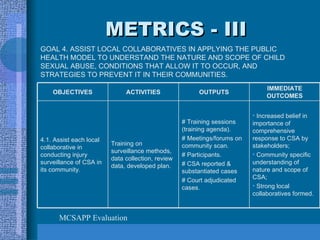
METRICS - III GOAL 4. ASSIST LOCAL COLLABORATIVES IN APPLYING THE PUBLIC HEALTH MODEL TO UNDERSTAND THE NATURE AND SCOPE OF CHILD SEXUAL ABUSE, CONDITIONS THAT ALLOW IT TO OCCUR, AND STRATEGIES TO PREVENT IT IN THEIR COMMUNITIES. MCSAPP Evaluation Increased belief in importance of comprehensive response to CSA by stakeholders; Community specific understanding of nature and scope of CSA; Strong local collaboratives formed. # Training sessions (training agenda). # Meetings/forums on community scan. # Participants. # CSA reported & substantiated cases # Court adjudicated cases.  Training on surveillance methods, data collection, review data, developed plan. 4.1. Assist each local collaborative in conducting injury surveillance of CSA in its community. IMMEDIATE OUTCOMES OUTPUTS ACTIVITIES OBJECTIVES
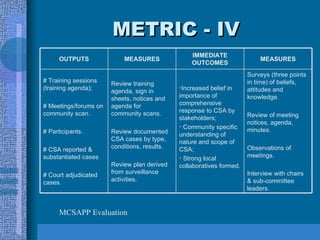
METRIC - IV MCSAPP Evaluation Surveys (three points in time) of beliefs, attitudes and knowledge. Review of meeting notices, agenda, minutes. Observations of meetings. Interview with chairs & sub-committee leaders. Increased belief in importance of comprehensive response to CSA by stakeholders; Community specific understanding of nature and scope of CSA; Strong local collaboratives formed. Review training agenda, sign in sheets, notices and agenda for community scans. Review documented CSA cases by type, conditions, results. Review plan derived from surveillance activities. # Training sessions (training agenda); # Meetings/forums on community scan. # Participants. # CSA reported & substantiated cases # Court adjudicated cases.  MEASURES IMMEDIATE OUTCOMES MEASURES OUTPUTS
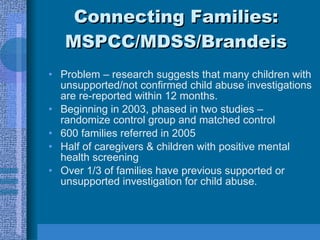
Connecting Families: MSPCC/MDSS/Brandeis Problem – research suggests that many children with unsupported/not confirmed child abuse investigations are re-reported within 12 months. Beginning in 2003, phased in two studies – randomize control group and matched control  600 families referred in 2005 Half of caregivers & children with positive mental health screening Over 1/3 of families have previous supported or unsupported investigation for child abuse.
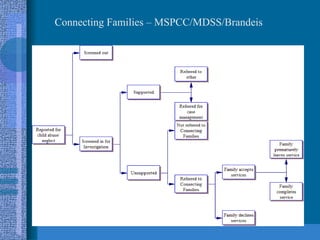
Connecting Families – MSPCC/MDSS/Brandeis
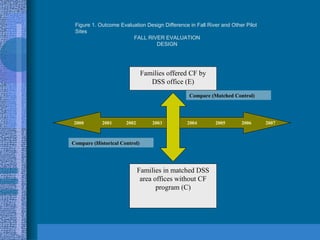
Figure 1. Outcome Evaluation Design Difference in Fall River and Other Pilot Sites FALL RIVER EVALUATION DESIGN Families offered CF by DSS office (E) Families in matched DSS area offices without CF program (C) 2000 2001 2002 2003 2004 2005 2006 2007 Compare (Matched Control) Compare (Historical Control)
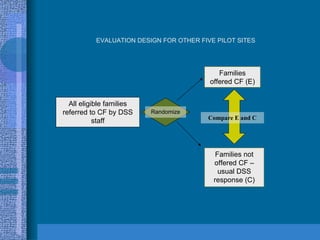
EVALUATION DESIGN FOR OTHER FIVE PILOT SITES All eligible families referred to CF by DSS staff Randomize Families offered CF (E) Families not offered CF – usual DSS response (C) Compare E and C
Shaken Baby Syndrome In-Hospital Prevention Program Evaluation Massachusetts Citizens for Children developed the Shaken Baby Syndrome Prevention curriculum which was approved by the Massachusetts Association of Registered Nurses in 2005 Nurses receive 1.2 Continuing Education hours upon completion of the SBS Prevention education program Nurses at the Worcester County birthing hospitals invite parents to watch a video on SBS and give parents a pamphlet about the dangers of shaking infants before they leave the hospital Nurses are encouraged to talk to each caregiver or parent to answer questions about the SBS prevention information By December 2005, over 262 nurses and 3076 parents and caregivers of newborns in four hospitals in Worcester County have been trained.
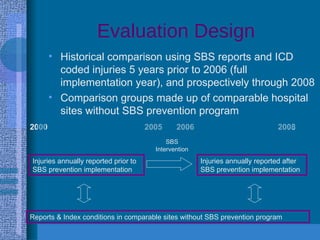
2005 Evaluation Design Historical comparison using SBS reports and ICD coded injuries 5 years prior to 2006 (full implementation year), and prospectively through 2008 Comparison groups made up of comparable hospital sites without SBS prevention program Injuries annually reported prior to SBS prevention implementation Injuries annually reported after  SBS prevention implementation Reports & Index conditions in comparable sites without SBS prevention program SBS Intervention 2000 2006 2008
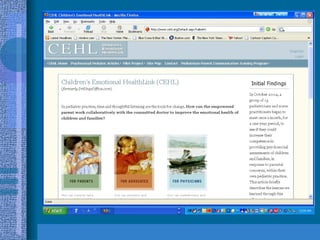
Children’s Emotional Health Link www.cehl.org This web site is intended to serve a dual purpose. It contains articles to empower parents, advocates and providers in caring for the psychosocial needs of children. It also serves as a coordinating tool for a  pilot project  for health care providers.  Resources for physicians, advocates and parents Focus on helping physicians initiate difficult conversations with parents about family violence, emotional problems, traumatic health conditions. Evaluation of unique pilot study to improve identification and response to family violence and emotional problems in children


Teaching Prevention Evaluation to Graduate Social Workers Principles of prevention and evidence-based programming Participatory and empowerment evaluation principles Combination of case study and placement evaluation planning & presentation Focus on program theory, logic model, research design, measurement, understanding stakeholder culture and setting complexity
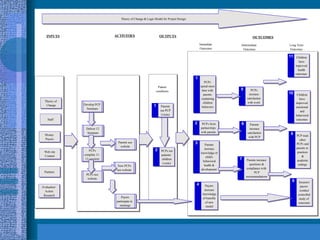
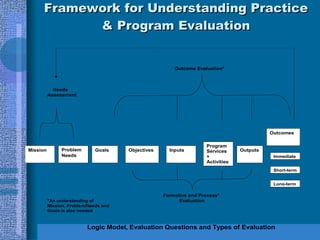
Framework for Understanding Practice & Program Evaluation
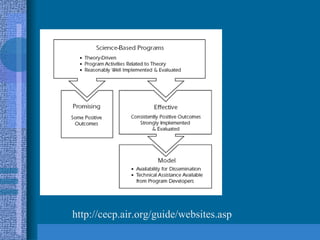
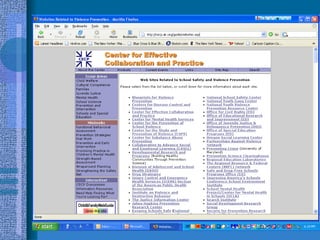
http://cecp.air.org/guide/websites.asp
 
Evaluation for Sustainability The Devolution Initiative – WKKF ( http://www.gse.harvard.edu/hfrp/pubs/onlinepubs/sustainability/planning.html ) Advanced Tools for Sustainability Assessment ( http://ivm5.ivm.vu.nl/sat/ ) Center for Civic Partnerships ( http://www.civicpartnerships.org/docs/tools_resources/sustainability.htm ) 10 Steps to Sustainability.
Evaluation for Dissemination What if Google and CDC DVP created “Google Violence Prevention” with database of local VP projects and case studies of dissemination activities? How would Syndemics and syndemic approach change implications for evaluation, dissemination and information management? What are other countries doing to disseminate information about VP and what problems are they working on and solving?
Flattening of the World Thomas Friedman’s thesis: it is now possible for more people than ever to collaborate and compete in real time with more other people on more different kinds of work from more different corners of the planet and on a more equal footing than at any previous time in the history of the world – using computers, e-mail, networks, teleconferencing, and dynamic new software. Open-sourcing: self-organizing collaborative communities; Outsourcing Offshoring Supply-chaining Insourcing In-forming Increasing speeding of Computational capability, storage capability, and input/output capability
Final Notes & Implications Opportunities for strengthening evaluation designs in real world settings Connecting learning, implementation, infrastructure and dissemination Strengthening appearance and reality Understanding and using the resistance Using the new connectivity as a tool
David S. Robinson, Ed.D. Faculty, Simmons College School of Social Work [email_address] President, DSRobinson & Associates 903 Providence Place, #155 Providence, RI 02903 O: 401-383-7953 M: 617-733-5979 [email_address] www.evaluationhelp.com

DSRA

  • 1.
    Evaluation Practice andViolence Prevention David S. Robinson, Ed.D. August 22, 2006 Add Corporate Logo Here Connecting Families - MSPCC Child Sexual Abuse Prevention Project
  • 2.
    TOPICS Violence preventionprojects & evaluation challenges in the field Evaluation for sustainability Evaluation for dissemination The flattening of the world (ala Thomas Freedman) Final Notes and Implications
  • 3.
    Violence Prevention ProjectsChild Sexual Abuse Prevention Program Connecting Families – Child Abuse Prevention Evaluation Shaken Baby Syndrome Prevention Program Evaluation Children’s Emotional Health Link Evaluation Teaching practice and program evaluation for prevention science
  • 4.
    Massachusetts Child SexualAbuse Prevention Initiative Evaluation 4 Sites in Massachusetts using Enough Abuse Campaign resources and concepts Community participatory process designed to prevent child sexual abuse perpetration Workshops focus on child safety, how adults can take action to keep children safe, identifying risky situations and “red flags” for concerning behaviors, and understanding and responding to children’s sexual behaviors
  • 5.
    Evaluation of theMassachusetts Child Sexual Abuse Prevention Partnership Initiative
  • 6.
    METRICS - IMCSAPP Evaluation Partnership has increased knowledge of CSA prevention services and gaps in services. Identification of #, type, and location of CSA prevention programs through inventories Conduct statewide inventories of CSA prevention programs 2.4. Identify existing CSA perpetration prevention services and gaps in services over time. IMMEDIATE OUTCOMES OUTPUTS ACTIVITIES OBJECTIVES
  • 7.
    METRICS - IIMCSAPP Evaluation Survey of members indicating % received inventory, % recognize prevention service gaps Partnership has increased knowledge of CSA prevention services and gaps in services. Inventory results published and distributed to members Identification of #, type, and location of CSA prevention programs through inventories MEASURES IMMEDIATE OUTCOMES MEASURES OUTPUTS
  • 8.
    METRICS - IIIGOAL 4. ASSIST LOCAL COLLABORATIVES IN APPLYING THE PUBLIC HEALTH MODEL TO UNDERSTAND THE NATURE AND SCOPE OF CHILD SEXUAL ABUSE, CONDITIONS THAT ALLOW IT TO OCCUR, AND STRATEGIES TO PREVENT IT IN THEIR COMMUNITIES. MCSAPP Evaluation Increased belief in importance of comprehensive response to CSA by stakeholders; Community specific understanding of nature and scope of CSA; Strong local collaboratives formed. # Training sessions (training agenda). # Meetings/forums on community scan. # Participants. # CSA reported & substantiated cases # Court adjudicated cases. Training on surveillance methods, data collection, review data, developed plan. 4.1. Assist each local collaborative in conducting injury surveillance of CSA in its community. IMMEDIATE OUTCOMES OUTPUTS ACTIVITIES OBJECTIVES
  • 9.
    METRIC - IVMCSAPP Evaluation Surveys (three points in time) of beliefs, attitudes and knowledge. Review of meeting notices, agenda, minutes. Observations of meetings. Interview with chairs & sub-committee leaders. Increased belief in importance of comprehensive response to CSA by stakeholders; Community specific understanding of nature and scope of CSA; Strong local collaboratives formed. Review training agenda, sign in sheets, notices and agenda for community scans. Review documented CSA cases by type, conditions, results. Review plan derived from surveillance activities. # Training sessions (training agenda); # Meetings/forums on community scan. # Participants. # CSA reported & substantiated cases # Court adjudicated cases. MEASURES IMMEDIATE OUTCOMES MEASURES OUTPUTS
  • 10.
    Connecting Families: MSPCC/MDSS/BrandeisProblem – research suggests that many children with unsupported/not confirmed child abuse investigations are re-reported within 12 months. Beginning in 2003, phased in two studies – randomize control group and matched control 600 families referred in 2005 Half of caregivers & children with positive mental health screening Over 1/3 of families have previous supported or unsupported investigation for child abuse.
  • 11.
    Connecting Families –MSPCC/MDSS/Brandeis
  • 12.
    Figure 1. OutcomeEvaluation Design Difference in Fall River and Other Pilot Sites FALL RIVER EVALUATION DESIGN Families offered CF by DSS office (E) Families in matched DSS area offices without CF program (C) 2000 2001 2002 2003 2004 2005 2006 2007 Compare (Matched Control) Compare (Historical Control)
  • 13.
    EVALUATION DESIGN FOROTHER FIVE PILOT SITES All eligible families referred to CF by DSS staff Randomize Families offered CF (E) Families not offered CF – usual DSS response (C) Compare E and C
  • 14.
    Shaken Baby SyndromeIn-Hospital Prevention Program Evaluation Massachusetts Citizens for Children developed the Shaken Baby Syndrome Prevention curriculum which was approved by the Massachusetts Association of Registered Nurses in 2005 Nurses receive 1.2 Continuing Education hours upon completion of the SBS Prevention education program Nurses at the Worcester County birthing hospitals invite parents to watch a video on SBS and give parents a pamphlet about the dangers of shaking infants before they leave the hospital Nurses are encouraged to talk to each caregiver or parent to answer questions about the SBS prevention information By December 2005, over 262 nurses and 3076 parents and caregivers of newborns in four hospitals in Worcester County have been trained.
  • 15.
    2005 Evaluation DesignHistorical comparison using SBS reports and ICD coded injuries 5 years prior to 2006 (full implementation year), and prospectively through 2008 Comparison groups made up of comparable hospital sites without SBS prevention program Injuries annually reported prior to SBS prevention implementation Injuries annually reported after SBS prevention implementation Reports & Index conditions in comparable sites without SBS prevention program SBS Intervention 2000 2006 2008
  • 16.
    Children’s Emotional HealthLink www.cehl.org This web site is intended to serve a dual purpose. It contains articles to empower parents, advocates and providers in caring for the psychosocial needs of children. It also serves as a coordinating tool for a pilot project for health care providers. Resources for physicians, advocates and parents Focus on helping physicians initiate difficult conversations with parents about family violence, emotional problems, traumatic health conditions. Evaluation of unique pilot study to improve identification and response to family violence and emotional problems in children
  • 17.
  • 18.
  • 19.
  • 20.
  • 21.
    Teaching Prevention Evaluationto Graduate Social Workers Principles of prevention and evidence-based programming Participatory and empowerment evaluation principles Combination of case study and placement evaluation planning & presentation Focus on program theory, logic model, research design, measurement, understanding stakeholder culture and setting complexity
  • 22.
    Framework for UnderstandingPractice & Program Evaluation
  • 23.
  • 24.
  • 25.
    Evaluation for SustainabilityThe Devolution Initiative – WKKF ( http://www.gse.harvard.edu/hfrp/pubs/onlinepubs/sustainability/planning.html ) Advanced Tools for Sustainability Assessment ( http://ivm5.ivm.vu.nl/sat/ ) Center for Civic Partnerships ( http://www.civicpartnerships.org/docs/tools_resources/sustainability.htm ) 10 Steps to Sustainability.
  • 26.
    Evaluation for DisseminationWhat if Google and CDC DVP created “Google Violence Prevention” with database of local VP projects and case studies of dissemination activities? How would Syndemics and syndemic approach change implications for evaluation, dissemination and information management? What are other countries doing to disseminate information about VP and what problems are they working on and solving?
  • 27.
    Flattening of theWorld Thomas Friedman’s thesis: it is now possible for more people than ever to collaborate and compete in real time with more other people on more different kinds of work from more different corners of the planet and on a more equal footing than at any previous time in the history of the world – using computers, e-mail, networks, teleconferencing, and dynamic new software. Open-sourcing: self-organizing collaborative communities; Outsourcing Offshoring Supply-chaining Insourcing In-forming Increasing speeding of Computational capability, storage capability, and input/output capability
  • 28.
    Final Notes &Implications Opportunities for strengthening evaluation designs in real world settings Connecting learning, implementation, infrastructure and dissemination Strengthening appearance and reality Understanding and using the resistance Using the new connectivity as a tool
  • 29.
    David S. Robinson,Ed.D. Faculty, Simmons College School of Social Work [email_address] President, DSRobinson & Associates 903 Providence Place, #155 Providence, RI 02903 O: 401-383-7953 M: 617-733-5979 [email_address] www.evaluationhelp.com

Editor's Notes

  • #6 Strong and Permanent State-Level Collaboration. Infrastructure: Broad, diverse, multidisciplinary cadre representing public and private groups A comprehensive State-Level Perpetration Prevention Response. Program Implementation: (1) develop action agenda (logic model); (2) Survey current attitudes (statewide & local); (3) Approve standards (treatment, referral, accountability); (4) Improve CSA knowledge (statewide conference and training of trainers); (5) Identify program services & gaps (statewide inventories). A Network of Three Permanent Local Collaboratives. Local Infrastructure: 3 broad, diverse collaboratives committed to implementing comprehensive CSA prevention & evaluation. Apply Public Health Model in Local Pilot Sites. Program Planning: (1) Injury surveillance (data collection & review); (2) Risk protective factors (individual & community); (3) Program development (community action plan). Comprehensive perpetration prevention responses in three local collaboratives. Program Implementation: (1) Public education about CSA )prevention booklet, media messages); (2) Increasing knowledge & skills for parents/adults (training with standardized curricula, pre- & post surveys); (3) Increasing knowledge and skills for professionals (training of targeted professionals, e.g., childcare providers, educators).
  • #7 Statewide inventory using self-selection, snowball sampling, advertisements, telephone survey, committee review and decisions about inclusion. Replicate annually.
  • #18 Dr. King had little experience with logic models and theory of change models. Introduced him to logic of program and possible outcomes. Revised three times based on his comments and reflections. Developed measures for practitioners and parents based on his extended list of outcomes and pilot tested in 2004-2005 Recently awarded grant to refine and replicate for 2006-2007. New seminar trainer with doctor-patient communication research and teaching leading. Modifying outcomes, indicators, measures for 2007 delivery.
  • #23 We discuss with them the principles of prevention and what we know about evidence-based prevention programs.
  • #24 From SAMHSA’s CSAP
  • #27 6.4 Dissemination Dissemination is the active, purposeful process of knowledge transfer. Like evaluation processes, dissemination requires resources, infrastructure and planning and is essential in the feedback link to informing future planning (see Figure 3, Section 4.1). Reviews of the dissemination processes for findings from health promotion practice indicate that these processes are complex, easily underestimated and often devoid of deliberate and systematic approaches. It is also noted that many health promotion programs in the past were not disseminated widely or findings were disseminated prematurely, limiting the full evidence of effectiveness being recognised or shared.100 Key findings and learnings can be disseminated via a range of strategies, such as training through workshops, train-the-trainer and continuing professional education; communication through print; communication through video and computer technologies such as databases of good practice stories, library search systems and websites; personal face-to-face contacts; consultancies; policies, administrative arrangements and funding incentives; committees and other decision-making structures; and collaborative applied research programs. The stages of dissemination can be summarised as: 1. Providing and seeking information. 2. Persuasion about the relevance and applicability of the innovation or findings. 3. Making a decision to adopt the findings or try the innovation. 4. Changing practices and using the innovation. 5. Sustaining the changed practice.101 Toolkit: For further information on dissemination see two key Australian references called: King, Hawe and Wise (1996) From research into practice in health promotion: a review of the literature on dissemination, Sydney. ISBN: 1 86451 228 8 Oldenburg B et al (1997) The dissemination effort in Australia: strengthening the links between health promotion research and practice, School of Public Health, Queensland University of Technology. Publication Identification No. 2182 Members of the Australian Health Promotion Association will be able to download these references from the Association’s website at http://www.healthpromotion.org.au The Department plays an active role in disseminating integrated health promotion practice examples, evidence and tools. See http://www.dhs.vic.gov.au/phkb under Health Promotion for further information. This guide also features a range of good practice examples from PCP funded health promotion programs. It is planned that more examples will be developed and disseminated as updates to the guide. In 2003–04, the Department will also support the development and dissemination of good practice case studies. These will be disseminated in partnership with VCHA as part of the QIPPS initiative.
  • #28 Thomas L. Friedman, 2005, The World is Flat: A Brief History of the Twenty-first Century, Farrar, Straus and Giroux, NY “ It is this triple convergence – of new players, on a new playing field, developing new processes and habits for horizontal collaboration – that I believe is the most important force shaping global economics and politics in the early twenty-first century. Giving so many people access to all these tools of collaboration, along with the ability through search engines and the Web to access billions of pages of raw information, ensures that the next generation of innovations will come from all over Planet Flat. The scale of the global community that is soon going to be able to participate in all sorts of discovery and innovation is something the world has simply never seen before.” p 181-2