Disability-inclusive &
gender responsive
edits to TRANSFORM
modules
Tia Palermo, Ph.D.
PRESTO
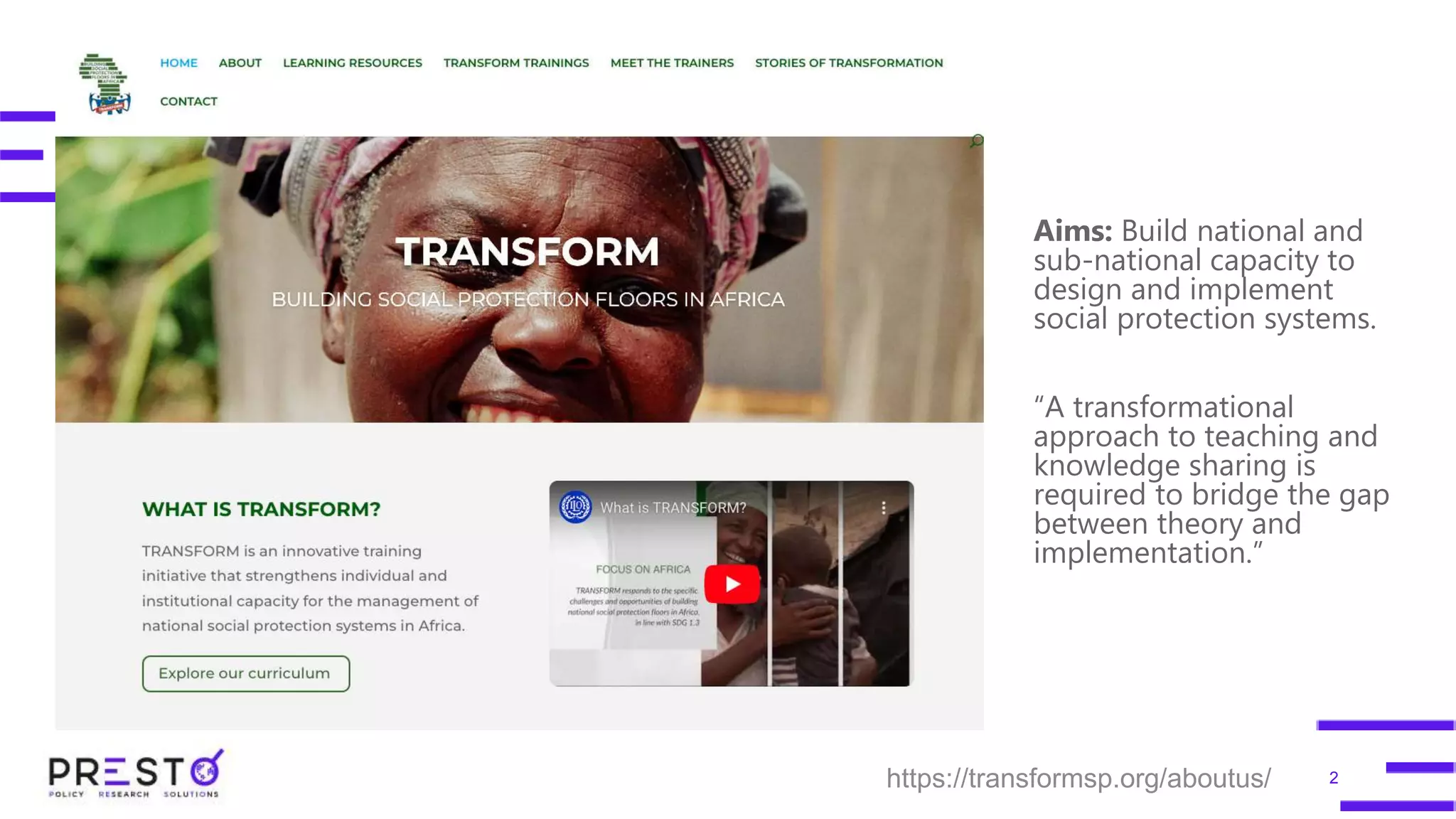
Aims: Build national and
sub-national capacity to
design and implement
social protection systems.
“A transformational
approach to teaching and
knowledge sharing is
required to bridge the gap
between theory and
implementation.”
https://transformsp.org/aboutus/ 2
How to make your social protection programme
gender-responsive
• Incremental progress is a great start!
• Gender can be integrated into existing
programmes & processes
• Easy to make programmes gender
sensitive (not a heavy lift)
• PRESTO revised the existing 9
modules to ensure the training
represents best practice principles
in gender-sensitive and disability-
inclusive social protection.
• Reviewed the evidence
• Interviewed social protection experts
• Short case studies
• Incorporation of best practice
principles
• Frame disability and gender within an
overarching framework of inclusive
social protection.
• Key issues for inclusive MIS, M&E and
program design
• Gender budgeting & budgeting
compliant with rights of persons with
disability
• Appreciating interlinkages
• Gender assessments
• Ensure programmes designed to do
no harm
3
4
The Government of the United Republic of Tanzania piloted e-payments, but prior to
further scale-up a gender assessment was conducted.
Gaps identified:
• <70% of poor women live in a household with a cell phone .
• mobile money use more common among men than women.
• Only 3% of TASAF beneficiaries had national IDs to register sim cards in their names.
• When given a choice in the e-payment pilot, only 31% of participants opted for e-
payments.
• Lack of technological know-how, lack of phones, and poor network coverage.
Case study: Gender assessment of e-payments
prior to scaling up in Tanzania’s PSSN
Thank you
UNICEF contact for TRANSFORM-related questions
Tayllor Spadafora (ESARO)
trspadafora@unicef.org
Sara Abdoulayi (WCARO)
sabdoulayi@unicef.org
PRESTO contact:
tiampalermo@policyresearchsolutions.com
Team credits:
Tia Palermo
Maja Gavrilovic
Morgon Banks
Nikola Balvin
Lusajo Kajula
With research assistance from Xanthe Hunt and Graca
Marwerwe
5
Disability-inclusive & Gender-responsive Edits to TRANSFORM Modules

Disability-inclusive & Gender-responsive Edits to TRANSFORM Modules

  • 1.
    Disability-inclusive & gender responsive editsto TRANSFORM modules Tia Palermo, Ph.D. PRESTO
  • 2.
    Aims: Build nationaland sub-national capacity to design and implement social protection systems. “A transformational approach to teaching and knowledge sharing is required to bridge the gap between theory and implementation.” https://transformsp.org/aboutus/ 2
  • 3.
    How to makeyour social protection programme gender-responsive • Incremental progress is a great start! • Gender can be integrated into existing programmes & processes • Easy to make programmes gender sensitive (not a heavy lift) • PRESTO revised the existing 9 modules to ensure the training represents best practice principles in gender-sensitive and disability- inclusive social protection. • Reviewed the evidence • Interviewed social protection experts • Short case studies • Incorporation of best practice principles • Frame disability and gender within an overarching framework of inclusive social protection. • Key issues for inclusive MIS, M&E and program design • Gender budgeting & budgeting compliant with rights of persons with disability • Appreciating interlinkages • Gender assessments • Ensure programmes designed to do no harm 3
  • 4.
    4 The Government ofthe United Republic of Tanzania piloted e-payments, but prior to further scale-up a gender assessment was conducted. Gaps identified: • <70% of poor women live in a household with a cell phone . • mobile money use more common among men than women. • Only 3% of TASAF beneficiaries had national IDs to register sim cards in their names. • When given a choice in the e-payment pilot, only 31% of participants opted for e- payments. • Lack of technological know-how, lack of phones, and poor network coverage. Case study: Gender assessment of e-payments prior to scaling up in Tanzania’s PSSN
  • 5.
    Thank you UNICEF contactfor TRANSFORM-related questions Tayllor Spadafora (ESARO) trspadafora@unicef.org Sara Abdoulayi (WCARO) sabdoulayi@unicef.org PRESTO contact: tiampalermo@policyresearchsolutions.com Team credits: Tia Palermo Maja Gavrilovic Morgon Banks Nikola Balvin Lusajo Kajula With research assistance from Xanthe Hunt and Graca Marwerwe 5

Editor's Notes

  • #3 TRANSFORM is an excellent tool for governments to build out their capacity in social protection at all levels (district, national, etc.) improve the operational capacity and technical competency of social protection practitioners in the development and implementation of social protection systems in Africa contribute to the strengthening of social protection agencies and institutions to design, management and deliver effective programmes and policies establish a community of practice to help build coalitions for change within countries and the region. overseen by the TRANSFORM inter-agency Advisory Group,
  • #4 Administration Sleection & Identification Monitoring & Evaluation Coordination MIS Governance Financing Legal Frameworks Shock-responsive Social Protection Appreciating interlinkages to mitigate drivers of poverty and exclusion
  • #5 Did an analysis and found where they needed to improve processes