A Systemic Model of Prevention: Implementing a
Collaborative Approach to Child Welfare
Presenters: Laura M. Ganci, LFMT & Melissa Stanley, MSMFT, CPP
Children’s Services Council of Broward County
lganci@cscbroward.org & mstanley@cscbroward.org
954-377-1000
June 25th, 2013
www.cscbroward.org
Children’s Services Council
of Broward County
Established in 2000 by the voters of Broward
County to provide the leadership, advocacy and
resources necessary to enhance children’s lives
and empower them to become responsible
adults through collaborative planning and
funding of a continuum of services.
www.cscbroward.org
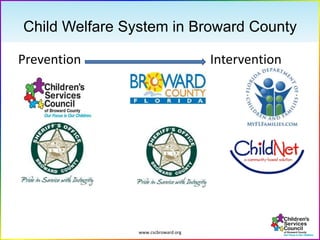
Child Welfare System in Broward County
Prevention Intervention
www.cscbroward.org
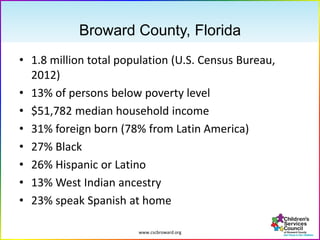
Broward County, Florida
• 1.8 million total population (U.S. Census Bureau,
2012)
• 13% of persons below poverty level
• $51,782 median household income
• 31% foreign born (78% from Latin America)
• 27% Black
• 26% Hispanic or Latino
• 13% West Indian ancestry
• 23% speak Spanish at home
www.cscbroward.org
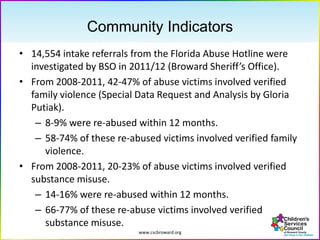
Community Indicators
• 14,554 intake referrals from the Florida Abuse Hotline were
investigated by BSO in 2011/12 (Broward Sheriff’s Office).
• From 2008-2011, 42-47% of abuse victims involved verified
family violence.
– 8-9% were re-abused within 12 months.
– 58-74% of these re-abused victims involved verified family
violence.
• From 2008-2011, 20-23% of abuse victims involved verified
substance misuse.
– 14-16% were re-abused within 12 months.
– 66-77% of these re-abuse victims involved verified
substance misuse.
www.cscbroward.org
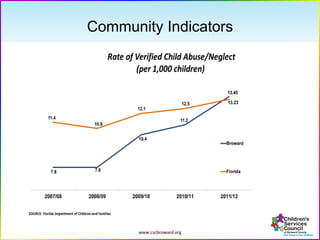
Community Indicators
www.cscbroward.org
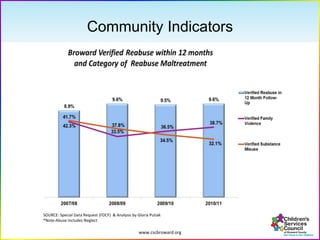
Community Indicators
www.cscbroward.org
www.cscbroward.org
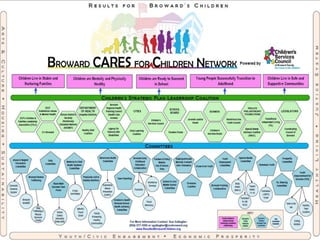
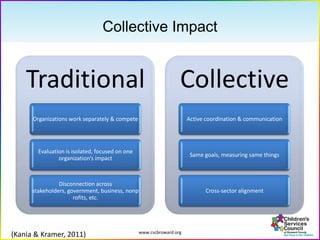
Collective Impact
Traditional
Organizations work separately & compete
Evaluation is isolated, focused on one organization’s
impact
Disconnection across
stakeholders, government, business, nonprofits, etc.
Collective
Active coordination & communication
Same goals, measuring same things
Cross-sector alignment
(Kania & Kramer, 2011)
www.cscbroward.org
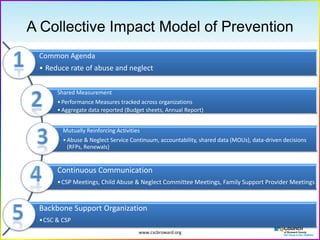
A Collective Impact Model of Prevention
Common Agenda
• Reduce rate of abuse and neglect
Shared Measurement
•Performance Measures tracked across organizations
•Aggregate data reported (Budget sheets, Annual Report)
Mutually Reinforcing Activities
•Abuse & Neglect Service Continuum, accountability, shared data (MOUs), data-driven decisions
(RFPs, Renewals)
Continuous Communication
•CSP Meetings, Child Abuse & Neglect Committee Meetings, Family Support Provider Meetings
Backbone Support Organization
•CSC & CSP
www.cscbroward.org
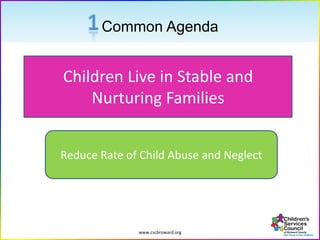
Common Agenda
Children Live in Stable and
Nurturing Families
Reduce Rate of Child Abuse and Neglect
www.cscbroward.org
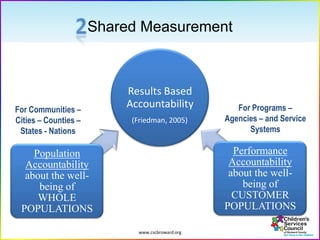
Shared Measurement
Results Based
Accountability
Population
Accountability
about the well-
being of
WHOLE
POPULATIONS
Performance
Accountability
about the well-
being of
CUSTOMER
POPULATIONS
For Communities –
Cities – Counties –
States - Nations
For Programs –
Agencies – and Service
Systems
(Friedman, 2005)
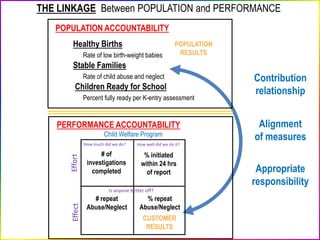
Contribution
relationship
Alignment
of measures
Appropriate
responsibility
THE LINKAGE Between POPULATION and PERFORMANCE
POPULATION ACCOUNTABILITY
Healthy Births
Rate of low birth-weight babies
Stable Families
Rate of child abuse and neglect
Children Ready for School
Percent fully ready per K-entry assessment
CUSTOMER
RESULTS
# of
investigations
completed
% initiated
within 24 hrs
of report
# repeat
Abuse/Neglect
% repeat
Abuse/Neglect
PERFORMANCE ACCOUNTABILITY
Child Welfare Program
POPULATION
RESULTS
Child Welfare Program
How much did we do? How well did we do it?
Is anyone better off?
EffortEffect
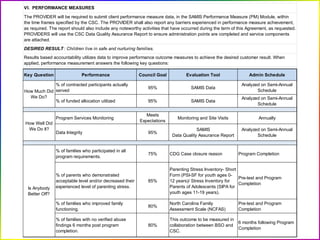
Key Question Performance Council Goal Evaluation Tool Admin Schedule
% of contracted participants actually
served
95% SAMIS Data
Analyzed on Semi-Annual
Schedule
% of funded allocation utilized 95% SAMIS Data
Analyzed on Semi-Annual
Schedule
Program Services Monitoring
Meets
Expectations
Monitoring and Site Visits Annually
Data Integrity 95%
SAMIS
Data Quality Assurance Report
Analyzed on Semi-Annual
Schedule
% of families who participated in all
program requirements.
75% CDG Case closure reason Program Completion
% of parents who demonstrated
acceptable level and/or decreased their
experienced level of parenting stress.
85%
Parenting Stress Inventory- Short
Form (PSI-SF for youth ages 0-
12 years)/ Stress Inventory for
Parents of Adolescents (SIPA for
youth ages 11-19 years).
Pre-test and Program
Completion
% of families who improved family
functioning.
80%
North Carolina Family
Assessment Scale (NCFAS)
Pre-test and Program
Completion
% of families with no verified abuse
findings 6 months post program
completion.
80%
This outcome to be measured in
collaboration between BSO and
CSC.
6 months following Program
Completion
VI. PERFORMANCE MEASURES
The PROVIDER will be required to submit client performance measure data, in the SAMIS Performance Measure (PM) Module, within
the time frames specified by the CSC. The PROVIDER shall also report any barriers experienced in performance measure achievement,
as required. The report should also include any noteworthy activities that have occurred during the term of this Agreement, as requested.
PROVIDERS will use the CSC Data Quality Assurance Report to ensure administration points are completed and service components
are attached.
Is Anybody
Better Off?
DESIRED RESULT : Children live in safe and nurturing families.
Results based accountability utilizes data to improve performance outcome measures to achieve the desired customer result. When
applied, performance measurement answers the following key questions:
How Much Did
We Do?
How Well Did
We Do It?
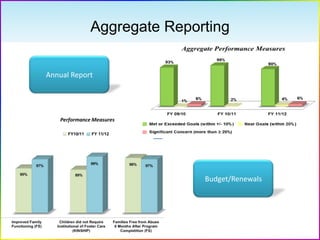
Aggregate Reporting
Annual Report
Budget/Renewals
www.cscbroward.org
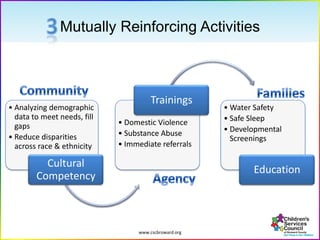
Mutually Reinforcing Activities
• Analyzing demographic
data to meet needs, fill
gaps
• Reduce disparities
across race & ethnicity
Cultural
Competency
• Domestic Violence
• Substance Abuse
• Immediate referrals
Trainings
• Water Safety
• Safe Sleep
• Developmental
Screenings
Education
www.cscbroward.org
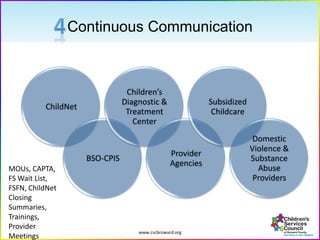
Continuous Communication
ChildNet
BSO-CPIS
Children’s
Diagnostic &
Treatment
Center
Provider
Agencies
Subsidized
Childcare
Domestic
Violence &
Substance
Abuse
Providers
MOUs, CAPTA,
FS Wait
List, FSFN, Child
Net Closing
Summaries, Trai
nings, Provider
Meetings
www.cscbroward.org
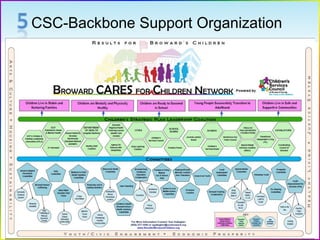
CSC-Backbone Support Organization
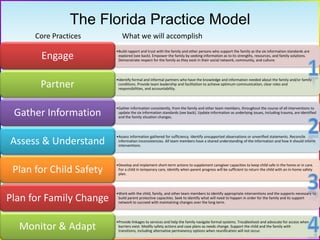
The Florida Practice Model
•Build rapport and trust with the family and other persons who support the family as the six information standards are
explored (see back). Empower the family by seeking information as to its strengths, resources, and family solutions.
Demonstrate respect for the family as they exist in their social network, community, and culture.
Engage
•Identify formal and informal partners who have the knowledge and information needed about the family and/or family
conditions. Provide team leadership and facilitation to achieve optimum communication, clear roles and
responsibilities, and accountability.
Partner
•Gather information consistently, from the family and other team members, throughout the course of all interventions to
update the six information standards (see back). Update information as underlying issues, including trauma, are identified
and the family situation changes.
Gather Information
•Assess information gathered for sufficiency. Identify unsupported observations or unverified statements. Reconcile
information inconsistencies. All team members have a shared understanding of the information and how it should inform
interventions.
Assess & Understand
•Develop and implement short‐term actions to supplement caregiver capacities to keep child safe in the home or in care.
For a child in temporary care, identify when parent progress will be sufficient to return the child with an in‐home safety
plan.
Plan for Child Safety
•Work with the child, family, and other team members to identify appropriate interventions and the supports necessary to
build parent protective capacities. Seek to identify what will need to happen in order for the family and its support
network to succeed with maintaining changes over the long term.
Plan for Family Change
•Provide linkages to services and help the family navigate formal systems. Troubleshoot and advocate for access when
barriers exist. Modify safety actions and case plans as needs change. Support the child and the family with
transitions, including alternative permanency options when reunification will not occur.
Monitor & Adapt
Core Practices What we will accomplish
www.cscbroward.org
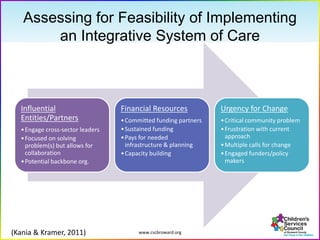
Assessing for Feasibility of Implementing
an Integrative System of Care
Influential
Entities/Partners
•Engage cross-sector leaders
•Focused on solving
problem(s) but allows for
collaboration
•Potential backbone org.
Financial Resources
•Committed funding partners
•Sustained funding
•Pays for needed
infrastructure & planning
•Capacity building
Urgency for Change
•Critical community problem
•Frustration with current
approach
•Multiple calls for change
•Engaged funders/policy
makers
(Kania & Kramer, 2011)
www.cscbroward.org
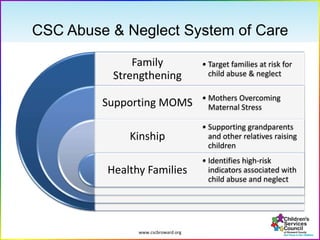
CSC Abuse & Neglect System of Care
Family
Strengthening
Supporting MOMS
Kinship
Healthy Families
• Target families at risk for
child abuse & neglect
• Mothers Overcoming
Maternal Stress
• Supporting grandparents
and other relatives raising
children
• Identifies high-risk
indicators associated with
child abuse and neglect
www.cscbroward.org
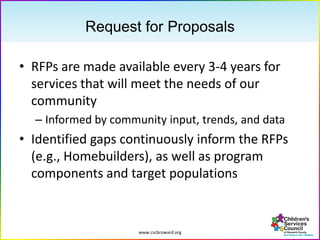
Request for Proposals
• RFPs are made available every 3-4 years for
services that will meet the needs of our
community
– Informed by community input, trends, and data
• Identified gaps continuously inform the RFPs
(e.g., Homebuilders), as well as program
components and target populations
www.cscbroward.org
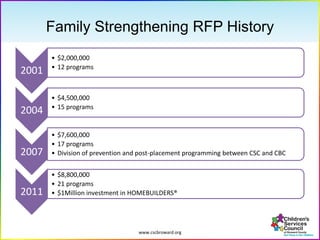
Family Strengthening RFP History
2001
• $2,000,000
• 12 programs
2004
• $4,500,000
• 15 programs
2007
• $7,600,000
• 17 programs
• Division of prevention and post-placement programming between CSC and CBC
2011
• $8,800,000
• 21 programs
• $1Million investment in HOMEBUILDERS®
www.cscbroward.org
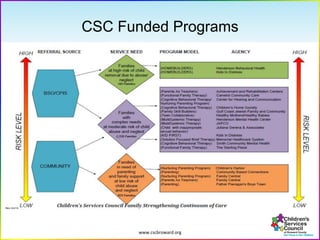
CSC Funded Programs
www.cscbroward.org
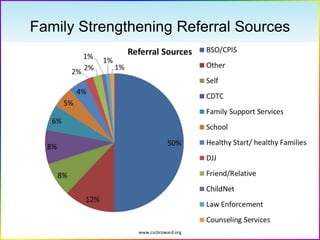
Family Strengthening Referral Sources
www.cscbroward.org
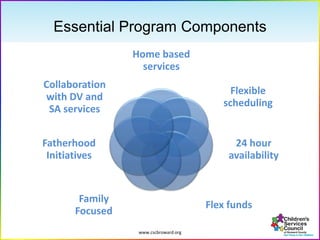
Essential Program Components
Home based
services
Flexible
scheduling
24 hour
availability
Flex funds
Family
Focused
Fatherhood
Initiatives
Collaboration
with DV and
SA services
www.cscbroward.org
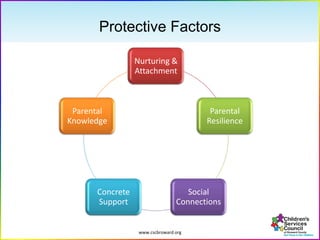
Protective Factors
Nurturing &
Attachment
Parental
Resilience
Social
Connections
Concrete
Support
Parental
Knowledge
www.cscbroward.org
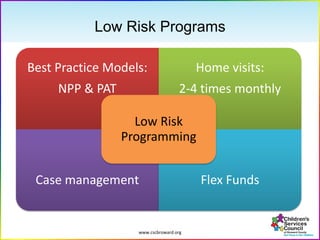
Low Risk Programs
Best Practice Models:
NPP & PAT
Home visits:
2-4 times monthly
Case management Flex Funds
Low Risk
Programming
www.cscbroward.org
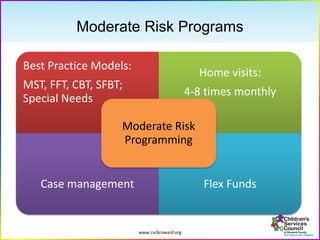
Moderate Risk Programs
Best Practice Models:
MST, FFT, CBT, SFBT;
Special Needs
Home visits:
4-8 times monthly
Case management Flex Funds
Moderate Risk
Programming
www.cscbroward.org
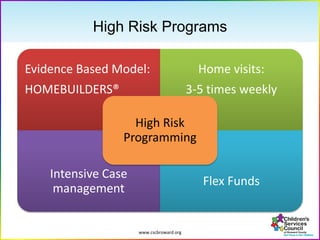
High Risk Programs
Evidence Based Model:
HOMEBUILDERS®
Home visits:
3-5 times weekly
Intensive Case
management
Flex Funds
High Risk
Programming
www.cscbroward.org
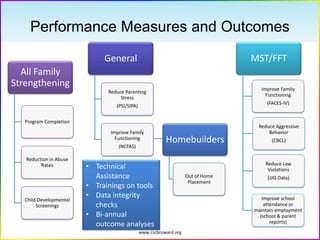
Performance Measures and Outcomes
All Family
Strengthening
Program Completion
Reduction in Abuse
Rates
Child Developmental
Screenings
General
Reduce Parenting
Stress
(PSI/SIPA)
Improve Family
Functioning
(NCFAS)
Homebuilders
Out of Home
Placement
MST/FFT
Improve Family
Functioning
(FACES-IV)
Reduce Aggressive
Behavior
(CBCL)
Reduce Law
Violations
(JJIS Data)
Improve school
attendance or
maintain employment
(school & parent
reports)
• Technical
Assistance
• Trainings on tools
• Data integrity
checks
• Bi-annual
outcome analyses
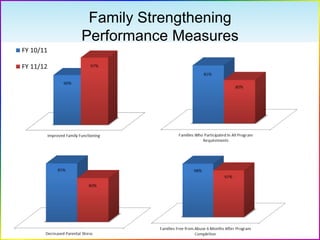
Family Strengthening
Performance Measures
www.cscbroward.org
CSC Support
Continuous Quality Assurance
• Completed annually by a team of
contract managers and research
analyst
• Case file reviews
• Program Service Observation
• Satisfaction Surveys
• Utilization
• Outcomes
• Data Integrity
Program
Monitoring:
www.cscbroward.org
Continuous Quality Assurance
• All contracts must be approved for renewal based on
program performance and sustainability
Yearly
Renewals:
• Continuous availability of contract manager to
troubleshoot any program or case specific concerns
• Performance Improvement Plans
• Research analyst available to troubleshoot questions
regarding outcomes, training, and SAMIS
Technical
Assistance:
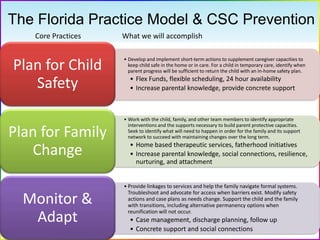
The Florida Practice Model & CSC Prevention
• Develop and implement short‐term actions to supplement caregiver capacities to
keep child safe in the home or in care. For a child in temporary care, identify when
parent progress will be sufficient to return the child with an in‐home safety plan.
• Flex Funds, flexible scheduling, 24 hour availability
• Increase parental knowledge, provide concrete support
Plan for Child
Safety
• Work with the child, family, and other team members to identify appropriate
interventions and the supports necessary to build parent protective capacities.
Seek to identify what will need to happen in order for the family and its support
network to succeed with maintaining changes over the long term.
• Home based therapeutic services, fatherhood initiatives
• Increase parental knowledge, social
connections, resilience, nurturing, and attachment
Plan for Family
Change
• Provide linkages to services and help the family navigate formal systems.
Troubleshoot and advocate for access when barriers exist. Modify safety
actions and case plans as needs change. Support the child and the family
with transitions, including alternative permanency options when
reunification will not occur.
• Case management, discharge planning, follow up
• Concrete support and social connections
Monitor &
Adapt
Core Practices What we will accomplish
www.cscbroward.org
References
• Core Tenets of Florida’s Practice Model (2012). Florida
Department of Children and Families. Retrieved from
http://centerforchildwelfare2.fmhi.usf.edu/kb/trainerscorner/
FlPracticeModel2012.pdf
• Friedman, M. (2005). Trying Hard is Not Good Enough. FPSI
Publishing.
• Kania, J., & Kramer, M. (2011). Collective Impact. Stanford
Social Innovation Review, 9(1), 36-41.
• U.S. Census Bureau (2012). QuickFacts: Broward County,
Florida. Retrieved from
http://quickfacts.census.gov/qfd/states/12/12011.html
Laura M. Ganci, LFMT & Melissa Stanley, MSMFT, CPP
Children’s Services Council of Broward County
lganci@cscbroward.org & mstanley@cscbroward.org
954-377-1000
Visit us online www.cscbroward.org | Follow us on social media @cscbroward

Children's Services Council of Broward County, Systemic Model of Prevention

  • 1.
    A Systemic Modelof Prevention: Implementing a Collaborative Approach to Child Welfare Presenters: Laura M. Ganci, LFMT & Melissa Stanley, MSMFT, CPP Children’s Services Council of Broward County lganci@cscbroward.org & mstanley@cscbroward.org 954-377-1000 June 25th, 2013
  • 2.
    www.cscbroward.org Children’s Services Council ofBroward County Established in 2000 by the voters of Broward County to provide the leadership, advocacy and resources necessary to enhance children’s lives and empower them to become responsible adults through collaborative planning and funding of a continuum of services.
  • 3.
    www.cscbroward.org Child Welfare Systemin Broward County Prevention Intervention
  • 4.
    www.cscbroward.org Broward County, Florida •1.8 million total population (U.S. Census Bureau, 2012) • 13% of persons below poverty level • $51,782 median household income • 31% foreign born (78% from Latin America) • 27% Black • 26% Hispanic or Latino • 13% West Indian ancestry • 23% speak Spanish at home
  • 5.
    www.cscbroward.org Community Indicators • 14,554intake referrals from the Florida Abuse Hotline were investigated by BSO in 2011/12 (Broward Sheriff’s Office). • From 2008-2011, 42-47% of abuse victims involved verified family violence. – 8-9% were re-abused within 12 months. – 58-74% of these re-abused victims involved verified family violence. • From 2008-2011, 20-23% of abuse victims involved verified substance misuse. – 14-16% were re-abused within 12 months. – 66-77% of these re-abuse victims involved verified substance misuse.
  • 6.
  • 7.
  • 8.
  • 9.
    www.cscbroward.org Collective Impact Traditional Organizations workseparately & compete Evaluation is isolated, focused on one organization’s impact Disconnection across stakeholders, government, business, nonprofits, etc. Collective Active coordination & communication Same goals, measuring same things Cross-sector alignment (Kania & Kramer, 2011)
  • 10.
    www.cscbroward.org A Collective ImpactModel of Prevention Common Agenda • Reduce rate of abuse and neglect Shared Measurement •Performance Measures tracked across organizations •Aggregate data reported (Budget sheets, Annual Report) Mutually Reinforcing Activities •Abuse & Neglect Service Continuum, accountability, shared data (MOUs), data-driven decisions (RFPs, Renewals) Continuous Communication •CSP Meetings, Child Abuse & Neglect Committee Meetings, Family Support Provider Meetings Backbone Support Organization •CSC & CSP
  • 11.
    www.cscbroward.org Common Agenda Children Livein Stable and Nurturing Families Reduce Rate of Child Abuse and Neglect
  • 12.
    www.cscbroward.org Shared Measurement Results Based Accountability Population Accountability aboutthe well- being of WHOLE POPULATIONS Performance Accountability about the well- being of CUSTOMER POPULATIONS For Communities – Cities – Counties – States - Nations For Programs – Agencies – and Service Systems (Friedman, 2005)
  • 13.
    Contribution relationship Alignment of measures Appropriate responsibility THE LINKAGEBetween POPULATION and PERFORMANCE POPULATION ACCOUNTABILITY Healthy Births Rate of low birth-weight babies Stable Families Rate of child abuse and neglect Children Ready for School Percent fully ready per K-entry assessment CUSTOMER RESULTS # of investigations completed % initiated within 24 hrs of report # repeat Abuse/Neglect % repeat Abuse/Neglect PERFORMANCE ACCOUNTABILITY Child Welfare Program POPULATION RESULTS Child Welfare Program How much did we do? How well did we do it? Is anyone better off? EffortEffect
  • 14.
    Key Question PerformanceCouncil Goal Evaluation Tool Admin Schedule % of contracted participants actually served 95% SAMIS Data Analyzed on Semi-Annual Schedule % of funded allocation utilized 95% SAMIS Data Analyzed on Semi-Annual Schedule Program Services Monitoring Meets Expectations Monitoring and Site Visits Annually Data Integrity 95% SAMIS Data Quality Assurance Report Analyzed on Semi-Annual Schedule % of families who participated in all program requirements. 75% CDG Case closure reason Program Completion % of parents who demonstrated acceptable level and/or decreased their experienced level of parenting stress. 85% Parenting Stress Inventory- Short Form (PSI-SF for youth ages 0- 12 years)/ Stress Inventory for Parents of Adolescents (SIPA for youth ages 11-19 years). Pre-test and Program Completion % of families who improved family functioning. 80% North Carolina Family Assessment Scale (NCFAS) Pre-test and Program Completion % of families with no verified abuse findings 6 months post program completion. 80% This outcome to be measured in collaboration between BSO and CSC. 6 months following Program Completion VI. PERFORMANCE MEASURES The PROVIDER will be required to submit client performance measure data, in the SAMIS Performance Measure (PM) Module, within the time frames specified by the CSC. The PROVIDER shall also report any barriers experienced in performance measure achievement, as required. The report should also include any noteworthy activities that have occurred during the term of this Agreement, as requested. PROVIDERS will use the CSC Data Quality Assurance Report to ensure administration points are completed and service components are attached. Is Anybody Better Off? DESIRED RESULT : Children live in safe and nurturing families. Results based accountability utilizes data to improve performance outcome measures to achieve the desired customer result. When applied, performance measurement answers the following key questions: How Much Did We Do? How Well Did We Do It?
  • 15.
  • 16.
    www.cscbroward.org Mutually Reinforcing Activities •Analyzing demographic data to meet needs, fill gaps • Reduce disparities across race & ethnicity Cultural Competency • Domestic Violence • Substance Abuse • Immediate referrals Trainings • Water Safety • Safe Sleep • Developmental Screenings Education
  • 17.
    www.cscbroward.org Continuous Communication ChildNet BSO-CPIS Children’s Diagnostic & Treatment Center Provider Agencies Subsidized Childcare Domestic Violence& Substance Abuse Providers MOUs, CAPTA, FS Wait List, FSFN, Child Net Closing Summaries, Trai nings, Provider Meetings
  • 18.
  • 19.
    The Florida PracticeModel •Build rapport and trust with the family and other persons who support the family as the six information standards are explored (see back). Empower the family by seeking information as to its strengths, resources, and family solutions. Demonstrate respect for the family as they exist in their social network, community, and culture. Engage •Identify formal and informal partners who have the knowledge and information needed about the family and/or family conditions. Provide team leadership and facilitation to achieve optimum communication, clear roles and responsibilities, and accountability. Partner •Gather information consistently, from the family and other team members, throughout the course of all interventions to update the six information standards (see back). Update information as underlying issues, including trauma, are identified and the family situation changes. Gather Information •Assess information gathered for sufficiency. Identify unsupported observations or unverified statements. Reconcile information inconsistencies. All team members have a shared understanding of the information and how it should inform interventions. Assess & Understand •Develop and implement short‐term actions to supplement caregiver capacities to keep child safe in the home or in care. For a child in temporary care, identify when parent progress will be sufficient to return the child with an in‐home safety plan. Plan for Child Safety •Work with the child, family, and other team members to identify appropriate interventions and the supports necessary to build parent protective capacities. Seek to identify what will need to happen in order for the family and its support network to succeed with maintaining changes over the long term. Plan for Family Change •Provide linkages to services and help the family navigate formal systems. Troubleshoot and advocate for access when barriers exist. Modify safety actions and case plans as needs change. Support the child and the family with transitions, including alternative permanency options when reunification will not occur. Monitor & Adapt Core Practices What we will accomplish
  • 20.
    www.cscbroward.org Assessing for Feasibilityof Implementing an Integrative System of Care Influential Entities/Partners •Engage cross-sector leaders •Focused on solving problem(s) but allows for collaboration •Potential backbone org. Financial Resources •Committed funding partners •Sustained funding •Pays for needed infrastructure & planning •Capacity building Urgency for Change •Critical community problem •Frustration with current approach •Multiple calls for change •Engaged funders/policy makers (Kania & Kramer, 2011)
  • 21.
    www.cscbroward.org CSC Abuse &Neglect System of Care Family Strengthening Supporting MOMS Kinship Healthy Families • Target families at risk for child abuse & neglect • Mothers Overcoming Maternal Stress • Supporting grandparents and other relatives raising children • Identifies high-risk indicators associated with child abuse and neglect
  • 22.
    www.cscbroward.org Request for Proposals •RFPs are made available every 3-4 years for services that will meet the needs of our community – Informed by community input, trends, and data • Identified gaps continuously inform the RFPs (e.g., Homebuilders), as well as program components and target populations
  • 23.
    www.cscbroward.org Family Strengthening RFPHistory 2001 • $2,000,000 • 12 programs 2004 • $4,500,000 • 15 programs 2007 • $7,600,000 • 17 programs • Division of prevention and post-placement programming between CSC and CBC 2011 • $8,800,000 • 21 programs • $1Million investment in HOMEBUILDERS®
  • 24.
  • 25.
  • 26.
    www.cscbroward.org Essential Program Components Homebased services Flexible scheduling 24 hour availability Flex funds Family Focused Fatherhood Initiatives Collaboration with DV and SA services
  • 27.
  • 28.
    www.cscbroward.org Low Risk Programs BestPractice Models: NPP & PAT Home visits: 2-4 times monthly Case management Flex Funds Low Risk Programming
  • 29.
    www.cscbroward.org Moderate Risk Programs BestPractice Models: MST, FFT, CBT, SFBT; Special Needs Home visits: 4-8 times monthly Case management Flex Funds Moderate Risk Programming
  • 30.
    www.cscbroward.org High Risk Programs EvidenceBased Model: HOMEBUILDERS® Home visits: 3-5 times weekly Intensive Case management Flex Funds High Risk Programming
  • 31.
    www.cscbroward.org Performance Measures andOutcomes All Family Strengthening Program Completion Reduction in Abuse Rates Child Developmental Screenings General Reduce Parenting Stress (PSI/SIPA) Improve Family Functioning (NCFAS) Homebuilders Out of Home Placement MST/FFT Improve Family Functioning (FACES-IV) Reduce Aggressive Behavior (CBCL) Reduce Law Violations (JJIS Data) Improve school attendance or maintain employment (school & parent reports) • Technical Assistance • Trainings on tools • Data integrity checks • Bi-annual outcome analyses
  • 32.
  • 33.
    www.cscbroward.org CSC Support Continuous QualityAssurance • Completed annually by a team of contract managers and research analyst • Case file reviews • Program Service Observation • Satisfaction Surveys • Utilization • Outcomes • Data Integrity Program Monitoring:
  • 34.
    www.cscbroward.org Continuous Quality Assurance •All contracts must be approved for renewal based on program performance and sustainability Yearly Renewals: • Continuous availability of contract manager to troubleshoot any program or case specific concerns • Performance Improvement Plans • Research analyst available to troubleshoot questions regarding outcomes, training, and SAMIS Technical Assistance:
  • 35.
    The Florida PracticeModel & CSC Prevention • Develop and implement short‐term actions to supplement caregiver capacities to keep child safe in the home or in care. For a child in temporary care, identify when parent progress will be sufficient to return the child with an in‐home safety plan. • Flex Funds, flexible scheduling, 24 hour availability • Increase parental knowledge, provide concrete support Plan for Child Safety • Work with the child, family, and other team members to identify appropriate interventions and the supports necessary to build parent protective capacities. Seek to identify what will need to happen in order for the family and its support network to succeed with maintaining changes over the long term. • Home based therapeutic services, fatherhood initiatives • Increase parental knowledge, social connections, resilience, nurturing, and attachment Plan for Family Change • Provide linkages to services and help the family navigate formal systems. Troubleshoot and advocate for access when barriers exist. Modify safety actions and case plans as needs change. Support the child and the family with transitions, including alternative permanency options when reunification will not occur. • Case management, discharge planning, follow up • Concrete support and social connections Monitor & Adapt Core Practices What we will accomplish
  • 36.
    www.cscbroward.org References • Core Tenetsof Florida’s Practice Model (2012). Florida Department of Children and Families. Retrieved from http://centerforchildwelfare2.fmhi.usf.edu/kb/trainerscorner/ FlPracticeModel2012.pdf • Friedman, M. (2005). Trying Hard is Not Good Enough. FPSI Publishing. • Kania, J., & Kramer, M. (2011). Collective Impact. Stanford Social Innovation Review, 9(1), 36-41. • U.S. Census Bureau (2012). QuickFacts: Broward County, Florida. Retrieved from http://quickfacts.census.gov/qfd/states/12/12011.html
  • 37.
    Laura M. Ganci,LFMT & Melissa Stanley, MSMFT, CPP Children’s Services Council of Broward County lganci@cscbroward.org & mstanley@cscbroward.org 954-377-1000 Visit us online www.cscbroward.org | Follow us on social media @cscbroward

Editor's Notes

  • #2 Objectives:Describe integrative model of prevention (collective impact, RBA) & implementation in Broward countyIdentify measures of quality and performance (RBA, PMs)Explain specific programming components (FS programs, Florida Practice Model)Assess feasibility
  • #3 Special independent taxing district funded by property taxes—average homeowner will pay approx. $77/year to support CSC services. Funding is provided for a wide variety of programs delivered by over 100 “provider” agencies throughout the county.
  • #4 Since its inception, the CSC of Broward has funded secondary and tertiary prevention programs within the child welfare system’s service continuum. Secondary prevention focuses on families who are at risk of maltreatment due to multiple risk factors (e.g., low income, teen parent, dv issues, mental health concerns). Tertiary prevention targets families where maltreatment has already occurred—focused on reducing negative consequences of the maltreatment and preventing reoccurrence. In 1999, DCF privatized Child Protective Investigations and contracted with BSO to provide these services—BSO Child Protective Investigations Section (CPIS). In 2002, DCF privatized child welfare services statewide. ChildNet was selected by the state to manage local system of services for Broward. ChildNet provides oversight to nearly 2,000 families a year who have had verified findings of child abuse and/or neglect.Broward County Board of County Commissioners under the auspices of the Human Services Department provides a comprehensive array of programs for children and adults including behavioral health treatment, sexual assault counseling, primary health care, homeless services, substance abuse treatment and assistance to individuals and families in achieving economic and social stability.
  • #5 U.S. Census Bureau: State and County QuickFacts / 2007-2011 American Community Survey 5-Year EstimatesAs you can see by these statistics, Broward county is a large, demographically diverse county. The diversity of the county further adds to the complexity of addressing child abuse and neglect throughout the community. There are cultural concerns with regards to disciplinary and parenting attitudes/thoughts/techniques/values across the variety of cultural backgrounds of Broward’s residents. Oftentimes, new immigrants are unaware of the child abuse and neglect laws in this country and they vastly differ from the laws in their countries of origin. Additionally, there is a cultural clash that requires sensitivity when we (social service providers) promote parenting skills/techniques that are viewed as “American” and do not resonate with the culture in which these parents were raised. Oftentimes, these parents do not want their kids to become “Americanized” and parenting in a way that reflects their cultural values is highly important to them. Finally, possible experiences of acculturative stress (mental health concerns, isolation, lack of social support) for recent immigrants is an important consideration when working with this population.
  • #6 This provides a recent reflection of how our community is doing with regards to child welfare. It is the common agenda, the data that informs our initiatives and guides the social services that need to be provided to resolve this complex social problem. This data shows clear patterns with regards to DV and SA and their correlations with child abuse and neglect. This specifically informed the RFP process and the programmatic components of the family strengthening programs.
  • #7 Again another gauge of how our community is doing, trend wise, there has been quite a rise in the rate of abuse and neglect in Broward county, most recently being higher than the state rate. We know that the increase, specifically between 08/09 and 09/10 had a lot to do with the economic recession and its affects on families in our communities.
  • #8 This slide shows the rate of re-abuse within 12 months, again showing a high percentage of almost 10%. Additionally, 71% of the re-abuse was due to verified family violence or substance misuse. The data regarding how our community is doing is what informs the overarching goals for the Children’s Services Council and Broward County’s Children Strategic Plan…
  • #9 CSP Leadership Coalition—Sr. Mgmt. (School Board, DOH, DCF, CSC, DJJ, Municipalities, County Govt., Social Service Providers, Philanthropic Foundations, Business, Parents/Youth CSP Committees—mid-level staff Funders’ Forum—Sr. Mgmt.Shared Vision/Results, shared language & planning framework, shared measurement systems (Broward benchmarks, community indicators, MOUs for individual level data (DCF, DJJ)Connects Govt. PMs with community indicators/planning
  • #10 Isolated Impact: oriented toward finding and funding a solution embodied within a single organization, combined with the hope that the most effective organizations will grow or replicate to extend their impact more widely. Focus on scaling up a few select organizations as the key to social progress.Collective Impact Initiatives are long-term commitments by a group of important actorsfrom different sectors to a common agenda for solving a specific social problem. It is different than simple collaboration in that there is a centralized infrastructure, dedicated staff, and structured process that leads to a common agenda, supported by a shared measurement system, mutually reinforcing activities,and ongoing communication, and are staffed by an independent backbone organization.Large scale social change comes from better cross-sector coordination rather than from isolated intervention of individual organizations—difficult to accomplish because organizations are accustomed to focusing on independent action as the primary vehicle for social change.
  • #11 (Kania & Kramer, 2011) Common Agenda: common understanding of the problem, shared vision for changeShared Measurement: shared accountability, performance management—common agenda is misleading without agreement on the ways success will be measured and reported—this ensures that community indicators are being addressed across all organizations, efforts remain aligned and allows for accountability across all orgz/participantsMutually Reinforcing Activities: coordination through joint plan of actionContinuous Communication: consistent & open communication, focus on building trustBackbone Support: resources & skills to convene and coordinate participating organizations
  • #12 (Kania & Kramer, 2011) Common Agenda: common understanding of the problem, shared vision for changeShared Measurement: shared accountability, performance managementMutually Reinforcing Activities: coordination through joint plan of actionContinuous Communication: consistent & open communication, focus on building trustBackbone Support: resources & skills to convene and coordinate participating organizations
  • #13 RBA provides a simple, plain language and useful framework for assisting communities and agencies to improve quality of life conditions. RBA encompasses two different kinds of accountability: Accountability for whole populations, like all children in Los Angeles, all elders in Chicago, all residents of North Carolina. This first kind of accountability is not the responsibility of any one agency or program. If we talk for example about “all children in your community being healthy,” who are some of the partners that have a role to play? Notice that the traditional answer is “It’s the health department.” It’s got the word health in it and so it must be the responsibility of the health department. And yet one of the things we have learned in the last 50 years is that the health department by itself can’t possibly produce health for all children without the active participation of many other partners. And that’s the nature of this first kind of accountability. It’s not about the health department. It’s about the kind of cross community partnerships necessary to make progress on quality of life for any population. Now the second kind of accountability, Performance Accountability, is about the health department. It’s about the programs and services we provide, and our role as managers, making sure our programs are working as well as possible. These are two profoundly different kinds of accountability.
  • #15 RBA example at programmatic level
  • #16 This is an example of the shared measurement component—aggregate reporting, utilizing the RBA framework, we provide data regarding our agency performance measures across all agencies—we answer the 3 questions of how much, how well, and is anybody better off
  • #17 strategies and action steps for system coordination, service continuum, accountability, shared data & data driven decisions, identified top-priority activities to pursueEvery participant in a collective impact effort will not and should not necessarily be doing the same activities but there are activities specifically across our FS programs that are done across agencies to promote shared initiatives. On a community level, it was important to recognize that diversity of our residents and how that would and does impact our service delivery. We continuously analyze data such as amount spent by zip codes, race/ethnicity served by zip codes & across the county, addressing disproportionality to make sure that needs are being addressed where they need to be. Furthermore, as informed by the community indicator data, we implemented trainings and emphasized the importance of DV and SA treatment across our FS programs, these are requirements for all of the programs despite their services being unique. Clients identified as having these concerns or being the reason for referral need to be referred to appropriate services. Finally on a client-education level, we have integrated educational components across all of the FS programs that address additional issues of child abuse/neglect, including water safety, drowning prevention (agency staff conducts water safety checklist with family), safe sleep training (referrals to Cribs for Kids, or purchasing of pack n plays with flex funds), and all children aged 5 and under are required to have an ASQ developmental screening done (with consent, even if they are not the IP) those clients requiring referrals are then linked to the appropriate service, we track this data in our system (CAPTA-Child Abuse Prevention and Treatment Act agreement with CDTC—data sharing MOU)
  • #18 (Kania & Kramer, 2011) CSC’s FS programs have been identified as a priority referral source for subsidized child care.Florida Safe Families Network—data portal for DCF, child abuse/neglect cases
  • #19 Shared Vision/Results, shared language & planning framework, shared measurement systems (Broward benchmarks, community indicators, MOUs for individual level data (DCF, DJJ)Connects Govt. PMs with community indicators/planning
  • #20 Florida Department of Children and FamiliesCommon agenda—DCF and FS programs share same goal of engaging families and community and partnering on a macro level across providersShared Measurement—On a meta level gathering information and assessing and understanding it reflects the idea of shared measurement Mutually Reinforcing Activities—Plan for child safety and family change mirrors the goals of our prevention programs and through our collaborative process we provide mutually reinforcing activities across the continuum of child welfareContinuous communication—Monitor and adapt relates to the continuous communication piece of CI in that collaboration and communication is required to best modify or adapt case plans for individual cases and families across service providers
  • #22 Healthy Families Broward is a nationally accredited home visiting program for expectant parents and parents of newborns. This program identifies high-risk indicators associated with child abuse and neglect and then either provides in-home services by a para-professional or refers the family to another service provider if they are at capacity or if the issue identified is beyond the scope of the program, such as maternal depression.
  • #23 Community stakeholders and experts review proposals and make recommendations for funding through a rating system. Rating committees are held to discuss findings and allow for applicant interviews. All rating committee recommendations are sent to Council for approval.
  • #24 FS was the first RFP CSC put out. It is the 2nd highest funding commitment to the community. 2007- Division of service funding2011- ASQ, water safety, subsidized child care, fatherhood focus, safe sleep; alignment with Florida prevention plan
  • #25 Programs receive referrals from various sources including but not limited to: BSO CPIS, ChildNet, Family Court, School Personnel, Community agencies, DJJ, Healthy Start, mental health, family or friends, and most importantly self-referrals
  • #26 Estimates based on SAMIS data.
  • #28 CSC funds various levels of home-based, family programming aimed to reduce risk factors while increasing protective factors to prevent CA/N
  • #30 Evidence Based Models: Multisystemic Therapy (MST), Functional Family Therapy (FFT); Intensive supervision, training, and oversight by national consultantsBest Practice Models: Cognitive Behavioral Therapy (CBT), Solution Focused Brief Therapy (SFBT)Special Needs Programming: Sexually Reactive Children, Hard of Hearing Population, Developmental Delays, Teen PregnancyInterventions: Family therapy, school/ court advocacy, crisis management, community resources, communication skills, parenting knowledge and skill practiceFlex Funding: Emergency assistance, incentives, rewards, parenting groups, family building events
  • #31 Referrals from BSO CPIS or ChildNet only for families at imminent risk for child removal.Interventions: Motivation enhancement, cognitive behavioral intervention, focus on issues threatening external placementSmall caseloads, brief but intensive services. Intensive supervision, training, and oversight by national consultants.
  • #34 Program Specialists and Research Analysts have many years of experience in the identified area and have practical work history in the field.