IMMUNOPHENOTYPING
by
(Mdede Sumu)
By definition
It is a technique used to study the protein expressed by cells.
 This technique is commonly used in basic science research
and laboratory for diagnostic purpose.
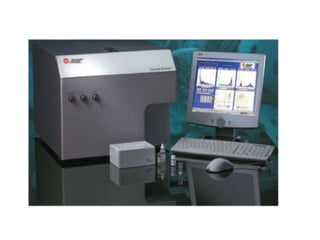
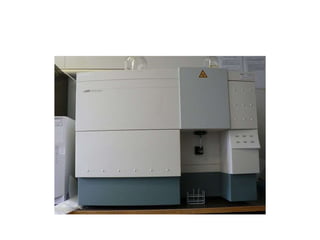
FLOW CYTOMETRY / FACS CALIBUR
FLOW CYTOMETRY
↓ ↓ ↓
Flow Cell Measument
 The concept of flow Cytometry has been in existence for more
than five decades.
 Flow cytometric immunophenotyping (FCI) first appeared in
clinical laboratories in the 1980s, in the wake of the AIDS
epidemic.
 Initially utilized to assess CD4 T-cells, the technique was soon
applied to lymphoid and eventually myeloid neoplasms.
SPECIMEN AND CONTAINER TYPES
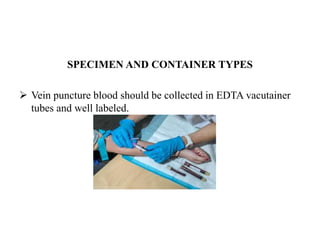
 Vein puncture blood should be collected in EDTA vacutainer
tubes and well labeled.
 Volume depends on the instruction of the manufacturer of the
vacutainer being used but at least 3mls of whole blood is
required.
 Storage 72 hours at room temperature
 Transport should be smooth to be positioned upright in the
sample rack in a cool box.
REAGENTS AND SUPPLIES
Reagent kits, True Count Tubes, Lysing solution, Facsc rinse, Calibrite beads: FITC, PE, PerCP,
APC and Unlabelled FACS Flow, BD Falcon tubes 12x75mm etc.
PROCEDURES FOR TESTING PATIENT SAMPLES
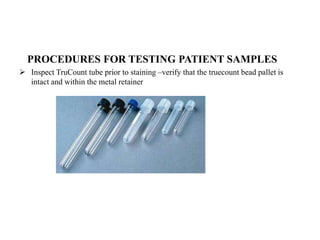
 Inspect TruCount tube prior to staining –verify that the truecount bead pallet is
intact and within the metal retainer
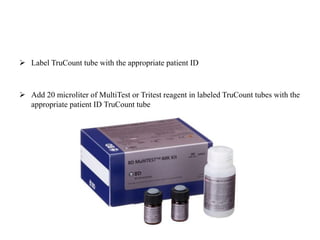
 Label TruCount tube with the appropriate patient ID
 Add 20 microliter of MultiTest or Tritest reagent in labeled TruCount tubes with the
appropriate patient ID TruCount tube
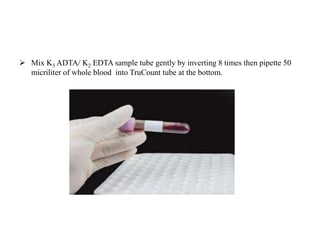
 Mix K3 ADTA/ K2 EDTA sample tube gently by inverting 8 times then pipette 50
micriliter of whole blood into TruCount tube at the bottom.
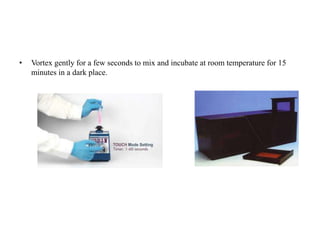
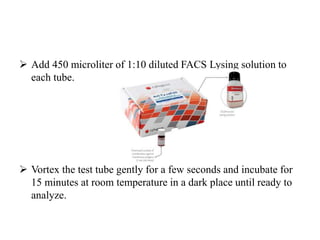
• Vortex gently for a few seconds to mix and incubate at room temperature for 15
minutes in a dark place.
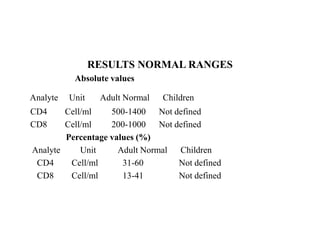
 Add 450 microliter of 1:10 diluted FACS Lysing solution to
each tube.
 Vortex the test tube gently for a few seconds and incubate for
15 minutes at room temperature in a dark place until ready to
analyze.
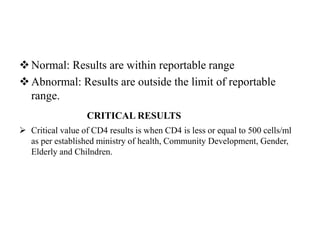
RESULTS NORMAL RANGES
Absolute values
Analyte Unit Adult Normal Children
CD4 Cell/ml 500-1400 Not defined
CD8 Cell/ml 200-1000 Not defined
Percentage values (%)
Analyte Unit Adult Normal Children
CD4 Cell/ml 31-60 Not defined
CD8 Cell/ml 13-41 Not defined
Normal: Results are within reportable range
Abnormal: Results are outside the limit of reportable
range.
CRITICAL RESULTS
 Critical value of CD4 results is when CD4 is less or equal to 500 cells/ml
as per established ministry of health, Community Development, Gender,
Elderly and Chilndren.
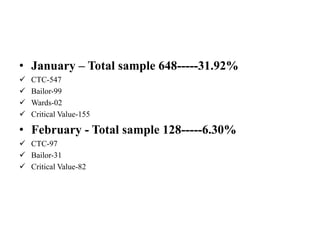
• January – Total sample 648-----31.92%
 CTC-547
 Bailor-99
 Wards-02
 Critical Value-155
• February - Total sample 128-----6.30%
 CTC-97
 Bailor-31
 Critical Value-82
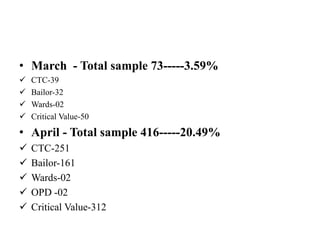
• March - Total sample 73-----3.59%
 CTC-39
 Bailor-32
 Wards-02
 Critical Value-50
• April - Total sample 416-----20.49%
 CTC-251
 Bailor-161
 Wards-02
 OPD -02
 Critical Value-312
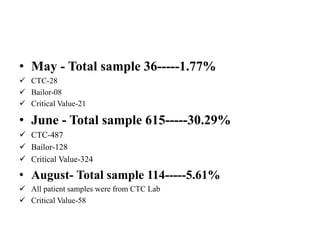
• May - Total sample 36-----1.77%
 CTC-28
 Bailor-08
 Critical Value-21
• June - Total sample 615-----30.29%
 CTC-487
 Bailor-128
 Critical Value-324
• August- Total sample 114-----5.61%
 All patient samples were from CTC Lab
 Critical Value-58
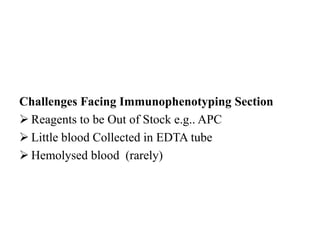
Challenges Facing Immunophenotyping Section
 Reagents to be Out of Stock e.g.. APC
 Little blood Collected in EDTA tube
 Hemolysed blood (rarely)
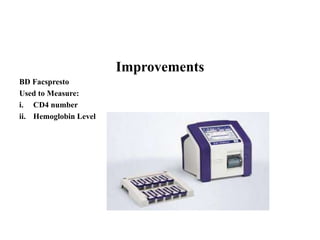
Improvements
BD Facspresto
Used to Measure:
i. CD4 number
ii. Hemoglobin Level
• CD4+ T helper cells are white blood cells that are an essential part of the human
immune system. They are often referred to as CD4 cells, T-helper cells or T4 cells.
• They are called helper cells because one of their main roles is to send signals to
other types of immune cells, including CD8 killer cells, which then destroy the
infectious particle.
• If CD4 cells become depleted, for example in untreated HIV infection, or
following immune suppression prior to a transplant, the body is left vulnerable to a
wide range of infections that it would otherwise have been able to fight.
• CD3 (cluster of differentiation 3) T-cell co-receptor helps to activate both the
cytotoxic T-Cell (CD8+ naive T cells) and also T helper cells (CD4+ naive T cells).
• CD8 (cluster of differentiation 8) is a transmembrane glycoprotein that serves as a
co-receptor for the T cell receptor (TCR). Like the TCR, CD8 binds to a major
histocompatibility complex (MHC) molecule, but is specific for the class I MHC
protein.

immunophenotyping

  • 1.
  • 2.
    By definition It isa technique used to study the protein expressed by cells.  This technique is commonly used in basic science research and laboratory for diagnostic purpose.
  • 3.
    FLOW CYTOMETRY /FACS CALIBUR
  • 6.
    FLOW CYTOMETRY ↓ ↓↓ Flow Cell Measument
  • 7.
     The conceptof flow Cytometry has been in existence for more than five decades.  Flow cytometric immunophenotyping (FCI) first appeared in clinical laboratories in the 1980s, in the wake of the AIDS epidemic.
  • 8.
     Initially utilizedto assess CD4 T-cells, the technique was soon applied to lymphoid and eventually myeloid neoplasms.
  • 9.
    SPECIMEN AND CONTAINERTYPES  Vein puncture blood should be collected in EDTA vacutainer tubes and well labeled.
  • 10.
     Volume dependson the instruction of the manufacturer of the vacutainer being used but at least 3mls of whole blood is required.
  • 11.
     Storage 72hours at room temperature  Transport should be smooth to be positioned upright in the sample rack in a cool box.
  • 12.
    REAGENTS AND SUPPLIES Reagentkits, True Count Tubes, Lysing solution, Facsc rinse, Calibrite beads: FITC, PE, PerCP, APC and Unlabelled FACS Flow, BD Falcon tubes 12x75mm etc.
  • 13.
    PROCEDURES FOR TESTINGPATIENT SAMPLES  Inspect TruCount tube prior to staining –verify that the truecount bead pallet is intact and within the metal retainer
  • 14.
     Label TruCounttube with the appropriate patient ID  Add 20 microliter of MultiTest or Tritest reagent in labeled TruCount tubes with the appropriate patient ID TruCount tube
  • 15.
     Mix K3ADTA/ K2 EDTA sample tube gently by inverting 8 times then pipette 50 micriliter of whole blood into TruCount tube at the bottom.
  • 16.
    • Vortex gentlyfor a few seconds to mix and incubate at room temperature for 15 minutes in a dark place.
  • 17.
     Add 450microliter of 1:10 diluted FACS Lysing solution to each tube.  Vortex the test tube gently for a few seconds and incubate for 15 minutes at room temperature in a dark place until ready to analyze.
  • 18.
    RESULTS NORMAL RANGES Absolutevalues Analyte Unit Adult Normal Children CD4 Cell/ml 500-1400 Not defined CD8 Cell/ml 200-1000 Not defined Percentage values (%) Analyte Unit Adult Normal Children CD4 Cell/ml 31-60 Not defined CD8 Cell/ml 13-41 Not defined
  • 19.
    Normal: Results arewithin reportable range Abnormal: Results are outside the limit of reportable range. CRITICAL RESULTS  Critical value of CD4 results is when CD4 is less or equal to 500 cells/ml as per established ministry of health, Community Development, Gender, Elderly and Chilndren.
  • 20.
    • January –Total sample 648-----31.92%  CTC-547  Bailor-99  Wards-02  Critical Value-155 • February - Total sample 128-----6.30%  CTC-97  Bailor-31  Critical Value-82
  • 21.
    • March -Total sample 73-----3.59%  CTC-39  Bailor-32  Wards-02  Critical Value-50 • April - Total sample 416-----20.49%  CTC-251  Bailor-161  Wards-02  OPD -02  Critical Value-312
  • 22.
    • May -Total sample 36-----1.77%  CTC-28  Bailor-08  Critical Value-21 • June - Total sample 615-----30.29%  CTC-487  Bailor-128  Critical Value-324 • August- Total sample 114-----5.61%  All patient samples were from CTC Lab  Critical Value-58
  • 23.
    Challenges Facing ImmunophenotypingSection  Reagents to be Out of Stock e.g.. APC  Little blood Collected in EDTA tube  Hemolysed blood (rarely)
  • 24.
    Improvements BD Facspresto Used toMeasure: i. CD4 number ii. Hemoglobin Level
  • 26.
    • CD4+ Thelper cells are white blood cells that are an essential part of the human immune system. They are often referred to as CD4 cells, T-helper cells or T4 cells. • They are called helper cells because one of their main roles is to send signals to other types of immune cells, including CD8 killer cells, which then destroy the infectious particle. • If CD4 cells become depleted, for example in untreated HIV infection, or following immune suppression prior to a transplant, the body is left vulnerable to a wide range of infections that it would otherwise have been able to fight.
  • 27.
    • CD3 (clusterof differentiation 3) T-cell co-receptor helps to activate both the cytotoxic T-Cell (CD8+ naive T cells) and also T helper cells (CD4+ naive T cells). • CD8 (cluster of differentiation 8) is a transmembrane glycoprotein that serves as a co-receptor for the T cell receptor (TCR). Like the TCR, CD8 binds to a major histocompatibility complex (MHC) molecule, but is specific for the class I MHC protein.