







Member of the Better Business Bureau with an A+ rating
General Service Administration (GSA) MOBIS Contract Holder
8401 Claude Thomas Road, Suite 30, Franklin, Ohio 45005 | 866.316.9126 | info@designingdigitally.com | www.designingdigitally.com
Immersive Learning and the Future of
Workplace Learning
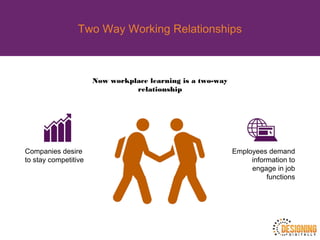
Two Way Working Relationships
Now workplace learning is a two-way
relationship
Companies desire
to stay competitive
Employees demand
information to
engage in job
functions
Key Topics to be Covered:
Mobile Technology
Adoption of Social Learning Tools
Alignment with Corporate Objectives
Use of Adaptive Learning Principles Ability
to Measure Effectiveness
Discussion will also include short
and long term approaches to the
following as they apply to the
workplace:
Virtual Reality
Gamification
Serious Games
Augmented Reality
Workplace Learning
During this session we will discuss the best
practices that companies should consider.
This session will talk about planning, developing,
implementing, and supporting the future of workplace
learning to assist companies by making sure they do
not end up behind the innovation curve.
The Future of Learning Is Here
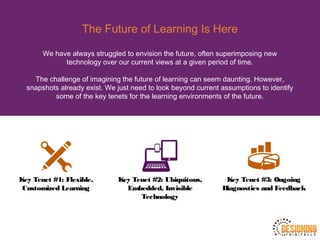
We have always struggled to envision the future, often superimposing new
technology over our current views at a given period of time.
The challenge of imagining the future of learning can seem daunting. However,
snapshots already exist. We just need to look beyond current assumptions to identify
some of the key tenets for the learning environments of the future.
Key Tenet #1: Flexible,
Customized Learning
Key Tenet #2: Ubiquitous,
Embedded, Invisible
Technology
Key Tenet #3: Ongoing
Diagnostics and Feedback
The Future of Learning is Here
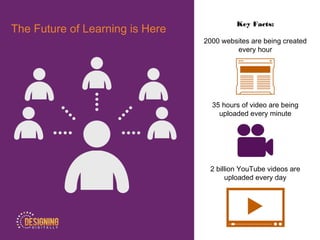
Key Facts:
2000 websites are being created
every hour
35 hours of video are being
uploaded every minute
2 billion YouTube videos are
uploaded every day
The Future of Learning is Here
Did You Know?
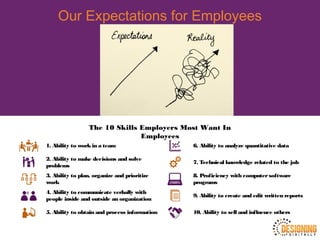
Our Expectations for Employees
The 10 Skills Employers Most Want In
Employees
1. Ability to workin a team 6. Ability to analyze quantitative data
2. Ability to make decisions and solve
problems
7. Technical knowledge related to the job
3. Ability to plan, organize and prioritize
work
8. Proficiency with computersoftware
programs
4. Ability to communicate verbally with
people inside and outside an organization
9. Ability to create and edit written reports
5. Ability to obtain and process information 10. Ability to sell and influence others
What Will Help Us?
Assassins Creed – American Revolutionary War
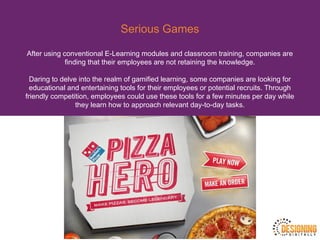
Serious Games
After using conventional E-Learning modules and classroom training, companies are
finding that their employees are not retaining the knowledge.
Daring to delve into the realm of gamified learning, some companies are looking for
educational and entertaining tools for their employees or potential recruits. Through
friendly competition, employees could use these tools for a few minutes per day while
they learn how to approach relevant day-to-day tasks.
Dominos Pizza Hero
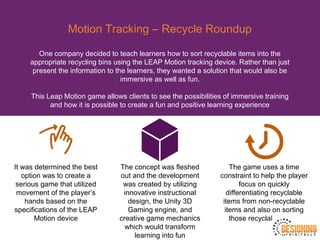
Motion Tracking – Recycle Roundup
One company decided to teach learners how to sort recyclable items into the
appropriate recycling bins using the LEAP Motion tracking device. Rather than just
present the information to the learners, they wanted a solution that would also be
immersive as well as fun.
This Leap Motion game allows clients to see the possibilities of immersive training
and how it is possible to create a fun and positive learning experience
It was determined the best
option was to create a
serious game that utilized
movement of the player’s
hands based on the
specifications of the LEAP
Motion device
The concept was fleshed
out and the development
was created by utilizing
innovative instructional
design, the Unity 3D
Gaming engine, and
creative game mechanics
which would transform
learning into fun
The game uses a time
constraint to help the player
focus on quickly
differentiating recyclable
items from non-recyclable
items and also on sorting
those recyclable items
Recycle Round Up
VOTA –Virtual Occupation Therapy Assistant
Virtual Touch Screens
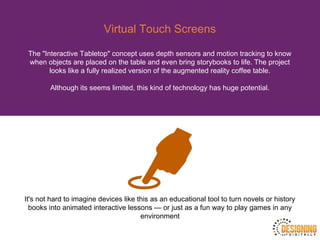
The "Interactive Tabletop" concept uses depth sensors and motion tracking to know
when objects are placed on the table and even bring storybooks to life. The project
looks like a fully realized version of the augmented reality coffee table.
Although its seems limited, this kind of technology has huge potential.
It's not hard to imagine devices like this as an educational tool to turn novels or history
books into animated interactive lessons — or just as a fun way to play games in any
environment
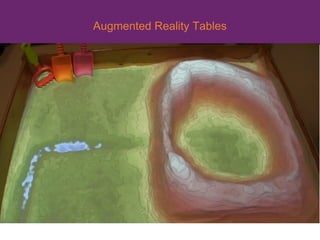
Augmented Reality Tables
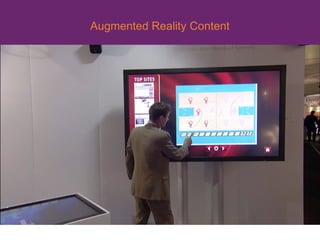
Augmented Reality Content
Virtual Reality
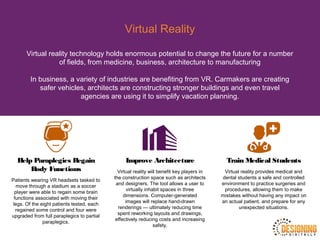
Virtual reality technology holds enormous potential to change the future for a number
of fields, from medicine, business, architecture to manufacturing
In business, a variety of industries are benefiting from VR. Carmakers are creating
safer vehicles, architects are constructing stronger buildings and even travel
agencies are using it to simplify vacation planning.
Help Paraplegics Regain
Body Functions
Patients wearing VR headsets tasked to
move through a stadium as a soccer
player were able to regain some brain
functions associated with moving their
legs. Of the eight patients tested, each
regained some control and four were
upgraded from full paraplegics to partial
paraplegics.
Improve Architecture
Virtual reality will benefit key players in
the construction space such as architects
and designers. The tool allows a user to
virtually inhabit spaces in three
dimensions. Computer-generated
images will replace hand-drawn
renderings — ultimately reducing time
spent reworking layouts and drawings,
effectively reducing costs and increasing
safety.
Train Medical Students
Virtual reality provides medical and
dental students a safe and controlled
environment to practice surgeries and
procedures, allowing them to make
mistakes without having any impact on
an actual patient, and prepare for any
unexpected situations.
Virtual Reality – Coral Reef
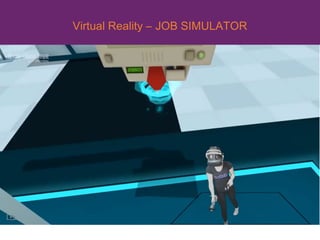
Virtual Reality – JOB SIMULATOR
Virtual Reality – CHOP & DROP
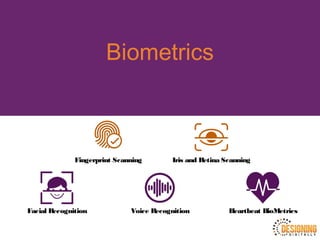
Biometrics
Facial Recognition Voice Recognition Heartbeat BioMetrics
Fingerprint Scanning Iris and Retina Scanning
Bio-Metrics & Augmented Reality
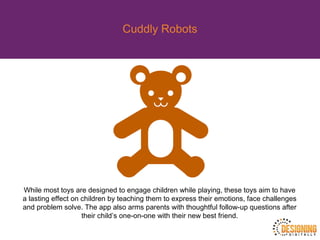
Cuddly Robots
While most toys are designed to engage children while playing, these toys aim to have
a lasting effect on children by teaching them to express their emotions, face challenges
and problem solve. The app also arms parents with thoughtful follow-up questions after
their child’s one-on-one with their new best friend.
POVI
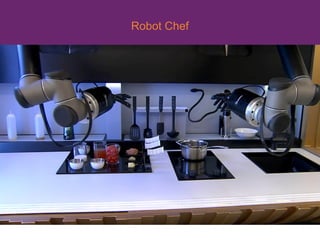
Robot Chef
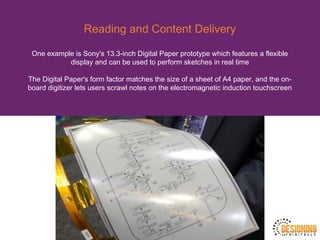
Reading and Content Delivery
One example is Sony's 13.3-inch Digital Paper prototype which features a flexible
display and can be used to perform sketches in real time
The Digital Paper's form factor matches the size of a sheet of A4 paper, and the on-
board digitizer lets users scrawl notes on the electromagnetic induction touchscreen
Reading & Content Delivery
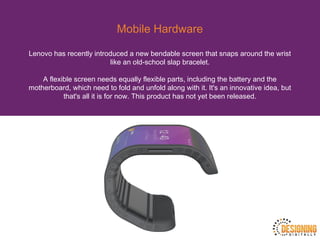
Mobile Hardware
Lenovo has recently introduced a new bendable screen that snaps around the wrist
like an old-school slap bracelet.
A flexible screen needs equally flexible parts, including the battery and the
motherboard, which need to fold and unfold along with it. It's an innovative idea, but
that's all it is for now. This product has not yet been released.
Wearable Hardware: GEST
Wearable Hardware: Athos
Wearable Hardware: VUFINE
Mobile Hardware in the Future
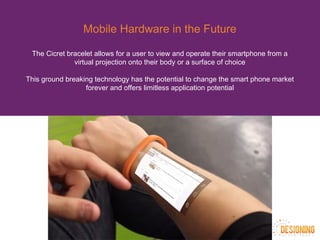
The Cicret bracelet allows for a user to view and operate their smartphone from a
virtual projection onto their body or a surface of choice
This ground breaking technology has the potential to change the smart phone market
forever and offers limitless application potential
Wearable Hardware: : CIRCRET Bracelet
5 Microlearning
Commandments:
Assign One Learning Objective
Per Asset
Use Video
Production Quality Matters
Timing is Everything
Prove Learning Took Place
What do We do to help the
Future?
Micro-learning
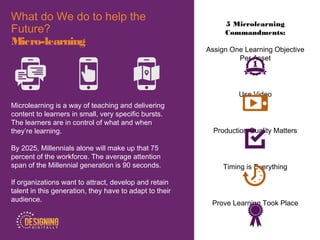
Microlearning is a way of teaching and delivering
content to learners in small, very specific bursts.
The learners are in control of what and when
they’re learning.
By 2025, Millennials alone will make up that 75
percent of the workforce. The average attention
span of the Millennial generation is 90 seconds.
If organizations want to attract, develop and retain
talent in this generation, they have to adapt to their
audience.
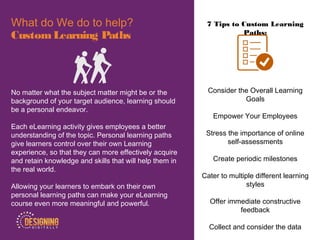
7 Tips to Custom Learning
Paths:
Consider the Overall Learning
Goals
Empower Your Employees
Stress the importance of online
self-assessments
Create periodic milestones
Cater to multiple different learning
styles
Offer immediate constructive
feedback
Collect and consider the data
What do We do to help?
CustomLearning Paths
No matter what the subject matter might be or the
background of your target audience, learning should
be a personal endeavor.
Each eLearning activity gives employees a better
understanding of the topic. Personal learning paths
give learners control over their own Learning
experience, so that they can more effectively acquire
and retain knowledge and skills that will help them in
the real world.
Allowing your learners to embark on their own
personal learning paths can make your eLearning
course even more meaningful and powerful.
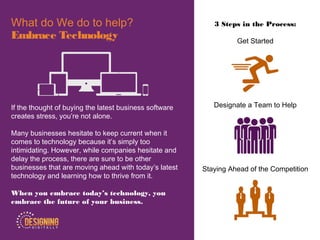
3 Steps in the Process:
Get Started
Designate a Team to Help
Staying Ahead of the Competition
What do We do to help?
Embrace Technology
If the thought of buying the latest business software
creates stress, you’re not alone.
Many businesses hesitate to keep current when it
comes to technology because it’s simply too
intimidating. However, while companies hesitate and
delay the process, there are sure to be other
businesses that are moving ahead with today’s latest
technology and learning how to thrive from it.
When you embrace today’s technology, you
embrace the future of your business.
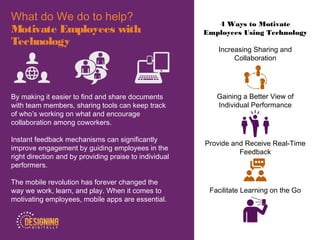
4 Ways to Motivate
Employees Using Technology
Increasing Sharing and
Collaboration
Gaining a Better View of
Individual Performance
Provide and Receive Real-Time
Feedback
Facilitate Learning on the Go
What do We do to help?
Motivate Employees with
Technology
By making it easier to find and share documents
with team members, sharing tools can keep track
of who’s working on what and encourage
collaboration among coworkers.
Instant feedback mechanisms can significantly
improve engagement by guiding employees in the
right direction and by providing praise to individual
performers.
The mobile revolution has forever changed the
way we work, learn, and play. When it comes to
motivating employees, mobile apps are essential.
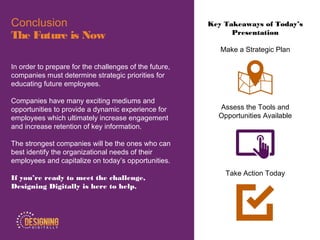
Key Takeaways of Today’s
Presentation
Make a Strategic Plan
Assess the Tools and
Opportunities Available
Take Action Today
Conclusion
The Future is Now
In order to prepare for the challenges of the future,
companies must determine strategic priorities for
educating future employees.
Companies have many exciting mediums and
opportunities to provide a dynamic experience for
employees which ultimately increase engagement
and increase retention of key information.
The strongest companies will be the ones who can
best identify the organizational needs of their
employees and capitalize on today’s opportunities.
If you’re ready to meet the challenge,
Designing Digitally is here to help.
Member of the Better Business Bureau with an A+ rating
General Service Administration (GSA) MOBIS Contract Holder
8401 Claude Thomas Road, Suite 30, Franklin, Ohio 45005 | 866.316.9126 | info@designingdigitally.com | www.designingdigitally.com
Andrew Hughes
President / Professor
Designing Digitally, Inc.
Andrew.hughes@designingdigitally.com
1-866-316-9126
Member of the Better Business Bureau with an A+ rating
General Service Administration (GSA) MOBIS Contract Holder
8401 Claude Thomas Road, Suite 30, Franklin, Ohio 45005 | 866.316.9126 | info@designingdigitally.com | www.designingdigitally.com

Immersive Learning and the Future of Workplace Learning

  • 1.
    Member of theBetter Business Bureau with an A+ rating General Service Administration (GSA) MOBIS Contract Holder 8401 Claude Thomas Road, Suite 30, Franklin, Ohio 45005 | 866.316.9126 | info@designingdigitally.com | www.designingdigitally.com Immersive Learning and the Future of Workplace Learning
  • 2.
    Two Way WorkingRelationships Now workplace learning is a two-way relationship Companies desire to stay competitive Employees demand information to engage in job functions
  • 3.
    Key Topics tobe Covered: Mobile Technology Adoption of Social Learning Tools Alignment with Corporate Objectives Use of Adaptive Learning Principles Ability to Measure Effectiveness Discussion will also include short and long term approaches to the following as they apply to the workplace: Virtual Reality Gamification Serious Games Augmented Reality Workplace Learning During this session we will discuss the best practices that companies should consider. This session will talk about planning, developing, implementing, and supporting the future of workplace learning to assist companies by making sure they do not end up behind the innovation curve.
  • 4.
    The Future ofLearning Is Here We have always struggled to envision the future, often superimposing new technology over our current views at a given period of time. The challenge of imagining the future of learning can seem daunting. However, snapshots already exist. We just need to look beyond current assumptions to identify some of the key tenets for the learning environments of the future. Key Tenet #1: Flexible, Customized Learning Key Tenet #2: Ubiquitous, Embedded, Invisible Technology Key Tenet #3: Ongoing Diagnostics and Feedback
  • 5.
    The Future ofLearning is Here
  • 6.
    The Future ofLearning is Here
  • 7.
    Key Facts: 2000 websitesare being created every hour 35 hours of video are being uploaded every minute 2 billion YouTube videos are uploaded every day The Future of Learning is Here
  • 8.
  • 9.
    Our Expectations forEmployees The 10 Skills Employers Most Want In Employees 1. Ability to workin a team 6. Ability to analyze quantitative data 2. Ability to make decisions and solve problems 7. Technical knowledge related to the job 3. Ability to plan, organize and prioritize work 8. Proficiency with computersoftware programs 4. Ability to communicate verbally with people inside and outside an organization 9. Ability to create and edit written reports 5. Ability to obtain and process information 10. Ability to sell and influence others
  • 10.
  • 11.
    Assassins Creed –American Revolutionary War
  • 12.
    Serious Games After usingconventional E-Learning modules and classroom training, companies are finding that their employees are not retaining the knowledge. Daring to delve into the realm of gamified learning, some companies are looking for educational and entertaining tools for their employees or potential recruits. Through friendly competition, employees could use these tools for a few minutes per day while they learn how to approach relevant day-to-day tasks.
  • 13.
  • 14.
    Motion Tracking –Recycle Roundup One company decided to teach learners how to sort recyclable items into the appropriate recycling bins using the LEAP Motion tracking device. Rather than just present the information to the learners, they wanted a solution that would also be immersive as well as fun. This Leap Motion game allows clients to see the possibilities of immersive training and how it is possible to create a fun and positive learning experience It was determined the best option was to create a serious game that utilized movement of the player’s hands based on the specifications of the LEAP Motion device The concept was fleshed out and the development was created by utilizing innovative instructional design, the Unity 3D Gaming engine, and creative game mechanics which would transform learning into fun The game uses a time constraint to help the player focus on quickly differentiating recyclable items from non-recyclable items and also on sorting those recyclable items
  • 15.
  • 16.
    VOTA –Virtual OccupationTherapy Assistant
  • 17.
    Virtual Touch Screens The"Interactive Tabletop" concept uses depth sensors and motion tracking to know when objects are placed on the table and even bring storybooks to life. The project looks like a fully realized version of the augmented reality coffee table. Although its seems limited, this kind of technology has huge potential. It's not hard to imagine devices like this as an educational tool to turn novels or history books into animated interactive lessons — or just as a fun way to play games in any environment
  • 18.
  • 19.
  • 20.
    Virtual Reality Virtual realitytechnology holds enormous potential to change the future for a number of fields, from medicine, business, architecture to manufacturing In business, a variety of industries are benefiting from VR. Carmakers are creating safer vehicles, architects are constructing stronger buildings and even travel agencies are using it to simplify vacation planning. Help Paraplegics Regain Body Functions Patients wearing VR headsets tasked to move through a stadium as a soccer player were able to regain some brain functions associated with moving their legs. Of the eight patients tested, each regained some control and four were upgraded from full paraplegics to partial paraplegics. Improve Architecture Virtual reality will benefit key players in the construction space such as architects and designers. The tool allows a user to virtually inhabit spaces in three dimensions. Computer-generated images will replace hand-drawn renderings — ultimately reducing time spent reworking layouts and drawings, effectively reducing costs and increasing safety. Train Medical Students Virtual reality provides medical and dental students a safe and controlled environment to practice surgeries and procedures, allowing them to make mistakes without having any impact on an actual patient, and prepare for any unexpected situations.
  • 21.
  • 22.
    Virtual Reality –JOB SIMULATOR
  • 23.
  • 24.
    Biometrics Facial Recognition VoiceRecognition Heartbeat BioMetrics Fingerprint Scanning Iris and Retina Scanning
  • 25.
  • 26.
  • 27.
    Cuddly Robots While mosttoys are designed to engage children while playing, these toys aim to have a lasting effect on children by teaching them to express their emotions, face challenges and problem solve. The app also arms parents with thoughtful follow-up questions after their child’s one-on-one with their new best friend.
  • 28.
  • 29.
  • 30.
    Reading and ContentDelivery One example is Sony's 13.3-inch Digital Paper prototype which features a flexible display and can be used to perform sketches in real time The Digital Paper's form factor matches the size of a sheet of A4 paper, and the on- board digitizer lets users scrawl notes on the electromagnetic induction touchscreen
  • 31.
  • 32.
    Mobile Hardware Lenovo hasrecently introduced a new bendable screen that snaps around the wrist like an old-school slap bracelet. A flexible screen needs equally flexible parts, including the battery and the motherboard, which need to fold and unfold along with it. It's an innovative idea, but that's all it is for now. This product has not yet been released.
  • 33.
  • 34.
  • 35.
  • 36.
    Mobile Hardware inthe Future The Cicret bracelet allows for a user to view and operate their smartphone from a virtual projection onto their body or a surface of choice This ground breaking technology has the potential to change the smart phone market forever and offers limitless application potential
  • 37.
    Wearable Hardware: :CIRCRET Bracelet
  • 38.
    5 Microlearning Commandments: Assign OneLearning Objective Per Asset Use Video Production Quality Matters Timing is Everything Prove Learning Took Place What do We do to help the Future? Micro-learning Microlearning is a way of teaching and delivering content to learners in small, very specific bursts. The learners are in control of what and when they’re learning. By 2025, Millennials alone will make up that 75 percent of the workforce. The average attention span of the Millennial generation is 90 seconds. If organizations want to attract, develop and retain talent in this generation, they have to adapt to their audience.
  • 39.
    7 Tips toCustom Learning Paths: Consider the Overall Learning Goals Empower Your Employees Stress the importance of online self-assessments Create periodic milestones Cater to multiple different learning styles Offer immediate constructive feedback Collect and consider the data What do We do to help? CustomLearning Paths No matter what the subject matter might be or the background of your target audience, learning should be a personal endeavor. Each eLearning activity gives employees a better understanding of the topic. Personal learning paths give learners control over their own Learning experience, so that they can more effectively acquire and retain knowledge and skills that will help them in the real world. Allowing your learners to embark on their own personal learning paths can make your eLearning course even more meaningful and powerful.
  • 40.
    3 Steps inthe Process: Get Started Designate a Team to Help Staying Ahead of the Competition What do We do to help? Embrace Technology If the thought of buying the latest business software creates stress, you’re not alone. Many businesses hesitate to keep current when it comes to technology because it’s simply too intimidating. However, while companies hesitate and delay the process, there are sure to be other businesses that are moving ahead with today’s latest technology and learning how to thrive from it. When you embrace today’s technology, you embrace the future of your business.
  • 41.
    4 Ways toMotivate Employees Using Technology Increasing Sharing and Collaboration Gaining a Better View of Individual Performance Provide and Receive Real-Time Feedback Facilitate Learning on the Go What do We do to help? Motivate Employees with Technology By making it easier to find and share documents with team members, sharing tools can keep track of who’s working on what and encourage collaboration among coworkers. Instant feedback mechanisms can significantly improve engagement by guiding employees in the right direction and by providing praise to individual performers. The mobile revolution has forever changed the way we work, learn, and play. When it comes to motivating employees, mobile apps are essential.
  • 42.
    Key Takeaways ofToday’s Presentation Make a Strategic Plan Assess the Tools and Opportunities Available Take Action Today Conclusion The Future is Now In order to prepare for the challenges of the future, companies must determine strategic priorities for educating future employees. Companies have many exciting mediums and opportunities to provide a dynamic experience for employees which ultimately increase engagement and increase retention of key information. The strongest companies will be the ones who can best identify the organizational needs of their employees and capitalize on today’s opportunities. If you’re ready to meet the challenge, Designing Digitally is here to help.
  • 43.
    Member of theBetter Business Bureau with an A+ rating General Service Administration (GSA) MOBIS Contract Holder 8401 Claude Thomas Road, Suite 30, Franklin, Ohio 45005 | 866.316.9126 | info@designingdigitally.com | www.designingdigitally.com Andrew Hughes President / Professor Designing Digitally, Inc. Andrew.hughes@designingdigitally.com 1-866-316-9126
  • 44.
    Member of theBetter Business Bureau with an A+ rating General Service Administration (GSA) MOBIS Contract Holder 8401 Claude Thomas Road, Suite 30, Franklin, Ohio 45005 | 866.316.9126 | info@designingdigitally.com | www.designingdigitally.com

Editor's Notes

  • #2 By 2025, Millennials alone will make up that 75 percent of the workforce. The average attention span of the Millennial generation is 90 seconds.
  • #3 The days when employers could dictate messages and working practices to employees are long gone. With the struggle for competitive advantage set to continue throughout the age for business, it pays dividends to create a flexible and technology-enabled learning ecosystem that can foster the future generations in the workforce.
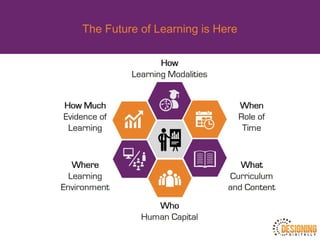
  • #5 #1 - Given the capabilities afforded by new technologies, especially mobile devices, learning no longer needs to be fixed and structured in one place. In the future, students will enter the room each day and then configure their space to fit their intellectual stature. 2. Learning will be completely supported and infused with technology. Seamlessly, tools and apps will buttress the ways in which students consume course content, create artifacts and evidence of their learning. 3. Learning plans could be adapted to align with the learning status of each student. Rather than developing their curriculum in isolation, teachers could take time to collaborate with colleagues to create customized, flexible learning plans.
  • #6 We have always embraced the future and ideas about what the future may hold. In order for organizations to meet the challenges of the future, it is necessary to begin with education and how learning is conducted. By designing the right educational systems we could create resource-rich, student-centric, active learning environments for our students.
  • #7 We have always embraced the future and ideas about what the future may hold. In order for organizations to meet the challenges of the future, it is necessary to begin with education and how learning is conducted. By designing the right educational systems we could create resource-rich, student-centric, active learning environments for our students.
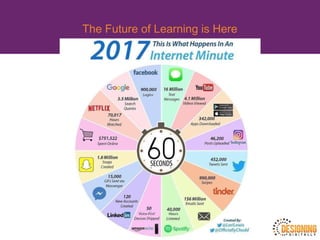
  • #8 The pace of change in today’s word is astounding with more content being produced than ever before. People are consuming, producing, and communicating information in previously unimaginable ways. To be competitive, tomorrow's workers must be more creative problem solvers, better communicators, and life-long learners.
  • #10 Employers want universal skills that cut across academic disciplines and are acquired in any job where employees are working with others. Despite all the emphasis in the news about the need for computer software and programming skills, the most important qualities employers seek are basic teamwork, problem-solving and the ability to plan and prioritize.
  • #11 Employers want universal skills that cut across academic disciplines and are acquired in any job where employees are working with others. Despite all the emphasis in the news about the need for computer software and programming skills, the most important qualities employers seek are basic teamwork, problem-solving and the ability to plan and prioritize.
  • #21 In business, a variety of industries are benefiting from VR. Carmakers are creating safer vehicles, architects are constructing stronger buildings and even travel agencies are using it to simplify vacation planning.
  • #25 Biometrics is a form of user identification and access control that uses physiological attributes such as a person’s fingerprints, face and retina in order to identify users. Biometrics can also identify users based on certain behavioral tendencies. With increasingly more sensitive and personal information being stored on devices nowadays, biometric technology has become more and more important for security, and to ensure that this information doesn’t fall into the wrong hands.
  • #28 With an overwhelming growth of screens and devices surrounding us today, many children born into this computing generation are remarkably tech savvy, but at the cost of learned communication To address this issue, there are soft dolls that bundle an ‘emotional intelligence content platform’ to deliver thousands of stories and hours of conversational recordings, all stored within the toy for offline use