Impression Techniques
in Implants
Presented by : Dr. Swagata
Laxmi Barua
Preceptor : Dr. Soorya Poduval
Date : 09/12/2021
CONTENTS
❖Introduction
❖Terminologies
❖Classification
❖Immediate implant transfer technique
❖Closed-tray technique
❖Open tray technique
❖Splinted techniques
❖Digital Impression Technique
❖Recent advances
❖Literature Review
❖Summary and Conclusion
❖References
INTRODUCTION
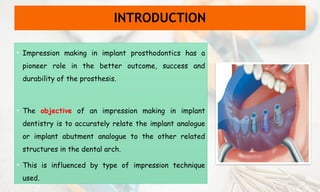
• Impression making in implant prosthodontics has a
pioneer role in the better outcome, success and
durability of the prosthesis.
• The objective of an impression making in implant
dentistry is to accurately relate the implant analogue
or implant abutment analogue to the other related
structures in the dental arch.
• This is influenced by type of impression technique
used.
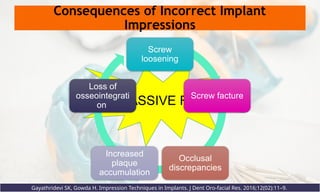
PASSIVE FIT!
Consequences of Incorrect Implant
Impressions
Screw
loosening
Screw facture
Occlusal
discrepancies
Increased
plaque
accumulation
Loss of
osseointegrati
on
Gayathridevi SK, Gowda H. Impression Techniques in Implants. J Dent Oro-facial Res. 2016;12(02):11–9.
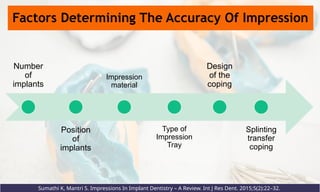
Factors Determining The Accuracy Of Impression
Sumathi K, Mantri S. Impressions In Implant Dentistry – A Review. Int J Res Dent. 2015;5(2):22–32.
Number
of
implants
Position
of
implants
Impression
material
Type of
Impression
Tray
Design
of the
coping
Splinting
transfer
coping
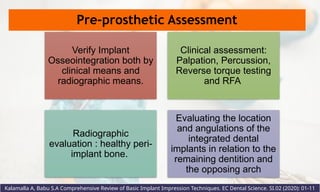
Pre-prosthetic Assessment
Kalamalla A, Babu S.A Comprehensive Review of Basic Implant Impression Techniques. EC Dental Science. SI.02 (2020): 01-11
Verify Implant
Osseointegration both by
clinical means and
radiographic means.
Clinical assessment:
Palpation, Percussion,
Reverse torque testing
and RFA
Radiographic
evaluation : healthy peri-
implant bone.
Evaluating the location
and angulations of the
integrated dental
implants in relation to the
remaining dentition and
the opposing arch
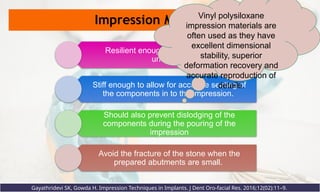
Impression Materials
Resilient enough to spring out of the
undercuts
Stiff enough to allow for accurate seating of
the components in to the impression.
Should also prevent dislodging of the
components during the pouring of the
impression
Avoid the fracture of the stone when the
prepared abutments are small.
Gayathridevi SK, Gowda H. Impression Techniques in Implants. J Dent Oro-facial Res. 2016;12(02):11–9.
Vinyl polysiloxane
impression materials are
often used as they have
excellent dimensional
stability, superior
deformation recovery and
accurate reproduction of
details.
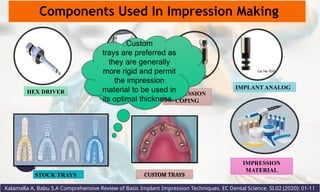
IMPRESSION
COPING
IMPLANT ANALOG
HEX DRIVER
STOCK TRAYS
IMPRESSION
MATERIAL
Components Used In Impression Making
CUSTOM TRAYS
ABUTMENTS
Custom
trays are preferred as
they are generally
more rigid and permit
the impression
material to be used in
its optimal thickness.
Kalamalla A, Babu S.A Comprehensive Review of Basic Implant Impression Techniques. EC Dental Science. SI.02 (2020): 01-11
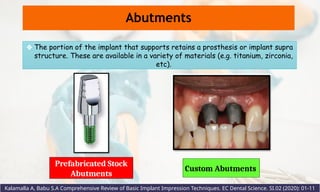
Custom Abutments
Prefabricated Stock
Abutments
Abutments
❖ The portion of the implant that supports retains a prosthesis or implant supra
structure. These are available in a variety of materials (e.g. titanium, zirconia,
etc).
Kalamalla A, Babu S.A Comprehensive Review of Basic Implant Impression Techniques. EC Dental Science. SI.02 (2020): 01-11
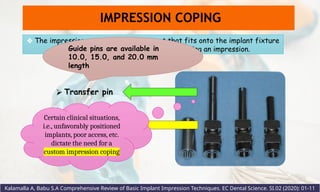
⮚ Transfer post
❖ The impression coping is the component that fits onto the implant fixture
head or an implant abutment while making an impression.
IMPRESSION COPING
⮚ Transfer pin
Certain clinical situations,
i.e., unfavorably positioned
implants, poor access, etc.
dictate the need for a
custom impression coping
Kalamalla A, Babu S.A Comprehensive Review of Basic Implant Impression Techniques. EC Dental Science. SI.02 (2020): 01-11
Guide pins are available in
10.0, 15.0, and 20.0 mm
length
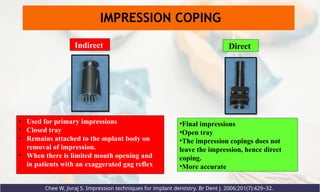
Direct
Indirect
• Used for primary impressions
• Closed tray
• Remains attached to the implant body on
removal of impression.
• When there is limited mouth opening and
in patients with an exaggerated gag reflex
•Final impressions
•Open tray
•The impression copings does not
leave the impression, hence direct
coping.
•More accurate
Chee W, Jivraj S. Impression techniques for implant dentistry. Br Dent J. 2006;201(7):429–32.
IMPRESSION COPING
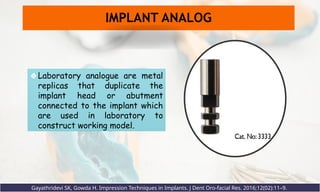
❖Laboratory analogue are metal
replicas that duplicate the
implant head or abutment
connected to the implant which
are used in laboratory to
construct working model.
IMPLANT ANALOG
Gayathridevi SK, Gowda H. Impression Techniques in Implants. J Dent Oro-facial Res. 2016;12(02):11–9.
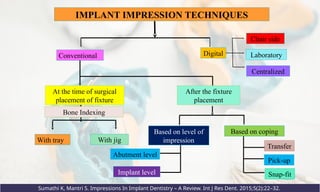
Conventional Digital
Implant level
Abutment level
Transfer
Pick-up
Chair side
Centralized
Laboratory
With tray With jig
Based on coping
Based on level of
impression
IMPLANT IMPRESSION TECHNIQUES
After the fixture
placement
At the time of surgical
placement of fixture
Sumathi K, Mantri S. Impressions In Implant Dentistry – A Review. Int J Res Dent. 2015;5(2):22–32.
Snap-fit
Bone Indexing
Immediate Implant Indexing
IMMEDIATE IMPLANT INDEXING
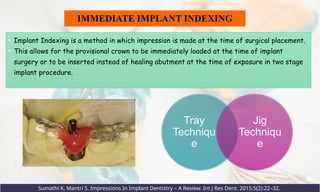
• Implant Indexing is a method in which impression is made at the time of surgical placement.
• This allows for the provisional crown to be immediately loaded at the time of implant
surgery or to be inserted instead of healing abutment at the time of exposure in two stage
implant procedure.
Sumathi K, Mantri S. Impressions In Implant Dentistry – A Review. Int J Res Dent. 2015;5(2):22–32.
Tray
Techniqu
e
Jig
Techniqu
e
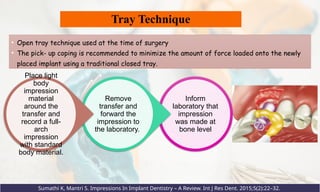
Tray Technique
• Open tray technique used at the time of surgery
• The pick- up coping is recommended to minimize the amount of force loaded onto the newly
placed implant using a traditional closed tray.
Sumathi K, Mantri S. Impressions In Implant Dentistry – A Review. Int J Res Dent. 2015;5(2):22–32.
Inform
laboratory that
impression
was made at
bone level
Remove
transfer and
forward the
impression to
the laboratory.
Place light
body
impression
material
around the
transfer and
record a full-
arch
impression
with standard
body material.
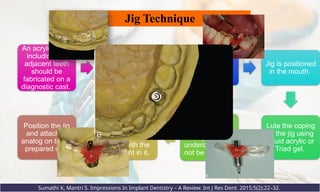
An acrylic splint
including 3-4
adjacent teeth
should be
fabricated on a
diagnostic cast.
Space is
created in the
jig for the future
impression
coping.
After implant
placement,
place the pick-
up coping.
Jig is positioned
in the mouth.
Lute the coping
to the jig using
liquid acrylic or
Triad gel.
Coping screw
should rotate
freely and the
undercut should
not be blocked.
Release the
coping screw
and free the
splint with the
abutment in it.
Position the jig
and attached
analog on to the
prepared cast
Sumathi K, Mantri S. Impressions In Implant Dentistry – A Review. Int J Res Dent. 2015;5(2):22–32.
Jig Technique
ABUTMENT LEVEL
IMPRESSION TECHNIQUES
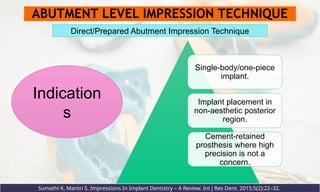
Direct/Prepared Abutment Impression Technique
ABUTMENT LEVEL IMPRESSION TECHNIQUE
Single-body/one-piece
implant.
Implant placement in
non-aesthetic posterior
region.
Cement-retained
prosthesis where high
precision is not a
concern.
Indication
s
Sumathi K, Mantri S. Impressions In Implant Dentistry – A Review. Int J Res Dent. 2015;5(2):22–32.
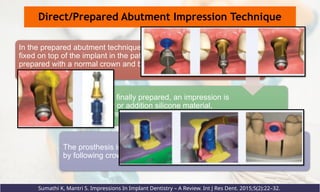
Direct/Prepared Abutment Impression Technique
In the prepared abutment technique, the final abutment is
fixed on top of the implant in the patient’s mouth and
prepared with a normal crown and bridge technique, using
a diamond or carbide bur.
Once the abutment is finally prepared, an impression is
made using polyether or addition silicone material,
poured with a high-strength stone material.
The prosthesis is fabricated and cemented in the mouth
by following crown and bridge technique steps
Sumathi K, Mantri S. Impressions In Implant Dentistry – A Review. Int J Res Dent. 2015;5(2):22–32.
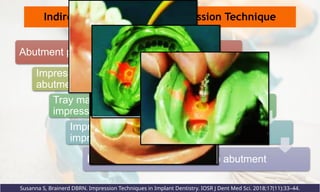
Indirect Abutment Level Impression Technique
Abutment placed at the implant site
Impression cap snapped onto the
abutment
Tray material used to make an
impression
Impression cap picked up by the
impression
Implant analogue attached to abutment
Susanna S, Brainerd DBRN. Impression Techniques in Implant Dentistry. IOSR J Dent Med Sci. 2018;17(11):33–44.
Abutment Level Impression
Simple
provisional
restoration
fabrication
Selecting
abutments in the
laboratory
For custom-made
abutments
Advantag
es
Susanna S, Brainerd DBRN. Impression Techniques in Implant Dentistry. IOSR J Dent Med Sci. 2018;17(11):33–44.
GINGIVAL
RETRACTION?
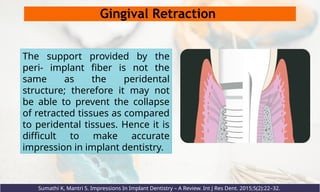
Gingival Retraction
The support provided by the
peri- implant fiber is not the
same as the peridental
structure; therefore it may not
be able to prevent the collapse
of retracted tissues as compared
to peridental tissues. Hence it is
difficult to make accurate
impression in implant dentistry.
Sumathi K, Mantri S. Impressions In Implant Dentistry – A Review. Int J Res Dent. 2015;5(2):22–32.
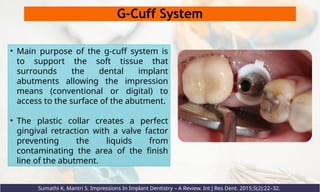
G-Cuff System
• Main purpose of the g-cuff system is
to support the soft tissue that
surrounds the dental implant
abutments allowing the impression
means (conventional or digital) to
access to the surface of the abutment.
• The plastic collar creates a perfect
gingival retraction with a valve factor
preventing the liquids from
contaminating the area of the finish
line of the abutment.
Sumathi K, Mantri S. Impressions In Implant Dentistry – A Review. Int J Res Dent. 2015;5(2):22–32.
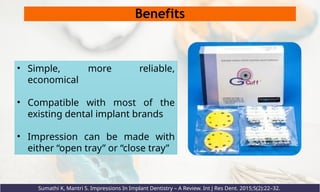
Benefits
• Simple, more reliable,
economical
• Compatible with most of the
existing dental implant brands
• Impression can be made with
either “open tray” or “close tray”
Sumathi K, Mantri S. Impressions In Implant Dentistry – A Review. Int J Res Dent. 2015;5(2):22–32.
IMPLANT LEVEL IMPRESSION
TECHNIQUES
IMPLANT LEVEL IMPRESSION TECHNIQUE
Sumathi K, Mantri S. Impressions In Implant Dentistry – A Review. Int J Res Dent. 2015;5(2):22–32.
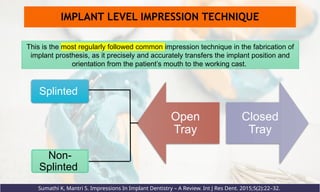
This is the most regularly followed common impression technique in the fabrication of
implant prosthesis, as it precisely and accurately transfers the implant position and
orientation from the patient’s mouth to the working cast.
Open
Tray
Closed
Tray
Splinted
Non-
Splinted
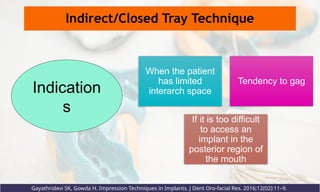
Indirect/Closed Tray Technique
When the patient
has limited
interarch space
Tendency to gag
If it is too difficult
to access an
implant in the
posterior region of
the mouth
Indication
s
Gayathridevi SK, Gowda H. Impression Techniques in Implants. J Dent Oro-facial Res. 2016;12(02):11–9.
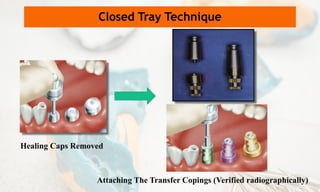
Healing Caps Removed
Closed Tray Technique
Attaching The Transfer Copings (Verified radiographically)
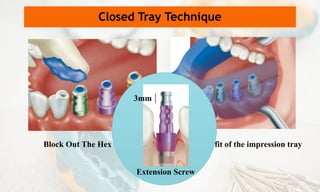
Block Out The Hex Holes
Closed Tray Technique
Verifying the fit of the impression tray
Extension Screw
3mm |
Closed Tray Technique
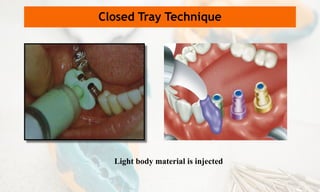
Light body material is injected
Closed Tray Technique
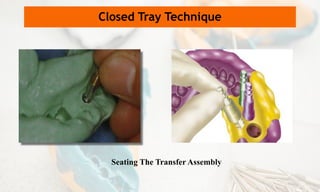
Seating The Transfer Assembly
Closed Tray Technique
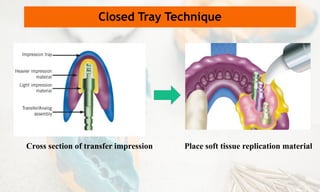
Cross section of transfer impression Place soft tissue replication material
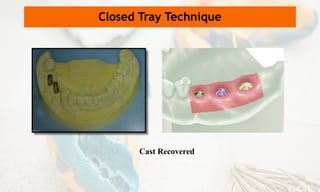
Cast Recovered
Closed Tray Technique
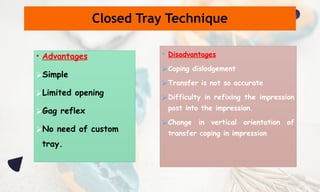
• Advantages
⮚Simple
⮚Limited opening
⮚Gag reflex
⮚No need of custom
tray.
• Disadvantages
⮚Coping dislodgement
⮚Transfer is not so accurate
⮚Difficulty in refixing the impression
post into the impression.
⮚Change in vertical orientation of
transfer coping in impression
Closed Tray Technique
Direct/ Open Tray Technique
Multiple number
of implants
which are not
parallel to each
other.
Full arch implant
supported fixed
prosthesis.
Joint screw-
retained
prosthesis over
multiple
implants.
Deep seated
implants.
Implant
Overdentures
Indication
s
Sumathi K, Mantri S. Impressions In Implant Dentistry – A Review. Int J Res Dent. 2015;5(2):22–32.
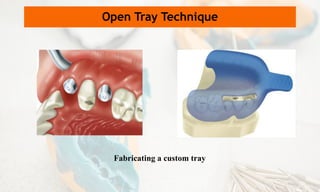
Fabricating a custom tray
Open Tray Technique
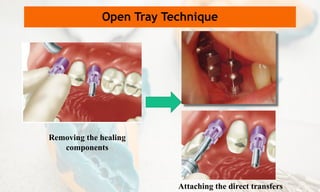
Removing the healing
components
Open Tray Technique
Attaching the direct transfers
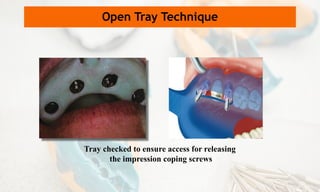
Tray checked to ensure access for releasing
the impression coping screws
Open Tray Technique
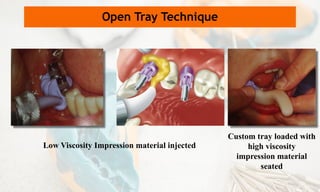
Low Viscosity Impression material injected
Custom tray loaded with
high viscosity
impression material
seated
Open Tray Technique
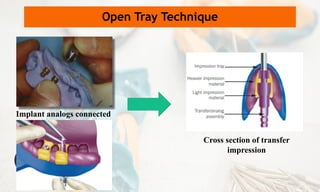
Implant analogs connected
Open Tray Technique
Cross section of transfer
impression
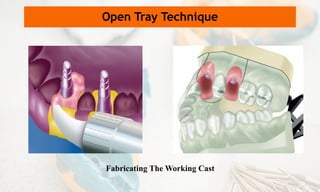
Fabricating The Working Cast
Open Tray Technique
• Advantages
⮚Prosthesis will accurately fit the abutment.
⮚Transfer copings remain in the impression.
⮚Multiple implant cases
⮚Minimum distortion.
⮚ Can contour the provisional prosthesis to
achieve the desired healing and soft tissue
contour before final crown fabrication.
• Disadvantages
⮚ Custom tray with access holes.
⮚ Time consuming.
⮚ The movement of impression
copings inside the impression
material
Open Tray Technique
Gayathridevi SK, Gowda H. Impression Techniques in Implants. J Dent Oro-facial Res. 2016;12(02):11–9.
Splinted Open Tray Technique
Gayathridevi SK, Gowda H. Impression Techniques in Implants. J Dent Oro-facial Res. 2016;12(02):11–9.
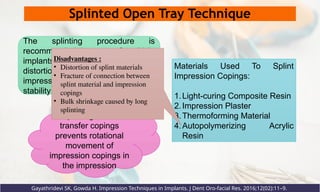
Splinting of the
transfer copings
prevents rotational
movement of
impression copings in
the impression
Materials Used To Splint
Impression Copings:
1.Light-curing Composite Resin
2.Impression Plaster
3.Thermoforming Material
4.Autopolymerizing Acrylic
Resin
The splinting procedure is
recommended in case of multiple
implants to decrease the amount of
distortion and to improve
impression accuracy and implant
stability
Disadvantages :
• Distortion of splint materials
• Fracture of connection between
splint material and impression
copings
• Bulk shrinkage caused by long
splinting
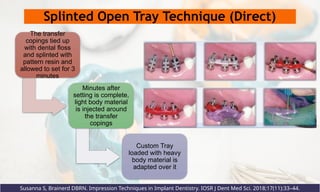
Splinted Open Tray Technique (Direct)
Susanna S, Brainerd DBRN. Impression Techniques in Implant Dentistry. IOSR J Dent Med Sci. 2018;17(11):33–44.
The transfer
copings tied up
with dental floss
and splinted with
pattern resin and
allowed to set for 3
minutes
Minutes after
setting is complete,
light body material
is injected around
the transfer
copings
Custom Tray
loaded with heavy
body material is
adapted over it
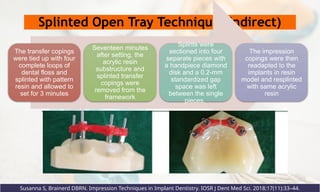
Splinted Open Tray Technique (Indirect)
Susanna S, Brainerd DBRN. Impression Techniques in Implant Dentistry. IOSR J Dent Med Sci. 2018;17(11):33–44.
The transfer copings
were tied up with four
complete loops of
dental floss and
splinted with pattern
resin and allowed to
set for 3 minutes
Seventeen minutes
after setting, the
acrylic resin
substructure and
splinted transfer
copings were
removed from the
framework
Splints were
sectioned into four
separate pieces with
a handpiece diamond
disk and a 0.2-mm
standardized gap
space was left
between the single
pieces.
The impression
copings were then
readapted to the
implants in resin
model and resplinted
with same acrylic
resin
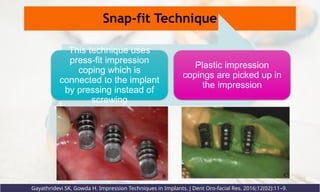
Snap-fit Technique
This technique uses
press-fit impression
coping which is
connected to the implant
by pressing instead of
screwing
Plastic impression
copings are picked up in
the impression
Gayathridevi SK, Gowda H. Impression Techniques in Implants. J Dent Oro-facial Res. 2016;12(02):11–9.
Snap-Fit Technique
Helps to overcome
the movement of
impression coping
inside the
impression
material
Time saving
Has the advantage
of both the open
and closed tray
implant impression
techniques
More comfortable
for both the
clinician and the
patient
Easy to
manipulate
Advantag
es
Gayathridevi SK, Gowda H. Impression Techniques in Implants. J Dent Oro-facial Res. 2016;12(02):11–9.
Soft Tissue Contours
Replication
Soft Tissue Contours Replication
Chee W, Jivraj S. Impression techniques for implant dentistry. Br Dent J. 2006;201(7):429–32.
1. Fabricating a custom impression coping which is adapted
to the soft tissue contours
2. Replacing the provisional restoration on the master cast
and forming the soft tissue around the sub mucosal areas of
the provisional restoration
3. Incorporating the provisional restoration into the
impression.
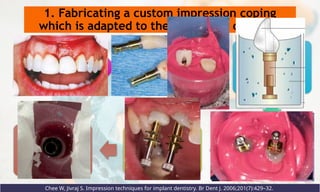
1. Fabricating a custom impression coping
which is adapted to the soft tissue contours
Chee W, Jivraj S. Impression techniques for implant dentistry. Br Dent J. 2006;201(7):429–32.
Provisional
restoration screw
retained on
uncovering
implants
Attach an
analogue to the
provisional
restoration
Place some
impression
material around
the sub mucosal
portion of the
provisional
restoration.
The space around
the customized
impression coping
is filled with acrylic
resin.
The customized
impression coping
is then used in the
impression making
process.
A cast is produced
with the implant
position and soft
tissue representing
the intra oral
condition
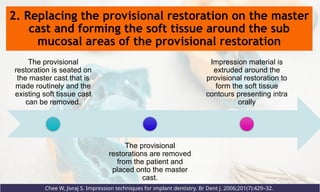
2. Replacing the provisional restoration on the master
cast and forming the soft tissue around the sub
mucosal areas of the provisional restoration
Chee W, Jivraj S. Impression techniques for implant dentistry. Br Dent J. 2006;201(7):429–32.
The provisional
restoration is seated on
the master cast that is
made routinely and the
existing soft tissue cast
can be removed.
The provisional
restorations are removed
from the patient and
placed onto the master
cast.
Impression material is
extruded around the
provisional restoration to
form the soft tissue
contours presenting intra
orally
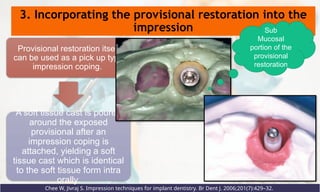
3. Incorporating the provisional restoration into the
impression
Chee W, Jivraj S. Impression techniques for implant dentistry. Br Dent J. 2006;201(7):429–32.
Provisional restoration itself
can be used as a pick up type
impression coping.
A soft tissue cast is poured
around the exposed
provisional after an
impression coping is
attached, yielding a soft
tissue cast which is identical
to the soft tissue form intra
orally.
Sub
Mucosal
portion of the
provisional
restoration
DIGITAL IMPLANT
IMPRESSIONS
Digital Implant Impression
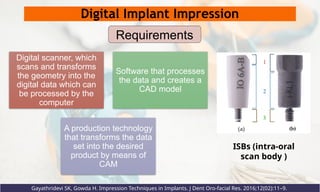
Digital scanner, which
scans and transforms
the geometry into the
digital data which can
be processed by the
computer
Software that processes
the data and creates a
CAD model
A production technology
that transforms the data
set into the desired
product by means of
CAM
Requirements
Gayathridevi SK, Gowda H. Impression Techniques in Implants. J Dent Oro-facial Res. 2016;12(02):11–9.
ISBs (intra-oral
scan body )
Digital Implant Impression
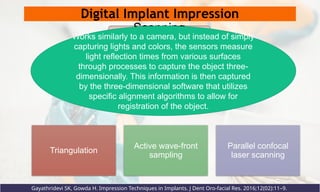
Triangulation
Active wave-front
sampling
Parallel confocal
laser scanning
Scanning
Principle
Gayathridevi SK, Gowda H. Impression Techniques in Implants. J Dent Oro-facial Res. 2016;12(02):11–9.
Works similarly to a camera, but instead of simply
capturing lights and colors, the sensors measure
light reflection times from various surfaces
through processes to capture the object three-
dimensionally. This information is then captured
by the three-dimensional software that utilizes
specific alignment algorithms to allow for
registration of the object.
Digital Implant Impression
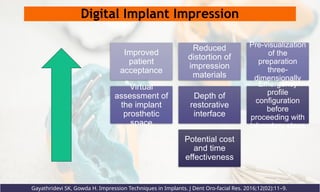
Improved
patient
acceptance
Reduced
distortion of
impression
materials
Pre-visualization
of the
preparation
three-
dimensionally
Virtual
assessment of
the implant
prosthetic
space
Depth of
restorative
interface
Emergency
profile
configuration
before
proceeding with
laboratory steps
Potential cost
and time
effectiveness
Gayathridevi SK, Gowda H. Impression Techniques in Implants. J Dent Oro-facial Res. 2016;12(02):11–9.
Digital Implant Impression
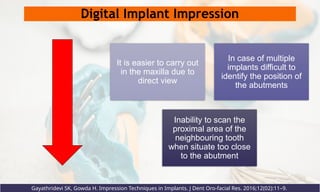
It is easier to carry out
in the maxilla due to
direct view
In case of multiple
implants difficult to
identify the position of
the abutments
Inability to scan the
proximal area of the
neighbouring tooth
when situate too close
to the abutment
Gayathridevi SK, Gowda H. Impression Techniques in Implants. J Dent Oro-facial Res. 2016;12(02):11–9.
Digital Implant Impression
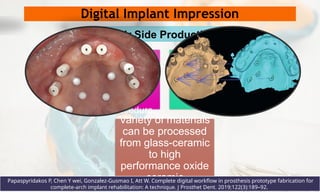
All the components
are available at the
chair side and thus
dental restoration
fabrication takes
place without a
laboratory procedure.
The intra oral
digital scanner
registers the
clinical situation
Variety of materials
can be processed
from glass-ceramic
to high
performance oxide
ceramic
Papaspyridakos P, Chen Y wei, Gonzalez-Gusmao I, Att W. Complete digital workflow in prosthesis prototype fabrication for
complete-arch implant rehabilitation: A technique. J Prosthet Dent. 2019;122(3):189–92.
Chair Side Production
Digital Implant Impression
The first step is similar to
the traditional FPD
impression.
The dentist sends the
impression to the
laboratory and the master
cast is scanned to obtain
the 3-dimensional data.
The CAD process data
will be sent to a special
milling devices and that
produces the real
geometry in the dental
laboratory.
Gayathridevi SK, Gowda H. Impression Techniques in Implants. J Dent Oro-facial Res. 2016;12(02):11–9.
Laboratory Production
Digital Implant Impression
In this, the prosthesis is
fabricated in a milling
centre.
The satellite scanner in
the laboratory is
connected with a
production centre via the
internet.
Data collected in the
laboratory are sent to the
production centre for the
fabrication of prosthesis
with a CAD/CAM device.
The benefit of this system
is only small investment
needed for the CAD
system and high quality
production obtained from
the centre.
Gayathridevi SK, Gowda H. Impression Techniques in Implants. J Dent Oro-facial Res. 2016;12(02):11–9.
Centralized Production
LITERATURE REVIEW
If three or fewer implants, there was no difference
between an open tray and closed tray approach. However,
if there were four or more implants, impressions appeared
more accurate with an open tray technique
Lee H., et al. “The accuracy of implant impressions: a systematic review”.
Journal of Prosthetic Dentistry 100.4 (2008): 285-291.
It has been shown that the pick up type impression coping is the
more accurate type of impression as errors occur on removal
and replacement of the transfer type impression copings,
especially in the occluso-gingival direction are minimum. [Liou
A D, Nicholls J I, Yuodelis R Aet al 2003]
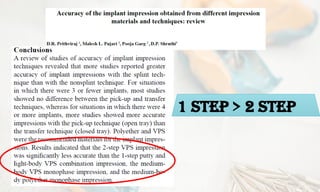
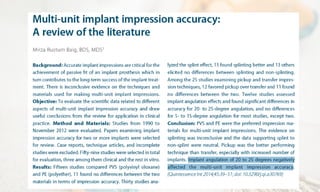
1 Step > 2 Step
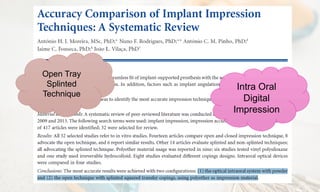
Open Tray
Splinted
Technique
Intra Oral
Digital
Impression
RECENT ADVANCES
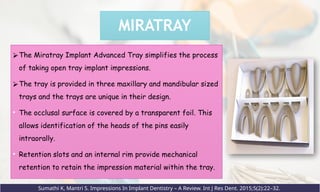
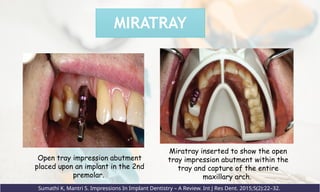
MIRATRAY
⮚The Miratray Implant Advanced Tray simplifies the process
of taking open tray implant impressions.
⮚The tray is provided in three maxillary and mandibular sized
trays and the trays are unique in their design.
• The occlusal surface is covered by a transparent foil. This
allows identification of the heads of the pins easily
intraorally.
• Retention slots and an internal rim provide mechanical
retention to retain the impression material within the tray.
Sumathi K, Mantri S. Impressions In Implant Dentistry – A Review. Int J Res Dent. 2015;5(2):22–32.
MIRATRAY
Open tray impression abutment
placed upon an implant in the 2nd
premolar.
Miratray inserted to show the open
tray impression abutment within the
tray and capture of the entire
maxillary arch.
Sumathi K, Mantri S. Impressions In Implant Dentistry – A Review. Int J Res Dent. 2015;5(2):22–32.
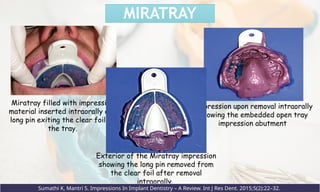
MIRATRAY
Miratray filled with impression
material inserted intraorally and
long pin exiting the clear foil of
the tray.
Impression upon removal intraorally
showing the embedded open tray
impression abutment
Exterior of the Miratray impression
showing the long pin removed from
the clear foil after removal
intraorally.
Sumathi K, Mantri S. Impressions In Implant Dentistry – A Review. Int J Res Dent. 2015;5(2):22–32.
BITE IMPRESSION COPING (CWM)
SUMMARY
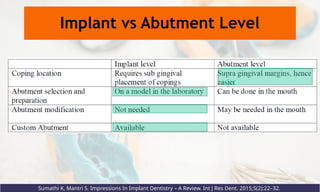
Implant vs Abutment Level
Sumathi K, Mantri S. Impressions In Implant Dentistry – A Review. Int J Res Dent. 2015;5(2):22–32.
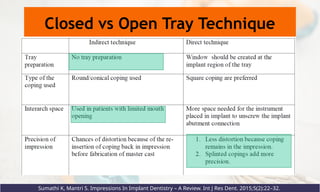
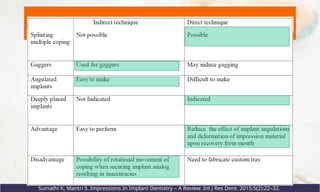
Closed vs Open Tray Technique
Sumathi K, Mantri S. Impressions In Implant Dentistry – A Review. Int J Res Dent. 2015;5(2):22–32.
Closed vs Open Tray Technique
Sumathi K, Mantri S. Impressions In Implant Dentistry – A Review. Int J Res Dent. 2015;5(2):22–32.
CONCLUSION
The best and accurate impression will lead to
the passive casting and accuracy in the
prosthesis.
Different techniques are available in the
literature. No one technique is suitable for all
the cases.
Hence the technique should be selected
according to the individual case.
REFERENCES
• Carl E. Misch - Dental implant prosthetics. Elsevier Mosby, China, 2005.
• Carl E. Misch Contemporary Implant Dentistry, 2nd
edition Mosby, 1993.
• Gayathridevi SK, Gowda H. Impression Techniques in Implants. J Dent Oro-
facial Res. 2016;12(02):11–9.
• Sumathi K, Mantri S. Impressions In Implant Dentistry – A Review. Int J Res
Dent. 2015;5(2):22–32.
• Kalamalla A, Babu S.A Comprehensive Review of Basic Implant Impression
Techniques. EC Dental Science. SI.02 (2020): 01-11
• Chee W, Jivraj S. Impression techniques for implant dentistry. Br Dent J.
2006;201(7):429–32.
REFERENCES
• Susanna S, Brainerd DBRN. Impression Techniques in Implant Dentistry. IOSR
J Dent Med Sci. 2018;17(11):33–44.
• Lee H., et al. “The accuracy of implant impressions: a systematic review”. Journal
of Prosthetic Dentistry 100.4 (2008): 285-291.
• Prithviraj DR, Pujari ML, Garg P, Shruthi DP. Accuracy of the implant impression
obtained from different impression materials and techniques: Review. J Clin Exp
Dent. 2011;3(2):106–11.
• Baig MR. Multi-unit implant impression accuracy: A review of the literature.
Quintessence Int (Berl). 2014;45(1):39–51.
• Papaspyridakos P, Chen Y wei, Gonzalez-Gusmao I, Att W. Complete digital
workflow in prosthesis prototype fabrication for complete-arch implant
rehabilitation: A technique. J Prosthet Dent. 2019;122(3):189–92.
Dental Implant Impression techniques.pptx

Dental Implant Impression techniques.pptx

  • 1.
    Impression Techniques in Implants Presentedby : Dr. Swagata Laxmi Barua Preceptor : Dr. Soorya Poduval Date : 09/12/2021
  • 2.
    CONTENTS ❖Introduction ❖Terminologies ❖Classification ❖Immediate implant transfertechnique ❖Closed-tray technique ❖Open tray technique ❖Splinted techniques ❖Digital Impression Technique ❖Recent advances ❖Literature Review ❖Summary and Conclusion ❖References
  • 3.
    INTRODUCTION • Impression makingin implant prosthodontics has a pioneer role in the better outcome, success and durability of the prosthesis. • The objective of an impression making in implant dentistry is to accurately relate the implant analogue or implant abutment analogue to the other related structures in the dental arch. • This is influenced by type of impression technique used.
  • 4.
    PASSIVE FIT! Consequences ofIncorrect Implant Impressions Screw loosening Screw facture Occlusal discrepancies Increased plaque accumulation Loss of osseointegrati on Gayathridevi SK, Gowda H. Impression Techniques in Implants. J Dent Oro-facial Res. 2016;12(02):11–9.
  • 6.
    Factors Determining TheAccuracy Of Impression Sumathi K, Mantri S. Impressions In Implant Dentistry – A Review. Int J Res Dent. 2015;5(2):22–32. Number of implants Position of implants Impression material Type of Impression Tray Design of the coping Splinting transfer coping
  • 7.
    Pre-prosthetic Assessment Kalamalla A,Babu S.A Comprehensive Review of Basic Implant Impression Techniques. EC Dental Science. SI.02 (2020): 01-11 Verify Implant Osseointegration both by clinical means and radiographic means. Clinical assessment: Palpation, Percussion, Reverse torque testing and RFA Radiographic evaluation : healthy peri- implant bone. Evaluating the location and angulations of the integrated dental implants in relation to the remaining dentition and the opposing arch
  • 8.
    Impression Materials Resilient enoughto spring out of the undercuts Stiff enough to allow for accurate seating of the components in to the impression. Should also prevent dislodging of the components during the pouring of the impression Avoid the fracture of the stone when the prepared abutments are small. Gayathridevi SK, Gowda H. Impression Techniques in Implants. J Dent Oro-facial Res. 2016;12(02):11–9. Vinyl polysiloxane impression materials are often used as they have excellent dimensional stability, superior deformation recovery and accurate reproduction of details.
  • 9.
    IMPRESSION COPING IMPLANT ANALOG HEX DRIVER STOCKTRAYS IMPRESSION MATERIAL Components Used In Impression Making CUSTOM TRAYS ABUTMENTS Custom trays are preferred as they are generally more rigid and permit the impression material to be used in its optimal thickness. Kalamalla A, Babu S.A Comprehensive Review of Basic Implant Impression Techniques. EC Dental Science. SI.02 (2020): 01-11
  • 10.
    Custom Abutments Prefabricated Stock Abutments Abutments ❖The portion of the implant that supports retains a prosthesis or implant supra structure. These are available in a variety of materials (e.g. titanium, zirconia, etc). Kalamalla A, Babu S.A Comprehensive Review of Basic Implant Impression Techniques. EC Dental Science. SI.02 (2020): 01-11
  • 11.
    ⮚ Transfer post ❖The impression coping is the component that fits onto the implant fixture head or an implant abutment while making an impression. IMPRESSION COPING ⮚ Transfer pin Certain clinical situations, i.e., unfavorably positioned implants, poor access, etc. dictate the need for a custom impression coping Kalamalla A, Babu S.A Comprehensive Review of Basic Implant Impression Techniques. EC Dental Science. SI.02 (2020): 01-11 Guide pins are available in 10.0, 15.0, and 20.0 mm length
  • 12.
    Direct Indirect • Used forprimary impressions • Closed tray • Remains attached to the implant body on removal of impression. • When there is limited mouth opening and in patients with an exaggerated gag reflex •Final impressions •Open tray •The impression copings does not leave the impression, hence direct coping. •More accurate Chee W, Jivraj S. Impression techniques for implant dentistry. Br Dent J. 2006;201(7):429–32. IMPRESSION COPING
  • 13.
    ❖Laboratory analogue aremetal replicas that duplicate the implant head or abutment connected to the implant which are used in laboratory to construct working model. IMPLANT ANALOG Gayathridevi SK, Gowda H. Impression Techniques in Implants. J Dent Oro-facial Res. 2016;12(02):11–9.
  • 14.
    Conventional Digital Implant level Abutmentlevel Transfer Pick-up Chair side Centralized Laboratory With tray With jig Based on coping Based on level of impression IMPLANT IMPRESSION TECHNIQUES After the fixture placement At the time of surgical placement of fixture Sumathi K, Mantri S. Impressions In Implant Dentistry – A Review. Int J Res Dent. 2015;5(2):22–32. Snap-fit Bone Indexing
  • 15.
  • 16.
    IMMEDIATE IMPLANT INDEXING •Implant Indexing is a method in which impression is made at the time of surgical placement. • This allows for the provisional crown to be immediately loaded at the time of implant surgery or to be inserted instead of healing abutment at the time of exposure in two stage implant procedure. Sumathi K, Mantri S. Impressions In Implant Dentistry – A Review. Int J Res Dent. 2015;5(2):22–32. Tray Techniqu e Jig Techniqu e
  • 17.
    Tray Technique • Opentray technique used at the time of surgery • The pick- up coping is recommended to minimize the amount of force loaded onto the newly placed implant using a traditional closed tray. Sumathi K, Mantri S. Impressions In Implant Dentistry – A Review. Int J Res Dent. 2015;5(2):22–32. Inform laboratory that impression was made at bone level Remove transfer and forward the impression to the laboratory. Place light body impression material around the transfer and record a full- arch impression with standard body material.
  • 18.
    An acrylic splint including3-4 adjacent teeth should be fabricated on a diagnostic cast. Space is created in the jig for the future impression coping. After implant placement, place the pick- up coping. Jig is positioned in the mouth. Lute the coping to the jig using liquid acrylic or Triad gel. Coping screw should rotate freely and the undercut should not be blocked. Release the coping screw and free the splint with the abutment in it. Position the jig and attached analog on to the prepared cast Sumathi K, Mantri S. Impressions In Implant Dentistry – A Review. Int J Res Dent. 2015;5(2):22–32. Jig Technique
  • 19.
  • 20.
    Direct/Prepared Abutment ImpressionTechnique ABUTMENT LEVEL IMPRESSION TECHNIQUE Single-body/one-piece implant. Implant placement in non-aesthetic posterior region. Cement-retained prosthesis where high precision is not a concern. Indication s Sumathi K, Mantri S. Impressions In Implant Dentistry – A Review. Int J Res Dent. 2015;5(2):22–32.
  • 21.
    Direct/Prepared Abutment ImpressionTechnique In the prepared abutment technique, the final abutment is fixed on top of the implant in the patient’s mouth and prepared with a normal crown and bridge technique, using a diamond or carbide bur. Once the abutment is finally prepared, an impression is made using polyether or addition silicone material, poured with a high-strength stone material. The prosthesis is fabricated and cemented in the mouth by following crown and bridge technique steps Sumathi K, Mantri S. Impressions In Implant Dentistry – A Review. Int J Res Dent. 2015;5(2):22–32.
  • 22.
    Indirect Abutment LevelImpression Technique Abutment placed at the implant site Impression cap snapped onto the abutment Tray material used to make an impression Impression cap picked up by the impression Implant analogue attached to abutment Susanna S, Brainerd DBRN. Impression Techniques in Implant Dentistry. IOSR J Dent Med Sci. 2018;17(11):33–44.
  • 23.
    Abutment Level Impression Simple provisional restoration fabrication Selecting abutmentsin the laboratory For custom-made abutments Advantag es Susanna S, Brainerd DBRN. Impression Techniques in Implant Dentistry. IOSR J Dent Med Sci. 2018;17(11):33–44.
  • 24.
  • 25.
    Gingival Retraction The supportprovided by the peri- implant fiber is not the same as the peridental structure; therefore it may not be able to prevent the collapse of retracted tissues as compared to peridental tissues. Hence it is difficult to make accurate impression in implant dentistry. Sumathi K, Mantri S. Impressions In Implant Dentistry – A Review. Int J Res Dent. 2015;5(2):22–32.
  • 26.
    G-Cuff System • Mainpurpose of the g-cuff system is to support the soft tissue that surrounds the dental implant abutments allowing the impression means (conventional or digital) to access to the surface of the abutment. • The plastic collar creates a perfect gingival retraction with a valve factor preventing the liquids from contaminating the area of the finish line of the abutment. Sumathi K, Mantri S. Impressions In Implant Dentistry – A Review. Int J Res Dent. 2015;5(2):22–32.
  • 27.
    Benefits • Simple, morereliable, economical • Compatible with most of the existing dental implant brands • Impression can be made with either “open tray” or “close tray” Sumathi K, Mantri S. Impressions In Implant Dentistry – A Review. Int J Res Dent. 2015;5(2):22–32.
  • 28.
  • 29.
    IMPLANT LEVEL IMPRESSIONTECHNIQUE Sumathi K, Mantri S. Impressions In Implant Dentistry – A Review. Int J Res Dent. 2015;5(2):22–32. This is the most regularly followed common impression technique in the fabrication of implant prosthesis, as it precisely and accurately transfers the implant position and orientation from the patient’s mouth to the working cast. Open Tray Closed Tray Splinted Non- Splinted
  • 30.
    Indirect/Closed Tray Technique Whenthe patient has limited interarch space Tendency to gag If it is too difficult to access an implant in the posterior region of the mouth Indication s Gayathridevi SK, Gowda H. Impression Techniques in Implants. J Dent Oro-facial Res. 2016;12(02):11–9.
  • 31.
    Healing Caps Removed ClosedTray Technique Attaching The Transfer Copings (Verified radiographically)
  • 32.
    Block Out TheHex Holes Closed Tray Technique Verifying the fit of the impression tray Extension Screw 3mm |
  • 33.
    Closed Tray Technique Lightbody material is injected
  • 34.
    Closed Tray Technique SeatingThe Transfer Assembly
  • 35.
    Closed Tray Technique Crosssection of transfer impression Place soft tissue replication material
  • 36.
  • 37.
    • Advantages ⮚Simple ⮚Limited opening ⮚Gagreflex ⮚No need of custom tray. • Disadvantages ⮚Coping dislodgement ⮚Transfer is not so accurate ⮚Difficulty in refixing the impression post into the impression. ⮚Change in vertical orientation of transfer coping in impression Closed Tray Technique
  • 38.
    Direct/ Open TrayTechnique Multiple number of implants which are not parallel to each other. Full arch implant supported fixed prosthesis. Joint screw- retained prosthesis over multiple implants. Deep seated implants. Implant Overdentures Indication s Sumathi K, Mantri S. Impressions In Implant Dentistry – A Review. Int J Res Dent. 2015;5(2):22–32.
  • 39.
    Fabricating a customtray Open Tray Technique
  • 40.
    Removing the healing components OpenTray Technique Attaching the direct transfers
  • 41.
    Tray checked toensure access for releasing the impression coping screws Open Tray Technique
  • 42.
    Low Viscosity Impressionmaterial injected Custom tray loaded with high viscosity impression material seated Open Tray Technique
  • 43.
    Implant analogs connected OpenTray Technique Cross section of transfer impression
  • 44.
    Fabricating The WorkingCast Open Tray Technique
  • 45.
    • Advantages ⮚Prosthesis willaccurately fit the abutment. ⮚Transfer copings remain in the impression. ⮚Multiple implant cases ⮚Minimum distortion. ⮚ Can contour the provisional prosthesis to achieve the desired healing and soft tissue contour before final crown fabrication. • Disadvantages ⮚ Custom tray with access holes. ⮚ Time consuming. ⮚ The movement of impression copings inside the impression material Open Tray Technique Gayathridevi SK, Gowda H. Impression Techniques in Implants. J Dent Oro-facial Res. 2016;12(02):11–9.
  • 46.
    Splinted Open TrayTechnique Gayathridevi SK, Gowda H. Impression Techniques in Implants. J Dent Oro-facial Res. 2016;12(02):11–9. Splinting of the transfer copings prevents rotational movement of impression copings in the impression Materials Used To Splint Impression Copings: 1.Light-curing Composite Resin 2.Impression Plaster 3.Thermoforming Material 4.Autopolymerizing Acrylic Resin The splinting procedure is recommended in case of multiple implants to decrease the amount of distortion and to improve impression accuracy and implant stability Disadvantages : • Distortion of splint materials • Fracture of connection between splint material and impression copings • Bulk shrinkage caused by long splinting
  • 47.
    Splinted Open TrayTechnique (Direct) Susanna S, Brainerd DBRN. Impression Techniques in Implant Dentistry. IOSR J Dent Med Sci. 2018;17(11):33–44. The transfer copings tied up with dental floss and splinted with pattern resin and allowed to set for 3 minutes Minutes after setting is complete, light body material is injected around the transfer copings Custom Tray loaded with heavy body material is adapted over it
  • 48.
    Splinted Open TrayTechnique (Indirect) Susanna S, Brainerd DBRN. Impression Techniques in Implant Dentistry. IOSR J Dent Med Sci. 2018;17(11):33–44. The transfer copings were tied up with four complete loops of dental floss and splinted with pattern resin and allowed to set for 3 minutes Seventeen minutes after setting, the acrylic resin substructure and splinted transfer copings were removed from the framework Splints were sectioned into four separate pieces with a handpiece diamond disk and a 0.2-mm standardized gap space was left between the single pieces. The impression copings were then readapted to the implants in resin model and resplinted with same acrylic resin
  • 49.
    Snap-fit Technique This techniqueuses press-fit impression coping which is connected to the implant by pressing instead of screwing Plastic impression copings are picked up in the impression Gayathridevi SK, Gowda H. Impression Techniques in Implants. J Dent Oro-facial Res. 2016;12(02):11–9.
  • 50.
    Snap-Fit Technique Helps toovercome the movement of impression coping inside the impression material Time saving Has the advantage of both the open and closed tray implant impression techniques More comfortable for both the clinician and the patient Easy to manipulate Advantag es Gayathridevi SK, Gowda H. Impression Techniques in Implants. J Dent Oro-facial Res. 2016;12(02):11–9.
  • 51.
  • 52.
    Soft Tissue ContoursReplication Chee W, Jivraj S. Impression techniques for implant dentistry. Br Dent J. 2006;201(7):429–32. 1. Fabricating a custom impression coping which is adapted to the soft tissue contours 2. Replacing the provisional restoration on the master cast and forming the soft tissue around the sub mucosal areas of the provisional restoration 3. Incorporating the provisional restoration into the impression.
  • 53.
    1. Fabricating acustom impression coping which is adapted to the soft tissue contours Chee W, Jivraj S. Impression techniques for implant dentistry. Br Dent J. 2006;201(7):429–32. Provisional restoration screw retained on uncovering implants Attach an analogue to the provisional restoration Place some impression material around the sub mucosal portion of the provisional restoration. The space around the customized impression coping is filled with acrylic resin. The customized impression coping is then used in the impression making process. A cast is produced with the implant position and soft tissue representing the intra oral condition
  • 54.
    2. Replacing theprovisional restoration on the master cast and forming the soft tissue around the sub mucosal areas of the provisional restoration Chee W, Jivraj S. Impression techniques for implant dentistry. Br Dent J. 2006;201(7):429–32. The provisional restoration is seated on the master cast that is made routinely and the existing soft tissue cast can be removed. The provisional restorations are removed from the patient and placed onto the master cast. Impression material is extruded around the provisional restoration to form the soft tissue contours presenting intra orally
  • 55.
    3. Incorporating theprovisional restoration into the impression Chee W, Jivraj S. Impression techniques for implant dentistry. Br Dent J. 2006;201(7):429–32. Provisional restoration itself can be used as a pick up type impression coping. A soft tissue cast is poured around the exposed provisional after an impression coping is attached, yielding a soft tissue cast which is identical to the soft tissue form intra orally. Sub Mucosal portion of the provisional restoration
  • 56.
  • 57.
    Digital Implant Impression Digitalscanner, which scans and transforms the geometry into the digital data which can be processed by the computer Software that processes the data and creates a CAD model A production technology that transforms the data set into the desired product by means of CAM Requirements Gayathridevi SK, Gowda H. Impression Techniques in Implants. J Dent Oro-facial Res. 2016;12(02):11–9. ISBs (intra-oral scan body )
  • 58.
    Digital Implant Impression Triangulation Activewave-front sampling Parallel confocal laser scanning Scanning Principle Gayathridevi SK, Gowda H. Impression Techniques in Implants. J Dent Oro-facial Res. 2016;12(02):11–9. Works similarly to a camera, but instead of simply capturing lights and colors, the sensors measure light reflection times from various surfaces through processes to capture the object three- dimensionally. This information is then captured by the three-dimensional software that utilizes specific alignment algorithms to allow for registration of the object.
  • 59.
    Digital Implant Impression Improved patient acceptance Reduced distortionof impression materials Pre-visualization of the preparation three- dimensionally Virtual assessment of the implant prosthetic space Depth of restorative interface Emergency profile configuration before proceeding with laboratory steps Potential cost and time effectiveness Gayathridevi SK, Gowda H. Impression Techniques in Implants. J Dent Oro-facial Res. 2016;12(02):11–9.
  • 60.
    Digital Implant Impression Itis easier to carry out in the maxilla due to direct view In case of multiple implants difficult to identify the position of the abutments Inability to scan the proximal area of the neighbouring tooth when situate too close to the abutment Gayathridevi SK, Gowda H. Impression Techniques in Implants. J Dent Oro-facial Res. 2016;12(02):11–9.
  • 61.
    Digital Implant Impression Allthe components are available at the chair side and thus dental restoration fabrication takes place without a laboratory procedure. The intra oral digital scanner registers the clinical situation Variety of materials can be processed from glass-ceramic to high performance oxide ceramic Papaspyridakos P, Chen Y wei, Gonzalez-Gusmao I, Att W. Complete digital workflow in prosthesis prototype fabrication for complete-arch implant rehabilitation: A technique. J Prosthet Dent. 2019;122(3):189–92. Chair Side Production
  • 62.
    Digital Implant Impression Thefirst step is similar to the traditional FPD impression. The dentist sends the impression to the laboratory and the master cast is scanned to obtain the 3-dimensional data. The CAD process data will be sent to a special milling devices and that produces the real geometry in the dental laboratory. Gayathridevi SK, Gowda H. Impression Techniques in Implants. J Dent Oro-facial Res. 2016;12(02):11–9. Laboratory Production
  • 63.
    Digital Implant Impression Inthis, the prosthesis is fabricated in a milling centre. The satellite scanner in the laboratory is connected with a production centre via the internet. Data collected in the laboratory are sent to the production centre for the fabrication of prosthesis with a CAD/CAM device. The benefit of this system is only small investment needed for the CAD system and high quality production obtained from the centre. Gayathridevi SK, Gowda H. Impression Techniques in Implants. J Dent Oro-facial Res. 2016;12(02):11–9. Centralized Production
  • 64.
  • 65.
    If three orfewer implants, there was no difference between an open tray and closed tray approach. However, if there were four or more implants, impressions appeared more accurate with an open tray technique Lee H., et al. “The accuracy of implant impressions: a systematic review”. Journal of Prosthetic Dentistry 100.4 (2008): 285-291. It has been shown that the pick up type impression coping is the more accurate type of impression as errors occur on removal and replacement of the transfer type impression copings, especially in the occluso-gingival direction are minimum. [Liou A D, Nicholls J I, Yuodelis R Aet al 2003]
  • 66.
    1 Step >2 Step
  • 68.
  • 69.
  • 70.
    MIRATRAY ⮚The Miratray ImplantAdvanced Tray simplifies the process of taking open tray implant impressions. ⮚The tray is provided in three maxillary and mandibular sized trays and the trays are unique in their design. • The occlusal surface is covered by a transparent foil. This allows identification of the heads of the pins easily intraorally. • Retention slots and an internal rim provide mechanical retention to retain the impression material within the tray. Sumathi K, Mantri S. Impressions In Implant Dentistry – A Review. Int J Res Dent. 2015;5(2):22–32.
  • 71.
    MIRATRAY Open tray impressionabutment placed upon an implant in the 2nd premolar. Miratray inserted to show the open tray impression abutment within the tray and capture of the entire maxillary arch. Sumathi K, Mantri S. Impressions In Implant Dentistry – A Review. Int J Res Dent. 2015;5(2):22–32.
  • 72.
    MIRATRAY Miratray filled withimpression material inserted intraorally and long pin exiting the clear foil of the tray. Impression upon removal intraorally showing the embedded open tray impression abutment Exterior of the Miratray impression showing the long pin removed from the clear foil after removal intraorally. Sumathi K, Mantri S. Impressions In Implant Dentistry – A Review. Int J Res Dent. 2015;5(2):22–32.
  • 73.
  • 74.
  • 75.
  • 76.
  • 77.
    Implant vs AbutmentLevel Sumathi K, Mantri S. Impressions In Implant Dentistry – A Review. Int J Res Dent. 2015;5(2):22–32.
  • 78.
    Closed vs OpenTray Technique Sumathi K, Mantri S. Impressions In Implant Dentistry – A Review. Int J Res Dent. 2015;5(2):22–32.
  • 79.
    Closed vs OpenTray Technique Sumathi K, Mantri S. Impressions In Implant Dentistry – A Review. Int J Res Dent. 2015;5(2):22–32.
  • 80.
    CONCLUSION The best andaccurate impression will lead to the passive casting and accuracy in the prosthesis. Different techniques are available in the literature. No one technique is suitable for all the cases. Hence the technique should be selected according to the individual case.
  • 81.
    REFERENCES • Carl E.Misch - Dental implant prosthetics. Elsevier Mosby, China, 2005. • Carl E. Misch Contemporary Implant Dentistry, 2nd edition Mosby, 1993. • Gayathridevi SK, Gowda H. Impression Techniques in Implants. J Dent Oro- facial Res. 2016;12(02):11–9. • Sumathi K, Mantri S. Impressions In Implant Dentistry – A Review. Int J Res Dent. 2015;5(2):22–32. • Kalamalla A, Babu S.A Comprehensive Review of Basic Implant Impression Techniques. EC Dental Science. SI.02 (2020): 01-11 • Chee W, Jivraj S. Impression techniques for implant dentistry. Br Dent J. 2006;201(7):429–32.
  • 82.
    REFERENCES • Susanna S,Brainerd DBRN. Impression Techniques in Implant Dentistry. IOSR J Dent Med Sci. 2018;17(11):33–44. • Lee H., et al. “The accuracy of implant impressions: a systematic review”. Journal of Prosthetic Dentistry 100.4 (2008): 285-291. • Prithviraj DR, Pujari ML, Garg P, Shruthi DP. Accuracy of the implant impression obtained from different impression materials and techniques: Review. J Clin Exp Dent. 2011;3(2):106–11. • Baig MR. Multi-unit implant impression accuracy: A review of the literature. Quintessence Int (Berl). 2014;45(1):39–51. • Papaspyridakos P, Chen Y wei, Gonzalez-Gusmao I, Att W. Complete digital workflow in prosthesis prototype fabrication for complete-arch implant rehabilitation: A technique. J Prosthet Dent. 2019;122(3):189–92.

Editor's Notes

  • #3 . IMPRESSION : A negative likeliness or copy in reverse of the surface of an object; an imprint of the teeth and adjacent structures for use in dentistry – G.P.T-8 The use of a dimensionally accurate impression material is the most critical factor, for achieving the passive frame work fit. objective : of making an impression in implant dentistry is to accurately relate an analogue of the implant or implant abutment to the other structures in the dental arch
  • #6 1. Number of implants Impression making of multiple implants are complicated than single implant. The positional errors in restorative stage are less likely to affect the passive fit in single implant. Daoydi MF et al found that a positional error in the restorative stage is unlikely to affect the passive fit with the implant. But rotational or dimensional discrepancy in the impression is likely to affect the appearance, contact points and occlusal requirements.23 2. Position of implants The amount of distortion is limited in parallel abutments. In case of non parallel abutments, the direct transfer method provides the accurate working cast when compared to the indirect method.24 3. Impression material The appropriate selection of impression material and tray bring the accuracy of the cast. The choice of material varies according to the complexity of work, impression technique, tray, implant system and prosthetic components to be used. 25 Elastomeric impression material seems to be logical, since they prevent impression displacement due to the rigidity. They are stable in diameters, resistant in deformation, have low strain when under pressure, and they also have high initial shear strength. The unpleasant smell and polymerization reactions of poly sulfide make it difficult to use. Condensation silicones are dimensionally less stable. Mostly poly ether and addition cured silicones are used. The amount of expansion of polyether makes the transfer loose and mobile in impression. Therefore not suitable for techniques using impression transfer.21 Polyether and addition silicone are preferred in presence of undercuts and multiple implants. A study by S Reddy et al concluded that polyvinyl or polyether impression materials have similar dimensional accuracy for transfer procedures in parallel or angled implants 4. Type of Impression Tray Selection of a tray is an effective factor on accuracy of impression. Impression trays can be either custom made or stock trays. Generally custom made trays are preferred since it permits a uniform thickness of impression material.27 It has been determined that applying special hard trays is better than polycarbonate trays because rigid stainless steel trays limits the distortion of the impression.28 Masri et al concluded in his study that plastic stock trays can increase the possibility of deformation due to lack of rigidity. 29Carotte et al found that metal and rigid plastic trays gave greater accuracy than flexible trays. Though the study was directed to conventional fixed partial dentures, the principle of implant dentistry remains the same.27 5. Design of the coping Shortened length connection screw eases the removal of the coping from the implant in open tray technique. Roberto Sorrentino et al stated that shortened connection length compensated the higher removal stress in angulated implants.30 The coping length extended inside the impression material plays an important role in retention and resistance against displacement.31New modifications like acrylic resin transfer caps, gold machined castable abutments have been introduced to improve the accuracy of impression. 6. Splinting transfer coping Inaccuracies in the impression during clinical and lab phase may occur due to the movement of the copings in multiple implants. To obtain maximum accuracy, splinting of transfer copings plays an important role in case of multiple implants. 7. Surface treatment of coping To enhance the accuracy, the coping can be treated with air-borne particle abrasion and impression adhesive.32 But a study conducted by Vigolo P, FonziF disprove this.33
  • #9 Drivers are designed to carry different types of components of implant to the mouth for easier placement and removal. screw drivers heads can be slotted, hexagonal, star shaped
  • #10 Prefabricated stock abutments are off-the-shelf components produced in a variety of collar heights, widths and angulations Custom abutments, individualised for each restoration, can be used where prefabricated abutments are inadequate. They are often made using CAD/CAM techniques and are available in a variety of metals and ceramics (Figure 11). Custom abutments are generally more expensive than prefabricated abutments. However, they can be designed so that the abutment-crown junction is hidden to ensure superior aesthetics
  • #14 .chair : The intra oral digital scanner registers the clinical situation and offers the patient indirectly fabricated restoration in a single visit. Lab : The first step is similar to the traditional FPD impression. The dentist sends the impression to the laboratory and the master cast is scanned to obtain the 3-dimensional data. The CAD process data will be sent to a special milling devices and that produces the real geometry in the dental laboratory. centralized: In this, the prosthesis is fabricated in a milling centre. Implant level impression involves placing an implant analog that mimics the implant on the stone model. Abutment level impression involves placing an abutment analog that mimics the abutment.
  • #22 The abutment level impression technique is practiced in cases of screw-retained multiple unit to full arch joint implant prosthesis.
  • #23 The snap-fit technique may be a reliable impression making technique but regarding accuracy of this technique none of the study is available for investigation46
  • #26 It is inserted on the apical end of the abutment before the abutment is engaged to the implant following the abutment’s engagement to the implant, the plastic collar is found between the apical part of the abutment and the gingival soft tissue. Shortly after the removal of the impression from the mouth, the plastic collar is pulled out and removed permanently.
  • #27 It is inserted on the apical end of the abutment before the abutment is engaged to the implant following the abutment’s engagement to the implant, the plastic collar is found between the apical part of the abutment and the gingival soft tissue. Shortly after the removal of the impression from the mouth, the plastic collar is pulled out and removed permanently.
  • #30 The open tray technique transfers the implant position and orientation more precisely and accurately than the closed technique and thus should be followed when a higher level of accuracy is required. It is required to be followed when castable implant components, which need a high level of precision to accurately seat the final cast prosthesis onto the implants in the mouth, are used. This technique should also be followed in cases of multiple implants inserted at different angulations, as the closed tray technique may tear the impression in such cases on removal from the mouth. The open tray technique is also helpful if the implants are seated very deep in the soft tissue, as this causes the emergence of a very short part of the closed tray impression abutment out of the thick soft tissue, which hardly gets engaged firmly in the impression
  • #31 • Remove the Healing Collars with the 1.25mmD Hex Tool. AdVent Implants: • Remove the Surgical Cover Screws [AVSC] with the Hex Tool and Implant Extender [AVE] if present. Indirect Transfers are available in various profile diameters to replicate anatomical tissue sulcus in the working cast. Orient the flat side of the Indirect Transfer toward the buccal surface, interdigitate its hex with the implant’s hex and press the transfer onto the implant. Thread the transfer screw into the implant and fingertighten with the 1.25mmD Hex Tool. Take a radiograph or use a non-abrading explorer to verify that the Indirect Transfers are fully seated
  • #32 Block out the hex holes in the tops of the transfer screws with medium of choice to prevent the ingress of impression material. Remove excess material so that the blockout is flush with the ends of the transfer screws.Failure to do so may prevent an accurate transfer procedure Verify that the Indirect Transfers fit within the confines of the custom tray or the modified stock tray prior to injecting the impression material. In areas where a greater length of transfer body is required, replace the transfer screw with the extension screw, [HLTE] for two-stage internal hex implants. This will increase the length of the transfer by 3mm and provide another circumferential groove for added vertical retention.
  • #33 Inject light-body impression material around the transfers and fill the closed tray with heavier body impression material. Make a full-arch impression, and allow the material to set according to the manufacturer’s recommendations before removing. Unthread the Indirect Transfers from the implants in the patient’s mouth. Send the impressions and transfer assemblies to the laboratory for fabrication of the working casts. Replace the Healing Collars on the implants in the patient’s mouth.
  • #34 Attach the Indirect transfers to corresponding Implant Analogs with the Hex Tool. Align the flat side of each transfer with the flat side of its corresponding hole in the impression and insert the transfer assembly into the impression material. A double click will indicate when the assembly has fully seated.
  • #35 From the cross section of the Indirect Transfer impression, note that there is no access to the transfers from outside of the impression tray. Place soft tissue replication material around the junctions of the assembled Implant Analogs and the transfers inside the impression. Take care not to cover the retention grooves of the Implant Analogs with the material. After the material sets, pour the impression in dental stone.
  • #36 After the dental stone sets separate the cast from the impression. The Implant Analogs will be incorporated within the stone cast with the same hex positions and orientations as the implants in the patient’s mouth. Unthread and remove the transfers from the Implant Analogs with the Hex Tool. The soft tissue replication material can be removed for a visual inspection of the abutment/implant analog connections, if desired
  • #38 The open tray technique transfers the implant position and orientation more precisely and accurately than the closed technique and thus should be followed when a higher level of accuracy is required. It is required to be followed when castable implant components, which need a high level of precision to accurately seat the final cast prosthesis onto the implants in the mouth, are used. This technique should also be followed in cases of multiple implants inserted at different angulations, as the closed tray technique may tear the impression in such cases on removal from the mouth. The open tray technique is also helpful if the implants are seated very deep in the soft tissue, as this causes the emergence of a very short part of the closed tray impression abutment out of the thick soft tissue, which hardly gets engaged firmly in the impression
  • #39 Pour the impression in dental stone and separate the preliminary cast after it sets. Block out the areas above the Healing Collars or Surgical Cover Screws with baseplate wax to simulate the positions of the implant transfers that will be usedFabricate the custom impression tray with autopolymerizing or light-cure tray resin. Create an opening above the implant areas to allow for access to the Direct Transfer screws
  • #40 Expose the tops of the implants . Place a Direct Transfer onto each implant in the patient’s mouth by interdigitating its hex with the hex of the implant. Use the 1.25mmD Hex Tool to thread the transfer screws through the transfer bodies and into the implants, then finger-tighten. In areas of limited vertical height, the transfer screws can be removed and shortened by 4mm with a cutting disc prior to use.
  • #41 Place the open-access tray over the assembled Direct Transfers in the patient’s mouth to verify that the screws penetrate through the top of the tray without hindrance. Remove the open-access tray.
  • #42 Inject light-body impression material around the Direct Transfers and fill the open-access tray with heavier body impression material. Place the loaded tray into the patient’s mouth and allow the screws to penetrate through the access area in the impression tray. Remove excess impression material from the tops of the screws and allow the impression material to set according to the manufacturer’s recommendations. Unthread the screws from the transfers with the Hex Tool and remove them from the patient’s mouth. Remove the tray from the mouth
  • #43 The Direct Transfer bodies will be picked up and retained in the impression material. Stabilize each Implant Analog [IA3, IA4, IA5 and AVR] with forceps to prevent rotation, and insert the screw-receiving end of a corresponding Implant Analog into the base of the transfer body within the impression material Attach the transfer screw to the 1.25mmD Hex Tool, and insert it through the respective access hole in the back of the transfer tray From the cross section of the Direct Transfer impression, note that there is access to the transfer screw from outside of the impression tray.
  • #44 Use the 1.25mmD Hex Tool to unthread and remove the transfer screws after the dental stone sets. Separate the cast from the impression (the open-tray transfer bodies will remain in the impression). The Implant Analogs will be incorporated within the stone cast with the same hex positions and orientations as the implants in the patient’s mouth.
  • #45 The open tray technique transfers the implant position and orientation more precisely and accurately than the closed technique and thus should be followed when a higher level of accuracy is required.
  • #46 The open tray technique transfers the implant position and orientation more precisely and accurately than the closed technique and thus should be followed when a higher level of accuracy is required. It is required to be followed when castable implant components, which need a high level of precision to accurately seat the final cast prosthesis onto the implants in the mouth, are used. This technique should also be followed in cases of multiple implants inserted at different angulations, as the closed tray technique may tear the impression in such cases on removal from the mouth. The open tray technique is also helpful if the implants are seated very deep in the soft tissue, as this causes the emergence of a very short part of the closed tray impression abutment out of the thick soft tissue, which hardly gets engaged firmly in the impression The advantages of impression plaster includes rapid setting, quite accurate ,rigid, easy to manipulate, less time consuming ,economical and exothermic reaction is negligible.17 Disadvantages of impression plaster is that it can be used only in completely edentulous patients in whom there are no anatomic limits like undercuts.
  • #47 The open tray technique transfers the implant position and orientation more precisely and accurately than the closed technique and thus should be followed when a higher level of accuracy is required. It is required to be followed when castable implant components, which need a high level of precision to accurately seat the final cast prosthesis onto the implants in the mouth, are used. This technique should also be followed in cases of multiple implants inserted at different angulations, as the closed tray technique may tear the impression in such cases on removal from the mouth. The open tray technique is also helpful if the implants are seated very deep in the soft tissue, as this causes the emergence of a very short part of the closed tray impression abutment out of the thick soft tissue, which hardly gets engaged firmly in the impression
  • #48 The open tray technique transfers the implant position and orientation more precisely and accurately than the closed technique and thus should be followed when a higher level of accuracy is required. It is required to be followed when castable implant components, which need a high level of precision to accurately seat the final cast prosthesis onto the implants in the mouth, are used. This technique should also be followed in cases of multiple implants inserted at different angulations, as the closed tray technique may tear the impression in such cases on removal from the mouth. The open tray technique is also helpful if the implants are seated very deep in the soft tissue, as this causes the emergence of a very short part of the closed tray impression abutment out of the thick soft tissue, which hardly gets engaged firmly in the impression
  • #49 44This technique is not a pick –up impression because it does not require an open tray, but instead uses a closed tray. It is not a transfer impression, either, because the plastic impression copings are picked up in the impressions
  • #50 The snap-fit technique may be a reliable impression making technique but regarding accuracy of this technique none of the study is available for investigation46
  • #52 that will frame the restoration and provide much of the aesthetics, will come from transfer of the contours surrounding the implant and also pontic areas
  • #53 that will frame the restoration and provide much of the aesthetics, will come from transfer of the contours surrounding the implant and also pontic areas
  • #54 that will frame the restoration and provide much of the aesthetics, will come from transfer of the contours surrounding the implant and also pontic areas
  • #55 When screw retained restorations are used
  • #57 The snap-fit technique may be a reliable impression making technique but regarding accuracy of this technique none of the study is available for investigation46
  • #58 The snap-fit technique may be a reliable impression making technique but regarding accuracy of this technique none of the study is available for investigation46
  • #59 The snap-fit technique may be a reliable impression making technique but regarding accuracy of this technique none of the study is available for investigation46
  • #60 The snap-fit technique may be a reliable impression making technique but regarding accuracy of this technique none of the study is available for investigation46
  • #61 The snap-fit technique may be a reliable impression making technique but regarding accuracy of this technique none of the study is available for investigation46
  • #62 The snap-fit technique may be a reliable impression making technique but regarding accuracy of this technique none of the study is available for investigation46
  • #63 The snap-fit technique may be a reliable impression making technique but regarding accuracy of this technique none of the study is available for investigation46