Plant Health
Monitoring using
Digital Image
processing
By:
SivaPriya.G
Introduction
 Farmers don’t have proper facilities or even idea
that they can contact to experts when a disease
has occurred in a plant
 For this problem we had proposed an app for plant
health monitoring by using image processing
technique.
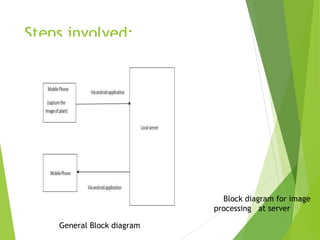
Steps involved:
Block diagram for image
processing at server
General Block diagram
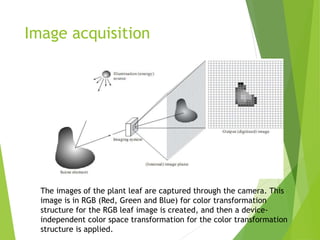
Image acquisition
The images of the plant leaf are captured through the camera. This
image is in RGB (Red, Green and Blue) for color transformation
structure for the RGB leaf image is created, and then a device-
independent color space transformation for the color transformation
structure is applied.
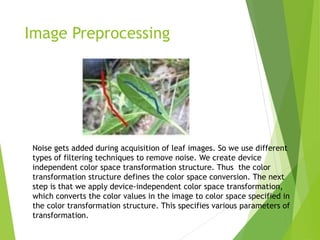
Image Preprocessing
Noise gets added during acquisition of leaf images. So we use different
types of filtering techniques to remove noise. We create device
independent color space transformation structure. Thus the color
transformation structure defines the color space conversion. The next
step is that we apply device-independent color space transformation,
which converts the color values in the image to color space specified in
the color transformation structure. This specifies various parameters of
transformation.
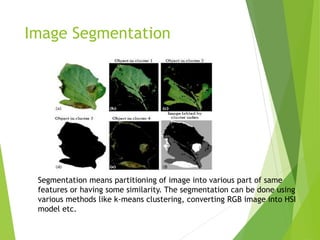
Image Segmentation
Segmentation means partitioning of image into various part of same
features or having some similarity. The segmentation can be done using
various methods like k-means clustering, converting RGB image into HSI
model etc.
K-mean clustering
 K-means clustering is a partitioning method.
 The function ‘kmeans’ partitions data into k mutually
exclusive clusters, and returns the index of the cluster to
which it has assigned each observation.
 The distinctions mean that k-means clustering is often more
suitable than hierarchical clustering for large amounts of
data.
 K-means treats each observation in your data as an object
having a location in space.
 It finds a partition in which objects within each cluster are as
close to each other as possible, and as far from objects in
other clusters as possible
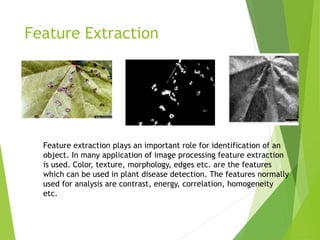
Feature Extraction
Feature extraction plays an important role for identification of an
object. In many application of image processing feature extraction
is used. Color, texture, morphology, edges etc. are the features
which can be used in plant disease detection. The features normally
used for analysis are contrast, energy, correlation, homogeneity
etc.
Classification Using SVM
The next step is extracting unique features from the leaf and classifying
the images as healthy or disease. The classifier used for this purpose is
Support Vector Machine (SVM). This classifier belongs to a group of
supervised learning methods which are normally used for classification and
pattern recognition. Supervised learning is a machine learning algorithm
that uses a known dataset i.e. the training dataset to make predictions for
a new dataset i.e. the testing dataset. The accuracy of SVM classifier gets
better as the number of samples in the training dataset increases.
• Represents unaffected
plants
• Represents affected plants
Advantages:
 Free-of-cost
 Less effort
 No need of plant experts. Just an app installation is
enough
 Less time
 More accuracy
Disadvantages:
 Can’t be applied to all kind of plants
Img process

Img process

  • 1.
    Plant Health Monitoring using DigitalImage processing By: SivaPriya.G
  • 2.
    Introduction  Farmers don’thave proper facilities or even idea that they can contact to experts when a disease has occurred in a plant  For this problem we had proposed an app for plant health monitoring by using image processing technique.
  • 3.
    Steps involved: Block diagramfor image processing at server General Block diagram
  • 4.
    Image acquisition The imagesof the plant leaf are captured through the camera. This image is in RGB (Red, Green and Blue) for color transformation structure for the RGB leaf image is created, and then a device- independent color space transformation for the color transformation structure is applied.
  • 5.
    Image Preprocessing Noise getsadded during acquisition of leaf images. So we use different types of filtering techniques to remove noise. We create device independent color space transformation structure. Thus the color transformation structure defines the color space conversion. The next step is that we apply device-independent color space transformation, which converts the color values in the image to color space specified in the color transformation structure. This specifies various parameters of transformation.
  • 6.
    Image Segmentation Segmentation meanspartitioning of image into various part of same features or having some similarity. The segmentation can be done using various methods like k-means clustering, converting RGB image into HSI model etc.
  • 7.
    K-mean clustering  K-meansclustering is a partitioning method.  The function ‘kmeans’ partitions data into k mutually exclusive clusters, and returns the index of the cluster to which it has assigned each observation.  The distinctions mean that k-means clustering is often more suitable than hierarchical clustering for large amounts of data.  K-means treats each observation in your data as an object having a location in space.  It finds a partition in which objects within each cluster are as close to each other as possible, and as far from objects in other clusters as possible
  • 8.
    Feature Extraction Feature extractionplays an important role for identification of an object. In many application of image processing feature extraction is used. Color, texture, morphology, edges etc. are the features which can be used in plant disease detection. The features normally used for analysis are contrast, energy, correlation, homogeneity etc.
  • 9.
    Classification Using SVM Thenext step is extracting unique features from the leaf and classifying the images as healthy or disease. The classifier used for this purpose is Support Vector Machine (SVM). This classifier belongs to a group of supervised learning methods which are normally used for classification and pattern recognition. Supervised learning is a machine learning algorithm that uses a known dataset i.e. the training dataset to make predictions for a new dataset i.e. the testing dataset. The accuracy of SVM classifier gets better as the number of samples in the training dataset increases. • Represents unaffected plants • Represents affected plants
  • 10.
    Advantages:  Free-of-cost  Lesseffort  No need of plant experts. Just an app installation is enough  Less time  More accuracy
  • 11.
    Disadvantages:  Can’t beapplied to all kind of plants