IMAGING OF THE
PLACENTA
     Dr.Thambidurai,
     Resident-Radiology,
     Stanley Medical College.
Importance
   Abnormalities of the placenta are important to
    recognize owing to the potential for maternal
    and fetal morbidity and mortality. Pathologic
    conditions of the placenta include
            Placental causes of hemorrhage,
            Gestational trophoblastic disease,
            Retained products of conception,
            Nontrophoblastic placental tumors, metastases, and
            Cystic lesions..
Imaging modalities
   Sonography remains the imaging modality of
    choice for evaluation of the placenta.
   Magnetic resonance (MR) imaging can be of
    added diagnostic value when further
    characterization is required, particularly in the
    setting of invasive placental processes such
    as
       placenta accreta and
       gestational trophoblastic disease.
Role of CT
   Computed tomography (CT) has a limited role
    in the evaluation of placental disease owing to
    limited tissue characterization, compared with
    that of MR imaging, and the radiation risk to
    the fetus;
   The primary role for CT is in the evaluation of
    trauma and gestational trophoblastic disease,
    for which it allows characterization of the
    primary lesion and distant metastases
Introduction

   The placenta is named for its appearance
    (Greek plakuos, meaning “flat cake”) and is
    responsible for the nutritive, respiratory, and
    excretory functions of the fetus.
   The placenta is often overlooked in the routine
    evaluation of a normal gestation, receiving
    attention only when an abnormality is
    detected.
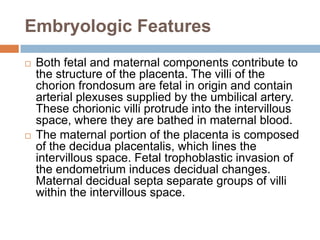
Embryologic Features
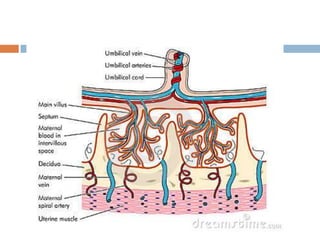
   Both fetal and maternal components contribute to
    the structure of the placenta. The villi of the
    chorion frondosum are fetal in origin and contain
    arterial plexuses supplied by the umbilical artery.
    These chorionic villi protrude into the intervillous
    space, where they are bathed in maternal blood.
   The maternal portion of the placenta is composed
    of the decidua placentalis, which lines the
    intervillous space. Fetal trophoblastic invasion of
    the endometrium induces decidual changes.
    Maternal decidual septa separate groups of villi
    within the intervillous space.
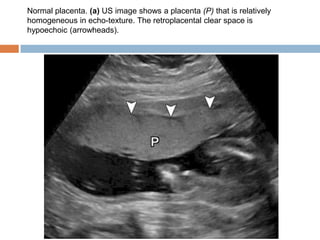
Normal placenta. (a) US image shows a placenta (P) that is relatively
homogeneous in echo-texture. The retroplacental clear space is
hypoechoic (arrowheads).
Sagittal single-shot fast spin-echo (SSFSE) T2-weighted MR image
shows a placenta (P)with intermediate signal intensity. The dark line
represents the retroplacental clear space (arrowheads).
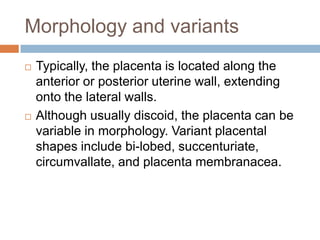
Morphology and variants
   Typically, the placenta is located along the
    anterior or posterior uterine wall, extending
    onto the lateral walls.
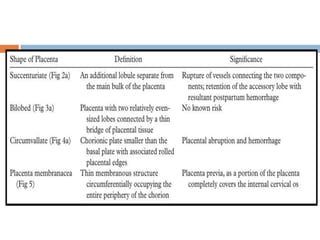
   Although usually discoid, the placenta can be
    variable in morphology. Variant placental
    shapes include bi-lobed, succenturiate,
    circumvallate, and placenta membranacea.
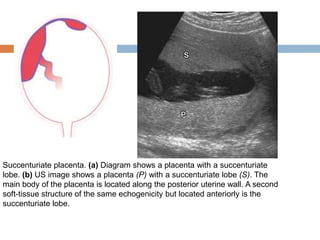
Succenturiate placenta. (a) Diagram shows a placenta with a succenturiate
lobe. (b) US image shows a placenta (P) with a succenturiate lobe (S). The
main body of the placenta is located along the posterior uterine wall. A second
soft-tissue structure of the same echogenicity but located anteriorly is the
succenturiate lobe.
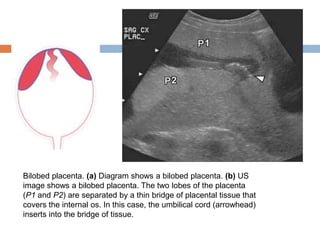
Bilobed placenta. (a) Diagram shows a bilobed placenta. (b) US
image shows a bilobed placenta. The two lobes of the placenta
(P1 and P2) are separated by a thin bridge of placental tissue that
covers the internal os. In this case, the umbilical cord (arrowhead)
inserts into the bridge of tissue.
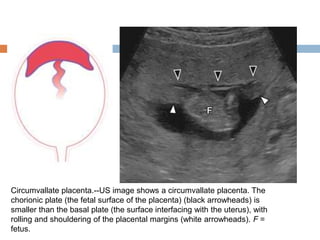
Circumvallate placenta.--US image shows a circumvallate placenta. The
chorionic plate (the fetal surface of the placenta) (black arrowheads) is
smaller than the basal plate (the surface interfacing with the uterus), with
rolling and shouldering of the placental margins (white arrowheads). F =
fetus.
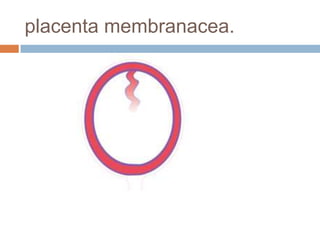
placenta membranacea.
   The umbilical cord typically inserts centrally, but
    eccentric and velamentous (outside the placental
    margin) insertions also occur .
   Eccentric insertions are cord insertions that are
    less than 1 cm from the placental edge. These are
    distinguished from a velamentous insertion, where
    the umbilical cord inserts on the chorioamniotic
    membranes rather than on the placental mass.
    This membranous insertion results in a variable
    segment of the umbilical vessels running between
    the amnion and the chorion, unprotected by
    Wharton jelly
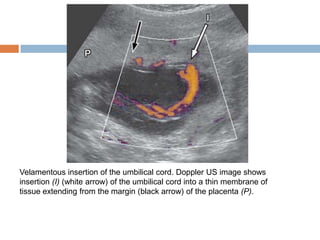
Velamentous insertion of the umbilical cord. Doppler US image shows
insertion (I) (white arrow) of the umbilical cord into a thin membrane of
tissue extending from the margin (black arrow) of the placenta (P).
   Placental size is expressed in terms of thickness
    in the midportion of the organ and should be
    between 2 and 4 cm.
   Placental thinning has been described in systemic
    vascular and hematologic diseases that result in
    microinfarctions.
   Thicker placentas (>4 cm) are seen in fetal
    hydrops, antepartum infections, maternal
    diabetes, and maternal anemia. Placental
    thickening can be simulated by myometrial
    contractions and underlying fibroids.
Chorioamniotic separation
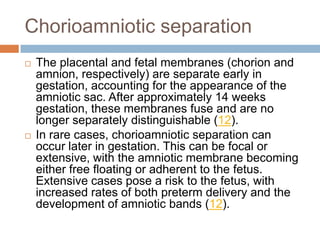
   The placental and fetal membranes (chorion and
    amnion, respectively) are separate early in
    gestation, accounting for the appearance of the
    amniotic sac. After approximately 14 weeks
    gestation, these membranes fuse and are no
    longer separately distinguishable (12).
   In rare cases, chorioamniotic separation can
    occur later in gestation. This can be focal or
    extensive, with the amniotic membrane becoming
    either free floating or adherent to the fetus.
    Extensive cases pose a risk to the fetus, with
    increased rates of both preterm delivery and the
    development of amniotic bands (12).
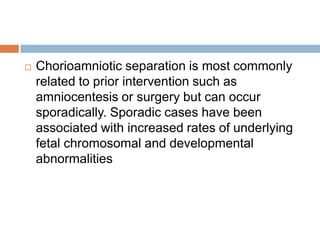
   Chorioamniotic separation is most commonly
    related to prior intervention such as
    amniocentesis or surgery but can occur
    sporadically. Sporadic cases have been
    associated with increased rates of underlying
    fetal chromosomal and developmental
    abnormalities
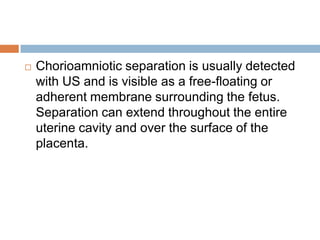
   Chorioamniotic separation is usually detected
    with US and is visible as a free-floating or
    adherent membrane surrounding the fetus.
    Separation can extend throughout the entire
    uterine cavity and over the surface of the
    placenta.
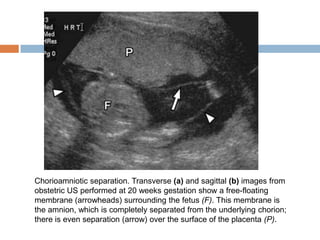
Chorioamniotic separation. Transverse (a) and sagittal (b) images from
obstetric US performed at 20 weeks gestation show a free-floating
membrane (arrowheads) surrounding the fetus (F). This membrane is
the amnion, which is completely separated from the underlying chorion;
there is even separation (arrow) over the surface of the placenta (P).
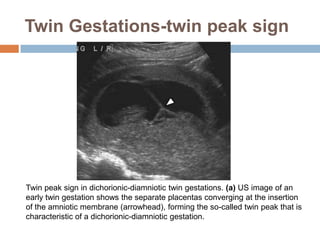
Twin Gestations-twin peak sign


Twin peak sign in dichorionic-diamniotic twin gestations. (a) US image of an
early twin gestation shows the separate placentas converging at the insertion
of the amniotic membrane (arrowhead), forming the so-called twin peak that is
characteristic of a dichorionic-diamniotic gestation.
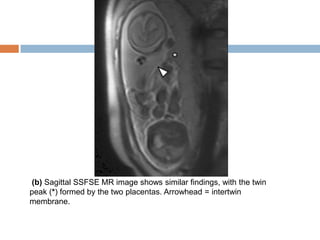
(b) Sagittal SSFSE MR image shows similar findings, with the twin
peak (*) formed by the two placentas. Arrowhead = intertwin
membrane.
Placental Causes of Antepartum
Hemorrhage
   Placenta previa and placental abruption
    account for more than one-half of cases of
    antepartum hemorrhage and are increasing in
    prevalence as the rate of cesarean section
    increases.
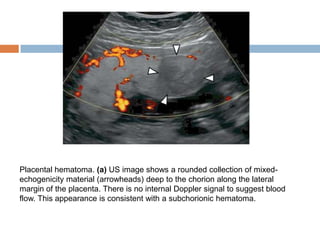
Placental Hematoma
   placental hematomas appear as well-
    circumscribed masses with echogenicity that
    varies according to chronicity.
   They are hypoechoic or anechoic in the acute
    phase, heterogeneously echogenic in the
    subacute phase, and anechoic in the chronic
    phase.
   Doppler interrogation should reveal absence of
    internal blood flow; this finding allows
    differentiation of hematomas from other placental
    masses
Placental hematoma. (a) US image shows a rounded collection of mixed-
echogenicity material (arrowheads) deep to the chorion along the lateral
margin of the placenta. There is no internal Doppler signal to suggest blood
flow. This appearance is consistent with a subchorionic hematoma.
Placental Abruption
   Placental abruption represents premature
    separation of the placenta from the uterine wall
   US is frequently performed to confirm the
    presence of abruption and assess the extent of
    subchorionic or retroplacental hematoma . The
    presence of blood in large enough volumes to be
    visible sonographically indicates retained
    hemorrhage that may remain symptomatic.
   False-negative results can occur when blood
    dissects out from beneath the placenta and drains
    through the cervix.
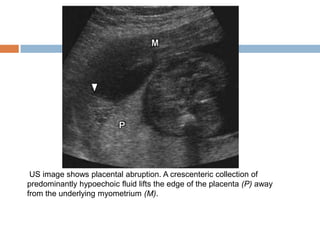
US image shows placental abruption. A crescenteric collection of
predominantly hypoechoic fluid lifts the edge of the placenta (P) away
from the underlying myometrium (M).
Placenta Previa
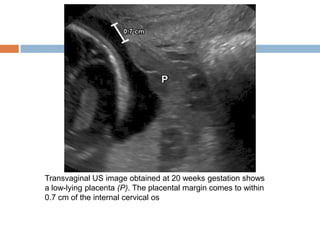
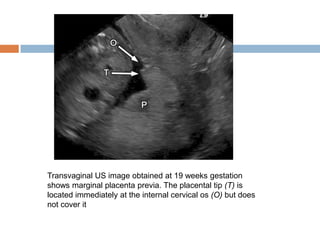
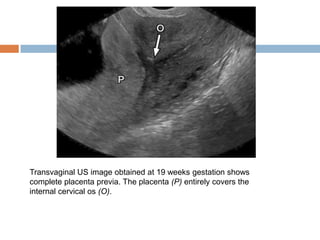
   Placenta previa refers to abnormal
    implantation of the placenta in the lower
    uterine segment, overlying or near the internal
    cervical os
   Normally, the lower placental edge should be
    at least 2 cm from the margin of the internal
    cervical os.
   The diagnosis of placenta previa should not be
    made before 15 weeks gestation.
Transvaginal US image obtained at 20 weeks gestation shows
a low-lying placenta (P). The placental margin comes to within
0.7 cm of the internal cervical os
Transvaginal US image obtained at 19 weeks gestation
shows marginal placenta previa. The placental tip (T) is
located immediately at the internal cervical os (O) but does
not cover it
Transvaginal US image obtained at 19 weeks gestation shows
complete placenta previa. The placenta (P) entirely covers the
internal cervical os (O).
Vasa Previa
   Vasa previa refers to the presence of abnormal
    fetal vessels within the amniotic membranes
    that cross the internal cervical os. These
    vessels are unsupported by Wharton jelly or
    placental tissue and are at risk of rupture when
    the supporting membranes rupture; such
    vessels are also at risk of direct injury during
    labor. Rupture of these vessels can lead to
    catastrophic fetal hemorrhage.
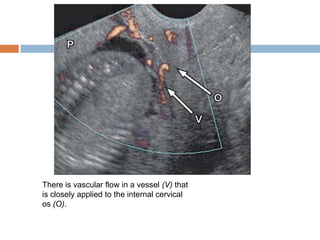
   The diagnosis of vasa previa is made with
    Doppler US, which demonstrates vascular flow
    within vessels overlying the internal cervical
    os .
There is vascular flow in a vessel (V) that
is closely applied to the internal cervical
os (O).
Placenta Accreta, Increta, and
Percreta
   During the process of placental development and
    implantation, a defect in the normal decidua basalis from
    prior surgery or instrumentation allows abnormal
    adherence or penetration of the chorionic villi to or into
    the uterine wall .
   The extent of adherence to and invasion of the placental
    tissue varies:
             Superficial invasion of the basalis layer is termed placenta
              accreta (approximately 75% of cases);
             deeper invasion of the myometrium is termed placenta
              increta ; and
             even deeper invasion involving the serosa or adjacent pelvic
              organs is termed placenta percreta
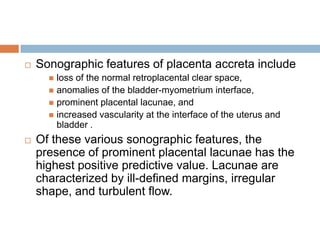
   Sonographic features of placenta accreta include
       loss of the normal retroplacental clear space,
       anomalies of the bladder-myometrium interface,
       prominent placental lacunae, and
       increased vascularity at the interface of the uterus and
        bladder .
   Of these various sonographic features, the
    presence of prominent placental lacunae has the
    highest positive predictive value. Lacunae are
    characterized by ill-defined margins, irregular
    shape, and turbulent flow.
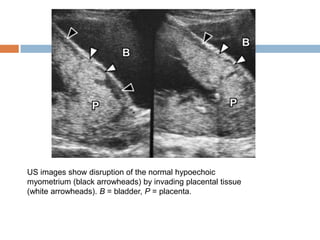
US images show disruption of the normal hypoechoic
myometrium (black arrowheads) by invading placental tissue
(white arrowheads). B = bladder, P = placenta.
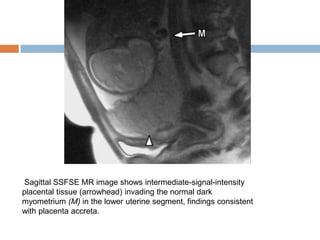
Sagittal SSFSE MR image shows intermediate-signal-intensity
placental tissue (arrowhead) invading the normal dark
myometrium (M) in the lower uterine segment, findings consistent
with placenta accreta.
Imaging of the placenta

Imaging of the placenta

  • 1.
    IMAGING OF THE PLACENTA Dr.Thambidurai, Resident-Radiology, Stanley Medical College.
  • 2.
    Importance  Abnormalities of the placenta are important to recognize owing to the potential for maternal and fetal morbidity and mortality. Pathologic conditions of the placenta include  Placental causes of hemorrhage,  Gestational trophoblastic disease,  Retained products of conception,  Nontrophoblastic placental tumors, metastases, and  Cystic lesions..
  • 3.
    Imaging modalities  Sonography remains the imaging modality of choice for evaluation of the placenta.  Magnetic resonance (MR) imaging can be of added diagnostic value when further characterization is required, particularly in the setting of invasive placental processes such as  placenta accreta and  gestational trophoblastic disease.
  • 4.
    Role of CT  Computed tomography (CT) has a limited role in the evaluation of placental disease owing to limited tissue characterization, compared with that of MR imaging, and the radiation risk to the fetus;  The primary role for CT is in the evaluation of trauma and gestational trophoblastic disease, for which it allows characterization of the primary lesion and distant metastases
  • 5.
    Introduction  The placenta is named for its appearance (Greek plakuos, meaning “flat cake”) and is responsible for the nutritive, respiratory, and excretory functions of the fetus.  The placenta is often overlooked in the routine evaluation of a normal gestation, receiving attention only when an abnormality is detected.
  • 6.
    Embryologic Features  Both fetal and maternal components contribute to the structure of the placenta. The villi of the chorion frondosum are fetal in origin and contain arterial plexuses supplied by the umbilical artery. These chorionic villi protrude into the intervillous space, where they are bathed in maternal blood.  The maternal portion of the placenta is composed of the decidua placentalis, which lines the intervillous space. Fetal trophoblastic invasion of the endometrium induces decidual changes. Maternal decidual septa separate groups of villi within the intervillous space.
  • 9.
    Normal placenta. (a)US image shows a placenta (P) that is relatively homogeneous in echo-texture. The retroplacental clear space is hypoechoic (arrowheads).
  • 10.
    Sagittal single-shot fastspin-echo (SSFSE) T2-weighted MR image shows a placenta (P)with intermediate signal intensity. The dark line represents the retroplacental clear space (arrowheads).
  • 11.
    Morphology and variants  Typically, the placenta is located along the anterior or posterior uterine wall, extending onto the lateral walls.  Although usually discoid, the placenta can be variable in morphology. Variant placental shapes include bi-lobed, succenturiate, circumvallate, and placenta membranacea.
  • 13.
    Succenturiate placenta. (a)Diagram shows a placenta with a succenturiate lobe. (b) US image shows a placenta (P) with a succenturiate lobe (S). The main body of the placenta is located along the posterior uterine wall. A second soft-tissue structure of the same echogenicity but located anteriorly is the succenturiate lobe.
  • 14.
    Bilobed placenta. (a)Diagram shows a bilobed placenta. (b) US image shows a bilobed placenta. The two lobes of the placenta (P1 and P2) are separated by a thin bridge of placental tissue that covers the internal os. In this case, the umbilical cord (arrowhead) inserts into the bridge of tissue.
  • 15.
    Circumvallate placenta.--US imageshows a circumvallate placenta. The chorionic plate (the fetal surface of the placenta) (black arrowheads) is smaller than the basal plate (the surface interfacing with the uterus), with rolling and shouldering of the placental margins (white arrowheads). F = fetus.
  • 16.
  • 17.
    The umbilical cord typically inserts centrally, but eccentric and velamentous (outside the placental margin) insertions also occur .  Eccentric insertions are cord insertions that are less than 1 cm from the placental edge. These are distinguished from a velamentous insertion, where the umbilical cord inserts on the chorioamniotic membranes rather than on the placental mass. This membranous insertion results in a variable segment of the umbilical vessels running between the amnion and the chorion, unprotected by Wharton jelly
  • 18.
    Velamentous insertion ofthe umbilical cord. Doppler US image shows insertion (I) (white arrow) of the umbilical cord into a thin membrane of tissue extending from the margin (black arrow) of the placenta (P).
  • 19.
    Placental size is expressed in terms of thickness in the midportion of the organ and should be between 2 and 4 cm.  Placental thinning has been described in systemic vascular and hematologic diseases that result in microinfarctions.  Thicker placentas (>4 cm) are seen in fetal hydrops, antepartum infections, maternal diabetes, and maternal anemia. Placental thickening can be simulated by myometrial contractions and underlying fibroids.
  • 20.
    Chorioamniotic separation  The placental and fetal membranes (chorion and amnion, respectively) are separate early in gestation, accounting for the appearance of the amniotic sac. After approximately 14 weeks gestation, these membranes fuse and are no longer separately distinguishable (12).  In rare cases, chorioamniotic separation can occur later in gestation. This can be focal or extensive, with the amniotic membrane becoming either free floating or adherent to the fetus. Extensive cases pose a risk to the fetus, with increased rates of both preterm delivery and the development of amniotic bands (12).
  • 21.
    Chorioamniotic separation is most commonly related to prior intervention such as amniocentesis or surgery but can occur sporadically. Sporadic cases have been associated with increased rates of underlying fetal chromosomal and developmental abnormalities
  • 22.
    Chorioamniotic separation is usually detected with US and is visible as a free-floating or adherent membrane surrounding the fetus. Separation can extend throughout the entire uterine cavity and over the surface of the placenta.
  • 23.
    Chorioamniotic separation. Transverse(a) and sagittal (b) images from obstetric US performed at 20 weeks gestation show a free-floating membrane (arrowheads) surrounding the fetus (F). This membrane is the amnion, which is completely separated from the underlying chorion; there is even separation (arrow) over the surface of the placenta (P).
  • 24.
    Twin Gestations-twin peaksign Twin peak sign in dichorionic-diamniotic twin gestations. (a) US image of an early twin gestation shows the separate placentas converging at the insertion of the amniotic membrane (arrowhead), forming the so-called twin peak that is characteristic of a dichorionic-diamniotic gestation.
  • 25.
    (b) Sagittal SSFSEMR image shows similar findings, with the twin peak (*) formed by the two placentas. Arrowhead = intertwin membrane.
  • 26.
    Placental Causes ofAntepartum Hemorrhage  Placenta previa and placental abruption account for more than one-half of cases of antepartum hemorrhage and are increasing in prevalence as the rate of cesarean section increases.
  • 27.
    Placental Hematoma  placental hematomas appear as well- circumscribed masses with echogenicity that varies according to chronicity.  They are hypoechoic or anechoic in the acute phase, heterogeneously echogenic in the subacute phase, and anechoic in the chronic phase.  Doppler interrogation should reveal absence of internal blood flow; this finding allows differentiation of hematomas from other placental masses
  • 28.
    Placental hematoma. (a)US image shows a rounded collection of mixed- echogenicity material (arrowheads) deep to the chorion along the lateral margin of the placenta. There is no internal Doppler signal to suggest blood flow. This appearance is consistent with a subchorionic hematoma.
  • 29.
    Placental Abruption  Placental abruption represents premature separation of the placenta from the uterine wall  US is frequently performed to confirm the presence of abruption and assess the extent of subchorionic or retroplacental hematoma . The presence of blood in large enough volumes to be visible sonographically indicates retained hemorrhage that may remain symptomatic.  False-negative results can occur when blood dissects out from beneath the placenta and drains through the cervix.
  • 30.
    US image showsplacental abruption. A crescenteric collection of predominantly hypoechoic fluid lifts the edge of the placenta (P) away from the underlying myometrium (M).
  • 31.
    Placenta Previa  Placenta previa refers to abnormal implantation of the placenta in the lower uterine segment, overlying or near the internal cervical os  Normally, the lower placental edge should be at least 2 cm from the margin of the internal cervical os.  The diagnosis of placenta previa should not be made before 15 weeks gestation.
  • 32.
    Transvaginal US imageobtained at 20 weeks gestation shows a low-lying placenta (P). The placental margin comes to within 0.7 cm of the internal cervical os
  • 33.
    Transvaginal US imageobtained at 19 weeks gestation shows marginal placenta previa. The placental tip (T) is located immediately at the internal cervical os (O) but does not cover it
  • 34.
    Transvaginal US imageobtained at 19 weeks gestation shows complete placenta previa. The placenta (P) entirely covers the internal cervical os (O).
  • 35.
    Vasa Previa  Vasa previa refers to the presence of abnormal fetal vessels within the amniotic membranes that cross the internal cervical os. These vessels are unsupported by Wharton jelly or placental tissue and are at risk of rupture when the supporting membranes rupture; such vessels are also at risk of direct injury during labor. Rupture of these vessels can lead to catastrophic fetal hemorrhage.
  • 36.
    The diagnosis of vasa previa is made with Doppler US, which demonstrates vascular flow within vessels overlying the internal cervical os .
  • 37.
    There is vascularflow in a vessel (V) that is closely applied to the internal cervical os (O).
  • 38.
    Placenta Accreta, Increta,and Percreta  During the process of placental development and implantation, a defect in the normal decidua basalis from prior surgery or instrumentation allows abnormal adherence or penetration of the chorionic villi to or into the uterine wall .  The extent of adherence to and invasion of the placental tissue varies:  Superficial invasion of the basalis layer is termed placenta accreta (approximately 75% of cases);  deeper invasion of the myometrium is termed placenta increta ; and  even deeper invasion involving the serosa or adjacent pelvic organs is termed placenta percreta
  • 39.
    Sonographic features of placenta accreta include  loss of the normal retroplacental clear space,  anomalies of the bladder-myometrium interface,  prominent placental lacunae, and  increased vascularity at the interface of the uterus and bladder .  Of these various sonographic features, the presence of prominent placental lacunae has the highest positive predictive value. Lacunae are characterized by ill-defined margins, irregular shape, and turbulent flow.
  • 40.
    US images showdisruption of the normal hypoechoic myometrium (black arrowheads) by invading placental tissue (white arrowheads). B = bladder, P = placenta.
  • 41.
    Sagittal SSFSE MRimage shows intermediate-signal-intensity placental tissue (arrowhead) invading the normal dark myometrium (M) in the lower uterine segment, findings consistent with placenta accreta.