Serial 
No. State/UT 
1 Kerala 1084 
2 Puducherry 1038 
3 Tamil Nadu 995 
4 Andhra Pradesh 992 
5 Chhattisgarh 991 
Serial 
No. 
State/UT 
Female sex 
ration as per 
Census 2011 
Female sex 
ratio as per 
Census 2011 
1 Haryana 877 
2 Delhi 866 
3 Chandigarh 818 
4 Dadra & Nagar 
Haveli 
775 
5 Daman & Diu 618
Future doesn’t look so bright!!!!
Legal Action To Stop Female Foeticide
CONTENTS 
I. History 
II. Definitions 
– Techniques 
– Places 
– Qualified Persons 
III. Registration 
– Procedure for Registration 
– Minimum Requirements for Registration 
– Process of Certification 
– Rejection of Application for Registration 
– Cancellation or Suspension of Registration 
– Provision for Appeal 
– Renewal of Registration 
– Rejection of Application for Renewal 
IV. Prohibitions 
A. Prohibitions 
A. On places 
B. On persons 
C. Miscellaneous 
– Prescriptions and Regulations 
– Penalties 
A. Offence by persons 
B. Offence by a company 
V. Instrumentalities for Implementing the Act 
– Policy Making Body 
– Implementing Authorities 
VI. Maintenance and Preservation of Records 
VII. Search and Seizure 
I. Search and Witnesses 
– Seizure and Preparation of List 
– Sealing 
– Collection of Evidence
History 
• 1860 
– Indian Penal Code, punishing causing of miscarriage and other like offences 
• 1978 
– directive banning the misuse of amniocentesis in government 
hospitals/laboratories 
• 1985 
– Dr. Sanjeev Kulkarni, Mumbai 
– Thesis of 200 sonography & abortion centres 
– Misuse of sonography machines for female foeticide 
• 1988 
– Embryo testing restriction law, Maharashtra 
– Maharashtra Regulation of Pre-natal Diagnostic Techniques Act 
• 1994 (20thh September) 
– Pre-Natal Diagnostic Techniques (Regulation and Prevention of Misuse) Act 
• 2003 (14th Feb) 
– “The Pre-conception and Pre-natal Diagnostic Techniques (Prohibition of Sex 
Selection) Act.”
DEFINITIONS 
– Techniques 
– Places 
– Qualified Persons
Techniques 
• Pre-natal diagnostic techniques include: 
– pre-natal diagnostic procedures and 
– pre-natal diagnostic tests.
Pre-natal diagnostic procedures 
It mean all gynaecological or obstetrical or medical 
procedures such as: 
– Ultrasonography; 
– Foetoscopy; 
– Taking or removing samples of: 
• Amniotic fluid 
• Chorionic villi 
• Blood 
• Any tissue 
• Fluid 
of a man or a woman before or after conception for being 
sent to a Genetic Laboratory or Genetic Clinic for conducting 
any type of analysis or pre-natal diagnostic tests for selection 
of sex before or after conception.
Pre-natal diagnostic tests 
B. Pre-natal diagnostic test means: 
– Ultrasonography 
– Test or analysis of: 
• Amniotic fluid 
• Chorionic villi 
• Blood 
• Any tissue 
• Fluid 
of any pregnant woman or conceptus conducted to detect: 
• Genetic disorders 
• Metabolic disorders 
• Chromosomal abnormalities 
• Congenital anomalies 
• Haemoglobinopathies 
• Sex-linked diseases.3
Sex selection 
C. Sex selection includes: 
– Procedure 
– Technique 
– Test 
– Administration 
– Prescription 
– Provision 
of anything for the purpose of ensuring or 
increasing the probability that an embryo will be of 
a particular sex.
Definitions 
– Techniques 
– Places 
– Qualified Persons
Places 
• Genetic Counselling Centre 
• Genetic Clinic 
• Genetic Laboratory
A. Genetic Counselling Centre 
• An institute 
• Hospital 
• Nursing home 
• Any place 
by whatever name called which provides genetic 
counselling to patients.
B. Genetic Clinic 
• A clinic 
• Institute 
• Hospital 
• Nursing home 
• Any place 
by whatever name called which is used for 
conducting pre-natal diagnostic procedures.
• By an amendment to the Act of 1994, an 
explanation has been added to clarify the 
position of a ‘vehicle’. 
• It provides that for the purposes of this clause, a 
Genetic Clinic includes a vehicle, where 
ultrasound machine or imaging machine or 
scanner or other equipment capable of 
determining sex of the foetus or a portable 
equipment which has the potential for detection 
of sex during pregnancy or selection of sex before 
conception, is used.
C. Genetic Laboratory 
• A laboratory; and 
• Includes a place 
where facilities are 
provided for conducting 
analysis or tests of 
samples received from 
Genetic Clinic for pre-natal 
diagnostic test.
• An explanation has been added by the 
amendments of 2002. The explanation provides 
that “for the purposes of this clause (definition of 
Genetic Laboratory), Genetic Laboratory includes 
a place where ultrasound machine or imaging 
machine or scanner or other equipment capable 
of determining sex of the foetus or a portable 
equipment which has the potential for detection 
of sex during pregnancy or selection of sex before 
conception, is used.”
• It has been clarified under the amended Rules 
that every Genetic Counselling Centre/ Genetic 
Laboratory/ Genetic Clinic would include an 
ultrasound centre/imaging centre/nursing 
home/hospital/institute or any other place, by 
whatever name called, where any of the 
machines or equipments capable of selection of 
sex before or after conception performing or 
performing any procedure, technique or test for 
pre-natal detection of sex of foetus is used.
Definitions 
– Techniques 
– Places 
– Qualified Persons
Qualified Persons 
A. Gynaecologist 
B. Medical Geneticist 
C. Paediatrician 
D. Registered Medical Practitioner 
E. Laboratory technician 
F. Radiologist 
G. Sonologist or Imaging Specialist
A. Gynaecologist 
means a person who possesses a post-graduate 
qualification in gynaecology and obstetrics. 
• The Rules framed under the Act further 
qualify the qualifications by providing 
additional requirements for a gynaecologist 
when employed by a genetic counselling 
centre or a genetic clinic but do not 
necessitate the engagement of a 
gynaecologist by a genetic laboratory.
• For a genetic counselling centre, the gynaecologist 
must have 
– 6 months experience in genetic counselling ; or 
– 4 weeks training in genetic counselling . 
• For a genetic clinic, the gynaecologist should have 
adequate experience in pre-natal diagnostic 
procedures i.e. should have performed at least 20 
procedures in chorionic villi aspirations per vagina or 
per abdomen, chorionic villi biopsy, amniocentesis, 
cordocentesis foetoscopy, foetal skin or organ biopsy or 
foetal blood sampling etc. under supervision of an 
experienced gynaecologist in these fields.
B. Medical Geneticist 
includes a person who possesses: 
– Degree, or 
– Diploma 
in genetic science in the fields of sex selection and pre-natal 
diagnostic techniques 
or has experience of not less than two years in any of 
these fields after obtaining- 
– Any one of the medical qualifications recognized under the 
Indian Medical Council Act, 1956; or 
– A post-graduate degree in biological sciences. 
Under the amended definition, possessing a certificate 
does not make one a qualified medical geneticist.
C. Paediatrician 
means a person who possesses a post-graduate 
qualification in paediatrics. 
• The Rules framed under the Act further qualify 
the qualifications by providing additional 
requirements for a paediatrician when employed 
by a genetic counselling centre. 
• For a genetic counselling centre, the paediatrician 
must have 
– 6 months experience in genetic counselling; or 
– 4 weeks training in genetic counselling.
D. Registered Medical Practitioner 
– A medical practitioner who possesses any recognized medical 
qualification as defined in clause (h) of Section 2 of the Indian 
Medical Council Act, 1956; and 
– Whose name has been entered in a State Medical Register. 
• The Rules framed under the Act further qualify the 
qualifications by providing additional requirements for a 
registered medical practitioner when employed by a 
genetic clinic. 
• For the purposes of a genetic clinic the registered medical 
practition should have 
– post graduate degree or 
– diploma or 
– six months training or 
– one year experience in sonography or image scanning.
• Besides, the Act and the Rules also refer to 
other types of personnel.
E. Laboratory Technician 
For a genetic laboratory, there should be a 
laboratory technician having 
– B.Sc. degree in Biological Sciences; or 
– Degree or; 
– Diploma, in medical laboratory course; and 
• At least one year’s experience in conducting 
appropriate pre-natal diagnostic techniques, 
tests or procedures.
F. Radiologist 
G. Sonologist or Imaging Specialist means a 
person who possesses- 
– Any one of the medical qualifications recognized 
under the Indian Medical Council Act, 1956; or 
– A post-graduate qualification in ultrasonography 
or imaging techniques or radiology.
Are training courses authorised by the 
Govt of India? 
• Medical Council of India has been given 
guidelines by the Central Supervisory Board in 
their meeting held in Mumbai in Jan 2012, to 
create a 6 month Level I training course in 
Ultrasound for MBBS doctors. 
• This process is still a work in progress.
Miscellaneous Definitions 
Certain miscellaneous definitions have been added to clarify concepts 
used for the first time in the amended Act. These are:- 
A. Conceptus means any product of conception at any stage of 
development from fertilization until birth including extra 
embryonic membranes as well as the embryo or foetus. 
B. Embryo means a developing human organism after fertilization till 
the end of eight weeks (fifty-six days). 
C. Foetus means a human organism during the period of its 
development beginning on the fifty-seventh day following 
fertilization or creation (excluding any time in which its 
development has been suspended) and ending at the birth.
• All bodies under the PNDT Act namely Genetic 
Counselling Centre, Genetic Laboratory or Genetic 
Clinic as defined in the preceding chapters, 
cannot function unless registered. 
• The requirement of registration is mandatory 
whether the body is government, private, 
voluntary, honorary, part-time, contractual or 
consultative. 
• However the PNDT Act allows registration of 
these bodies either separately or jointly when a 
body is for instance both a centre and a clinic.
Procedure for Registration 
A. Every application for registration shall be 
made TO: 
– Chief Medical Officer of the district; or any other 
medical officer constituted as an appropriate 
authority 
– Medical officer constituted as appropriate 
authority for the sub-district within whose area or 
jurisdiction the centre, clinic or laboratory is 
situated. 
B. Every application shall be made in duplicate 
in Form A which is appended to the rules.
• The owner needs to register, at least 3 months in 
advance, all the places where a USG machine, 
whether a black and white or color Doppler 
machine, is to be used; this applies to 
medical/surgical nursing homes/intensive cardiac 
care unit and wherever a USG machine is used. 
This registration is compulsory and is regardless 
of the type of studies intended to be performed 
on that machine, whether pregnancy scans, 
abdominal scans, or only 2D echocardiograms.
C. Every application shall be duly accompanied by an 
AFFIDAVIT containing-i. 
An undertaking to the effect that the Genetic 
Centre/Laboratory/Clinic/ Ultrasound Clinic/Imaging 
Centre/combination thereof, as the case may be, shall not 
conduct any test or procedure, by whatever name called, for 
selection of sex before or after conception or for detection of 
sex of foetus except for diseases specified in Section 4(2) nor 
shall the sex of foetus be disclosed to any body; and 
ii. An undertaking to the effect that the Genetic 
Centre/Laboratory/Clinic/ combination thereof, as the case 
may be, shall display prominently a notice that they do not 
conduct any technique, test or procedure etc. by whatever 
name called, for detection of sex of foetus or for selection of 
sex before or after conception.
D. The Appropriate Authority or any authorised 
person will acknowledge the application in 
the acknowledgement slip provided at the 
bottom of Form A on the very same day if 
personally delivered, otherwise on the next 
day by post.
E. Every application form shall be submitted 
along with an application fee of: 
a) Rs.3000.00 for Genetic Counselling Centre, 
Genetic Laboratory, Genetic Clinic, Ultrasound 
Clinic or Imaging Centre. 
b) Rs.4000.00 for an institute, hospital, nursing 
home, or any place providing jointly the service 
of a Genetic Counselling Centre, Genetic 
Laboratory, Genetic Clinic, Ultrasound Clinic or 
Imaging Centre or any combination thereof.
• However, if an application for registration has 
been rejected by the Appropriate Authority, 
no fee shall be required to be paid on re-submission 
of the application by the applicant 
for the same body within 90 days of rejection. 
But every subsequent application shall be 
accompanied by the prescribed fee. 
• Application fee once paid will not be 
refunded.
F. The application fee shall be paid 
– By way of a demand draft 
– Drawn in favour of the Appropriate Authority 
– On any scheduled bank payable at the 
headquarters of the Appropriate Authority 
concerned.
G. The fees collected by the Appropriate 
Authority for registration shall be deposited 
by the Appropriate Authority concerned in a 
bank account opened in the name of the 
official designation of the Appropriate 
Authority concerned.
H. The fees so collected by the Appropriate 
Authority shall be utilized by the Appropriate 
Authority in connection with the activities 
connected with implementation of the 
provisions of the Act and these rules.
Minimum Requirements for 
Registration 
• There are different minimum requirements for 
different bodies as regards minimum qualifications of 
the employees and the minimum equipment for each 
of the bodies under the PNDT Act. 
• All the requirements relating to qualifications and 
equipment are mandatory. 
• Under the amended Rules, the Schedules appended to 
the earlier Rules have been done away with and the 
requirements for a Genetic Counselling Centre, Genetic 
Laboratory and Genetic Clinic have been added under 
Rule 3 itself by redrafting the same though the 
requirements remain the same, more or less.
A. Genetic Counselling Centre: 
• The requirements for a Genetic Counselling Centre are 
enumerated in Rule 3(1) in the amended Rules. 
– The centre should have adequate space. 
– The centre should contain educational 
charts/models/equipments for carrying out genetic 
counselling. 
– The centre must have any one of the following employees 
namely: 
• A medical geneticist 
• A gynaecologist; or 
• A paediatrician 
having such qualifications and experience as mentioned 
previously.
B. Genetic Laboratory 
• The requirements for a genetic laboratory are 
enumerated in Rule 3(2) in the amended Rules under 
the PNDT Act. 
– The laboratory should have adequate space for conducting 
the tests. 
– The laboratory should have or acquire such of the 
equipments as may be necessary to conduct chromosomal 
studies, biochemical studies and molecular studies from 
amongst those enumerated under the amended Rules. 
– The laboratory must have both a medical geneticist and a 
laboratory technician in its employment having such 
qualifications and experience as mentioned previously.
C. Genetic Clinic 
• The requirements for a genetic clinic are enumerated in Rule 3(3) of the 
amended Rules under the PNDT Act. 
– The centre should have adequate space. 
– The clinic/ultrasound clinic/imaging centre should have or acquire such of the 
following equipments, as may be necessary for carrying out the tests or 
procedures: 
a) Equipment and accessories necessary for carrying out clinical examination by an 
obstetrician/gynaecologist 
b) An ultra-sonography machine including mobile ultrasound machine, imaging machine 
or any other equipment capable of conducting foetal ultrasonography. 
c) Appropriate catheters and equipment for carrying out chorionic villi aspirations per 
vagina or per abdomen. 
d) Appropriate sterile needles for amniocentesis or cordocentesis. 
e) A suitable foetoscope with appropriate accessories for foetoscopy, foetal skin or organ 
biopsy or foetal blood sampling shall be optional. 
f) Equipment for dry and wet sterilization 
g) Equipment for carrying out emergency procedures such as evacuation of uterus or 
resuscitation in case of need. 
h) Genetic Works Station.
• The clinic must have gynaecologist or sonologist, imaging specialist, 
Radiologist or Registered Medical Practitioner or medical geneticist in its 
employment having such qualifications and experience as mentioned 
previously. 
• The aforementioned requirements are minimum mandatory and each of 
these bodies can have more equipment, more number of employees etc. 
as long as they fulfill the necessary qualifications mentioned in the PNDT 
Act. 
• Documentary proof of requisite qualifications and experience as specified 
under the PNDT Act and rules of persons employed by the facility should 
be annexed with the application for registration. 
• The bodies can be owned by any person and he need not have the 
qualifications required under the Act as long as he has employees that 
fulfill the minimum qualifications required under the PNDT Act. If an 
institute, hospital, nursing home or any place provides services jointly of 
any of these bodies then such a place should fulfill the minimum 
requirements of both the bodies in order to be registered.
Process of Certification 
a) Every application received by the appropriate authority will firstly be 
scrutinized by it and an enquiry into whether such body fulfills all the 
requirements under the PNDT Act will be done. 
b) An enquiry by the Appropriate Authority includes an inspection of the 
premises after giving due notice to the applicant. 
c) After the appropriate authority is satisfied that the applicant has fulfilled 
all minimum requirements, the application will be placed before the 
Advisory Committee. 
d) The Advisory Committee shall thereafter scrutinize the application and 
give its advice on the same to the appropriate authority. 
e) The Appropriate Authority after considering the advice will grant a 
certificate of registration. 
f) The certificate of registration shall be given in duplicate and in the form 
as prescribed in Form B under the PNDT Act. The grant of certificate of 
registration shall be communicated within 90 days from the date of 
receipt of application for registration.
f) It is mandatory for everybody registered 
under this Act to display the certificate of 
registration at a conspicuous place in such 
centre, laboratory or clinic.
g) In some cases the appropriate authority 
depending upon the requirements available 
at such centre, laboratory or clinic may grant 
a certificate only to conduct one or more 
specified prenatal diagnostic tests or 
procedures. 
h) The certificate of registration shall be non-transferable.
i) In the event of change of ownership or 
change of management or when the centre, 
laboratory or clinic ceases to function as one 
both copies of certificate of registration shall 
be surrendered to the Appropriate Authority. 
j) Each new owner or manager of a centre, 
laboratory or clinic has to apply afresh for 
grant of certificate of registration.
k) All centres, laboratories and clinics registered under the 
PNDT Act shall give an affidavit affirming that they will not 
indulge in pre-natal determination of sex as mandated by 
the Supreme Court in the case of CEHAT & Ors v. Union of 
India. 
l) The Registration Certificate must mention the number of 
ultrasound machines in the centre. Further the 
registration certificate must also mention all the portable 
ultrasound machines in the said centre. 
In case of registration certificates already issued, the list of 
ultrasound machines portable or otherwise must be 
mentioned on another paper and the said paper must also be 
displayed along with the registration certificate at a 
conspicuous place in the centre.
Rejection of Application for 
Registration 
• If after enquiry and after giving an opportunity of 
hearing to the applicant and after taking advise from 
the Advisory Committee the Appropriate Authority has 
come to a conclusion that the applicant has not 
complied with the requirements of the Act then the 
said application will be rejected. 
• The reasons for the rejection shall be given in writing 
and as specified in Form C appended to the Rules 
under PNDT Act. 
• The rejection of registration shall be communicated to 
the applicant within 90 days from the date of the 
receipt of the registration.
Cancellation or Suspension of 
Registration 
• The Appropriate Authority can at any time either on its own or on a complaint by 
anyone issue a show cause notice to the Genetic Counselling Centre, Genetic 
Laboratory or Genetic Clinic, Ultrasound Clinic or Imaging Centre as to why its 
registration should not be cancelled or suspended for breach of any of the 
provisions of the PNDT Act or the rules. The reasons for every such notice should 
be mentioned in the notice itself. 
• Thereafter the clinic, laboratory or centre must be given an opportunity to defend 
itself against the charges. After giving the centre, laboratory or clinic a reasonable 
opportunity of being heard and after taking into account the advice given by the 
Advisory Committee, the Appropriate Authority may either suspend the 
registration of such a place or cancel the registration depending upon the gravity 
of the charge. Action can be taken by the Appropriate Authority irrespective of any 
criminal action that will be taken against such a place. 
• In certain exceptional cases like in the case of public interest the Appropriate 
Authority may suspend or cancel registration without issuing a show cause notice. 
However the reasons for waiving show cause notice have to be given in writing.
Provision for Appeal 
• Any genetic counselling centre, genetic laboratory or 
genetic clinic may appeal against an order of cancellation or 
suspension of registration within 30 days of the order of 
cancellation or suspension. 
• The appeal may be made to: 
– The Appropriate Authority at the district level if the order is 
passed by the Appropriate Authority at sub-district level. 
– The Appropriate Authority at the State/UT level if the order is 
passed by the Appropriate Authority at district level. 
• Each appeal shall be disposed of by the District Appropriate 
Authority or by the State/UT Appropriate Authority, as the 
case may be, within 60 days of its receipt.
• Thus a hierarchy of appellate bodies has been provided and 
further the time limit for disposing of the appeals has been 
laid down. 
• Moreover the appeal shall be made to the Central 
Government if the order is passed by the Central 
Appropriate Authority. 
• The appeal shall be made to the State government if the 
order is passed by the State Appropriate Authority. 
• If the appeal is not made within the time as prescribed 
above, the Appropriate Authority may condone the delay in 
case he/she is satisfied that appellant was prevented for 
sufficient cause from making such appeal.
Renewal of Registration 
A. Every certificate of registration shall be valid for 
a period of five years since its issuance. 
B. Thirty days before the date of expiry of the 
certificate of registration a fresh application for 
a certificate of Registration should be 
made.(ideally 3 months) 
C. The application for renewal must be made in 
duplicate in the prescribed Form A (same as the 
one prescribed for obtaining the first 
registration certificate) to the Appropriate 
Authority.
D. The Appropriate Authority shall acknowledge 
the receipt of the application in the 
acknowledgement slip provided at the 
bottom of Form A on the very same day if 
personally delivered, otherwise on the next 
day by post.
E. Along with the application for renewal of 
certificate, registration fees of half of what 
was initially payable will be paid depending 
upon whether it is for a genetic counselling 
centre, genetic laboratory or genetic clinic, 
ultrasound clinic or imaging centre or for a 
joint facility.
F. After the receipt of the application the Appropriate Authority will 
hold an enquiry including an inspection of the premises after 
giving due notice into whether the applicant has fulfilled all the 
requirements necessary under the Act. The Appropriate Authority 
will also give the applicant a hearing. 
G. After conducting the enquiry and hearing if the Appropriate 
Authority finds everything satisfactory then it will place the 
application before the Advisory Committee for its scrutiny. 
H. Thereafter having regard to the advice of the Advisory Committee 
the Appropriate Authority will renew the certificate of registration 
in the prescribed Form B (same as the one prescribed for the first 
registration certificate) for a further period of 5 years starting 
from the date of expiry of the old certificate.
I. On the receipt of the renewed certificate of 
registration in duplicate, the two copies of the earlier 
certificates will have to be surrendered immediately 
to the Appropriate Authority. 
J. One copy of the renewed certificate has to be 
displayed in a conspicuous place of the centre, 
laboratory or clinic. 
K. If the Appropriate Authority fails to renew the 
certificate of registration within 90 days of its 
receiving the application for renewal, it will amount 
to automatic renewal or deemed renewal
Rejection of Application for Renewal 
• After conducting an enquiry into the application 
for renewal, after hearing the applicant and after 
taking the advice of the Advisory Committee if 
the Appropriate Authority finds that the applicant 
has not complied with the requirements of the 
Act then the Appropriate Authority can reject the 
application for renewal. 
• Every order of rejection will contain reasons for 
rejection and it will be communicated in the 
prescribed Form C. (same as the one prescribed 
for the initial rejection)
• Once the applicant receives the 
communication of rejection the applicant 
must immediately surrender both the copies 
of the earlier certificate of registration. 
• In case the appropriate authority fails to 
communicate its rejection to the applicant 
within 90 days of receiving the application for 
renewal then it amounts to automatic renewal 
or deemed renewal.
Note!!! 
In case of defence establishments, applications for 
registration have to be submitted to the 
Appropriate Authorities specifically notified for 
defence establishments who are otherwise 
responsible for the implementation of the Act in 
their areas. 
If the machines are lying packed or are not in use, 
then also registration is mandatory because 
requirement of registration arises by the very 
possession of the machines.
Is there a restriction on portable 
ultrasound devices ? 
• The Maharashtra State Branch of IRIA 
challenged the ban being imposed by the 
Municipal Corporation of Mumbai on the use 
of portable machines before the Hon'ble High 
Court Mumbai, which petition came to be 
dismissed and the judgment in the petition 
means that the portable machine can now be 
used only in the institute or hospital where it 
is registered thereby restricting the portability 
of the portable USG
• Do MRI machines need to be registered? 
• Yes, they need to be registered and all 
changes to be notified to the AA 
• Do CT scan machines need to be registered? 
• Yes, they need to be registered and all 
changes to be notified to the AA
• The IRIA has filed a petition before the 
Hon'ble High Court Delhi, whereby a few 
provisions of the PC-PNDT Act have been 
challenged, such as the registration given to 
other faculty members, the mode of training 
imparted. 
• The said petition is still pending……
PROHIBITIONS 
• The PNDT Act is a comprehensive piece of 
legislation which prohibits sex selection before 
or after conception and misuse of pre-natal 
diagnostic techniques for determination of the 
sex of the foetus, leading to female foeticide as 
also advertisements in relation to such 
techniques for detection or determination of sex. 
• The Act also specifies the punishment for 
violation of its provisions. Accordingly, the Act 
imposes the following:
ON PLACES 
• No genetic counselling centre or genetic clinic 
or genetic laboratory shall 
– Conduct; or 
– Associate with; or 
– Help in conducting pre-natal diagnostic techniques 
unless registered. 
Moreover the Registration certificate has to be 
displayed prominently on a board in such place.
• No genetic counselling centre or genetic clinic or genetic 
laboratory shall 
– Employ or cause to be employed or take services of any person, 
whether on honorary basis or on payment who does not 
possess prescribed qualifications. 
A qualified person could be: 
• Gynaecologist 
• Medical Geneticist 
• Paediatrician 
• Registered Medical Practitioner 
• Radiologist 
• Sonologist 
• Imaging Specialist 
who fulfils the requirements laid down under the Act
• No genetic counselling centre or genetic clinic 
or genetic laboratory shall 
– Conduct or cause to be conducted a pre-natal 
diagnostic technique except for the purposes 
specified in the Act. 
– Conduct or cause to be conducted a pre-natal 
diagnostic technique including an 
ultrasonography for the purpose of determining 
the sex of the foetus.
Every genetic counselling centre or genetic clinic or genetic laboratory is required to 
display prominently a notice in English and in the local language or languages that 
conduct of sex-determination tests/disclosure of sex of the foetus is prohibited.
B. ON PERSONS 
• No person shall open any genetic counselling centre, 
genetic clinic or genetic laboratory including clinic, 
laboratory or centre having ultrasound or imaging 
machine or scanner or any other technology capable of 
undertaking determination of sex of foetus and sex 
selection unless such centre, clinic or laboratory is duly 
registered separately or jointly. 
• No qualified person shall conduct or aid in conducting 
himself or through any other person a pre-natal 
diagnostic technique at any place other than the place 
registered.
Illustration 
A. No one can conduct a pre-natal diagnostic 
technique at home, unless the facility at 
home is also registered. 
B. No one can conduct a pre-natal diagnostic 
technique either on a voluntary basis, or on a 
charitable basis unless the body is registered 
after meeting all necessary qualifications of 
persons, place and equipment.
• Any changes in the center (e.g., change in 
machine or place of use) should be intimated 
to the AA 30 days in advance. 
• Any change of the doctor operating the 
machine should be intimated to the AA within 
30 days.
• No person shall render any services to any facility, after the 
commencement of the Pre-natal Diagnostic Techniques (Regulation 
and Prevention of Misuse) Amendment Act, 2002 unless such 
facility is duly registered under the Act. 
• No person including a relative or husband of the pregnant woman 
shall seek or encourage the conduct of any pre-natal diagnostic 
techniques on her except for the purposes specified in clause (2) of 
Section 4 of the Act. 
• No person including a relative or husband of a woman shall seek or 
encourage the conduct of any sex-selection technique on her or 
him or both. 
• No person shall conduct or cause to be conducted any pre-natal 
diagnostic technique including ultrasonography for purpose of sex 
determination.
• In fact a good doctor should counsel the 
patient that sex-determination is illegal and 
should also positively propagate about the girl 
child. 
• A doctor is highly regarded in the society and 
any counselling by him/her will have great 
impact in the implementation of the Act.
• No person, including a specialist or a team of specialists in 
the field of infertility, shall conduct or cause to be 
conducted or aid in conducting by himself or by any other 
person, sex selection on a woman or a man or on both or 
on any tissue, embryo, conceptus, fluid or gametes derived 
from either or both of them. 
• No person shall, by whatever means, cause or allow to be 
caused selection of sex before or after conception. 
• No person including the person conducting a pre-natal 
diagnostic procedures shall communicate to the pregnant 
woman concerned or her relatives or any other person the 
sex of the foetus by words, signs or in any other manner 
whatsoever.
Illustration 
A. Dr. Sirisha tells Ramu it is time to celebrate, give me a packet of sweets. 
This is illegal as indirectly the doctor is communicating to the father that 
it is a baby boy. 
B. Dr. Deepthi told Geeta, “Oh! your shoulders have become heavy now”. 
This is also illegal as the same indirectly conveys the fact that it is baby 
girl. 
C. Dr Sreedhar used to tell all his patients “You see I have all the latest 
techniques from America, I can tell the sex of the child within 10 weeks 
of pregnancy”. In every case the doctor used to tell his patients it was a 
girl and his wife Mrs. Sreedhar used to conduct the abortions the very 
next day. Dr. Sreedhar’s actions are in clear violation of the PNDT law. Dr. 
Sreedhar’s actions also amount to misrepresentation and fraud. 
D. Dr. Preetham never told his patients anything, he used raise his left 
eyebrow when it was a boy and right eyebrow when it was a girl. Dr. 
Preetham’s, actions though creative are also in violation of the PNDT law 
as the same amount to signs and gestures which is also prohibited.
• The Central Supervisory Board has laid down a 
code of conduct under section 16 (iv) of the 
Act to be observed by persons working in 
bodies specified therein and as such the same 
has to be strictly followed.
Can one arrange for a locum sonologist 
when one is on leave or vacation? 
• One has to give one month notice for the same 
to local AA with a letter, and copy of certificates 
of that doctor. 
• A recent Gazette notification has stated that 
application for locum to adding a doctor's name 
to the Registration Certificate needs to be done 
30 days in advance; 
• This gazette has been challenged by IRIA in Delhi 
High Court in July 2012, and interim relief has 
been given of 7 days.
C. MISCELLANEOUS 
• No person, organization, Genetic Counselling Centre, 
Genetic Laboratory or Genetic Clinic, including clinic, 
laboratory or centre having ultrasound machine or 
imaging machine or scanner or any other technology 
capable of undertaking determination of sex of foetus 
or sex selection shall issue, publish, distribute, 
communicate or cause to be issued, published, 
distributed or communicated any advertisement, in 
any form, including internet, regarding facilities of pre-natal 
determination of sex or sex selection before 
conception available at such centre, laboratory, clinic 
or at any other place.
Illustration 
A. “Spend Rs.5000 now and save Rs.5 lakhs later. 
Contact Dr. Ahmed of Ahmed Diagnostic Center.” 
This advertisement is illegal as it advertises 
facilities for sex determination. 
B. “Urine test now and result known immediately 
whether boy or girl.” This advertisement is also 
clearly illegal. 
C. “Want to know – boy or girl, quick and easy. No 
surgery required.” This advertisement is clearly 
illegal.
• No person, organization including Genetic 
Counselling Centre, Genetic Laboratory or 
Genetic Clinic shall issue, publish, distribute, 
communicate or cause to be issued, 
published, distributed or communicated any 
advertisement, in any manner regarding pre-natal 
determination or pre-conception 
selection of sex by any means whatsoever, 
scientific or otherwise.
Illustration 
A. A magazine published in America but distributed by AB Co 
in India, with its office in Delhi carries an advertisement 
for sex-determination. Such an action on the part of the 
company in Delhi is in violation of the Act. 
• Advertisement includes any notice, circular, label, wrapper 
or other document including advertisement through 
internet or any other media in electronic or print form and 
also includes any visible representation made by means of 
any hoarding, wall-painting, signal, light, sound, smoke or 
gas. 
B. Wrappers of Saritha Milk food with a colorful picture of a 
baby boy— if you want a baby boy contact Saritha 
Diagnostic Centre and they will help you, otherwise money 
back guaranteed. This is clearly illegal.
• No person shall sell, distribute, supply, rent, allow or 
authorize the use of any ultrasound machine or 
imaging machine or scanner or any other equipment 
capable of detecting sex of foetus whether on payment 
or otherwise to any Genetic Counselling Centre, 
Genetic Laboratory, Genetic Clinic or any other person 
or body not registered under the Act. 
• “Person” includes manufacturer, importer, dealer or 
supplier of ultrasound machines/imaging machines or 
any other equipment capable of detecting sex of 
foetus” as also any organization including a commercial 
organization.
Further the provider of such machine/equipment to any 
person/body registered under the Act shall: 
a) send to the concerned State/UT Appropriate 
Authority and to the Central Government, once in 
three months a list of those to whom the 
machine/equipment has been provided; and 
b) take an affidavit from such body or person purchasing 
or getting authorization for using such 
machine/equipment that the machine/equipment 
shall not be used for detection of sex of foetus or 
selection of sex before or after conception.
Is there a restriction on the number 
of places a Sonologist can visit ? 
• As per the recent gazette dated 5 June 2012, a 
sonologist can visit only 2 places in one district. 
• This gazette has been challenged in Delhi High Court by 
IRIA and ad-interim stay has been obtained. 
• It has also been challenged in Mumbai High Court by 
Dr Rajeev Zankar, and ad-interim stay has been given 
until next hearing in October. 
– In the next hearing, the appropriate authority informed 
the court that they were unconditionally withdrawing the 
restriction on number of places visited by a radiologist.
Prescriptions and Regulations 
• The PNDT law is a prohibitory and regulatory statute; it seeks to 
put in place a mechanism which prohibits sex selection while 
preventing the misuse and over-use of the pre-natal diagnostic 
techniques. 
• At the same time, the Act permits and regulates the use of such 
techniques for the purpose of detection of specific genetic 
abnormalities or disorders and for the larger benefit of mankind. 
• The Act further permits the use of such techniques only under 
certain conditions by the registered bodies. 
• The PNDT Act prohibits the conduct of pre-natal diagnostic 
techniques for determination of the sex of the foetus but allows the 
conduct of pre-natal diagnostic techniques for purposes that have 
also been specified under the Act.
• These are for detection of: 
– Chromosomal abnormalities; 
– Genetic metabolic diseases; 
– Haemoglobinopathies; 
– Sex-linked genetic diseases; 
– Congenital anomalies; 
– Other abnormalities or diseases as specified by 
the Central Supervisory Board.
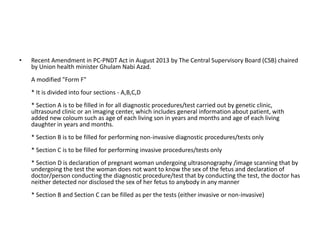
• The Central Supervisory Board has laid down a representative list of 
indications for ultrasound during pregnancy (new Form F under the 
amended Rules) 
• The conduct of pre-natal diagnostic techniques is further permissible if the 
person qualified is satisfied for reasons to be recorded in writing that any 
of the following conditions exist: 
– Age of the pregnant woman is above thirty-five years; 
– Pregnant woman has undergone two or more spontaneous abortions or foetal 
loss; 
– Pregnant woman has been exposed to potentially teratogenic agents such as 
drugs, radiation, infection or chemicals; 
– The pregnant woman or her spouse has a family history of mental retardation 
or physical deformities such as, spasticity or any other genetic disease; 
– Any other condition specified by the Central Supervisory Board. 
• The doctors conducting pre-natal diagnostic techniques should maintain 
proper documentation.
• Under the amendments it has been made mandatory that the 
person conducting ultrasonography on a pregnant woman shall 
keep complete record thereof in the clinic in such manner, as may 
be prescribed, and any deficiency or inaccuracy found therein shall 
amount to contravention of provisions of section 5 or section 6 
unless contrary is proved by the person conducting such 
ultrasongraphy. 
• Once the doctor follows all the necessary requirements under the 
law and does the necessary paperwork as mentioned below, he can 
have no fear from the law. 
• The woman must not only make sure that her consent is taken in 
case of invasive procedures but must ask for a copy of every 
document that she signs. If she does not understand anything she 
must ask for an explanation and it is her right to be told.
• Pre-implantation genetic diagnosis or a pre-natal diagnostic 
technique/test/procedure such as amniocentesis, chorionic villi 
biopsy, foetoscopy, foetal skin or organ biopsy or cordocentesis can 
be conducted: 
ONLY 
– After obtaining the written consent of the woman in the prescribed 
format in a language which she understands. The format for the 
written consent is provided in Form G under the Rules. 
– However, an exception is that where a Genetic Clinic has taken a 
sample of any body tissue or body fluid and sent it to a Genetic 
Laboratory for analysis or test, it shall not be necessary for the Genetic 
Laboratory to obtain a fresh consent in Form G. 
– Giving her a copy of the same; and 
– Explaining all known side and after effects of the procedures to the 
pregnant woman.
• Under the amended Rules, a distinction has been made 
between invasive and non-invasive techniques for the 
purpose of obtaining consent and the consent is required in 
the case of invasive techniques. 
• However, in case of ultrasonography, other documentation 
is now required. 
– Any person conducting ultrasonography/image scanning on a 
pregnant woman shall give a declaration on each report on 
ultrasonography/image scanning that he/she has neither 
detected nor disclosed the sex of foetus of the pregnant woman 
to any body. 
– The pregnant woman before undergoing ultrasonography/image 
scanning declare that she does not want to know the sex of her 
foetus.
• It is important to mention that the PNDT Act has an 
important link with the Medical Termination of 
Pregnancy Act, 1971 (hereinafter referred to as the 
MTP Act). Prior to 1971, abortions were considered 
illegal in our country and in fact the same could be 
punishable under the Indian Penal Code. In 1971, the 
MTP Act was passed which provides for the 
termination of certain pregnancies by registered 
medical practitioners (as defined under the MTP Act). 
Thus it is clear that abortion is not provided for in all 
cases of pregnancy but only in case of certain 
pregnancies.
• Under the Act, termination of pregnancy is possible where: 
– The length of the pregnancy does not exceed twelve weeks; 
– The length of the pregnancy exceeds twelve weeks but does 
not exceed twenty weeks: in this case the opinion of two 
registered medical practitioners in favour of the termination of 
the pregnancy is essential. 
ONLY 
• If the continuance of the pregnancy would involve a RISK to 
the life of the pregnant woman or of grave injury to her 
physical or mental health27; or 
• If there is a substantial risk that if the child were born, it 
would suffer from such physical or mental abnormalities as 
to be seriously handicapped.
• It has been clarified under the Act that where 
the pregnancy is alleged to have been caused 
by rape, the anguish caused by such 
pregnancy shall be presumed to constitute a 
grave injury to the mental health of the 
pregnant woman. 
• Thus, pregnancy due to rape can be validly 
terminated.
• Further, where the pregnancy occurs as a result 
of failure of any device or method used by any 
married woman or her husband for the purpose 
of limiting the number of children, the anguish 
caused by such unwanted pregnancy may be 
presumed to constitute a grave injury to the 
mental health of the pregnant woman. 
• Thus, failure of methods of family planning could 
also give rise to a ground for termination of the 
pregnancy.
• While considering whether the continuance of 
pregnancy would involve risk or injury to the health of 
the pregnant woman, account may be taken of the 
pregnant woman’s actual or reasonable foreseeable 
environment. 
• There is another provision under which the pregnancy 
can be terminated validly irrespective of the length of 
the pregnancy and the opinion of two registered 
medical practitioners. In this case, the registered 
medical practitioner should be of the opinion, formed 
in good faith that the termination of the pregnancy is 
immediately necessary to save the life of the 
pregnant woman.
• The opinion of the registered medical practitioners 
should be formed in good faith. Such opinion has to be 
certified in Form I under the MTP Regulations framed 
under the Act. 
• In this form the reasons for forming the opinion also 
have to be stated. Further every registered medical 
practitioner who terminates any pregnancy is required 
within three hours from the termination of the 
pregnancy to certify such termination in the said form 
where again the reason for terminating the pregnancy 
has to be specified.
• It is clear from what is above mentioned that termination 
of pregnancy is possible only in certain cases and where the 
pregnancy is more than 12 weeks old, opinion of two 
registered medical practitioners as defined under the MTP 
Act is essential, and then also abortion is possible only up 
to the twentieth week. 
• Through ultrasonography, which is the most commonly 
used technique for determination of the sex of the foetus, 
the sex of the foetus can be known only after the 14th 
week. Thus if a woman were to go in for abortion after 
getting to know the sex of the foetus, since it would be a 
second trimester pregnancy, opinion of two registered 
medical practitioners would be essential.
• The MTP Act further provides that the 
pregnancy cannot be terminated (except 
where the woman has not attained the age of 
18 years or she has attained the age of 18 
years but is a mentally ill person in which case 
the consent in writing of the guardian is to be 
taken) except with the consent of the 
pregnant woman. The form for the consent is 
provided in Form C under the MTP Rules 
framed under the MTP Act.
• To be put in a sealed envelope; 
• The envelope to be sent by the registered medical practitioner to 
the head of the hospital or owner of the approved place; 
• Safe-custody of the same by the latter; 
• A weekly statement of cases where medical termination of 
pregnancy has been done is required to be sent to the Chief 
Medical Officer by the head of the hospital or the owner of the 
approved place. This is to be done in Form II under the Regulations. 
• An admission register is to be maintained for recording therein the 
admissions of women for the termination of their pregnancies. 
• This is to be done in Form III under the Regulations.
• If all these records are duly maintained, with 
their aid the Appropriate Authorities can 
monitor the abortions that are being done. 
For instance, if there are too many cases 
referred by a particular doctor or the reasons 
stated are essentially the same, the real 
reason for the abortion may be traceable to a 
determination of the sex of the foetus.
• The Rules framed under the PNDT Act lay down 
certain other conditions for analysis or test and 
prenatal diagnostic procedures. Thus: 
– A Genetic Laboratory cannot accept for analysis or 
test any sample, unless referred to it by a Genetic 
Clinic; 
– Every pre-natal diagnostic procedure has to be 
immediately preceded by locating the foetus and 
placenta through ultrasonography; 
– The pre-natal diagnostic procedure shall be done 
under direct ultrasonographic monitoring so as to 
prevent any damage to the foetus and placenta.
A. Offence by persons 
B. Offence by a company:
A. Offence by persons 
I. If any person acts contrary to the prohibitions 
listed above, including under Sections 22(1) and 
22(2) relating to advertisement, he will be liable 
to be punished with: 
– Imprisonment which may extend to 3 years; and 
– Fine which may extend to Rs.10,000/-. 
Any subsequent conviction entails: 
– Imprisonment which may extend to 5 years; and 
– Fine which may extend to Rs.50,000/-
• Advertisement of any sort is banned and is 
punishable under the Act with 
– a fine of up to Rs.1 Lakh 
and/or 
– imprisonment for 5 years
II. In case of a person seeking the aid of the bodies 
or persons referred to above for sex selection or 
for conducting pre-natal diagnostic techniques 
on any pregnant woman for the purposes other 
than those specified in Section 4(2), he shall be 
liable to be punished with: 
– Imprisonment which may extend to three years; and 
– Fine which may extend to Rs.50,000/-. 
• Any subsequent conviction entails: 
– Imprisonment which may extend to 5 years; and 
– Fine which may extend to Rs.1 lakh.
III. In case of a registered medical practitioner, his 
name shall be reported by the Appropriate 
Authority to the State Medical Council 
concerned for taking necessary action: 
– Including temporary suspension of the MCI 
registration from the time of framing the case upto 
disposal; and 
– on conviction for the period of: 
• Five years for the first offence; 
• Permanently for the subsequent offence.
IV. Husband and relatives of the pregnant woman 
who undergoes a pre-natal diagnostic technique 
for the purposes other than those specified in 
sub-section (2) of section 4 shall be: 
– Presumed to have compelled the woman to undergo 
the pre-natal diagnostic technique unless the contrary 
is proved; and 
– Liable for abetment of offence under Section 23 (3); 
and 
– Punishable for the offence under Section 23 (3).
NOTE!!! 
• If the contrary is proved, the woman can also 
be likewise punished. 
• For the removal of doubts, it has been made 
clear under the amendments that the 
provisions of Section 23 (3) shall not apply to 
the woman who was compelled to undergo 
such diagnostic techniques or such selection.
V. If any person contravenes any provision of the Act or 
the Rules made thereunder for which no penalty has 
been specified, he will be liable to be punished with: 
– Imprisonment which may extend to three months; or 
– Fine which may extend to Rs.1000/-; or 
– With both. 
• Any subsequent contravention entails an additional 
fine which may extend to Rs.500/- for every day during 
which such contravention continues after conviction 
for the first such contravention.
• Even if a radiologist is attached on 
HONORARY/ NAMESAKE basis to a ultrasound 
clinic, he is equally responsible for any 
contraventions of provisions of PCPNDT law 
done in the center and thus is equally liable 
for punishment like imprisonment and fine.
• Onus of proving not-guilty is on 
radiologist/sonologist and NOT on the 
authorities. 
• This is similar to dowry or rape case where 
accused has to prove that he is not guilty. 
• In other criminal cases the prosecution has to 
prove that the accused is guilty.
B. Offence by a company: 
• A company: 
– Means any body corporate; 
– Includes a firm or other association of individuals. 
• In case of offence by a company: 
– Every person incharge of; and 
– Every person responsible to the company for the 
conduct of the business of the company at the time 
the offence was committed 
– The company shall all be deemed to be guilty and 
accordingly proceeded against and punished.
• The aforesaid is subject to the qualification that if any such 
person proves that the offence was committed without his 
knowledge or that he had exercise due diligence to prevent 
the commission of such offence, he may not be so liable. 
• If consent, connivance of or that it was attributable to any 
neglect on the part of: 
– Director and in relation to a firm, a partner in the firm 
– Manager 
– Secretary 
– Other officer 
they shall also be deemed to be guilty and accordingly 
proceeded against and punished.
The offences under the Act are: 
• Cognizable: This means that for such an 
offence the police officer may arrest without 
warrant. 
• Non-bailable: This means that the police 
cannot grant bail in such a case. 
• Non-compoundable: This means that the 
parties to the case cannot settle the case and 
decide not to prosecute.
Who Can Make A Complaint? 
• The Appropriate Authority concerned; 
• Any officer authorized in this behalf by the 
Central Government or State Government or the 
Appropriate Authority; 
• A person who has given notice of at least 15 days 
to the Appropriate Authority of the alleged 
offence and of his intention to make a complaint 
in the court i.e. if the Appropriate Authority fails 
to take action on the complaint made by a 
person, on the lapse of 15 days, that person can 
directly approach the court.
• Every public spirited person can activate the 
PNDT law for the violation of the same and 
he/she can seek the assistance of a lawyer, an 
NGO and even a group of persons can file a 
complaint together. 
• Once the complaint is made in the Court the 
public prosecutor will take on from there and 
the complainant need not be present on every 
date of hearing. 
Significantly “person” includes a social organization.
There is incentive of Rs. 20,000/- each 
for informers of violation of the PNDT 
Act.
• In such a case, the court, on demand by such 
person, may direct the Appropriate Authority 
to make available copies of the relevant 
records in its possession to such person. 
• The drafts of complaints that can be made by 
a public spirited person to the Appropriate 
Authority is shown in Annexure V 
The offence under the Act shall be tried only in a court of the Metropolitan Magistrate or a 
Judicial Magistrate of the First Class.
• The drafts of complaints that can be filed by 
the Appropriate Authority in court are 
annexed herewith as Annexure-VI.
• The reply that can be filed by the Appropriate 
Authority to an application for anticipatory 
bail is annexed as Annexure-VII.
Good Faith 
• No suit, prosecution or other legal proceeding 
shall lie against the Central or State Government 
or the Appropriate Authority or any officer 
authorized by them for anything which is in good 
faith done or intended to be done under the Act. 
• Thus the Appropriate Authority can perform its 
duties under the Act without any fear of any type 
of legal proceedings being initiated against 
him/her.
Major 
violations
Minor 
violations
INSTRUMENTALITIES 
FOR IMPLEMENTING 
THE ACT 
A. Policy Making Body 
B. Implementing 
Authorities
A. Policy Making Body 
• A Board is required to be constituted by the 
Central Government which is known as the 
Central Supervisory Board (hereinafter 
referred to as the Board). 
• The Act makes provision for inclusion of 
government officials, specialists as well as 
representatives of welfare organizations in this 
Board.
Accordingly the Board is to comprise of: 
a) Chairman (ex-officio) 
– The Minister in charge of the Ministry of Department of Family 
Welfare. 
b) Vice-Chairman (ex-officio) 
– The Secretary to the Government of India in charge of the Department 
of Family Welfare. 
c) Three members (ex-officio) appointed by the Central 
Government to represent the Ministries of Central Government in 
charge of 
– Women and Child Development, 
– Department of Legal Affairs or Legislative Department in the Ministry 
of Law and Justice, and 
– Indian System of Medicine and Homoeopathy. 
d) Director General of Health Services of the Central Government 
(ex-officio)
e) Ten members appointed by the Central 
Government, two each from amongst- 
1. Eminent medical geneticists; 
2. Eminent gynaecologists and obstetrician or expert of 
stri-roga or prasuti tantra; 
3. Eminent paediatricians; 
4. Eminent social scientists; and 
5. Representatives of women welfare organizations. 
f) Three women members of Parliament 
– two elected from Lok Sabha and 
– one from Rajya Sabha.
g) Four members appointed by the Central 
Government (on the recommendation of the 
respective State Government or of Union 
Territory) by rotation to represent the States 
and Union Territories. 
h) Member Secretary (ex-officio) 
– An officer, not below the rank of Joint Secretary 
or equivalent of the Central Government, in 
charge of Family Welfare.
• The Act also specifies the terms of the various 
members and prescribes the procedure for the 
meetings of the Board which is to be further provided 
for by regulations made by the Board. 
• It is mandatory for the Board to meet at least once in 
six months. 
• Importantly, if a person, in the opinion of the Central 
Government, has been associated with the use or 
promotion of pre-natal diagnostic technique for 
determination of sex or with any sex selection 
technique, he shall be disqualified from being 
appointed as a member of the Board.
• In the amendments it has been clarified that 
no member other than an ex-officio member 
shall be appointed for more than two 
consecutive terms.
Functions Of The Board 
• The functions of the Board as specified under the Act are: 
i. To advise the Central Government on policy matters relating to use 
of pre-natal diagnostic techniques, sex selection techniques and 
against their misuse; 
ii. To review and monitor implementation of the Act and the rules 
made thereunder and to recommend to the Central Government 
changes in both; 
iii. To create public awareness against the practice of pre-conception 
sex selection and pre-natal determination of sex of foetus leading 
to female foeticide; 
iv. To lay down code of conduct to be observed by persons working at 
Genetic Counselling Centres, Genetic Laboratories and Genetic 
Clinics; 
v. To oversee the performance of various bodies constituted under 
the Act and take appropriate steps to ensure its proper and 
effective implementation.
• The Board is also to perform any other functions 
as may be specified under the Act such as 
specifying abnormalities or diseases for which 
pre-natal diagnostic techniques can be conducted 
or the conditions which are necessary to exist 
before the conduct of these techniques. 
• Thus the Act envisages the Board as the main 
body which is to make recommendations on 
policy maters and on amendments that are 
necessary in the Act.
• The Supreme Court vide its order dated 4.5.2001 had 
also directed the Board to lay down a code of conduct 
under section 16 (iv) of the Act to be observed by 
persons working in bodies specified therein and to 
ensure its publication so that the public at large can 
know about it. 
• Pursuant to this, the Board has laid down a Code of 
Conduct to be observed by persons working at any of 
the facilities. This provides that all persons including 
the owner, employee or any other persons associated 
with facilities registered under the Act/the Rules shall-
Code of Conduct 
i. Not conduct or associate with, or help in carrying out detection or 
disclosure of sex of foetus in any manner; 
ii. Not employ or cause to be employed any person not possessing 
qualifications necessary for carrying out pre-natal diagnostic 
techniques/procedures and tests including ultrasonography; 
iii. Not conduct or cause to be conducted or aid in conducting by himself 
or through any other person any techniques or procedure for selection 
of sex before or after conception or for detection of sex of foetus except 
for the purposes specified in sub-section (2) of section 4 of the Act; 
iv. Not conduct or cause to be conducted or aid in conducting by himself 
or through any other person any techniques or test or procedure under 
the Act at a place other than a place registered under the Act/the Rules; 
v. Ensure that no provision of the Act and these Rules are violated in any 
manner;
vi. Ensure that the person conducting any techniques, test or 
procedure leading to detection of sex of foetus for purposes not 
covered under section 4(2) of the Act or selection of sex before or 
after conception is informed that such procedures lead to 
violation of the Act and the Rules which are punishable offences; 
vii. Help the law enforcing agencies in bringing to book the violators 
of the provisions of the Act and the Rules; 
viii. Display his/her name and designation prominently on the dress 
worn by him/her; 
ix. Write his/her name and designation in full under his/her 
signature; 
x. On no account conduct or allow/cause to be conducted female 
foeticide; 
xi. Not commit any other act of professional misconduct.
State Supervisory Board 
II. Under the amended provisions of the Act, a 
State Supervisory Board or the Union 
Territory Supervisory Board is required to be 
constituted by each State and Union 
Territory having a Legislature;
State/Union Territory Supervisory 
Board 
a) Chairperson, ex-officio 
– The Minister in charge of Health and Family Welfare in the State 
b) Vice- Chairperson, ex-officio 
– The Secretary in charge of the Department of Health and Family 
Welfare 
c) Secretaries or Commissioners in charge of ex-officio 
– Departments of Women and Child Development, 
– Social Welfare, 
– Law and 
– Indian System of Medicines and Homoeopathy, ex-officio, or their 
representatives; 
d) Director of Health and Family Welfare or Indian System of 
Medicines and Homoeopathy of the State Government,; 
e) Three women members of Legislative Assembly or Legislative 
Council
f) Ten members to be appointed by the State Government 
out of which two each shall be from the following 
categories: 
i. Eminent social scientists and legal experts; 
ii. Eminent women activists from non-governmental 
organizations or otherwise; 
iii. Eminent gynaecologists and obstetricians or experts of stri-roga 
or prasuti tantra; 
iv. Eminent paediatricians or medical geneticists; 
v. Eminent radiologists or sonologists; 
g) Member Secretary, ex-officio 
– An officer not below the rank of Joint Director in charge of 
Family Welfare
• The Act also specifies the terms of the various members 
other than ex-officio members as three years, co-opting of 
members and procedure for the meetings of the Board. 
• The number of co-opted members cannot exceed one-third 
of the total strength of the State Board. The co-opted 
members shall have the same powers and functions as 
other members, except the right to vote and shall abide by 
the rules and regulations. 
• It has been clarified that if a member of the Legislative 
Assembly or member of the Legislative Council who is a 
member of the State Board, becomes Minister or Speaker 
or Deputy Speaker of the Legislative Assembly or 
Chairperson or Deputy Chairperson of the Legislative 
Council, she shall cease to be a member of the State Board.
• It is mandatory for the Board to meet at least 
once in four months 
and 
• one-third of the total number of members of 
the State Board shall constitute the quorum.
The functions of the Board as specified 
are: 
i. To create public awareness against the practice of pre-conception 
sex selection and prenatal determination of sex of foetus leading 
to female foeticide in the State; 
ii. To review the activities of the Appropriate Authorities functioning 
in the State and recommend appropriate action against them; 
iii. To monitor the implementation of provisions of the Act and the 
rules and make suitable recommendations relating thereto, to the 
CSB; 
iv. To send such consolidated reports as may be prescribed in 
respect of the various activities undertaken in the State under the 
Act to the Board and the Central Government; and 
v. Any other functions as may be prescribed under the Act.
• The Act does not specify the time frame 
within which such Boards are to be 
constituted but as the Board has an important 
role with regard to policy matters and 
reviewing and monitoring the work of the 
other bodies in the State, it would further the 
implementation of the provisions of the Act if 
such Boards are set up as expediently as 
possible.
B. IMPLEMENTING AUTHORITIES 
The role of the implementation of the Act has been 
assigned to the appropriate authorities. The Appropriate 
Authorities are to function with the aid and advice of an 
Advisory Committee. Under the Act: 
• The Central Government is required to appoint one or 
more Appropriate Authorities for each of the Union 
territories; 
• The State Government is required to appoint one or 
more Appropriate Authorities for the whole or part of 
the States having regard to the intensity of the problem 
of pre-natal determination of sex leading to female 
foeticide;
• Under the amendments, a MULTI-MEMBER 
BODY has been provided as the State Appropriate 
Authority (or when appointed for the whole of 
the Union Territory) consisting of: 
– Chairperson 
• An officer of or above the rank of the Joint Director of Health 
and Family Welfare 
– An eminent woman representing women’s 
organization; and 
– An officer of Law Department of the State or the 
Union Territory concerned.
• Such authorities are to be constituted within 
three months of coming into force of the 
Amended Act and any vacancy occurring 
therein is required to be filled within three 
months of the occurrence.
• Under the directions of the Supreme Court, 
Appropriate Authorities are to be appointed at 
District and sub-district levels as well. 
– At the District level, the Chief Medical Officers or 
the Civil Surgeons have been designated as the 
Appropriate Authorities while 
– at the sub-district level, the practice varies from 
State to State.
Functions of the Appropriate 
Authority: 
• To grant, suspend or cancel the registration; 
• To enforce the standards for genetic counselling centre, 
genetic clinic and genetic laboratory. 
• To investigate complaints of breach of provisions of the 
Act and the Rules; 
• To take the complaints to the court. 
• To take appropriate legal action against the use of any 
sex selection technique by any person at any place, suo 
motu or brought to its notice and also to initiate 
independent investigations in such matter; 
• To create public awareness against the practice of sex 
selection or pre-natal determination of sex;
• To supervise the implementation of the 
provisions of the Act and rules; 
• To recommend to the CSB and State Boards 
modifications required in the rules in accordance 
with changes in technology or social conditions; 
• To take action on the recommendations of the 
Advisory Committee made after investigation of 
complaint for suspension or cancellation of 
registration
• While it is the function of the Appropriate 
Authority to take a complaint of breach of 
provisions of the Act and the Rules thereunder 
to the court, if the Appropriate Authority fails 
to act on the complaint within 15 days, a 
public spirited person can take the complaint 
to the court directly.
• Moreover the Appropriate Authority has been invested with the 
following POWERS, namely-a) 
Summoning of any person who is in possession of any information 
relating to violation of the provisions of this Act or the rules made 
thereunder; 
b) Production of any document or material object relating to clause 
(a); 
c) Issuing search warrant for any place suspected to be indulging in 
sex selection techniques or prenatal sex determination; and 
d) Any other matter which may be prescribed. 
• These provisions are meant to strengthen the hands of the 
Appropriate Authority while discharging its functions under the Act.
• Under the directions of the Supreme Court dated 4.5.2001, all State/Union 
Territory Appropriate Authorities are required to furnish quarterly returns 
to the Board giving a report on the implementation and working of the 
Act. 
• These returns are to cover information, inter alia about: 
i. Survey of bodies specified in Section 3 of the Act; 
ii. Registration of bodies specified in Section 3 of the Act including bodies 
using ultrasound machines; 
iii. Action taken against non-registered bodies operating in violation of Section 
3 of the Act, inclusive of search and seizure of records; 
iv. Complaints received by the Appropriate Authorities under the Act and 
action taken pursuant thereto; 
v. Number and nature of awareness campaigns conducted and results flowing 
therefrom. 
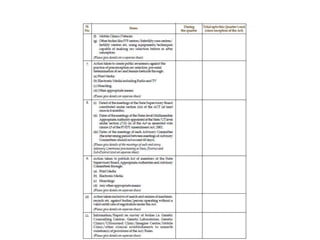
• The format of the quarterly report that is required to be submitted is 
herewith as Annexure-IX.
• The Act also provides for the appointment of 
an Advisory Committee by the Central or the 
State Government, as the case may be, to aid 
and advise the Appropriate Authority in the 
discharge of its functions.
The Advisory Committee 
• The Advisory Committee is to consist of: 
– Three medical experts from amongst 
gynecologists, obstetricians, pediatricians and 
medical geneticists; 
– One legal expert; 
– One officer to represent the information and 
publicity department of the respective 
government; 
– Three eminent social workers with at least one 
being a representative of a women’s organization.
• A person who has been associated with the use or 
promotion of pre-natal diagnostic techniques for 
determination of sex or sex selection shall be disqualified 
from appointment as a member of the Advisory 
Committee. 
• The intervening period between any two meetings of the 
Advisory Committee shall not exceed 60 days whether any 
application for registration or cancellation of the same is 
pending or not. 
• At every meeting of the Advisory Committee, four 
members shall form a quorum. Thus at least four members 
should be present for the meeting of the Advisory 
Committee to be held.
• Under the Rules specially framed in this 
behalf, the Appropriate Authority is required 
to attend the meeting of the Advisory 
Committee, provide all secretarial and other 
assistance to the Advisory Committee for the 
discharge of its functions, though the 
Appropriate Authority shall not have a right to 
vote in case of any difference of opinion 
amongst the members of the Advisory 
Committee and voting is done.
MAINTENANCE 
AND 
PRESERVATION 
OF RECORDS
• The Act and the Rules also deal elaborately with the 
maintenance and preservation of records. 
• Maintenance of proper records has a dual advantage: 
– From the point of view of the centre or clinic or laboratory, if 
there is any complaint against them, through the records they 
can prove that their action was in accordance with the law and 
the rules. 
– From the point of view of the implementing authorities, while 
non-maintenance of proper records can itself give rise to a 
cause of action, the fact that proper records have not been 
maintained or that for certain cases no records have been 
maintained can be indicative of the fact that the centre or the 
clinic or the laboratory is conducting pre-natal diagnostic 
techniques for the purpose of determination of the sex of the 
foetus or in violation of the Act.
• Every Genetic Counselling Centre, Genetic 
Clinic or Genetic Laboratory, Ultrasound Clinic 
and Imaging Centre is required to maintain 
certain records:
Register 
• Register showing in serial order: 
– Names and addresses of men or women given 
genetic counselling and/or subjected to pre-natal 
diagnostic procedure or test; 
– Names of their spouses or fathers; 
– Date on which they first reported for such 
counselling, procedure or test.
• Further, 
– Record by every Genetic Counselling Centre of 
each woman counselled is to be as specified in 
FORM D under the Rules;
– Record by every Genetic Laboratory of each man 
or woman subjected to pre-natal diagnostic test is 
to be as specified in FORM E under the Rules;
• Record by every Genetic Clinic of each man or 
woman subjected to pre-natal diagnostic procedure 
is to be as specified in FORM F under the Rules
Other Kinds Of Records 
• Case records 
• Forms of consent 
• Laboratory results 
• Microscopic pictures 
• Sonographic plates or slides 
• Recommendations and letters
• A person conducting ultrasonography on a pregnant 
woman shall keep complete record thereof in the clinic in 
such manner, as may be prescribed, and if any deficiency or 
inaccuracy is found in the same, that would be treated as a 
contravention of provisions of section 5 or section 6 unless 
contrary is proved by the person conducting the 
ultrasonography. 
• Moreover every Genetic Counselling Centre, Genetic 
Laboratory, Genetic Clinic, Ultrasound Clinic and Imaging 
Centre shall send a complete report in respect of all pre-conception 
or pregnancy-related 
procedures/techniques/tests conducted by them in respect 
of each month by 5th day of the following month to the 
concerned Appropriate Authority.
• These records are required to be maintained for a period of 
two years from the date of completion of counselling , pre-natal 
diagnostic procedure or pre-natal diagnostic test 
or 
• in the event of any legal proceeding, till the final disposal 
of the legal proceeding. 
• In case the records are maintained on computer or other 
electronic equipment, a printed copy of the record is 
required to be taken and preserved after authentication by 
a person responsible for such record. 
• Records, at all reasonable times are to be made available 
for inspection to Appropriate Authority or person 
authorized by the Appropriate Authority on this behalf.
• The Appropriate Authority is to maintain a 
permanent record of: 
– Applications for grant of certificate of registration; 
– Applications for renewal of certificate of 
registration as specified in Form H under the 
Rules; 
– Letters of intimation of every change of employee, 
place, address and equipment installed.
SEARCH AND 
SEIZURE
• A search is an integral step in a criminal 
investigation. 
• Whenever an appropriate authority or any other 
authorised officer has reason to believe that an 
offence under the Act has been or is being 
committed, he may search for a genetic 
counselling centre, a genetic laboratory or genetic 
clinic or any other place which is suspected to be 
conducting pre-natal diagnostic techniques.
• The scope of the powers of the appropriate 
authority to search and seize is very wide and 
it includes the power to: 
– Enter freely into the place of search. 
– Search at all reasonable times.
• Examine and inspect all documents like: 
i. Registers 
ii. Records including consent forms, referral slips, 
charts, laboratory results, microscopic pictures 
iii. Forms 
iv. Books 
v. Pamphlets 
vi. Advertisements 
vii. Material objects like sonographic plates or slides 
viii. Equipment like ultrasonography machines, needles, 
foetoscope etc.
• Seize and seal any document, record, material 
object or equipment etc. if there is reason to 
believe that it may furnish evidence of 
commission of an offence punishable under 
the Act. 
• It has been clarified that ‘material object’ 
would include records, machines and 
equipments; and ‘seize’ and ‘seizure’ would 
include ‘seal’ and ‘sealing’ respectively.
• Under the amended Rules, it has been provided that every Genetic 
Counselling Centre, Genetic Laboratory, Genetic Clinic, Ultrasound 
Clinic, Imaging Centre, nursing home, hospital, institute or any 
other place where any of the machines or equipments capable of 
performing any procedure, technique or pre-natal determination of 
sex or selection of sex before or after conception is used, shall 
afford all reasonable facilities for inspection of the place, 
equipment and records to the Appropriate Authority in this behalf 
for registration of such institutions, by whatever name called, under 
the Act, or for detection of misuse of such facilities or 
advertisement therefore, or for selection of sex before or after 
conception, or for detection/disclosure of sex of foetus or for 
detection of cases of violation of the provisions of the Act in any 
other manner.
• Further the Appropriate Authority may seal 
and seize any offending equiment if the facility 
has not registered itself. 
• The Act has to be read in conjunction with the 
rules under the Act and the Code of Criminal 
Procedure to ensure that the search and 
seizure is done in a fair and non-arbitrary 
manner.
• There are certain safeguards or prerequisites 
to be followed during the search and seizure 
to ensure the aforementioned objective 
namely:
Search and Witnesses 
A. During the search at least two independent witnesses of the locality 
should be present; 
B. If no such persons are available or willing to be a witness to the search, 
then two such persons of another locality should be present; 
C. The search should be made in the presence of the two or more 
independent witnesses; 
D. The witnesses are to be selected by the appropriate authority or the 
officer duly authorised to conduct search; 
E. The witnesses so selected should be unprejudiced and uninterested as the 
object of the section is to ensure fair dealing and a feeling of confidence 
and security amongst public; 
F. The witnesses may be summoned by Court to appear as witnesses. 
G. Any person suspected of having any object on his person may also be 
searched. However, if such person is a woman then, the search can be 
done only by a female officer.
Seizure and Preparation of List 
A. A list of documents, records, material objects etc. 
seized during the search should be prepared in 
duplicate and both copies of such list shall be signed 
on every page by the appropriate authority or the 
officer authorised and the witnesses to the seizure; 
B. Assistance of your office staff can always be taken 
during the process of search and seizure; 
C. The list should be prepared at the place affecting the 
seizure and if it is not practicable to do so at the place 
affecting the seizure then for reasons to be recorded 
in writing it can be done in any other place but it has 
to be in the presence of the witnesses;
D. A copy of the list prepared must be handed over to the person 
from whose custody the document, record or material object etc. 
is being seized or his representative under acknowledgment or 
sent by registered post to him if he is not available at the place of 
effecting the seizure; 
E. The person from whose custody the document, record or material 
object etc. is being seized or his representative should be 
permitted to attend during the search and seizure; 
F. The appropriate authority or the officer duly authorised in this 
behalf may seize any document, material object, record or 
equipment and take the same into safe custody; 
G. It is preferable that along with the preparation of list of objects 
seized, a slip is made and pasted on each object seized along with 
the date, time and the signature of the witnesses;
H. After a list of seizure is prepared the same must be sent to 
the Magistrate having jurisdiction or incharge of the case 
within 24 hours of the seizure by the appropriate 
authority or officer duly authorised. Permission to retain 
the seized objects should be obtained from the Court. The 
owner of the seized object may make an application to 
the court for the release of the same. The court may do so 
after imposing conditions for custody and taking a bond to 
the effect that, the objects must not be misused for 
conducting sex-determination tests and that the objects 
must be produced in Court as and when required etc. 
I. Police aid can be taken if the appropriate authority 
apprehends a law and order problem during the process 
of search and seizure.
SEALING 
A. If any material object seized is perishable in nature 
then arrangements shall be made promptly by the 
appropriate authority or officer duly authorised for 
sealing, identification and preservation of the same 
and send the same to a facility for test if so required; 
B. And till such arrangements for safe removal are made 
the refrigerator or other equipment used by the 
Genetic Counselling Centre, Genetic Laboratory or 
Genetic Clinic for preservation of such material object 
seized shall be sealed; In case of such sealing it is 
important to mention the same in the list of seizure 
prepared;
C. If the search and seizure is not completed in a day 
then the appropriate authority or officer duly 
authorised may either seal the premises or mount a 
guard for safe keeping to prevent any tampering of 
the documents, records, material objects etc; 
D. After seizure the seized objects can be removed to 
your own premises or may be left in the custody of a 
respectable person of the locality. If it is not possible 
to remove the seized objects, they may be retained 
where they are found after taking a bond from the 
owner that the same would be produced before the 
court as and when required.
BUT………………. 
• The machines of the facility that are seized 
and sealed may be released if such 
organization pays penalty equal to five times 
of the registration fee to the Appropriate 
Authority concerned and gives an undertaking 
that it shall not undertake detection of sex of 
foetus.
• The appropriate authority is duty bound to 
maintain systematic records of the search and 
seizure and the same would also safeguard 
the appropriate authority against any 
allegations of abuse.
What are the steps one needs to take 
to deseal their machines? 
• If a show cause notice has been issued by 
authorities and the machine sealed, one 
needs to release the machine through the 
courts only.
Collection of Evidence 
• The evidence that needs to be collected in 
order to make out a case under the PNDT Act 
varies depending upon the nature of the 
violation and in some cases the pieces of 
evidence can overlap.
I. Illegal Advertisement 
• In case any genetic counselling centre, genetic 
laboratory, genetic clinic, ultrasound clinic or 
imaging centre advertises the facilities for pre-natal 
determination of sex or sex selection 
before or after conception, the advertiser, the 
distributor, the person or centre who issues or 
causes to be issued an advertisement for the 
aforementioned purpose will all be equally 
liable under the PNDT Act.
The documentary evidence will 
include: 
A. The paper cutting of the advertisement, the name of the newspaper or 
magazine or any other document which carries the advertisement, the 
date of the issuance of the advertisement; 
B. The name of the advertiser, his place of business; 
C. The name of the owner of the clinic, centre or laboratory issuing such 
advertisement, the address of the said centre, laboratory or clinic; 
D. The name of the distributor, his place of business ; 
E. The photograph of the advertisement, the photograph of the hoarding, 
board, wall on which the advertisement is present etc. 
F. The letter heads, memorandum of association, annual reports, 
statements showing organizational structure and ownership of the 
newspaper, or distributorship, or the centre. This information has to be 
collected in order to link the person to the violation. 
• The aforementioned list is not exhaustive but 
merely illustrative.
II. In case of conducting a test for determination of sex 
or communication of the sex of the foetus: 
• The investigation of cases of this nature is 
difficult because of the collusion between the 
doctor and the persons wanting the test. 
Nevertheless there are ways and means to 
collect evidence is such cases as well:
The documentary evidence will 
include: 
1) referral slips 
2) consent forms 
3) laboratory results 
4) microscopic pictures 
5) sonographic plates or slides 
6) registers containing names and addresses of patients and their 
families 
7) case history of the patient 
8) records of clients maintained on the computer or other electronic 
equipment can be taken on a floppy or a printed copy of the 
same 
9) floppy or printed copy of the ultrasound image of the foetus 
10) Receipt of fee paid for the test, details of cheque payment etc.
Oral and other evidence 
• Apart from documentary evidence, decoy witnesses namely pregnant 
women can also be sent to suspected centres to find out if pre-natal 
determination of sex is done. If it is found that such centres are 
conducting the tests the statements of such witnesses can be recorded by 
the appropriate authority. 
• Hidden tape recorders or cameras can also be used to record the 
conversation between the decoy witness and the doctor. When decoy 
witnesses are sent for getting the tests done then the Chief Medical 
Officer can at the same time raid the premises or inspect the premises 
and collect the evidence on the spot. As and when decoy witnesses are 
used their statement should be taken on affidavit that they are getting the 
tests done on humanitarian and on the grounds of public interest in order 
to assist the appropriate authority. 
• In some cases women may themselves complain that they were forced to 
get the sex of the foetus determined. Then that woman’s statement can 
be recorded and she can also be called as a witness to depose about the 
doctor, the centre and the family members who forced her to get the test 
done.
• There is incentive of Rs. 10,000/- each 
for decoy patients who help to nab 
violators of the Act.
III. In case of non-registration, cancellation 
or suspension of registration: 
• The collection of evidence in these cases is not 
very difficult as most of the records are 
available with the appropriate authority itself.
The documentary and oral evidence 
will include 
a) Copy of the registration certificate 
b) Copy of the affidavit given by the owner that he will not 
conduct pre-natal determination of sex. 
c) Copy of the particulars given about the qualifications of 
the employees while registration 
d) Documents collected from the MCI, the degree certificate 
of the medical practitioners (employees of the centre) 
etc. 
e) Statements of decoy witnesses 
f) The tape and video recording 
g) Other materials collected as evidence in case of 
conducting tests.
• The complete evidence to be submitted before the 
Magistrate would include: 
1. A copy of the complaint 
2. A statement showing the list of witnesses both of the 
search and seizure and decoy witnesses 
3. The report of the search and seizure or commonly called 
Panchnamah 
4. A copy of the all the documents collected. 
5. Statements of witnesses if any. 
6. Most essential would be the complete address of the 
genetic counselling centre, genetic clinic or genetic 
laboratory.
Conclusion 
• This malaise has taken root, and society needs to be 
warned that trying to detect the sex of the fetus is a crime. 
• This has to be done using wide-ranging methods including 
articles and interviews in the media, as well as in cinema 
halls and on television. 
• The awareness of this program should percolate deep 
down into societies and households, and the message that 
the guilty party could be imprisoned and jailed should 
come through. 
• A multipronged approach with cohesion between doctors, 
the government, and nongovernmental organizations 
(NGOs) is the way forward to improve the female sex ratio 
in our country.
Why save GIRL child?? 
• A HAPPY GIRL child is a 
future 
– Daughter 
– Sister 
– Friend 
– Wife 
– Mother 
– Grandmother…… 
• From Sita…. to Saina…. 
we have a legacy…..
Rakesh C A
• Recent Amendment in PC-PNDT Act in August 2013 by The Central Supervisory Board (CSB) chaired 
by Union health minister Ghulam Nabi Azad. 
A modified "Form F" 
* It is divided into four sections - A,B,C,D 
* Section A is to be filled in for all diagnostic procedures/test carried out by genetic clinic, 
ultrasound clinic or an imaging center, which includes general information about patient, with 
added new coloum such as age of each living son in years and months and age of each living 
daughter in years and months. 
* Section B is to be filled for performing non-invasive diagnostic procedures/tests only 
* Section C is to be filled for performing invasive procedures/tests only 
* Section D is declaration of pregnant woman undergoing ultrasonography /image scanning that by 
undergoing the test the woman does not want to know the sex of the fetus and declaration of 
doctor/person conducting the diagnostic procedure/test that by conducting the test, the doctor has 
neither detected nor disclosed the sex of her fetus to anybody in any manner 
* Section B and Section C can be filled as per the tests (either invasive or non-invasive)

Pcpndt act

  • 5.
    Serial No. State/UT 1 Kerala 1084 2 Puducherry 1038 3 Tamil Nadu 995 4 Andhra Pradesh 992 5 Chhattisgarh 991 Serial No. State/UT Female sex ration as per Census 2011 Female sex ratio as per Census 2011 1 Haryana 877 2 Delhi 866 3 Chandigarh 818 4 Dadra & Nagar Haveli 775 5 Daman & Diu 618
  • 7.
    Future doesn’t lookso bright!!!!
  • 8.
    Legal Action ToStop Female Foeticide
  • 10.
    CONTENTS I. History II. Definitions – Techniques – Places – Qualified Persons III. Registration – Procedure for Registration – Minimum Requirements for Registration – Process of Certification – Rejection of Application for Registration – Cancellation or Suspension of Registration – Provision for Appeal – Renewal of Registration – Rejection of Application for Renewal IV. Prohibitions A. Prohibitions A. On places B. On persons C. Miscellaneous – Prescriptions and Regulations – Penalties A. Offence by persons B. Offence by a company V. Instrumentalities for Implementing the Act – Policy Making Body – Implementing Authorities VI. Maintenance and Preservation of Records VII. Search and Seizure I. Search and Witnesses – Seizure and Preparation of List – Sealing – Collection of Evidence
  • 11.
    History • 1860 – Indian Penal Code, punishing causing of miscarriage and other like offences • 1978 – directive banning the misuse of amniocentesis in government hospitals/laboratories • 1985 – Dr. Sanjeev Kulkarni, Mumbai – Thesis of 200 sonography & abortion centres – Misuse of sonography machines for female foeticide • 1988 – Embryo testing restriction law, Maharashtra – Maharashtra Regulation of Pre-natal Diagnostic Techniques Act • 1994 (20thh September) – Pre-Natal Diagnostic Techniques (Regulation and Prevention of Misuse) Act • 2003 (14th Feb) – “The Pre-conception and Pre-natal Diagnostic Techniques (Prohibition of Sex Selection) Act.”
  • 12.
    DEFINITIONS – Techniques – Places – Qualified Persons
  • 13.
    Techniques • Pre-nataldiagnostic techniques include: – pre-natal diagnostic procedures and – pre-natal diagnostic tests.
  • 14.
    Pre-natal diagnostic procedures It mean all gynaecological or obstetrical or medical procedures such as: – Ultrasonography; – Foetoscopy; – Taking or removing samples of: • Amniotic fluid • Chorionic villi • Blood • Any tissue • Fluid of a man or a woman before or after conception for being sent to a Genetic Laboratory or Genetic Clinic for conducting any type of analysis or pre-natal diagnostic tests for selection of sex before or after conception.
  • 15.
    Pre-natal diagnostic tests B. Pre-natal diagnostic test means: – Ultrasonography – Test or analysis of: • Amniotic fluid • Chorionic villi • Blood • Any tissue • Fluid of any pregnant woman or conceptus conducted to detect: • Genetic disorders • Metabolic disorders • Chromosomal abnormalities • Congenital anomalies • Haemoglobinopathies • Sex-linked diseases.3
  • 16.
    Sex selection C.Sex selection includes: – Procedure – Technique – Test – Administration – Prescription – Provision of anything for the purpose of ensuring or increasing the probability that an embryo will be of a particular sex.
  • 17.
    Definitions – Techniques – Places – Qualified Persons
  • 18.
    Places • GeneticCounselling Centre • Genetic Clinic • Genetic Laboratory
  • 19.
    A. Genetic CounsellingCentre • An institute • Hospital • Nursing home • Any place by whatever name called which provides genetic counselling to patients.
  • 20.
    B. Genetic Clinic • A clinic • Institute • Hospital • Nursing home • Any place by whatever name called which is used for conducting pre-natal diagnostic procedures.
  • 21.
    • By anamendment to the Act of 1994, an explanation has been added to clarify the position of a ‘vehicle’. • It provides that for the purposes of this clause, a Genetic Clinic includes a vehicle, where ultrasound machine or imaging machine or scanner or other equipment capable of determining sex of the foetus or a portable equipment which has the potential for detection of sex during pregnancy or selection of sex before conception, is used.
  • 22.
    C. Genetic Laboratory • A laboratory; and • Includes a place where facilities are provided for conducting analysis or tests of samples received from Genetic Clinic for pre-natal diagnostic test.
  • 23.
    • An explanationhas been added by the amendments of 2002. The explanation provides that “for the purposes of this clause (definition of Genetic Laboratory), Genetic Laboratory includes a place where ultrasound machine or imaging machine or scanner or other equipment capable of determining sex of the foetus or a portable equipment which has the potential for detection of sex during pregnancy or selection of sex before conception, is used.”
  • 24.
    • It hasbeen clarified under the amended Rules that every Genetic Counselling Centre/ Genetic Laboratory/ Genetic Clinic would include an ultrasound centre/imaging centre/nursing home/hospital/institute or any other place, by whatever name called, where any of the machines or equipments capable of selection of sex before or after conception performing or performing any procedure, technique or test for pre-natal detection of sex of foetus is used.
  • 25.
    Definitions – Techniques – Places – Qualified Persons
  • 26.
    Qualified Persons A.Gynaecologist B. Medical Geneticist C. Paediatrician D. Registered Medical Practitioner E. Laboratory technician F. Radiologist G. Sonologist or Imaging Specialist
  • 27.
    A. Gynaecologist meansa person who possesses a post-graduate qualification in gynaecology and obstetrics. • The Rules framed under the Act further qualify the qualifications by providing additional requirements for a gynaecologist when employed by a genetic counselling centre or a genetic clinic but do not necessitate the engagement of a gynaecologist by a genetic laboratory.
  • 28.
    • For agenetic counselling centre, the gynaecologist must have – 6 months experience in genetic counselling ; or – 4 weeks training in genetic counselling . • For a genetic clinic, the gynaecologist should have adequate experience in pre-natal diagnostic procedures i.e. should have performed at least 20 procedures in chorionic villi aspirations per vagina or per abdomen, chorionic villi biopsy, amniocentesis, cordocentesis foetoscopy, foetal skin or organ biopsy or foetal blood sampling etc. under supervision of an experienced gynaecologist in these fields.
  • 29.
    B. Medical Geneticist includes a person who possesses: – Degree, or – Diploma in genetic science in the fields of sex selection and pre-natal diagnostic techniques or has experience of not less than two years in any of these fields after obtaining- – Any one of the medical qualifications recognized under the Indian Medical Council Act, 1956; or – A post-graduate degree in biological sciences. Under the amended definition, possessing a certificate does not make one a qualified medical geneticist.
  • 30.
    C. Paediatrician meansa person who possesses a post-graduate qualification in paediatrics. • The Rules framed under the Act further qualify the qualifications by providing additional requirements for a paediatrician when employed by a genetic counselling centre. • For a genetic counselling centre, the paediatrician must have – 6 months experience in genetic counselling; or – 4 weeks training in genetic counselling.
  • 31.
    D. Registered MedicalPractitioner – A medical practitioner who possesses any recognized medical qualification as defined in clause (h) of Section 2 of the Indian Medical Council Act, 1956; and – Whose name has been entered in a State Medical Register. • The Rules framed under the Act further qualify the qualifications by providing additional requirements for a registered medical practitioner when employed by a genetic clinic. • For the purposes of a genetic clinic the registered medical practition should have – post graduate degree or – diploma or – six months training or – one year experience in sonography or image scanning.
  • 32.
    • Besides, theAct and the Rules also refer to other types of personnel.
  • 33.
    E. Laboratory Technician For a genetic laboratory, there should be a laboratory technician having – B.Sc. degree in Biological Sciences; or – Degree or; – Diploma, in medical laboratory course; and • At least one year’s experience in conducting appropriate pre-natal diagnostic techniques, tests or procedures.
  • 34.
    F. Radiologist G.Sonologist or Imaging Specialist means a person who possesses- – Any one of the medical qualifications recognized under the Indian Medical Council Act, 1956; or – A post-graduate qualification in ultrasonography or imaging techniques or radiology.
  • 35.
    Are training coursesauthorised by the Govt of India? • Medical Council of India has been given guidelines by the Central Supervisory Board in their meeting held in Mumbai in Jan 2012, to create a 6 month Level I training course in Ultrasound for MBBS doctors. • This process is still a work in progress.
  • 36.
    Miscellaneous Definitions Certainmiscellaneous definitions have been added to clarify concepts used for the first time in the amended Act. These are:- A. Conceptus means any product of conception at any stage of development from fertilization until birth including extra embryonic membranes as well as the embryo or foetus. B. Embryo means a developing human organism after fertilization till the end of eight weeks (fifty-six days). C. Foetus means a human organism during the period of its development beginning on the fifty-seventh day following fertilization or creation (excluding any time in which its development has been suspended) and ending at the birth.
  • 38.
    • All bodiesunder the PNDT Act namely Genetic Counselling Centre, Genetic Laboratory or Genetic Clinic as defined in the preceding chapters, cannot function unless registered. • The requirement of registration is mandatory whether the body is government, private, voluntary, honorary, part-time, contractual or consultative. • However the PNDT Act allows registration of these bodies either separately or jointly when a body is for instance both a centre and a clinic.
  • 39.
    Procedure for Registration A. Every application for registration shall be made TO: – Chief Medical Officer of the district; or any other medical officer constituted as an appropriate authority – Medical officer constituted as appropriate authority for the sub-district within whose area or jurisdiction the centre, clinic or laboratory is situated. B. Every application shall be made in duplicate in Form A which is appended to the rules.
  • 43.
    • The ownerneeds to register, at least 3 months in advance, all the places where a USG machine, whether a black and white or color Doppler machine, is to be used; this applies to medical/surgical nursing homes/intensive cardiac care unit and wherever a USG machine is used. This registration is compulsory and is regardless of the type of studies intended to be performed on that machine, whether pregnancy scans, abdominal scans, or only 2D echocardiograms.
  • 44.
    C. Every applicationshall be duly accompanied by an AFFIDAVIT containing-i. An undertaking to the effect that the Genetic Centre/Laboratory/Clinic/ Ultrasound Clinic/Imaging Centre/combination thereof, as the case may be, shall not conduct any test or procedure, by whatever name called, for selection of sex before or after conception or for detection of sex of foetus except for diseases specified in Section 4(2) nor shall the sex of foetus be disclosed to any body; and ii. An undertaking to the effect that the Genetic Centre/Laboratory/Clinic/ combination thereof, as the case may be, shall display prominently a notice that they do not conduct any technique, test or procedure etc. by whatever name called, for detection of sex of foetus or for selection of sex before or after conception.
  • 45.
    D. The AppropriateAuthority or any authorised person will acknowledge the application in the acknowledgement slip provided at the bottom of Form A on the very same day if personally delivered, otherwise on the next day by post.
  • 47.
    E. Every applicationform shall be submitted along with an application fee of: a) Rs.3000.00 for Genetic Counselling Centre, Genetic Laboratory, Genetic Clinic, Ultrasound Clinic or Imaging Centre. b) Rs.4000.00 for an institute, hospital, nursing home, or any place providing jointly the service of a Genetic Counselling Centre, Genetic Laboratory, Genetic Clinic, Ultrasound Clinic or Imaging Centre or any combination thereof.
  • 50.
    • However, ifan application for registration has been rejected by the Appropriate Authority, no fee shall be required to be paid on re-submission of the application by the applicant for the same body within 90 days of rejection. But every subsequent application shall be accompanied by the prescribed fee. • Application fee once paid will not be refunded.
  • 51.
    F. The applicationfee shall be paid – By way of a demand draft – Drawn in favour of the Appropriate Authority – On any scheduled bank payable at the headquarters of the Appropriate Authority concerned.
  • 52.
    G. The feescollected by the Appropriate Authority for registration shall be deposited by the Appropriate Authority concerned in a bank account opened in the name of the official designation of the Appropriate Authority concerned.
  • 53.
    H. The feesso collected by the Appropriate Authority shall be utilized by the Appropriate Authority in connection with the activities connected with implementation of the provisions of the Act and these rules.
  • 54.
    Minimum Requirements for Registration • There are different minimum requirements for different bodies as regards minimum qualifications of the employees and the minimum equipment for each of the bodies under the PNDT Act. • All the requirements relating to qualifications and equipment are mandatory. • Under the amended Rules, the Schedules appended to the earlier Rules have been done away with and the requirements for a Genetic Counselling Centre, Genetic Laboratory and Genetic Clinic have been added under Rule 3 itself by redrafting the same though the requirements remain the same, more or less.
  • 55.
    A. Genetic CounsellingCentre: • The requirements for a Genetic Counselling Centre are enumerated in Rule 3(1) in the amended Rules. – The centre should have adequate space. – The centre should contain educational charts/models/equipments for carrying out genetic counselling. – The centre must have any one of the following employees namely: • A medical geneticist • A gynaecologist; or • A paediatrician having such qualifications and experience as mentioned previously.
  • 56.
    B. Genetic Laboratory • The requirements for a genetic laboratory are enumerated in Rule 3(2) in the amended Rules under the PNDT Act. – The laboratory should have adequate space for conducting the tests. – The laboratory should have or acquire such of the equipments as may be necessary to conduct chromosomal studies, biochemical studies and molecular studies from amongst those enumerated under the amended Rules. – The laboratory must have both a medical geneticist and a laboratory technician in its employment having such qualifications and experience as mentioned previously.
  • 57.
    C. Genetic Clinic • The requirements for a genetic clinic are enumerated in Rule 3(3) of the amended Rules under the PNDT Act. – The centre should have adequate space. – The clinic/ultrasound clinic/imaging centre should have or acquire such of the following equipments, as may be necessary for carrying out the tests or procedures: a) Equipment and accessories necessary for carrying out clinical examination by an obstetrician/gynaecologist b) An ultra-sonography machine including mobile ultrasound machine, imaging machine or any other equipment capable of conducting foetal ultrasonography. c) Appropriate catheters and equipment for carrying out chorionic villi aspirations per vagina or per abdomen. d) Appropriate sterile needles for amniocentesis or cordocentesis. e) A suitable foetoscope with appropriate accessories for foetoscopy, foetal skin or organ biopsy or foetal blood sampling shall be optional. f) Equipment for dry and wet sterilization g) Equipment for carrying out emergency procedures such as evacuation of uterus or resuscitation in case of need. h) Genetic Works Station.
  • 58.
    • The clinicmust have gynaecologist or sonologist, imaging specialist, Radiologist or Registered Medical Practitioner or medical geneticist in its employment having such qualifications and experience as mentioned previously. • The aforementioned requirements are minimum mandatory and each of these bodies can have more equipment, more number of employees etc. as long as they fulfill the necessary qualifications mentioned in the PNDT Act. • Documentary proof of requisite qualifications and experience as specified under the PNDT Act and rules of persons employed by the facility should be annexed with the application for registration. • The bodies can be owned by any person and he need not have the qualifications required under the Act as long as he has employees that fulfill the minimum qualifications required under the PNDT Act. If an institute, hospital, nursing home or any place provides services jointly of any of these bodies then such a place should fulfill the minimum requirements of both the bodies in order to be registered.
  • 59.
    Process of Certification a) Every application received by the appropriate authority will firstly be scrutinized by it and an enquiry into whether such body fulfills all the requirements under the PNDT Act will be done. b) An enquiry by the Appropriate Authority includes an inspection of the premises after giving due notice to the applicant. c) After the appropriate authority is satisfied that the applicant has fulfilled all minimum requirements, the application will be placed before the Advisory Committee. d) The Advisory Committee shall thereafter scrutinize the application and give its advice on the same to the appropriate authority. e) The Appropriate Authority after considering the advice will grant a certificate of registration. f) The certificate of registration shall be given in duplicate and in the form as prescribed in Form B under the PNDT Act. The grant of certificate of registration shall be communicated within 90 days from the date of receipt of application for registration.
  • 62.
    f) It ismandatory for everybody registered under this Act to display the certificate of registration at a conspicuous place in such centre, laboratory or clinic.
  • 63.
    g) In somecases the appropriate authority depending upon the requirements available at such centre, laboratory or clinic may grant a certificate only to conduct one or more specified prenatal diagnostic tests or procedures. h) The certificate of registration shall be non-transferable.
  • 64.
    i) In theevent of change of ownership or change of management or when the centre, laboratory or clinic ceases to function as one both copies of certificate of registration shall be surrendered to the Appropriate Authority. j) Each new owner or manager of a centre, laboratory or clinic has to apply afresh for grant of certificate of registration.
  • 65.
    k) All centres,laboratories and clinics registered under the PNDT Act shall give an affidavit affirming that they will not indulge in pre-natal determination of sex as mandated by the Supreme Court in the case of CEHAT & Ors v. Union of India. l) The Registration Certificate must mention the number of ultrasound machines in the centre. Further the registration certificate must also mention all the portable ultrasound machines in the said centre. In case of registration certificates already issued, the list of ultrasound machines portable or otherwise must be mentioned on another paper and the said paper must also be displayed along with the registration certificate at a conspicuous place in the centre.
  • 66.
    Rejection of Applicationfor Registration • If after enquiry and after giving an opportunity of hearing to the applicant and after taking advise from the Advisory Committee the Appropriate Authority has come to a conclusion that the applicant has not complied with the requirements of the Act then the said application will be rejected. • The reasons for the rejection shall be given in writing and as specified in Form C appended to the Rules under PNDT Act. • The rejection of registration shall be communicated to the applicant within 90 days from the date of the receipt of the registration.
  • 68.
    Cancellation or Suspensionof Registration • The Appropriate Authority can at any time either on its own or on a complaint by anyone issue a show cause notice to the Genetic Counselling Centre, Genetic Laboratory or Genetic Clinic, Ultrasound Clinic or Imaging Centre as to why its registration should not be cancelled or suspended for breach of any of the provisions of the PNDT Act or the rules. The reasons for every such notice should be mentioned in the notice itself. • Thereafter the clinic, laboratory or centre must be given an opportunity to defend itself against the charges. After giving the centre, laboratory or clinic a reasonable opportunity of being heard and after taking into account the advice given by the Advisory Committee, the Appropriate Authority may either suspend the registration of such a place or cancel the registration depending upon the gravity of the charge. Action can be taken by the Appropriate Authority irrespective of any criminal action that will be taken against such a place. • In certain exceptional cases like in the case of public interest the Appropriate Authority may suspend or cancel registration without issuing a show cause notice. However the reasons for waiving show cause notice have to be given in writing.
  • 69.
    Provision for Appeal • Any genetic counselling centre, genetic laboratory or genetic clinic may appeal against an order of cancellation or suspension of registration within 30 days of the order of cancellation or suspension. • The appeal may be made to: – The Appropriate Authority at the district level if the order is passed by the Appropriate Authority at sub-district level. – The Appropriate Authority at the State/UT level if the order is passed by the Appropriate Authority at district level. • Each appeal shall be disposed of by the District Appropriate Authority or by the State/UT Appropriate Authority, as the case may be, within 60 days of its receipt.
  • 70.
    • Thus ahierarchy of appellate bodies has been provided and further the time limit for disposing of the appeals has been laid down. • Moreover the appeal shall be made to the Central Government if the order is passed by the Central Appropriate Authority. • The appeal shall be made to the State government if the order is passed by the State Appropriate Authority. • If the appeal is not made within the time as prescribed above, the Appropriate Authority may condone the delay in case he/she is satisfied that appellant was prevented for sufficient cause from making such appeal.
  • 71.
    Renewal of Registration A. Every certificate of registration shall be valid for a period of five years since its issuance. B. Thirty days before the date of expiry of the certificate of registration a fresh application for a certificate of Registration should be made.(ideally 3 months) C. The application for renewal must be made in duplicate in the prescribed Form A (same as the one prescribed for obtaining the first registration certificate) to the Appropriate Authority.
  • 73.
    D. The AppropriateAuthority shall acknowledge the receipt of the application in the acknowledgement slip provided at the bottom of Form A on the very same day if personally delivered, otherwise on the next day by post.
  • 75.
    E. Along withthe application for renewal of certificate, registration fees of half of what was initially payable will be paid depending upon whether it is for a genetic counselling centre, genetic laboratory or genetic clinic, ultrasound clinic or imaging centre or for a joint facility.
  • 76.
    F. After thereceipt of the application the Appropriate Authority will hold an enquiry including an inspection of the premises after giving due notice into whether the applicant has fulfilled all the requirements necessary under the Act. The Appropriate Authority will also give the applicant a hearing. G. After conducting the enquiry and hearing if the Appropriate Authority finds everything satisfactory then it will place the application before the Advisory Committee for its scrutiny. H. Thereafter having regard to the advice of the Advisory Committee the Appropriate Authority will renew the certificate of registration in the prescribed Form B (same as the one prescribed for the first registration certificate) for a further period of 5 years starting from the date of expiry of the old certificate.
  • 78.
    I. On thereceipt of the renewed certificate of registration in duplicate, the two copies of the earlier certificates will have to be surrendered immediately to the Appropriate Authority. J. One copy of the renewed certificate has to be displayed in a conspicuous place of the centre, laboratory or clinic. K. If the Appropriate Authority fails to renew the certificate of registration within 90 days of its receiving the application for renewal, it will amount to automatic renewal or deemed renewal
  • 79.
    Rejection of Applicationfor Renewal • After conducting an enquiry into the application for renewal, after hearing the applicant and after taking the advice of the Advisory Committee if the Appropriate Authority finds that the applicant has not complied with the requirements of the Act then the Appropriate Authority can reject the application for renewal. • Every order of rejection will contain reasons for rejection and it will be communicated in the prescribed Form C. (same as the one prescribed for the initial rejection)
  • 81.
    • Once theapplicant receives the communication of rejection the applicant must immediately surrender both the copies of the earlier certificate of registration. • In case the appropriate authority fails to communicate its rejection to the applicant within 90 days of receiving the application for renewal then it amounts to automatic renewal or deemed renewal.
  • 82.
    Note!!! In caseof defence establishments, applications for registration have to be submitted to the Appropriate Authorities specifically notified for defence establishments who are otherwise responsible for the implementation of the Act in their areas. If the machines are lying packed or are not in use, then also registration is mandatory because requirement of registration arises by the very possession of the machines.
  • 83.
    Is there arestriction on portable ultrasound devices ? • The Maharashtra State Branch of IRIA challenged the ban being imposed by the Municipal Corporation of Mumbai on the use of portable machines before the Hon'ble High Court Mumbai, which petition came to be dismissed and the judgment in the petition means that the portable machine can now be used only in the institute or hospital where it is registered thereby restricting the portability of the portable USG
  • 84.
    • Do MRImachines need to be registered? • Yes, they need to be registered and all changes to be notified to the AA • Do CT scan machines need to be registered? • Yes, they need to be registered and all changes to be notified to the AA
  • 85.
    • The IRIAhas filed a petition before the Hon'ble High Court Delhi, whereby a few provisions of the PC-PNDT Act have been challenged, such as the registration given to other faculty members, the mode of training imparted. • The said petition is still pending……
  • 87.
    PROHIBITIONS • ThePNDT Act is a comprehensive piece of legislation which prohibits sex selection before or after conception and misuse of pre-natal diagnostic techniques for determination of the sex of the foetus, leading to female foeticide as also advertisements in relation to such techniques for detection or determination of sex. • The Act also specifies the punishment for violation of its provisions. Accordingly, the Act imposes the following:
  • 88.
    ON PLACES •No genetic counselling centre or genetic clinic or genetic laboratory shall – Conduct; or – Associate with; or – Help in conducting pre-natal diagnostic techniques unless registered. Moreover the Registration certificate has to be displayed prominently on a board in such place.
  • 89.
    • No geneticcounselling centre or genetic clinic or genetic laboratory shall – Employ or cause to be employed or take services of any person, whether on honorary basis or on payment who does not possess prescribed qualifications. A qualified person could be: • Gynaecologist • Medical Geneticist • Paediatrician • Registered Medical Practitioner • Radiologist • Sonologist • Imaging Specialist who fulfils the requirements laid down under the Act
  • 90.
    • No geneticcounselling centre or genetic clinic or genetic laboratory shall – Conduct or cause to be conducted a pre-natal diagnostic technique except for the purposes specified in the Act. – Conduct or cause to be conducted a pre-natal diagnostic technique including an ultrasonography for the purpose of determining the sex of the foetus.
  • 91.
    Every genetic counsellingcentre or genetic clinic or genetic laboratory is required to display prominently a notice in English and in the local language or languages that conduct of sex-determination tests/disclosure of sex of the foetus is prohibited.
  • 92.
    B. ON PERSONS • No person shall open any genetic counselling centre, genetic clinic or genetic laboratory including clinic, laboratory or centre having ultrasound or imaging machine or scanner or any other technology capable of undertaking determination of sex of foetus and sex selection unless such centre, clinic or laboratory is duly registered separately or jointly. • No qualified person shall conduct or aid in conducting himself or through any other person a pre-natal diagnostic technique at any place other than the place registered.
  • 93.
    Illustration A. Noone can conduct a pre-natal diagnostic technique at home, unless the facility at home is also registered. B. No one can conduct a pre-natal diagnostic technique either on a voluntary basis, or on a charitable basis unless the body is registered after meeting all necessary qualifications of persons, place and equipment.
  • 94.
    • Any changesin the center (e.g., change in machine or place of use) should be intimated to the AA 30 days in advance. • Any change of the doctor operating the machine should be intimated to the AA within 30 days.
  • 95.
    • No personshall render any services to any facility, after the commencement of the Pre-natal Diagnostic Techniques (Regulation and Prevention of Misuse) Amendment Act, 2002 unless such facility is duly registered under the Act. • No person including a relative or husband of the pregnant woman shall seek or encourage the conduct of any pre-natal diagnostic techniques on her except for the purposes specified in clause (2) of Section 4 of the Act. • No person including a relative or husband of a woman shall seek or encourage the conduct of any sex-selection technique on her or him or both. • No person shall conduct or cause to be conducted any pre-natal diagnostic technique including ultrasonography for purpose of sex determination.
  • 96.
    • In facta good doctor should counsel the patient that sex-determination is illegal and should also positively propagate about the girl child. • A doctor is highly regarded in the society and any counselling by him/her will have great impact in the implementation of the Act.
  • 97.
    • No person,including a specialist or a team of specialists in the field of infertility, shall conduct or cause to be conducted or aid in conducting by himself or by any other person, sex selection on a woman or a man or on both or on any tissue, embryo, conceptus, fluid or gametes derived from either or both of them. • No person shall, by whatever means, cause or allow to be caused selection of sex before or after conception. • No person including the person conducting a pre-natal diagnostic procedures shall communicate to the pregnant woman concerned or her relatives or any other person the sex of the foetus by words, signs or in any other manner whatsoever.
  • 98.
    Illustration A. Dr.Sirisha tells Ramu it is time to celebrate, give me a packet of sweets. This is illegal as indirectly the doctor is communicating to the father that it is a baby boy. B. Dr. Deepthi told Geeta, “Oh! your shoulders have become heavy now”. This is also illegal as the same indirectly conveys the fact that it is baby girl. C. Dr Sreedhar used to tell all his patients “You see I have all the latest techniques from America, I can tell the sex of the child within 10 weeks of pregnancy”. In every case the doctor used to tell his patients it was a girl and his wife Mrs. Sreedhar used to conduct the abortions the very next day. Dr. Sreedhar’s actions are in clear violation of the PNDT law. Dr. Sreedhar’s actions also amount to misrepresentation and fraud. D. Dr. Preetham never told his patients anything, he used raise his left eyebrow when it was a boy and right eyebrow when it was a girl. Dr. Preetham’s, actions though creative are also in violation of the PNDT law as the same amount to signs and gestures which is also prohibited.
  • 99.
    • The CentralSupervisory Board has laid down a code of conduct under section 16 (iv) of the Act to be observed by persons working in bodies specified therein and as such the same has to be strictly followed.
  • 100.
    Can one arrangefor a locum sonologist when one is on leave or vacation? • One has to give one month notice for the same to local AA with a letter, and copy of certificates of that doctor. • A recent Gazette notification has stated that application for locum to adding a doctor's name to the Registration Certificate needs to be done 30 days in advance; • This gazette has been challenged by IRIA in Delhi High Court in July 2012, and interim relief has been given of 7 days.
  • 101.
    C. MISCELLANEOUS •No person, organization, Genetic Counselling Centre, Genetic Laboratory or Genetic Clinic, including clinic, laboratory or centre having ultrasound machine or imaging machine or scanner or any other technology capable of undertaking determination of sex of foetus or sex selection shall issue, publish, distribute, communicate or cause to be issued, published, distributed or communicated any advertisement, in any form, including internet, regarding facilities of pre-natal determination of sex or sex selection before conception available at such centre, laboratory, clinic or at any other place.
  • 102.
    Illustration A. “SpendRs.5000 now and save Rs.5 lakhs later. Contact Dr. Ahmed of Ahmed Diagnostic Center.” This advertisement is illegal as it advertises facilities for sex determination. B. “Urine test now and result known immediately whether boy or girl.” This advertisement is also clearly illegal. C. “Want to know – boy or girl, quick and easy. No surgery required.” This advertisement is clearly illegal.
  • 103.
    • No person,organization including Genetic Counselling Centre, Genetic Laboratory or Genetic Clinic shall issue, publish, distribute, communicate or cause to be issued, published, distributed or communicated any advertisement, in any manner regarding pre-natal determination or pre-conception selection of sex by any means whatsoever, scientific or otherwise.
  • 104.
    Illustration A. Amagazine published in America but distributed by AB Co in India, with its office in Delhi carries an advertisement for sex-determination. Such an action on the part of the company in Delhi is in violation of the Act. • Advertisement includes any notice, circular, label, wrapper or other document including advertisement through internet or any other media in electronic or print form and also includes any visible representation made by means of any hoarding, wall-painting, signal, light, sound, smoke or gas. B. Wrappers of Saritha Milk food with a colorful picture of a baby boy— if you want a baby boy contact Saritha Diagnostic Centre and they will help you, otherwise money back guaranteed. This is clearly illegal.
  • 105.
    • No personshall sell, distribute, supply, rent, allow or authorize the use of any ultrasound machine or imaging machine or scanner or any other equipment capable of detecting sex of foetus whether on payment or otherwise to any Genetic Counselling Centre, Genetic Laboratory, Genetic Clinic or any other person or body not registered under the Act. • “Person” includes manufacturer, importer, dealer or supplier of ultrasound machines/imaging machines or any other equipment capable of detecting sex of foetus” as also any organization including a commercial organization.
  • 106.
    Further the providerof such machine/equipment to any person/body registered under the Act shall: a) send to the concerned State/UT Appropriate Authority and to the Central Government, once in three months a list of those to whom the machine/equipment has been provided; and b) take an affidavit from such body or person purchasing or getting authorization for using such machine/equipment that the machine/equipment shall not be used for detection of sex of foetus or selection of sex before or after conception.
  • 107.
    Is there arestriction on the number of places a Sonologist can visit ? • As per the recent gazette dated 5 June 2012, a sonologist can visit only 2 places in one district. • This gazette has been challenged in Delhi High Court by IRIA and ad-interim stay has been obtained. • It has also been challenged in Mumbai High Court by Dr Rajeev Zankar, and ad-interim stay has been given until next hearing in October. – In the next hearing, the appropriate authority informed the court that they were unconditionally withdrawing the restriction on number of places visited by a radiologist.
  • 108.
    Prescriptions and Regulations • The PNDT law is a prohibitory and regulatory statute; it seeks to put in place a mechanism which prohibits sex selection while preventing the misuse and over-use of the pre-natal diagnostic techniques. • At the same time, the Act permits and regulates the use of such techniques for the purpose of detection of specific genetic abnormalities or disorders and for the larger benefit of mankind. • The Act further permits the use of such techniques only under certain conditions by the registered bodies. • The PNDT Act prohibits the conduct of pre-natal diagnostic techniques for determination of the sex of the foetus but allows the conduct of pre-natal diagnostic techniques for purposes that have also been specified under the Act.
  • 109.
    • These arefor detection of: – Chromosomal abnormalities; – Genetic metabolic diseases; – Haemoglobinopathies; – Sex-linked genetic diseases; – Congenital anomalies; – Other abnormalities or diseases as specified by the Central Supervisory Board.
  • 110.
    • The CentralSupervisory Board has laid down a representative list of indications for ultrasound during pregnancy (new Form F under the amended Rules) • The conduct of pre-natal diagnostic techniques is further permissible if the person qualified is satisfied for reasons to be recorded in writing that any of the following conditions exist: – Age of the pregnant woman is above thirty-five years; – Pregnant woman has undergone two or more spontaneous abortions or foetal loss; – Pregnant woman has been exposed to potentially teratogenic agents such as drugs, radiation, infection or chemicals; – The pregnant woman or her spouse has a family history of mental retardation or physical deformities such as, spasticity or any other genetic disease; – Any other condition specified by the Central Supervisory Board. • The doctors conducting pre-natal diagnostic techniques should maintain proper documentation.
  • 111.
    • Under theamendments it has been made mandatory that the person conducting ultrasonography on a pregnant woman shall keep complete record thereof in the clinic in such manner, as may be prescribed, and any deficiency or inaccuracy found therein shall amount to contravention of provisions of section 5 or section 6 unless contrary is proved by the person conducting such ultrasongraphy. • Once the doctor follows all the necessary requirements under the law and does the necessary paperwork as mentioned below, he can have no fear from the law. • The woman must not only make sure that her consent is taken in case of invasive procedures but must ask for a copy of every document that she signs. If she does not understand anything she must ask for an explanation and it is her right to be told.
  • 112.
    • Pre-implantation geneticdiagnosis or a pre-natal diagnostic technique/test/procedure such as amniocentesis, chorionic villi biopsy, foetoscopy, foetal skin or organ biopsy or cordocentesis can be conducted: ONLY – After obtaining the written consent of the woman in the prescribed format in a language which she understands. The format for the written consent is provided in Form G under the Rules. – However, an exception is that where a Genetic Clinic has taken a sample of any body tissue or body fluid and sent it to a Genetic Laboratory for analysis or test, it shall not be necessary for the Genetic Laboratory to obtain a fresh consent in Form G. – Giving her a copy of the same; and – Explaining all known side and after effects of the procedures to the pregnant woman.
  • 114.
    • Under theamended Rules, a distinction has been made between invasive and non-invasive techniques for the purpose of obtaining consent and the consent is required in the case of invasive techniques. • However, in case of ultrasonography, other documentation is now required. – Any person conducting ultrasonography/image scanning on a pregnant woman shall give a declaration on each report on ultrasonography/image scanning that he/she has neither detected nor disclosed the sex of foetus of the pregnant woman to any body. – The pregnant woman before undergoing ultrasonography/image scanning declare that she does not want to know the sex of her foetus.
  • 115.
    • It isimportant to mention that the PNDT Act has an important link with the Medical Termination of Pregnancy Act, 1971 (hereinafter referred to as the MTP Act). Prior to 1971, abortions were considered illegal in our country and in fact the same could be punishable under the Indian Penal Code. In 1971, the MTP Act was passed which provides for the termination of certain pregnancies by registered medical practitioners (as defined under the MTP Act). Thus it is clear that abortion is not provided for in all cases of pregnancy but only in case of certain pregnancies.
  • 116.
    • Under theAct, termination of pregnancy is possible where: – The length of the pregnancy does not exceed twelve weeks; – The length of the pregnancy exceeds twelve weeks but does not exceed twenty weeks: in this case the opinion of two registered medical practitioners in favour of the termination of the pregnancy is essential. ONLY • If the continuance of the pregnancy would involve a RISK to the life of the pregnant woman or of grave injury to her physical or mental health27; or • If there is a substantial risk that if the child were born, it would suffer from such physical or mental abnormalities as to be seriously handicapped.
  • 117.
    • It hasbeen clarified under the Act that where the pregnancy is alleged to have been caused by rape, the anguish caused by such pregnancy shall be presumed to constitute a grave injury to the mental health of the pregnant woman. • Thus, pregnancy due to rape can be validly terminated.
  • 118.
    • Further, wherethe pregnancy occurs as a result of failure of any device or method used by any married woman or her husband for the purpose of limiting the number of children, the anguish caused by such unwanted pregnancy may be presumed to constitute a grave injury to the mental health of the pregnant woman. • Thus, failure of methods of family planning could also give rise to a ground for termination of the pregnancy.
  • 119.
    • While consideringwhether the continuance of pregnancy would involve risk or injury to the health of the pregnant woman, account may be taken of the pregnant woman’s actual or reasonable foreseeable environment. • There is another provision under which the pregnancy can be terminated validly irrespective of the length of the pregnancy and the opinion of two registered medical practitioners. In this case, the registered medical practitioner should be of the opinion, formed in good faith that the termination of the pregnancy is immediately necessary to save the life of the pregnant woman.
  • 120.
    • The opinionof the registered medical practitioners should be formed in good faith. Such opinion has to be certified in Form I under the MTP Regulations framed under the Act. • In this form the reasons for forming the opinion also have to be stated. Further every registered medical practitioner who terminates any pregnancy is required within three hours from the termination of the pregnancy to certify such termination in the said form where again the reason for terminating the pregnancy has to be specified.
  • 121.
    • It isclear from what is above mentioned that termination of pregnancy is possible only in certain cases and where the pregnancy is more than 12 weeks old, opinion of two registered medical practitioners as defined under the MTP Act is essential, and then also abortion is possible only up to the twentieth week. • Through ultrasonography, which is the most commonly used technique for determination of the sex of the foetus, the sex of the foetus can be known only after the 14th week. Thus if a woman were to go in for abortion after getting to know the sex of the foetus, since it would be a second trimester pregnancy, opinion of two registered medical practitioners would be essential.
  • 122.
    • The MTPAct further provides that the pregnancy cannot be terminated (except where the woman has not attained the age of 18 years or she has attained the age of 18 years but is a mentally ill person in which case the consent in writing of the guardian is to be taken) except with the consent of the pregnant woman. The form for the consent is provided in Form C under the MTP Rules framed under the MTP Act.
  • 123.
    • To beput in a sealed envelope; • The envelope to be sent by the registered medical practitioner to the head of the hospital or owner of the approved place; • Safe-custody of the same by the latter; • A weekly statement of cases where medical termination of pregnancy has been done is required to be sent to the Chief Medical Officer by the head of the hospital or the owner of the approved place. This is to be done in Form II under the Regulations. • An admission register is to be maintained for recording therein the admissions of women for the termination of their pregnancies. • This is to be done in Form III under the Regulations.
  • 124.
    • If allthese records are duly maintained, with their aid the Appropriate Authorities can monitor the abortions that are being done. For instance, if there are too many cases referred by a particular doctor or the reasons stated are essentially the same, the real reason for the abortion may be traceable to a determination of the sex of the foetus.
  • 125.
    • The Rulesframed under the PNDT Act lay down certain other conditions for analysis or test and prenatal diagnostic procedures. Thus: – A Genetic Laboratory cannot accept for analysis or test any sample, unless referred to it by a Genetic Clinic; – Every pre-natal diagnostic procedure has to be immediately preceded by locating the foetus and placenta through ultrasonography; – The pre-natal diagnostic procedure shall be done under direct ultrasonographic monitoring so as to prevent any damage to the foetus and placenta.
  • 126.
    A. Offence bypersons B. Offence by a company:
  • 127.
    A. Offence bypersons I. If any person acts contrary to the prohibitions listed above, including under Sections 22(1) and 22(2) relating to advertisement, he will be liable to be punished with: – Imprisonment which may extend to 3 years; and – Fine which may extend to Rs.10,000/-. Any subsequent conviction entails: – Imprisonment which may extend to 5 years; and – Fine which may extend to Rs.50,000/-
  • 128.
    • Advertisement ofany sort is banned and is punishable under the Act with – a fine of up to Rs.1 Lakh and/or – imprisonment for 5 years
  • 129.
    II. In caseof a person seeking the aid of the bodies or persons referred to above for sex selection or for conducting pre-natal diagnostic techniques on any pregnant woman for the purposes other than those specified in Section 4(2), he shall be liable to be punished with: – Imprisonment which may extend to three years; and – Fine which may extend to Rs.50,000/-. • Any subsequent conviction entails: – Imprisonment which may extend to 5 years; and – Fine which may extend to Rs.1 lakh.
  • 130.
    III. In caseof a registered medical practitioner, his name shall be reported by the Appropriate Authority to the State Medical Council concerned for taking necessary action: – Including temporary suspension of the MCI registration from the time of framing the case upto disposal; and – on conviction for the period of: • Five years for the first offence; • Permanently for the subsequent offence.
  • 131.
    IV. Husband andrelatives of the pregnant woman who undergoes a pre-natal diagnostic technique for the purposes other than those specified in sub-section (2) of section 4 shall be: – Presumed to have compelled the woman to undergo the pre-natal diagnostic technique unless the contrary is proved; and – Liable for abetment of offence under Section 23 (3); and – Punishable for the offence under Section 23 (3).
  • 132.
    NOTE!!! • Ifthe contrary is proved, the woman can also be likewise punished. • For the removal of doubts, it has been made clear under the amendments that the provisions of Section 23 (3) shall not apply to the woman who was compelled to undergo such diagnostic techniques or such selection.
  • 133.
    V. If anyperson contravenes any provision of the Act or the Rules made thereunder for which no penalty has been specified, he will be liable to be punished with: – Imprisonment which may extend to three months; or – Fine which may extend to Rs.1000/-; or – With both. • Any subsequent contravention entails an additional fine which may extend to Rs.500/- for every day during which such contravention continues after conviction for the first such contravention.
  • 134.
    • Even ifa radiologist is attached on HONORARY/ NAMESAKE basis to a ultrasound clinic, he is equally responsible for any contraventions of provisions of PCPNDT law done in the center and thus is equally liable for punishment like imprisonment and fine.
  • 135.
    • Onus ofproving not-guilty is on radiologist/sonologist and NOT on the authorities. • This is similar to dowry or rape case where accused has to prove that he is not guilty. • In other criminal cases the prosecution has to prove that the accused is guilty.
  • 136.
    B. Offence bya company: • A company: – Means any body corporate; – Includes a firm or other association of individuals. • In case of offence by a company: – Every person incharge of; and – Every person responsible to the company for the conduct of the business of the company at the time the offence was committed – The company shall all be deemed to be guilty and accordingly proceeded against and punished.
  • 137.
    • The aforesaidis subject to the qualification that if any such person proves that the offence was committed without his knowledge or that he had exercise due diligence to prevent the commission of such offence, he may not be so liable. • If consent, connivance of or that it was attributable to any neglect on the part of: – Director and in relation to a firm, a partner in the firm – Manager – Secretary – Other officer they shall also be deemed to be guilty and accordingly proceeded against and punished.
  • 138.
    The offences underthe Act are: • Cognizable: This means that for such an offence the police officer may arrest without warrant. • Non-bailable: This means that the police cannot grant bail in such a case. • Non-compoundable: This means that the parties to the case cannot settle the case and decide not to prosecute.
  • 139.
    Who Can MakeA Complaint? • The Appropriate Authority concerned; • Any officer authorized in this behalf by the Central Government or State Government or the Appropriate Authority; • A person who has given notice of at least 15 days to the Appropriate Authority of the alleged offence and of his intention to make a complaint in the court i.e. if the Appropriate Authority fails to take action on the complaint made by a person, on the lapse of 15 days, that person can directly approach the court.
  • 140.
    • Every publicspirited person can activate the PNDT law for the violation of the same and he/she can seek the assistance of a lawyer, an NGO and even a group of persons can file a complaint together. • Once the complaint is made in the Court the public prosecutor will take on from there and the complainant need not be present on every date of hearing. Significantly “person” includes a social organization.
  • 141.
    There is incentiveof Rs. 20,000/- each for informers of violation of the PNDT Act.
  • 142.
    • In sucha case, the court, on demand by such person, may direct the Appropriate Authority to make available copies of the relevant records in its possession to such person. • The drafts of complaints that can be made by a public spirited person to the Appropriate Authority is shown in Annexure V The offence under the Act shall be tried only in a court of the Metropolitan Magistrate or a Judicial Magistrate of the First Class.
  • 145.
    • The draftsof complaints that can be filed by the Appropriate Authority in court are annexed herewith as Annexure-VI.
  • 147.
    • The replythat can be filed by the Appropriate Authority to an application for anticipatory bail is annexed as Annexure-VII.
  • 150.
    Good Faith •No suit, prosecution or other legal proceeding shall lie against the Central or State Government or the Appropriate Authority or any officer authorized by them for anything which is in good faith done or intended to be done under the Act. • Thus the Appropriate Authority can perform its duties under the Act without any fear of any type of legal proceedings being initiated against him/her.
  • 151.
  • 152.
  • 153.
    INSTRUMENTALITIES FOR IMPLEMENTING THE ACT A. Policy Making Body B. Implementing Authorities
  • 154.
    A. Policy MakingBody • A Board is required to be constituted by the Central Government which is known as the Central Supervisory Board (hereinafter referred to as the Board). • The Act makes provision for inclusion of government officials, specialists as well as representatives of welfare organizations in this Board.
  • 155.
    Accordingly the Boardis to comprise of: a) Chairman (ex-officio) – The Minister in charge of the Ministry of Department of Family Welfare. b) Vice-Chairman (ex-officio) – The Secretary to the Government of India in charge of the Department of Family Welfare. c) Three members (ex-officio) appointed by the Central Government to represent the Ministries of Central Government in charge of – Women and Child Development, – Department of Legal Affairs or Legislative Department in the Ministry of Law and Justice, and – Indian System of Medicine and Homoeopathy. d) Director General of Health Services of the Central Government (ex-officio)
  • 156.
    e) Ten membersappointed by the Central Government, two each from amongst- 1. Eminent medical geneticists; 2. Eminent gynaecologists and obstetrician or expert of stri-roga or prasuti tantra; 3. Eminent paediatricians; 4. Eminent social scientists; and 5. Representatives of women welfare organizations. f) Three women members of Parliament – two elected from Lok Sabha and – one from Rajya Sabha.
  • 157.
    g) Four membersappointed by the Central Government (on the recommendation of the respective State Government or of Union Territory) by rotation to represent the States and Union Territories. h) Member Secretary (ex-officio) – An officer, not below the rank of Joint Secretary or equivalent of the Central Government, in charge of Family Welfare.
  • 158.
    • The Actalso specifies the terms of the various members and prescribes the procedure for the meetings of the Board which is to be further provided for by regulations made by the Board. • It is mandatory for the Board to meet at least once in six months. • Importantly, if a person, in the opinion of the Central Government, has been associated with the use or promotion of pre-natal diagnostic technique for determination of sex or with any sex selection technique, he shall be disqualified from being appointed as a member of the Board.
  • 159.
    • In theamendments it has been clarified that no member other than an ex-officio member shall be appointed for more than two consecutive terms.
  • 160.
    Functions Of TheBoard • The functions of the Board as specified under the Act are: i. To advise the Central Government on policy matters relating to use of pre-natal diagnostic techniques, sex selection techniques and against their misuse; ii. To review and monitor implementation of the Act and the rules made thereunder and to recommend to the Central Government changes in both; iii. To create public awareness against the practice of pre-conception sex selection and pre-natal determination of sex of foetus leading to female foeticide; iv. To lay down code of conduct to be observed by persons working at Genetic Counselling Centres, Genetic Laboratories and Genetic Clinics; v. To oversee the performance of various bodies constituted under the Act and take appropriate steps to ensure its proper and effective implementation.
  • 161.
    • The Boardis also to perform any other functions as may be specified under the Act such as specifying abnormalities or diseases for which pre-natal diagnostic techniques can be conducted or the conditions which are necessary to exist before the conduct of these techniques. • Thus the Act envisages the Board as the main body which is to make recommendations on policy maters and on amendments that are necessary in the Act.
  • 162.
    • The SupremeCourt vide its order dated 4.5.2001 had also directed the Board to lay down a code of conduct under section 16 (iv) of the Act to be observed by persons working in bodies specified therein and to ensure its publication so that the public at large can know about it. • Pursuant to this, the Board has laid down a Code of Conduct to be observed by persons working at any of the facilities. This provides that all persons including the owner, employee or any other persons associated with facilities registered under the Act/the Rules shall-
  • 163.
    Code of Conduct i. Not conduct or associate with, or help in carrying out detection or disclosure of sex of foetus in any manner; ii. Not employ or cause to be employed any person not possessing qualifications necessary for carrying out pre-natal diagnostic techniques/procedures and tests including ultrasonography; iii. Not conduct or cause to be conducted or aid in conducting by himself or through any other person any techniques or procedure for selection of sex before or after conception or for detection of sex of foetus except for the purposes specified in sub-section (2) of section 4 of the Act; iv. Not conduct or cause to be conducted or aid in conducting by himself or through any other person any techniques or test or procedure under the Act at a place other than a place registered under the Act/the Rules; v. Ensure that no provision of the Act and these Rules are violated in any manner;
  • 164.
    vi. Ensure thatthe person conducting any techniques, test or procedure leading to detection of sex of foetus for purposes not covered under section 4(2) of the Act or selection of sex before or after conception is informed that such procedures lead to violation of the Act and the Rules which are punishable offences; vii. Help the law enforcing agencies in bringing to book the violators of the provisions of the Act and the Rules; viii. Display his/her name and designation prominently on the dress worn by him/her; ix. Write his/her name and designation in full under his/her signature; x. On no account conduct or allow/cause to be conducted female foeticide; xi. Not commit any other act of professional misconduct.
  • 165.
    State Supervisory Board II. Under the amended provisions of the Act, a State Supervisory Board or the Union Territory Supervisory Board is required to be constituted by each State and Union Territory having a Legislature;
  • 166.
    State/Union Territory Supervisory Board a) Chairperson, ex-officio – The Minister in charge of Health and Family Welfare in the State b) Vice- Chairperson, ex-officio – The Secretary in charge of the Department of Health and Family Welfare c) Secretaries or Commissioners in charge of ex-officio – Departments of Women and Child Development, – Social Welfare, – Law and – Indian System of Medicines and Homoeopathy, ex-officio, or their representatives; d) Director of Health and Family Welfare or Indian System of Medicines and Homoeopathy of the State Government,; e) Three women members of Legislative Assembly or Legislative Council
  • 167.
    f) Ten membersto be appointed by the State Government out of which two each shall be from the following categories: i. Eminent social scientists and legal experts; ii. Eminent women activists from non-governmental organizations or otherwise; iii. Eminent gynaecologists and obstetricians or experts of stri-roga or prasuti tantra; iv. Eminent paediatricians or medical geneticists; v. Eminent radiologists or sonologists; g) Member Secretary, ex-officio – An officer not below the rank of Joint Director in charge of Family Welfare
  • 168.
    • The Actalso specifies the terms of the various members other than ex-officio members as three years, co-opting of members and procedure for the meetings of the Board. • The number of co-opted members cannot exceed one-third of the total strength of the State Board. The co-opted members shall have the same powers and functions as other members, except the right to vote and shall abide by the rules and regulations. • It has been clarified that if a member of the Legislative Assembly or member of the Legislative Council who is a member of the State Board, becomes Minister or Speaker or Deputy Speaker of the Legislative Assembly or Chairperson or Deputy Chairperson of the Legislative Council, she shall cease to be a member of the State Board.
  • 169.
    • It ismandatory for the Board to meet at least once in four months and • one-third of the total number of members of the State Board shall constitute the quorum.
  • 170.
    The functions ofthe Board as specified are: i. To create public awareness against the practice of pre-conception sex selection and prenatal determination of sex of foetus leading to female foeticide in the State; ii. To review the activities of the Appropriate Authorities functioning in the State and recommend appropriate action against them; iii. To monitor the implementation of provisions of the Act and the rules and make suitable recommendations relating thereto, to the CSB; iv. To send such consolidated reports as may be prescribed in respect of the various activities undertaken in the State under the Act to the Board and the Central Government; and v. Any other functions as may be prescribed under the Act.
  • 171.
    • The Actdoes not specify the time frame within which such Boards are to be constituted but as the Board has an important role with regard to policy matters and reviewing and monitoring the work of the other bodies in the State, it would further the implementation of the provisions of the Act if such Boards are set up as expediently as possible.
  • 172.
    B. IMPLEMENTING AUTHORITIES The role of the implementation of the Act has been assigned to the appropriate authorities. The Appropriate Authorities are to function with the aid and advice of an Advisory Committee. Under the Act: • The Central Government is required to appoint one or more Appropriate Authorities for each of the Union territories; • The State Government is required to appoint one or more Appropriate Authorities for the whole or part of the States having regard to the intensity of the problem of pre-natal determination of sex leading to female foeticide;
  • 173.
    • Under theamendments, a MULTI-MEMBER BODY has been provided as the State Appropriate Authority (or when appointed for the whole of the Union Territory) consisting of: – Chairperson • An officer of or above the rank of the Joint Director of Health and Family Welfare – An eminent woman representing women’s organization; and – An officer of Law Department of the State or the Union Territory concerned.
  • 174.
    • Such authoritiesare to be constituted within three months of coming into force of the Amended Act and any vacancy occurring therein is required to be filled within three months of the occurrence.
  • 175.
    • Under thedirections of the Supreme Court, Appropriate Authorities are to be appointed at District and sub-district levels as well. – At the District level, the Chief Medical Officers or the Civil Surgeons have been designated as the Appropriate Authorities while – at the sub-district level, the practice varies from State to State.
  • 176.
    Functions of theAppropriate Authority: • To grant, suspend or cancel the registration; • To enforce the standards for genetic counselling centre, genetic clinic and genetic laboratory. • To investigate complaints of breach of provisions of the Act and the Rules; • To take the complaints to the court. • To take appropriate legal action against the use of any sex selection technique by any person at any place, suo motu or brought to its notice and also to initiate independent investigations in such matter; • To create public awareness against the practice of sex selection or pre-natal determination of sex;
  • 177.
    • To supervisethe implementation of the provisions of the Act and rules; • To recommend to the CSB and State Boards modifications required in the rules in accordance with changes in technology or social conditions; • To take action on the recommendations of the Advisory Committee made after investigation of complaint for suspension or cancellation of registration
  • 178.
    • While itis the function of the Appropriate Authority to take a complaint of breach of provisions of the Act and the Rules thereunder to the court, if the Appropriate Authority fails to act on the complaint within 15 days, a public spirited person can take the complaint to the court directly.
  • 179.
    • Moreover theAppropriate Authority has been invested with the following POWERS, namely-a) Summoning of any person who is in possession of any information relating to violation of the provisions of this Act or the rules made thereunder; b) Production of any document or material object relating to clause (a); c) Issuing search warrant for any place suspected to be indulging in sex selection techniques or prenatal sex determination; and d) Any other matter which may be prescribed. • These provisions are meant to strengthen the hands of the Appropriate Authority while discharging its functions under the Act.
  • 180.
    • Under thedirections of the Supreme Court dated 4.5.2001, all State/Union Territory Appropriate Authorities are required to furnish quarterly returns to the Board giving a report on the implementation and working of the Act. • These returns are to cover information, inter alia about: i. Survey of bodies specified in Section 3 of the Act; ii. Registration of bodies specified in Section 3 of the Act including bodies using ultrasound machines; iii. Action taken against non-registered bodies operating in violation of Section 3 of the Act, inclusive of search and seizure of records; iv. Complaints received by the Appropriate Authorities under the Act and action taken pursuant thereto; v. Number and nature of awareness campaigns conducted and results flowing therefrom. • The format of the quarterly report that is required to be submitted is herewith as Annexure-IX.
  • 185.
    • The Actalso provides for the appointment of an Advisory Committee by the Central or the State Government, as the case may be, to aid and advise the Appropriate Authority in the discharge of its functions.
  • 186.
    The Advisory Committee • The Advisory Committee is to consist of: – Three medical experts from amongst gynecologists, obstetricians, pediatricians and medical geneticists; – One legal expert; – One officer to represent the information and publicity department of the respective government; – Three eminent social workers with at least one being a representative of a women’s organization.
  • 187.
    • A personwho has been associated with the use or promotion of pre-natal diagnostic techniques for determination of sex or sex selection shall be disqualified from appointment as a member of the Advisory Committee. • The intervening period between any two meetings of the Advisory Committee shall not exceed 60 days whether any application for registration or cancellation of the same is pending or not. • At every meeting of the Advisory Committee, four members shall form a quorum. Thus at least four members should be present for the meeting of the Advisory Committee to be held.
  • 188.
    • Under theRules specially framed in this behalf, the Appropriate Authority is required to attend the meeting of the Advisory Committee, provide all secretarial and other assistance to the Advisory Committee for the discharge of its functions, though the Appropriate Authority shall not have a right to vote in case of any difference of opinion amongst the members of the Advisory Committee and voting is done.
  • 189.
  • 190.
    • The Actand the Rules also deal elaborately with the maintenance and preservation of records. • Maintenance of proper records has a dual advantage: – From the point of view of the centre or clinic or laboratory, if there is any complaint against them, through the records they can prove that their action was in accordance with the law and the rules. – From the point of view of the implementing authorities, while non-maintenance of proper records can itself give rise to a cause of action, the fact that proper records have not been maintained or that for certain cases no records have been maintained can be indicative of the fact that the centre or the clinic or the laboratory is conducting pre-natal diagnostic techniques for the purpose of determination of the sex of the foetus or in violation of the Act.
  • 191.
    • Every GeneticCounselling Centre, Genetic Clinic or Genetic Laboratory, Ultrasound Clinic and Imaging Centre is required to maintain certain records:
  • 192.
    Register • Registershowing in serial order: – Names and addresses of men or women given genetic counselling and/or subjected to pre-natal diagnostic procedure or test; – Names of their spouses or fathers; – Date on which they first reported for such counselling, procedure or test.
  • 193.
    • Further, –Record by every Genetic Counselling Centre of each woman counselled is to be as specified in FORM D under the Rules;
  • 196.
    – Record byevery Genetic Laboratory of each man or woman subjected to pre-natal diagnostic test is to be as specified in FORM E under the Rules;
  • 199.
    • Record byevery Genetic Clinic of each man or woman subjected to pre-natal diagnostic procedure is to be as specified in FORM F under the Rules
  • 201.
    Other Kinds OfRecords • Case records • Forms of consent • Laboratory results • Microscopic pictures • Sonographic plates or slides • Recommendations and letters
  • 202.
    • A personconducting ultrasonography on a pregnant woman shall keep complete record thereof in the clinic in such manner, as may be prescribed, and if any deficiency or inaccuracy is found in the same, that would be treated as a contravention of provisions of section 5 or section 6 unless contrary is proved by the person conducting the ultrasonography. • Moreover every Genetic Counselling Centre, Genetic Laboratory, Genetic Clinic, Ultrasound Clinic and Imaging Centre shall send a complete report in respect of all pre-conception or pregnancy-related procedures/techniques/tests conducted by them in respect of each month by 5th day of the following month to the concerned Appropriate Authority.
  • 203.
    • These recordsare required to be maintained for a period of two years from the date of completion of counselling , pre-natal diagnostic procedure or pre-natal diagnostic test or • in the event of any legal proceeding, till the final disposal of the legal proceeding. • In case the records are maintained on computer or other electronic equipment, a printed copy of the record is required to be taken and preserved after authentication by a person responsible for such record. • Records, at all reasonable times are to be made available for inspection to Appropriate Authority or person authorized by the Appropriate Authority on this behalf.
  • 204.
    • The AppropriateAuthority is to maintain a permanent record of: – Applications for grant of certificate of registration; – Applications for renewal of certificate of registration as specified in Form H under the Rules; – Letters of intimation of every change of employee, place, address and equipment installed.
  • 206.
  • 207.
    • A searchis an integral step in a criminal investigation. • Whenever an appropriate authority or any other authorised officer has reason to believe that an offence under the Act has been or is being committed, he may search for a genetic counselling centre, a genetic laboratory or genetic clinic or any other place which is suspected to be conducting pre-natal diagnostic techniques.
  • 208.
    • The scopeof the powers of the appropriate authority to search and seize is very wide and it includes the power to: – Enter freely into the place of search. – Search at all reasonable times.
  • 209.
    • Examine andinspect all documents like: i. Registers ii. Records including consent forms, referral slips, charts, laboratory results, microscopic pictures iii. Forms iv. Books v. Pamphlets vi. Advertisements vii. Material objects like sonographic plates or slides viii. Equipment like ultrasonography machines, needles, foetoscope etc.
  • 210.
    • Seize andseal any document, record, material object or equipment etc. if there is reason to believe that it may furnish evidence of commission of an offence punishable under the Act. • It has been clarified that ‘material object’ would include records, machines and equipments; and ‘seize’ and ‘seizure’ would include ‘seal’ and ‘sealing’ respectively.
  • 211.
    • Under theamended Rules, it has been provided that every Genetic Counselling Centre, Genetic Laboratory, Genetic Clinic, Ultrasound Clinic, Imaging Centre, nursing home, hospital, institute or any other place where any of the machines or equipments capable of performing any procedure, technique or pre-natal determination of sex or selection of sex before or after conception is used, shall afford all reasonable facilities for inspection of the place, equipment and records to the Appropriate Authority in this behalf for registration of such institutions, by whatever name called, under the Act, or for detection of misuse of such facilities or advertisement therefore, or for selection of sex before or after conception, or for detection/disclosure of sex of foetus or for detection of cases of violation of the provisions of the Act in any other manner.
  • 212.
    • Further theAppropriate Authority may seal and seize any offending equiment if the facility has not registered itself. • The Act has to be read in conjunction with the rules under the Act and the Code of Criminal Procedure to ensure that the search and seizure is done in a fair and non-arbitrary manner.
  • 213.
    • There arecertain safeguards or prerequisites to be followed during the search and seizure to ensure the aforementioned objective namely:
  • 214.
    Search and Witnesses A. During the search at least two independent witnesses of the locality should be present; B. If no such persons are available or willing to be a witness to the search, then two such persons of another locality should be present; C. The search should be made in the presence of the two or more independent witnesses; D. The witnesses are to be selected by the appropriate authority or the officer duly authorised to conduct search; E. The witnesses so selected should be unprejudiced and uninterested as the object of the section is to ensure fair dealing and a feeling of confidence and security amongst public; F. The witnesses may be summoned by Court to appear as witnesses. G. Any person suspected of having any object on his person may also be searched. However, if such person is a woman then, the search can be done only by a female officer.
  • 215.
    Seizure and Preparationof List A. A list of documents, records, material objects etc. seized during the search should be prepared in duplicate and both copies of such list shall be signed on every page by the appropriate authority or the officer authorised and the witnesses to the seizure; B. Assistance of your office staff can always be taken during the process of search and seizure; C. The list should be prepared at the place affecting the seizure and if it is not practicable to do so at the place affecting the seizure then for reasons to be recorded in writing it can be done in any other place but it has to be in the presence of the witnesses;
  • 216.
    D. A copyof the list prepared must be handed over to the person from whose custody the document, record or material object etc. is being seized or his representative under acknowledgment or sent by registered post to him if he is not available at the place of effecting the seizure; E. The person from whose custody the document, record or material object etc. is being seized or his representative should be permitted to attend during the search and seizure; F. The appropriate authority or the officer duly authorised in this behalf may seize any document, material object, record or equipment and take the same into safe custody; G. It is preferable that along with the preparation of list of objects seized, a slip is made and pasted on each object seized along with the date, time and the signature of the witnesses;
  • 217.
    H. After alist of seizure is prepared the same must be sent to the Magistrate having jurisdiction or incharge of the case within 24 hours of the seizure by the appropriate authority or officer duly authorised. Permission to retain the seized objects should be obtained from the Court. The owner of the seized object may make an application to the court for the release of the same. The court may do so after imposing conditions for custody and taking a bond to the effect that, the objects must not be misused for conducting sex-determination tests and that the objects must be produced in Court as and when required etc. I. Police aid can be taken if the appropriate authority apprehends a law and order problem during the process of search and seizure.
  • 218.
    SEALING A. Ifany material object seized is perishable in nature then arrangements shall be made promptly by the appropriate authority or officer duly authorised for sealing, identification and preservation of the same and send the same to a facility for test if so required; B. And till such arrangements for safe removal are made the refrigerator or other equipment used by the Genetic Counselling Centre, Genetic Laboratory or Genetic Clinic for preservation of such material object seized shall be sealed; In case of such sealing it is important to mention the same in the list of seizure prepared;
  • 219.
    C. If thesearch and seizure is not completed in a day then the appropriate authority or officer duly authorised may either seal the premises or mount a guard for safe keeping to prevent any tampering of the documents, records, material objects etc; D. After seizure the seized objects can be removed to your own premises or may be left in the custody of a respectable person of the locality. If it is not possible to remove the seized objects, they may be retained where they are found after taking a bond from the owner that the same would be produced before the court as and when required.
  • 220.
    BUT………………. • Themachines of the facility that are seized and sealed may be released if such organization pays penalty equal to five times of the registration fee to the Appropriate Authority concerned and gives an undertaking that it shall not undertake detection of sex of foetus.
  • 221.
    • The appropriateauthority is duty bound to maintain systematic records of the search and seizure and the same would also safeguard the appropriate authority against any allegations of abuse.
  • 222.
    What are thesteps one needs to take to deseal their machines? • If a show cause notice has been issued by authorities and the machine sealed, one needs to release the machine through the courts only.
  • 223.
    Collection of Evidence • The evidence that needs to be collected in order to make out a case under the PNDT Act varies depending upon the nature of the violation and in some cases the pieces of evidence can overlap.
  • 224.
    I. Illegal Advertisement • In case any genetic counselling centre, genetic laboratory, genetic clinic, ultrasound clinic or imaging centre advertises the facilities for pre-natal determination of sex or sex selection before or after conception, the advertiser, the distributor, the person or centre who issues or causes to be issued an advertisement for the aforementioned purpose will all be equally liable under the PNDT Act.
  • 225.
    The documentary evidencewill include: A. The paper cutting of the advertisement, the name of the newspaper or magazine or any other document which carries the advertisement, the date of the issuance of the advertisement; B. The name of the advertiser, his place of business; C. The name of the owner of the clinic, centre or laboratory issuing such advertisement, the address of the said centre, laboratory or clinic; D. The name of the distributor, his place of business ; E. The photograph of the advertisement, the photograph of the hoarding, board, wall on which the advertisement is present etc. F. The letter heads, memorandum of association, annual reports, statements showing organizational structure and ownership of the newspaper, or distributorship, or the centre. This information has to be collected in order to link the person to the violation. • The aforementioned list is not exhaustive but merely illustrative.
  • 226.
    II. In caseof conducting a test for determination of sex or communication of the sex of the foetus: • The investigation of cases of this nature is difficult because of the collusion between the doctor and the persons wanting the test. Nevertheless there are ways and means to collect evidence is such cases as well:
  • 227.
    The documentary evidencewill include: 1) referral slips 2) consent forms 3) laboratory results 4) microscopic pictures 5) sonographic plates or slides 6) registers containing names and addresses of patients and their families 7) case history of the patient 8) records of clients maintained on the computer or other electronic equipment can be taken on a floppy or a printed copy of the same 9) floppy or printed copy of the ultrasound image of the foetus 10) Receipt of fee paid for the test, details of cheque payment etc.
  • 228.
    Oral and otherevidence • Apart from documentary evidence, decoy witnesses namely pregnant women can also be sent to suspected centres to find out if pre-natal determination of sex is done. If it is found that such centres are conducting the tests the statements of such witnesses can be recorded by the appropriate authority. • Hidden tape recorders or cameras can also be used to record the conversation between the decoy witness and the doctor. When decoy witnesses are sent for getting the tests done then the Chief Medical Officer can at the same time raid the premises or inspect the premises and collect the evidence on the spot. As and when decoy witnesses are used their statement should be taken on affidavit that they are getting the tests done on humanitarian and on the grounds of public interest in order to assist the appropriate authority. • In some cases women may themselves complain that they were forced to get the sex of the foetus determined. Then that woman’s statement can be recorded and she can also be called as a witness to depose about the doctor, the centre and the family members who forced her to get the test done.
  • 229.
    • There isincentive of Rs. 10,000/- each for decoy patients who help to nab violators of the Act.
  • 230.
    III. In caseof non-registration, cancellation or suspension of registration: • The collection of evidence in these cases is not very difficult as most of the records are available with the appropriate authority itself.
  • 231.
    The documentary andoral evidence will include a) Copy of the registration certificate b) Copy of the affidavit given by the owner that he will not conduct pre-natal determination of sex. c) Copy of the particulars given about the qualifications of the employees while registration d) Documents collected from the MCI, the degree certificate of the medical practitioners (employees of the centre) etc. e) Statements of decoy witnesses f) The tape and video recording g) Other materials collected as evidence in case of conducting tests.
  • 232.
    • The completeevidence to be submitted before the Magistrate would include: 1. A copy of the complaint 2. A statement showing the list of witnesses both of the search and seizure and decoy witnesses 3. The report of the search and seizure or commonly called Panchnamah 4. A copy of the all the documents collected. 5. Statements of witnesses if any. 6. Most essential would be the complete address of the genetic counselling centre, genetic clinic or genetic laboratory.
  • 233.
    Conclusion • Thismalaise has taken root, and society needs to be warned that trying to detect the sex of the fetus is a crime. • This has to be done using wide-ranging methods including articles and interviews in the media, as well as in cinema halls and on television. • The awareness of this program should percolate deep down into societies and households, and the message that the guilty party could be imprisoned and jailed should come through. • A multipronged approach with cohesion between doctors, the government, and nongovernmental organizations (NGOs) is the way forward to improve the female sex ratio in our country.
  • 234.
    Why save GIRLchild?? • A HAPPY GIRL child is a future – Daughter – Sister – Friend – Wife – Mother – Grandmother…… • From Sita…. to Saina…. we have a legacy…..
  • 235.
  • 236.
    • Recent Amendmentin PC-PNDT Act in August 2013 by The Central Supervisory Board (CSB) chaired by Union health minister Ghulam Nabi Azad. A modified "Form F" * It is divided into four sections - A,B,C,D * Section A is to be filled in for all diagnostic procedures/test carried out by genetic clinic, ultrasound clinic or an imaging center, which includes general information about patient, with added new coloum such as age of each living son in years and months and age of each living daughter in years and months. * Section B is to be filled for performing non-invasive diagnostic procedures/tests only * Section C is to be filled for performing invasive procedures/tests only * Section D is declaration of pregnant woman undergoing ultrasonography /image scanning that by undergoing the test the woman does not want to know the sex of the fetus and declaration of doctor/person conducting the diagnostic procedure/test that by conducting the test, the doctor has neither detected nor disclosed the sex of her fetus to anybody in any manner * Section B and Section C can be filled as per the tests (either invasive or non-invasive)