Images of successful
listening
By Inga Jelkinienė
Kaunas, 2010
2010.11.12I. Jelkinienė2
Content
• Listening in general
• Problems for students
• The importance of pre- listening
• While listening activities
• Follow-up tasks
• Other sources of listening
• Sample activities
• The results of a survey in our faculty
2010.11.12I. Jelkinienė3
Listening is like jogging
2010.11.12I. Jelkinienė4
Remind to take small steps at
the beginning and increase
difficulty
2010.11.12I. Jelkinienė5
Summary of J. Scrivener’s ideas on
teaching and learning listening
• effort put into listening and searching
for an answer is crucial
• process vs. product
• listening to a piece more than once
• the importance of task based approach
• success-oriented tasks
2010.11.12I. Jelkinienė6
Listening
Toughtoteach
andlearn
Practice often
Frustrating for
students
N
o
rules
A receptive skill
Practice
for short periods
2010.11.12I. Jelkinienė7
Problems for students
• Unfamiliar context.
• Unknown vocabulary.
• Lack of time to process information, lack of
concentration and anxiety about longer texts.
• Too fast. Can’t distinguish separate words.
• Can’t follow the rhythm. Not able to recognise
sense groups, inferred message, mood or
intonation.
• Difficult accents.
• Background noises.
2010.11.12I. Jelkinienė8
The importance of pre-listening
• prepare students for listening
• facilitate the listening process
• accelerate the acquiring of the skill
• help to to concentrate on listening if you
have little interest in a topic or situation
2010.11.12I. Jelkinienė9
Types of pre-listening tasks
• Setting the context
• Generating interest
• Acquiring knowledge
• Activating vocabulary / language
• Predicting content
• Checking / understanding the listening
tasks
2010.11.12I. Jelkinienė10
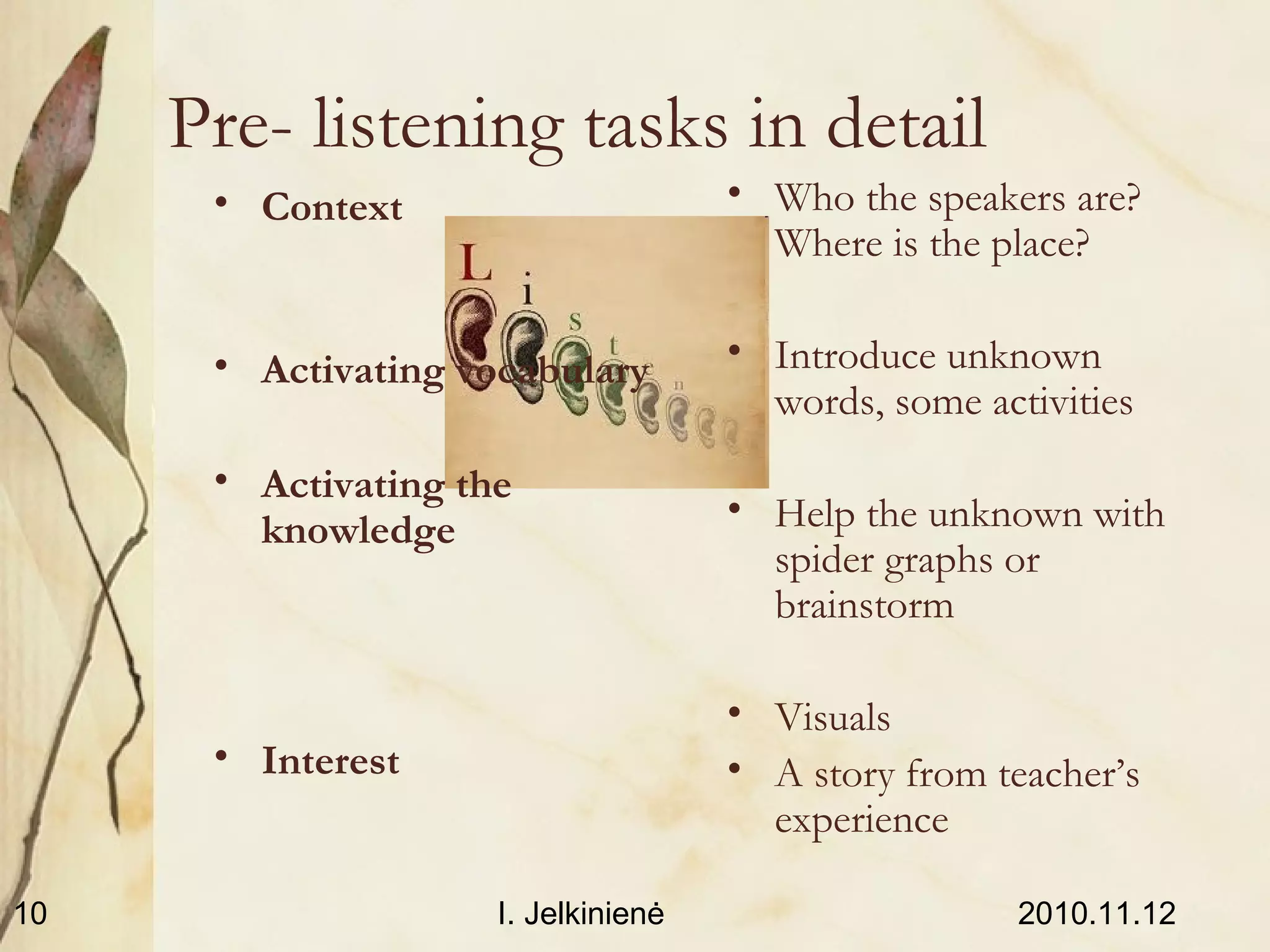
Pre- listening tasks in detail
• Context
• Activating vocabulary
• Activating the
knowledge
• Interest
• Who the speakers are?
Where is the place?
• Introduce unknown
words, some activities
• Help the unknown with
spider graphs or
brainstorm
• Visuals
• A story from teacher’s
experience
2010.11.12I. Jelkinienė11
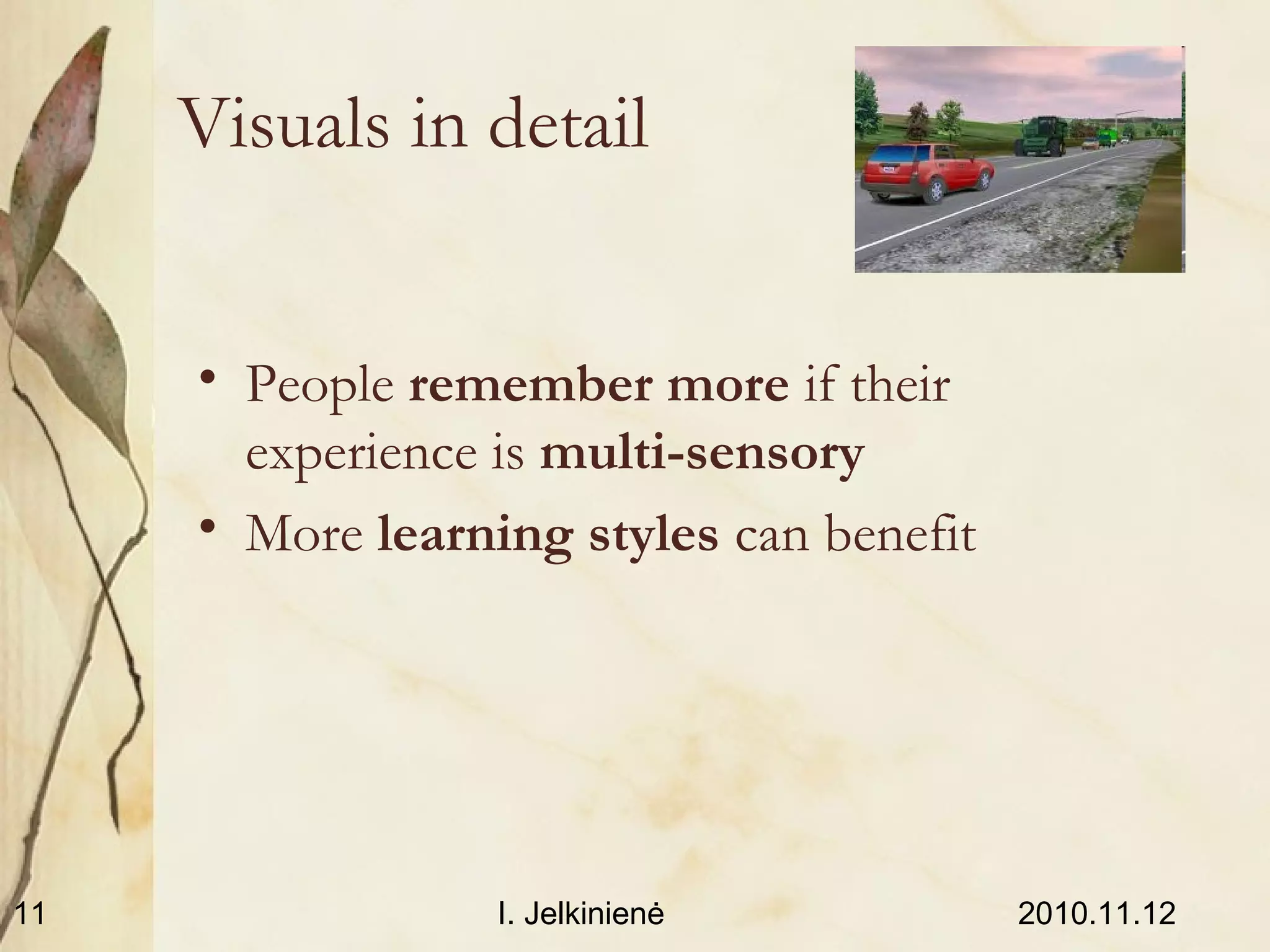
Visuals in detail
• People remember more if their
experience is multi-sensory
• More learning styles can benefit
2010.11.12I. Jelkinienė12
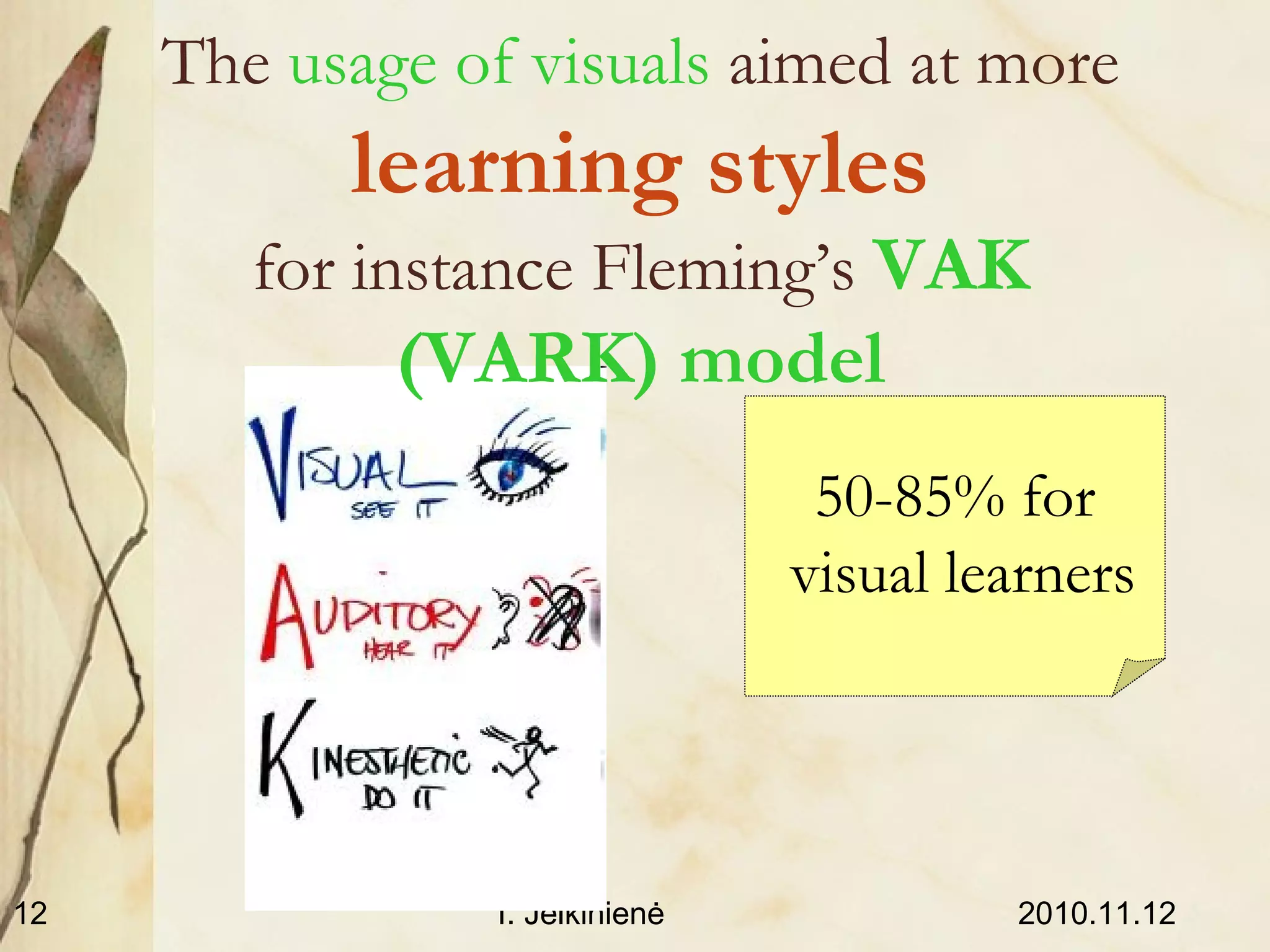
The usage of visuals aimed at more
learning styles
for instance Fleming’s VAK
(VARK) model
50-85% for
visual learners
2010.11.12I. Jelkinienė13
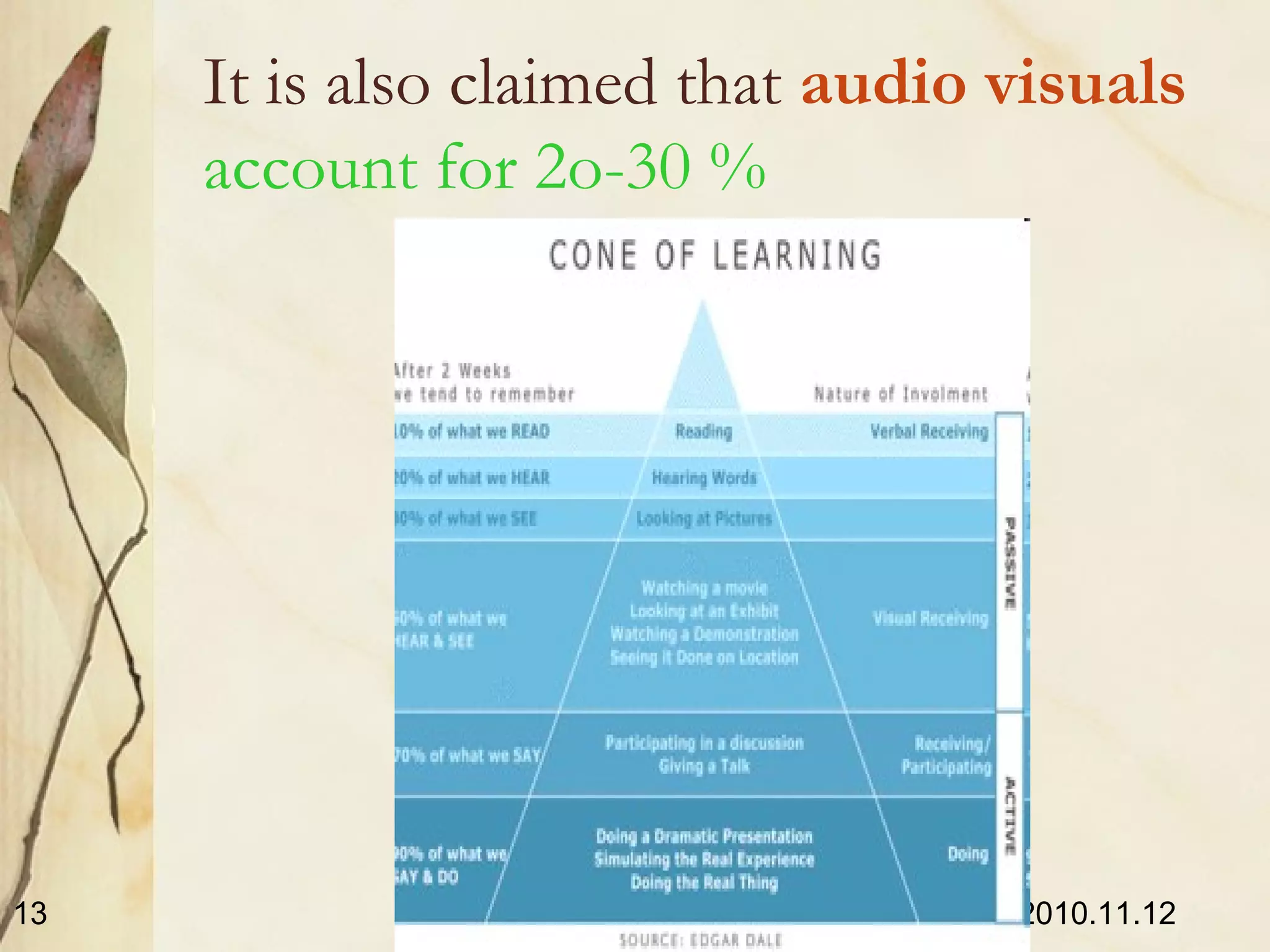
It is also claimed that audio visuals
account for 2o-30 %
2010.11.12I. Jelkinienė14
Visuals in detail
• Pictures
• Posters
• Objects
• Flashcards
• Drawings on the board
2010.11.12I. Jelkinienė15
Visuals in detail
•Maps
2010.11.12I. Jelkinienė16
Visuals in detail
• Line graphs
• Bar charts
• Pie charts
• Numbers
2010.11.12I. Jelkinienė17
and power point presentations
2010.11.12I. Jelkinienė18
Activating current knowledge
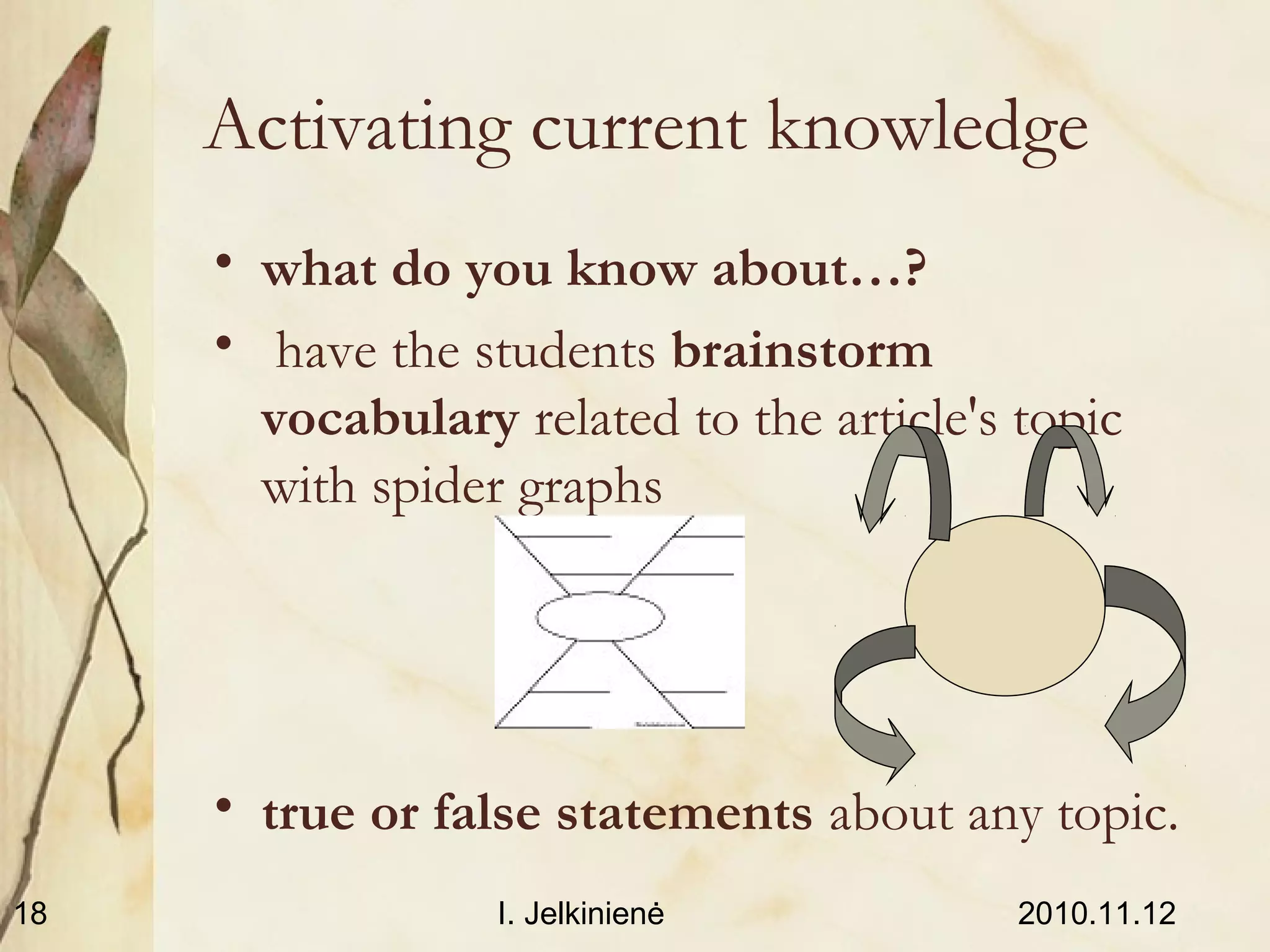
• what do you know about…?
• have the students brainstorm
vocabulary related to the article's topic
with spider graphs
• true or false statements about any topic.
2010.11.12I. Jelkinienė19
Activating vocabulary
It is important to activate vocabulary by:
• Matching words to definitions
• Synonym matching
• Fill-in-the-blank
• Vocabulary speculation
• Vocabulary selection/sort
2010.11.12I. Jelkinienė20
While listening activities
…done during or immediately after the time they
are listening
• allow them to read through it before listening;
• keep writing to a minimum during listening;
• from global to details;
• use questions to focus students' attention;
• use predicting to encourage students;
• give immediate feedback whenever possible.
2010.11.12I. Jelkinienė21
Follow-up tasks
1. Give meaning to the whole listening
2. Students use new knowledge or
vocabulary in a less controlled way.
Examples:
• Role Play
• Discussion: “Have you ever experienced such a situation?”
• Debate: "Do you agree/disagree?"
2010.11.12I. Jelkinienė22
Feedback and Correction
The warm up and the feedback and correction
stages are the bookends of an effective
lesson!
The following can be covered:
• Correction
• Review
• Feedback and Motivation
2010.11.12I. Jelkinienė23
Are there any other
sources for
listening?
2010.11.12I. Jelkinienė24
Other ways to encourage listening
Podcasts
Podcasts help with the most up-to- date
listening:
• released episodically
• can be downloaded easily for free
• can be transferred into a portable
device
2010.11.12I. Jelkinienė25
Interesting and useful material
online 6 Minute English
Learn and practise useful English language for everyday situations
with the BBC. Your weekly instruction manual for saying or doing
something in English is published every Friday. Each programme is
six minutes long and contains examples and explanations to help
you improve your knowledge of the English language across a wide
range of topics.
Updated: weekly
Subscribe to this podcast
and automatically
receive the latest episodes.
http://www.bbc.co.uk/podcasts/series/6min
2010.11.12I. Jelkinienė26
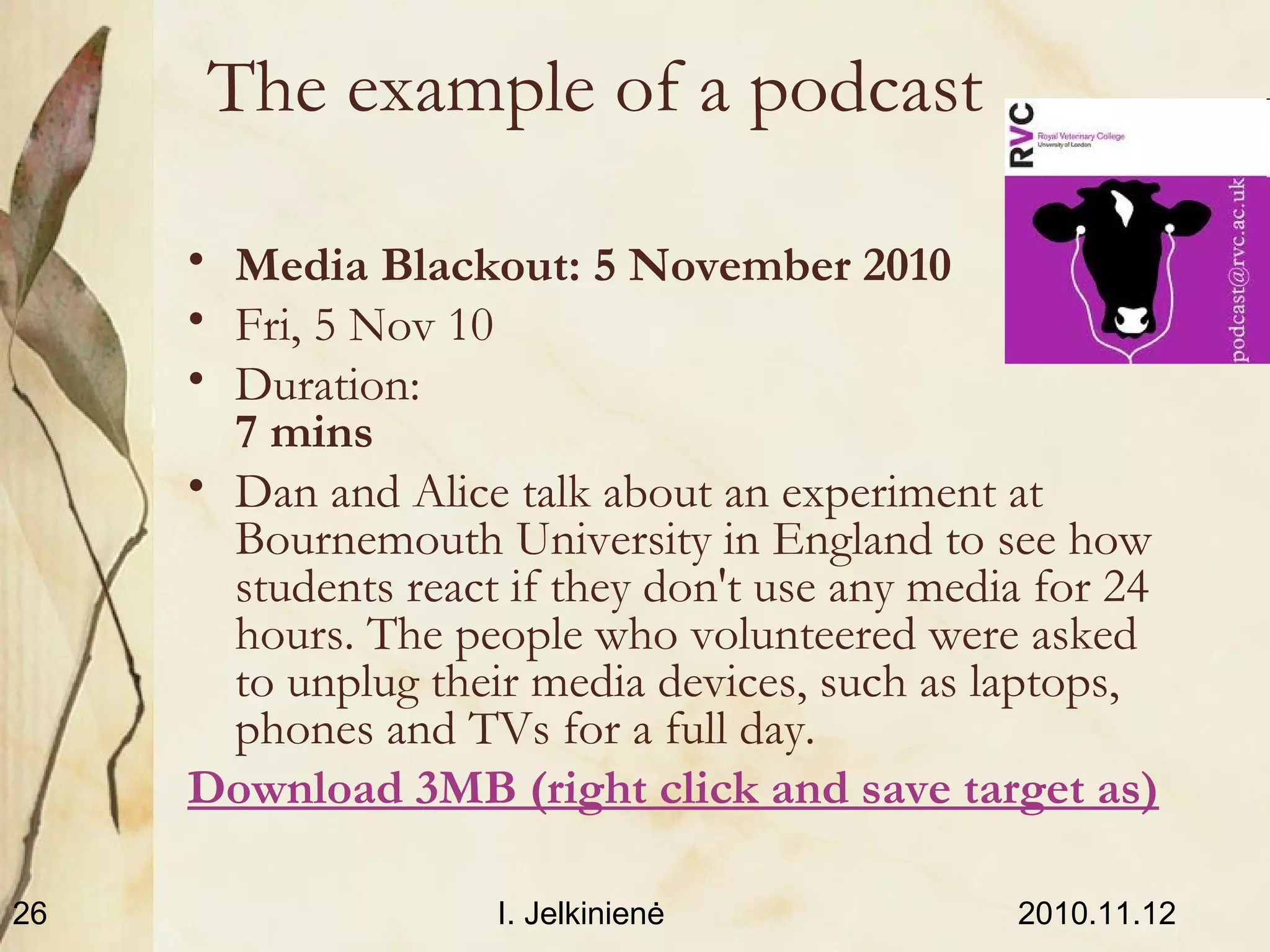
The example of a podcast
• Media Blackout: 5 November 2010
• Fri, 5 Nov 10
• Duration:
7 mins
• Dan and Alice talk about an experiment at
Bournemouth University in England to see how
students react if they don't use any media for 24
hours. The people who volunteered were asked
to unplug their media devices, such as laptops,
phones and TVs for a full day.
Download 3MB (right click and save target as)
2010.11.12I. Jelkinienė27
Other ways to encourage listening
Videos
• beneficial
• communicate cultural and 'non verbal' aspects
Activities:
• turning off sound and asking students to
create the dialogue from a scene
• getting one part of the class to watch and
describe to the others then exchange
• use a freeze frame technique – for
prediction
2010.11.12I. Jelkinienė28
Other ways to encourage listening
Songs
English songs can be used for a wide variety
of ESL learning and teaching activities:
• Great for teaching listening (fill in the
blanks etc.)
• Start a discussion
• Teach grammar
• Compare accents
• Teach new vocabulary
2010.11.12I. Jelkinienė29
Sample activities for attentive
listening
• Listening to a personal teacher’s story with
visuals- pictures or slides
• Listening to a story – students ask questions to
the story
• Chain Gang Stories -One student begins with
any portion of a sentence, or full sentence. The
next student repeats the prior sentence and adds
to it
• Dual dictation
• Listen for lies
2010.11.12I. Jelkinienė30
Sample listening activity- what can a
teacher make of it?
An example how a teacher can employ
various pre-listening and post listening
activities
Advertising Adventure;
• Topic: health/appearance,
• Level: pre-interemediate
2010.11.12I. Jelkinienė31
Advertising Adventure –
Pre-Listening
• Show visuals: photos of healthy-looking
people; before-and-after photos. Before-
and-after photos showing a hippopotamus
and a spider. Photos of people doing
exercise.
2010.11.12I. Jelkinienė32
Advertising Adventure –
Pre-Listening
A teacher could ask questions while showing
pictures:
• Have you seen photos of before and after?
How do you feel about them? Do you believe
all of the adds like that? What adjectives can
we use for a hippo or a spider? Which way to
loose weight is more effective and longer
lasting?
2010.11.12I. Jelkinienė33
Advertising Adventure –
Pre-Listening
Adjectives can be presented in a spidergraph-
brainstormed together with the students:
2010.11.12I. Jelkinienė34
Read over the ideas for adverts for a
slimming product. Which one do you
think is the best? Why? Which one is the
most ridiculous?
Be healthier and more confident with
 with Adios slimming!!!
Why are you still overweight?
Advertising Adventure –
Pre-Listening
                                                                        
Fat to Fit with PHEN 35
Get thin this summer
2010.11.12I. Jelkinienė35
Advertising Adventure
While- listening
Listening I
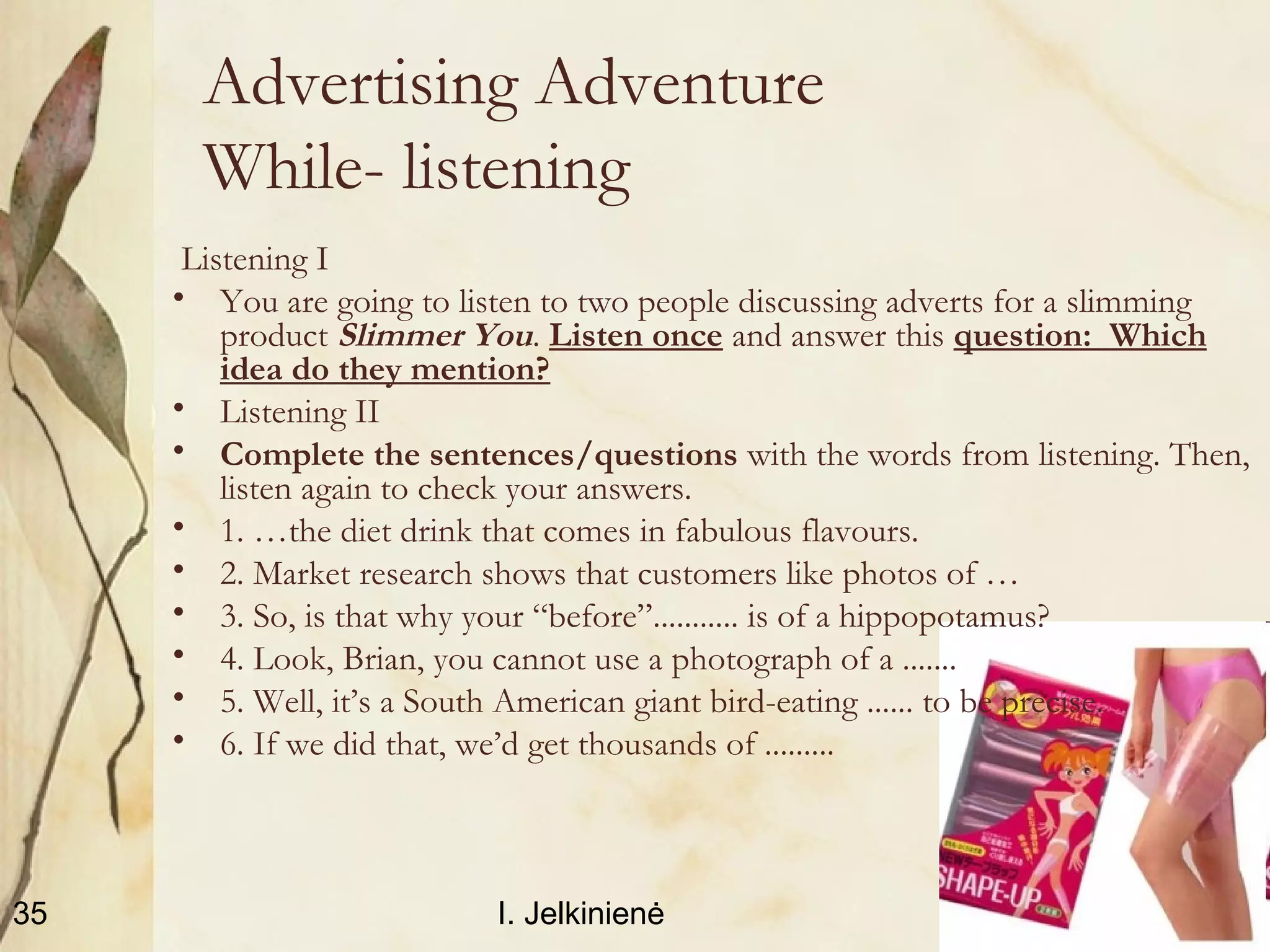
• You are going to listen to two people discussing adverts for a slimming
product Slimmer You. Listen once and answer this question: Which
idea do they mention?
• Listening II
• Complete the sentences/questions with the words from listening. Then,
listen again to check your answers.
• 1. …the diet drink that comes in fabulous flavours.
• 2. Market research shows that customers like photos of …
• 3. So, is that why your “before”........... is of a hippopotamus?
• 4. Look, Brian, you cannot use a photograph of a .......
• 5. Well, it’s a South American giant bird-eating ...... to be precise.
• 6. If we did that, we’d get thousands of .........
2010.11.12I. Jelkinienė36
Advertising Adventure
Follow- up
Discussion
• Have you seen any slimming ads recently?
What images did they use?
• What’s the funniest ad you’ve ever seen?
Why was it funny?
• If you had to create an ad for a slimming
product, what images would it have?
2010.11.12I. Jelkinienė37
A short survey on listening
2010.11.12I. Jelkinienė38
Basic level students are positive
about listening
Do you like listening?
read
tasks
very well
28,5
no; 4,8
when I'm
good;
29,2
yes; 46,3
2010.11.12I. Jelkinienė39
Basic level students usually read
questions
Pre-listening
read
tasks
very well
28,5
look at
pictures;
19,5
read
question
s; 42,8
nothing;
9,5
2010.11.12I. Jelkinienė40
They are going to practice mostly in
class and at home
Where are you going to practice
listening?
everything
; 4,8
read tasks
very well
28,5
in class/at
home;
60,9
in my car;
24,3
in class;
7,3
2010.11.12I. Jelkinienė41
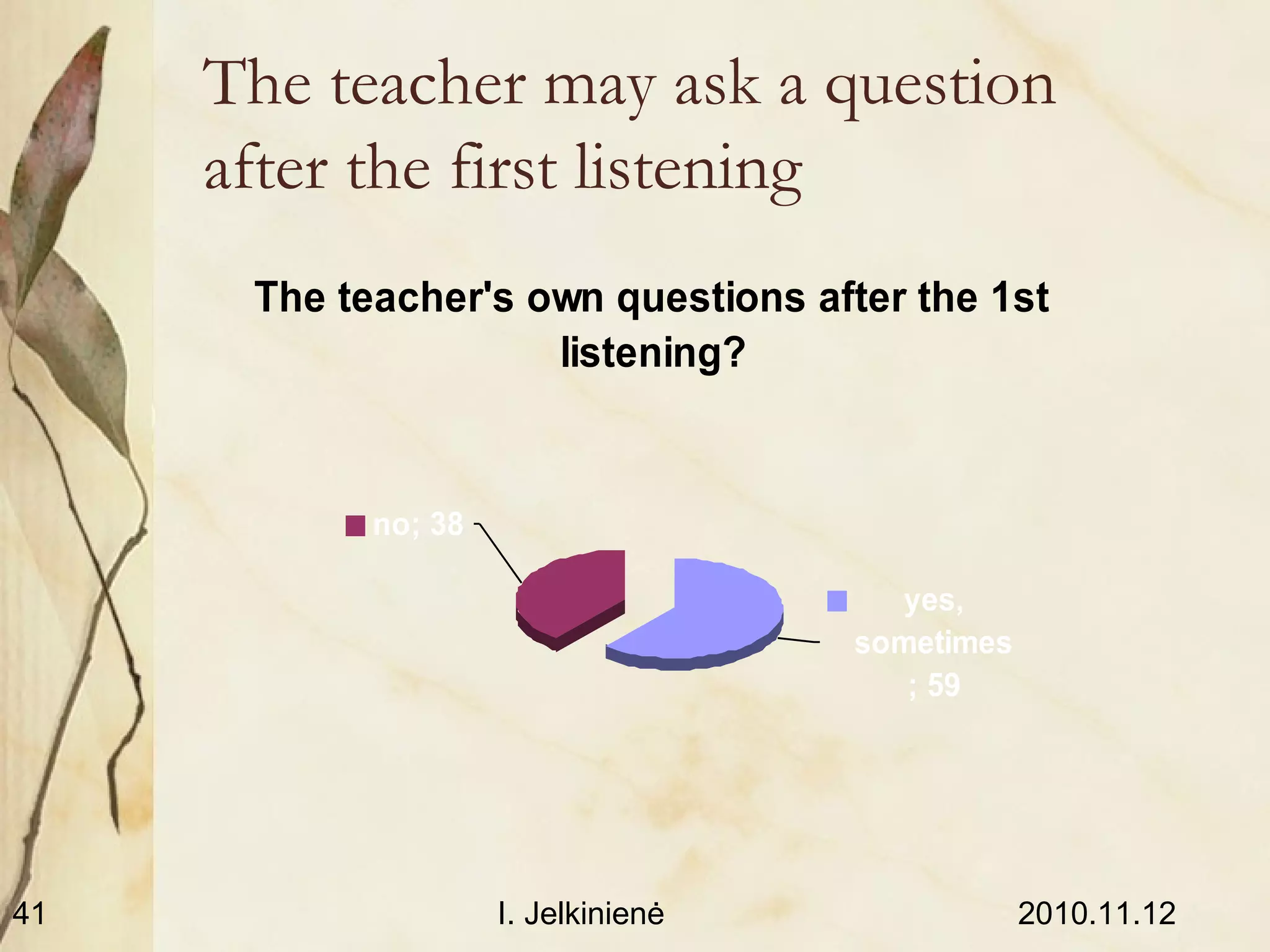
The teacher may ask a question
after the first listening
The teacher's own questions after the 1st
listening?
no; 38
yes,
sometimes
; 59
2010.11.12I. Jelkinienė42
Teachers usually do not use visuals
Visuals
no; 60
yes,
sometimes
; 40
2010.11.12I. Jelkinienė43
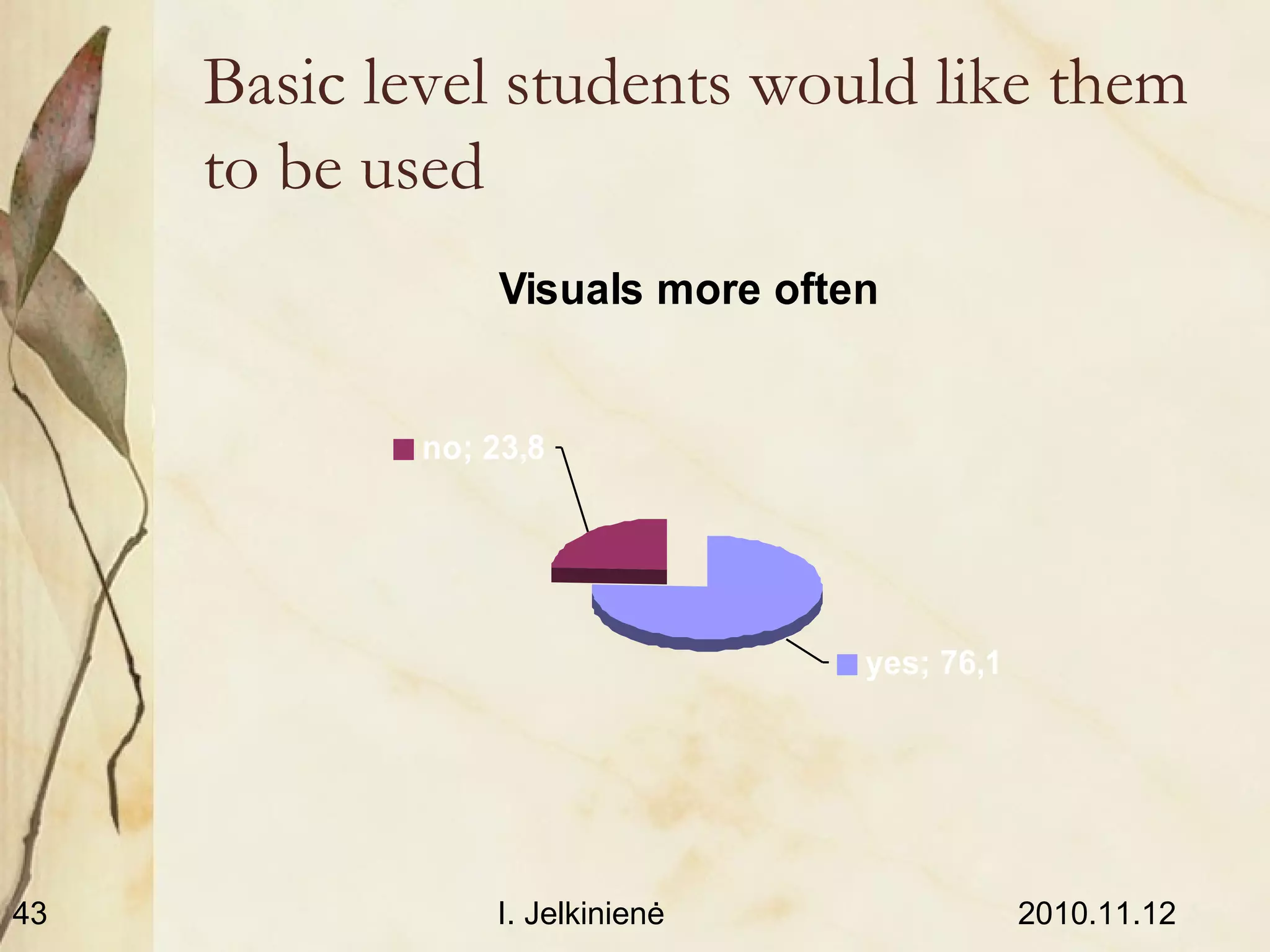
Basic level students would like them
to be used
Visuals more often
no; 23,8
yes; 76,1
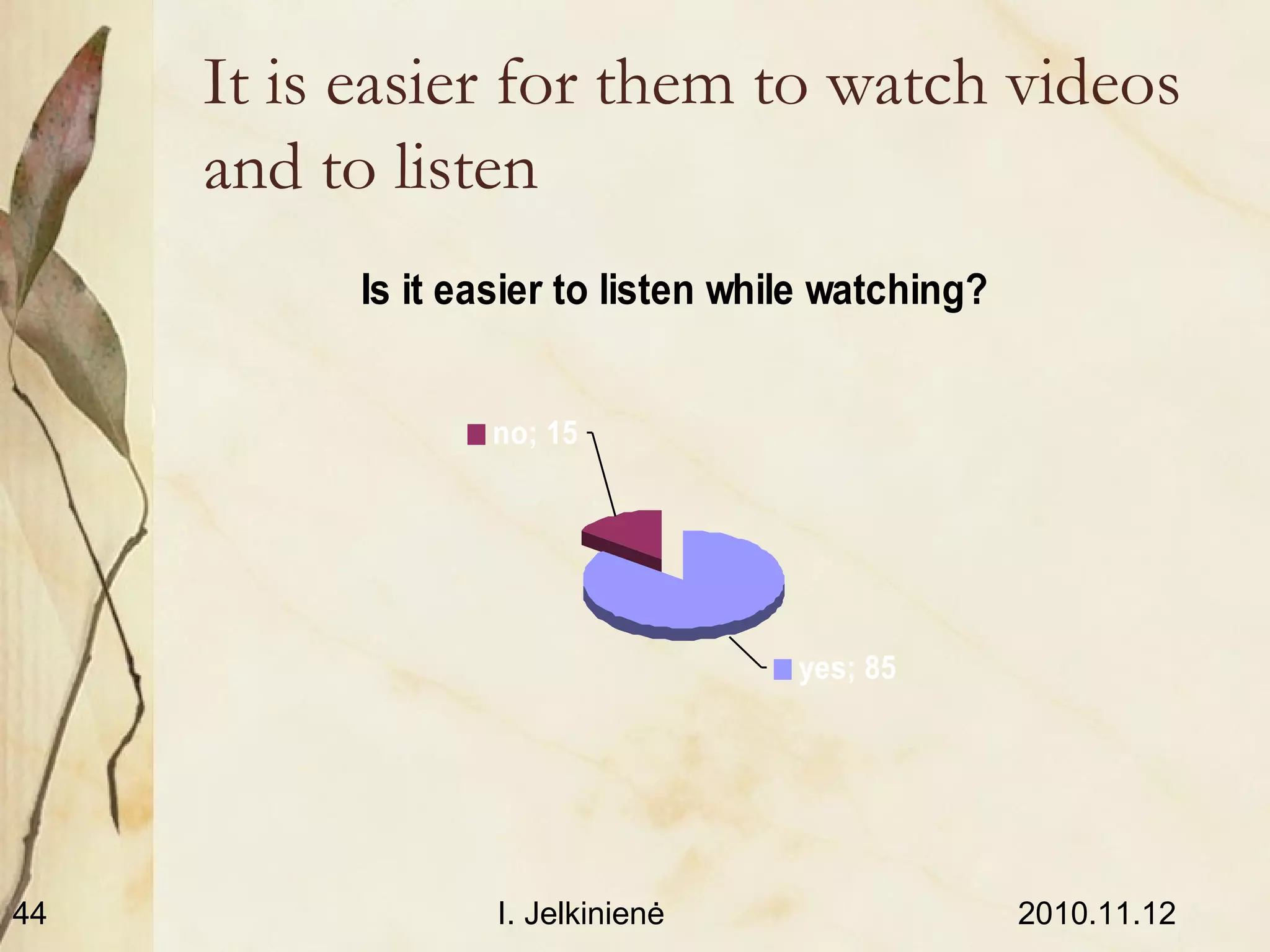
2010.11.12I. Jelkinienė44
It is easier for them to watch videos
and to listen
Is it easier to listen while watching?
no; 15
yes; 85
2010.11.12I. Jelkinienė45
The results of a short survey in our
faculty
A survey among basic and the second level
students.There are some general trends obvious:
BASIC LEVEL:
• The teacher most likely will repeat the item for students;
• Ss like listening and especially when they are good at it;
• Ss improve their listening skills after listening in class/at
home and on the Internet- never in a car;
• teachers usually ask questions after the first listening and
only sometimes give feedback; sometimes use visuals
• they watch videos and they like listening while watching
them.
• fill- ins and questions are the most difficult tasks for them
2010.11.12I. Jelkinienė46
The results of a short survey in our
faculty
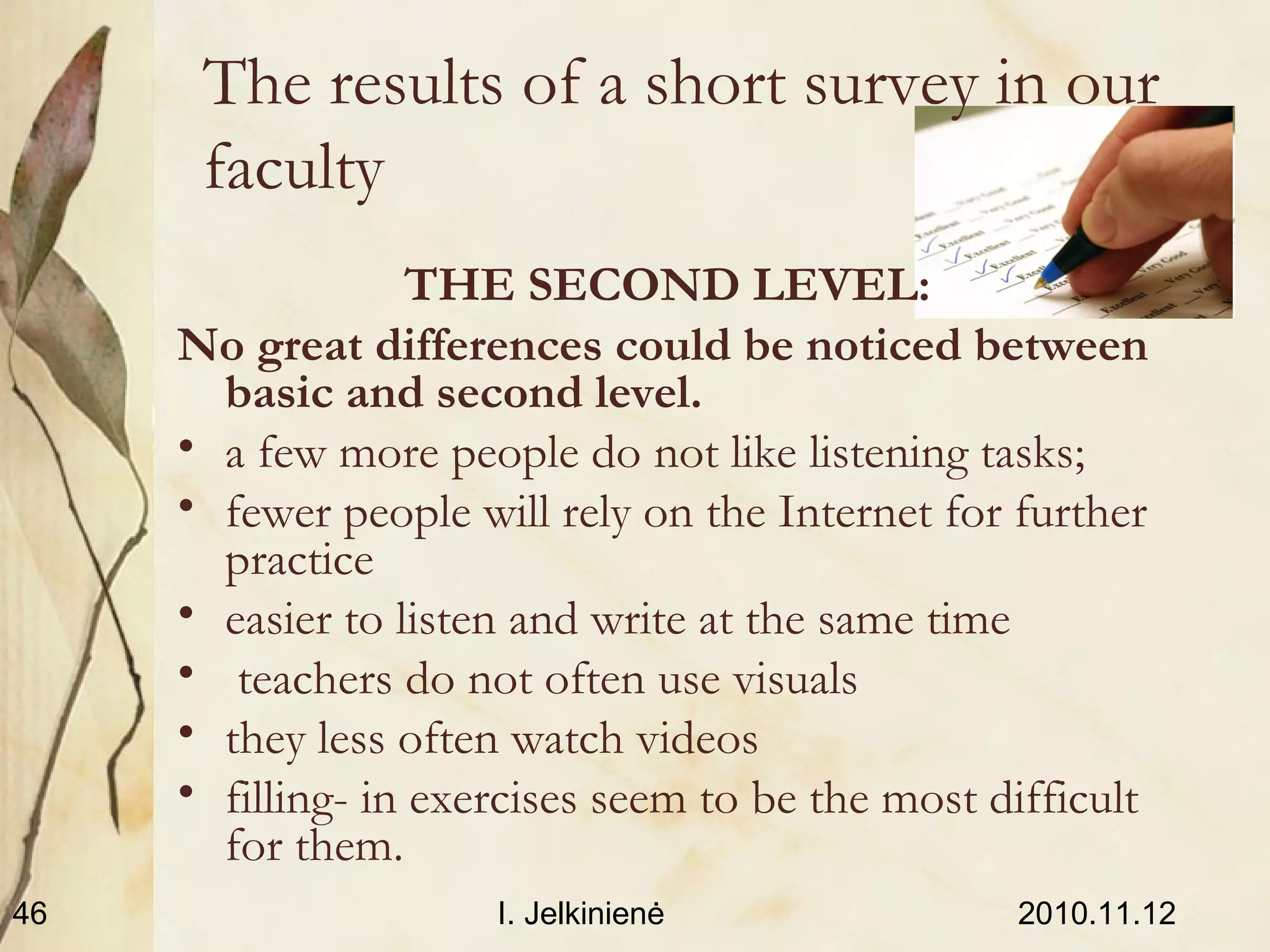
THE SECOND LEVEL:
No great differences could be noticed between
basic and second level.
• a few more people do not like listening tasks;
• fewer people will rely on the Internet for further
practice
• easier to listen and write at the same time
• teachers do not often use visuals
• they less often watch videos
• filling- in exercises seem to be the most difficult
for them.
2010.11.12I. Jelkinienė47
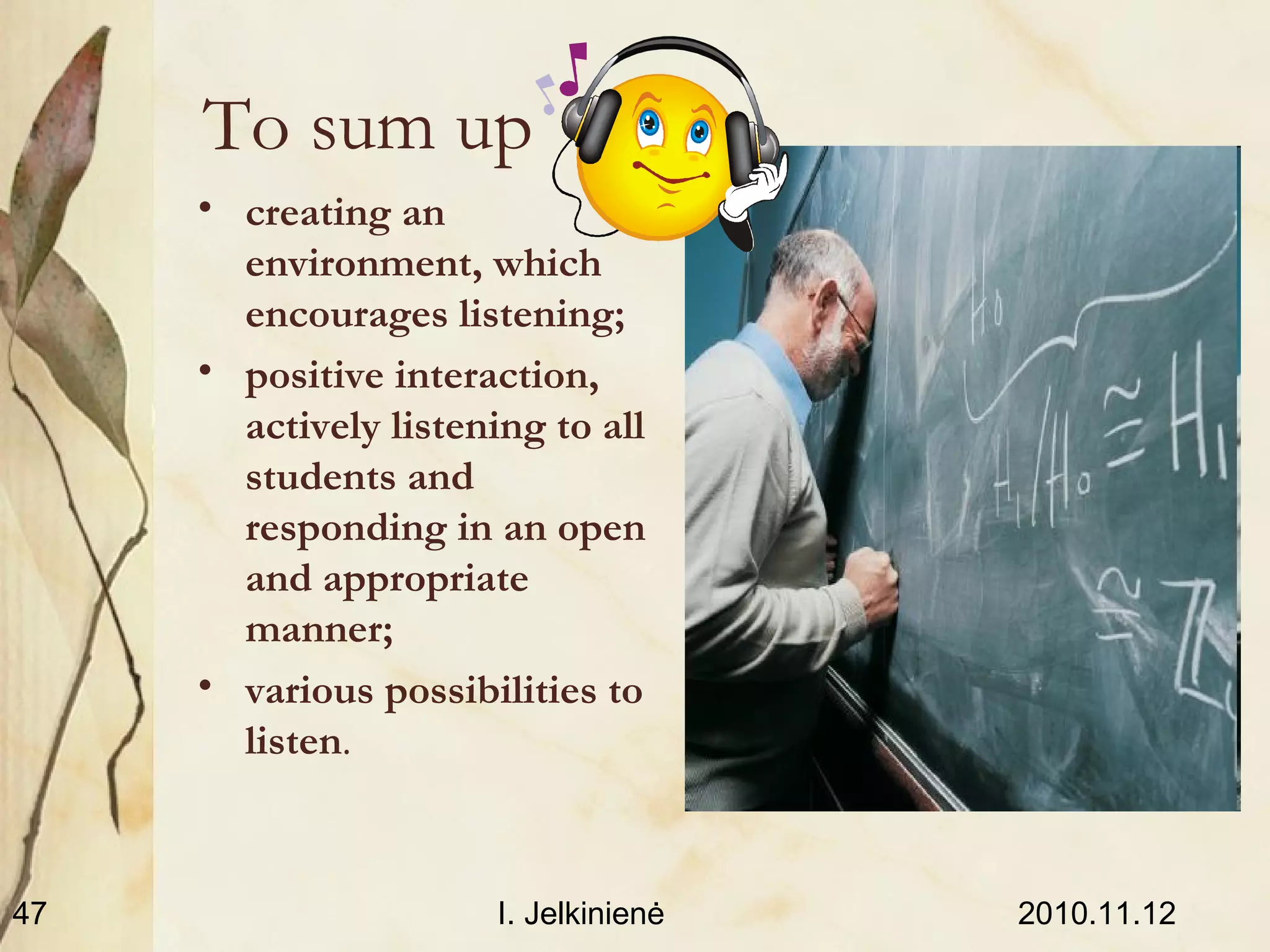
To sum up
• creating an
environment, which
encourages listening;
• positive interaction,
actively listening to all
students and
responding in an open
and appropriate
manner;
• various possibilities to
listen.
Any
questions?

Images of successful listening

  • 1.
    Images of successful listening ByInga Jelkinienė Kaunas, 2010
  • 2.
    2010.11.12I. Jelkinienė2 Content • Listeningin general • Problems for students • The importance of pre- listening • While listening activities • Follow-up tasks • Other sources of listening • Sample activities • The results of a survey in our faculty
  • 3.
  • 4.
    2010.11.12I. Jelkinienė4 Remind totake small steps at the beginning and increase difficulty
  • 5.
    2010.11.12I. Jelkinienė5 Summary ofJ. Scrivener’s ideas on teaching and learning listening • effort put into listening and searching for an answer is crucial • process vs. product • listening to a piece more than once • the importance of task based approach • success-oriented tasks
  • 6.
    2010.11.12I. Jelkinienė6 Listening Toughtoteach andlearn Practice often Frustratingfor students N o rules A receptive skill Practice for short periods
  • 7.
    2010.11.12I. Jelkinienė7 Problems forstudents • Unfamiliar context. • Unknown vocabulary. • Lack of time to process information, lack of concentration and anxiety about longer texts. • Too fast. Can’t distinguish separate words. • Can’t follow the rhythm. Not able to recognise sense groups, inferred message, mood or intonation. • Difficult accents. • Background noises.
  • 8.
    2010.11.12I. Jelkinienė8 The importanceof pre-listening • prepare students for listening • facilitate the listening process • accelerate the acquiring of the skill • help to to concentrate on listening if you have little interest in a topic or situation
  • 9.
    2010.11.12I. Jelkinienė9 Types ofpre-listening tasks • Setting the context • Generating interest • Acquiring knowledge • Activating vocabulary / language • Predicting content • Checking / understanding the listening tasks
  • 10.
    2010.11.12I. Jelkinienė10 Pre- listeningtasks in detail • Context • Activating vocabulary • Activating the knowledge • Interest • Who the speakers are? Where is the place? • Introduce unknown words, some activities • Help the unknown with spider graphs or brainstorm • Visuals • A story from teacher’s experience
  • 11.
    2010.11.12I. Jelkinienė11 Visuals indetail • People remember more if their experience is multi-sensory • More learning styles can benefit
  • 12.
    2010.11.12I. Jelkinienė12 The usageof visuals aimed at more learning styles for instance Fleming’s VAK (VARK) model 50-85% for visual learners
  • 13.
    2010.11.12I. Jelkinienė13 It isalso claimed that audio visuals account for 2o-30 %
  • 14.
    2010.11.12I. Jelkinienė14 Visuals indetail • Pictures • Posters • Objects • Flashcards • Drawings on the board
  • 15.
  • 16.
    2010.11.12I. Jelkinienė16 Visuals indetail • Line graphs • Bar charts • Pie charts • Numbers
  • 17.
  • 18.
    2010.11.12I. Jelkinienė18 Activating currentknowledge • what do you know about…? • have the students brainstorm vocabulary related to the article's topic with spider graphs • true or false statements about any topic.
  • 19.
    2010.11.12I. Jelkinienė19 Activating vocabulary Itis important to activate vocabulary by: • Matching words to definitions • Synonym matching • Fill-in-the-blank • Vocabulary speculation • Vocabulary selection/sort
  • 20.
    2010.11.12I. Jelkinienė20 While listeningactivities …done during or immediately after the time they are listening • allow them to read through it before listening; • keep writing to a minimum during listening; • from global to details; • use questions to focus students' attention; • use predicting to encourage students; • give immediate feedback whenever possible.
  • 21.
    2010.11.12I. Jelkinienė21 Follow-up tasks 1.Give meaning to the whole listening 2. Students use new knowledge or vocabulary in a less controlled way. Examples: • Role Play • Discussion: “Have you ever experienced such a situation?” • Debate: "Do you agree/disagree?"
  • 22.
    2010.11.12I. Jelkinienė22 Feedback andCorrection The warm up and the feedback and correction stages are the bookends of an effective lesson! The following can be covered: • Correction • Review • Feedback and Motivation
  • 23.
    2010.11.12I. Jelkinienė23 Are thereany other sources for listening?
  • 24.
    2010.11.12I. Jelkinienė24 Other waysto encourage listening Podcasts Podcasts help with the most up-to- date listening: • released episodically • can be downloaded easily for free • can be transferred into a portable device
  • 25.
    2010.11.12I. Jelkinienė25 Interesting anduseful material online 6 Minute English Learn and practise useful English language for everyday situations with the BBC. Your weekly instruction manual for saying or doing something in English is published every Friday. Each programme is six minutes long and contains examples and explanations to help you improve your knowledge of the English language across a wide range of topics. Updated: weekly Subscribe to this podcast and automatically receive the latest episodes. http://www.bbc.co.uk/podcasts/series/6min
  • 26.
    2010.11.12I. Jelkinienė26 The exampleof a podcast • Media Blackout: 5 November 2010 • Fri, 5 Nov 10 • Duration: 7 mins • Dan and Alice talk about an experiment at Bournemouth University in England to see how students react if they don't use any media for 24 hours. The people who volunteered were asked to unplug their media devices, such as laptops, phones and TVs for a full day. Download 3MB (right click and save target as)
  • 27.
    2010.11.12I. Jelkinienė27 Other waysto encourage listening Videos • beneficial • communicate cultural and 'non verbal' aspects Activities: • turning off sound and asking students to create the dialogue from a scene • getting one part of the class to watch and describe to the others then exchange • use a freeze frame technique – for prediction
  • 28.
    2010.11.12I. Jelkinienė28 Other waysto encourage listening Songs English songs can be used for a wide variety of ESL learning and teaching activities: • Great for teaching listening (fill in the blanks etc.) • Start a discussion • Teach grammar • Compare accents • Teach new vocabulary
  • 29.
    2010.11.12I. Jelkinienė29 Sample activitiesfor attentive listening • Listening to a personal teacher’s story with visuals- pictures or slides • Listening to a story – students ask questions to the story • Chain Gang Stories -One student begins with any portion of a sentence, or full sentence. The next student repeats the prior sentence and adds to it • Dual dictation • Listen for lies
  • 30.
    2010.11.12I. Jelkinienė30 Sample listeningactivity- what can a teacher make of it? An example how a teacher can employ various pre-listening and post listening activities Advertising Adventure; • Topic: health/appearance, • Level: pre-interemediate
  • 31.
    2010.11.12I. Jelkinienė31 Advertising Adventure– Pre-Listening • Show visuals: photos of healthy-looking people; before-and-after photos. Before- and-after photos showing a hippopotamus and a spider. Photos of people doing exercise.
  • 32.
    2010.11.12I. Jelkinienė32 Advertising Adventure– Pre-Listening A teacher could ask questions while showing pictures: • Have you seen photos of before and after? How do you feel about them? Do you believe all of the adds like that? What adjectives can we use for a hippo or a spider? Which way to loose weight is more effective and longer lasting?
  • 33.
    2010.11.12I. Jelkinienė33 Advertising Adventure– Pre-Listening Adjectives can be presented in a spidergraph- brainstormed together with the students:
  • 34.
    2010.11.12I. Jelkinienė34 Read overthe ideas for adverts for a slimming product. Which one do you think is the best? Why? Which one is the most ridiculous? Be healthier and more confident with  with Adios slimming!!! Why are you still overweight? Advertising Adventure – Pre-Listening                                                                          Fat to Fit with PHEN 35 Get thin this summer
  • 35.
    2010.11.12I. Jelkinienė35 Advertising Adventure While-listening Listening I • You are going to listen to two people discussing adverts for a slimming product Slimmer You. Listen once and answer this question: Which idea do they mention? • Listening II • Complete the sentences/questions with the words from listening. Then, listen again to check your answers. • 1. …the diet drink that comes in fabulous flavours. • 2. Market research shows that customers like photos of … • 3. So, is that why your “before”........... is of a hippopotamus? • 4. Look, Brian, you cannot use a photograph of a ....... • 5. Well, it’s a South American giant bird-eating ...... to be precise. • 6. If we did that, we’d get thousands of .........
  • 36.
    2010.11.12I. Jelkinienė36 Advertising Adventure Follow-up Discussion • Have you seen any slimming ads recently? What images did they use? • What’s the funniest ad you’ve ever seen? Why was it funny? • If you had to create an ad for a slimming product, what images would it have?
  • 37.
  • 38.
    2010.11.12I. Jelkinienė38 Basic levelstudents are positive about listening Do you like listening? read tasks very well 28,5 no; 4,8 when I'm good; 29,2 yes; 46,3
  • 39.
    2010.11.12I. Jelkinienė39 Basic levelstudents usually read questions Pre-listening read tasks very well 28,5 look at pictures; 19,5 read question s; 42,8 nothing; 9,5
  • 40.
    2010.11.12I. Jelkinienė40 They aregoing to practice mostly in class and at home Where are you going to practice listening? everything ; 4,8 read tasks very well 28,5 in class/at home; 60,9 in my car; 24,3 in class; 7,3
  • 41.
    2010.11.12I. Jelkinienė41 The teachermay ask a question after the first listening The teacher's own questions after the 1st listening? no; 38 yes, sometimes ; 59
  • 42.
    2010.11.12I. Jelkinienė42 Teachers usuallydo not use visuals Visuals no; 60 yes, sometimes ; 40
  • 43.
    2010.11.12I. Jelkinienė43 Basic levelstudents would like them to be used Visuals more often no; 23,8 yes; 76,1
  • 44.
    2010.11.12I. Jelkinienė44 It iseasier for them to watch videos and to listen Is it easier to listen while watching? no; 15 yes; 85
  • 45.
    2010.11.12I. Jelkinienė45 The resultsof a short survey in our faculty A survey among basic and the second level students.There are some general trends obvious: BASIC LEVEL: • The teacher most likely will repeat the item for students; • Ss like listening and especially when they are good at it; • Ss improve their listening skills after listening in class/at home and on the Internet- never in a car; • teachers usually ask questions after the first listening and only sometimes give feedback; sometimes use visuals • they watch videos and they like listening while watching them. • fill- ins and questions are the most difficult tasks for them
  • 46.
    2010.11.12I. Jelkinienė46 The resultsof a short survey in our faculty THE SECOND LEVEL: No great differences could be noticed between basic and second level. • a few more people do not like listening tasks; • fewer people will rely on the Internet for further practice • easier to listen and write at the same time • teachers do not often use visuals • they less often watch videos • filling- in exercises seem to be the most difficult for them.
  • 47.
    2010.11.12I. Jelkinienė47 To sumup • creating an environment, which encourages listening; • positive interaction, actively listening to all students and responding in an open and appropriate manner; • various possibilities to listen.
  • 48.