TEACHING LISTENING
Group 1
THE IMPORTANCE OF LISTENING
WELL
 Most frequently used communication skill
 50% of typical workday spent communicating
 of this 50%, 45% is spent listening
 45% of business person’s salary earned listening
 Good listeners
 are perceived as more intelligent
 save time, energy, and other resources
 increase chances for advancement and success
Goin’
Fishin’
1. What are the people doing?
PlayingPlaying ShoppingShopping
Scoring
2. What is the girl asking for?
AdviceAdvicePermissionPermission
Scoring
3. What is the man talking about?
PricePriceCurrencyCurrency
Scoring
4. What is the girl doing?
CookingCooking InvitingInviting
Scoring
5. What are they talking about?
Daily routinesDaily routinesPast activitiesPast activities
Scoring
6. What is the song about?
Family Love
Scoring
7. What is the song about?
Love FriendshipFriendship
Scoring
8. What is the song about?
ChristmasChristmas New YearNew Year
Scoring
9. What are the people talking about?
New YearNew Year ChristmasChristmas
Scoring
10. What is the man talking about?
CountriesCountriesPopulationPopulation
Scoring
Congratulations!
You’ve caught enough fish for dinner!
TEACHING LISTENING STEPS
Step 1: Pre-listening
Step 2: While listening
Step 3: Post listening
PRE-LISTENING
FIRST EXAMPLE OF PRE-LISTENING SATGE
Introduction:
You’re going to listen to someone talking about her first school prom.
Language support or definitions of important words
School prom: a formal party held for older students at the end of
the school year, at which there is dancing.
Eliciting:
Now everybody, let’s imagine what would happen there when she is
at the prom.
Predicting: Look at the task. What could be in each blank?
WHILE LISTENING ACTIVITIES
1. Gap Filling
Second Example of Pre-listening Stage
Introduction:
We’re going to listen to Stuart talking about things he does at the weekend.
Language support:
Rugby: a sport like football but played
with an oval ball and hands
(bóng b u d c)ầ ụ
Eliciting:
What do you do at the weekend?
Who do you spend your weekend with?
Do you…?
Game: Someone makes guestures for others to guess the actions
2. Multiple choice
a. Circle Italic word
b. Circle the correct answer (Choose a, b or c)
a. Listen and circle the correct answer: ( More 1-Test 7&8)
1. Stuart is 13 /15 years old.
2. Stuart live in near / far away from the town centre.
3. Stuart goes to a local youth club / football club on Friday night.
4. He meets his parents / friends there.
5. He does lots of sports like rugby and basketball / rugby and hockey.
b. Listen and circle the correct answer: ( More 1-Test 7 &8)
1. What three other things can you do there?
a. talk to friends, dance and work out
b. dance, do gymnastics and have a drink
c. play tennis, talk to friends and go for a run
2. When does Stuart play football matches?
a. on a Saturday morningb. on a Sunday morning
c. on a Sunday afternoon
1. Who goes to Stuart’s football matches with him?
a. his parents b. his friends c. his cousins
4. What else is there to do in town?
a. go to the cinema b. go to the theatre c. go to a museum
5. What can you do in the parks in Plymouth?
a. ride motorbikes and climb trees
b. rollerblade and climb trees
c. rollerblade and ride horses
Pre-listening Example 3
Introduction:
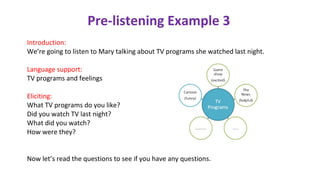
We’re going to listen to Mary talking about TV programs she watched last night.
Language support:
TV programs and feelings
Eliciting:
What TV programs do you like?
Did you watch TV last night?
What did you watch?
How were they?
Now let’s read the questions to see if you have any questions.
3. True (T) or False (F)
Listen and circle T (True) or F (False)
1. Suzannah was at Mary’s house. T / F
2. Suzannah and Mary love romantic films. T / F
3. Suzannah wanted to watch the film in the kitchen. T / F
4. They were scared by the film. T /F
5. There was a mistake in the TV magazine. T /F
6. Suzannah wanted to watch the horror film. T / F
7. The film was scary. T / F
8. Mary wanted to watch the film. T / F
9. The film finished at 9 o’clock. T / F
10. Mary didn’t like the film. T / F
4. Matching
Listen and match the number of TV programme to the films or shows
(More 2- Unit 2 page 16)
IMPROVING YOUR LISTENING SKILLS
 Identify Objectives
 Know Your Listening Habits
 Generate Motivation and Energy
 Eliminate Distractions
 Ask questions
Closed
Open
 Evaluate Your Progress
Listening Skill

Listening Skill

  • 1.
  • 2.
    THE IMPORTANCE OFLISTENING WELL  Most frequently used communication skill  50% of typical workday spent communicating  of this 50%, 45% is spent listening  45% of business person’s salary earned listening  Good listeners  are perceived as more intelligent  save time, energy, and other resources  increase chances for advancement and success
  • 3.
  • 4.
    1. What arethe people doing? PlayingPlaying ShoppingShopping
  • 5.
  • 6.
    2. What isthe girl asking for? AdviceAdvicePermissionPermission
  • 7.
  • 8.
    3. What isthe man talking about? PricePriceCurrencyCurrency
  • 9.
  • 10.
    4. What isthe girl doing? CookingCooking InvitingInviting
  • 11.
  • 12.
    5. What arethey talking about? Daily routinesDaily routinesPast activitiesPast activities
  • 13.
  • 14.
    6. What isthe song about? Family Love
  • 15.
  • 16.
    7. What isthe song about? Love FriendshipFriendship
  • 17.
  • 18.
    8. What isthe song about? ChristmasChristmas New YearNew Year
  • 19.
  • 20.
    9. What arethe people talking about? New YearNew Year ChristmasChristmas
  • 21.
  • 22.
    10. What isthe man talking about? CountriesCountriesPopulationPopulation
  • 23.
  • 24.
  • 25.
    TEACHING LISTENING STEPS Step1: Pre-listening Step 2: While listening Step 3: Post listening
  • 26.
  • 27.
    FIRST EXAMPLE OFPRE-LISTENING SATGE Introduction: You’re going to listen to someone talking about her first school prom. Language support or definitions of important words School prom: a formal party held for older students at the end of the school year, at which there is dancing. Eliciting: Now everybody, let’s imagine what would happen there when she is at the prom. Predicting: Look at the task. What could be in each blank?
  • 28.
  • 33.
    Second Example ofPre-listening Stage Introduction: We’re going to listen to Stuart talking about things he does at the weekend. Language support: Rugby: a sport like football but played with an oval ball and hands (bóng b u d c)ầ ụ Eliciting: What do you do at the weekend? Who do you spend your weekend with? Do you…? Game: Someone makes guestures for others to guess the actions
  • 34.
    2. Multiple choice a.Circle Italic word b. Circle the correct answer (Choose a, b or c)
  • 35.
    a. Listen andcircle the correct answer: ( More 1-Test 7&8) 1. Stuart is 13 /15 years old. 2. Stuart live in near / far away from the town centre. 3. Stuart goes to a local youth club / football club on Friday night. 4. He meets his parents / friends there. 5. He does lots of sports like rugby and basketball / rugby and hockey.
  • 36.
    b. Listen andcircle the correct answer: ( More 1-Test 7 &8) 1. What three other things can you do there? a. talk to friends, dance and work out b. dance, do gymnastics and have a drink c. play tennis, talk to friends and go for a run 2. When does Stuart play football matches? a. on a Saturday morningb. on a Sunday morning c. on a Sunday afternoon 1. Who goes to Stuart’s football matches with him? a. his parents b. his friends c. his cousins 4. What else is there to do in town? a. go to the cinema b. go to the theatre c. go to a museum 5. What can you do in the parks in Plymouth? a. ride motorbikes and climb trees b. rollerblade and climb trees c. rollerblade and ride horses
  • 37.
    Pre-listening Example 3 Introduction: We’regoing to listen to Mary talking about TV programs she watched last night. Language support: TV programs and feelings Eliciting: What TV programs do you like? Did you watch TV last night? What did you watch? How were they? Now let’s read the questions to see if you have any questions.
  • 38.
    3. True (T)or False (F) Listen and circle T (True) or F (False) 1. Suzannah was at Mary’s house. T / F 2. Suzannah and Mary love romantic films. T / F 3. Suzannah wanted to watch the film in the kitchen. T / F 4. They were scared by the film. T /F 5. There was a mistake in the TV magazine. T /F 6. Suzannah wanted to watch the horror film. T / F 7. The film was scary. T / F 8. Mary wanted to watch the film. T / F 9. The film finished at 9 o’clock. T / F 10. Mary didn’t like the film. T / F
  • 39.
    4. Matching Listen andmatch the number of TV programme to the films or shows (More 2- Unit 2 page 16)
  • 40.
    IMPROVING YOUR LISTENINGSKILLS  Identify Objectives  Know Your Listening Habits  Generate Motivation and Energy  Eliminate Distractions  Ask questions Closed Open  Evaluate Your Progress