IMAGE PROCESSING
PRESENTED BY:
SHER MUHAMMAD RAHEEL AHMED
2K16/TCT/62 2K16/TCT/50
1
CONTENTS:
INTRODUCTION. TYPES OF
“IMAGE PROCESSING”.
TECHNIQUES OF
“IMAGE PROCESSING”.
APPLICATIONS OF
“IMAGE PROCESSING”.
2
INTRODUCTION:
Image processing is any form of signal processing for which the input is an image, such as a
photograph or video frame; the output of image processing may be either an image or a set of
characteristics or parameters related to the image.
Why we need image processing:
 Checking for presence
 Object detection and localization.
 Identification and verification.
Since an image is an array, or a matrix, of square pixels (picture elements) arranged in
columns and rows. If it is an grey scale image it has 8 bit colour depth = 256 grayscales. While
A "true colour" image has 24 bit colour depth = 8 x 8 x 8 bits = 256 x 256 x colour = ~16 million
colours
3
TYPES/ METHODS OF IMAGE PROCESSING:
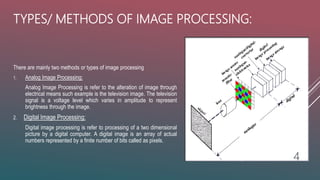
There are mainly two methods or types of image processing
1. Analog Image Processing:
Analog Image Processing is refer to the alteration of image through
electrical means such example is the television image. The television
signal is a voltage level which varies in amplitude to represent
brightness through the image.
2. Digital Image Processing:
Digital image processing is refer to processing of a two dimensional
picture by a digital computer. A digital image is an array of actual
numbers represented by a finite number of bits called as pixels.
4
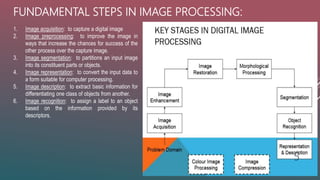
FUNDAMENTAL STEPS IN IMAGE PROCESSING:
1. Image acquisition: to capture a digital image
2. Image preprocessing: to improve the image in
ways that increase the chances for success of the
other process over the capture image.
3. Image segmentation: to partitions an input image
into its constituent parts or objects.
4. Image representation: to convert the input data to
a form suitable for computer processing.
5. Image description: to extract basic information for
differentiating one class of objects from another.
6. Image recognition: to assign a label to an object
based on the information provided by its
descriptors.
5
IMAGE PROCESSING TECHNIQUES :
The various Image Processing techniques are:
Image representation
Image preprocessing
Image enhancement
Image analysis
Image data compression
6
IMAGE REPRESENATION:
IMAGE PROCESSING TECHNIQUES:
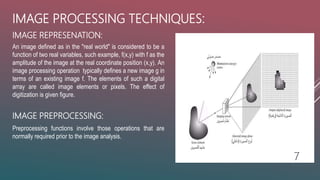
An image defined as in the "real world" is considered to be a
function of two real variables, such example, f(x,y) with f as the
amplitude of the image at the real coordinate position (x,y). An
image processing operation typically defines a new image g in
terms of an existing image f. The elements of such a digital
array are called image elements or pixels. The effect of
digitization is given figure.
IMAGE PREPROCESSING:
Preprocessing functions involve those operations that are
normally required prior to the image analysis.
7
IMAGE PROCESSING TECHNIQUES:
IMAGE ENHANCEMENT:
This technique include the function over pixels (Spatial method), Fourier transform of an image, Equalization
and Filtering of an image.
IMAGE COMPRESSION:
IMAGE ANALYSIS :
Image analysis differs from other types of image processing methods, such as enhancement or restoration in that the final
result of image analysis procedures is a numerical output rather than a picture such as object detection.
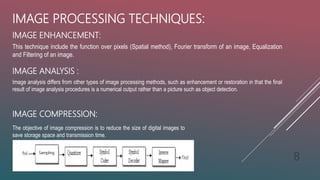
The objective of image compression is to reduce the size of digital images to
save storage space and transmission time.
Sampling
8
APPLICATION OF IMAGE PROCESSING:
Image Processing is used in various applications such as:
• Remote Sensing
• Medical Imaging
• Forensic Studies
• Textiles
• Military
• Film industry
• Document processing
• Graphic arts
• Printing Industry
9
10

Image processing

  • 1.
    IMAGE PROCESSING PRESENTED BY: SHERMUHAMMAD RAHEEL AHMED 2K16/TCT/62 2K16/TCT/50 1
  • 2.
    CONTENTS: INTRODUCTION. TYPES OF “IMAGEPROCESSING”. TECHNIQUES OF “IMAGE PROCESSING”. APPLICATIONS OF “IMAGE PROCESSING”. 2
  • 3.
    INTRODUCTION: Image processing isany form of signal processing for which the input is an image, such as a photograph or video frame; the output of image processing may be either an image or a set of characteristics or parameters related to the image. Why we need image processing:  Checking for presence  Object detection and localization.  Identification and verification. Since an image is an array, or a matrix, of square pixels (picture elements) arranged in columns and rows. If it is an grey scale image it has 8 bit colour depth = 256 grayscales. While A "true colour" image has 24 bit colour depth = 8 x 8 x 8 bits = 256 x 256 x colour = ~16 million colours 3
  • 4.
    TYPES/ METHODS OFIMAGE PROCESSING: There are mainly two methods or types of image processing 1. Analog Image Processing: Analog Image Processing is refer to the alteration of image through electrical means such example is the television image. The television signal is a voltage level which varies in amplitude to represent brightness through the image. 2. Digital Image Processing: Digital image processing is refer to processing of a two dimensional picture by a digital computer. A digital image is an array of actual numbers represented by a finite number of bits called as pixels. 4
  • 5.
    FUNDAMENTAL STEPS INIMAGE PROCESSING: 1. Image acquisition: to capture a digital image 2. Image preprocessing: to improve the image in ways that increase the chances for success of the other process over the capture image. 3. Image segmentation: to partitions an input image into its constituent parts or objects. 4. Image representation: to convert the input data to a form suitable for computer processing. 5. Image description: to extract basic information for differentiating one class of objects from another. 6. Image recognition: to assign a label to an object based on the information provided by its descriptors. 5
  • 6.
    IMAGE PROCESSING TECHNIQUES: The various Image Processing techniques are: Image representation Image preprocessing Image enhancement Image analysis Image data compression 6
  • 7.
    IMAGE REPRESENATION: IMAGE PROCESSINGTECHNIQUES: An image defined as in the "real world" is considered to be a function of two real variables, such example, f(x,y) with f as the amplitude of the image at the real coordinate position (x,y). An image processing operation typically defines a new image g in terms of an existing image f. The elements of such a digital array are called image elements or pixels. The effect of digitization is given figure. IMAGE PREPROCESSING: Preprocessing functions involve those operations that are normally required prior to the image analysis. 7
  • 8.
    IMAGE PROCESSING TECHNIQUES: IMAGEENHANCEMENT: This technique include the function over pixels (Spatial method), Fourier transform of an image, Equalization and Filtering of an image. IMAGE COMPRESSION: IMAGE ANALYSIS : Image analysis differs from other types of image processing methods, such as enhancement or restoration in that the final result of image analysis procedures is a numerical output rather than a picture such as object detection. The objective of image compression is to reduce the size of digital images to save storage space and transmission time. Sampling 8
  • 9.
    APPLICATION OF IMAGEPROCESSING: Image Processing is used in various applications such as: • Remote Sensing • Medical Imaging • Forensic Studies • Textiles • Military • Film industry • Document processing • Graphic arts • Printing Industry 9
  • 10.