AI and Sensor based assistive system for visually impaired people
College Of Engineering and Technology,BBSR
Presented To-
The Department of
Instrumentation and
Electronics Engineering
Presented By-
Gyana Ranjan Tripathy,
Regd. no-1501106249,
8th sem,I&E-A1 1
Abstract:
The need for developing a low-cost assistive system for the visually impaired and blind people has
increased with steady increase in their population worldwide. The stick system presented in the Seminar
uses artificial intelligence along with various sensors in real time to help the visually disabled people to
navigate their environment independently. Image recognition, collision detection and obstacle detection
are the three tasks performed by the system. The image recognition task was performed using a
smartphone application powered by artificial intelligence. The tasks of collision detection and obstacle
detection utilized ultrasonic sensors to alert the user of the obstacles appearing in his route. The stick
system also managed to demonstrate the important characteristics of affordability, high efficiency,mobility
and ease of use.
2
Contents:
● Introduction
● Objective
● Why AI?
● What is AI?
● System Working principle
● Hardware specifications
● Flowchart Algorithms
● Conclusion
● References
3
introduction:
● According to the survey of WHO(World health organisation) almost 40-45
million people are blind .
● 90% of the of visually impaired people belongs to lower economic or poor
class family in developing country like india.
● Blind person have a constant need of a assistant in daily life.
● They use dog,white cane as their assistant in most of the case.
4
Objective:
● Several technology like Electronics travel aid(ETA),ulta sonic and feedback
audio system,Tactile vision system.
● ETA is very costly and being unaffordable.
● Ultrasonic and feedback audio system blocked the daily routine audio system
of visually impaired individuals.
● Tactile vision system converted the information in a tactile signal.The
prototype used in this system is very heavy and unable to differentiate
between hanging and ground obstacles.
5
Why AI(Artificial intelligence)?
● It can be easy to use and low costly than other method.
● It is free from other drawbacks.
● 70% of blind persons use smart android phone which is very helpful to
implement this type of system.
6
What is AI(Artificial Intelligence)?
● Artificial Intelligence is the called as machine intelligence.
● It is the science of creating intelligent machines that work and react like humans.
● AI is the combinations of machine learning,deep learning and neural networks.
source:internet(www.google.co.in/search?q=applications+of+artificial+intelligenB&biw=1326)
7
Fig.1:Structure of AI
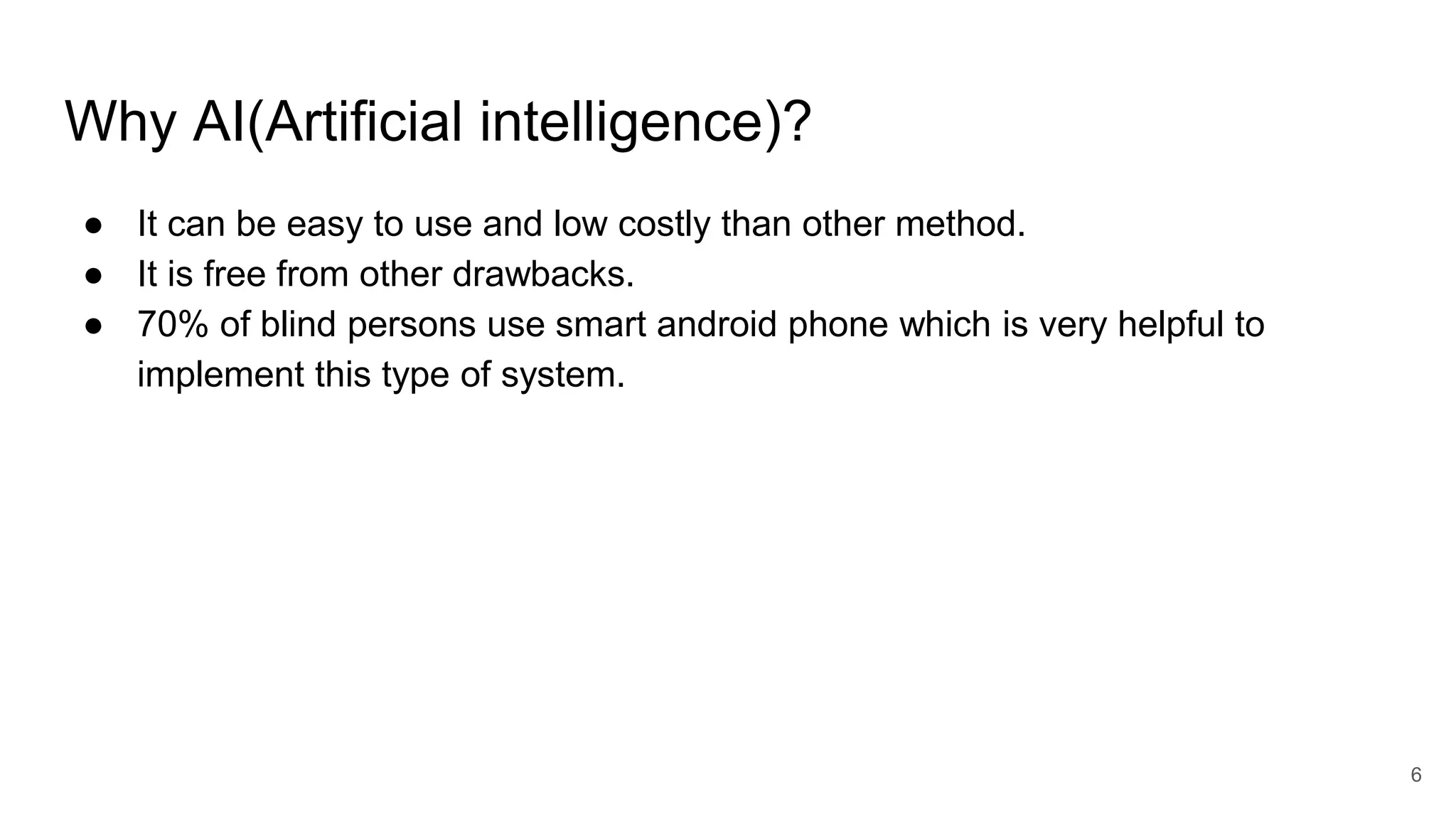
Some Application of AI-
Source:internet(www.google.co.in/search?q=applicationssource&biw=1326&bih=641#imgrc=aUk2yLlERLOjdM) 8
Fig 2:Application of AI
9
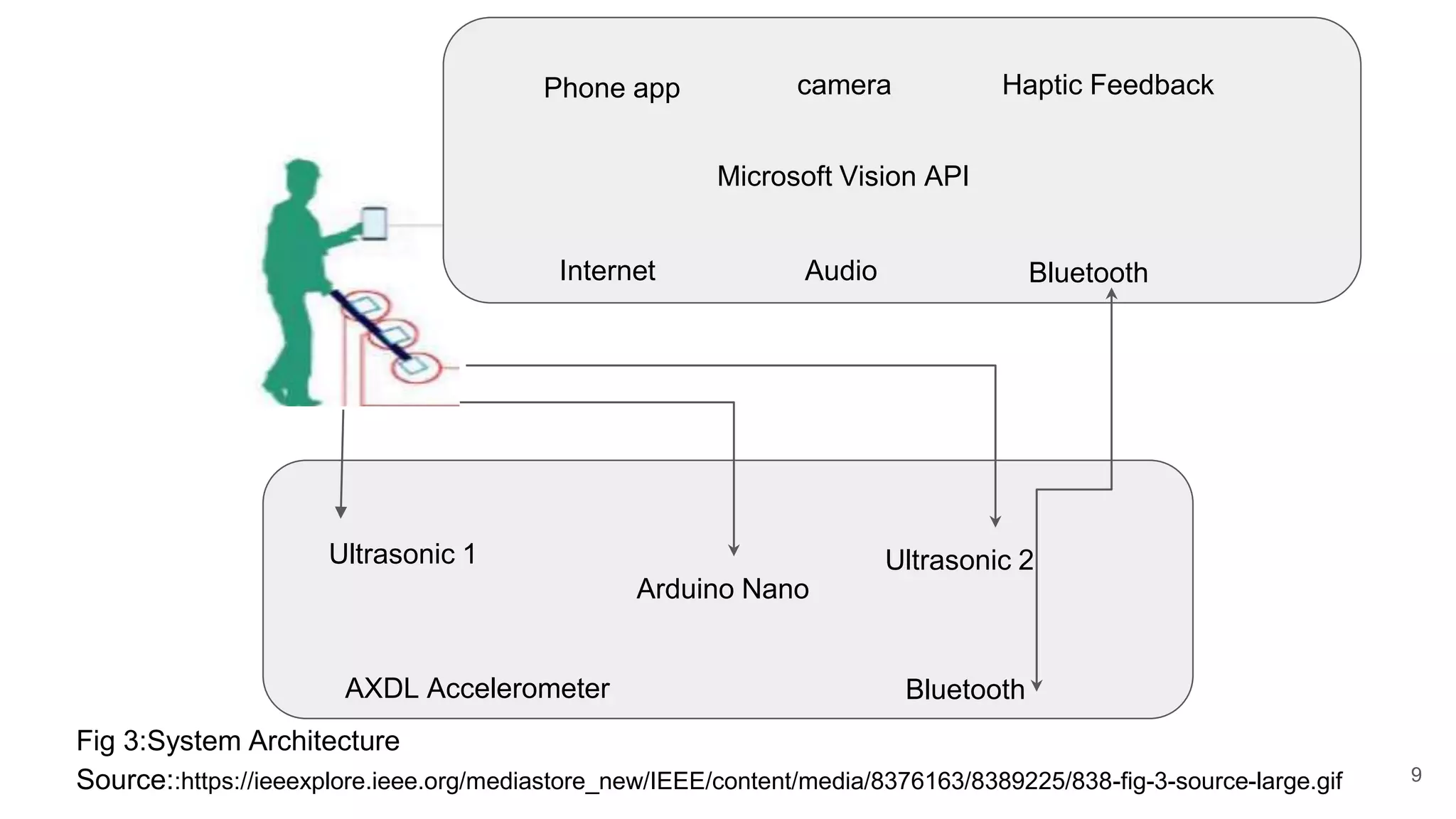
Phone app camera Haptic Feedback
Microsoft Vision API
Internet Audio Bluetooth
Ultrasonic 1
AXDL Accelerometer
Arduino Nano
Ultrasonic 2
Bluetooth
Fig 3:System Architecture
Source::https://ieeexplore.ieee.org/mediastore_new/IEEE/content/media/8376163/8389225/838-fig-3-source-large.gif
Hardware description:
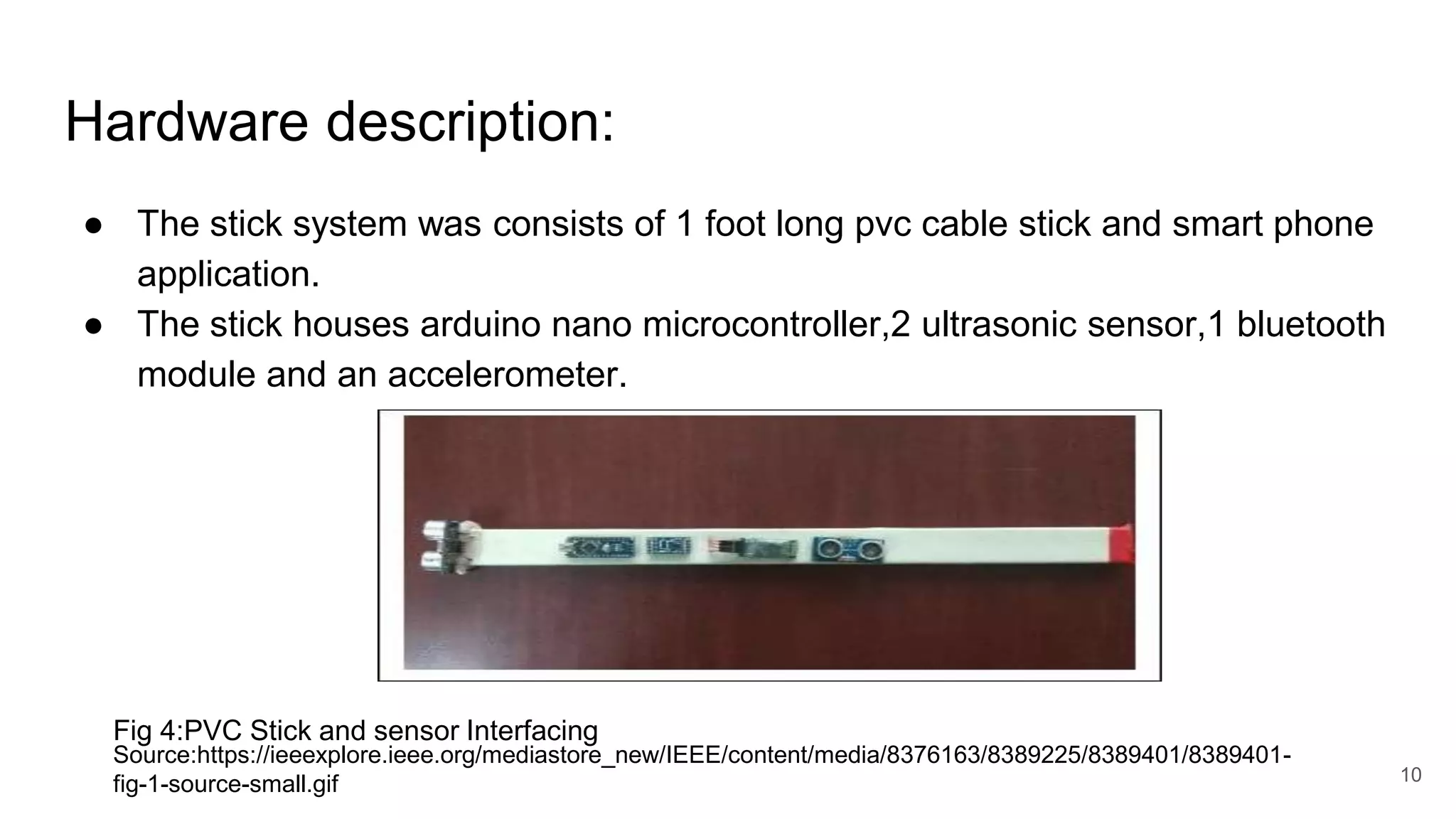
● The stick system was consists of 1 foot long pvc cable stick and smart phone
application.
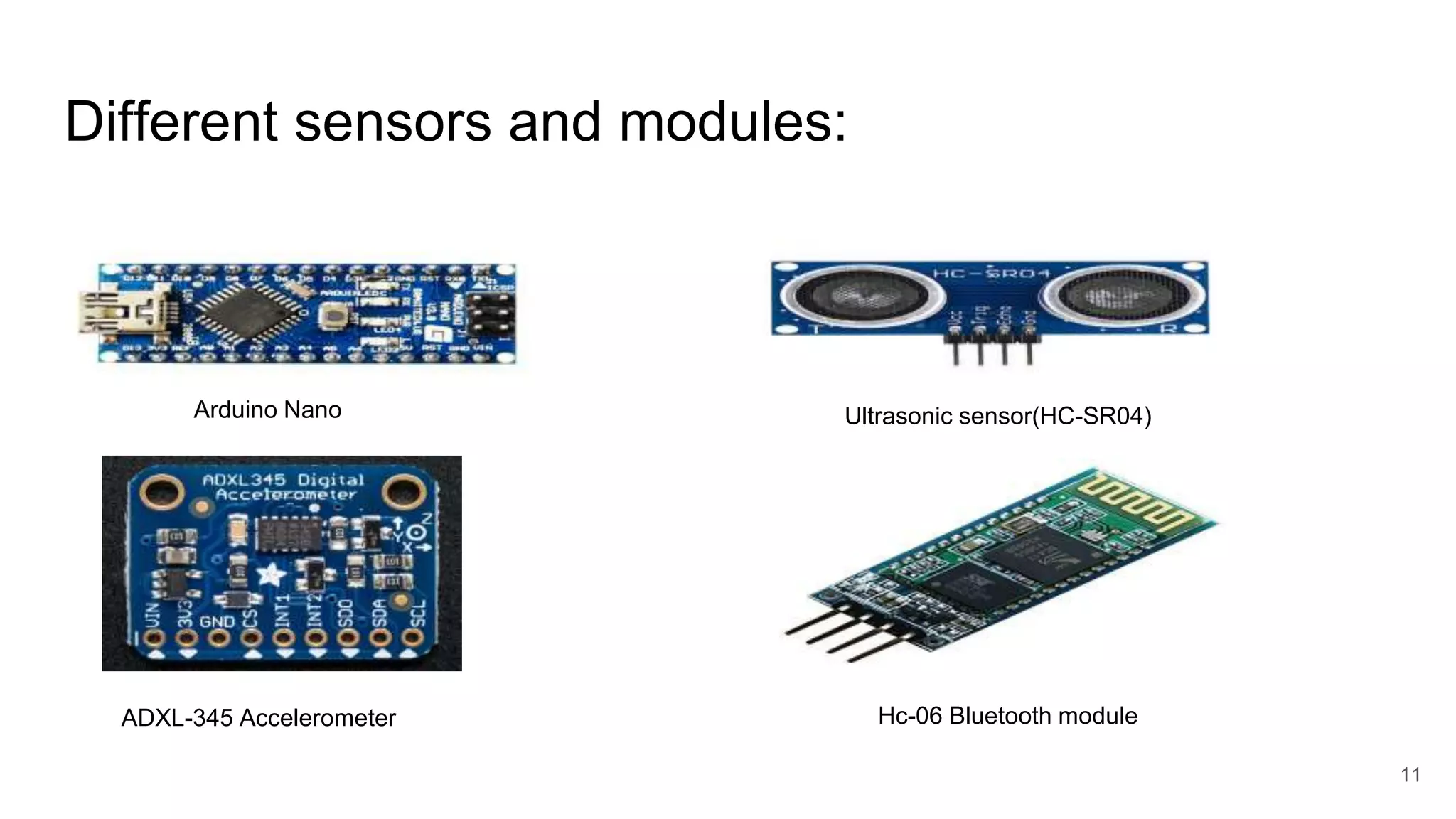
● The stick houses arduino nano microcontroller,2 ultrasonic sensor,1 bluetooth
module and an accelerometer.
10
Source:https://ieeexplore.ieee.org/mediastore_new/IEEE/content/media/8376163/8389225/8389401/8389401-
fig-1-source-small.gif
Fig 4:PVC Stick and sensor Interfacing
Different sensors and modules:
11
Arduino Nano Ultrasonic sensor(HC-SR04)
ADXL-345 Accelerometer Hc-06 Bluetooth module
System working principle:
● There are 3 basic work of the system.
● Obstacle detection
● Collision detection
● Image recognition
12
Obstacle detection:
● By the help of ultrasonic sensor we can detect the distance from the
obstacles.
● Distance=(duration/2)/(1/c),c=343.5 m/s
● Here the threshold distance is 4 feet.
● Bluetooth distance between the arduino and smart system can be used to
transfer the computed distance.
13
Collision Detection:
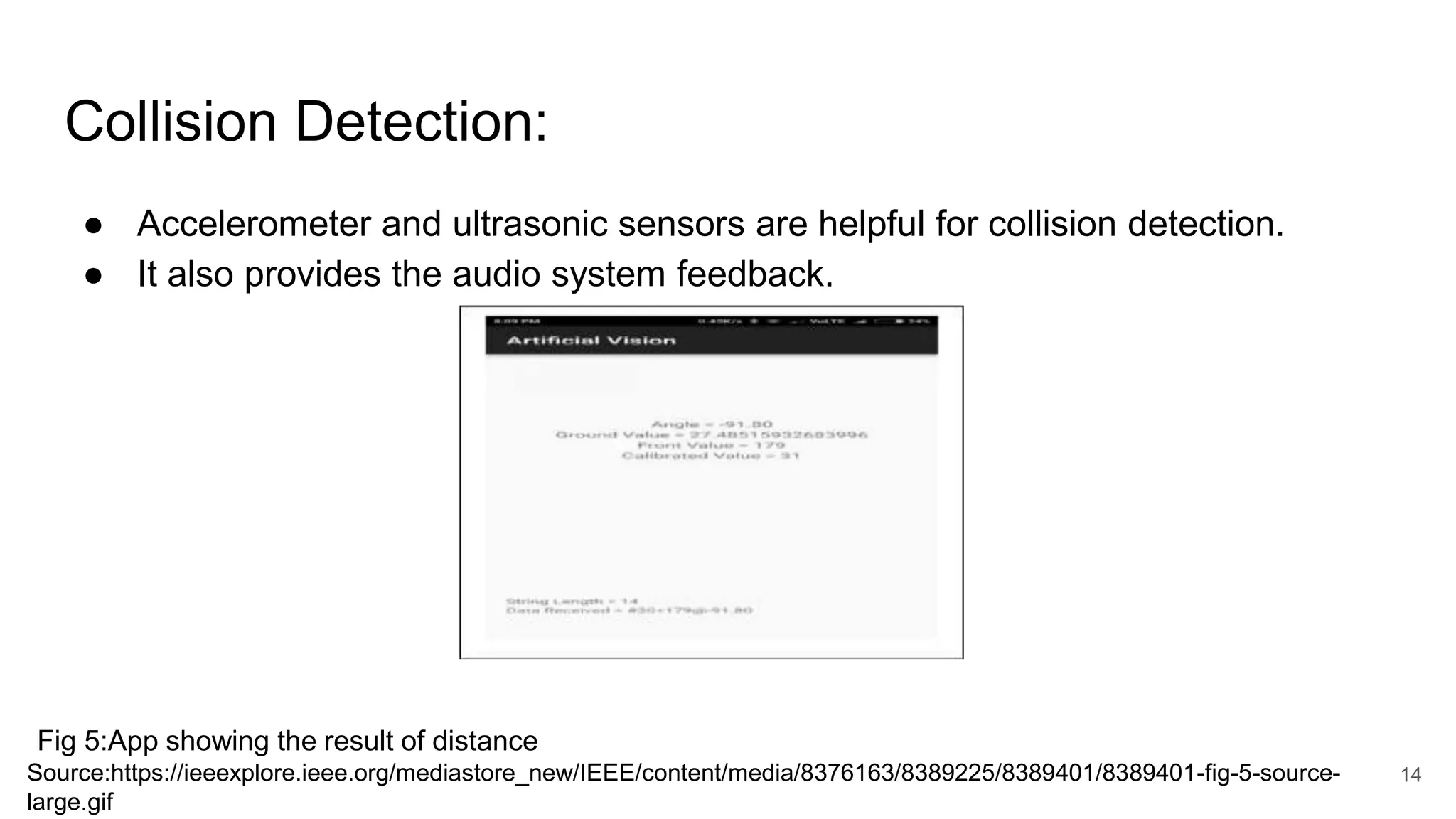
● Accelerometer and ultrasonic sensors are helpful for collision detection.
● It also provides the audio system feedback.
14Source:https://ieeexplore.ieee.org/mediastore_new/IEEE/content/media/8376163/8389225/8389401/8389401-fig-5-source-
large.gif
Fig 5:App showing the result of distance
Image recognition:
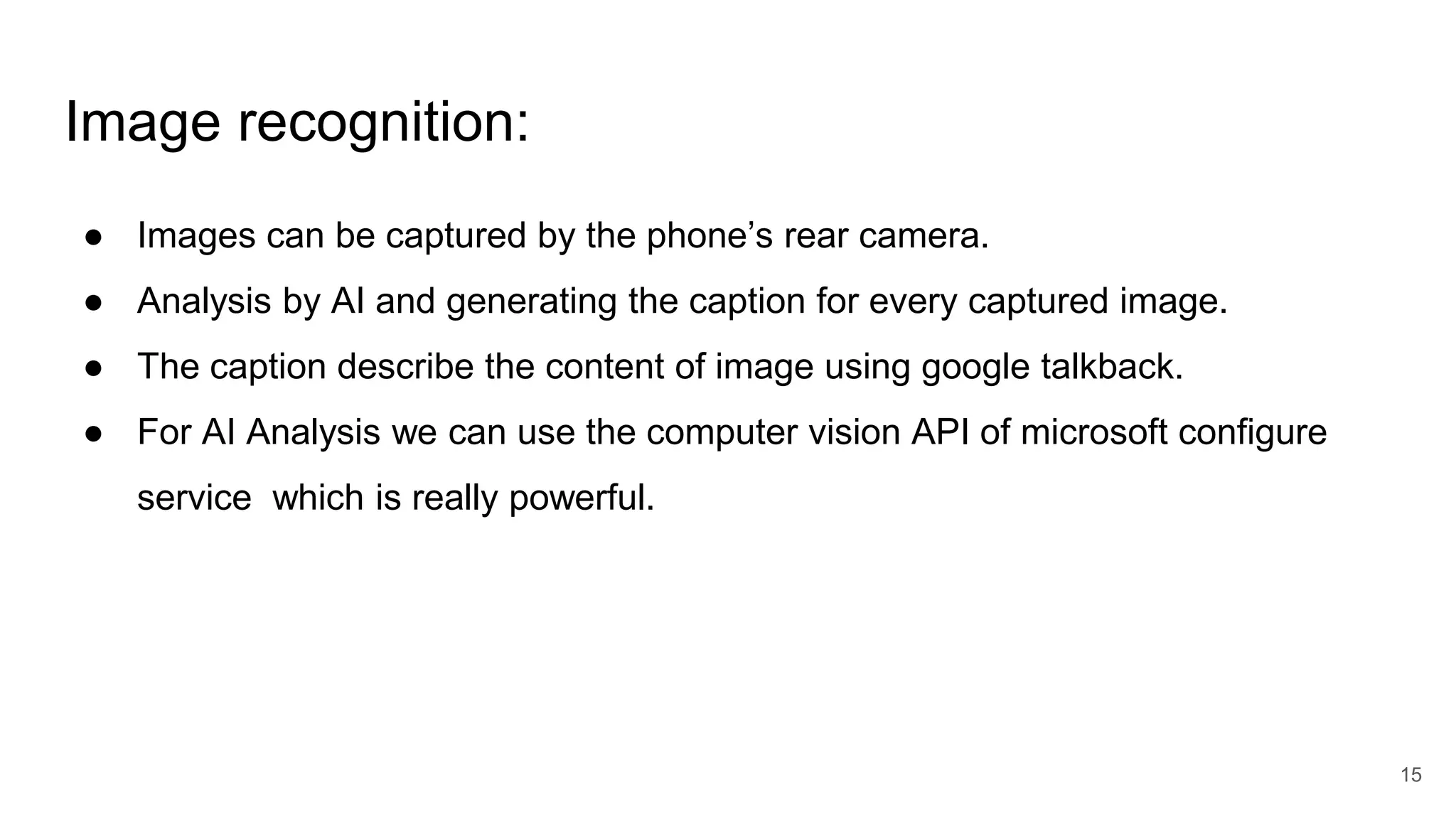
● Images can be captured by the phone’s rear camera.
● Analysis by AI and generating the caption for every captured image.
● The caption describe the content of image using google talkback.
● For AI Analysis we can use the computer vision API of microsoft configure
service which is really powerful.
15
16
Source:internet(https://ieeexplore.ieee.org/mediastore_new/IEEE/content/media/8376163/8389225/8389401/
8389401-fig-4-source-small.gif)
Fig 7:Image Detection
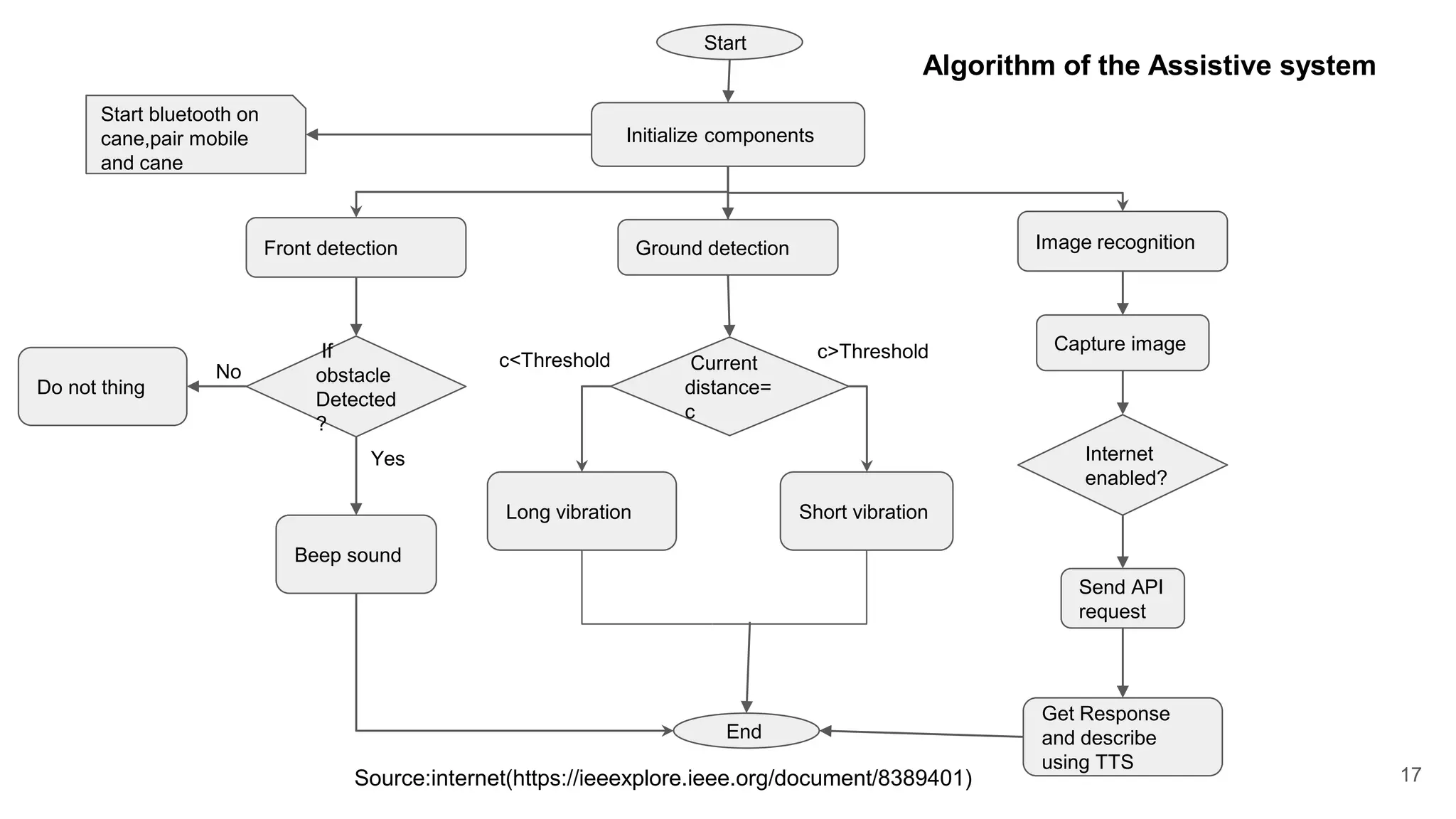
Start
Initialize components
Front detection Ground detection Image recognition
Capture imageIf
obstacle
Detected
?
Current
distance=
c
Internet
enabled?
Do not thing
Beep sound
Long vibration Short vibration
Send API
request
Get Response
and describe
using TTS
End
Start bluetooth on
cane,pair mobile
and cane
Yes
No
c<Threshold c>Threshold
Algorithm of the Assistive system
Source:internet(https://ieeexplore.ieee.org/document/8389401) 17
Conclusion:
In this seminar, design and development of a real-time artificial intelligence
system for assisting visually impaired and blind people has been discussed. The
system performed three main tasks of image recognition, collision detection and
obstacle detection allowing the user to navigate his route independently. Using
incumbent devices like a smartphone and a compact but high quality hardware,
our system managed to overcome the hurdle of developing an assistive system
which was both efficient and affordable enough for the visually impaired people
especially belonging to the low-income households. Future research work involves
refining our system so that a more hands-free assistive system experience can be
provided for the visually disabled people.
18
References:
[1]Sandesh Chinchole,Samir Patel,”Artificial Intelligence and Sensors Based Assistive System for the Visually Impaired
People”Proceedings of the International Conference on Intelligent Sustainable Systems (ICISS 2017).IEEE Xplore
Compliant - Part Number:CFP17M19-ART, ISBN:978-1-5386-1959-9,December 2018.
[2] A. Iqbal, U. Farooq, H. Mahmood, and M.U. Asad, “A low cost artificial vision system for visually impaired people,” 2009
Second International Conference on Computer and Electrical Engineering,pp. 474-479, December 2009.
[3]Blindness: vision 2020 - The global initiative for the elimination of avoidable blindness. Retrieved from
http://www.who.int/mediacentre/factsheets/fs213/en/
[4]L.A. Johnson and C.M. Higgins, “A navigation aid for the blind using tactile-visual sensory substitution,” 2006 International
Conference of the IEEE Engineering in Medicine and Biology Society, pp. 6298–6292, August 2006.
19
20
Thank You

Artificial intelligence and sensor based assistive sytem for visually impaired person

  • 1.
    AI and Sensorbased assistive system for visually impaired people College Of Engineering and Technology,BBSR Presented To- The Department of Instrumentation and Electronics Engineering Presented By- Gyana Ranjan Tripathy, Regd. no-1501106249, 8th sem,I&E-A1 1
  • 2.
    Abstract: The need fordeveloping a low-cost assistive system for the visually impaired and blind people has increased with steady increase in their population worldwide. The stick system presented in the Seminar uses artificial intelligence along with various sensors in real time to help the visually disabled people to navigate their environment independently. Image recognition, collision detection and obstacle detection are the three tasks performed by the system. The image recognition task was performed using a smartphone application powered by artificial intelligence. The tasks of collision detection and obstacle detection utilized ultrasonic sensors to alert the user of the obstacles appearing in his route. The stick system also managed to demonstrate the important characteristics of affordability, high efficiency,mobility and ease of use. 2
  • 3.
    Contents: ● Introduction ● Objective ●Why AI? ● What is AI? ● System Working principle ● Hardware specifications ● Flowchart Algorithms ● Conclusion ● References 3
  • 4.
    introduction: ● According tothe survey of WHO(World health organisation) almost 40-45 million people are blind . ● 90% of the of visually impaired people belongs to lower economic or poor class family in developing country like india. ● Blind person have a constant need of a assistant in daily life. ● They use dog,white cane as their assistant in most of the case. 4
  • 5.
    Objective: ● Several technologylike Electronics travel aid(ETA),ulta sonic and feedback audio system,Tactile vision system. ● ETA is very costly and being unaffordable. ● Ultrasonic and feedback audio system blocked the daily routine audio system of visually impaired individuals. ● Tactile vision system converted the information in a tactile signal.The prototype used in this system is very heavy and unable to differentiate between hanging and ground obstacles. 5
  • 6.
    Why AI(Artificial intelligence)? ●It can be easy to use and low costly than other method. ● It is free from other drawbacks. ● 70% of blind persons use smart android phone which is very helpful to implement this type of system. 6
  • 7.
    What is AI(ArtificialIntelligence)? ● Artificial Intelligence is the called as machine intelligence. ● It is the science of creating intelligent machines that work and react like humans. ● AI is the combinations of machine learning,deep learning and neural networks. source:internet(www.google.co.in/search?q=applications+of+artificial+intelligenB&biw=1326) 7 Fig.1:Structure of AI
  • 8.
    Some Application ofAI- Source:internet(www.google.co.in/search?q=applicationssource&biw=1326&bih=641#imgrc=aUk2yLlERLOjdM) 8 Fig 2:Application of AI
  • 9.
    9 Phone app cameraHaptic Feedback Microsoft Vision API Internet Audio Bluetooth Ultrasonic 1 AXDL Accelerometer Arduino Nano Ultrasonic 2 Bluetooth Fig 3:System Architecture Source::https://ieeexplore.ieee.org/mediastore_new/IEEE/content/media/8376163/8389225/838-fig-3-source-large.gif
  • 10.
    Hardware description: ● Thestick system was consists of 1 foot long pvc cable stick and smart phone application. ● The stick houses arduino nano microcontroller,2 ultrasonic sensor,1 bluetooth module and an accelerometer. 10 Source:https://ieeexplore.ieee.org/mediastore_new/IEEE/content/media/8376163/8389225/8389401/8389401- fig-1-source-small.gif Fig 4:PVC Stick and sensor Interfacing
  • 11.
    Different sensors andmodules: 11 Arduino Nano Ultrasonic sensor(HC-SR04) ADXL-345 Accelerometer Hc-06 Bluetooth module
  • 12.
    System working principle: ●There are 3 basic work of the system. ● Obstacle detection ● Collision detection ● Image recognition 12
  • 13.
    Obstacle detection: ● Bythe help of ultrasonic sensor we can detect the distance from the obstacles. ● Distance=(duration/2)/(1/c),c=343.5 m/s ● Here the threshold distance is 4 feet. ● Bluetooth distance between the arduino and smart system can be used to transfer the computed distance. 13
  • 14.
    Collision Detection: ● Accelerometerand ultrasonic sensors are helpful for collision detection. ● It also provides the audio system feedback. 14Source:https://ieeexplore.ieee.org/mediastore_new/IEEE/content/media/8376163/8389225/8389401/8389401-fig-5-source- large.gif Fig 5:App showing the result of distance
  • 15.
    Image recognition: ● Imagescan be captured by the phone’s rear camera. ● Analysis by AI and generating the caption for every captured image. ● The caption describe the content of image using google talkback. ● For AI Analysis we can use the computer vision API of microsoft configure service which is really powerful. 15
  • 16.
  • 17.
    Start Initialize components Front detectionGround detection Image recognition Capture imageIf obstacle Detected ? Current distance= c Internet enabled? Do not thing Beep sound Long vibration Short vibration Send API request Get Response and describe using TTS End Start bluetooth on cane,pair mobile and cane Yes No c<Threshold c>Threshold Algorithm of the Assistive system Source:internet(https://ieeexplore.ieee.org/document/8389401) 17
  • 18.
    Conclusion: In this seminar,design and development of a real-time artificial intelligence system for assisting visually impaired and blind people has been discussed. The system performed three main tasks of image recognition, collision detection and obstacle detection allowing the user to navigate his route independently. Using incumbent devices like a smartphone and a compact but high quality hardware, our system managed to overcome the hurdle of developing an assistive system which was both efficient and affordable enough for the visually impaired people especially belonging to the low-income households. Future research work involves refining our system so that a more hands-free assistive system experience can be provided for the visually disabled people. 18
  • 19.
    References: [1]Sandesh Chinchole,Samir Patel,”ArtificialIntelligence and Sensors Based Assistive System for the Visually Impaired People”Proceedings of the International Conference on Intelligent Sustainable Systems (ICISS 2017).IEEE Xplore Compliant - Part Number:CFP17M19-ART, ISBN:978-1-5386-1959-9,December 2018. [2] A. Iqbal, U. Farooq, H. Mahmood, and M.U. Asad, “A low cost artificial vision system for visually impaired people,” 2009 Second International Conference on Computer and Electrical Engineering,pp. 474-479, December 2009. [3]Blindness: vision 2020 - The global initiative for the elimination of avoidable blindness. Retrieved from http://www.who.int/mediacentre/factsheets/fs213/en/ [4]L.A. Johnson and C.M. Higgins, “A navigation aid for the blind using tactile-visual sensory substitution,” 2006 International Conference of the IEEE Engineering in Medicine and Biology Society, pp. 6298–6292, August 2006. 19
  • 20.