M Satish, Mujumdar et al Int. Journal of Engineering Research and Applications www.ijera.com 
ISSN : 2248-9622, Vol. 4, Issue 7( Version 4), July 2014, pp.163-166 
www.ijera.com 163 | P a g e 
Image Denoising Using Wavelet Transform Mohit Satish, Mujumdar1, Sagar More2, Sagar Kulkarni3 Undergraduate student, Department of Electronics and Telecommunication, Ramrao Adik Institute of Technology, Maharashtra, India. Undergraduate student, Department of Electronics and Telecommunication, Ramrao Adik Institute of Technology, Maharashtra, India Undergraduate student, Department of Electronics and Telecommunication, Ramrao Adik Institute of Technology, Maharashtra, India Abstract In this project, we have studied the importance of wavelet theory in image denoising over other traditional methods. We studied the importance of thresholding in wavelet theory and the two basic thresholding method i.e. hard and soft thresholding experimentally. We also studied why soft thresholding is preferred over hard thresholding, three types of soft thresholding (Bayes shrink, Sure shrink, Visu shrink) as well as advantages and disadvantage of each of them 
I. INTRODUCTION 
A digital image is a 2-D matrix given by a function f(u,v) where the value at co-ordinate (u,v) specify the intensity of the pixel whose co-ordinate is given by (u,v). In our everyday schedule, we come across various kinds of digital images such as television and computer images, MRI images, space and heavenly body images, images taken with the help of remote sensing. In all the above fields, noise gets added due to interference of unwanted high frequency electromagnetic signals with desired digital image during its transmission. The noise may also get added because of improper lighting, inherent noisy characteristics of channel or due to mechanical degradation of equipments. Image denoising is necessary to obtain best approximation of the original digital image from the received noisy image. Before couple of decades, denoising was a challenging task. But after the advent of wavelet theory, denoising has been simplified to a great extent. 
II. WAVELETS OVER FOURIER DOMAIN 
Before the invention of the wavelets, the one and only tool to analyze the signal in frequency domain was Fourier Transform. But it has one major disadvantage. This can be explained by considering the following example. Consider a signal consisting of 5 frequencies viz.100KHz, 50KHz, 300KHZ, 200KHz, 150Khz. Let the signal frequencies are received in the same order shown above. If Fourier transform is applied to above signal then the frequency response will contain the frequencies in the order as 50KHZ, 100 KHZ, 150 KHZ, 200 KHZ, and 300 KHZ. It means that, Fourier transform is not capable of acknowledging the order at which the frequencies have arrived. This disadvantage of Fourier transform can be overcome by using Wavelet transform. Wavelet transform can analyze the signal in frequency domain and can also give the order at which individual frequency has arrived at the receiver. The various types of wavelets are Haar wavelet, Daubechies wavelet, Mexican hat wavelet, Biorthogonal wavelet, Gaussian wavelet etc. 
III. WAVELETS THRESHOLDING FOR DENOISING 
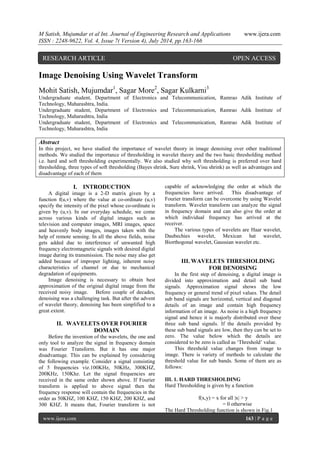
In the first step of denoising, a digital image is divided into approximation and detail sub band signals. Approximation signal shows the low frequency or general trend of pixel values. The detail sub band signals are horizontal, vertical and diagonal details of an image and contain high frequency information of an image. As noise is a high frequency signal and hence it is majorly distributed over these three sub band signals. If the details provided by these sub band signals are low, then they can be set to zero. The value below which the details are considered to be zero is called as „Threshold‟ value. This threshold value changes from image to image. There is variety of methods to calculate the threshold value for sub bands. Some of them are as follows: III. 1. HARD THRESHOLDING Hard Thresholding is given by a function f(x,y) = x for all |x| > y = 0 otherwise The Hard Thresholding function is shown in Fig.1 
RESEARCH ARTICLE OPEN ACCESS
M Satish, Mujumdar et al Int. Journal of Engineering Research and Applications www.ijera.com 
ISSN : 2248-9622, Vol. 4, Issue 7( Version 4), July 2014, pp.163-166 
www.ijera.com 164 | P a g e 
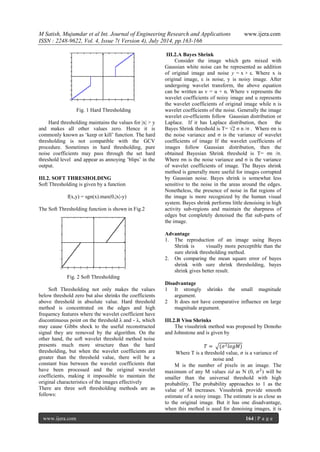
Fig. 1 Hard Thresholding Hard thresholding maintains the values for |x| > y and makes all other values zero. Hence it is commonly known as „keep or kill‟ function. The hard thresholding is not compatible with the GCV procedure. Sometimes in hard thresholding, pure noise coefficients may pass through the set hard threshold level and appear as annoying ‟blips‟ in the output. III.2. SOFT THRESHOLDING Soft Thresholding is given by a function f(x,y) = sgn(x).max(0,|x|-y) The Soft Thresholding function is shown in Fig.2 
Fig. 2 Soft Thresholding Soft Thresholding not only makes the values below threshold zero but also shrinks the coefficients above threshold in absolute value. Hard threshold method is concentrated on the edges and high frequency features where the wavelet coefficient have discontinuous point on the threshold λ and - λ, which may cause Gibbs shock to the useful reconstructed signal they are removed by the algorithm. On the other hand, the soft wavelet threshold method noise presents much more structure than the hard thresholding, but when the wavelet coefficients are greater than the threshold value, there will be a constant bias between the wavelet coefficients that have been processed and the original wavelet coefficients, making it impossible to maintain the original characteristics of the images effectively There are three soft thresholding methods are as follows: 
III.2.A Bayes Shrink 
Consider the image which gets mixed with Gaussian white noise can be represented as addition of original image and noise y = x + ε. Where x is original image, ε is noise, y is noisy image. After undergoing wavelet transform, the above equation can be written as v = u + n. Where v represents the wavelet coefficients of noisy image and u represents the wavelet coefficients of original image while n is wavelet coefficients of the noise. Generally the image wavelet co-efficients follow Gaussian distribution or Laplace. If it has Laplace distribution, then the Bayes Shrink threshold is T= √2 σ n /σ . Where σn is the noise variance and σ is the variance of wavelet coefficients of image If the wavelet coefficients of images follow Gaussian distribution, then the obtained Bayesian Shrink threshold is T= σn /σ. Where σn is the noise variance and σ is the variance of wavelet coefficients of image. The Bayes shrink method is generally more useful for images corrupted by Gaussian noise. Bayes shrink is somewhat less sensitive to the noise in the areas around the edges. Nonetheless, the presence of noise in flat regions of the image is more recognized by the human visual system. Bayes shrink performs little denoising in high activity sub-regions and maintain the sharpness of edges but completely denoised the flat sub-parts of the image. Advantage 
1. The reproduction of an image using Bayes Shrink is visually more perceptible than the sure shrink thresholding method. 
2. On comparing the mean square error of bayes shrink with sure shrink thresholding, bayes shrink gives better result. 
Disadvantage 1 It strongly shrinks the small magnitude argument. 2 It does not have comparative influence on large magnitude argument. 
III.2.B Visu Shrinks The visushrink method was proposed by Donoho and Johnstone and is given by 푇= (휎2푙표푔푀) Where T is a threshold value, 휎 is a variance of noise and 
M is the number of pixels in an image. The maximum of any M values iid as N (0, 휎2) will be smaller than the universal threshold with high probability. The probability approaches to 1 as the value of M increases. Visushrink provide smooth estimate of a noisy image. The estimate is as close as to the original image. But it has one disadvantage, when this method is used for denoising images, it is
M Satish, Mujumdar et al Int. Journal of Engineering Research and Applications www.ijera.com 
ISSN : 2248-9622, Vol. 4, Issue 7( Version 4), July 2014, pp.163-166 
www.ijera.com 165 | P a g e 
found to yield an over smoothed estimate . This is 
because the universal threshold (UT) is derived under 
the constraint that with high probability the estimate 
should be at least as smooth as the signal. So the UT 
increases with increase in values of M.As a result 
along with noise, various signal co-efficients are also 
removed. Thus, the threshold does not adapt well to 
discontinuities in the signal. 
ADVANTAGE 
1 The computational time is comparatively good. 
DISADVANTAGE 
1 Visu Shrink thresholding is not suitable for the 
images in which there are various discontinuities.. 
III.2.C. SURE SHRINK 
Donoho and Johnston invented a threshold 
chooser which was based on Stein‟s Unbiased Risk 
Estimator (SURE) and is called as Sureshrink 
Thresholding. It tries to minimize the mean square 
error (MSE) which is define as 
MSE = 
Where z(x,y) is estimate of signal while s(x,y) is the 
original signal without noise and n is the signal size. 
Let μ = (μi :i = 1….. d) be a vector whose length is d, 
and 
Let x = {xi} (with xi distributed as N(μi,1)) be 
multivariate 
Normal observations with mean vector μ. Let 
ǔ = ǔ(x) be an fixed estimate of μ based on the 
observations 
x. SURE (Stein‟s unbiased Risk Estimator) 
is a method for estimating the loss ‖ǔ-μ‖2 in an 
unambiguous fashion .The sure shrink threshold is 
lower than that of visu shrink threshold 
separate threshold is calculated for each detail sub 
band. 
ADVANTAGE 
1 The output PSNR of images is maximum for sure 
shrink 
Thresholding. 
2 There are less perceptible distortion in the images 
which use this thresholding. 
DISADVANTAGE 
1 The computational time required is more for sure 
shrink thresholding. 
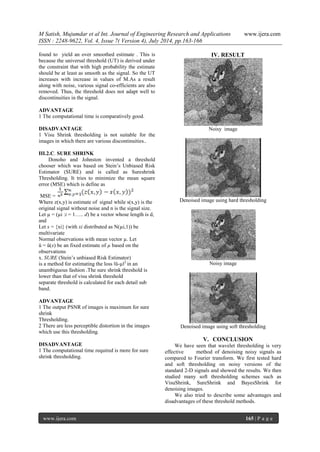
IV. RESULT 
Noisy image 
Denoised image using hard thresholding 
Noisy image 
Denoised image using soft thresholding 
V. CONCLUSION 
We have seen that wavelet thresholding is very 
effective method of denoising noisy signals as 
compared to Fourier transform. We first tested hard 
and soft thresholding on noisy versions of the 
standard 2-D signals and showed the results. We then 
studied many soft thresholding schemes such as 
VisuShrink, SureShrink and BayesShrink for 
denoising images. 
We also tried to describe some advantages and 
disadvantages of these threshold methods.
M Satish, Mujumdar et al Int. Journal of Engineering Research and Applications www.ijera.com 
ISSN : 2248-9622, Vol. 4, Issue 7( Version 4), July 2014, pp.163-166 
www.ijera.com 166 | P a g e 
REFERENCES [1] Martin Vetterli S Grace Chang, Bin Yu. Adaptive wavelet thresholding for image denoising and compression. IEEE Transactions on Image Processing, 9(9):1532–1546, Sep 2000. [2] Asem Khmag, Abd Rahman Ramli, Syed Abdul Rahman Al-Haddad, Shaiful Jahari Hashim “A Detailed Study on Image Denoising Algorithms by Using the Discrete Wavelet Transformation” IJCST Vol. 5, SPL - 1, Jan - March 2014 [3] Rajesh Kumar Rai, Trimbak R. Sontakke “ Implementation of Image Denoising using Thresholding Techniques “International Journal of Computer Technology and Electronics Engineering (IJCTEE) Volume 1 , Issue 2 [4] David L Donoho. Ideal spatial adaptation by wavelet shrinkage. Biometrika, [5] Iain M.Johnstone David L Donoho. Adapting to smoothness via wavelet shrinkage. Journal of the Statistical Association, 90(432):1200–1224, Dec 1995. [6] Swati Varun Yadav , Sabah Wajahat ”Implementation of image denoising using wavelet thresholding techniques based on sure shrink approach” International Journal of emerging trend in Electronics and computer Science volume 1, Issue 1. [7] S.Arivazhagan, S.Deivalakshmi, K.Kannan ” Performance Analysis of Image Denoising System for different levels of Wavelet decomposition” in International journal of imaging science and engineering (IJISE) [8] D.Marpe, H.L.Cycon, G.Zander, K.U.Barthel, 2002, “Context- based Denoising of Images Using Iterative Wavelet Thresholding,” Proc. SPIE, Vol. 4671, pp. 907-914. [9] Aarti, 2Gaurav Pushkarna, Comparative Study of Image Denoising Algorithms in Digital Image Processing COMPUSOFT, An international journal of advanced computer technology, 3 (5), May-2014 (Volume-III, Issue-V) [10] Digital Image processing (2nd Edition) Rafael C.Gunzalez & Richards E.Eoods

Image Denoising Using Wavelet Transform

  • 1.
    M Satish, Mujumdaret al Int. Journal of Engineering Research and Applications www.ijera.com ISSN : 2248-9622, Vol. 4, Issue 7( Version 4), July 2014, pp.163-166 www.ijera.com 163 | P a g e Image Denoising Using Wavelet Transform Mohit Satish, Mujumdar1, Sagar More2, Sagar Kulkarni3 Undergraduate student, Department of Electronics and Telecommunication, Ramrao Adik Institute of Technology, Maharashtra, India. Undergraduate student, Department of Electronics and Telecommunication, Ramrao Adik Institute of Technology, Maharashtra, India Undergraduate student, Department of Electronics and Telecommunication, Ramrao Adik Institute of Technology, Maharashtra, India Abstract In this project, we have studied the importance of wavelet theory in image denoising over other traditional methods. We studied the importance of thresholding in wavelet theory and the two basic thresholding method i.e. hard and soft thresholding experimentally. We also studied why soft thresholding is preferred over hard thresholding, three types of soft thresholding (Bayes shrink, Sure shrink, Visu shrink) as well as advantages and disadvantage of each of them I. INTRODUCTION A digital image is a 2-D matrix given by a function f(u,v) where the value at co-ordinate (u,v) specify the intensity of the pixel whose co-ordinate is given by (u,v). In our everyday schedule, we come across various kinds of digital images such as television and computer images, MRI images, space and heavenly body images, images taken with the help of remote sensing. In all the above fields, noise gets added due to interference of unwanted high frequency electromagnetic signals with desired digital image during its transmission. The noise may also get added because of improper lighting, inherent noisy characteristics of channel or due to mechanical degradation of equipments. Image denoising is necessary to obtain best approximation of the original digital image from the received noisy image. Before couple of decades, denoising was a challenging task. But after the advent of wavelet theory, denoising has been simplified to a great extent. II. WAVELETS OVER FOURIER DOMAIN Before the invention of the wavelets, the one and only tool to analyze the signal in frequency domain was Fourier Transform. But it has one major disadvantage. This can be explained by considering the following example. Consider a signal consisting of 5 frequencies viz.100KHz, 50KHz, 300KHZ, 200KHz, 150Khz. Let the signal frequencies are received in the same order shown above. If Fourier transform is applied to above signal then the frequency response will contain the frequencies in the order as 50KHZ, 100 KHZ, 150 KHZ, 200 KHZ, and 300 KHZ. It means that, Fourier transform is not capable of acknowledging the order at which the frequencies have arrived. This disadvantage of Fourier transform can be overcome by using Wavelet transform. Wavelet transform can analyze the signal in frequency domain and can also give the order at which individual frequency has arrived at the receiver. The various types of wavelets are Haar wavelet, Daubechies wavelet, Mexican hat wavelet, Biorthogonal wavelet, Gaussian wavelet etc. III. WAVELETS THRESHOLDING FOR DENOISING In the first step of denoising, a digital image is divided into approximation and detail sub band signals. Approximation signal shows the low frequency or general trend of pixel values. The detail sub band signals are horizontal, vertical and diagonal details of an image and contain high frequency information of an image. As noise is a high frequency signal and hence it is majorly distributed over these three sub band signals. If the details provided by these sub band signals are low, then they can be set to zero. The value below which the details are considered to be zero is called as „Threshold‟ value. This threshold value changes from image to image. There is variety of methods to calculate the threshold value for sub bands. Some of them are as follows: III. 1. HARD THRESHOLDING Hard Thresholding is given by a function f(x,y) = x for all |x| > y = 0 otherwise The Hard Thresholding function is shown in Fig.1 RESEARCH ARTICLE OPEN ACCESS
  • 2.
    M Satish, Mujumdaret al Int. Journal of Engineering Research and Applications www.ijera.com ISSN : 2248-9622, Vol. 4, Issue 7( Version 4), July 2014, pp.163-166 www.ijera.com 164 | P a g e Fig. 1 Hard Thresholding Hard thresholding maintains the values for |x| > y and makes all other values zero. Hence it is commonly known as „keep or kill‟ function. The hard thresholding is not compatible with the GCV procedure. Sometimes in hard thresholding, pure noise coefficients may pass through the set hard threshold level and appear as annoying ‟blips‟ in the output. III.2. SOFT THRESHOLDING Soft Thresholding is given by a function f(x,y) = sgn(x).max(0,|x|-y) The Soft Thresholding function is shown in Fig.2 Fig. 2 Soft Thresholding Soft Thresholding not only makes the values below threshold zero but also shrinks the coefficients above threshold in absolute value. Hard threshold method is concentrated on the edges and high frequency features where the wavelet coefficient have discontinuous point on the threshold λ and - λ, which may cause Gibbs shock to the useful reconstructed signal they are removed by the algorithm. On the other hand, the soft wavelet threshold method noise presents much more structure than the hard thresholding, but when the wavelet coefficients are greater than the threshold value, there will be a constant bias between the wavelet coefficients that have been processed and the original wavelet coefficients, making it impossible to maintain the original characteristics of the images effectively There are three soft thresholding methods are as follows: III.2.A Bayes Shrink Consider the image which gets mixed with Gaussian white noise can be represented as addition of original image and noise y = x + ε. Where x is original image, ε is noise, y is noisy image. After undergoing wavelet transform, the above equation can be written as v = u + n. Where v represents the wavelet coefficients of noisy image and u represents the wavelet coefficients of original image while n is wavelet coefficients of the noise. Generally the image wavelet co-efficients follow Gaussian distribution or Laplace. If it has Laplace distribution, then the Bayes Shrink threshold is T= √2 σ n /σ . Where σn is the noise variance and σ is the variance of wavelet coefficients of image If the wavelet coefficients of images follow Gaussian distribution, then the obtained Bayesian Shrink threshold is T= σn /σ. Where σn is the noise variance and σ is the variance of wavelet coefficients of image. The Bayes shrink method is generally more useful for images corrupted by Gaussian noise. Bayes shrink is somewhat less sensitive to the noise in the areas around the edges. Nonetheless, the presence of noise in flat regions of the image is more recognized by the human visual system. Bayes shrink performs little denoising in high activity sub-regions and maintain the sharpness of edges but completely denoised the flat sub-parts of the image. Advantage 1. The reproduction of an image using Bayes Shrink is visually more perceptible than the sure shrink thresholding method. 2. On comparing the mean square error of bayes shrink with sure shrink thresholding, bayes shrink gives better result. Disadvantage 1 It strongly shrinks the small magnitude argument. 2 It does not have comparative influence on large magnitude argument. III.2.B Visu Shrinks The visushrink method was proposed by Donoho and Johnstone and is given by 푇= (휎2푙표푔푀) Where T is a threshold value, 휎 is a variance of noise and M is the number of pixels in an image. The maximum of any M values iid as N (0, 휎2) will be smaller than the universal threshold with high probability. The probability approaches to 1 as the value of M increases. Visushrink provide smooth estimate of a noisy image. The estimate is as close as to the original image. But it has one disadvantage, when this method is used for denoising images, it is
  • 3.
    M Satish, Mujumdaret al Int. Journal of Engineering Research and Applications www.ijera.com ISSN : 2248-9622, Vol. 4, Issue 7( Version 4), July 2014, pp.163-166 www.ijera.com 165 | P a g e found to yield an over smoothed estimate . This is because the universal threshold (UT) is derived under the constraint that with high probability the estimate should be at least as smooth as the signal. So the UT increases with increase in values of M.As a result along with noise, various signal co-efficients are also removed. Thus, the threshold does not adapt well to discontinuities in the signal. ADVANTAGE 1 The computational time is comparatively good. DISADVANTAGE 1 Visu Shrink thresholding is not suitable for the images in which there are various discontinuities.. III.2.C. SURE SHRINK Donoho and Johnston invented a threshold chooser which was based on Stein‟s Unbiased Risk Estimator (SURE) and is called as Sureshrink Thresholding. It tries to minimize the mean square error (MSE) which is define as MSE = Where z(x,y) is estimate of signal while s(x,y) is the original signal without noise and n is the signal size. Let μ = (μi :i = 1….. d) be a vector whose length is d, and Let x = {xi} (with xi distributed as N(μi,1)) be multivariate Normal observations with mean vector μ. Let ǔ = ǔ(x) be an fixed estimate of μ based on the observations x. SURE (Stein‟s unbiased Risk Estimator) is a method for estimating the loss ‖ǔ-μ‖2 in an unambiguous fashion .The sure shrink threshold is lower than that of visu shrink threshold separate threshold is calculated for each detail sub band. ADVANTAGE 1 The output PSNR of images is maximum for sure shrink Thresholding. 2 There are less perceptible distortion in the images which use this thresholding. DISADVANTAGE 1 The computational time required is more for sure shrink thresholding. IV. RESULT Noisy image Denoised image using hard thresholding Noisy image Denoised image using soft thresholding V. CONCLUSION We have seen that wavelet thresholding is very effective method of denoising noisy signals as compared to Fourier transform. We first tested hard and soft thresholding on noisy versions of the standard 2-D signals and showed the results. We then studied many soft thresholding schemes such as VisuShrink, SureShrink and BayesShrink for denoising images. We also tried to describe some advantages and disadvantages of these threshold methods.
  • 4.
    M Satish, Mujumdaret al Int. Journal of Engineering Research and Applications www.ijera.com ISSN : 2248-9622, Vol. 4, Issue 7( Version 4), July 2014, pp.163-166 www.ijera.com 166 | P a g e REFERENCES [1] Martin Vetterli S Grace Chang, Bin Yu. Adaptive wavelet thresholding for image denoising and compression. IEEE Transactions on Image Processing, 9(9):1532–1546, Sep 2000. [2] Asem Khmag, Abd Rahman Ramli, Syed Abdul Rahman Al-Haddad, Shaiful Jahari Hashim “A Detailed Study on Image Denoising Algorithms by Using the Discrete Wavelet Transformation” IJCST Vol. 5, SPL - 1, Jan - March 2014 [3] Rajesh Kumar Rai, Trimbak R. Sontakke “ Implementation of Image Denoising using Thresholding Techniques “International Journal of Computer Technology and Electronics Engineering (IJCTEE) Volume 1 , Issue 2 [4] David L Donoho. Ideal spatial adaptation by wavelet shrinkage. Biometrika, [5] Iain M.Johnstone David L Donoho. Adapting to smoothness via wavelet shrinkage. Journal of the Statistical Association, 90(432):1200–1224, Dec 1995. [6] Swati Varun Yadav , Sabah Wajahat ”Implementation of image denoising using wavelet thresholding techniques based on sure shrink approach” International Journal of emerging trend in Electronics and computer Science volume 1, Issue 1. [7] S.Arivazhagan, S.Deivalakshmi, K.Kannan ” Performance Analysis of Image Denoising System for different levels of Wavelet decomposition” in International journal of imaging science and engineering (IJISE) [8] D.Marpe, H.L.Cycon, G.Zander, K.U.Barthel, 2002, “Context- based Denoising of Images Using Iterative Wavelet Thresholding,” Proc. SPIE, Vol. 4671, pp. 907-914. [9] Aarti, 2Gaurav Pushkarna, Comparative Study of Image Denoising Algorithms in Digital Image Processing COMPUSOFT, An international journal of advanced computer technology, 3 (5), May-2014 (Volume-III, Issue-V) [10] Digital Image processing (2nd Edition) Rafael C.Gunzalez & Richards E.Eoods