http://www.iaeme.com/IJMET/index.asp 243 editor@iaeme.com
International Journal of Mechanical Engineering and Technology (IJMET)
Volume 6, Issue 10, Oct 2015, pp. 243-251, Article ID: IJMET_06_10_024
Available online at
http://www.iaeme.com/IJMET/issues.asp?JType=IJMET&VType=6&IType=10
ISSN Print: 0976-6340 and ISSN Online: 0976-6359
© IAEME Publication
CFD SIMULATION OF FLOW BEHAVIOUR
IN EVAPORATING UNIT OF A WINDOW
AIR-CONDITIONING SYSTEM
Hassan A. Khayyat
Assistant Professor, Department of Mechanical Engineering,
Shaqra University, Kingdom of Saudi Arabia
Ikramuddin Sohail Md
Lecturer, Department of Mechanical Engineering,
Shaqra University, Kingdom of Saudi Arabia
ABSTRACT
CFD has been universally recognized as essential for engineering
analyses associated with transport phenomena. The main objective of this
Paper was to visualize the flow phenomena across a typical air conditioning
system and analyse the fluid properties at different locations by preparing the
exact model of the window air conditioner and it has been found that the mass
flow rate of air through the system is 0.27 based on the model
geometry the velocity of fluid (air) ranging from 1.329 to 14.083 ,
and the static pressure varies from -1.356 Pa to +0.348 respectively at inlet
and outlet sections of the air-conditioner designed.
Key words: Evaporating Unit, Static Pressure, Velocity of flow, CFD.
Cite this Article: Khayyat, H. A. and Sohail Md., I. CFD Simulation of Flow
Behaviour in Evaporating Unit of A Window Air-Conditioning System.
International Journal of Mechanical Engineering and Technology, 6(10),
2015, pp. 243-251.
http://www.iaeme.com/IJMET/issues.asp?JType=IJMET&VType=6&IType=10
1. INTRODUCTION
Optimization of the flow within a window air-conditioning system is important in
enhancing the design and consequently improving the system efficiency. One area of
interest is within the evaporator. Refrigerant flows inside small parallel tubes in the
evaporator when changing from a two-phase mixture to a vapour. For an even
distribution of refrigerant, Air-flow is needed for the most efficient heat transfer.
Misdistribution of the Air flow can lead to problems such as dry-out, with reduced
heat transfer at locations in the evaporator. The present work deals more about the
application of the results by simulating whole evaporating unit model using
commercially available CFD code ANSYS. The CFD analysis enables us to find out,
Hassan A. Khayyat and Ikramuddin Sohail Md
http://www.iaeme.com/IJMET/index.asp 244 editor@iaeme.com
on an average base, the performance of an actually operating heat exchanger. We can
also come to know the temperatures at any points in heat exchanger. However, the
results available through CFD analysis are for the ideal condition, i.e. for no-loss
operating condition. For this analysis, whole evaporating unit is selected and divided
into domains and meshed with ANSYS-ICEM-12.0 with a number of elements. The
material properties and boundary conditions are applied and the domain is solved by
using ANSYS-CFX-12.0 to satisfy continuity, momentum and energy equations. This
powerful tool along with faster and robust digital computers makes it possible to
predict velocity of air flowing across the whole domain.
Barbosa et al. (1 ) investigated the influence of geometric parameters, such as the
number of tube rows, fin pitch, number of fins and air flow rate, on the airside
thermalhydraulic performance of eight tubefin 'nofrost' evaporator samples. The
experimental data was correlated in terms of the Colburn factor, j, and the Darcy
friction factor, ƒ, through empirical correlations with ±7% error.
Yashar at al [2] presented a comparable evaluation of R600a (isobutene), R290
(propane), R134a, R22, R410A, and R32 in an optimized finned-tube evaporator, and
Analyzes the impact of evaporator effects on the System coefficient of performance
(COP), The study relied on a detailed evaporator model derived from NIST’s EVAP-
COND simulation package and used the ISHED1 scheme employing a non-Darwinian
learnable evolution model for circuitry optimization. Karatas, H., [3] Shih [4] and
Kim, Y [5] did similar research in the field of CFD.
2. SCHEMATIC MODEL FOR ANALYSIS
The schematic model picture of a typical window Air-Conditioner and the
evaporating unit transverse sections are shown as here under.
3. EVAPORATOR-WORKING AND DESIGN:
Evaporator is a heat transfer surface in which a volatile liquid is vaporized for the
purpose of removing heat from a refrigerated space or product.
The evaporator absorbs the heat from the air passing through the coil and provides
required degree of superheating of the refrigerant gas to ensure elimination of the
liquid refrigerant entering the compressor. Liquid refrigerant entry will cause damage
to suction valve of compressor.
The evaporator should normally be sized to ensure that the refrigerant returns to
the compressor in a completely gaseous state.
The factors that largely influence the heat transfer rate in a forced convection type
evaporator are
CFD Simulation of Flow Behaviour in Evaporating Unit of A Window Air-Conditioning
System
http://www.iaeme.com/IJMET/index.asp 245 editor@iaeme.com
 Primary surface area
 Secondary surface area
 Bonding between primary and secondary surface
 Temperature difference between cooling medium and cooled medium.
 Materials used
 Contact factor
 Refrigerant factor
 Air-flow through evaporator coils.
The capacity of the evaporator, that is, the rate at which heat passes through the wall
is determined by the same factors that governs the rate of heat flow by conduction
through any heat transfer surface and is expressed by the equation.
Q = A × U ×LMTD
Where Q = the quantity of heat transferred in K.Cal/hr
A = the outside surface area of the evaporator ( Both prime and finned) in m2
U = the overall conductance factor in K.Cal/m2
-0
C-Hr
LMTD = the logarithmic mean temperature difference in o
C between the
temperature outside the evaporator and the temperature of the refrigerant inside the
evaporator.
3.1. Heat transfer coefficient
The resistance to heat flow offered by the evaporator walls is the sum of three factors
whose relationships is expressed by the following.
Where U = the overall conductance factor in K.Cal/m2
-0
C-Hr
f1= the conductance factor of the inside surface film in K.Cal/m2
-0
C-Hr
L/k = resistance to heat flow offered by metal of tubes and fins.
f0 = the conductance factor of the outside surface film in K.Cal/m2
-0
C-Hr
R = ratio of outside surface to inside surface.
Any increase in the turbulence of the flow either inside or outside the evaporator
will materially increase the rate of heat transfer through evaporator walls. In general,
internal turbulence increases with the difference in temperature across the walls of the
tube, closer spacing of the tubes, and the roughness of the internal tube surface. In
some instances, heat transfer is improved by internal finning.Outside flow turbulence
is influenced by fluid velocity over the coil, the tube spacing and the shape of the fins.
3.2. Log Mean Temperature Difference
LMTD =
Where LMTD = the log mean temperature difference
Te = the temperature of the air entering the coil
Tl = temperature of the air leaving the coil
Tr = the temperature of the refrigerant in the tubes
Hassan A. Khayyat and Ikramuddin Sohail Md
http://www.iaeme.com/IJMET/index.asp 246 editor@iaeme.com
Therefore the temperature of air across the cooling coil is an important parameter
to consider while designing the air conditioning unit for obtaining optimum COP and
thermal capacity.
3.3. The effect of Air Quality on Evaporator Capacity:
The factors external to the coil which greatly affect coil performance are circulation,
velocity and the distribution of air in the refrigerated space over the coil. Normally,
the air velocity over the cooling coil is between 1.5 m/s to 3 m/s for air-conditioning
applications.
If air circulation is inadequate, heat is not carried from the product to the
evaporator at a rate sufficient to allow the evaporator at peak efficiency.
It is important also that the circulation of air is evenly distributed in all parts of the
refrigerated space and over the coil. Poor distribution of the circulating air results in
uneven temperatures in the refrigerated space , where as the uneven distribution of the
air over the coil surface causes some parts of the surface to function less-efficiently
than others and lower evaporation capacity.
The velocity of the air passing over the coil has a considerable influence on both
the value of U and the LMTD and is important in determining evaporator capacity.
When air velocity is low, the air passing over the coil stays in contact with the coil per
unit of time, the LMTD increases, and the rate of heat transfer improves. In addition,
high air velocities tend to break up the thin film of stagnant air which is adjacent to all
surfaces. Since this film of air acts as a heat barrier and insulates the surface, its
disturbance increases the conductance of the outside surface film and the overall value
of U improves.
The total cooling capacity of any evaporator is directly related to the air quantity
circulated over the evaporator. The air quantity required for a given evaporator
capacity is basically a function of two factors; (1) the sensible heat ratios; and (2) the
drop in temperatures of the air passing over the evaporator.
The sensible heat ratio is the ratio of the sensible cooling capacity of the
evaporator to the total cooling capacity. When air is cooled below its dew point
temperature, both the temperature and the moisture content of the air are reduced.
The temperature reduction is the result of sensible cooling, whereas the moisture
removed is the result of latent cooling. Naturally, the sensible heat ratio of any
evaporator will depend upon the conditions of the application, the design of the
evaporator and the air quantity. The sensible heat ratio varies from 0.6 to 0.8
depending on the application
3.4. Surface Area:
In general for the same total surface area, a long wide, flat coil will, perform more
efficiently than a short, narrow coil having more rows depth. As a general rule, the
greater the coil depth, the longer the air stays in contact with the coil surface and the
more closely the leaving temperature of the air will approach the surface temperature
of the coil. Since the temperature of some part of the air passing through a cooling
coil is usually reduced below the entering dew point temperature, dehumidification is
accomplished. Obviously, the lower the leaving air temperature, the greater is the
amount of dehumidification.
CFD Simulation of Flow Behaviour in Evaporating Unit of A Window Air-Conditioning
System
http://www.iaeme.com/IJMET/index.asp 247 editor@iaeme.com
3.5. Static Pressure Drop:
An excessive pressure drop in the evaporator results in the suction vapour arriving at
the suction inlet of the compressor at a lower pressure than is actually necessary,
thereby causing a loss of compressor capacity and efficiency.
To avoid unnecessary losses in compressor capacity and efficiency, it is desirable
to design the evaporator so that the refrigerant experiences a minimum drop in
pressure. On the other hand, a certain amount of pressure drop is required to flow the
refrigerant through the evaporator, and since velocity is a function of pressure drop,
the drop in pressure must be sufficient to assure refrigerant velocities high enough to
sweep the tube surfaces free of vapour bubbles and oil and to carry the oil back to the
compressor. Hence, good design requires that the method of evaporator circuiting be
such that the drop in pressure through the evaporator is the minimum necessary to
produce refrigerant velocities sufficient to provide a high rate of heat transfer and
good oil return.
In general the drop in pressure through evaporator circuit will depend upon the
size of the tubes, the length of the circuit, and the circuit load. The circuit load means,
the time rate of heat flow through the tube walls of the circuit. The circuit load
determines the quantity of refrigerant which must pass through the circuit per unit of
time. The greater the circuit load, the greater must be the quantity of refrigerant
flowing through the circuit and the greater will be the drop in pressure. Hence, for any
given tube size, the greater the load on the circuit, the shorter the circuit must be in
order to avoid excessive pressure drop.
3.6. Temperature Difference:
One of the most important factors to be considered in selecting the proper evaporator
for any given application is the evaporator temperature difference. It is defined as the
difference in temperature between the temperature of the air entering the evaporator
and the saturation temperature of the refrigerant corresponding to the pressure at the
evaporator outlet.
4. SIMULATION MODEL in ANSYS:
The Unit is divided into seven domains namely Inlet domain, Heat Exchangers (four),
Blower and Casings assembly, to reduce the complexity of meshing the entire system.
Different domains have been meshed with different Qualities of mesh and minimum
angle. The Mesh report is generated in ANSYS CFX. Visuals of Mesh size and Mesh
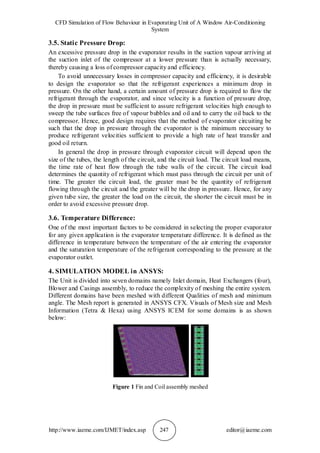
Information (Tetra & Hexa) using ANSYS ICEM for some domains is as shown
below:
Figure 1 Fin and Coil assembly meshed
Hassan A. Khayyat and Ikramuddin Sohail Md
http://www.iaeme.com/IJMET/index.asp 248 editor@iaeme.com
Figure 2 Blower meshed part Figure 3. Casing meshed part
5. MESHING HISTORY:
Domains Casing Coil-1 Coil-2 Coil-3 Coil-4
Air
Inlet
Mid Blower
All
Domains
Nodes 42119 90930 59064 93918 87816 34808 10640 200240 638990
Elements 36514 56504 32736 52724 54432 31882 9581 169240 461085
6. RESULTS AND DISCUSSIONS
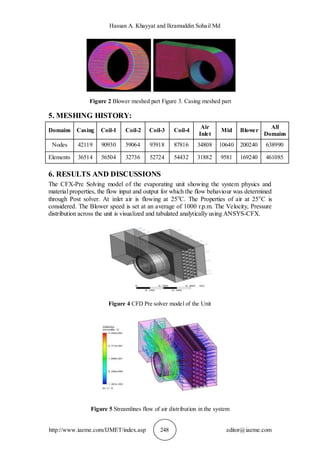
The CFX-Pre Solving model of the evaporating unit showing the system physics and
material properties, the flow input and output for which the flow behaviour was determined
through Post solver. At inlet air is flowing at 25o
C. The Properties of air at 25o
C is
considered. The Blower speed is set at an average of 1000 r.p.m. The Velocity, Pressure
distribution across the unit is visualized and tabulated analytically using ANSYS-CFX.
Figure 4 CFD Pre solver model of the Unit
Figure 5 Streamlines flow of air distribution in the system
CFD Simulation of Flow Behaviour in Evaporating Unit of A Window Air-Conditioning
System
http://www.iaeme.com/IJMET/index.asp 249 editor@iaeme.com
Figure shows the Streamline flow of air inside the evaporating Unit. The Inlet
streamlines are straight and parallel at main inlet domain. As the air passes over the
tubes the streamlines bends and acquires the form of tube surface. The velocity of air
here changes according to continuity equation ( ). As the flow proceeds further
into blower, the velocity of the air coming out of the evaporator coils is increased by the
rotating blower which is rotating at a speed of 1175r.p.m clockwise from the front. The
net velocity between the coils should be between 1.5 m to 3 m for efficient heat
transfer from cooled coils to air at the outlet and is obtained from the results.
Figure 6 Vector flow of air in the system
Figure 7 Velocity Contour inside unit
The vector flow in the whole evaporating unit from the top view is shown above.
The droplets indicate the air flow rate and different colours indicates velocity
magnitude and direction from inlet of the evaporator to the outlet. The air flow
converges at the point of rotation of blower and gets expand in the casing to deliver
the required output flow of air satisfying continuity equation. The velocity contour
and velocity vectors at some plane inside the Blower Casing showing the magnitude
of velocity at various points of flow and the direction. Tabulated Values of various
properties of air across the unit through CFD.
Mass Flow Rate
(kg/s)
Velocity
(m/s)
Pressure [Pa]
Total Pressure
[Pa]
Inlet 0.27 1.329 -1.056 0.001
Shroud Cone 0.27 1.338 -1.072 0.002
Coil1 in 1 0.27 1.447 -2.732 -1.435
Coil2 in 2 0.27 1.526 -5.127 -3.619
Coil3 in 3 0.27 1.609 -6.774 -5.023
Coil4 in 4 0.27 1.716 -8.687 -6.674
Domain Inlet 0.27 2.52 -11.1 -6.768
Rotary1 0.27 10.858 -73.66 -29.88
Rotary2 0.27 10.536 -67.63 -26.85
Rotary3 0.27 10.12 -53 -27.94
Outlet 0.27 14.083 0.348 120.64
Hassan A. Khayyat and Ikramuddin Sohail Md
http://www.iaeme.com/IJMET/index.asp 250 editor@iaeme.com
6.1. Static Pressure across the System:
Static pressure is defined as “The pressure exerted by a still liquid or gas, especially
water or air”. Static Pressure Indicates how much negative pressure the fans are
creating as they pull air through the available inlets. Maintaining proper negative
pressure in the system allows air to enter the room at the right direction and speed for
mixing with air already inside the room. Insufficient static pressure will not allow the
air to mix well. There will be stratification of warm air high and cold air low in the
system. This results in decrease of cooling capacity.
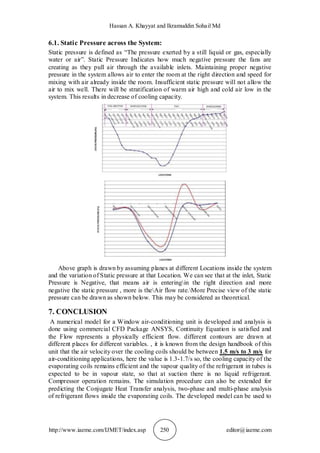
Above graph is drawn by assuming planes at different Locations inside the system
and the variation of Static pressure at that Location. We can see that at the inlet, Static
Pressure is Negative, that means air is enteringin the right direction and more
negative the static pressure , more is theAir flow rate.More Precise view of the static
pressure can be drawn as shown below. This may be considered as theoretical.
7. CONCLUSION
A numerical model for a Window air-conditioning unit is developed and analysis is
done using commercial CFD Package ANSYS, Continuity Equation is satisfied and
the Flow represents a physically efficient flow. different contours are drawn at
different places for different variables. , it is known from the design handbook of this
unit that the air velocity over the cooling coils should be between 1.5 m/s to 3 m/s for
air-conditioning applications, here the value is 1.3-1.7/s so, the cooling capacity of the
evaporating coils remains efficient and the vapour quality of the refrigerant in tubes is
expected to be in vapour state, so that at suction there is no liquid refrigerant.
Compressor operation remains. The simulation procedure can also be extended for
predicting the Conjugate Heat Transfer analysis, two-phase and multi-phase analysis
of refrigerant flows inside the evaporating coils. The developed model can be used to
CFD Simulation of Flow Behaviour in Evaporating Unit of A Window Air-Conditioning
System
http://www.iaeme.com/IJMET/index.asp 251 editor@iaeme.com
predict the design changes. More accurate analysis can be done by using exact
material properties at locations where temperature is known from experiments.
REFERENCES
[1] Barbosa Jr., J. R., Melo, C. and Hermes, C. J. L. A study of the airside heat
transfer and pressure drop characteristics of tubefin 'nofrost' evaporators. Applied
Energy, 86, 2009, pp. 1484-1491.
[2] Yashar, D., Domanski, P. A. and Kim, M. Performance of finned-tube evaporator
optimized for different refrigerants and its effect on system efficiency.
International Journal of Refrigeration, 2005, pp. 820–827
[3] Karatas, H., Dirik, E. and Derbentil, T. An experimental study of airside heat
transfer and friction factor correlations on domestic refrigerator finnedtube
evaporator coils. Proceedings of the 8th International Refrigeration and Air
Conditioning Conference at Purdue, West Lafayette, IN, July 25-28, 1996.
[4] Shih, Y. C. Numerical study of heat transfer performance on the air side of
evaporator for a domestic refrigerator. Numerical Heat Transfer, Part A, 44,
2003, pp. 851-870.
[5] Kim, Y., Tikhonov, A., Shin, Y. and Lee, J. Experimental study on high
performance defrosting heater for household refrigerator. Proceeding of the 13th
International Heat Transfer Conference, Sydney, Australia, 2006.
[6] Versteeg, H. K., Malalasekera, W. An Introduction to Computational Fluid
Dynamics: The Finite Volume Method. Prentice Hall: Pearson, 1995
[7] Process Heat Transfer,K Q Kern, Prentice hall of India, 2010.
[8] Numerical Heat transfer,Patankar 2009.
[9] Kumar, S., Rajput, S.P.S. and Kumar, A. Thermodynamic Analysis of Year
Round Air Conditioning System for Variable Wet Bulb Temperature of Outlet
Air of Pre-Heating Coil (Cold And Dry Weather). International Journal of
Mechanical Engineering and Technology, 6(4), 2015, pp. 109-116.

Ijmet 06 10_024

  • 1.
    http://www.iaeme.com/IJMET/index.asp 243 editor@iaeme.com InternationalJournal of Mechanical Engineering and Technology (IJMET) Volume 6, Issue 10, Oct 2015, pp. 243-251, Article ID: IJMET_06_10_024 Available online at http://www.iaeme.com/IJMET/issues.asp?JType=IJMET&VType=6&IType=10 ISSN Print: 0976-6340 and ISSN Online: 0976-6359 © IAEME Publication CFD SIMULATION OF FLOW BEHAVIOUR IN EVAPORATING UNIT OF A WINDOW AIR-CONDITIONING SYSTEM Hassan A. Khayyat Assistant Professor, Department of Mechanical Engineering, Shaqra University, Kingdom of Saudi Arabia Ikramuddin Sohail Md Lecturer, Department of Mechanical Engineering, Shaqra University, Kingdom of Saudi Arabia ABSTRACT CFD has been universally recognized as essential for engineering analyses associated with transport phenomena. The main objective of this Paper was to visualize the flow phenomena across a typical air conditioning system and analyse the fluid properties at different locations by preparing the exact model of the window air conditioner and it has been found that the mass flow rate of air through the system is 0.27 based on the model geometry the velocity of fluid (air) ranging from 1.329 to 14.083 , and the static pressure varies from -1.356 Pa to +0.348 respectively at inlet and outlet sections of the air-conditioner designed. Key words: Evaporating Unit, Static Pressure, Velocity of flow, CFD. Cite this Article: Khayyat, H. A. and Sohail Md., I. CFD Simulation of Flow Behaviour in Evaporating Unit of A Window Air-Conditioning System. International Journal of Mechanical Engineering and Technology, 6(10), 2015, pp. 243-251. http://www.iaeme.com/IJMET/issues.asp?JType=IJMET&VType=6&IType=10 1. INTRODUCTION Optimization of the flow within a window air-conditioning system is important in enhancing the design and consequently improving the system efficiency. One area of interest is within the evaporator. Refrigerant flows inside small parallel tubes in the evaporator when changing from a two-phase mixture to a vapour. For an even distribution of refrigerant, Air-flow is needed for the most efficient heat transfer. Misdistribution of the Air flow can lead to problems such as dry-out, with reduced heat transfer at locations in the evaporator. The present work deals more about the application of the results by simulating whole evaporating unit model using commercially available CFD code ANSYS. The CFD analysis enables us to find out,
  • 2.
    Hassan A. Khayyatand Ikramuddin Sohail Md http://www.iaeme.com/IJMET/index.asp 244 editor@iaeme.com on an average base, the performance of an actually operating heat exchanger. We can also come to know the temperatures at any points in heat exchanger. However, the results available through CFD analysis are for the ideal condition, i.e. for no-loss operating condition. For this analysis, whole evaporating unit is selected and divided into domains and meshed with ANSYS-ICEM-12.0 with a number of elements. The material properties and boundary conditions are applied and the domain is solved by using ANSYS-CFX-12.0 to satisfy continuity, momentum and energy equations. This powerful tool along with faster and robust digital computers makes it possible to predict velocity of air flowing across the whole domain. Barbosa et al. (1 ) investigated the influence of geometric parameters, such as the number of tube rows, fin pitch, number of fins and air flow rate, on the airside thermalhydraulic performance of eight tubefin 'nofrost' evaporator samples. The experimental data was correlated in terms of the Colburn factor, j, and the Darcy friction factor, ƒ, through empirical correlations with ±7% error. Yashar at al [2] presented a comparable evaluation of R600a (isobutene), R290 (propane), R134a, R22, R410A, and R32 in an optimized finned-tube evaporator, and Analyzes the impact of evaporator effects on the System coefficient of performance (COP), The study relied on a detailed evaporator model derived from NIST’s EVAP- COND simulation package and used the ISHED1 scheme employing a non-Darwinian learnable evolution model for circuitry optimization. Karatas, H., [3] Shih [4] and Kim, Y [5] did similar research in the field of CFD. 2. SCHEMATIC MODEL FOR ANALYSIS The schematic model picture of a typical window Air-Conditioner and the evaporating unit transverse sections are shown as here under. 3. EVAPORATOR-WORKING AND DESIGN: Evaporator is a heat transfer surface in which a volatile liquid is vaporized for the purpose of removing heat from a refrigerated space or product. The evaporator absorbs the heat from the air passing through the coil and provides required degree of superheating of the refrigerant gas to ensure elimination of the liquid refrigerant entering the compressor. Liquid refrigerant entry will cause damage to suction valve of compressor. The evaporator should normally be sized to ensure that the refrigerant returns to the compressor in a completely gaseous state. The factors that largely influence the heat transfer rate in a forced convection type evaporator are
  • 3.
    CFD Simulation ofFlow Behaviour in Evaporating Unit of A Window Air-Conditioning System http://www.iaeme.com/IJMET/index.asp 245 editor@iaeme.com  Primary surface area  Secondary surface area  Bonding between primary and secondary surface  Temperature difference between cooling medium and cooled medium.  Materials used  Contact factor  Refrigerant factor  Air-flow through evaporator coils. The capacity of the evaporator, that is, the rate at which heat passes through the wall is determined by the same factors that governs the rate of heat flow by conduction through any heat transfer surface and is expressed by the equation. Q = A × U ×LMTD Where Q = the quantity of heat transferred in K.Cal/hr A = the outside surface area of the evaporator ( Both prime and finned) in m2 U = the overall conductance factor in K.Cal/m2 -0 C-Hr LMTD = the logarithmic mean temperature difference in o C between the temperature outside the evaporator and the temperature of the refrigerant inside the evaporator. 3.1. Heat transfer coefficient The resistance to heat flow offered by the evaporator walls is the sum of three factors whose relationships is expressed by the following. Where U = the overall conductance factor in K.Cal/m2 -0 C-Hr f1= the conductance factor of the inside surface film in K.Cal/m2 -0 C-Hr L/k = resistance to heat flow offered by metal of tubes and fins. f0 = the conductance factor of the outside surface film in K.Cal/m2 -0 C-Hr R = ratio of outside surface to inside surface. Any increase in the turbulence of the flow either inside or outside the evaporator will materially increase the rate of heat transfer through evaporator walls. In general, internal turbulence increases with the difference in temperature across the walls of the tube, closer spacing of the tubes, and the roughness of the internal tube surface. In some instances, heat transfer is improved by internal finning.Outside flow turbulence is influenced by fluid velocity over the coil, the tube spacing and the shape of the fins. 3.2. Log Mean Temperature Difference LMTD = Where LMTD = the log mean temperature difference Te = the temperature of the air entering the coil Tl = temperature of the air leaving the coil Tr = the temperature of the refrigerant in the tubes
  • 4.
    Hassan A. Khayyatand Ikramuddin Sohail Md http://www.iaeme.com/IJMET/index.asp 246 editor@iaeme.com Therefore the temperature of air across the cooling coil is an important parameter to consider while designing the air conditioning unit for obtaining optimum COP and thermal capacity. 3.3. The effect of Air Quality on Evaporator Capacity: The factors external to the coil which greatly affect coil performance are circulation, velocity and the distribution of air in the refrigerated space over the coil. Normally, the air velocity over the cooling coil is between 1.5 m/s to 3 m/s for air-conditioning applications. If air circulation is inadequate, heat is not carried from the product to the evaporator at a rate sufficient to allow the evaporator at peak efficiency. It is important also that the circulation of air is evenly distributed in all parts of the refrigerated space and over the coil. Poor distribution of the circulating air results in uneven temperatures in the refrigerated space , where as the uneven distribution of the air over the coil surface causes some parts of the surface to function less-efficiently than others and lower evaporation capacity. The velocity of the air passing over the coil has a considerable influence on both the value of U and the LMTD and is important in determining evaporator capacity. When air velocity is low, the air passing over the coil stays in contact with the coil per unit of time, the LMTD increases, and the rate of heat transfer improves. In addition, high air velocities tend to break up the thin film of stagnant air which is adjacent to all surfaces. Since this film of air acts as a heat barrier and insulates the surface, its disturbance increases the conductance of the outside surface film and the overall value of U improves. The total cooling capacity of any evaporator is directly related to the air quantity circulated over the evaporator. The air quantity required for a given evaporator capacity is basically a function of two factors; (1) the sensible heat ratios; and (2) the drop in temperatures of the air passing over the evaporator. The sensible heat ratio is the ratio of the sensible cooling capacity of the evaporator to the total cooling capacity. When air is cooled below its dew point temperature, both the temperature and the moisture content of the air are reduced. The temperature reduction is the result of sensible cooling, whereas the moisture removed is the result of latent cooling. Naturally, the sensible heat ratio of any evaporator will depend upon the conditions of the application, the design of the evaporator and the air quantity. The sensible heat ratio varies from 0.6 to 0.8 depending on the application 3.4. Surface Area: In general for the same total surface area, a long wide, flat coil will, perform more efficiently than a short, narrow coil having more rows depth. As a general rule, the greater the coil depth, the longer the air stays in contact with the coil surface and the more closely the leaving temperature of the air will approach the surface temperature of the coil. Since the temperature of some part of the air passing through a cooling coil is usually reduced below the entering dew point temperature, dehumidification is accomplished. Obviously, the lower the leaving air temperature, the greater is the amount of dehumidification.
  • 5.
    CFD Simulation ofFlow Behaviour in Evaporating Unit of A Window Air-Conditioning System http://www.iaeme.com/IJMET/index.asp 247 editor@iaeme.com 3.5. Static Pressure Drop: An excessive pressure drop in the evaporator results in the suction vapour arriving at the suction inlet of the compressor at a lower pressure than is actually necessary, thereby causing a loss of compressor capacity and efficiency. To avoid unnecessary losses in compressor capacity and efficiency, it is desirable to design the evaporator so that the refrigerant experiences a minimum drop in pressure. On the other hand, a certain amount of pressure drop is required to flow the refrigerant through the evaporator, and since velocity is a function of pressure drop, the drop in pressure must be sufficient to assure refrigerant velocities high enough to sweep the tube surfaces free of vapour bubbles and oil and to carry the oil back to the compressor. Hence, good design requires that the method of evaporator circuiting be such that the drop in pressure through the evaporator is the minimum necessary to produce refrigerant velocities sufficient to provide a high rate of heat transfer and good oil return. In general the drop in pressure through evaporator circuit will depend upon the size of the tubes, the length of the circuit, and the circuit load. The circuit load means, the time rate of heat flow through the tube walls of the circuit. The circuit load determines the quantity of refrigerant which must pass through the circuit per unit of time. The greater the circuit load, the greater must be the quantity of refrigerant flowing through the circuit and the greater will be the drop in pressure. Hence, for any given tube size, the greater the load on the circuit, the shorter the circuit must be in order to avoid excessive pressure drop. 3.6. Temperature Difference: One of the most important factors to be considered in selecting the proper evaporator for any given application is the evaporator temperature difference. It is defined as the difference in temperature between the temperature of the air entering the evaporator and the saturation temperature of the refrigerant corresponding to the pressure at the evaporator outlet. 4. SIMULATION MODEL in ANSYS: The Unit is divided into seven domains namely Inlet domain, Heat Exchangers (four), Blower and Casings assembly, to reduce the complexity of meshing the entire system. Different domains have been meshed with different Qualities of mesh and minimum angle. The Mesh report is generated in ANSYS CFX. Visuals of Mesh size and Mesh Information (Tetra & Hexa) using ANSYS ICEM for some domains is as shown below: Figure 1 Fin and Coil assembly meshed
  • 6.
    Hassan A. Khayyatand Ikramuddin Sohail Md http://www.iaeme.com/IJMET/index.asp 248 editor@iaeme.com Figure 2 Blower meshed part Figure 3. Casing meshed part 5. MESHING HISTORY: Domains Casing Coil-1 Coil-2 Coil-3 Coil-4 Air Inlet Mid Blower All Domains Nodes 42119 90930 59064 93918 87816 34808 10640 200240 638990 Elements 36514 56504 32736 52724 54432 31882 9581 169240 461085 6. RESULTS AND DISCUSSIONS The CFX-Pre Solving model of the evaporating unit showing the system physics and material properties, the flow input and output for which the flow behaviour was determined through Post solver. At inlet air is flowing at 25o C. The Properties of air at 25o C is considered. The Blower speed is set at an average of 1000 r.p.m. The Velocity, Pressure distribution across the unit is visualized and tabulated analytically using ANSYS-CFX. Figure 4 CFD Pre solver model of the Unit Figure 5 Streamlines flow of air distribution in the system
  • 7.
    CFD Simulation ofFlow Behaviour in Evaporating Unit of A Window Air-Conditioning System http://www.iaeme.com/IJMET/index.asp 249 editor@iaeme.com Figure shows the Streamline flow of air inside the evaporating Unit. The Inlet streamlines are straight and parallel at main inlet domain. As the air passes over the tubes the streamlines bends and acquires the form of tube surface. The velocity of air here changes according to continuity equation ( ). As the flow proceeds further into blower, the velocity of the air coming out of the evaporator coils is increased by the rotating blower which is rotating at a speed of 1175r.p.m clockwise from the front. The net velocity between the coils should be between 1.5 m to 3 m for efficient heat transfer from cooled coils to air at the outlet and is obtained from the results. Figure 6 Vector flow of air in the system Figure 7 Velocity Contour inside unit The vector flow in the whole evaporating unit from the top view is shown above. The droplets indicate the air flow rate and different colours indicates velocity magnitude and direction from inlet of the evaporator to the outlet. The air flow converges at the point of rotation of blower and gets expand in the casing to deliver the required output flow of air satisfying continuity equation. The velocity contour and velocity vectors at some plane inside the Blower Casing showing the magnitude of velocity at various points of flow and the direction. Tabulated Values of various properties of air across the unit through CFD. Mass Flow Rate (kg/s) Velocity (m/s) Pressure [Pa] Total Pressure [Pa] Inlet 0.27 1.329 -1.056 0.001 Shroud Cone 0.27 1.338 -1.072 0.002 Coil1 in 1 0.27 1.447 -2.732 -1.435 Coil2 in 2 0.27 1.526 -5.127 -3.619 Coil3 in 3 0.27 1.609 -6.774 -5.023 Coil4 in 4 0.27 1.716 -8.687 -6.674 Domain Inlet 0.27 2.52 -11.1 -6.768 Rotary1 0.27 10.858 -73.66 -29.88 Rotary2 0.27 10.536 -67.63 -26.85 Rotary3 0.27 10.12 -53 -27.94 Outlet 0.27 14.083 0.348 120.64
  • 8.
    Hassan A. Khayyatand Ikramuddin Sohail Md http://www.iaeme.com/IJMET/index.asp 250 editor@iaeme.com 6.1. Static Pressure across the System: Static pressure is defined as “The pressure exerted by a still liquid or gas, especially water or air”. Static Pressure Indicates how much negative pressure the fans are creating as they pull air through the available inlets. Maintaining proper negative pressure in the system allows air to enter the room at the right direction and speed for mixing with air already inside the room. Insufficient static pressure will not allow the air to mix well. There will be stratification of warm air high and cold air low in the system. This results in decrease of cooling capacity. Above graph is drawn by assuming planes at different Locations inside the system and the variation of Static pressure at that Location. We can see that at the inlet, Static Pressure is Negative, that means air is enteringin the right direction and more negative the static pressure , more is theAir flow rate.More Precise view of the static pressure can be drawn as shown below. This may be considered as theoretical. 7. CONCLUSION A numerical model for a Window air-conditioning unit is developed and analysis is done using commercial CFD Package ANSYS, Continuity Equation is satisfied and the Flow represents a physically efficient flow. different contours are drawn at different places for different variables. , it is known from the design handbook of this unit that the air velocity over the cooling coils should be between 1.5 m/s to 3 m/s for air-conditioning applications, here the value is 1.3-1.7/s so, the cooling capacity of the evaporating coils remains efficient and the vapour quality of the refrigerant in tubes is expected to be in vapour state, so that at suction there is no liquid refrigerant. Compressor operation remains. The simulation procedure can also be extended for predicting the Conjugate Heat Transfer analysis, two-phase and multi-phase analysis of refrigerant flows inside the evaporating coils. The developed model can be used to
  • 9.
    CFD Simulation ofFlow Behaviour in Evaporating Unit of A Window Air-Conditioning System http://www.iaeme.com/IJMET/index.asp 251 editor@iaeme.com predict the design changes. More accurate analysis can be done by using exact material properties at locations where temperature is known from experiments. REFERENCES [1] Barbosa Jr., J. R., Melo, C. and Hermes, C. J. L. A study of the airside heat transfer and pressure drop characteristics of tubefin 'nofrost' evaporators. Applied Energy, 86, 2009, pp. 1484-1491. [2] Yashar, D., Domanski, P. A. and Kim, M. Performance of finned-tube evaporator optimized for different refrigerants and its effect on system efficiency. International Journal of Refrigeration, 2005, pp. 820–827 [3] Karatas, H., Dirik, E. and Derbentil, T. An experimental study of airside heat transfer and friction factor correlations on domestic refrigerator finnedtube evaporator coils. Proceedings of the 8th International Refrigeration and Air Conditioning Conference at Purdue, West Lafayette, IN, July 25-28, 1996. [4] Shih, Y. C. Numerical study of heat transfer performance on the air side of evaporator for a domestic refrigerator. Numerical Heat Transfer, Part A, 44, 2003, pp. 851-870. [5] Kim, Y., Tikhonov, A., Shin, Y. and Lee, J. Experimental study on high performance defrosting heater for household refrigerator. Proceeding of the 13th International Heat Transfer Conference, Sydney, Australia, 2006. [6] Versteeg, H. K., Malalasekera, W. An Introduction to Computational Fluid Dynamics: The Finite Volume Method. Prentice Hall: Pearson, 1995 [7] Process Heat Transfer,K Q Kern, Prentice hall of India, 2010. [8] Numerical Heat transfer,Patankar 2009. [9] Kumar, S., Rajput, S.P.S. and Kumar, A. Thermodynamic Analysis of Year Round Air Conditioning System for Variable Wet Bulb Temperature of Outlet Air of Pre-Heating Coil (Cold And Dry Weather). International Journal of Mechanical Engineering and Technology, 6(4), 2015, pp. 109-116.