International 
OPEN ACCESS Journal 
Of Modern Engineering Research (IJMER) 
| IJMER | ISSN: 2249–6645 | www.ijmer.com | Vol. 4 | Iss.7| July. 2014 | 66| 
Optimization of Corynebacterium glutamicum Immobilization on Alginate and Investigation into its Storage Conditions Tran Thi Minh Tam1, Nguyen Thuy Huong2 1,2 Department of Biotechnology, Ho Chi Minh City University of Technology, Vietnam 
I. INTRODUCTION 
Alginate is the natural polysaccharide extracted from the brown alga (Phaeophyce) which is discovered in the shallow water in the temperate zones. The viscosity of alginate depends on derivation of the alga, its molecular weight, temperature and pH of the liquor [1]. Under controlled conditions, alginate can create the gels in the liquor containing the II valence cations [2]. The cation Ca2+ is often used to immobilize cells because of its low toxicity. The capability of creating gels of alginate mainly relates to acid guluronic. The divalent cations linked with the G mass to make “an egg box” form that it is more solid than the M one [2]. Alginate is used as a carrier in the enzyme immobilization technology and it is developed into the traditional carrier in the cell immobilization technology, especially in the cell of micro-organism one. The cell immobilization in alginate carrier method which is usually used is the entrapment, in micro-encapsulation, creating cross linking [3]. Corynebacterium glutamicum is the viscous membrane bacterium, able to hold on the carrier and together. Therefore, we can use it to study the cell immobilization on some suitable carriers. The Corynebacterium glutamicum immobilization process is carried out by the hole trapping technology [4]. L- Lysine is an essential amino acid which cannot be synthesized by human being and animals. The too much amylaceous diets of the agricultural nations lead to the loss of this substance in the body. The L-Lysine is received from Corynebacterium glutamicum which can be applied in a few factories all over the world. One of solutions to upgrade the productivity of the L-Lysine is using immobilized Corynebacterium glutamicum cells on some carriers. Corynebacterium glutamicum is immobilized on alginate by entrapment methods. It is based on the inclusion of cells within a rigid network to prevent the cells from diffusing into the surrounding medium, while still allowing mass transfer of nutrients and metabolites [3]. L-lysine production using immobilized Corynebacterium glutamicum cells on alginate in fermentation process seems to be very promising. The advantages of this production process is that time, effort and expense are minimized during preparation period for the breed before fermenting. Consequently, efficiency of the Lysine fermentation is improved. However, application of immobilized Corynebacterium glutamicum in L-lysine fermentation still pointed out some disadvantages like physical carriers in fermentation medium or the ability of enzyme activity. It is one of some important reasons to study immobilization of cells [3]. 
II. THE MATERIALS AND METHODS 
2.1 The materials and cultural medium The micro-organism species: Corynebacterium glutamicum VTCC – B – 0632 is provided by the Vietnam Type Culture Collection. 
Abstract: The parameters of the immobilized process of Corynebacterium glutamicum VTCC – B – 0632 on alginate were identified by Plackett-Burman matrix, and the experiments were designed by response surface methodology having the central composite designs (RSM-CCD). The maximum yield of cell immobilization on alginate carrier reached at 92.6%. Optimal parameters were the cell density of 89.3 million cells/mL in the 4% sterile alginate with ratio 1:1. This mixture went through the syringe system of the 2M CaCl2 solution at 200C with the shaking speed of 75 rpm until the gels get in shape. Then, these gels were soaked in the CaCl2 liquor and shaken for 41 minutes (150 rpm). At last, the particle size of final products was 4mm and the average cell density was 14.75 million cells/gram. This immobile product is maintained under the suitable condition in the CaCl2 liquor (w/v), pH=7. The cell survival percentage after 72 hours were 98% when it was stored in 40C, 0.5% CaCl2 and pH of 7. 
Keywords: Corynebacterium glutamicum, alginate, entrapment, micro-entrapment, Plackett-Burman, Response Surface Methods, Central Composite Designs.
The optimization of Corynebacterium glutamicum immobilization on alginate and the…. 
| IJMER | ISSN: 2249–6645 | www.ijmer.com | Vol. 4 | Iss.7| July. 2014 | 67| 
The carrier: the utilized alginate is provided by the producer Sigma – Ahdrich. Alginate is powdery, light brown and its moisture content is below 15%. The 1% alginate solution is prepared and kept at 250C. Its viscosity is 5-40 Cps and pH is from 5 to 8. The cultural medium: Corynebacterium glutamicum grows in the minimal medium with glucose (20g/L), peptone (10g/L), yeast extract (5g/L), NaCl ( 5g/L), agar (15g/L), pH ~ 7,2, the temperature at 300C, the agitation rate of 150 rpm [5]. 2.2. Optimizing the Corynebacterium glutamicum immobilization process on Alginate The inoculums were introduced in seed culture and were incubated in a rotary shaker at 120 rpm, 300C. After 16 hours, the number of the cells was checked and counted and then the necessary breed density was predicted for the immobilization process with 100 mL breed liquor and alginate. Seven factors were examined in the Plackett-Burman matrix with different 12 runs. Determine the immobilization productivity for each validation formula. Analyze the factors that affect the productivity. The main factors had the value of p < 0.05. With the selected factors, we carried out the first experiments with the original values (+1, -1). After analyzing the initial experiments, we determined whether the factors having great impacts on the high regression equation suitably or not. Based on that, we conducted the experiments for response surface methodology having the central composite designs (RMS-CCD) and determined function of the polynomial regression accurately to describe relations between the immobilization yield and factors having great impacts on the hole trapping method. 2.3. The survey of the conditions to maintain the immobile Corynebacterium glutamicum final products on alginate The aim is to determine the appropriate conditions to store the immobile Corynebacterium glutamicum products. We start to soak the products in some different pH liquors at different temperatures. The major function is the survival percentage of Corynebacterium glutamicum after 72 hours storing according to the validation formula laid out (Table 1). Table 1. Set up the survey experiment of the conditions 
Runs 
Changeable factors 
Fixed factors 
1 
The liquor to soak (aseptic water-CaCl2 (g/L): 0.5 – 1.0 – 2.0 – 3.0) 
-The weight of immobile bacterium: 10 gram -The maintaining temperature: 40C -pH of the liquor: 7 
2 
pH of the solvent: 4 – 5 – 6 – 7 – 8 
-The weight of immobile bacterium: 10 gram -The maintaining temperature: 40C -The solvent to soak the finished product: chosen in the experiment 1 
3 
The maintaining temperature (0C): 0 – 4 – 10 – 15 – 20 – 30 
-The weight of immobile bacterium: 10 gram -The solvent to soak the finished product: chosen in the experiment 1 -The pH of the liquor: chosen in the experiment 2 
2.4 The analyzing method Analyzing the immobilized finished products: the immobilized Corynebacterium glutamicum on alginate is soaked in the sodium citrate in order to break the gels totally, and then release micro-organisms. After diluting the liquid medium, inoculums were spread over surface of culture medium, and then the colonies were counted after 24 hours brewing. Formula: The immobilization yield: 퐻= 푡푕푒 푖푚푚표푏푖푙푖푧푒푑 푐푒푙푙푠 푖푛 푎푙푔푖푛푎푡푒 푡푕푒 푛푢푚푏푒푟 표푓 푐푒푙푙푠 푎푑푑푒푑 .100 (%) The average cell density: 푡푕푒 푛푢푚푏푒푟 표푓 푖푚푚표푏푖푙푒 푐푒푙푙푠 푖푛 푎푙푔푖푛푎푡푒 푡푕푒 푤푒푖푔푕푡 표푓 푡푕푒 푓푖푛푖푠푕푒푑 푝푟표푑푢푐푡 (millions cells/g)
The optimization of Corynebacterium glutamicum immobilization on alginate and the…. 
| IJMER | ISSN: 2249–6645 | www.ijmer.com | Vol. 4 | Iss.7| July. 2014 | 68| 
III. RESULTS 
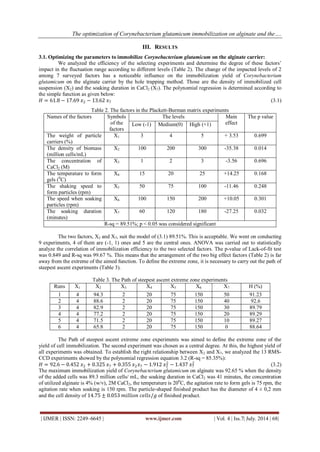
3.1. Optimizing the parameters to immobilize Corynebacterium glutamicum on the alginate carrier: We analyzed the efficiency of the selecting experiments and determine the degree of these factors’ impact in the fluctuation range according to different levels (Table 2). The change of the impacted levels of 2 among 7 surveyed factors has a noticeable influence on the immobilization yield of Corynebacterium glutamicum on the alginate carrier by the hole trapping method. Those are the density of immobilized cell suspension (X2) and the soaking duration in CaCl2 (X7). The polynomial regression is determined according to the simple function as given below: 퐻=61.8−17.69 푥2−13.62 푥7 (3.1) Table 2. The factors in the Plackett-Burman matrix experiments 
Names of the factors 
Symbols of the factors 
The levels 
Main effect 
The p value 
Low (-1) 
Medium(0) 
High (+1) 
The weight of particle carriers (%) 
X1 
3 
4 
5 
+ 3.53 
0.699 
The density of biomass (million cells/mL) 
X2 
100 
200 
300 
-35.38 
0.014 
The concentration of CaCl2 (M) 
X3 
1 
2 
3 
-3.56 
0.696 
The temperature to form gels (0C) 
X4 
15 
20 
25 
+14.25 
0.168 
The shaking speed to form particles (rpm) 
X5 
50 
75 
100 
-11.46 
0.248 
The speed when soaking particles (rpm) 
X6 
100 
150 
200 
+10.05 
0.301 
The soaking duration (minutes) 
X7 
60 
120 
180 
-27.25 
0.032 
R-sq = 89.51%; p < 0.05 was considered significant 
The two factors, X2 and X7, suit the model of (3.1) 89.51%. This is acceptable. We went on conducting 9 experiments, 4 of them are (-1, 1) ones and 5 are the central ones. ANOVA was carried out to statistically analyze the correlation of immobilization efficiency to the two selected factors. The p-value of Lack-of-fit test was 0.849 and R-sq was 99.67 %. This means that the arrangement of the two big effect factors (Table 2) is far away from the extreme of the aimed function. To define the extreme zone, it is necessary to carry out the path of steepest ascent experiments (Table 3). Table 3. The Path of steepest ascent extreme zone experiments 
Runs 
X1 
X2 
X3 
X4 
X5 
X6 
X7 
H (%) 
1 
4 
94.3 
2 
20 
75 
150 
50 
91.23 
2 
4 
88.6 
2 
20 
75 
150 
40 
92.6 
3 
4 
82.9 
2 
20 
75 
150 
30 
89.79 
4 
4 
77.2 
2 
20 
75 
150 
20 
89.29 
5 
4 
71.5 
2 
20 
75 
150 
10 
89.27 
6 
4 
65.8 
2 
20 
75 
150 
0 
88.64 
The Path of steepest ascent extreme zone experiments was aimed to define the extreme zone of the yield of cell immobilization. The second experiment was chosen as a central degree. At this, the highest yield of all experiments was obtained. To establish the right relationship between X2 and X7, we analyzed the 13 RMS- CCD experiments showed by the polynomial regression equation 3.2 (R-sq = 85.35%): 퐻=92.6−0.452 푥2+0.325 푥7+0.355 푥2푥7−1.912 푥22−1.437 푥72 (3.2) The maximum immobilization yield of Corynebacterium glutamicum on alginate was 92.65 % when the density of the added cells was 89.3 million cells/ mL, the soaking duration in CaCl2 was 41 minutes, the concentration of utilized alginate is 4% (w/v), 2M CaCl2, the temperature is 200C, the agitation rate to form gels is 75 rpm, the agitation rate when soaking is 150 rpm. The particle-shaped finished product has the diameter of 4 ± 0,2 mm and the cell density of 14.75±0.053 푚푖푙푙푖표푛 푐푒푙푙푠/푔 of finished product.
The optimization of Corynebacterium glutamicum immobilization on alginate and the…. 
| IJMER | ISSN: 2249–6645 | www.ijmer.com | Vol. 4 | Iss.7| July. 2014 | 69| 
Figure 1. The Path of steepest ascent extreme zone chart 
Figure 2. The equation contours (3.2) show the relationship between H (%) and X2, X7 3.2. Examination the storage conditions We chose the round products with no bubbles which are achieved from the optimizing process. We took them to examine. The validation formulas examined use 20 ± 0.2 g of products in 50 mL of solvent. 3.2.1 The influence of the maintaining solvents We analyzed the finished products of 5 validation formulas to examine the two solvents: water and CaCl2 liquor (0.5-1.0-2.0-3.0%). We determined the cell survival percentage after 72 hours maintaining under the 40C condition. Table 4. The survival percentage of cells at different solvents 
The survival cell rate after 72-hour incubation (%) 
Sterile water 
CaCl2 0.5% 
CaCl2 1.0% 
CaCl2 2.0% 
CaCl2 3.0 % 
67.31 ±7.87a 
94.8±4.64b 
90.15±1.05c 
83.64±2.35d 
68.95±0.45a 
Data presented as mean ± standard deviation The values with the same symbols are not different from the meaning p < 0.05; the values with different symbols are different from the meaning of p < 0.05 
CaCl2 was the solvent to maintain the immobile final product Corynebacterium glutamicum on alginate better than distilled water. The cell survival percentage after 72 hours was higher 68% and higher than in distilled water (67.3%). Especially, the 0.5% CaCl2 solution (w/v) had the highest percentage (94.8%). This concentration was used for the next experiments. 3.2.2 The influence of pH The validation formulas examined the change of pH (4-5-6-7-8) of the 0.5 % CaCl2 solvent and adjusted by HCl 1N and 25% NH3 solution, we examined the survival percentage of cells after 72 hours at 40C. Table 5. The survival percentage of immobile cells at the different pH 
The survival cell rate after 72-hour incubation (%) 
pH=4 
pH=5 
pH=6 
pH=7 
pH=8 
65.58 ±2.31a 
66.20 ± 2.40a 
75.49 ± 2.93b 
95.29 ± 3.66c 
83.36 ± 3.29d 
Data presented as mean ± standard deviation The values with the same symbols are not different from the meaning p < 0.05; the values with different symbols are different from the meaning of p < 0.05 
88 
89 
90 
91 
92 
93 
0 
1 
2 
3 
4 
5 
6 
7 
Yield (%) 
The number of experiments 
X2 X7 9609409209008808608408205045403530> – – – – – – < 8686878788888989909091919292H (%)
The optimization of Corynebacterium glutamicum immobilization on alginate and the…. 
| IJMER | ISSN: 2249–6645 | www.ijmer.com | Vol. 4 | Iss.7| July. 2014 | 70| 
In the limit of pH from 4 to 7, the survival cell rate increases. If we continue to raise the pH to 8, the percentage decreases less 12% than that of pH of 7. At the pH of 7, the survival rate was maximum with the value of 7. The pH of 7 is used to examine the influence of temperature that was used to maintain the finished product. 3.2.3 The influence of temperature Examine the change of the temperatures that was used to store the final product from 0 to 400C. Determine the immobilized cell survival percent after 72 hours soaking in 0.5% CaCl2 solution , pH = 7. Table 6. The survival cell percent at different maintaining temperatures 
The survival cell percentage after 72-hour incubation (%) 
0oC 
4oC 
10oC 
20oC 
30oC 
40oC 
50.37 ± 0.14a 
98.31 ± 0.31b 
82.24 ± 0.09c 
87.91 ± 0.13d 
86.09 ± 0.26d 
27.35 ± 0.09e 
Data presented as mean ± standard deviation The values with the same symbols are not different from the meaning p<0.05; the values with different symbols are different from the meaning of p<0.05 
The cell survival percentage is the lowest one when the temperature is bad for the cells’ survival, this percent gets minimum at 40oC (27%). In the limit of 4oC-30oC, the survival percentage is 82% or higher. The percentage is the highest one when we maintain the finished product at 4oC (98%). 
IV. DISCUSSION 
4.1 The optimizing parameters for the cell Corynebacterium glutamicum immobilization on alginate carrier process by entrapment method The hole trapping technology is also called the outside forming gel. Guisan (2006) assumed that under the Ca2+ ion condition, the above surface of alginate immediately caused gels. After that, the Ca2+ ions diffused into alginate particles. This made the alginate ones inside become gels and form the network button links [3,6]. The gels were continuously soaked in the Ca2+ for a while to make the structures stable before it was used in the fermentation process [3]. According to Gordon F. Bickerstaff (1997), the alginate concentration did not affect the shape and the size of gels but it led solid state. When we increased the alginate concentration, the gel networks in the outside surface became dense. This increased the solid state of gels but decreased the cell metabolism [3]. Moreover, Gordon (1997), Guisan (2006) and Morch (2006) claimed that the gels got more solid when the concentration of Ca2+ ions was increased. However, the growth of the cells could be affected by too high concentration [3, 7]. As regards the physical space, the each gel hole had a certain size, so it contained a certain number of cells. Therefore, original suitably adjusted density of cells was able to make the immobilization efficiency maximum. Kourkoutas (2004) claimed that the large density of cells among the mesh fabrics of the linking networks blocked the polymer circuit shrinking and reduce the solid state of the whole gene mass [8]. 4.2. The storage condition The Corynebacterium glutamicum immobilized products on alginate has the growth that is nearly same as the Corynebacterium glutamicum free cells. The only difference is that disadvantages of the stored condition can be reduced by the assistance of the immobilized carrier. The examination of stored condition is based on the growth limit of Corynebacterium glutamicum and the condition to firm the structure of alginate gel. Morch (2006) assumed that Ca2+ ions had ability to firm the structure and maintain pH of solvents stably during the store process as well as the fermentation process. Thus, calcium chloride is the chosen solvent that is used to store the final products [7]. Nevertheless, too high concentration of salt in the solvent affects the damage of the membrane of Corynebacterium glutamicum [9]. Kourhoutas (2004) recognized that if the pH was not suitable, the solid state of gels would be decreased. However, as mentioned by Eggeling (2003), the gel structure was not affected when pH was in range 4-10, this change affected the existence of Corynebacterium glutamicum. He also claimed that these bacteria grew stably at the neutral pH [5]. According to Ohnishi (2003), the suitable limit of temperature for the growth of Corynebacterium glutamicum was from 20-400C [10]. The cells were able to grow within this temperature range. During cell growth, the rapidly increasing number of gels will block the formation of Ca2+ and the carboxyl dyads of the alginate molecules in the gel making process. As a result, the stability of gel structures goes down and the cells get out of the easily in store process [3]. Besides, during cell growth, CO2 is released and break the gel structures [11].
The optimization of Corynebacterium glutamicum immobilization on alginate and the…. 
| IJMER | ISSN: 2249–6645 | www.ijmer.com | Vol. 4 | Iss.7| July. 2014 | 71| 
V. CONCLUSION 
The maximum yield of the Corynebaterium glutamicum immobilization on alginate process is 92.6%. The cells have density of 83.9 million cells/mL mixed in 4g of sterile alginate to get the volume of 100 ml. Let this mixture go through the syringe system of 2M CaCl2 at 200C and the agitation rate of 75 rpm until the gel shape is totally created. Continue to soak these gels in CaCl2 2M in 41 minutes with the agitation rate of 150 rpm. The obtained result is that the final products have particle shape with 4 mm in diameter and the cell density is 14.75 million cells/g. Final product is soaked in 0.5% CaCl2 solvent (w/v), pH = 7 and then kept at 4OC. After 72h, the percentage of cell survival is 98%. The immobilized Corynebaterium glutamicum final product on alginate is used as a method to upgrade the efficiency of ferment to create L-Lysine amino acid. Acknowledgements We would like to fully appreciate the help of the teachers/professors in the Chemistry Faculty of Ho Chi Minh City University of Technology in this study. 
REFERENCES 
[1] Clayton, H., et al., The effect of capsule composition on the biocompatibility of alginate-poly-1-lysine capsules, Journal of microencapsulation, 8(2), 1991, 221-233. 
[2] Smidsrod, O., Molecular basis for some physical properties of alginates in the gel state, Faraday discussions of the Chemical Society, 57, 1974, 263-274. 
[3] Guisan, J.M., Immobilization of enzymes and cells (Springer, 2006). 
[4] Dautzenberg, H., et al., Development of Cellulose Sulfate-based Polyelectrolyte Complex Microcapsules for Medical Applications, Annals of the New York Academy of Sciences, 75(1), 1999, 46-63. 
[5] Eggeling, L. and M. Bott, Handbook of Corynebacterium glutamicum (CRC press, 2010). 
[6] Su, Z., Y. Guo, and Z. Peng, Production of intracellular enzyme by Corynebacterium glutamicum T6-13 protoplasts immobilized in Ca-alginate gels, Enzyme and microbial technology, 15(9), 1993, 791-795. 
[7] Morch, Y.A., et al., Effect of Ca2+, Ba2+, and Sr2+ on alginate microbeads, Biomacro molecules, 7(5), 2006, 1471- 1480. 
[8] Kourkoutas, Y., et al., Immobilization technologies and support materials suitable in alcohol beverages production: a review, Food Microbiology, 21(4), 2004,377-397. 
[9] Bayan, N., et al., Mycomembrane and S-layer: two important structures of Corynebacterium glutamicum cell envelope with promising biotechnology applications, Journal of biotechnology, 104(1), 2003, 55-67. 
[10] Ohnishi, J., et al., Efficient 400 C fermentation of L-lysine by a new Corynebacterium glutamicum mutant developed by genome breeding, Applied microbiology and biotechnology, 62(1), 2003, 69-75. 
[11] Rao, B., C.V. Murthy, and A. Swamy, Studies on Continuous Reactor Kinetics of L-Lysine by Immobilized Corynebacterium glutamicum Cells, IUP Journal of Chemical Engineering, 2011.

Optimization of Corynebacterium glutamicum Immobilization on Alginate and Investigation into its Storage Conditions

  • 1.
    International OPEN ACCESSJournal Of Modern Engineering Research (IJMER) | IJMER | ISSN: 2249–6645 | www.ijmer.com | Vol. 4 | Iss.7| July. 2014 | 66| Optimization of Corynebacterium glutamicum Immobilization on Alginate and Investigation into its Storage Conditions Tran Thi Minh Tam1, Nguyen Thuy Huong2 1,2 Department of Biotechnology, Ho Chi Minh City University of Technology, Vietnam I. INTRODUCTION Alginate is the natural polysaccharide extracted from the brown alga (Phaeophyce) which is discovered in the shallow water in the temperate zones. The viscosity of alginate depends on derivation of the alga, its molecular weight, temperature and pH of the liquor [1]. Under controlled conditions, alginate can create the gels in the liquor containing the II valence cations [2]. The cation Ca2+ is often used to immobilize cells because of its low toxicity. The capability of creating gels of alginate mainly relates to acid guluronic. The divalent cations linked with the G mass to make “an egg box” form that it is more solid than the M one [2]. Alginate is used as a carrier in the enzyme immobilization technology and it is developed into the traditional carrier in the cell immobilization technology, especially in the cell of micro-organism one. The cell immobilization in alginate carrier method which is usually used is the entrapment, in micro-encapsulation, creating cross linking [3]. Corynebacterium glutamicum is the viscous membrane bacterium, able to hold on the carrier and together. Therefore, we can use it to study the cell immobilization on some suitable carriers. The Corynebacterium glutamicum immobilization process is carried out by the hole trapping technology [4]. L- Lysine is an essential amino acid which cannot be synthesized by human being and animals. The too much amylaceous diets of the agricultural nations lead to the loss of this substance in the body. The L-Lysine is received from Corynebacterium glutamicum which can be applied in a few factories all over the world. One of solutions to upgrade the productivity of the L-Lysine is using immobilized Corynebacterium glutamicum cells on some carriers. Corynebacterium glutamicum is immobilized on alginate by entrapment methods. It is based on the inclusion of cells within a rigid network to prevent the cells from diffusing into the surrounding medium, while still allowing mass transfer of nutrients and metabolites [3]. L-lysine production using immobilized Corynebacterium glutamicum cells on alginate in fermentation process seems to be very promising. The advantages of this production process is that time, effort and expense are minimized during preparation period for the breed before fermenting. Consequently, efficiency of the Lysine fermentation is improved. However, application of immobilized Corynebacterium glutamicum in L-lysine fermentation still pointed out some disadvantages like physical carriers in fermentation medium or the ability of enzyme activity. It is one of some important reasons to study immobilization of cells [3]. II. THE MATERIALS AND METHODS 2.1 The materials and cultural medium The micro-organism species: Corynebacterium glutamicum VTCC – B – 0632 is provided by the Vietnam Type Culture Collection. Abstract: The parameters of the immobilized process of Corynebacterium glutamicum VTCC – B – 0632 on alginate were identified by Plackett-Burman matrix, and the experiments were designed by response surface methodology having the central composite designs (RSM-CCD). The maximum yield of cell immobilization on alginate carrier reached at 92.6%. Optimal parameters were the cell density of 89.3 million cells/mL in the 4% sterile alginate with ratio 1:1. This mixture went through the syringe system of the 2M CaCl2 solution at 200C with the shaking speed of 75 rpm until the gels get in shape. Then, these gels were soaked in the CaCl2 liquor and shaken for 41 minutes (150 rpm). At last, the particle size of final products was 4mm and the average cell density was 14.75 million cells/gram. This immobile product is maintained under the suitable condition in the CaCl2 liquor (w/v), pH=7. The cell survival percentage after 72 hours were 98% when it was stored in 40C, 0.5% CaCl2 and pH of 7. Keywords: Corynebacterium glutamicum, alginate, entrapment, micro-entrapment, Plackett-Burman, Response Surface Methods, Central Composite Designs.
  • 2.
    The optimization ofCorynebacterium glutamicum immobilization on alginate and the…. | IJMER | ISSN: 2249–6645 | www.ijmer.com | Vol. 4 | Iss.7| July. 2014 | 67| The carrier: the utilized alginate is provided by the producer Sigma – Ahdrich. Alginate is powdery, light brown and its moisture content is below 15%. The 1% alginate solution is prepared and kept at 250C. Its viscosity is 5-40 Cps and pH is from 5 to 8. The cultural medium: Corynebacterium glutamicum grows in the minimal medium with glucose (20g/L), peptone (10g/L), yeast extract (5g/L), NaCl ( 5g/L), agar (15g/L), pH ~ 7,2, the temperature at 300C, the agitation rate of 150 rpm [5]. 2.2. Optimizing the Corynebacterium glutamicum immobilization process on Alginate The inoculums were introduced in seed culture and were incubated in a rotary shaker at 120 rpm, 300C. After 16 hours, the number of the cells was checked and counted and then the necessary breed density was predicted for the immobilization process with 100 mL breed liquor and alginate. Seven factors were examined in the Plackett-Burman matrix with different 12 runs. Determine the immobilization productivity for each validation formula. Analyze the factors that affect the productivity. The main factors had the value of p < 0.05. With the selected factors, we carried out the first experiments with the original values (+1, -1). After analyzing the initial experiments, we determined whether the factors having great impacts on the high regression equation suitably or not. Based on that, we conducted the experiments for response surface methodology having the central composite designs (RMS-CCD) and determined function of the polynomial regression accurately to describe relations between the immobilization yield and factors having great impacts on the hole trapping method. 2.3. The survey of the conditions to maintain the immobile Corynebacterium glutamicum final products on alginate The aim is to determine the appropriate conditions to store the immobile Corynebacterium glutamicum products. We start to soak the products in some different pH liquors at different temperatures. The major function is the survival percentage of Corynebacterium glutamicum after 72 hours storing according to the validation formula laid out (Table 1). Table 1. Set up the survey experiment of the conditions Runs Changeable factors Fixed factors 1 The liquor to soak (aseptic water-CaCl2 (g/L): 0.5 – 1.0 – 2.0 – 3.0) -The weight of immobile bacterium: 10 gram -The maintaining temperature: 40C -pH of the liquor: 7 2 pH of the solvent: 4 – 5 – 6 – 7 – 8 -The weight of immobile bacterium: 10 gram -The maintaining temperature: 40C -The solvent to soak the finished product: chosen in the experiment 1 3 The maintaining temperature (0C): 0 – 4 – 10 – 15 – 20 – 30 -The weight of immobile bacterium: 10 gram -The solvent to soak the finished product: chosen in the experiment 1 -The pH of the liquor: chosen in the experiment 2 2.4 The analyzing method Analyzing the immobilized finished products: the immobilized Corynebacterium glutamicum on alginate is soaked in the sodium citrate in order to break the gels totally, and then release micro-organisms. After diluting the liquid medium, inoculums were spread over surface of culture medium, and then the colonies were counted after 24 hours brewing. Formula: The immobilization yield: 퐻= 푡푕푒 푖푚푚표푏푖푙푖푧푒푑 푐푒푙푙푠 푖푛 푎푙푔푖푛푎푡푒 푡푕푒 푛푢푚푏푒푟 표푓 푐푒푙푙푠 푎푑푑푒푑 .100 (%) The average cell density: 푡푕푒 푛푢푚푏푒푟 표푓 푖푚푚표푏푖푙푒 푐푒푙푙푠 푖푛 푎푙푔푖푛푎푡푒 푡푕푒 푤푒푖푔푕푡 표푓 푡푕푒 푓푖푛푖푠푕푒푑 푝푟표푑푢푐푡 (millions cells/g)
  • 3.
    The optimization ofCorynebacterium glutamicum immobilization on alginate and the…. | IJMER | ISSN: 2249–6645 | www.ijmer.com | Vol. 4 | Iss.7| July. 2014 | 68| III. RESULTS 3.1. Optimizing the parameters to immobilize Corynebacterium glutamicum on the alginate carrier: We analyzed the efficiency of the selecting experiments and determine the degree of these factors’ impact in the fluctuation range according to different levels (Table 2). The change of the impacted levels of 2 among 7 surveyed factors has a noticeable influence on the immobilization yield of Corynebacterium glutamicum on the alginate carrier by the hole trapping method. Those are the density of immobilized cell suspension (X2) and the soaking duration in CaCl2 (X7). The polynomial regression is determined according to the simple function as given below: 퐻=61.8−17.69 푥2−13.62 푥7 (3.1) Table 2. The factors in the Plackett-Burman matrix experiments Names of the factors Symbols of the factors The levels Main effect The p value Low (-1) Medium(0) High (+1) The weight of particle carriers (%) X1 3 4 5 + 3.53 0.699 The density of biomass (million cells/mL) X2 100 200 300 -35.38 0.014 The concentration of CaCl2 (M) X3 1 2 3 -3.56 0.696 The temperature to form gels (0C) X4 15 20 25 +14.25 0.168 The shaking speed to form particles (rpm) X5 50 75 100 -11.46 0.248 The speed when soaking particles (rpm) X6 100 150 200 +10.05 0.301 The soaking duration (minutes) X7 60 120 180 -27.25 0.032 R-sq = 89.51%; p < 0.05 was considered significant The two factors, X2 and X7, suit the model of (3.1) 89.51%. This is acceptable. We went on conducting 9 experiments, 4 of them are (-1, 1) ones and 5 are the central ones. ANOVA was carried out to statistically analyze the correlation of immobilization efficiency to the two selected factors. The p-value of Lack-of-fit test was 0.849 and R-sq was 99.67 %. This means that the arrangement of the two big effect factors (Table 2) is far away from the extreme of the aimed function. To define the extreme zone, it is necessary to carry out the path of steepest ascent experiments (Table 3). Table 3. The Path of steepest ascent extreme zone experiments Runs X1 X2 X3 X4 X5 X6 X7 H (%) 1 4 94.3 2 20 75 150 50 91.23 2 4 88.6 2 20 75 150 40 92.6 3 4 82.9 2 20 75 150 30 89.79 4 4 77.2 2 20 75 150 20 89.29 5 4 71.5 2 20 75 150 10 89.27 6 4 65.8 2 20 75 150 0 88.64 The Path of steepest ascent extreme zone experiments was aimed to define the extreme zone of the yield of cell immobilization. The second experiment was chosen as a central degree. At this, the highest yield of all experiments was obtained. To establish the right relationship between X2 and X7, we analyzed the 13 RMS- CCD experiments showed by the polynomial regression equation 3.2 (R-sq = 85.35%): 퐻=92.6−0.452 푥2+0.325 푥7+0.355 푥2푥7−1.912 푥22−1.437 푥72 (3.2) The maximum immobilization yield of Corynebacterium glutamicum on alginate was 92.65 % when the density of the added cells was 89.3 million cells/ mL, the soaking duration in CaCl2 was 41 minutes, the concentration of utilized alginate is 4% (w/v), 2M CaCl2, the temperature is 200C, the agitation rate to form gels is 75 rpm, the agitation rate when soaking is 150 rpm. The particle-shaped finished product has the diameter of 4 ± 0,2 mm and the cell density of 14.75±0.053 푚푖푙푙푖표푛 푐푒푙푙푠/푔 of finished product.
  • 4.
    The optimization ofCorynebacterium glutamicum immobilization on alginate and the…. | IJMER | ISSN: 2249–6645 | www.ijmer.com | Vol. 4 | Iss.7| July. 2014 | 69| Figure 1. The Path of steepest ascent extreme zone chart Figure 2. The equation contours (3.2) show the relationship between H (%) and X2, X7 3.2. Examination the storage conditions We chose the round products with no bubbles which are achieved from the optimizing process. We took them to examine. The validation formulas examined use 20 ± 0.2 g of products in 50 mL of solvent. 3.2.1 The influence of the maintaining solvents We analyzed the finished products of 5 validation formulas to examine the two solvents: water and CaCl2 liquor (0.5-1.0-2.0-3.0%). We determined the cell survival percentage after 72 hours maintaining under the 40C condition. Table 4. The survival percentage of cells at different solvents The survival cell rate after 72-hour incubation (%) Sterile water CaCl2 0.5% CaCl2 1.0% CaCl2 2.0% CaCl2 3.0 % 67.31 ±7.87a 94.8±4.64b 90.15±1.05c 83.64±2.35d 68.95±0.45a Data presented as mean ± standard deviation The values with the same symbols are not different from the meaning p < 0.05; the values with different symbols are different from the meaning of p < 0.05 CaCl2 was the solvent to maintain the immobile final product Corynebacterium glutamicum on alginate better than distilled water. The cell survival percentage after 72 hours was higher 68% and higher than in distilled water (67.3%). Especially, the 0.5% CaCl2 solution (w/v) had the highest percentage (94.8%). This concentration was used for the next experiments. 3.2.2 The influence of pH The validation formulas examined the change of pH (4-5-6-7-8) of the 0.5 % CaCl2 solvent and adjusted by HCl 1N and 25% NH3 solution, we examined the survival percentage of cells after 72 hours at 40C. Table 5. The survival percentage of immobile cells at the different pH The survival cell rate after 72-hour incubation (%) pH=4 pH=5 pH=6 pH=7 pH=8 65.58 ±2.31a 66.20 ± 2.40a 75.49 ± 2.93b 95.29 ± 3.66c 83.36 ± 3.29d Data presented as mean ± standard deviation The values with the same symbols are not different from the meaning p < 0.05; the values with different symbols are different from the meaning of p < 0.05 88 89 90 91 92 93 0 1 2 3 4 5 6 7 Yield (%) The number of experiments X2 X7 9609409209008808608408205045403530> – – – – – – < 8686878788888989909091919292H (%)
  • 5.
    The optimization ofCorynebacterium glutamicum immobilization on alginate and the…. | IJMER | ISSN: 2249–6645 | www.ijmer.com | Vol. 4 | Iss.7| July. 2014 | 70| In the limit of pH from 4 to 7, the survival cell rate increases. If we continue to raise the pH to 8, the percentage decreases less 12% than that of pH of 7. At the pH of 7, the survival rate was maximum with the value of 7. The pH of 7 is used to examine the influence of temperature that was used to maintain the finished product. 3.2.3 The influence of temperature Examine the change of the temperatures that was used to store the final product from 0 to 400C. Determine the immobilized cell survival percent after 72 hours soaking in 0.5% CaCl2 solution , pH = 7. Table 6. The survival cell percent at different maintaining temperatures The survival cell percentage after 72-hour incubation (%) 0oC 4oC 10oC 20oC 30oC 40oC 50.37 ± 0.14a 98.31 ± 0.31b 82.24 ± 0.09c 87.91 ± 0.13d 86.09 ± 0.26d 27.35 ± 0.09e Data presented as mean ± standard deviation The values with the same symbols are not different from the meaning p<0.05; the values with different symbols are different from the meaning of p<0.05 The cell survival percentage is the lowest one when the temperature is bad for the cells’ survival, this percent gets minimum at 40oC (27%). In the limit of 4oC-30oC, the survival percentage is 82% or higher. The percentage is the highest one when we maintain the finished product at 4oC (98%). IV. DISCUSSION 4.1 The optimizing parameters for the cell Corynebacterium glutamicum immobilization on alginate carrier process by entrapment method The hole trapping technology is also called the outside forming gel. Guisan (2006) assumed that under the Ca2+ ion condition, the above surface of alginate immediately caused gels. After that, the Ca2+ ions diffused into alginate particles. This made the alginate ones inside become gels and form the network button links [3,6]. The gels were continuously soaked in the Ca2+ for a while to make the structures stable before it was used in the fermentation process [3]. According to Gordon F. Bickerstaff (1997), the alginate concentration did not affect the shape and the size of gels but it led solid state. When we increased the alginate concentration, the gel networks in the outside surface became dense. This increased the solid state of gels but decreased the cell metabolism [3]. Moreover, Gordon (1997), Guisan (2006) and Morch (2006) claimed that the gels got more solid when the concentration of Ca2+ ions was increased. However, the growth of the cells could be affected by too high concentration [3, 7]. As regards the physical space, the each gel hole had a certain size, so it contained a certain number of cells. Therefore, original suitably adjusted density of cells was able to make the immobilization efficiency maximum. Kourkoutas (2004) claimed that the large density of cells among the mesh fabrics of the linking networks blocked the polymer circuit shrinking and reduce the solid state of the whole gene mass [8]. 4.2. The storage condition The Corynebacterium glutamicum immobilized products on alginate has the growth that is nearly same as the Corynebacterium glutamicum free cells. The only difference is that disadvantages of the stored condition can be reduced by the assistance of the immobilized carrier. The examination of stored condition is based on the growth limit of Corynebacterium glutamicum and the condition to firm the structure of alginate gel. Morch (2006) assumed that Ca2+ ions had ability to firm the structure and maintain pH of solvents stably during the store process as well as the fermentation process. Thus, calcium chloride is the chosen solvent that is used to store the final products [7]. Nevertheless, too high concentration of salt in the solvent affects the damage of the membrane of Corynebacterium glutamicum [9]. Kourhoutas (2004) recognized that if the pH was not suitable, the solid state of gels would be decreased. However, as mentioned by Eggeling (2003), the gel structure was not affected when pH was in range 4-10, this change affected the existence of Corynebacterium glutamicum. He also claimed that these bacteria grew stably at the neutral pH [5]. According to Ohnishi (2003), the suitable limit of temperature for the growth of Corynebacterium glutamicum was from 20-400C [10]. The cells were able to grow within this temperature range. During cell growth, the rapidly increasing number of gels will block the formation of Ca2+ and the carboxyl dyads of the alginate molecules in the gel making process. As a result, the stability of gel structures goes down and the cells get out of the easily in store process [3]. Besides, during cell growth, CO2 is released and break the gel structures [11].
  • 6.
    The optimization ofCorynebacterium glutamicum immobilization on alginate and the…. | IJMER | ISSN: 2249–6645 | www.ijmer.com | Vol. 4 | Iss.7| July. 2014 | 71| V. CONCLUSION The maximum yield of the Corynebaterium glutamicum immobilization on alginate process is 92.6%. The cells have density of 83.9 million cells/mL mixed in 4g of sterile alginate to get the volume of 100 ml. Let this mixture go through the syringe system of 2M CaCl2 at 200C and the agitation rate of 75 rpm until the gel shape is totally created. Continue to soak these gels in CaCl2 2M in 41 minutes with the agitation rate of 150 rpm. The obtained result is that the final products have particle shape with 4 mm in diameter and the cell density is 14.75 million cells/g. Final product is soaked in 0.5% CaCl2 solvent (w/v), pH = 7 and then kept at 4OC. After 72h, the percentage of cell survival is 98%. The immobilized Corynebaterium glutamicum final product on alginate is used as a method to upgrade the efficiency of ferment to create L-Lysine amino acid. Acknowledgements We would like to fully appreciate the help of the teachers/professors in the Chemistry Faculty of Ho Chi Minh City University of Technology in this study. REFERENCES [1] Clayton, H., et al., The effect of capsule composition on the biocompatibility of alginate-poly-1-lysine capsules, Journal of microencapsulation, 8(2), 1991, 221-233. [2] Smidsrod, O., Molecular basis for some physical properties of alginates in the gel state, Faraday discussions of the Chemical Society, 57, 1974, 263-274. [3] Guisan, J.M., Immobilization of enzymes and cells (Springer, 2006). [4] Dautzenberg, H., et al., Development of Cellulose Sulfate-based Polyelectrolyte Complex Microcapsules for Medical Applications, Annals of the New York Academy of Sciences, 75(1), 1999, 46-63. [5] Eggeling, L. and M. Bott, Handbook of Corynebacterium glutamicum (CRC press, 2010). [6] Su, Z., Y. Guo, and Z. Peng, Production of intracellular enzyme by Corynebacterium glutamicum T6-13 protoplasts immobilized in Ca-alginate gels, Enzyme and microbial technology, 15(9), 1993, 791-795. [7] Morch, Y.A., et al., Effect of Ca2+, Ba2+, and Sr2+ on alginate microbeads, Biomacro molecules, 7(5), 2006, 1471- 1480. [8] Kourkoutas, Y., et al., Immobilization technologies and support materials suitable in alcohol beverages production: a review, Food Microbiology, 21(4), 2004,377-397. [9] Bayan, N., et al., Mycomembrane and S-layer: two important structures of Corynebacterium glutamicum cell envelope with promising biotechnology applications, Journal of biotechnology, 104(1), 2003, 55-67. [10] Ohnishi, J., et al., Efficient 400 C fermentation of L-lysine by a new Corynebacterium glutamicum mutant developed by genome breeding, Applied microbiology and biotechnology, 62(1), 2003, 69-75. [11] Rao, B., C.V. Murthy, and A. Swamy, Studies on Continuous Reactor Kinetics of L-Lysine by Immobilized Corynebacterium glutamicum Cells, IUP Journal of Chemical Engineering, 2011.