WHAT IS SITEANALYIS / SITE STUDY ?
Site Analysis is a comprehensive examination and
evaluation of a specific location (the “site”) where an
architectural project is proposed. It is one of the
earliest and most essential phases in the design
process.
Before creating any architectural drawings, it is
important to gain a thorough understanding of the
site's characteristics — including its natural elements,
surrounding context, climate, and patterns of human
use. This knowledge supports thoughtful, practical,
and sustainable design solutions.
3.
IMPORTANCE OF SITEANALYSIS
• Informs design with real-world context: topography, climate,
and surroundings.
• Helps optimize natural light, ventilation, and thermal comfort.
• Identifies site constraints and opportunities early.
• Ensures harmony with environmental and social context.
• Supports sustainable and efficient design decisions.
WHAT IS PASSIVEDESIGNING ?
Passive design is an architectural approach to climate-responsive design that uses
natural elements like sunlight, wind, and shading to maintain indoor comfort and energy
efficiency without relying on mechanical systems.
IMPORTANCE OF PASSIVE DESIGNING
• Uses natural elements like sunlight, wind, and shade for heating, cooling, and
lighting.
• Reduces reliance on mechanical systems, lowering energy consumption.
• Enhances indoor comfort and environmental performance.
• Promotes sustainable, low-carbon architectural solutions.
• Adapts design to site-specific climate conditions for better efficiency.
6.
Total Site Area:
36421.70sq.m. (9
acres)
Total built-up: 8000
sq m. (School of
Architecture)
University comprises
of 5 faculties
● Architecture
● Planning
● Design
● Management
● Building Science
and Technology
Architect:
Balkrishna
Vithaldas Doshi.
CEPT was
Granted by UGC
in 2007
Construction
type: Exposed
Brickwork and
exposed Concrete
Climate: Hot
and Semi-arid
climate
02
03
04
05
01
Year of
establishment -
1962 with Faculty of
architecture
Construction
completed - 1968
Latest
establishment -
Faculty of
management - 2013
06
Sources - CEPT University NZEB Report_V2.indd
INTRODUCTION
7.
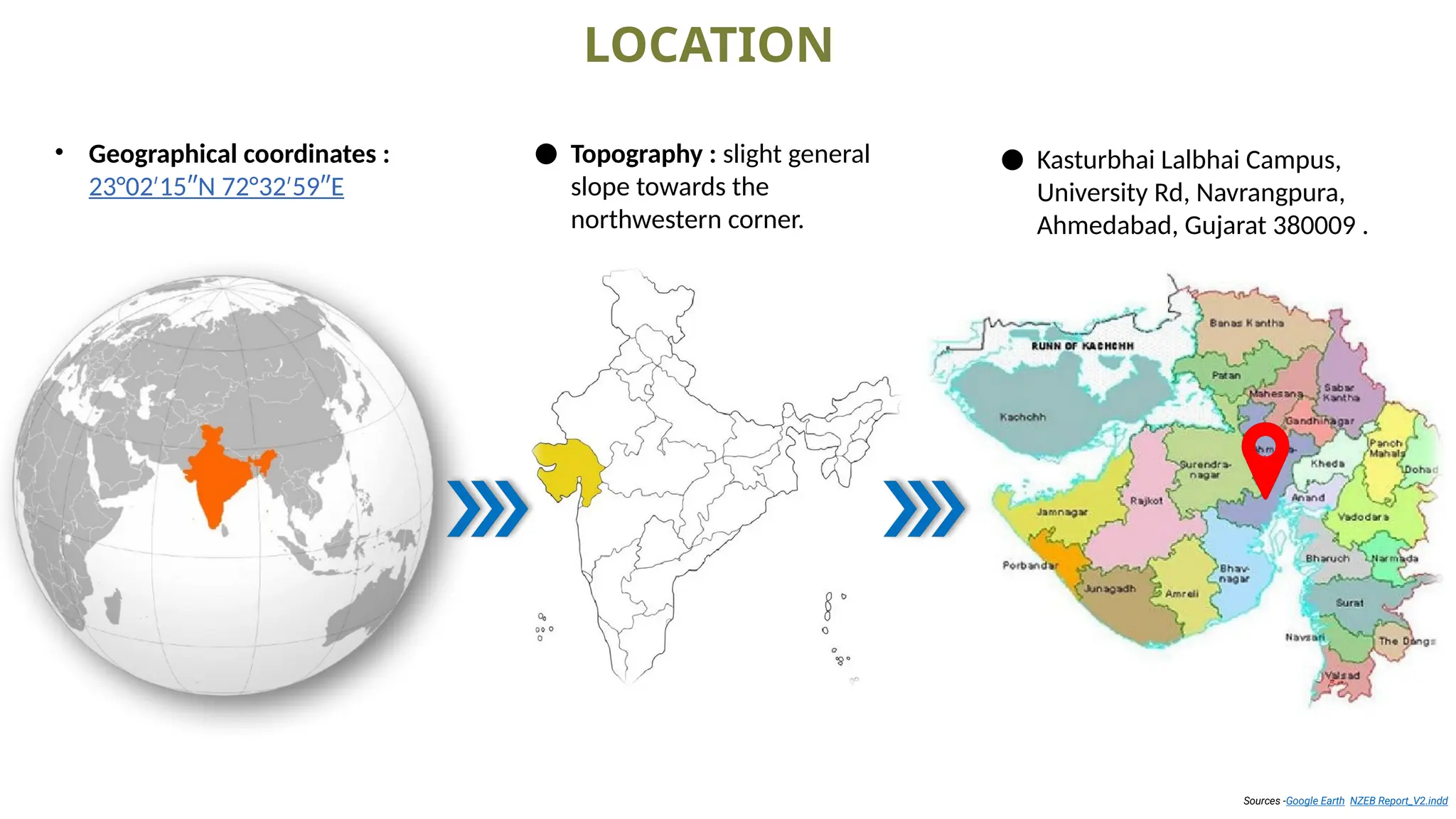
Sources -Google EarthNZEB Report_V2.indd
LOCATION
● Kasturbhai Lalbhai Campus,
University Rd, Navrangpura,
Ahmedabad, Gujarat 380009 .
● Topography : slight general
slope towards the
northwestern corner.
• Geographical coordinates :
23°02 15″N 72°32 59″E
′ ′
8.
Sources -Google EarthNZEB Report_V2.indd
SITE INFORMATION
Site Connectivity
● Airport 11 km
● Railway station 4 km
● 0.3 km from the municipal transport bus stand
● 1.1 km from Bus Rapid Transit System
Landmarks Nearby
● Indian Institute of Management (IIM) - 3.1 km
● Amrit school of management - 230 mt
● University of Gujarat - 1.1 km
● School of engineering and applied science - towards east
● M.G. Science institute, L.M. College of Pharmacy - towards
south
● Amadavadani gufa
N
9.
SITE CLIMATE (AHMEDABAD)
Sources- Climate Ahmedabad - meteoblue
•Ahmedabad has a hot, semi-arid climate with
three main seasons: Summer, Rainy, and
Winter.
•The climate remains very dry except during
the monsoon.
•Summers (Mar–Jun) are hot, with avg. highs
of 42°C and lows of 24°C.
•Monsoon (mid-Jun to mid-Sep)
brings humidity and rainfall.
•Winters (Nov–Feb) are mild, with avg. highs of
30°C and lows of 13°C.
•January experiences a slight chill due to cold
northerly winds.
•Annual rainfall averages 800 mm.
•August sees the highest rain, up to
15 rainy days.
10.
SUN PATH DIAGRAMSOF THE
SITE
• SUMMER SUN (MARCH – JUNE) • MONSOON SUN (JULY – SEPTEMBER) • WINTER SUN (NOVEMBER – FEBRUARY)
11.
Sources - CEPTUniversity Campus Map
• North side : The first building is the Faculty of Architecture
and Faculty of Planning and lawns are in front of the building.
• South side : Faculty of Technology and Faculty of Design
with School of Interior design and New Library building and
Hussain Doshi Gufa and canteen and recreational area.
• East side :Amenities like canteen, stationery, printing shop,
etc, and a basketball court, are placed on the front side, it also
has faculty parking.
SITE PLANNING
N
Sources - CampusExpansion Plans - Academics - Event - CEPT
ROADS
NORTH LAWN
BUILT STRUCTURES
HARDSCAPING
SOFTSCAPING
SOUTH LAWN
GUJARAT UNIVERSITY
ROAD
GUJARAT UNIVERSITY
PARKING
ENTRANCE POINTS
SITE ZONING (ACCESS POINTS)
● Main access on the northern
side (from the secondary
road).
● 1 entrances on the western
side (from main university
road).
● 2 entrance on the southern
side (internal access).
N
14.
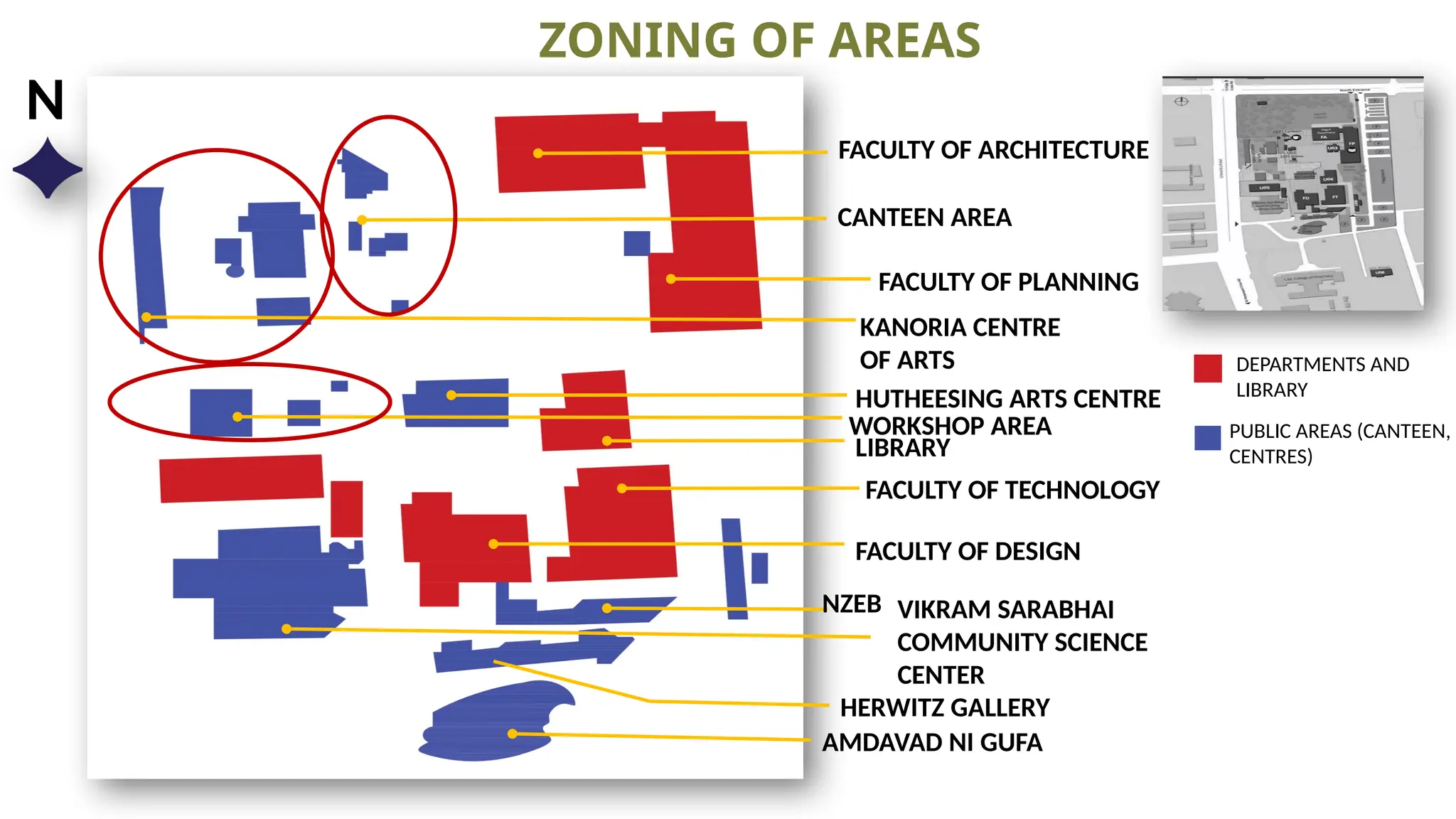
FACULTY OF ARCHITECTURE
FACULTYOF PLANNING
LIBRARY
FACULTY OF TECHNOLOGY
FACULTY OF DESIGN
CANTEEN AREA
KANORIA CENTRE
OF ARTS
VIKRAM SARABHAI
COMMUNITY SCIENCE
CENTER
NZEB
HUTHEESING ARTS CENTRE
DEPARTMENTS AND
LIBRARY
PUBLIC AREAS (CANTEEN,
CENTRES)
AMDAVAD NI GUFA
HERWITZ GALLERY
WORKSHOP AREA
ZONING OF AREAS
N
15.
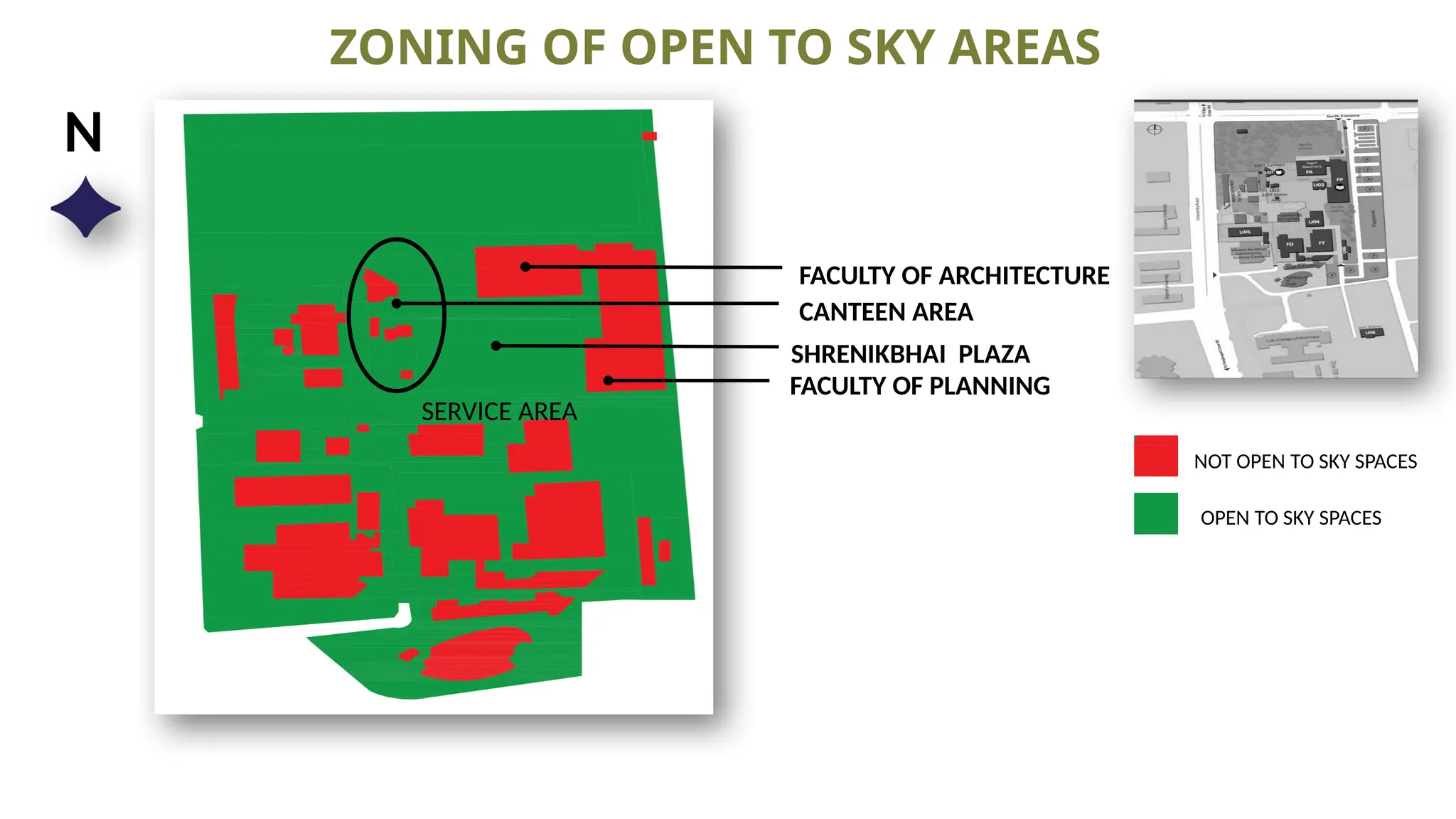
NOT OPEN TOSKY SPACES
OPEN TO SKY SPACES
FACULTY OF PLANNING
FACULTY OF ARCHITECTURE
SHRENIKBHAI PLAZA
CANTEEN AREA
ZONING OF OPEN TO SKY AREAS
N
SERVICE AREA
16.
ZONING OF LEVELS(FLOOR PLANS)
N
STUDIOS/CLASSROOMS
ADMIN AREAS
PUBLIC AREAS
CIRCULATION
SERVICE AREA
LEVEL 4
LEVEL 1
LEVEL 2
LEVEL 3
LEVEL 5
17.
FACULTY OF PLANNING
LEVEL1
ZONING OF DEPARTMENTS (FLOOR PLANS)
FACULTY OF ARCHITECTURE
WORKSHOP
CIRCULATION
SERVICE AREA
N
18.
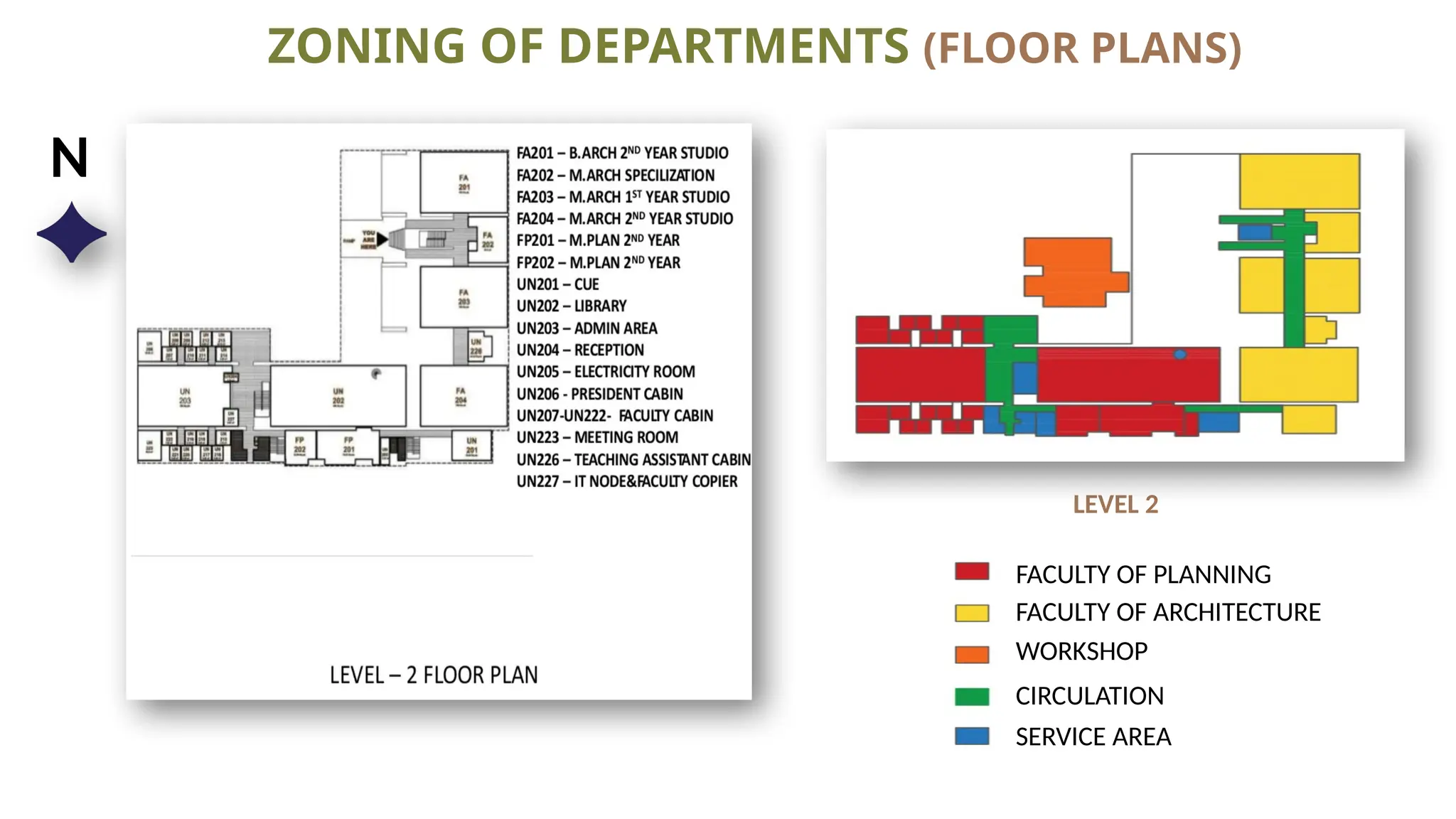
FACULTY OF PLANNING
LEVEL2
ZONING OF DEPARTMENTS (FLOOR PLANS)
FACULTY OF ARCHITECTURE
WORKSHOP
CIRCULATION
SERVICE AREA
N
19.
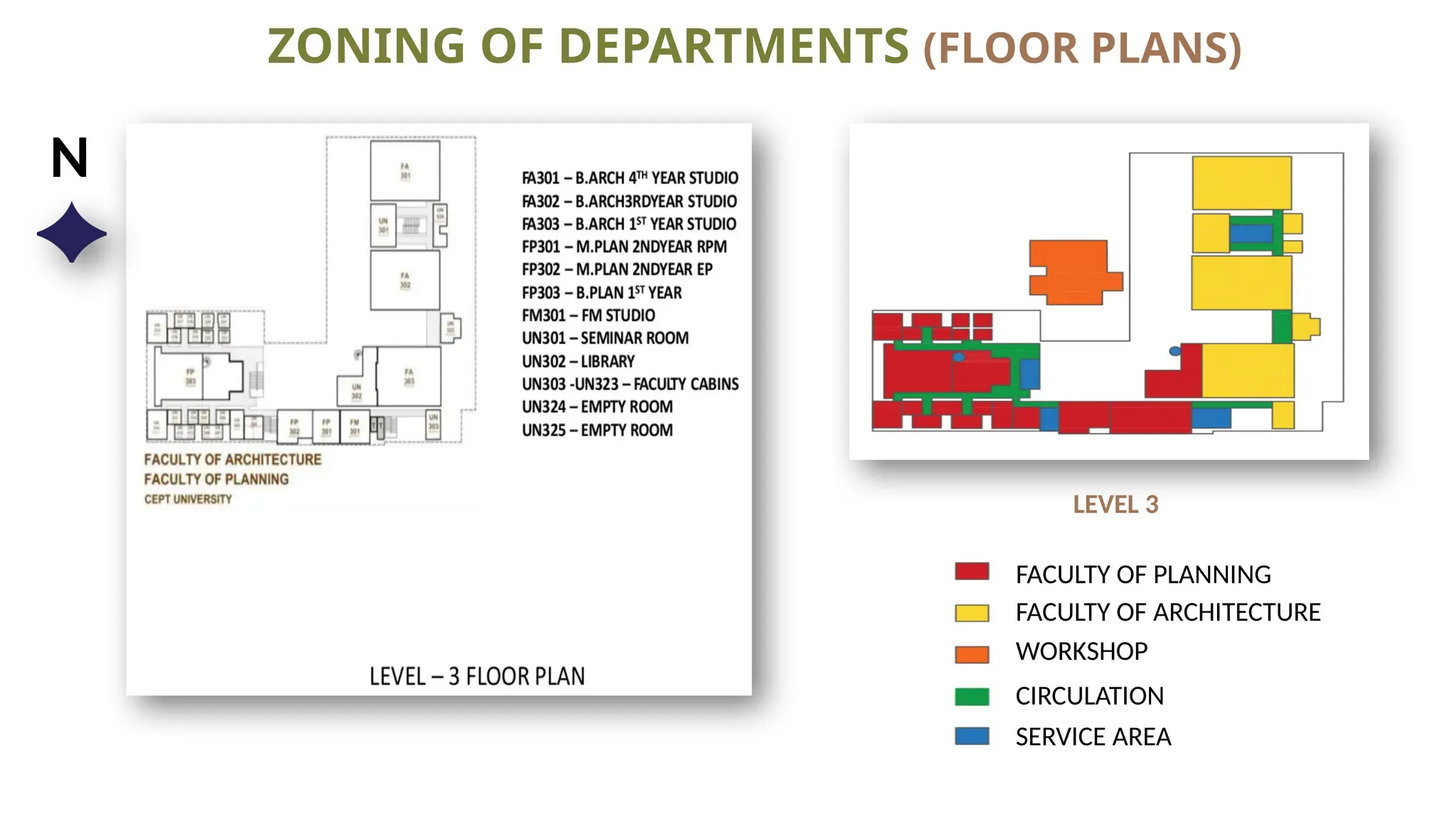
FACULTY OF PLANNING
LEVEL3
ZONING OF DEPARTMENTS (FLOOR PLANS)
FACULTY OF ARCHITECTURE
WORKSHOP
CIRCULATION
SERVICE AREA
N
20.
FACULTY OF PLANNING
ZONINGOF DEPARTMENTS (FLOOR PLANS)
FACULTY OF ARCHITECTURE
WORKSHOP
CIRCULATION
SERVICE AREA
N
LEVEL 4
LEVEL 5
21.
ZONING OF MULTIFUNCTIONALBASEMENT
N
BASEMENT LEVEL FLOOR PLAN OF ARCHITECTURE DEPARTMENT
The basement is a
multipurpose space. It
is a very active space
on the campus.
Numerous activities
are performed here
like cultural programs,
fest and exhibitions,
indoor games.
Academic juries, open
seminars, and
interactions are also
held in this basement.
22.
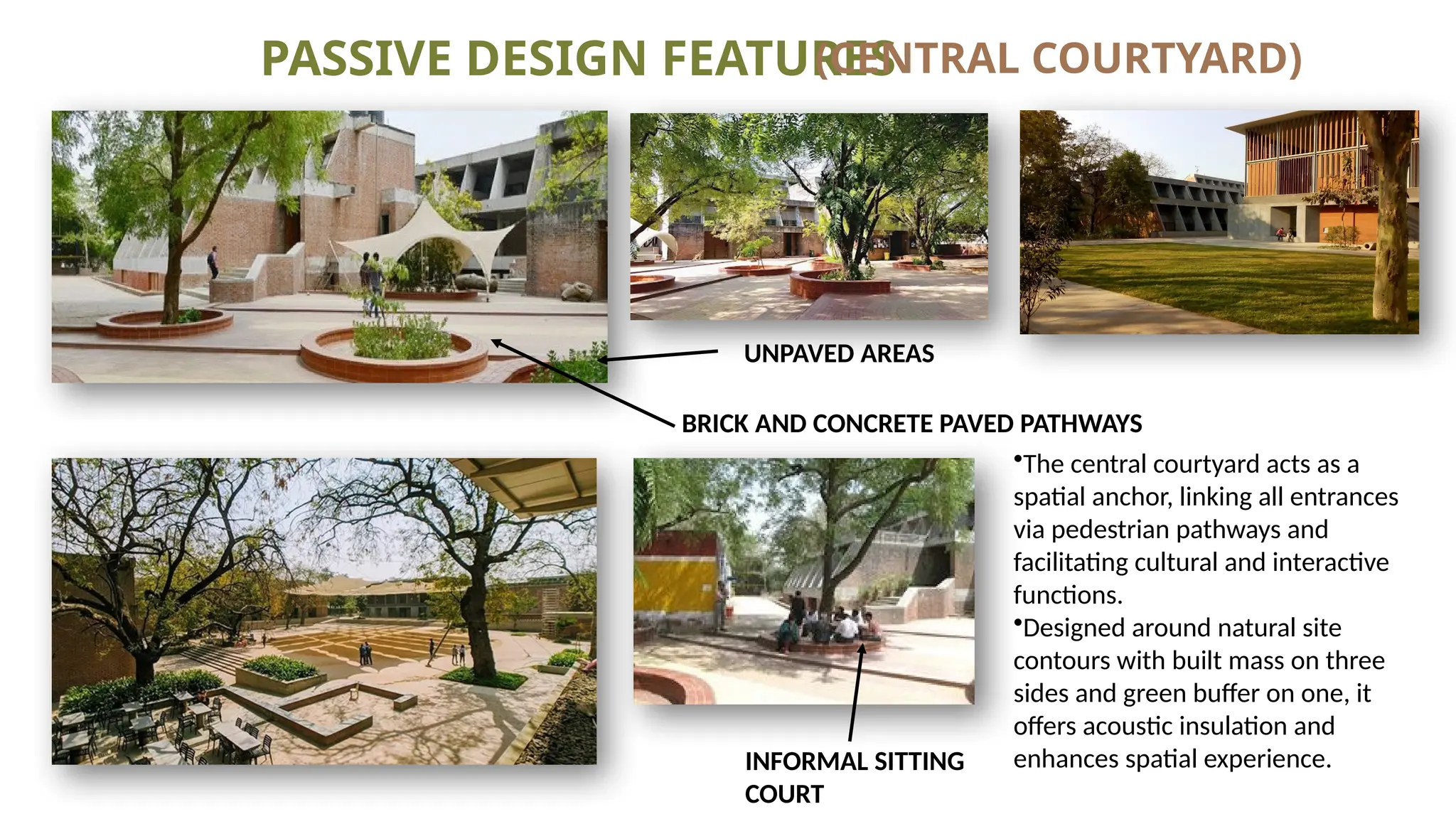
PASSIVE DESIGN FEATURES
(CENTRALCOURTYARD)
•The central courtyard acts as a
spatial anchor, linking all entrances
via pedestrian pathways and
facilitating cultural and interactive
functions.
•Designed around natural site
contours with built mass on three
sides and green buffer on one, it
offers acoustic insulation and
enhances spatial experience.
UNPAVED AREAS
BRICK AND CONCRETE PAVED PATHWAYS
INFORMAL SITTING
COURT
23.
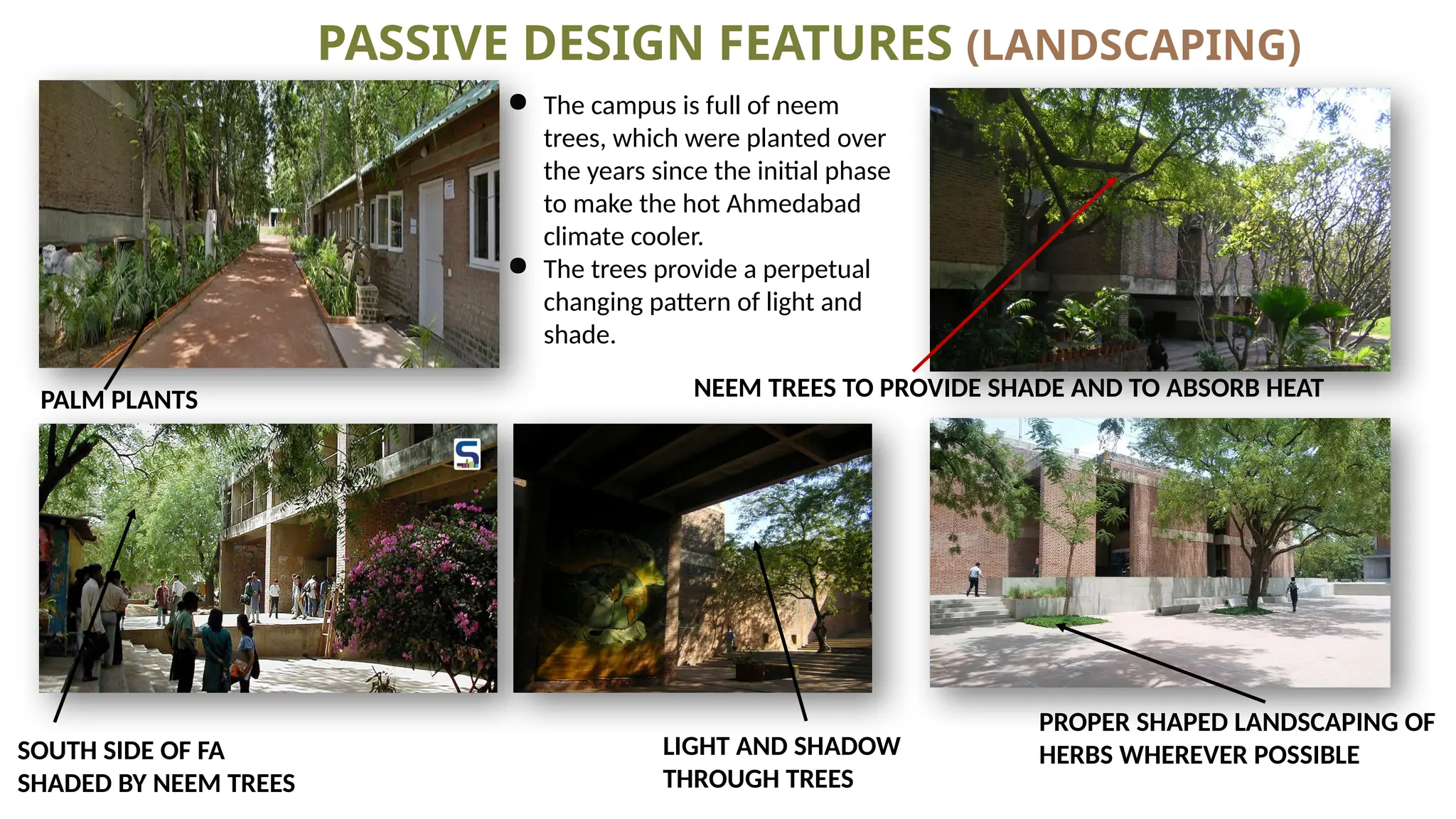
PASSIVE DESIGN FEATURES(LANDSCAPING)
● The campus is full of neem
trees, which were planted over
the years since the initial phase
to make the hot Ahmedabad
climate cooler.
● The trees provide a perpetual
changing pattern of light and
shade.
PALM PLANTS NEEM TREES TO PROVIDE SHADE AND TO ABSORB HEAT
SOUTH SIDE OF FA
SHADED BY NEEM TREES
PROPER SHAPED LANDSCAPING OF
HERBS WHEREVER POSSIBLE
LIGHT AND SHADOW
THROUGH TREES
24.
PASSIVE DESIGN FEATURES(NORTH OPENINGS)
To reduce campus heat gain, buildings are designed with north-facing
openings to harness soft, indirect light. Additionally, windows are
strategically inclined to enhance natural daylight penetration without
allowing harsh sunlight, ensuring thermal comfort and energy efficiency.
25.
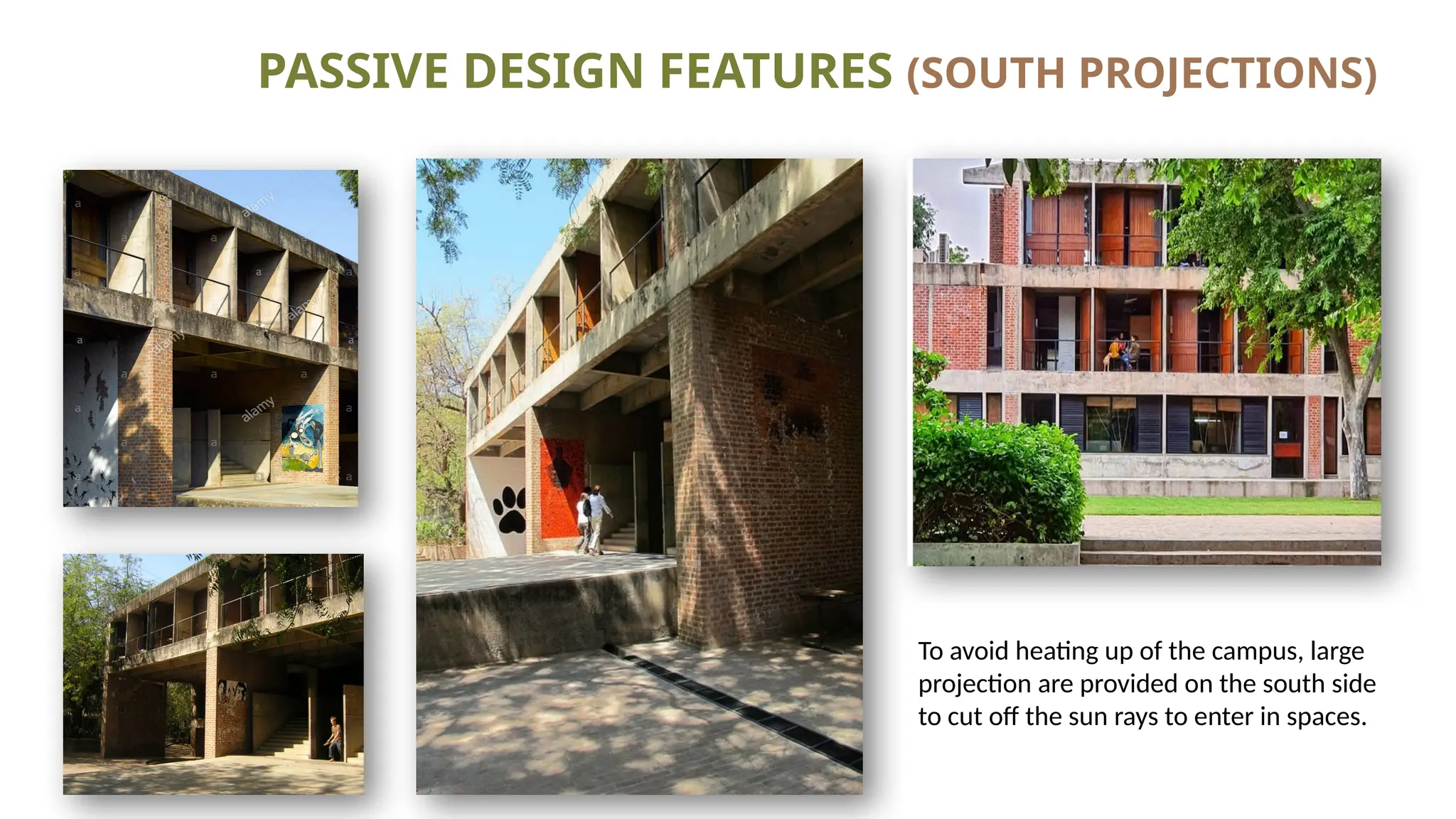
PASSIVE DESIGN FEATURES(SOUTH PROJECTIONS)
To avoid heating up of the campus, large
projection are provided on the south side
to cut off the sun rays to enter in spaces.
26.
PASSIVE DESIGN FEATURES(PLAYING WITH LEVELS)
PEOPLE SITTING
FOR
DISCUSSIONS
BENCH FOR
SITTING
Steps or levels made of brick and
sandstone are used for segregating
places as well as they provide a space
reading, organising informal
discussions, performances etc.
PEOPLE SITTING ON STAIRS WATCHING
PERFORMANCES